
Reports
The Global Aquarium Pumps Market was valued at USD 1,253.6 Million in 2025 and is anticipated to reach a value of USD 2,202.7 Million by 2033 expanding at a CAGR of 7.3% between 2026 and 2033. Rising demand for energy-efficient circulation systems, expansion of commercial aquaculture infrastructure, and increasing adoption of smart aquarium automation are accelerating innovation in high-performance aquarium pumps.
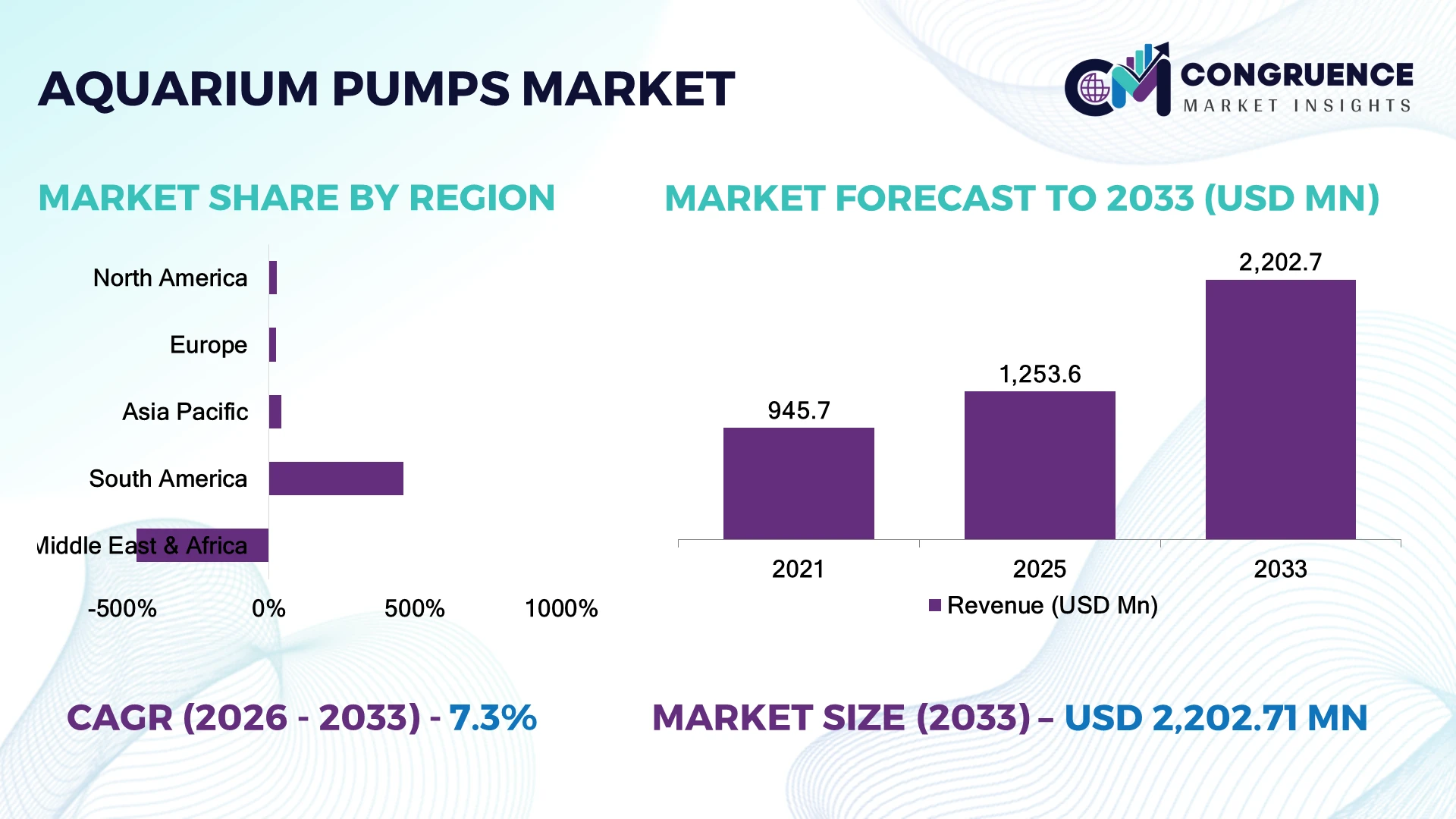
China remains the dominant manufacturing and consumption hub, accounting for approximately 34% of global production capacity, supported by strong electronics manufacturing, ornamental fish exports, and integrated supply chains. Compared with Germany's estimated 8% production share, China benefits from lower manufacturing costs and large-scale OEM capabilities, while over 46% of premium aquarium pumps now feature variable-speed or brushless DC motor technology. Continued diversification of global supply chains following geopolitical trade realignments has further strengthened domestic production investments and export competitiveness.
Manufacturers positioned with energy-efficient, digitally controlled, and durable pump portfolios are expected to secure stronger long-term advantages across residential, commercial, and aquaculture applications.
Market Size & Growth: USD 1,253.6 million in 2025, reaching USD 2,202.7 million by 2033 at 7.3% CAGR, driven by smart aquarium automation and energy-efficient pump adoption.
Top Growth Drivers: Energy-efficient pumps (+38%), commercial aquaculture expansion (+29%), smart aquarium adoption (+33%).
Short-Term Forecast: By 2028, brushless DC pumps improve energy efficiency by nearly 24% while reducing operating noise by 18%.
Emerging Technologies: IoT monitoring, brushless DC motors, and intelligent flow controllers improve operational precision by over 22%.
Regional Leaders: Asia-Pacific leads manufacturing, North America drives premium demand, Europe advances eco-efficient aquarium technologies.
Consumer/End-User Trends: Nearly 47% of premium aquarium buyers prefer controllable variable-flow pump systems.
Pilot/Case Example: 2025 commercial aquaculture upgrades improved water circulation efficiency by approximately 21% through intelligent pump deployment.
Competitive Landscape: Top manufacturers collectively control about 49% of premium product demand through innovation and distribution strength.
Regulatory & ESG Impact: High-efficiency motors reduce electricity consumption by nearly 19%, supporting sustainability initiatives.
Investment & Funding: More than USD 320 million supports manufacturing expansion, automation, and product development.
Innovation & Future Outlook: Smart monitoring, quieter operation, and modular pump platforms are strengthening next-generation product differentiation.
The Aquarium Pumps Market is benefiting from growing demand across ornamental aquariums, commercial aquaculture, public aquariums, and aquatic research facilities. Brushless DC motor technology now represents approximately 42% of newly introduced premium products, while connected monitoring features continue expanding. Supply-chain localization and energy-efficiency regulations are encouraging manufacturers to develop quieter, digitally controlled pumps, setting the foundation for broader strategic market transformation.
The aquarium pumps market has become strategically important as aquaculture modernization, premium home aquariums, and automated aquatic life-support systems increasingly depend on reliable water circulation and filtration. Industry competition is shifting toward intelligent, energy-efficient products capable of delivering stable water quality with minimal maintenance. Manufacturers are restructuring supply chains and expanding regional assembly operations to improve delivery reliability and reduce dependence on single-country sourcing.
Brushless DC motor technology delivers approximately 24% higher energy efficiency than conventional AC-driven pumps while reducing operating noise by nearly 18%, making it the preferred choice for premium residential and commercial installations. Asia-Pacific dominates manufacturing through large-scale production capabilities, whereas North America leads demand for connected aquarium automation and premium ecosystem management solutions. Over the next two to three years, smart pump adoption is expected to accelerate as wireless monitoring and programmable flow control become standard features in higher-value systems.
Commercial aquaculture facilities increasingly deploy variable-speed circulation pumps to optimize oxygen distribution and improve livestock health while reducing electricity consumption. Manufacturers are strengthening R&D investment, expanding distribution partnerships, and integrating digital monitoring capabilities into broader aquatic ecosystem platforms. Long-term competitive leadership will depend on delivering efficient, intelligent, and highly reliable pump systems that combine operational performance with advanced automation.
Growing adoption of automated aquarium management systems is accelerating demand for high-efficiency aquarium pumps with programmable flow control and continuous monitoring capabilities. Approximately 44% of premium aquarium installations now incorporate variable-speed pumps, while brushless DC technology improves energy efficiency by nearly 23%. China continues expanding intelligent aquarium equipment manufacturing through integrated electronics production, enabling faster commercialization of connected pump solutions. This technological shift improves water quality consistency, lowers maintenance requirements, and extends equipment lifespan. Manufacturers are responding by investing in IoT-enabled product development, expanding OEM collaborations, and introducing modular pump platforms compatible with advanced filtration systems. Companies that combine energy efficiency with digital ecosystem integration are securing stronger positioning across residential, commercial, and aquaculture applications.
Aquarium pump manufacturing remains vulnerable to fluctuations in electronic controllers, permanent magnets, and precision motor components. Around 28% of production costs are linked to imported electronic assemblies, while component shortages can extend manufacturing lead times by nearly 19%. Germany and China continue facing procurement pressure for specialized motor-control electronics during broader industrial demand cycles. These supply constraints compress operating margins, delay product launches, and reduce inventory flexibility for manufacturers. Companies are mitigating exposure through supplier diversification, localized motor production, strategic procurement contracts, and standardized component architectures that reduce dependency on single-source vendors. Strengthening regional sourcing has become a decisive operational priority for maintaining production continuity.
Integration of artificial intelligence with aquarium pumps is opening opportunities across ornamental aquariums, commercial aquaculture, and aquatic research facilities. Nearly 36% of newly developed premium systems now support automated flow optimization, while predictive maintenance algorithms reduce unplanned equipment downtime by approximately 22%. Japan is accelerating smart aquarium technology development by integrating sensors, wireless connectivity, and adaptive pump controls into compact ecosystem management platforms. Manufacturers are expanding software partnerships, investing in cloud-connected monitoring solutions, and developing intelligent pump ecosystems rather than standalone hardware. A high-value opportunity lies in subscription-based remote equipment management that enhances operational efficiency while creating recurring service revenue beyond traditional equipment sales.
Advanced aquarium pumps must operate seamlessly with filtration units, UV sterilizers, automated feeders, oxygenation equipment, and digital monitoring platforms, increasing deployment complexity. Approximately 31% of commercial installations require additional calibration to synchronize multiple connected devices, while interoperability testing extends commissioning timelines by nearly 17%. Singapore's commercial aquaculture operators increasingly require unified control platforms capable of managing complete aquatic environments through centralized interfaces. Manufacturers must invest in open communication protocols, software validation, engineering expertise, and strategic technology alliances to ensure reliable integration across diverse equipment ecosystems. Long-term competitiveness will depend on delivering complete intelligent aquatic management platforms rather than isolated pumping solutions.
Smart Connectivity Expansion: Around 48% of newly launched premium aquarium pumps now feature app-based monitoring and programmable flow control, reducing manual intervention by nearly 24%. Manufacturers are integrating wireless connectivity with automated ecosystem management, responding to growing consumer demand for intelligent aquatic maintenance and higher operational reliability.
Brushless Motor Transition: Nearly 45% of advanced aquarium pumps now utilize brushless DC motors, improving electrical efficiency by approximately 23% while lowering operating noise by 18%. Energy-efficiency regulations and rising electricity costs are encouraging manufacturers to replace legacy motor platforms with quieter, longer-lasting designs supported by expanded production investments.
Localized Manufacturing Networks: About 34% of leading manufacturers are increasing regional sourcing and assembly operations to shorten delivery cycles and reduce logistics exposure. Supply-chain diversification has accelerated investments in localized component manufacturing, enabling faster customization, improved inventory resilience, and stronger responsiveness to commercial aquaculture and retail demand.
Compact Modular Pump Designs: Approximately 41% of newly introduced circulation systems adopt modular pump architectures that reduce maintenance time by nearly 20% while simplifying component replacement. Companies are standardizing interchangeable assemblies and expanding partnerships with filtration equipment manufacturers, creating integrated aquatic life-support systems that improve operational flexibility across residential and commercial installations.
Submersible pumps accounted for approximately 46% of the global aquarium pumps market in 2025, maintaining their leading position through compact installation, quiet operation, low maintenance requirements, and compatibility with freshwater and marine aquarium filtration systems. Their ability to function entirely underwater minimizes vibration while improving aesthetic appeal, making them the preferred choice for residential aquariums and commercial display tanks. External pumps remain essential for large-capacity systems requiring higher flow rates and easier servicing, while air pumps continue supporting oxygenation in breeding tanks and nano aquariums. Water circulation pumps hold strategic relevance in reef aquariums where stable current patterns are critical for coral growth and aquatic health.
DC controllable pumps represent the fastest-growing segment, supported by rising adoption of smart aquarium ecosystems and energy-efficient equipment. They currently contribute nearly 19% of market demand, while approximately 42% of newly launched premium pumps incorporate variable-speed control and programmable flow management. Manufacturers are investing in brushless motor technology, wireless connectivity, modular product platforms, and premium product expansion to strengthen differentiation. Investment priorities are steadily shifting toward intelligent, energy-efficient pumping solutions capable of integrating with automated aquarium management systems.
Industry observations published during 2026 by the Ornamental Aquatic Trade Association indicate that programmable DC circulation pumps are becoming the preferred choice for premium marine aquarium installations because of improved ecosystem stability and lower energy consumption.
Residential aquariums represented approximately 54% of global aquarium pump demand in 2025, supported by expanding ornamental fishkeeping and growing adoption of automated home aquarium management. Home users prioritize compact, low-noise, and energy-efficient pumps capable of supporting filtration, circulation, and aeration with minimal maintenance. Commercial aquariums remain an important application requiring continuous-duty, high-capacity pumping systems for large aquatic displays. Aquaculture continues strengthening its strategic role by driving demand for durable pumps capable of maintaining water quality, dissolved oxygen levels, and continuous circulation under intensive operating conditions.
Aquaculture is the fastest-growing application, accounting for nearly 24% of market demand as investments increase in recirculating aquaculture systems and controlled aquatic farming. Public aquariums and aquatic research facilities collectively contribute approximately 11%, requiring specialized high-performance circulation systems. Manufacturers are expanding corrosion-resistant product portfolios, integrating intelligent monitoring capabilities, and developing customized flow configurations to address diverse operational requirements. Product development is increasingly focused on balancing energy efficiency, reliability, and automation across multiple application environments.
According to findings released during 2025 by the World Aquaculture Society, automated water circulation and oxygen management systems are being deployed across an increasing proportion of intensive recirculating aquaculture facilities to improve production efficiency and water-use optimization.
Household consumers accounted for approximately 58% of aquarium pump purchases in 2025, reflecting sustained interest in ornamental fishkeeping and smart home aquarium management. Residential buyers emphasize quiet operation, low maintenance, compact dimensions, and energy-efficient performance, encouraging manufacturers to introduce connected and user-friendly product ranges. Commercial aquarium operators remain major purchasers of high-capacity circulation equipment designed for uninterrupted operation, while aquaculture enterprises continue investing in industrial-grade pumps capable of supporting large-scale aquatic production systems. Educational institutions and research laboratories maintain stable demand for precision-controlled circulation equipment supporting aquatic research applications.
Commercial aquaculture operators represent the fastest-growing end-user category as investments in intensive fish farming and water recirculation infrastructure accelerate worldwide. This segment currently contributes nearly 22% of market demand, while commercial aquariums account for approximately 15%. Manufacturers are strengthening competitiveness through customized product configurations, extended warranty programs, strategic distributor partnerships, and integrated digital monitoring capabilities tailored to different operational environments.
An enterprise survey released during 2026 by the Ornamental Aquatic Trade Association highlighted that commercial aquarium operators increasingly prioritize energy-efficient, programmable circulation systems to reduce maintenance frequency while improving long-term aquatic habitat stability.
Asia-Pacific accounted for the largest market share at 42.8% in 2025 however, North America is expected to register the fastest growth, expanding at a CAGR of 8.2% between 2026 and 2033.

Smart Aquarium Automation Drives Premium Equipment Adoption
North America accounted for approximately 26.4% of the global aquarium pumps market in 2025, supported by high consumer spending on premium aquarium equipment and rapid adoption of intelligent aquatic management systems. Commercial aquariums, ornamental fish retailers, and advanced aquaculture facilities are increasingly deploying programmable DC pumps integrated with digital monitoring platforms. More than 45% of premium aquarium installations now utilize variable-speed circulation technology to improve energy efficiency and aquatic habitat stability. Manufacturers are expanding regional distribution networks, strengthening aftermarket services, and introducing IoT-enabled product portfolios. Investments in recirculating aquaculture systems and automated aquatic infrastructure continue supporting demand for reliable, energy-efficient pumping solutions across both commercial and residential applications.
United States Market Outlook: The United States leads the regional market through its large ornamental aquarium industry, established aquaculture sector, and strong consumer preference for connected home equipment. Approximately 62% of North American premium aquarium equipment sales originate in the U.S., where retailers increasingly promote programmable circulation systems and smart ecosystem management platforms. Domestic distributors continue expanding premium product availability through e-commerce channels and strategic partnerships with global manufacturers.
Energy-Efficient Product Modernization Shapes Market Evolution
Europe represents a technologically advanced market where energy efficiency, product durability, and environmental compliance strongly influence purchasing decisions. Germany, France, Italy, and the Netherlands continue driving demand for low-noise, brushless aquarium pumps that reduce electricity consumption while improving long-term operational reliability. Approximately 39% of newly introduced premium aquarium pumps feature high-efficiency DC motor technology. Manufacturers are investing in recyclable materials, modular product designs, and localized distribution networks to strengthen competitiveness while addressing sustainability expectations across both commercial and residential markets.
Germany Market Outlook: Germany remains the regional leader due to its established aquarium equipment industry, advanced engineering capabilities, and strong hobbyist community. Domestic manufacturers continue developing energy-efficient circulation technologies supported by precision motor production and automation expertise. Approximately one-third of Europe's premium aquarium equipment manufacturing capacity is concentrated in Germany, enabling continuous product innovation and export competitiveness.
Manufacturing Scale Supports Global Supply Leadership
Asia-Pacific leads the global aquarium pumps market through large-scale manufacturing capacity, expanding ornamental fish production, and rapidly growing domestic consumer demand. China, Japan, and Southeast Asian countries collectively serve as major production hubs for aquarium equipment supplied to international markets. Nearly 48% of globally exported consumer aquarium pumps are manufactured within the region. Manufacturers continue investing in automated assembly lines, brushless motor production, and intelligent pump technologies while expanding OEM partnerships with international aquarium equipment brands to strengthen supply-chain efficiency and product competitiveness.
China Market Outlook: China dominates regional production through integrated electronics manufacturing, motor production, and established export infrastructure. Large-scale manufacturing clusters support cost-efficient production of residential and commercial aquarium pumps while enabling rapid product customization. Approximately 55% of Asia-Pacific aquarium pump manufacturing capacity is concentrated in China, strengthening its position as the industry's primary global supply base.
Aquaculture Expansion Creates New Demand Centers
South America is experiencing steady market development as commercial aquaculture investments and ornamental fishkeeping continue expanding across major economies. Brazil, Chile, and Colombia are increasing deployment of water circulation equipment for aquaculture operations while specialty aquarium retailers broaden premium product availability. Approximately 18% of regional commercial aquaculture facilities have upgraded to energy-efficient circulation systems during recent modernization programs. Manufacturers are expanding distributor partnerships and localized service capabilities while balancing growth opportunities against infrastructure limitations and import dependency for advanced electronic pump technologies.
Brazil Market Outlook: Brazil represents the region's largest market due to its expanding aquaculture production, growing aquarium hobby community, and improving retail distribution network. Commercial fish farms increasingly deploy reliable circulation systems to improve water quality management and operational productivity. Domestic importers continue strengthening relationships with international manufacturers to expand access to premium programmable aquarium pump technologies.
Commercial Aquaculture Investment Supports Market Expansion
The Middle East & Africa market is strengthening through expanding aquaculture projects, tourism-driven public aquariums, and increasing consumer interest in ornamental aquatic systems. Gulf countries continue investing in controlled aquaculture infrastructure where efficient water circulation systems remain operationally critical. Approximately 21% of newly established commercial aquaculture facilities now incorporate automated circulation and monitoring technologies. Manufacturers are strengthening regional distribution partnerships while introducing corrosion-resistant products designed for demanding operating environments and varying water conditions.
Saudi Arabia Market Outlook: Saudi Arabia leads regional demand through government-supported aquaculture development, large-scale food security initiatives, and investment in modern aquatic production facilities. Commercial operators increasingly deploy automated pumping systems to optimize water circulation and improve operational efficiency. Continued infrastructure investment and technology adoption are positioning the country as the primary regional market for advanced aquarium and aquaculture pumping equipment.
Leading global brands including EHEIM, OASE, Fluval (Hagen), Sicce, and Aquael compete directly in the premium segment through energy efficiency, digital control, and long-term reliability, while Sunsun, Resun, and Jebao challenge established players with aggressive pricing and high-volume production. The top five manufacturers collectively account for approximately 48% of global market share. Competition increasingly centers on brushless DC motors, where premium pumps reduce energy consumption by nearly 30% and extend operating life by over 35% compared with conventional AC models. Companies are strengthening their positions through product innovation, regional warehouse expansion, OEM partnerships, and vertically integrated motor manufacturing to improve delivery speed by approximately 20%. The competitive landscape is shifting from hardware differentiation toward connected aquarium ecosystems featuring app-based monitoring and automation. Entry pressure remains high due to precision motor engineering, distribution network requirements, and brand credibility. Winning requires combining efficient technology, dependable after-sales support, rapid innovation cycles, and global channel reach.
EHEIM GmbH & Co. KG
OASE GmbH
Fluval (Rolf C. Hagen Inc.)
Sicce S.p.A.
Aquael Sp. z o.o.
Tetra GmbH
Hydor S.r.l.
Resun Group Co., Ltd.
Jebao Co., Ltd.
SUNSUN Group Co., Ltd.
Reef Octopus
Danner Manufacturing, Inc.
Boyu Group
Xylem Inc.
Brushless DC motor technology has become the benchmark for premium aquarium pumps, with approximately 44% of newly launched models incorporating electronically commutated motors and variable-speed controllers. These systems improve electrical efficiency by nearly 28% while reducing operating noise by around 35% compared with traditional AC pumps. Adoption is strongest among marine aquariums and professional aquaculture, where stable flow directly improves filtration performance and aquatic health. Manufacturers offering integrated electronic control platforms are securing stronger positioning in premium retail and commercial installations.
IoT-enabled monitoring, wireless connectivity, and intelligent flow optimization are reshaping equipment management. Nearly 32% of premium aquarium systems now integrate app-based scheduling, maintenance alerts, and remote diagnostics. Compared with conventional manually adjusted pumps, connected systems improve water circulation consistency by approximately 22% while lowering unnecessary energy consumption by about 18%. Companies investing in software ecosystems, cloud connectivity, and sensor integration benefit from higher customer retention through complete aquarium management solutions rather than standalone hardware.
Between 2026 and 2028, predictive maintenance, AI-assisted water quality optimization, and modular pump architectures will accelerate commercial adoption. Integrated sensor ecosystems are expected to exceed 40% deployment within premium aquarium installations, while interchangeable motor modules simplify servicing and reduce maintenance downtime by nearly 25%. Manufacturers capable of combining intelligent automation, energy-efficient engineering, and digital ecosystem compatibility will strengthen competitive differentiation as customers increasingly prioritize lifecycle performance over initial purchase cost.
December 2024 EHEIM launched the Digital Connect App, enabling centralized control of filtration, heating, lighting, UV sterilization, and connected aquarium equipment through a unified platform, strengthening smart aquarium ecosystem integration and customer engagement. Source: EHEIM
March 2025 EHEIM announced an open REST API for its Digital product family, allowing Smart Home integration and developer access. The initiative supports future software releases and expands interoperability with connected automation platforms, enhancing premium ecosystem competitiveness. Source: EHEIM Digital
July 2025 EHEIM received the Plus X Award as "Specialist Retail Brand of the Year" for the third consecutive year, reinforcing retailer confidence and strengthening its premium distribution position across international aquarium technology channels. Source: EHEIM News
November 2025 EHEIM's aquaAlert+e received the Trophée d'Or de l'Innovation from Promojardin Promanimal, selected from 60 product entries. The recognition accelerated market visibility for intelligent aquarium monitoring technologies and reinforced digital product differentiation. Source: Promojardin Promanimal.
This report provides a comprehensive assessment of the global aquarium pumps market across product types, applications, end-users, and major geographical markets between 2026 and 2033. It evaluates submersible, external, air, and circulation pumps alongside residential aquariums, commercial aquariums, aquaculture, and research applications. The analysis covers more than 12 major manufacturers, emerging product innovations, deployment trends, and adoption patterns influencing purchasing decisions across mature and developing markets.
The study further examines regional manufacturing concentration, technology adoption, distribution strategies, and competitive positioning while assessing intelligent pump systems, brushless DC motors, IoT connectivity, and energy-efficient designs. Strategic insights support investment prioritization, product development, expansion planning, supply-chain optimization, partnership opportunities, and competitive benchmarking by identifying evolving demand centers, technology transition patterns, and operational trends shaping the future direction of the global aquarium pumps industry.
| Report Attribute/Metric | Report Details |
|---|---|
|
Market Revenue in 2025 |
USD 1,253.6 Million |
|
Market Revenue in 2033 |
USD 2,202.7 Million |
|
CAGR (2026 - 2033) |
7.3% |
|
Base Year |
2025 |
|
Forecast Period |
2026 - 2033 |
|
Historic Period |
2021 - 2025 |
|
Segments Covered |
By Type
By Application
By End-User
|
|
Key Report Deliverable |
Revenue Forecast, Growth Trends, Market Dynamics, Segmental Overview, Regional and Country-wise Analysis, Competition Landscape |
|
Region Covered |
North America, Europe, Asia-Pacific, South America, Middle East, Africa |
|
Key Players Analyzed |
EHEIM GmbH & Co. KG, OASE GmbH, Fluval (Rolf C. Hagen Inc.), Sicce S.p.A., Aquael Sp. z o.o., Tetra GmbH, Hydor S.r.l., Resun Group Co., Ltd., Jebao Co., Ltd., SUNSUN Group Co., Ltd., Reef Octopus, Danner Manufacturing, Inc., Boyu Group, Xylem Inc. |
|
Customization & Pricing |
Available on Request (10% Customization is Free) |




