
Reports
The Global Aquafeed Premix Market was valued at USD 14119.59 Million in 2025 and is anticipated to reach a value of USD 18882.18 Million by 2033 expanding at a CAGR of 3.7% between 2026 and 2033. Growth is driven by precision nutrition formulations, higher commercial aquaculture output, improved feed conversion efficiency, and wider inclusion of functional vitamins, minerals, enzymes, and probiotics in species-specific feed programs.
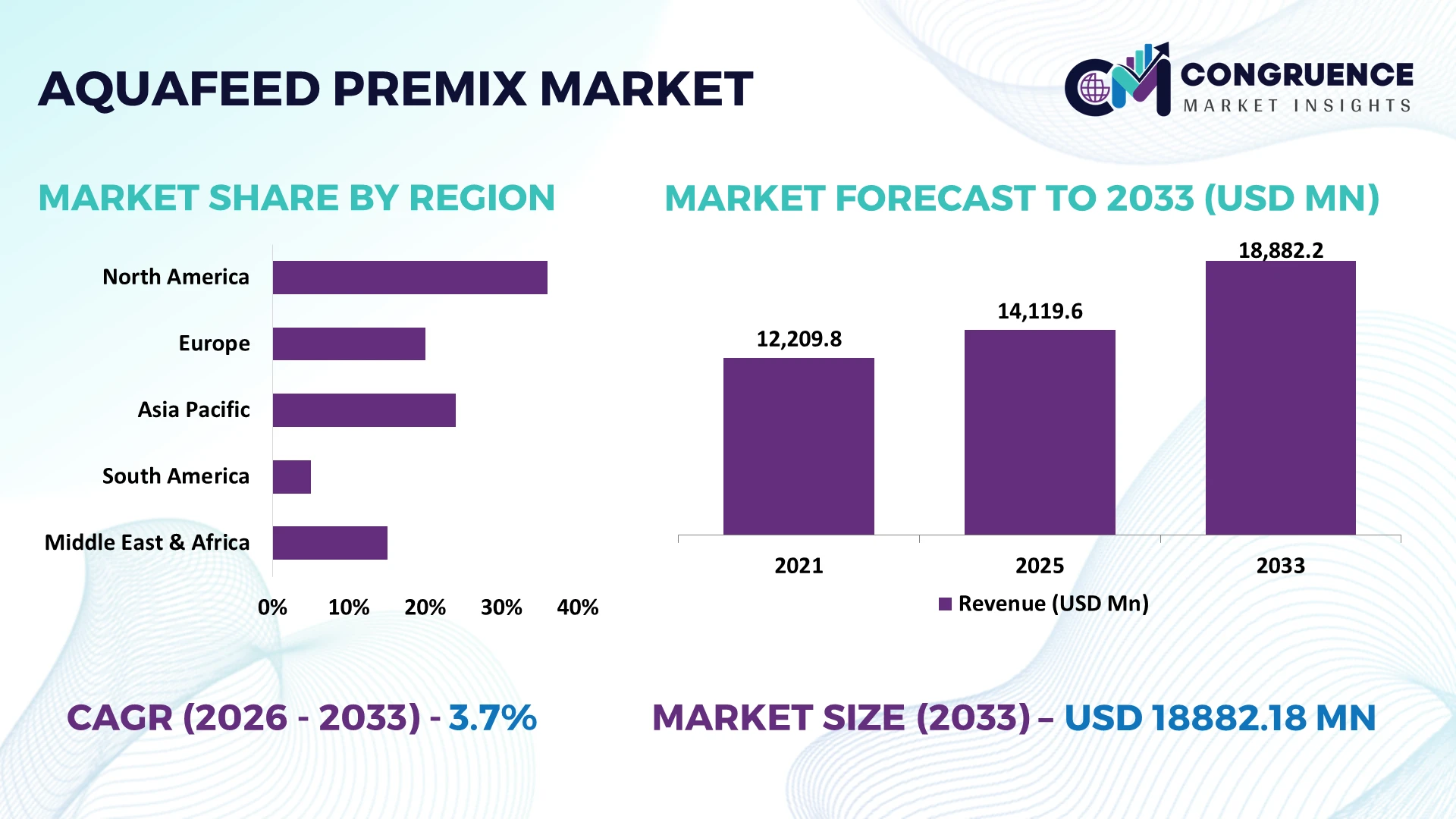
China remains the dominant country, accounting for approximately 32% of global aquafeed production capacity, supported by large-scale aquaculture investments, integrated feed manufacturing, and advanced nutritional technologies. India continues expanding rapidly with production growth exceeding 8% through commercial shrimp and freshwater fish farming. Ongoing diversification of global seafood supply chains following Red Sea logistics disruptions has accelerated regional sourcing and localized premix manufacturing strategies.
Strategic implication: Companies investing in localized production, precision premix formulations, and resilient raw-material sourcing are positioned to strengthen long-term competitiveness across high-volume aquaculture markets.
Market Size & Growth: USD 14119.59 million in 2025 is projected to reach USD 18882.18 million by 2033 at a 3.7% CAGR, supported by precision nutrition technologies and expanding commercial aquaculture integration.
Top Growth Drivers: Functional feed additives improve feed efficiency by 12%, shrimp farming expands above 8%, and micronutrient optimization enhances survival rates by nearly 10%.
Short-Term Forecast: By 2028, automated feed formulation reduces production costs by approximately 9% while increasing formulation accuracy by over 15%.
Emerging Technologies: AI-based feed optimization, automated dosing systems, and advanced probiotic premixes improve nutritional precision and production consistency across global operations.
Regional Leaders: Asia-Pacific exceeds USD 9000 million, Europe approaches USD 3200 million, and North America surpasses USD 2400 million, supported by sustainable aquaculture expansion and digital feed management.
Consumer/End-User Trends: More than 60% of commercial aquaculture producers increasingly adopt functional premixes to improve fish health, productivity, and feed utilization.
Pilot/Case Example: A 2025 commercial aquaculture nutrition program achieved approximately 14% better feed conversion efficiency through optimized vitamin and enzyme premix integration.
Competitive Landscape: The leading supplier holds nearly 12% market share alongside several multinational nutrition companies competing through innovation, regional expansion, and customized formulations.
Regulatory & ESG Impact: Sustainable feed initiatives reduce nutrient waste by around 15%, while stricter quality compliance accelerates adoption of traceable premix solutions.
Investment & Funding: More than USD 600 million has been directed toward manufacturing expansion, strategic partnerships, and resilient regional supply chains since 2024.
Innovation & Future Outlook: Next-generation functional premixes, precision nutrition platforms, and digital quality monitoring strengthen high-growth aquaculture production with greater operational resilience.
Aquafeed premix demand is strengthening across shrimp, salmon, tilapia, and carp production through advanced micronutrient blends, enzyme technologies, and probiotic formulations that improve feed utilization by approximately 12%. Manufacturers are expanding localized production to manage raw-material supply volatility while meeting stricter nutritional and quality standards, reinforcing operational resilience and setting the foundation for the strategic market assessment ahead.
Aquafeed premix has become a strategic component of commercial aquaculture as producers compete on feed efficiency, animal health, and production consistency rather than volume alone. Supply-chain restructuring after recent global logistics disruptions has accelerated localized premix manufacturing and diversified ingredient sourcing. Feed manufacturers are strengthening partnerships with nutrition specialists to secure stable micronutrient availability while complying with stricter feed quality and traceability requirements across export-oriented seafood markets.
Digital formulation platforms combined with precision dosing systems deliver feed formulation accuracy above 98%, compared with approximately 92% using conventional manual blending, while reducing ingredient wastage by nearly 10%. China continues to lead large-scale deployment through integrated aquaculture clusters, whereas Norway emphasizes high-value salmon nutrition supported by advanced functional additives and data-driven feed optimization. Over the next two to three years, automated formulation systems are expected to exceed 45% adoption among large commercial feed mills, improving operational consistency and procurement planning.
Commercial shrimp feed manufacturers are increasingly integrating enzyme and probiotic premixes to improve feed conversion while lowering nutrient discharge into production systems. Companies are expanding regional production facilities, investing in digital quality monitoring, and forming strategic ingredient partnerships to improve supply resilience. Organizations combining precision nutrition with localized manufacturing and technology-enabled quality control will secure stronger competitive positioning and long-term operational advantage.
Commercial aquaculture operators are prioritizing precision nutrition to improve productivity while controlling feed costs, making advanced premix formulations a core investment area. Functional additives have improved feed conversion efficiency by approximately 12%, while survival rates in intensive farming systems have increased by nearly 9% through optimized micronutrient inclusion. India's expanding shrimp farming industry and China's integrated aquaculture production continue to accelerate adoption of customized premix solutions. Rising quality standards for export seafood are encouraging manufacturers to expand formulation capabilities, establish technical partnerships, and invest in automated blending technologies. The strategic shift from standardized feed toward species-specific nutritional programs enables companies to differentiate performance while strengthening customer retention and operational efficiency.
Dependence on imported vitamins, trace minerals, and specialty additives continues to expose manufacturers to procurement volatility and uneven production planning. Price fluctuations for selected micronutrient ingredients have exceeded 15% during recent procurement cycles, while logistics costs remain approximately 10% above pre-disruption levels in several international trade corridors. Feed manufacturers in Southeast Asia face additional scheduling pressure from extended import lead times and fluctuating container availability. Companies are responding by diversifying supplier networks, increasing localized inventory buffers, and negotiating longer-term procurement agreements. Businesses that strengthen regional sourcing strategies and improve ingredient traceability achieve better production continuity and reduce operational uncertainty.
AI-enabled formulation platforms, automated dosing systems, and digital quality analytics are creating new opportunities beyond conventional feed manufacturing. Advanced formulation software reduces ingredient variation by nearly 18%, while automated quality verification improves batch consistency by approximately 20%. Norway and Vietnam are expanding digital nutrition programs to optimize species-specific feed performance and improve export competitiveness. Companies are increasing investment in research partnerships, precision nutrition platforms, and functional additive development that integrates probiotics, enzymes, and bioactive compounds. A notable strategic opportunity lies in combining digital formulation with localized production, enabling manufacturers to shorten product development cycles while responding faster to changing aquaculture requirements.
Maintaining consistent premix quality across multiple manufacturing locations remains a significant execution challenge as production networks expand. Batch performance deviations of 5%–7% can affect nutritional consistency, while skilled technical personnel remain limited in several emerging aquaculture manufacturing hubs. Increasing digital integration also requires standardized quality data, laboratory validation, and interoperability between formulation and production systems. Companies are investing in centralized quality management, workforce training, advanced laboratory infrastructure, and harmonized manufacturing protocols to address these complexities. Organizations capable of scaling standardized production while preserving formulation accuracy and operational transparency will achieve stronger long-term competitiveness and sustain customer confidence across international aquaculture markets.
Precision Formulation Expands Rapidly Commercial feed mills are replacing fixed nutritional blends with species-specific formulations, improving feed conversion by nearly 12% and reducing micronutrient wastage by approximately 9%. China's large integrated producers are scaling digital formulation platforms as stricter feed quality standards reshape procurement, while manufacturers strengthen technical partnerships to accelerate formulation accuracy and operational consistency.
Localized Supply Networks Strengthen Feed ingredient sourcing is shifting closer to production hubs as companies reduce import dependence and shorten replenishment cycles by around 15%. Inventory optimization has improved raw-material availability by nearly 10% following supply-chain disruptions, prompting manufacturers in India and Vietnam to expand regional blending facilities and establish long-term supplier agreements for improved production continuity.
Functional Additives Gain Priority Demand for probiotic, enzyme, and immune-support premixes has increased by more than 18% as commercial aquaculture focuses on disease resilience and lower nutrient losses. Regulatory attention on sustainable aquaculture practices is encouraging manufacturers to restructure product portfolios, introduce customized functional blends, and expand technical advisory services alongside premium nutrition programs.
Automation Improves Production Control Automated dosing, digital quality verification, and process monitoring have increased batch consistency by approximately 20% while reducing manual formulation errors by nearly 16%. Norwegian feed producers continue integrating intelligent manufacturing systems, and multinational suppliers are investing in automated production lines to improve scalability, product traceability, and customer-specific formulation capabilities.
Vitamin Premixes remain the leading segment, accounting for approximately 38% of total demand due to their essential role in supporting fish health, immunity, and feed efficiency across commercial aquaculture operations. Their broad compatibility with multiple species, cost-effective integration into compound feed, and standardized manufacturing processes continue to reinforce large-scale adoption. Mineral Premixes remain a mature category, providing balanced skeletal development and metabolic performance, while Amino Acid Premixes strengthen feed optimization through targeted nutritional precision.
Functional Premixes represent the fastest-growing segment as producers increasingly incorporate probiotics, enzymes, and bioactive ingredients into advanced nutrition programs. Adoption has expanded by nearly 16% among intensive farming systems, while customized formulations have improved production efficiency by approximately 11%. Companies are expanding specialized formulation facilities, investing in nutritional research, and partnering with aquaculture enterprises to develop species-specific products. This transition reflects a strategic movement from conventional nutritional supplementation toward performance-oriented and health-focused feed solutions.
Fish Feed represents the largest application, contributing approximately 52% of market demand because of its extensive use across freshwater and marine aquaculture production. Large commercial operations require standardized nutritional programs that support consistent growth, efficient feed utilization, and disease management. Shrimp Feed is the fastest-growing application, with adoption increasing by nearly 14% as intensive shrimp farming expands and producers prioritize precision nutrition to improve survival rates and production performance.
Crab Feed and Mollusk Feed remain strategically important niche applications where specialized micronutrient blends improve shell development, metabolic efficiency, and overall stock quality. Commercial feed manufacturers are introducing automated formulation systems that enhance batch precision by approximately 18%, while integrated aquaculture companies continue scaling customized feed production for different aquatic species. Investment priorities increasingly emphasize flexible manufacturing capabilities capable of supplying diverse feed formulations with greater operational efficiency.
Feed Manufacturers constitute the dominant end-user group, representing approximately 46% of total demand because centralized production facilities purchase premixes in large volumes for standardized commercial feed manufacturing. Their procurement scale, advanced processing infrastructure, and quality assurance capabilities make them the primary customers for customized nutritional formulations. Aquaculture Farms remain the fastest-growing end-user segment, with direct adoption increasing by nearly 13% as larger producers implement precision feeding strategies and integrated nutrition management.
Hatcheries continue expanding demand for specialized early-stage nutritional premixes that improve larval survival and healthy development, while Research Institutes support formulation innovation through nutrition trials and ingredient validation. Companies are strengthening customer engagement through technical support, customized formulation services, and long-term supply partnerships. Digital quality monitoring and collaborative product development are becoming important competitive differentiators as buyers increasingly prioritize nutritional performance, traceability, and production consistency.
Asia-Pacific accounted for the largest market share at 48.6% in 2025 however, South America is expected to register the fastest growth, expanding at a 5.2% CAGR between 2026 and 2033.

Integrated Nutrition and Digital Manufacturing Drive Market Efficiency
North America represents a mature aquafeed premix market, supported by advanced feed manufacturing infrastructure, high-quality nutritional standards, and widespread adoption of precision formulation technologies. The region contributes approximately 18% of global demand, with commercial aquaculture operators increasingly integrating automated dosing, digital quality assurance, and species-specific nutrition programs. Feed manufacturers continue expanding functional premix portfolios to improve production consistency and reduce nutrient losses. More than 40% of large feed facilities have implemented automated formulation systems, improving batch accuracy and reducing production variability. Strategic partnerships between ingredient suppliers and aquaculture enterprises continue strengthening localized supply chains while enhancing product customization for salmon, trout, and marine species.
United States Market Outlook: The United States leads the regional market through advanced feed manufacturing capacity, established aquaculture research infrastructure, and strong commercial adoption of functional nutrition technologies. More than 55% of industrial feed production facilities utilize digital formulation platforms, enabling consistent product quality and efficient raw-material management. Companies continue investing in customized nutritional solutions, technical support services, and production modernization to strengthen operational competitiveness across freshwater and marine aquaculture.
Sustainability Standards Reshape Feed Innovation
Europe maintains a technologically advanced aquafeed premix industry where sustainability, traceability, and regulatory compliance drive product development. The region accounts for approximately 22% of global market activity, supported by sophisticated salmon farming, integrated feed production, and continuous nutritional research. Manufacturers increasingly incorporate functional additives and precision micronutrient blends to improve feed efficiency while reducing nutrient discharge. Automated production systems have increased manufacturing consistency by nearly 18%, while collaborative research programs accelerate innovation in specialized aquaculture nutrition. Enterprise investment continues focusing on environmentally responsible formulations that align with evolving seafood production standards.
Norway Market Outlook: Norway remains Europe's strategic leader due to its globally competitive salmon industry, advanced feed technology ecosystem, and strong collaboration between feed producers and aquaculture enterprises. Digital monitoring and precision nutrition systems have been implemented across more than 60% of large salmon production facilities. Manufacturers continue strengthening research partnerships and developing premium premix formulations that improve biological performance while supporting sustainable aquaculture operations.
Manufacturing Scale Supports Global Leadership
Asia-Pacific dominates the aquafeed premix market through extensive aquaculture production, integrated feed manufacturing networks, and expanding commercial seafood exports. The region contributes approximately 48.6% of global demand, supported by high-volume fish and shrimp farming across China, India, Vietnam, and Indonesia. Commercial feed manufacturers continue investing in automated blending facilities and localized ingredient sourcing to improve production resilience. Precision nutrition deployment has expanded by nearly 20% among leading enterprises, while new production capacity supports growing export-oriented aquaculture industries. Integrated value chains enable manufacturers to optimize costs, improve feed consistency, and accelerate commercial product deployment.
China Market Outlook: China remains the largest national market, supported by large-scale aquaculture production, advanced feed manufacturing infrastructure, and continuous investment in nutritional innovation. Approximately 32% of global aquafeed production capacity is concentrated in China, allowing manufacturers to achieve significant economies of scale. Companies continue expanding intelligent manufacturing, strengthening ingredient localization, and developing customized premix formulations for multiple commercial aquatic species.
Export-Oriented Aquaculture Expands Nutritional Demand
South America is strengthening its position through expanding commercial aquaculture production and growing seafood exports. The region contributes approximately 7% of global market activity, with increasing investment in feed manufacturing infrastructure and nutritional modernization. Producers are adopting specialized premix formulations to improve feed conversion and product quality while supporting international export requirements. Commercial feed plants have improved production efficiency by approximately 14% through process optimization and upgraded formulation systems. Infrastructure development remains uneven across countries, encouraging companies to prioritize localized manufacturing partnerships and integrated supply-chain planning.
Brazil Market Outlook: Brazil leads the regional market with expanding tilapia production, improving feed manufacturing capacity, and increasing investment in commercial aquaculture infrastructure. Large feed manufacturers continue modernizing production facilities while strengthening technical collaboration with aquaculture enterprises. Automated production technologies have improved formulation consistency by nearly 15%, supporting higher-quality feed products and stronger competitiveness within domestic and export markets.
Infrastructure Investment Strengthens Aquaculture Capacity
The Middle East & Africa market is progressing through targeted investment in aquaculture infrastructure, food security initiatives, and commercial fish farming projects. The region contributes approximately 4.4% of global demand, with governments encouraging domestic seafood production and modern feed manufacturing capabilities. Feed producers are expanding localized blending operations and adopting standardized nutritional formulations to improve production performance. Recent infrastructure upgrades have increased commercial production capacity by approximately 12%, while strategic partnerships continue supporting technology transfer and workforce development. Companies are prioritizing scalable production models capable of serving emerging aquaculture clusters with improved supply reliability.
Saudi Arabia Market Outlook: Saudi Arabia is emerging as the region's strategic market through sustained investment in aquaculture expansion, industrial modernization, and advanced feed production facilities. Commercial producers continue integrating precision nutrition systems to improve farming efficiency and reduce feed losses. New aquaculture development programs have accelerated deployment of modern feed technologies, positioning the country as a leading regional hub for technologically advanced aquaculture production.
Competition is led by Cargill, ADM, DSM-Firmenich, dsm-firmenich Animal Nutrition, Nutreco, and Kemin Industries, with global nutrition leaders competing against regional premix manufacturers through formulation expertise, integrated supply chains, and technical service capabilities. The top five players collectively control approximately 48% of the market, creating moderate consolidation while leaving room for specialized suppliers. Competition centers on customized formulations, production efficiency, and raw-material security rather than pricing alone. Digital formulation platforms improve batch consistency by nearly 20%, while automated blending reduces manufacturing errors by approximately 15%. Companies are expanding regional production facilities, strengthening ingredient partnerships, and integrating quality analytics to improve delivery reliability. Vertical integration into feed ingredients and technical advisory services is becoming a key differentiator. Supply-chain localization and functional additive innovation are shifting competitive advantage away from commodity premixes. Strict quality compliance, formulation expertise, and validated performance create significant entry barriers. Winning requires scalable manufacturing, resilient sourcing, precision nutrition capabilities, and strong customer collaboration.
Cargill Incorporated
Archer Daniels Midland (ADM)
DSM-Firmenich
Nutreco
Kemin Industries
Alltech
Novus International
Adisseo
EW Nutrition
Phibro Animal Health Corporation
Zinpro Corporation
Biomin
De Heus Animal Nutrition
Kent Nutrition Group
Digital formulation platforms, automated micro-dosing systems, and intelligent quality monitoring are redefining aquafeed premix manufacturing. AI-assisted formulation analyzes nutrient interactions and raw-material variability in real time, improving formulation accuracy by approximately 18% while reducing ingredient waste by nearly 10%. Around 45% of large commercial feed manufacturers have deployed automated formulation workflows, enabling faster product customization and more consistent batch performance. Companies with integrated digital production systems benefit from shorter development cycles and improved customer responsiveness.
Emerging technologies are shifting beyond conventional vitamin and mineral blending toward functional nutrition platforms incorporating probiotics, enzymes, encapsulated micronutrients, and precision delivery systems. Compared with traditional manual formulation, automated production improves batch consistency by nearly 20% and lowers processing errors by approximately 16%. Digital traceability platforms are also strengthening regulatory compliance and inventory visibility. Global nutrition companies gain the greatest competitive advantage because they combine advanced research capabilities with scalable manufacturing and integrated quality management.
Between 2026 and 2028, intelligent manufacturing, predictive quality analytics, and digital twin production models will accelerate commercialization of species-specific premixes. Adoption of connected production technologies is expected to exceed 55% among advanced feed facilities, supporting faster formulation validation and operational flexibility. Manufacturers investing early in automation, functional ingredient innovation, and data-driven production ecosystems will strengthen competitive differentiation, reduce operating complexity, and respond more effectively to evolving aquaculture nutrition requirements.
September 2025 DSM-Firmenich inaugurated a new feed additive manufacturing facility in Jadcherla, India, integrating it with its existing premix operations to strengthen regional production. The new facility spans 11,200 square meters, improving manufacturing efficiency and customer responsiveness across Asia. Business impact: Faster supply and localized production capabilities. Source: https://www.aquafeed.co.uk
June 2026 ADM opened a technologically advanced animal nutrition premix plant in Apucarana, Brazil, expanding production capacity to approximately 40,000 tons annually with automated formulation and traceability systems. Business impact: Increased manufacturing scale and stronger supply-chain resilience for feed customers. Source: https://www.adm.com
February 2026 Cargill introduced a specialized aquafeed solution for Norway's closed salmon farming systems, developed through customer collaboration to improve water quality and feed performance. The formulation supports nutrient stability while addressing biological challenges in closed production environments. Business impact: Strengthened premium aquaculture nutrition portfolio. Source: https://www.cargill.com
2025 Cargill reported that its dedicated aquaculture nutrition business operated 12 specialized aquafeed mills across eight countries, producing 2.07 million tonnes of aquafeed during the year. Business impact: Expanded global production footprint and stronger operational scale supporting commercial aquaculture customers. Source: https://www.reuters.com
The report delivers comprehensive analysis across Vitamin Premixes, Mineral Premixes, Amino Acid Premixes, and Functional Premixes while evaluating demand across Fish Feed, Shrimp Feed, Crab Feed, and Mollusk Feed applications. It further examines procurement patterns among Aquaculture Farms, Feed Manufacturers, Hatcheries, and Research Institutes, supported by assessment of production concentration, technology adoption, operational efficiency, and competitive positioning. More than 10 leading industry participants are evaluated alongside deployment trends across North America, Europe, Asia-Pacific, South America, and the Middle East & Africa.
The study assesses precision nutrition technologies, automated formulation systems, digital quality monitoring, functional feed additives, and localized manufacturing strategies shaping industry competitiveness between 2026 and 2033. It provides strategic intelligence for capacity expansion, investment prioritization, partnership evaluation, supply-chain optimization, product portfolio planning, and regional market entry. Coverage also includes emerging opportunities in customized species-specific formulations, sustainable feed innovation, advanced manufacturing integration, and evolving commercial aquaculture ecosystems, enabling informed business decisions across mature and developing markets.
| Report Attribute/Metric | Report Details |
|---|---|
Market Revenue in 2025 | USD 14119.59 Million |
Market Revenue in 2033 | USD 18882.18 Million |
CAGR (2026 - 2033) | 3.7% |
Base Year | 2025 |
Forecast Period | 2026 - 2033 |
Historic Period | 2021 - 2025 |
Segments Covered | By Type
By Application
By End-User
|
Key Report Deliverable | Revenue Forecast, Growth Trends, Market Dynamics, Segmental Overview, Regional and Country-wise Analysis, Competition Landscape |
Region Covered | North America, Europe, Asia-Pacific, South America, Middle East, Africa |
Key Players Analyzed | Cargill Incorporated, Archer Daniels Midland (ADM), DSM-Firmenich, Nutreco, Kemin Industries, Alltech, Novus International, Adisseo, EW Nutrition, Phibro Animal Health Corporation, Zinpro Corporation, Biomin, De Heus Animal Nutrition, Kent Nutrition Group |
Customization & Pricing | Available on Request (10% Customization is Free) |




