
Reports
The Global Aqua Ammonia Market was valued at USD 650.4 Million in 2025 and is anticipated to reach a value of USD 792.4 Million by 2033 expanding at a CAGR of 2.5% between 2026 and 2033. Growth is driven by expanding industrial wastewater treatment, fertilizer processing, semiconductor cleaning, and emissions-control applications, alongside tighter handling and environmental requirements.
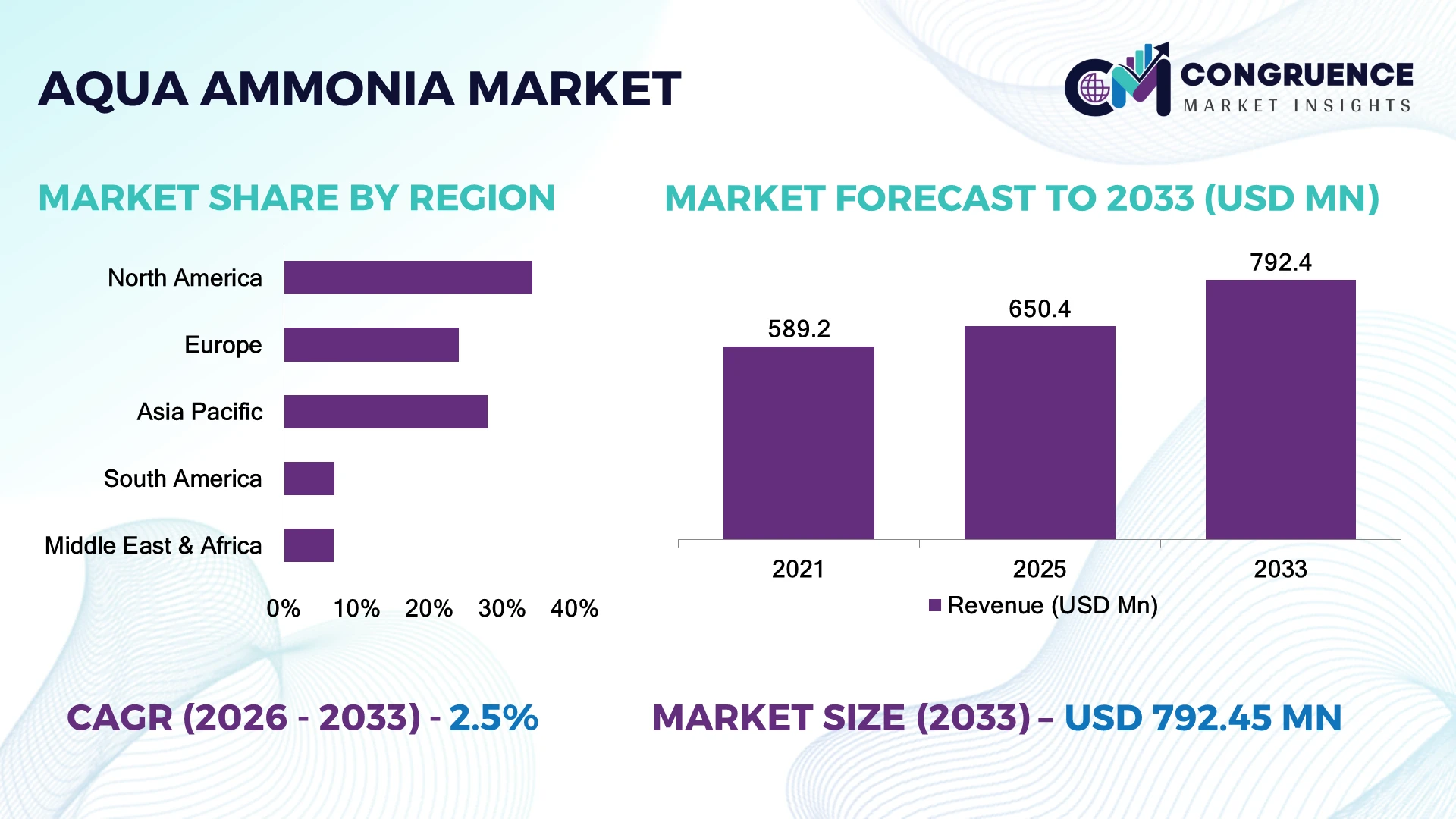
The United States represents approximately 31% of global aqua ammonia demand, supported by water treatment, fertilizers, chemicals, refrigeration, and industrial cleaning. China accounts for nearly 22%, while Japan and Germany contribute smaller high-purity application bases. U.S. industrial users increasingly favor automated dosing, with optimized systems reducing ammonia consumption by 8–12%. Supply-chain restructuring following Red Sea shipping disruptions is strengthening localized chemical inventories and supplier qualification.
Strategically, suppliers should prioritize high-purity grades, localized storage, automated dosing, and dependable industrial supply contracts.
Market Size & Growth: USD 650.4 million in 2025 to USD 792.4 million by 2033 at 2.5% CAGR, driven by wastewater treatment, fertilizer processing, and emissions-control applications.
Top Growth Drivers: Water treatment 34%; fertilizers 23%; industrial chemicals 17%.
Short-Term Forecast: By 2028, automated dosing systems will improve ammonia-use efficiency by 8–12% across high-volume industrial treatment operations.
Emerging Technologies: Digital dosing, ammonia concentration sensors, automated storage monitoring, and closed-loop treatment systems are reshaping advanced aqua ammonia handling.
Regional Leaders: North America USD 228 million; Asia-Pacific USD 214 million; Europe USD 156 million, with automation and high-purity applications strengthening adoption.
Consumer/End-User Trends: Industrial water-treatment users account for approximately 34% of demand, increasingly adopting automated dosing and inventory-monitoring systems.
Pilot/Case Example: A 2026 industrial treatment deployment using automated ammonia dosing targeted 10% lower chemical consumption while maintaining required pH-control performance.
Competitive Landscape: U.S.-based suppliers lead with approximately 31% market share collectively; key participants include Tanner Industries, Verma Gases, BASF, INEOS, and Air Liquide.
Regulatory & ESG Impact: Closed-system handling and automated dosing reduce avoidable ammonia losses by approximately 5–10%, supporting tighter occupational and environmental controls.
Investment & Funding: Approximately USD 140 million is being directed toward storage modernization, regional distribution, purification, and industrial chemical infrastructure.
Innovation & Future Outlook: High-purity aqua ammonia, smart storage, precision dosing, and integrated emissions-control systems will shift competition toward safety, efficiency, traceability, and application-specific performance.
Aqua Ammonia Market demand centers on industrial wastewater treatment, fertilizer processing, semiconductor manufacturing, refrigeration, emissions control, and chemical processing. Water-treatment applications represent approximately 34% of demand, while high-purity grades are gaining traction in electronics and specialty manufacturing. Automated dosing and concentration monitoring are becoming more important as Red Sea-related logistics disruptions encourage localized chemical storage and supply planning, creating a natural transition toward the market's strategic implications.
The Aqua Ammonia Market is becoming strategically important because its applications span essential industrial processes where chemical consistency, handling safety, and treatment efficiency directly affect operating costs. Water-intensive manufacturing and emissions-control systems are increasing demand for reliable ammonia-based chemistry, while supply-chain restructuring is pushing large buyers toward regional inventories and multiple qualified suppliers.
Technology adoption is changing purchasing economics. Automated dosing and online concentration monitoring can improve chemical-use efficiency by 8–12% versus manually controlled systems, while closed handling reduces operator exposure and avoidable losses. The United States remains the largest demand center, supported by industrial water treatment and chemical processing, while Germany and Japan emphasize high-purity applications and tighter process control. This creates distinct investment priorities between volume-oriented supply and specification-driven production.
Through 2026–2028, adoption of smart dosing, digital storage monitoring, and localized distribution will strengthen operational resilience. An industrial wastewater facility using automated pH-linked ammonia dosing can stabilize treatment conditions while reducing unnecessary chemical consumption. Companies are therefore expanding storage infrastructure, strengthening distributor partnerships, and investing in high-purity processing. The strongest competitive position will belong to suppliers combining dependable supply, precise application control, safety infrastructure, and application-specific technical support.
Industrial water treatment represents approximately 34% of aqua ammonia demand, while fertilizer and chemical processing contribute about 23% and 17%, respectively. Expanding wastewater reuse, pH adjustment, and nitrogen-management systems are increasing consumption across U.S. manufacturing and municipal treatment facilities. Automated dosing can improve ammonia-use efficiency by 8–12% compared with manual adjustment, strengthening the economics of controlled application. U.S. operators are upgrading chemical-management systems to improve consistency and reduce handling losses, while suppliers are expanding regional storage and integrating dosing equipment with monitoring platforms. The non-obvious growth lever is recurring treatment demand: aqua ammonia consumption is tied to continuous process throughput rather than one-time infrastructure purchases, giving suppliers stronger opportunities for contracted industrial supply.
Aqua ammonia requires specialized storage, ventilation, transfer systems, and worker-protection infrastructure, increasing delivered operating costs for smaller industrial users. Storage and handling infrastructure can represent approximately 10–15% of installed chemical-management expenditure, while transportation costs can add 8–12% to delivered pricing during constrained logistics periods. Concentrated supply networks also expose buyers to regional disruptions, particularly when hazardous-material transportation capacity tightens. U.S. and European facilities face stricter handling requirements than many emerging markets, increasing compliance-related operating overhead. Companies are reducing exposure through localized inventory hubs, longer-term supply contracts, smaller distributed storage systems, and optimized delivery schedules. The key operational constraint is that proximity matters disproportionately: reducing transport distance can materially improve delivered economics because aqua ammonia requires specialized logistics.
Smart storage, automated transfer, and sensor-controlled dosing create an underdeveloped opportunity for aqua ammonia suppliers beyond conventional chemical sales. Integrated monitoring can reduce avoidable chemical consumption by approximately 8–15% and lower manual intervention requirements by 20–30%. U.S. wastewater operators and Japanese electronics manufacturers are particularly relevant targets because process consistency and controlled chemical environments carry high operational value. Emerging ammonia-sensing technologies can connect storage levels, concentration, pressure, and dosing data to centralized control systems. Companies are positioning through equipment partnerships, application engineering, and bundled chemical-management services. A non-obvious opportunity lies in brownfield upgrades: retrofitting existing treatment systems can improve chemical efficiency without replacing core process infrastructure, creating faster customer payback and recurring service revenue.
Long-term deployment increasingly depends on integrating aqua ammonia systems with plant controls, sensors, safety interlocks, and workforce procedures. Industrial facilities can experience 10–20% variation in chemical consumption when dosing remains disconnected from real-time process conditions, while sensor calibration and maintenance can account for 5–10% of monitoring-system downtime. U.S. chemical and water-treatment facilities are therefore increasing operator training and automated alarm management as ammonia systems become more digitally connected. The challenge extends beyond hardware: incompatible control architectures can prevent seamless data exchange across legacy equipment. Suppliers must invest in interoperable controls, predictive maintenance, cybersecurity safeguards, and technical training. Competitive advantage will favor providers that deliver complete chemical-management ecosystems rather than standalone aqua ammonia supply.
Smart Storage Gains Adoption: Industrial buyers are increasingly installing level sensors, automated alarms, and remote inventory monitoring, reducing manual inspection requirements by approximately 20–30%. U.S. facilities are prioritizing connected storage as hazardous-material oversight becomes more data-driven. Suppliers are responding by bundling monitoring hardware with supply contracts, creating stronger operational visibility and reducing emergency replenishment events.
High-Purity Grades Expand Electronics: Semiconductor and specialty-electronics manufacturers are increasing use of high-purity aqua ammonia for controlled chemical processing. High-purity applications can command approximately 10–20% specification premiums over industrial grades, reflecting tighter impurity controls. Japanese and U.S. suppliers are strengthening purification, packaging, and qualification capabilities as electronics manufacturers diversify chemical sourcing and demand tighter batch consistency.
Closed Handling Systems Strengthen: Automated transfer and enclosed handling are replacing more manual chemical movement in larger facilities. Closed systems can reduce operator intervention by approximately 30–40% and lower avoidable ammonia exposure events by 10–15%. U.S. chemical plants and wastewater operators are upgrading transfer infrastructure, while suppliers increasingly provide engineered handling packages alongside chemical deliveries.
Supply Networks Become Localized: Freight volatility and hazardous-material transport constraints are encouraging shorter aqua ammonia supply routes and regional storage buffers. Selected industrial buyers are increasing safety inventories by approximately 10–20%, particularly where delivery interruptions threaten continuous treatment. Producers are responding through satellite warehouses, distributor partnerships, and localized logistics planning, making delivery reliability an increasingly important procurement criterion.
Industrial grade aqua ammonia leads the market with approximately 75% of demand, reflecting its scalability, established supply chains, and broad use across water treatment, chemical processing, fertilizer-related operations, and industrial cleaning. Pharmaceutical and specialty grades account for smaller shares, generally below 10% each, but command higher value because of tighter impurity specifications and qualification requirements. Concentration also shapes procurement economics, with 25–30% solutions widely used where higher ammonia loading reduces transport and handling frequency.
Electronic grade is the fastest-growing type, driven by semiconductor fabrication and increasingly stringent contamination control. High-purity grades are particularly important for advanced wafer processing, where G5-grade material represented approximately 45% of electronic-grade demand in 2025. Japanese fabs can pay 30–50% premiums for 6N versus 5N5 purity, encouraging suppliers to invest in purification, dedicated packaging, and qualification infrastructure. Companies are consequently shifting investment from bulk capacity toward specialty purification and application-specific supply.
In 2025, electronic-grade aqua ammonia demand was concentrated in semiconductor cleaning and etching, which represented approximately 68% of that specialized application market, highlighting the strategic value of ultra-high-purity supply chains.
Water treatment is the leading application, accounting for approximately 34.8% of the Aqua Ammonia Market in 2025. Its dominance reflects recurring use for pH adjustment, chloramine formation, wastewater conditioning, and industrial process-water management. Chemical manufacturing follows at approximately 22%, while fertilizer production, emission control, pharmaceuticals, textiles, pulp and paper, and electronics provide diversified demand. The broad installed base makes water treatment less dependent on individual capital cycles and supports recurring chemical procurement.
Electronics manufacturing is the fastest-changing application, particularly in Japan, South Korea, Taiwan, China, and the United States. Semiconductor cleaning and etching represented approximately 68% of electronic-grade aqua ammonia applications in 2025, driven by advanced-node fabrication and tighter contamination control. Companies are expanding purification capacity, qualifying dual suppliers, and integrating point-of-use delivery systems. Conventional industrial applications remain cost-focused, whereas semiconductor customers prioritize purity, trace-metal control, and delivery reliability, creating substantially higher specification barriers and stronger supplier retention.
Japan's semiconductor sector accounts for roughly 65–70% of domestic ultra-high-purity ammonia consumption, reinforcing electronics manufacturing as the most specification-intensive application segment.
Chemical manufacturing and industrial processing represent the dominant end-user group, accounting for approximately 30–35% of Aqua Ammonia demand through water treatment, synthesis, cleaning, and pH-control applications. Municipal utilities and water-management operators form another major buyer base because aqua ammonia supports chloramine formation and controlled nitrogen chemistry. Agriculture remains important, while semiconductor and electronics manufacturers represent the fastest-growing high-value group. Their purchasing behavior differs sharply: conventional industrial buyers emphasize delivered cost and dependable bulk supply, whereas semiconductor fabs prioritize ultra-high purity and contamination control.
Electronics manufacturers are increasing qualification intensity as advanced fabrication expands. G5-grade products represented approximately 45% of electronic-grade demand in 2025, while semiconductor cleaning and etching captured nearly 68% of electronic-grade applications. Companies are responding through dedicated purification lines, cleanroom packaging, point-of-use delivery, and multi-year qualification programs. Municipal and industrial water users increasingly favor automated dosing and inventory monitoring, while chemical producers prioritize integrated supply contracts. The strategic opportunity is therefore shifting toward segmented service models, with premium customers rewarding purity assurance and conventional buyers favoring logistics efficiency.
Japan's ultra-high-purity ammonia supply remains only about 55–65% domestically produced, leaving semiconductor manufacturers dependent on qualified imports and reinforcing the value of diversified, high-purity supply chains.
North America accounted for the largest market share at 34.1% in 2025 however, Asia-Pacific is expected to register the fastest growth, expanding at a CAGR of 3.1% between 2026 and 2033.
Industrial Water Treatment Strengthens Contracted Demand
North America represents approximately 34.1% of the global Aqua Ammonia Market, supported by municipal water treatment, fertilizer manufacturing, food processing, refrigeration, and chemical production. The United States dominates regional consumption through large-scale treatment infrastructure and established chemical distribution networks. Aqua ammonia is increasingly incorporated into automated pH adjustment and chloramine-generation systems, where controlled dosing improves chemical utilization and operating consistency. A 2025 U.S. government procurement program for Washington Aqueduct specified potential aqua ammonia requirements of up to 1,020 dry tons over three years, demonstrating substantial recurring institutional demand. Producers are strengthening regional storage, delivery contracts, and monitoring capabilities to reduce hazardous-material logistics exposure. The competitive advantage is increasingly tied to dependable local inventory and application support rather than bulk chemical availability alone.
United States Market Outlook: The United States remains the region's most strategically important market because of its extensive municipal treatment network and large industrial customer base. Fertilizer, chemical, food-processing, and refrigeration operations provide diversified demand, reducing dependence on a single application. CF Industries operated North American ammonia assets at approximately 96% average capacity utilization over the latest five-year period, illustrating strong upstream ammonia infrastructure supporting downstream aqua ammonia availability.
Regulatory Transition Supports Low-Impact Applications
Europe maintains a mature aqua ammonia market anchored by water treatment, chemical manufacturing, pharmaceuticals, food processing, and industrial refrigeration. Regulatory modernization is favoring ammonia-based technologies where they offer lower environmental impact than conventional alternatives. Industrial refrigeration is particularly relevant because ammonia has a global warming potential of zero, while EU restrictions on higher-GWP refrigerants are accelerating equipment transition. From January 2025, several high-GWP refrigeration applications became subject to tighter restrictions, strengthening the position of ammonia-based systems. Producers are consequently emphasizing high-purity grades, controlled handling, and integrated supply arrangements for industrial customers.
Germany Market Outlook: Germany represents a strategically important European market because of its dense chemical, pharmaceutical, food-processing, and industrial refrigeration infrastructure. Demand increasingly favors tightly controlled chemical handling and efficient process systems. Industrial buyers are prioritizing suppliers capable of meeting stringent safety and purity requirements while supporting automated dosing and refrigeration applications, strengthening the value of technically qualified regional distribution.
Manufacturing Scale Meets Semiconductor Expansion
Asia-Pacific is the fastest-developing market for aqua ammonia, supported by China's chemical manufacturing base, Japan's semiconductor industry, South Korea's electronics production, and India's expanding industrial infrastructure. China represents approximately 22% of global consumption, while high-purity applications are gaining disproportionate value in semiconductor fabrication. Electronic-grade aqua ammonia requires substantially tighter impurity controls than conventional industrial grades, encouraging investment in purification and dedicated packaging. Japanese and South Korean manufacturers are strengthening qualified chemical supply networks as advanced-node semiconductor production expands. Suppliers are responding through purification upgrades, cleanroom packaging, regional warehouses, and long-term qualification programs. The strategic shift is toward specialty-grade capacity rather than simply increasing bulk ammonia-water output.
China Market Outlook: China is the region's largest volume market because of its integrated chemical manufacturing ecosystem, fertilizer industry, industrial water treatment, and electronics production. Domestic suppliers benefit from feedstock availability and extensive chemical distribution infrastructure. Increasing semiconductor investment is also creating demand for higher-purity aqua ammonia, encouraging producers to upgrade purification, contamination control, and dedicated logistics rather than relying solely on conventional industrial-grade production.
Industrial Processing Broadens Regional Demand
South America remains a smaller but diversified aqua ammonia market, with Brazil accounting for the largest demand base through chemical manufacturing, agriculture, food processing, refrigeration, and water treatment. Brazilian ammonia imports reached approximately 396.8 kilotons in 2024, demonstrating the scale of the broader ammonia supply chain supporting downstream aqueous applications. Water treatment and industrial processing provide recurring consumption, while fertilizer-related activity creates additional demand. However, import dependence and logistics concentration can increase delivered-cost volatility. Suppliers are strengthening distributor networks and regional inventory positions around major industrial corridors to improve availability. The strategic opportunity is strongest where chemical suppliers can combine reliable deliveries with application engineering rather than competing solely through spot pricing.
Brazil Market Outlook: Brazil offers the strongest South American commercial platform because of its agricultural, chemical, food-processing, refrigeration, and industrial water-treatment base. The country imported approximately USD 205.5 million of ammonia in 2024, indicating substantial reliance on external ammonia supply. Local distribution and storage therefore remain important competitive differentiators, particularly for customers requiring predictable industrial chemical availability.
Desalination Modernization Expands Treatment Demand
Middle East & Africa demand is increasingly connected to desalination, municipal water treatment, petrochemicals, fertilizers, and industrial processing. Saudi Arabia is the region's leading strategic market, with national desalinated-water production exceeding 16 million cubic meters per day in 2025. Large-scale reverse-osmosis deployment is strengthening demand for controlled chemical treatment, while modernization programs are increasing automation across water infrastructure. Saudi Arabia also adopted 40 innovative water-treatment and reuse technologies in 2025, including AI-assisted treatment and zero-liquid-discharge systems. Suppliers are responding with automated dosing, technical partnerships, localized inventories, and higher-efficiency chemical management. The region's distinctive opportunity is the combination of extreme water scarcity and unusually large centralized treatment infrastructure.
Saudi Arabia Market Outlook: Saudi Arabia has the strongest regional positioning because water infrastructure is expanding alongside industrial diversification. In 2026, Eastern Region desalination capacity reached 3 million cubic meters per day, while transmission capacity exceeded 3.1 million cubic meters per day. The scale of these systems creates recurring requirements for controlled water-treatment chemistry and automated chemical management. Suppliers with local technical support and reliable delivery infrastructure are best positioned to participate in major water-sector modernization programs.
Tanner Industries, Verma Gases, BASF, Hill Brothers, and TradeMark Nitrogen compete, with U.S. distributors and regional producers challenging global chemical suppliers on delivered cost and availability. The top five hold an estimated 38% combined share. Competition centers on price, purity, logistics, and service; high-purity grades command 10–20% premiums, while localized storage can reduce delivery exposure 15–25%. Tanner and Hill Brothers emphasize domestic distribution, BASF targets electronic-grade ammonium hydroxide, and TradeMark Nitrogen is rebuilding regional production through automated capacity. Players are expanding storage, qualifying customers, upgrading purification, and forming technology partnerships. The competitive shift is moving from commodity supply toward supply assurance and application-specific grades, particularly semiconductor and municipal water markets. Entry barriers include hazardous-material handling, certification, storage infrastructure, customer qualification, and reliable ammonia feedstock. Winning suppliers will combine regional inventory, consistent concentration, high-purity capability, responsive technical service, and automated handling to outperform established distributors and secure long-term industrial contracts.
CF Industries Holdings, Inc.
Yara International ASA
BASF SE
Tanner Industries, Inc.
Hill Brothers Chemical Company
TradeMark Nitrogen Corporation
Verma Gases Pvt. Ltd.
Nutrien Ltd.
OCI N.V.
Linde plc
Air Liquide S.A.
Hawkins, Inc.
Thermo Fisher Scientific Inc.
Merck KGaA
Aqua ammonia technology is moving from conventional batch production and manual dosing toward automated concentration control, closed transfer, and digital monitoring. Sensor-linked dosing can improve chemical-use efficiency by 8–12%, while automated storage monitoring reduces manual inspection workload by 20–30%. Adoption is strongest in municipal water treatment, chemical plants, and semiconductor facilities requiring tighter process consistency.
High-purity purification is becoming a competitive differentiator. Electronic-grade ammonium hydroxide requires tighter trace-metal control than conventional industrial grades, with specialized systems supporting contamination-sensitive wafer cleaning and etching. Compared with conventional manual quality checks, continuous monitoring can shorten response time by 10–15% and reduce batch variability by 5–10%. BASF benefits from this shift through its new Ludwigshafen electronic-grade capacity, while regional producers compete through flexible delivery and localized storage.
During 2026–2028, connected dosing, automated transfer, high-purity packaging, and closed-loop process control will gain broader deployment. TradeMark Nitrogen’s 10-ton-per-hour automated aqua ammonia system illustrates the move toward modern production infrastructure. Suppliers integrating chemistry, sensors, storage, and technical service can reduce chemical losses, improve safety, and secure recurring contracts. The strongest competitive advantage will shift toward integrated systems rather than standalone chemical supply, especially where municipal reliability and semiconductor purity requirements justify higher-value solutions and improve uptime.
March 2026 TradeMark Nitrogen restarted aqua ammonia production after more than 20 years, installing a system designed for approximately 10 tons per hour. The expansion targets municipal chloramination, wastewater treatment, and industrial customers, strengthening domestic Southeast supply resilience across Florida. Source: trademarknitrogen.com
October 2025 BASF began construction of an electronic-grade ammonium hydroxide plant in Ludwigshafen, with operations planned for 2027. The facility strengthens European semiconductor chemical supply, supporting wafer cleaning and etching while reducing dependence on imported high-purity materials across Europe reliably. Source: basf.com
March 2024 Valley Water advanced replacement of the Rinconada Water Treatment Plant aqua ammonia system, replacing one 6,700-gallon tank with two tanks and upgrading four metering pumps. The project improves reliability, redundancy, and safety for municipal treatment operations reliably. Source: valleywater.org
April 2025 CF Industries finalized a joint venture with JERA and Mitsui for a $4 billion low-carbon ammonia facility in Louisiana, designed for 1.4 million metric tons annually. The investment strengthens ammonia supply infrastructure and integrates carbon capture technologies globally. Source: CF Industries
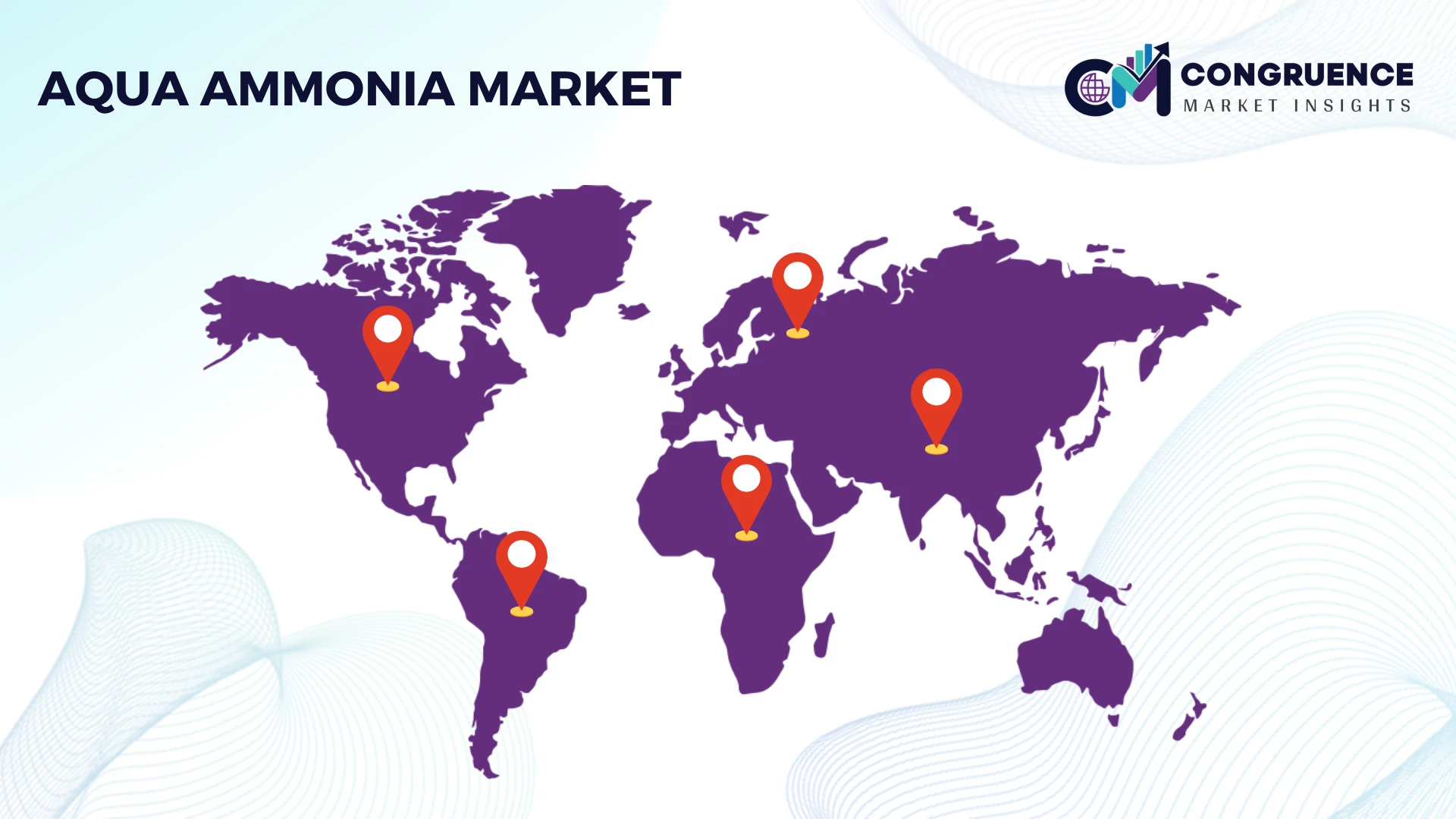
The Aqua Ammonia Market Report evaluates technical, reagent, electronic, pharmaceutical, and industrial grades across water treatment, fertilizer processing, chemical manufacturing, refrigeration, emissions control, pharmaceuticals, semiconductor fabrication, and industrial cleaning. End-user coverage includes municipal utilities, chemical producers, semiconductor manufacturers, agricultural enterprises, pharmaceutical companies, and industrial processors. Regional analysis spans North America, Europe, Asia-Pacific, South America, and Middle East & Africa.
The report examines automated dosing, closed-transfer systems, high-purity purification, digital concentration monitoring, smart storage, and application-specific packaging. Water treatment represents approximately 34% of demand, while electronics is the fastest-changing high-purity application. Competitive coverage evaluates 14 major participants across global producers, regional distributors, specialty suppliers, and integrated chemical companies. Findings support capacity planning, geographic expansion, supplier qualification, technology investment, competitive positioning, and strategic assessment of market direction through 2033.
| Report Attribute/Metric | Report Details |
|---|---|
|
Market Revenue in 2025 |
USD 650.4 Million |
|
Market Revenue in 2033 |
USD 792.4 Million |
|
CAGR (2026 - 2033) |
2.5% |
|
Base Year |
2025 |
|
Forecast Period |
2026 - 2033 |
|
Historic Period |
2021 - 2025 |
|
Segments Covered |
By Type
By Application
By End-User
|
|
Key Report Deliverable |
Revenue Forecast, Growth Trends, Market Dynamics, Segmental Overview, Regional and Country-wise Analysis, Competition Landscape |
|
Region Covered |
North America, Europe, Asia-Pacific, South America, Middle East, Africa |
|
Key Players Analyzed |
CF Industries Holdings, Inc., Yara International ASA, BASF SE, Tanner Industries, Inc., Hill Brothers Chemical Company, TradeMark Nitrogen Corporation, Verma Gases Pvt. Ltd., Nutrien Ltd., OCI N.V., Linde plc, Air Liquide S.A., Hawkins, Inc., Thermo Fisher Scientific Inc., Merck KGaA |
|
Customization & Pricing |
Available on Request (10% Customization is Free) |




