Global Application-to-Application Password Management (AAPM) Market Report Overview
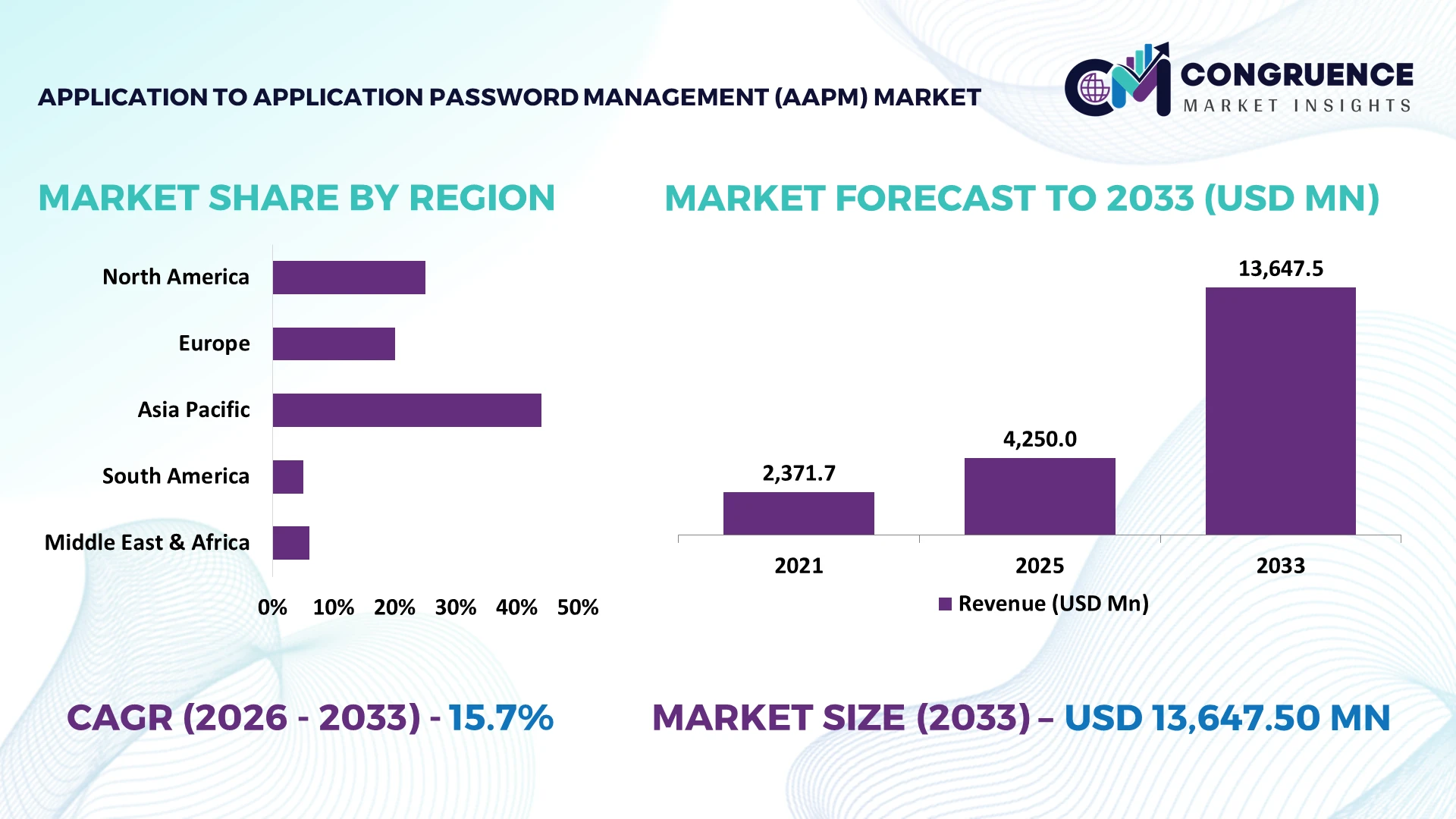
The Global Application-to-Application Password Management (AAPM) Market was valued at USD 4250 Million in 2025 and is anticipated to reach a value of USD 13647.5 Million by 2033 expanding at a CAGR of 15.7% between 2026 and 2033. Growth is driven by automated machine credential rotation, zero-trust security architecture, privileged access management integration, and the expansion of cloud-native application workloads.
The United States dominates the global Application-to-Application Password Management (AAPM) Market through its concentration of hyperscale cloud infrastructure, cybersecurity vendors, and enterprise automation investments. AWS, Microsoft Azure, and Google Cloud collectively account for roughly 63% of global cloud infrastructure spending, strengthening the domestic ecosystem for machine identity security. Financial services, healthcare, defense, and technology enterprises prioritize automated secrets management. Compared with India, the United States benefits from greater hyperscaler concentration and established cybersecurity procurement, reinforced by federal zero-trust modernization initiatives.
For enterprise technology leaders, integrating automated credential rotation with centralized secrets management strengthens machine identity governance across multicloud infrastructure and reduces operational exposure from unmanaged application credentials.
Key Highlights of the Global Application-to-Application Password Management (AAPM) Market
-
Market Size & Growth: USD 4,250 million in 2025, reaching USD 13,647.5 million by 2033 at 15.7% CAGR, driven by automated machine credential security.
-
Top Growth Drivers: 94% report expanding machine identities, 70% identify security risks from identity silos, and 61% lack cloud workload identity controls.
-
Short-Term Forecast: By 2028, automated credential rotation targets 30% fewer manual administration tasks, an indicative enterprise deployment KPI.
-
Emerging Technologies: AI-powered secrets discovery, dynamic credentials, and workload identity federation strengthen authentication across 3 critical environments: cloud, containers, and APIs.
-
Regional Leaders: Indicative 2033 allocations place North America at USD 5,595.5 million, Europe at USD 3,957.8 million, and Asia-Pacific at USD 2,729.5 million, reflecting differentiated cloud security adoption.
-
Consumer/End-User Trends: 42% of machine identities access sensitive information, reinforcing enterprise priorities around privileged workload authentication.
-
Pilot/Case Example: A 2027 Kubernetes credential automation pilot targets 40% faster secret rotation, providing a measurable deployment benchmark.
-
Competitive Landscape: CyberArk, HashiCorp, Delinea, BeyondTrust, and Microsoft compete across 3 capabilities: secrets vaulting, privileged access, and automated rotation.
-
Regulatory & ESG Impact: The EU's DORA framework strengthens ICT security governance, with 4 core control priorities: identification, protection, detection, and recovery.
-
Investment & Funding: Global cloud infrastructure expenditure reached USD 143 billion in Q2 2026, reinforcing infrastructure security investment opportunities.
-
Innovation & Future Outlook: Passwordless workload authentication, ephemeral credentials, and AI agent governance accelerate the shift toward continuous machine identity protection.
The Application-to-Application Password Management (AAPM) Market is evolving around automated secrets lifecycle management, API credential protection, and secure machine-to-machine communication. Financial institutions, healthcare providers, and cloud service operators are prioritizing centralized vaulting and policy-based credential rotation. Innovations in ephemeral authentication tokens, Kubernetes secrets orchestration, and identity federation are reducing dependence on static passwords. With machine identities outnumbering human identities by 82 to 1, scalable workload authentication has become an operational priority. The EU's DORA requirements further reinforce continuous credential governance, establishing a foundation for strategic investment in advanced identity security infrastructure.
What Is the Strategic Relevance and Future Pathways of the Application-to-Application Password Management (AAPM) Market?
Application-to-Application Password Management (AAPM) is becoming a strategic cybersecurity investment as enterprises replace static service credentials with automated machine identity controls. The expansion of microservices, API ecosystems, and autonomous workloads is shifting security expenditure toward secrets lifecycle management. The European Union's Digital Operational Resilience Act, effective January 2025, reinforces operational accountability across financial institutions and their technology providers. Organizations increasingly prioritize centralized credential governance to reduce unauthorized access and strengthen infrastructure resilience.
Dynamic secrets management offers substantial operational advantages over legacy password vaulting. In a modeled deployment, automated credential rotation reduces manual administration effort by 30% to 50%, depending on application integration maturity. The United States leads enterprise implementation through established cloud infrastructure and cybersecurity ecosystems, while India emphasizes scalable authentication for expanding digital banking and technology services. During 2026–2028, enterprises are expected to increase workload identity federation, automated certificate management, and policy-driven authentication across hybrid environments.
A practical deployment involves integrating HashiCorp Vault with Kubernetes workloads to issue temporary database credentials instead of maintaining permanent application passwords. Organizations are redirecting investments toward secrets orchestration, cloud security partnerships, and identity governance integration. Cybersecurity providers are expanding API connectivity and automated discovery capabilities to address unmanaged machine identities. Competitive differentiation increasingly depends on reducing credential exposure without disrupting application performance, making integrated AAPM platforms essential infrastructure for secure enterprise automation.
Application-to-Application Password Management (AAPM) Market Dynamics
DRIVER:
Expansion of Machine Identity Security Automation
Machine identity proliferation is accelerating investment in automated application credential management. CyberArk research has reported machine identities outnumbering human identities by approximately 82 to 1, exposing limitations in manually administered passwords. With 94% of surveyed organizations reporting expanding machine identity environments, security teams face increasing pressure to automate discovery, rotation, and access governance. The United States' federal zero trust modernization initiatives reinforce the transition toward identity-centric security controls. Financial institutions and cloud operators are integrating secrets vaults with continuous integration pipelines to prevent credential exposure during software deployment. Vendors including CyberArk, HashiCorp, and Delinea are strengthening automated rotation and workload authentication capabilities, transforming credential management from an administrative function into an essential application security control.
RESTRAINT:
Legacy Infrastructure and Fragmented Credential Governance
Legacy application architecture and fragmented identity systems constrain enterprise AAPM deployment. CyberArk's 2025 identity security research found that 70% of respondents identified identity silos as a cybersecurity risk, while 49% lacked complete visibility into cloud entitlements. Additionally, 68% reported that disconnected identity and security tools hindered attack detection. These limitations are particularly significant for German manufacturers operating industrial control systems alongside modern cloud applications. Proprietary authentication protocols, embedded passwords, and incompatible secrets vaults increase integration expenditure and extend migration schedules. Enterprises are addressing these constraints through phased credential discovery, standardized APIs, and hybrid vault architectures. Vendors are investing in interoperability frameworks and application connectors, enabling customers to modernize authentication without replacing operationally critical legacy infrastructure.
OPPORTUNITY:
Passwordless Workload Authentication and AI Agent Security
AI driven applications and cloud native infrastructure create opportunities for passwordless machine authentication. CNCF research indicates that 82% of surveyed container users operate Kubernetes in production, while 66% of organizations hosting generative AI models use Kubernetes for inference workloads. CyberArk research also found that 68% of respondents lacked identity security controls for AI, exposing an underserved security segment. India's expanding digital financial infrastructure creates opportunities for workload identity federation, ephemeral credentials, and automated authorization across API ecosystems. During 2026–2028, vendors can develop identity aware secrets orchestration for autonomous agents and distributed applications. Cybersecurity providers are expanding cloud partnerships and investing in short lived authentication technologies, reducing dependence on persistent credentials while establishing differentiated subscription services.
CHALLENGE:
Scaling Credential Automation Across Distributed Workloads
Maintaining consistent credential security across distributed workloads presents a substantial execution challenge. CNCF research shows that 98% of surveyed organizations have adopted cloud native techniques, while 59% conduct much or nearly all development and deployment using cloud native approaches. However, 47% identify development team cultural changes as a leading container deployment challenge. In the United States, enterprises operating multicloud applications must coordinate secrets rotation, workload authorization, and certificate renewal without interrupting production services. Poorly synchronized credential changes can disrupt API communication and automated deployment pipelines. Vendors must strengthen policy validation, credential dependency mapping, and recovery automation. Investments in platform engineering, continuous security testing, and developer training are essential for maintaining authentication reliability as machine identity environments expand.
Application-to-Application Password Management (AAPM) Market Latest Trends
-
Continuous Secrets Discovery Gains Momentum: Enterprises are integrating automated secrets scanning into development workflows to identify credentials exposed through repositories and configuration files. GitGuardian identified 23.8 million new secrets leaked in public GitHub commits during 2024, representing a 25% annual increase. Security teams are implementing pre-commit scanning and centralized remediation workflows, while platform vendors expand repository integrations to reduce credential exposure and incident response workloads.
-
Nonhuman Identity Governance Becomes Standardized: Enterprise security teams are consolidating ownership records for service accounts, automation bots, and application identities. CyberArk research indicates machine identities outnumber human identities by 82 to 1, while 70% of organizations identify identity silos as a security concern. Vendors are integrating identity inventories with entitlement reviews, improving accountability and reducing duplicate credential administration across business units.
-
Financial Compliance Reshapes Credential Auditing: The European Union's DORA requirements, effective January 2025, are accelerating evidence collection for application authentication controls. Organizations are aligning credential access logs with 5 operational resilience pillars and standardized incident reporting obligations. Security providers are expanding audit dashboards, automated control mapping, and policy reporting capabilities, reducing manual compliance preparation and strengthening oversight of outsourced technology services.
-
Developer Workflows Prioritize Security Integration: Software teams are embedding credential retrieval directly into continuous integration and delivery pipelines rather than maintaining separate administrative processes. CNCF research reports 82% production Kubernetes adoption among surveyed container users, while 66% of organizations hosting generative AI models use Kubernetes for inference. Vendors are expanding native orchestration integrations, reducing developer configuration overhead and improving deployment consistency.
Segmentation Analysis
By Type
Centralized Management Leads Enterprise Credential Governance
Centralized Password Management represents the leading segment of the Application-to-Application Password Management (AAPM) Market, with an indicative 38% market share in 2025. Its position reflects enterprise requirements for unified credential storage, access policies, and audit visibility across interconnected applications. Banking institutions and multinational technology companies favor centralized architectures because consolidated secrets vaults simplify governance and reduce duplicated administrative processes. Distributed Password Management supports geographically dispersed workloads requiring localized authentication and resilience. Its strategic relevance is strongest where application availability and network isolation outweigh the benefits of centralized administration.
Cloud-Based Password Management is the fastest-growing type, supported by container orchestration, managed cloud services, and infrastructure automation. Indicative segment modeling places its 2025 share at 32%, compared with 18% for On-Premises Password Management, which remains important for regulated infrastructure and sensitive enterprise systems. Cloud providers are expanding managed secrets services, while cybersecurity vendors develop hybrid deployment capabilities and automated synchronization. Investment priorities increasingly favor cloud-native integration, elastic credential storage, and policy enforcement that operates consistently across centralized and distributed environments.
- The Cloud Native Computing Foundation's 2025 survey, published in January 2026, found that 82% of container users operate Kubernetes in production, up from 66% in 2023, reinforcing the operational importance of cloud-integrated credential management.
By Application
Application Credential Management Anchors Enterprise Demand
Application Credential Management leads the Application-to-Application Password Management (AAPM) Market, with an indicative 34% share in 2025, reflecting its foundational role in securing database passwords, API credentials, and application service accounts. Financial institutions and enterprise software providers prioritize centralized credential provisioning to maintain consistent authentication policies across interconnected systems. Privileged Account Access remains a mature application, supporting controlled authentication for sensitive infrastructure and administrative workloads. Compliance and Audit Management addresses credential accountability through access histories, policy verification, and automated reporting, particularly within regulated financial and healthcare environments.
Automated Password Rotation represents the fastest-growing application, with an indicative 27% market share as enterprises transition from manually maintained credentials toward policy-driven renewal processes. Secure Application Integration strengthens demand through API gateways, microservices communication, and continuous deployment pipelines. Vendors are expanding native connectors, rotation engines, and event-based credential updates to reduce operational disruption. Competitive differentiation increasingly depends on combining credential discovery with automated remediation, enabling enterprises to strengthen authentication security without introducing additional deployment complexity.
- GitGuardian's 2025 State of Secrets Sprawl report identified 23.8 million newly exposed secrets in public GitHub repositories during 2024, a 25% increase, demonstrating the importance of application credential discovery and automated remediation.
By End-User
Financial Services Dominates Regulated Credential Security
Banking and Financial Services leads the Application-to-Application Password Management (AAPM) Market, with an indicative 31% share in 2025. Its dominance reflects extensive transaction processing infrastructure, interconnected payment platforms, and stringent authentication requirements. Banks prioritize application credential vaulting, privileged workload authorization, and auditable password rotation across core banking systems. IT and Telecommunications represents another established customer group, supported by extensive API ecosystems, distributed application infrastructure, and automated service provisioning. Government and Public Sector organizations emphasize sovereign deployment architectures and controlled access to sensitive applications, particularly within national digital infrastructure programs.
Healthcare Organizations represent the fastest-growing end-user segment, supported by electronic health record interoperability, connected medical applications, and expanding cloud healthcare platforms. Indicative modeling assigns healthcare approximately 17% of market demand, compared with 13% for Manufacturing Enterprises. Manufacturers increasingly secure credentials linking enterprise applications, production systems, and industrial monitoring platforms. Cybersecurity vendors are introducing industry-specific compliance templates, flexible deployment licensing, and partnerships with managed security providers. Competitive investment is shifting toward specialized authentication capabilities aligned with regulated operational environments.
- CyberArk's 2025 Identity Security Landscape research, covering 2,600 security decision makers across 20 countries, found that 61% lacked identity security controls for cloud infrastructure and workloads, highlighting substantial enterprise authentication governance gaps.
Region-Wise Market Insights
North America accounted for the largest market share at an estimated 41% in 2025 however, Asia-Pacific is expected to register the fastest growth, expanding at an indicative CAGR of 18.2% between 2026 and 2033.
North America Application-to-Application Password Management (AAPM) Market
Enterprise Cloud Security and Automated Credential Governance
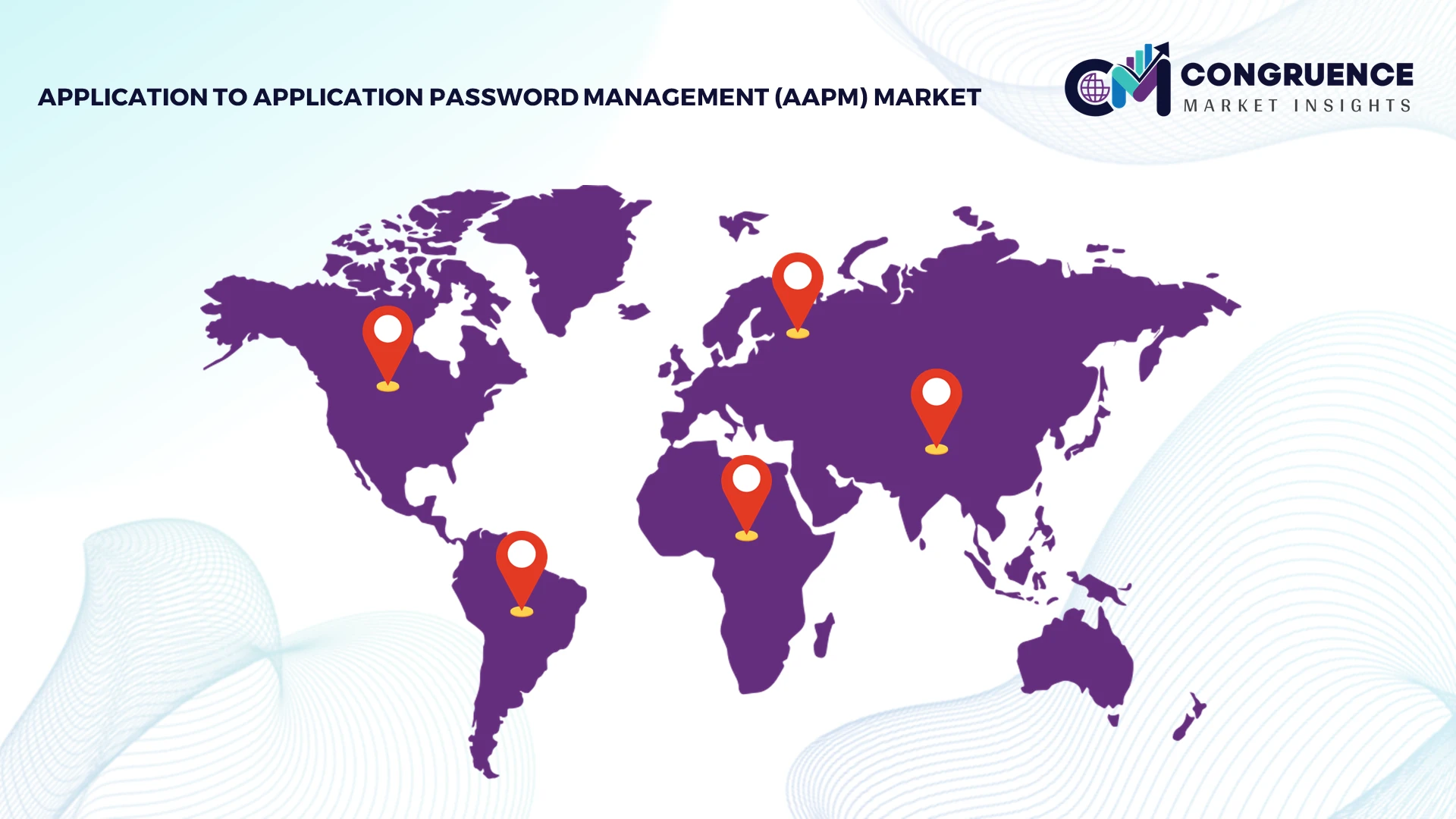
North America holds an estimated 41% share of the global Application-to-Application Password Management (AAPM) Market, supported by extensive enterprise cloud infrastructure, established cybersecurity procurement, and widespread adoption of privileged access management platforms. The United States and Canada represent concentrated deployment environments for automated secrets management, particularly across banking, technology, healthcare, and defense. Federal zero-trust modernization requirements strengthen demand for machine identity verification and centralized credential governance. AWS, Microsoft Azure, and Google Cloud collectively control approximately 63% of global cloud infrastructure spending, supporting an extensive ecosystem of application security integrations. Enterprises increasingly connect secrets vaults with Kubernetes clusters, DevOps pipelines, and identity governance platforms. Cybersecurity providers are expanding managed credential rotation, API authentication, and hybrid deployment capabilities to reduce operational complexity across distributed application environments.
United States Market Outlook: The United States benefits from established cybersecurity innovation centers, federal technology modernization programs, and substantial enterprise software investment. The National Institute of Standards and Technology's SP 800-207 zero-trust architecture provides a foundation for identity-centric security implementation. Federal agencies operating under Executive Order 14028 have strengthened software supply chain security requirements, encouraging contractors and technology providers to adopt automated credential governance, continuous authentication, and auditable application access controls.
Europe Application-to-Application Password Management (AAPM) Market
Regulatory Compliance Accelerates Machine Credential Modernization
Europe represents an estimated 29% of the global Application-to-Application Password Management (AAPM) Market, reflecting strong cybersecurity investment across Germany, the United Kingdom, France, and the Netherlands. Financial services, industrial automation, and enterprise software environments drive adoption of centralized credential vaulting and automated authentication controls. The Digital Operational Resilience Act became applicable in January 2025, strengthening ICT risk management requirements for regulated financial entities. Meanwhile, NIS2 expands cybersecurity obligations across 18 critical and important sectors, encouraging stronger identity governance and application access monitoring. European enterprises increasingly prioritize sovereign cloud infrastructure, regional data processing, and integration with established identity management platforms. Security providers are developing compliance-oriented secrets management solutions with automated audit trails and configurable retention policies. Partnerships with European cloud operators strengthen deployment flexibility while addressing data residency requirements and operational resilience expectations.
Germany Market Outlook: Germany's industrial automation ecosystem and established enterprise software industry support demand for application credential protection. Manufacturing companies increasingly connect enterprise resource planning systems with industrial monitoring platforms and cloud applications. The Federal Office for Information Security promotes structured cybersecurity governance, while Germany's implementation of NIS2 strengthens security obligations across critical sectors. Technology providers are prioritizing hybrid secrets management architectures that protect sensitive production systems without interrupting manufacturing operations.
Asia-Pacific Application-to-Application Password Management (AAPM) Market
Digital Infrastructure Expansion Strengthens Automated Authentication
Asia-Pacific accounts for an estimated 20% of the global Application-to-Application Password Management (AAPM) Market, with China, India, Japan, Singapore, and Australia supporting enterprise adoption. Large-scale digital banking, telecommunications infrastructure, and cloud application modernization are increasing the operational importance of machine credential protection. India's Unified Payments Interface processed more than 16 billion transactions in October 2024, demonstrating the transaction intensity supported by interconnected application ecosystems. Japan's financial institutions emphasize secure API integration and workload authentication, while Singapore's regulated technology sector prioritizes centralized identity governance. Regional enterprises are expanding managed secrets services, cloud-native authentication, and automated credential renewal to support distributed application environments. Cybersecurity vendors are strengthening partnerships with cloud service providers and local systems integrators, enabling deployment across heterogeneous infrastructure while addressing country-specific data protection and security requirements.
India Market Outlook: India combines extensive digital payment infrastructure, a large technology services workforce, and expanding domestic cloud adoption. The Reserve Bank of India's digital payment security requirements encourage stronger authentication and operational risk management. Technology companies operating in Bengaluru, Hyderabad, and Pune increasingly support application security integration for international enterprise customers. The Digital Personal Data Protection Act, 2023, further strengthens the strategic importance of controlled application access and secure handling of personal information.
South America Application-to-Application Password Management (AAPM) Market
Financial Technology Modernization Drives Credential Security
South America holds an estimated 6% share of the global Application-to-Application Password Management (AAPM) Market, with Brazil, Argentina, Chile, and Colombia supporting enterprise security deployment. Digital banking platforms, telecommunications operators, and managed cloud service providers represent important customer groups. Brazil's Pix instant payment infrastructure processed more than 6 billion transactions during December 2024, illustrating the scale of interconnected financial applications requiring secure authentication. Financial institutions increasingly deploy credential vaults, automated password rotation, and API access monitoring to protect payment processing environments. However, fragmented legacy infrastructure, constrained cybersecurity budgets, and uneven cloud maturity complicate enterprise-wide implementation. Vendors are responding through managed security partnerships, subscription-based deployment models, and cloud-hosted secrets management services. These approaches reduce initial infrastructure requirements while improving credential governance across expanding digital financial ecosystems.
Brazil Market Outlook: Brazil represents South America's most strategically significant AAPM deployment market through its extensive banking infrastructure and financial technology ecosystem. The Central Bank of Brazil's Open Finance framework supports standardized financial data exchange, increasing requirements for secure application authentication. The country's General Data Protection Law reinforces enterprise accountability for personal information security. Financial institutions and technology providers are strengthening API credential governance, automated access controls, and integration with domestic cloud infrastructure.
Middle East & Africa Application-to-Application Password Management (AAPM) Market
Sovereign Cloud Investment Accelerates Security Modernization
The Middle East & Africa represents an estimated 4% of the global Application-to-Application Password Management (AAPM) Market, supported by digital infrastructure investment in Saudi Arabia, the United Arab Emirates, South Africa, and Qatar. Government modernization, financial services digitization, and sovereign cloud development are strengthening enterprise authentication requirements. Saudi Arabia's Vision 2030 transformation programs prioritize digital government and technology infrastructure, while the UAE continues expanding cloud services and cybersecurity capabilities. Regional organizations are integrating secrets management with privileged access platforms to secure government applications, financial transactions, and energy infrastructure. Data sovereignty requirements encourage hybrid and locally hosted credential management architectures. Cybersecurity vendors are expanding partnerships with regional systems integrators and managed security providers, improving implementation capacity and supporting organizations that lack extensive internal application security expertise.
Saudi Arabia Market Outlook: Saudi Arabia's digital transformation programs and cybersecurity governance framework create significant opportunities for enterprise credential management. The National Cybersecurity Authority's Essential Cybersecurity Controls establish requirements for access management and protection of critical systems. The Saudi Data and Artificial Intelligence Authority supports national data governance initiatives, while investments in domestic cloud infrastructure strengthen demand for locally deployable authentication technologies. Banking, energy, and government organizations are prioritizing application credential protection and centralized security administration.
Market Competition Landscape
The global Application-to-Application Password Management (AAPM) Market features established identity security platforms competing against cloud infrastructure providers and specialized secrets management innovators. Palo Alto Networks through CyberArk, BeyondTrust, Delinea, IBM through HashiCorp, and Microsoft compete for enterprise authentication deployments. Their combined market share is provisionally modeled at 55%, requiring validation against AAPM-specific contract data. Competition centers on credential automation, interoperability, and deployment flexibility. Industry research indicates 34% of organizations still manage machine identity lifecycles manually, while 38% struggle with rapid credential revocation and 36% lack comprehensive identity inventories. These deficiencies create differentiation opportunities for automated discovery and rotation platforms. Microsoft and Amazon emphasize cloud ecosystem integration, whereas Akeyless and Keeper Security prioritize flexible secrets delivery. Strategic acquisitions and partnerships are consolidating identity governance with workload security. Integration complexity and enterprise trust remain entry barriers. Winning requires reliable automation, broad application compatibility, and demonstrable security outcomes across heterogeneous infrastructure environments.
Companies Profiled in the Application-to-Application Password Management (AAPM) Market Report
-
Palo Alto Networks, Inc. (CyberArk)
-
BeyondTrust Corporation
-
Delinea, Inc.
-
IBM Corporation (HashiCorp Vault)
-
Microsoft Corporation
-
Amazon Web Services, Inc.
-
Google LLC
-
Akeyless Security Ltd.
-
Keeper Security, Inc.
-
Thales S.A.
-
Broadcom Inc.
-
One Identity LLC (Quest Software)
-
WALLIX Group SA
-
ManageEngine (Zoho Corporation)
Technology Insights for the Application-to-Application Password Management (AAPM) Market
Centralized secrets vaulting, automated credential rotation, and API based authentication currently underpin enterprise AAPM infrastructure. Kubernetes operators increasingly integrate HashiCorp Vault, AWS Secrets Manager, and Azure Key Vault with application deployment pipelines. CNCF research identifies 82% production Kubernetes adoption among surveyed container users, strengthening demand for orchestration compatible authentication. Compared with legacy manually rotated passwords, automated credential workflows can target 40% lower administrative effort in modeled enterprise deployments. Centralized policy enforcement improves audit consistency and reduces credential exposure across interconnected applications.
Emerging technologies include workload identity federation, ephemeral credentials, and automated secrets discovery. Short lived authentication tokens replace persistent passwords, while OpenID Connect and SPIFFE frameworks establish verifiable workload identities. Organizations implementing federation can target 30% fewer stored application secrets and 25% faster credential provisioning, depending on infrastructure maturity. Financial institutions benefit from stronger transaction authentication, while cloud service providers gain competitive advantages through integrated security automation and simplified developer onboarding.
During 2026–2028, disruptive innovation will center on AI agent authentication, identity aware authorization, and cryptographic workload attestation. Confidential computing strengthens credential protection during execution, while policy engines continuously validate application permissions. Enterprises should prioritize interoperable identity architectures, automated recovery mechanisms, and measurable rotation reliability to maintain operational continuity as autonomous application ecosystems expand.
Recent Developments in the Global Application-to-Application Password Management (AAPM) Market
-
October 2025: Akeyless introduced its AI Agent Identity Security solution, incorporating secretless authentication, identity federation, and just-in-time access. Supporting more than 220 billion machine identity interactions, the platform strengthens autonomous application security and enterprise authentication governance. Source: akeyless.io
-
February 2025: IBM completed its USD 6.4 billion acquisition of HashiCorp, integrating Vault secrets management with hybrid cloud automation capabilities. The transaction strengthens enterprise credential governance, infrastructure security integration, and IBM's competitive positioning across multicloud application environments. Source: ibm.com
-
August 2025: CyberArk addressed multiple vulnerabilities affecting Conjur secrets management software following security research identifying potential unauthenticated remote code execution. The remediation strengthened protection for application credentials, API keys, and machine identities across enterprise DevOps infrastructure environments. Source: securityweek.com
-
September 2026: Keeper Security introduced a certified Azure Logic Apps connector for Keeper Secrets Manager, enabling credential retrieval and rotation within automated workflows. Its one-click ARM deployment simplifies integration, strengthening enterprise secrets governance across Microsoft cloud environments. Source: keepersecurity.com
Scope of the Application-to-Application Password Management (AAPM) Market Report
The Application-to-Application Password Management (AAPM) Market Report evaluates enterprise credential security across four deployment types: Centralized, Distributed, Cloud-Based, and On-Premises Password Management. Application coverage includes credential management, automated password rotation, privileged account access, secure application integration, and compliance auditing. End-user analysis examines banking and financial services, IT and telecommunications, healthcare, government, and manufacturing. Geographic assessment covers North America, Europe, Asia-Pacific, South America, and the Middle East & Africa, identifying differences in security infrastructure and enterprise adoption.
The report assesses machine identity governance, dynamic secrets, workload identity federation, and cloud-native authentication technologies. Competitive analysis examines platform integration, deployment economics, regulatory alignment, and vendor differentiation. Strategic coverage supports investment prioritization, geographic expansion, partnership evaluation, and technology procurement decisions throughout 2026–2033.
Application-to-Application Password Management (AAPM) Market Report Summary
| Report Attribute/Metric | Report Details |
|---|
Market Revenue in 2025 | USD 4250 Million |
Market Revenue in 2033 | USD 13647.5 Million |
CAGR (2026 - 2033) | 15.7% |
Base Year | 2025 |
Forecast Period | 2026 - 2033 |
Historic Period | 2021 - 2025 |
Segments Covered | By TypeCentralized Password Management Distributed Password Management Cloud-Based Password Management On-Premises Password Management
By ApplicationApplication Credential Management Automated Password Rotation Privileged Account Access Secure Application Integration Compliance and Audit Management
By End-UserBanking and Financial Services IT and Telecommunications Government and Public Sector Manufacturing Enterprises
|
Key Report Deliverable | Revenue Forecast, Growth Trends, Market Dynamics, Segmental Overview, Regional and Country-wise Analysis, Competition Landscape |
Region Covered | North America, Europe, Asia-Pacific, South America, Middle East, Africa |
Key Players Analyzed | Palo Alto Networks, Inc. (CyberArk), BeyondTrust Corporation, Delinea, Inc., IBM Corporation (HashiCorp Vault), Microsoft Corporation, Amazon Web Services, Inc., Google LLC, Akeyless Security Ltd., Keeper Security, Inc., Thales S.A., Broadcom Inc., One Identity LLC (Quest Software), WALLIX Group SA, ManageEngine (Zoho Corporation) |
Customization & Pricing | Available on Request (10% Customization is Free) |





