
Reports
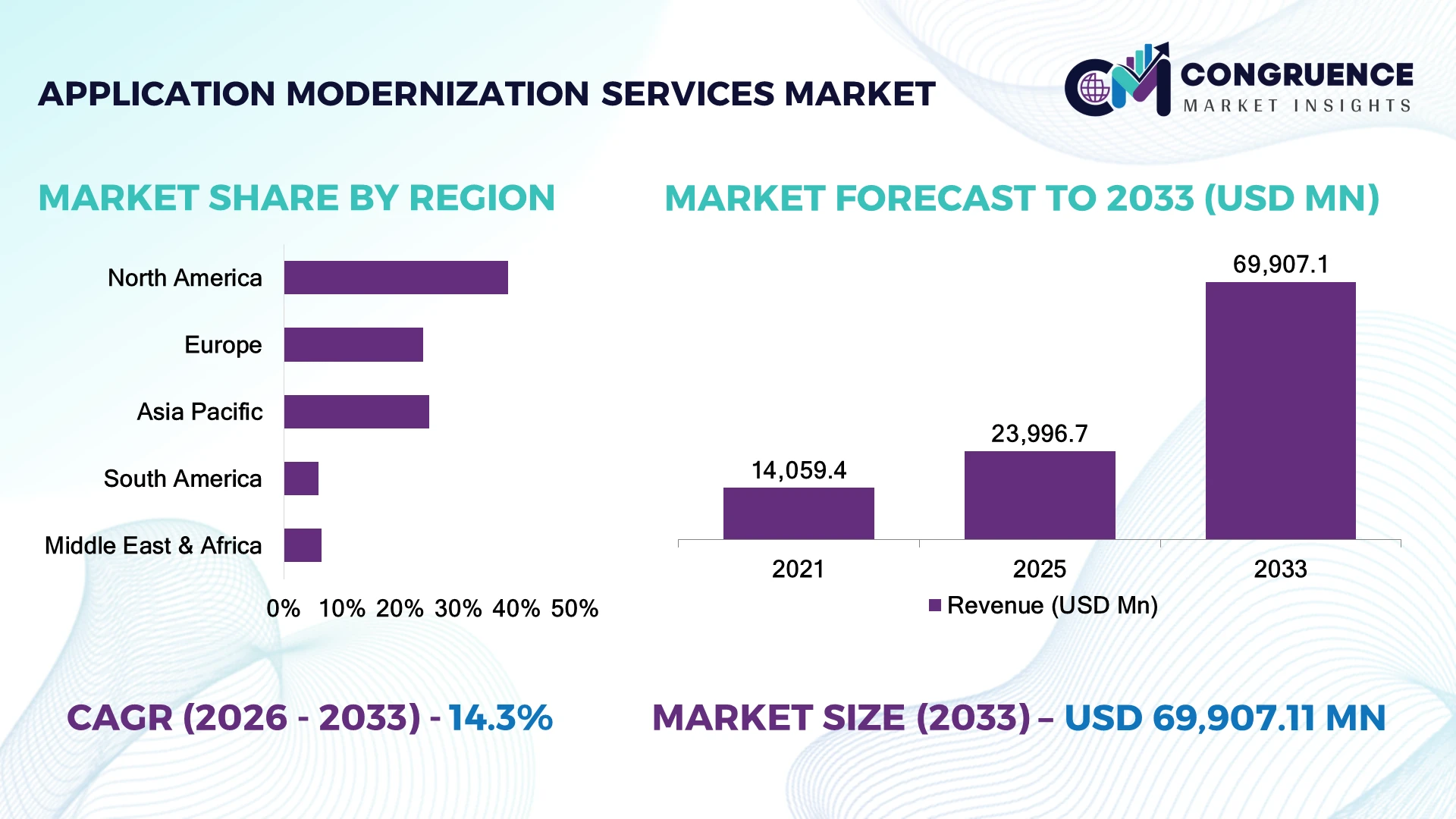
The Global Application Modernization Services Market was valued at USD 23,996.7 Million in 2025 and is anticipated to reach a value of USD 69,907.1 Million by 2033 expanding at a CAGR of 14.3% between 2026 and 2033. Growth is driven by legacy application replacement, cloud migration, AI-enabled code transformation, and enterprise demand for interoperable digital platforms that reduce technical debt and accelerate software delivery.
The United States remains a leading application modernization hub, supported by substantial enterprise cloud spending, established hyperscaler ecosystems, and modernization programs across banking, healthcare, retail, and government. Federal cybersecurity requirements and continued adoption of cloud-native architectures are increasing pressure to replace unsupported applications. Compared with India's cost-competitive engineering ecosystem, the United States benefits from deeper enterprise technology budgets, while Indian service providers strengthen global delivery through specialized modernization teams. Organizations targeting even a 20% reduction in application maintenance effort can redirect technology resources toward digital products, automation, and security improvements, although actual savings depend on application complexity and migration scope.
Providers should prioritize AI-assisted code conversion, secure cloud migration, and measurable technical-debt reduction to win enterprise modernization programs.
Market Size & Growth: The market reached USD 24.00 billion in 2025 and is projected to reach USD 69.91 billion by 2033, supported by cloud-native transformation and legacy-system replacement.
Top Growth Drivers: Cloud migration, AI-assisted software engineering, and cybersecurity modernization are accelerating enterprise investment in application transformation.
Short-Term Forecast: By 2028, enterprises prioritizing automated code analysis and continuous testing will target shorter modernization cycles and lower manual rework, with results varying by application complexity.
Emerging Technologies: Generative AI coding assistants, automated refactoring, containerization, microservices, and API-led integration are reshaping application modernization workflows.
Regional Leaders: North America benefits from enterprise cloud investment, Europe emphasizes regulatory compliance and data sovereignty, and Asia-Pacific combines digital transformation demand with large software-engineering delivery ecosystems.
Consumer/End-User Trends: Banks, manufacturers, healthcare organizations, and retailers increasingly prioritize interoperable applications, resilient digital services, and faster software-release cycles.
Pilot/Case Example: In 2025–2026, enterprises continued applying generative AI to code documentation, test generation, and legacy-code analysis to reduce repetitive engineering work and accelerate application assessment.
Competitive Landscape: Accenture, IBM, Capgemini, Cognizant, and TCS compete through cloud engineering, legacy-system expertise, AI-enabled delivery, and large-scale transformation capabilities.
Regulatory & ESG Impact: Data-protection obligations, sector-specific cybersecurity requirements, and sustainability objectives are strengthening demand for secure architectures and more efficient infrastructure utilization.
Investment & Funding: Enterprise technology budgets increasingly support cloud migration, platform engineering, AI-assisted development, and modernization partnerships that connect legacy applications with digital services.
Innovation & Future Outlook: Competitive differentiation is shifting toward AI-enabled transformation factories, automated testing, composable architectures, and continuous modernization rather than isolated migration projects.
The application modernization services market supports enterprises seeking to transform aging software into secure, scalable, and interoperable applications. Demand extends across mainframe modernization, cloud migration, application re-architecting, API integration, containerization, and AI-assisted code transformation. Organizations are moving beyond infrastructure relocation toward modernization programs that improve software maintainability and accelerate product delivery. Generative AI is changing code assessment, documentation, and testing workflows, while cybersecurity requirements increase the importance of dependency management and architecture redesign. Providers that combine engineering automation with domain expertise and controlled migration processes are better positioned to deliver modernization outcomes without disrupting critical business operations.
Application modernization services have become strategically important as enterprises face rising maintenance costs, unsupported legacy platforms, cybersecurity exposure, and pressure to introduce digital capabilities faster. Banks, insurers, manufacturers, and government agencies increasingly depend on systems that were not designed for cloud-native deployment or continuous software delivery. Modernization connects these systems with APIs, scalable infrastructure, and contemporary development practices, enabling organizations to extend existing investments while reducing architectural constraints. In 2026, generative AI is also changing how providers assess legacy code and plan transformation programs.
Traditional modernization relies heavily on manual code analysis, documentation, and regression testing, whereas AI-assisted tools can automate portions of these workflows. A 10–20% reduction in selected repetitive engineering effort is a potential project target, not a universal verified outcome. North American enterprises emphasize large-scale transformation and cloud integration, while India combines domestic modernization demand with extensive outsourced engineering capabilities. European projects place additional emphasis on data residency, privacy, and regulatory compliance. The most effective strategy combines automation with human validation, particularly for business-critical applications and complex dependencies.
During 2026–2028, providers are expected to strengthen investments in AI-assisted refactoring, automated testing, platform engineering, and application portfolio assessment. For example, an enterprise can first identify redundant dependencies, modernize high-value services, and migrate workloads in controlled stages rather than replace an entire platform simultaneously. Technology consultancies are expanding cloud partnerships and developing reusable modernization frameworks to improve delivery consistency. Competitive advantage will depend on demonstrating secure migration, predictable execution, measurable maintenance improvements, and minimal business disruption throughout the transformation lifecycle.
Enterprises are accelerating modernization as aging applications become harder to maintain, integrate, and secure. Mainframe dependencies, outdated programming languages, fragmented databases, and unsupported software restrict product development and increase operational exposure. In suitable programs, automated code analysis and testing can target 10–20% reductions in selected repetitive engineering tasks, while API-based integration helps connect existing systems with digital channels. United States financial institutions and government agencies face particular pressure to strengthen security and system resilience. Service providers are responding with AI-assisted assessment, cloud migration frameworks, and phased re-architecture programs. The strategic advantage lies in identifying which components require replacement and which can be retained, preventing unnecessary redevelopment and concentrating investment on applications with the greatest business impact.
Application modernization projects face substantial constraints from undocumented code, tightly coupled systems, outdated interfaces, and limited internal expertise. Complex applications require extensive dependency mapping and regression testing before migration, increasing delivery time and cost. Data conversion errors and incompatibility between legacy databases and modern platforms can disrupt critical workflows. Enterprises can target 10–15% reductions in avoidable migration rework through early assessment and automated testing, although outcomes depend on system condition and project scope. Organizations are mitigating these pressures through phased migration, parallel testing, application rationalization, and fixed-scope pilot programs. The key purchasing consideration is total transformation cost rather than cloud infrastructure pricing alone, because poorly sequenced migration can reproduce legacy complexity in a new environment.
Generative AI, automated refactoring, and cloud-native development create opportunities to accelerate application transformation while improving software maintainability. AI tools can assist with code explanation, test generation, documentation, and identification of obsolete dependencies, allowing engineers to focus on architecture and validation. Enterprises can target 10–20% improvements in selected development workflows when automation is applied to repeatable tasks with appropriate oversight. Containerization and microservices also enable gradual modernization without replacing entire application estates. Providers are investing in reusable transformation platforms, AI governance, and partnerships with cloud infrastructure vendors. An important opportunity lies in modernizing mid-tier applications that lack the visibility of major core systems but create significant integration bottlenecks, offering measurable benefits without the risk of a complete enterprise-wide replacement.
Modernization introduces long-term challenges involving cybersecurity, software supply-chain integrity, architecture governance, and shortages of engineers experienced in legacy and cloud-native technologies. AI-generated code requires security review and functional validation because automated transformations can introduce defects or preserve unsafe logic. Enterprises should target comprehensive automated test coverage and documented security checks for critical application changes, with acceptable thresholds determined by application risk. Organizations operating across jurisdictions must also preserve data residency, access controls, and auditability during migration. Providers are responding through secure development pipelines, specialist training, architecture review boards, and human approval gates. Sustainable modernization requires teams capable of understanding legacy business logic as well as contemporary engineering practices, rather than relying on code-generation tools alone.
AI-Assisted Code Transformation Expands — Generative AI tools increasingly support legacy-code explanation, documentation, test generation, and refactoring. Enterprises are integrating these capabilities into development environments to reduce repetitive engineering work and accelerate application assessment. A 10–20% improvement in selected tasks is a potential target rather than an established industry-wide result. Providers are adding human review and automated testing to control defects and maintain code quality.
Cloud-Native Architectures Replace Monolithic Designs — Organizations are decomposing selected monolithic applications into modular services, containers, and API-connected components. This allows independent releases and more flexible scaling, although poorly designed decomposition can increase operational complexity. Companies are adopting platform engineering and standardized deployment pipelines to improve consistency. Modernization teams increasingly prioritize business-critical components rather than restructuring entire applications without a clear operational benefit.
Automated Testing Strengthens Migration Control — Enterprises are expanding regression testing, dependency analysis, and continuous integration to reduce disruption during application transformation. Automated test generation helps teams validate legacy behavior against modernized components, while observability tools identify performance regressions after deployment. Organizations are responding with staged releases, rollback procedures, and automated quality gates. The operational shift is toward validating modernization continuously rather than treating testing as a final project phase.
Security-First Modernization Gains Priority — Cybersecurity and software supply-chain risks are influencing application architecture decisions as organizations replace unsupported components and strengthen identity controls. Secure coding checks, dependency scanning, and secrets management are increasingly embedded in development pipelines. Providers are integrating security assessment with migration planning to identify vulnerabilities before workloads move. This approach reduces the risk of transferring legacy weaknesses into cloud environments and supports stronger governance across distributed application portfolios.
Re-platforming represents an estimated 30% of application modernization services demand in 2025, reflecting enterprises' preference for moving existing applications to modern infrastructure without completely rebuilding business logic. Its relative cost efficiency, shorter implementation cycles, and compatibility with established systems support adoption across banking, retail, manufacturing, and government. Re-architecting is among the fastest-growing approaches as organizations shift toward microservices, containerized workloads, and cloud-native applications that support independent deployment and flexible scaling. Rehosting remains relevant for rapid migration, while refactoring, application replacement, and retirement address specific performance, maintenance, and portfolio-rationalization requirements. These approaches serve different modernization objectives: rehosting prioritizes speed, re-platforming balances cost and functionality, and re-architecting targets deeper architectural transformation.
Investment priorities increasingly reflect application criticality and long-term operating requirements. Enterprises can target 10–20% reductions in selected maintenance activities through automation and architectural simplification, although outcomes depend on the application portfolio and implementation quality. AI-assisted code analysis is also helping teams identify dependencies and assess transformation options before committing to costly redevelopment. Providers are expanding automated assessment, testing, and migration capabilities to differentiate delivery performance. For buyers, the strongest strategy combines rapid migration for suitable workloads with selective refactoring and re-architecting where scalability, resilience, or release speed creates measurable business value.
Cloud migration represents an estimated 35% of application modernization services demand in 2025, supported by enterprise efforts to improve infrastructure flexibility, application availability, and access to managed cloud services. Organizations across financial services, healthcare, retail, and manufacturing use migration programs to replace aging infrastructure and connect applications with digital platforms. Application re-architecting is among the fastest-expanding applications as enterprises move beyond infrastructure relocation toward modular services, containerization, and API-driven integration. Application integration, legacy code modernization, performance optimization, and security remediation remain important complementary applications. Cloud migration prioritizes infrastructure transition, whereas re-architecting changes how applications are designed, deployed, and maintained, creating different requirements for engineering expertise and project governance.
Enterprises are increasingly combining migration with automated testing, observability, and security controls to reduce disruption and prevent legacy weaknesses from transferring into modern environments. Selected automation initiatives target 10–20% improvements in repetitive assessment or testing tasks, although actual results vary by system complexity. Financial institutions emphasize controlled migration and auditability, while digital-native businesses prioritize deployment flexibility and faster release cycles. Service providers are responding with application discovery tools, reusable migration frameworks, and cloud-platform partnerships. The strongest opportunities lie in programs that connect infrastructure modernization with clear operational objectives, including improved resilience, reduced maintenance burden, and more reliable integration with customer-facing digital services.
Large enterprises represent an estimated 60% of application modernization services demand in 2025, reflecting extensive legacy application portfolios, complex integration requirements, and substantial cybersecurity and compliance obligations. Banks, insurers, telecommunications operators, manufacturers, and government organizations often depend on mission-critical systems that require carefully staged transformation. Small and medium-sized enterprises are an emerging growth group as cloud platforms, managed services, and AI-assisted engineering reduce the need to maintain large internal modernization teams. Public-sector organizations and mid-sized businesses also pursue targeted modernization to improve digital service delivery, reduce dependence on unsupported software, and integrate data across departments. Large enterprises typically favor multi-year transformation programs, while smaller buyers prioritize defined scopes, predictable costs, and faster implementation.
Enterprise buyers increasingly evaluate providers on measurable outcomes, security controls, integration expertise, and the ability to modernize applications without interrupting critical operations. Organizations can target 10–20% reductions in selected repetitive engineering effort through code analysis and test automation, although benefits depend on workload characteristics. Large clients favor strategic partnerships and portfolio-wide modernization frameworks, whereas smaller organizations often prefer fixed-scope projects and managed cloud services. Providers are developing modular service packages, industry-specific accelerators, and consumption-based offerings to broaden access. Competitive positioning increasingly depends on matching delivery models to buyer maturity, balancing enterprise-scale transformation capabilities with affordable, incremental modernization for organizations with limited engineering capacity.
North America accounted for the largest market share at an estimated 38.5% in 2025 however, Asia-Pacific is expected to register the fastest growth, expanding at an estimated CAGR of 16.2% between 2026 and 2033.
AI-Assisted Transformation and Cloud Optimization Reshape Enterprise Modernization
North America maintains a leading position in application modernization services through substantial enterprise technology budgets, established hyperscaler ecosystems, and extensive demand from financial services, healthcare, retail, and government. The United States drives regional activity as organizations modernize mainframe applications, migrate workloads, and integrate legacy systems with cloud-native platforms. Generative AI is accelerating code assessment, documentation, and test generation, while cybersecurity requirements increase the urgency of replacing unsupported software components. Enterprises increasingly combine migration with application rationalization and cloud-cost governance rather than treating infrastructure relocation as the final objective. Providers are strengthening partnerships with major cloud platforms and expanding automated transformation capabilities. Competitive advantage increasingly depends on demonstrating measurable modernization outcomes, protecting critical workloads, and controlling implementation costs across complex enterprise portfolios.
United States Market Outlook: The United States benefits from mature cloud infrastructure, deep software-engineering expertise, and strong demand for modernization across banking, healthcare, insurance, and public-sector systems. Federal cybersecurity priorities and enterprise AI adoption are strengthening investment in application assessment, automated testing, and secure architecture redesign. Organizations are prioritizing phased modernization to reduce disruption and preserve critical business logic. Providers with strong cloud partnerships, regulated-industry expertise, and measurable delivery frameworks are well positioned to capture large transformation programs.
Regulatory Compliance and Sovereign Cloud Strategies Influence Modernization
Europe's application modernization market is shaped by legacy-system replacement, cloud adoption, cybersecurity requirements, and growing attention to data sovereignty. Germany, the United Kingdom, and France are important demand centers because of their established financial, industrial, and public-sector technology infrastructure. Organizations are modernizing enterprise resource planning, manufacturing applications, and customer platforms while maintaining compliance with GDPR and sector-specific requirements. Hybrid-cloud architectures remain relevant where sensitive workloads require tighter control over data location. Providers are emphasizing secure migration, application integration, and automated testing to manage transformation complexity. The commercial opportunity lies in combining modernization with governance and interoperability, particularly for multinational organizations operating across different regulatory environments.
Germany Market Outlook: Germany's industrial base creates substantial modernization requirements across automotive manufacturing, engineering, financial services, and enterprise software. Manufacturers are connecting established production applications with cloud analytics, industrial IoT platforms, and modern planning systems. The country's strong engineering ecosystem supports complex integration and application re-architecture projects, while data-protection requirements encourage controlled deployment models. Providers that understand industrial workflows and can modernize production-critical applications without interrupting operations are positioned to serve manufacturers seeking greater software flexibility and digital coordination.
Digital Transformation and Engineering Scale Accelerate Modernization Adoption
Asia-Pacific is an increasingly important application modernization market, supported by expanding cloud infrastructure, digital banking, manufacturing transformation, and large software-engineering delivery ecosystems. India combines extensive IT services capabilities with modernization demand from financial institutions, telecommunications providers, government agencies, and retailers. China emphasizes enterprise digitization and integration across manufacturing and digital platforms, while Japan faces modernization requirements associated with aging enterprise systems. Providers are expanding AI-assisted engineering, application migration, and cloud-native development capabilities to address varied client needs. The region's competitive advantage combines technical delivery capacity with growing domestic demand, although legacy complexity, uneven cloud maturity, and data-localization requirements influence implementation strategies across individual markets.
India Market Outlook: India benefits from a large software-services workforce, established global delivery centers, and a mature ecosystem of IT consulting and cloud engineering providers. Financial services, telecommunications, government digital platforms, and manufacturing enterprises are important modernization buyers. India's Digital Personal Data Protection framework also increases the importance of privacy-conscious application design and data governance. Providers are investing in AI-assisted development, cloud migration, and reusable transformation tools to improve delivery productivity. Firms that combine cost-efficient engineering with strong security, domain expertise, and measurable outcomes can strengthen their position in domestic and international modernization programs.
Banking Digitization and Cloud Adoption Support Targeted Transformation
South America's application modernization market is developing through banking digitization, telecommunications upgrades, retail-platform transformation, and enterprise cloud adoption. Brazil represents the principal regional opportunity because of its large financial-services sector, substantial consumer market, and established technology-services ecosystem. Organizations are replacing fragmented applications, improving digital customer journeys, and connecting legacy platforms with cloud-based services. However, currency volatility, uneven digital infrastructure, and constrained IT budgets can delay complex transformation programs. Businesses are therefore prioritizing phased migration, application rationalization, and managed modernization services that limit upfront expenditure. Providers with regional delivery capabilities and local regulatory expertise can differentiate through predictable implementation, integration support, and flexible engagement models.
Brazil Market Outlook: Brazil's banking and fintech ecosystem creates significant demand for modern payment platforms, secure customer applications, and scalable transaction-processing systems. Established digital banking adoption encourages institutions to improve integration between legacy cores, mobile channels, and fraud-management applications. Enterprises are also modernizing retail, logistics, and telecommunications systems to improve service continuity and operational visibility. Providers that offer phased transformation, robust data protection, and local implementation expertise can help organizations manage technical complexity while controlling investment exposure.
Government Digitization and Cloud Infrastructure Investment Drive Transformation
The Middle East and Africa application modernization market is shaped by government digitization, financial-services transformation, telecommunications investment, and enterprise cloud adoption. The United Arab Emirates and Saudi Arabia are prominent demand centers, supported by digital-government programs, expanding cloud infrastructure, and investment in technology-enabled industries. Organizations are modernizing customer-service applications, enterprise platforms, and data-intensive systems to improve integration and service delivery. Across Africa, financial technology, telecommunications, and public-service digitization provide opportunities, although infrastructure constraints and limited modernization budgets affect implementation speed. Providers are emphasizing managed services, hybrid-cloud architectures, and phased migration to balance modernization priorities with operational resilience and local infrastructure conditions.
United Arab Emirates Market Outlook: The UAE benefits from advanced digital infrastructure, established cloud-service availability, and sustained investment in government and enterprise technology. Financial services, aviation, logistics, retail, and public-sector organizations are modernizing applications to improve integration, service accessibility, and operational visibility. The UAE's national digital-government initiatives reinforce demand for interoperable platforms and secure data exchange. Providers with regional delivery teams, cloud expertise, and strong cybersecurity capabilities can support complex modernization programs while helping organizations meet governance requirements and maintain continuity across critical services.
The Application Modernization Services market pits global systems integrators Accenture, IBM, Capgemini, Cognizant, and Infosys against cloud-led specialists and regional engineering firms. Hyperscalers such as AWS, Microsoft, and Google Cloud compete through automation platforms, while service providers compete to deliver assessment, migration, refactoring, integration, and ongoing management. The market remains fragmented; a defensible combined share for the top five providers is not publicly established, so a precise CR5 percentage would be misleading. Competition increasingly turns on AI-enabled delivery, domain expertise, cloud partnerships, and execution risk rather than hourly rates alone. AWS reports that AI-assisted Windows .NET modernization can be up to four times faster, with licensing costs reduced by up to 40%, raising pressure on manual delivery models. Large providers respond through proprietary accelerators, hyperscaler alliances, and industry-specific modernization frameworks; smaller specialists compete through focused expertise and customization. High switching costs, legacy-system complexity, security requirements, and scarce skills constrain entry. Winners must demonstrate measurable productivity, preserve business logic, integrate securely, and deliver modernization outcomes with transparent cost and lower operational disruption.
AI-assisted code discovery, generative transformation, and agentic workflows are shifting modernization from manual redevelopment to evidence-led engineering. Tools map dependencies, extract business rules, generate target code, and automate tests. AWS reports Windows .NET modernization with Amazon Q Developer can be up to four times faster, with licensing costs reduced by up to 40%. Providers combining AI tooling with architecture, security, and domain expertise gain an advantage.
Cloud-native refactoring, containers, microservices, APIs, and platform engineering remain core technologies. Hybrid integration lets enterprises modernize incrementally while mission-critical systems keep running; automated regression testing and observability reduce release risk. Around 90% of organizations are pursuing mainframe cloud modernization, yet fewer than 20% of workloads have transitioned, exposing a substantial execution gap. CI/CD and infrastructure-as-code improve deployment consistency and reduce manual provisioning.
During 2026–2028, agentic AI is likely to expand from code assistance into portfolio assessment, migration planning, refactoring, testing, and remediation. AWS, Microsoft, IBM, Accenture, and Tech Mahindra benefit when tools integrate with enterprise governance and cloud ecosystems. In suitable programs, AI-assisted approaches can compress modernization timelines by 30–40% versus manual delivery, although code quality and validation determine results. Start with bounded workloads and track defects, lead time, and operating costs before scaling.
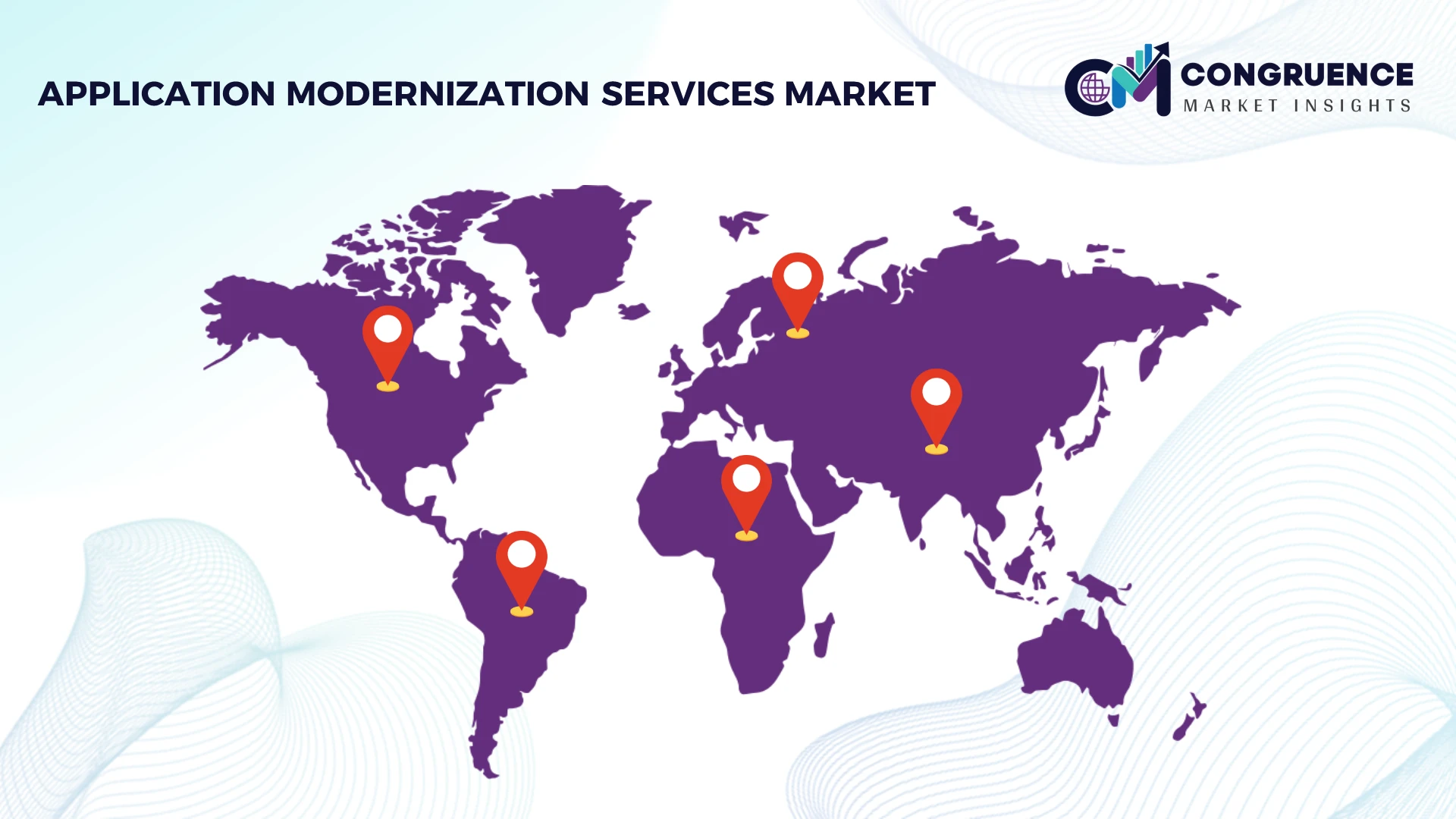
The report evaluates Application Modernization Services across types including rehosting, re-platforming, refactoring, re-architecting, re-engineering, replacement, and retirement; application environments spanning mainframe systems, cloud-native applications, and enterprise software; and end users in BFSI, healthcare, manufacturing, retail, telecommunications, and government. Regional analysis covers North America, Europe, Asia-Pacific, South America, and the Middle East and Africa, comparing global providers, cloud platforms, specialists, and regional delivery partners.
Technology coverage includes generative and agentic AI, automated code conversion, cloud migration, containers, microservices, APIs, DevSecOps, testing automation, observability, and hybrid integration. The report assesses deployment patterns, legacy complexity, security requirements, and the shift toward reusable automation. Competitive analysis supports investment screening, partner selection, regional expansion, portfolio planning, and differentiation. Its 2026–2033 outlook helps decision-makers prioritize modernization opportunities, assess delivery risks, and align capabilities with changing enterprise demand.
| Report Attribute/Metric | Report Details |
|---|---|
|
Market Revenue in 2025 |
USD 23,996.7 Million |
|
Market Revenue in 2033 |
USD 69,907.1 Million |
|
CAGR (2026 - 2033) |
14.3% |
|
Base Year |
2025 |
|
Forecast Period |
2026 - 2033 |
|
Historic Period |
2021 - 2025 |
|
Segments Covered |
By Type
By Application
By End-User
|
|
Key Report Deliverable |
Revenue Forecast, Growth Trends, Market Dynamics, Segmental Overview, Regional and Country-wise Analysis, Competition Landscape |
|
Region Covered |
North America, Europe, Asia-Pacific, South America, Middle East, Africa |
|
Key Players Analyzed |
Accenture, IBM, Capgemini, Cognizant, Infosys, Tata Consultancy Services (TCS), HCLTech, Wipro, Tech Mahindra, Kyndryl, DXC Technology, LTM (formerly LTIMindtree) |
|
Customization & Pricing |
Available on Request (10% Customization is Free) |




