
Reports
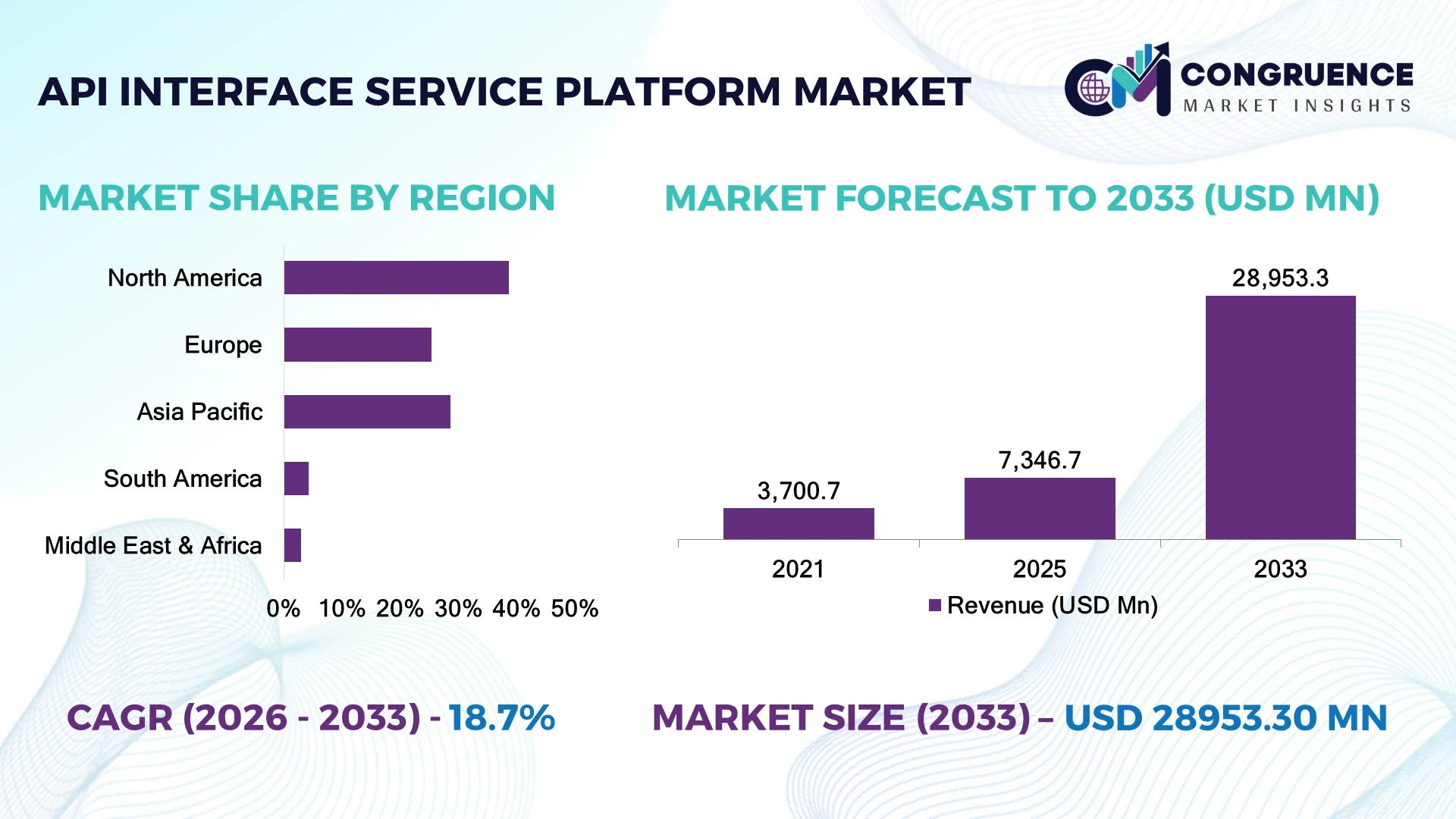
The Global API Interface Service Platform Market was valued at USD 7,346.7 Million in 2025 and is anticipated to reach a value of USD 28,953.3 Million by 2033 expanding at a CAGR of 18.7% between 2026 and 2033. Accelerating cloud-native application development, AI-powered API management, and enterprise-wide digital integration initiatives are driving large-scale deployment of API interface service platforms across financial services, healthcare, retail, and manufacturing.
The United States leads the market with approximately 39% of global platform deployment, supported by hyperscale cloud investments, mature enterprise software ecosystems, and widespread API-first development strategies. More than 74% of large enterprises have implemented centralized API management platforms, compared with lower enterprise penetration in Germany despite its strong industrial digitalization initiatives. Ongoing digital sovereignty policies and evolving cross-border data governance frameworks are further shaping platform architecture and deployment priorities.
Platform providers investing in AI-driven automation, hybrid-cloud interoperability, and enterprise-grade security are best positioned to strengthen long-term competitive advantage.
Market Size & Growth: USD 7,346.7 Million in 2025 reaches USD 28,953.3 Million by 2033 at a CAGR of 18.7%, driven by AI-enabled API lifecycle management and cloud-native modernization.
Top Growth Drivers: Multi-cloud adoption (+34%), API-first development (+31%), and enterprise automation (+27%) accelerate platform deployment.
Short-Term Forecast: By 2028, API deployment time declines nearly 35% while operational efficiency improves approximately 26%.
Emerging Technologies: AI-powered API governance, low-code integration, and event-driven architecture redefine enterprise connectivity.
Regional Leaders: North America exceeds USD 10.8 Billion, Asia-Pacific approaches USD 9.7 Billion, and Europe surpasses USD 5.9 Billion through accelerated digital infrastructure expansion.
Consumer/End-User Trends: More than 69% of large enterprises centralize API management to improve governance and security.
Pilot/Case Example: In 2026, AI-assisted API monitoring reduced incident response time by nearly 42% across enterprise integration environments.
Competitive Landscape: Top providers control approximately 46% of the market, led by Google Cloud, Microsoft, IBM, MuleSoft, and Boomi.
Regulatory & ESG Impact: Automated governance reduces compliance workloads by nearly 24% while strengthening data protection practices.
Investment & Funding: More than USD 4.5 Billion supports cloud partnerships, AI integration, and platform expansion amid global digital infrastructure investment.
Innovation & Future Outlook: Intelligent API orchestration and autonomous integration engines are becoming the primary competitive differentiators.
API Interface Service Platform adoption is accelerating across banking, healthcare, manufacturing, telecommunications, and public-sector digital transformation programs as organizations prioritize secure application connectivity and real-time data exchange. AI-assisted API governance, automated testing, and intelligent traffic management improve operational efficiency by approximately 30%, while evolving data localization requirements are encouraging hybrid-cloud deployment strategies and stronger API security architectures, setting the foundation for the broader strategic discussion.
API Interface Service Platform Market has become strategically important because enterprises increasingly compete through digital ecosystems rather than standalone applications. API-first architectures now underpin cloud migration, AI deployment, and cross-enterprise collaboration, making centralized API management essential for operational agility. At the same time, stricter data governance regulations and supply-chain digitalization are driving organizations to modernize integration infrastructure while strengthening security and compliance across distributed environments.
Modern AI-enabled API platforms automate lifecycle management, monitoring, and governance, reducing deployment effort by nearly 40% compared with legacy point-to-point integration environments while lowering maintenance workloads by approximately 28%. North America leads enterprise-scale implementation through mature cloud ecosystems, whereas Asia-Pacific is experiencing faster deployment across manufacturing, financial technology, and digital government initiatives. During the next two to three years, enterprise adoption of AI-assisted API governance is expected to exceed 60% as organizations prioritize automation and standardized integration frameworks.
A multinational financial institution deploying a unified API management platform can accelerate digital service delivery while improving regulatory compliance through centralized policy enforcement and real-time monitoring. Platform providers are expanding AI capabilities, strengthening hyperscaler partnerships, and investing in hybrid-cloud interoperability to support enterprise transformation. Organizations that combine intelligent automation, zero-trust security, and scalable API governance will establish stronger competitive positioning, improve operational resilience, and secure long-term strategic advantage within the evolving digital economy.
AI-enabled API lifecycle management and enterprise-wide integration strategies are fundamentally reshaping digital infrastructure investments. More than 72% of large enterprises now prioritize API-first architectures for new application development, while AI-assisted API governance reduces deployment time by nearly 38% and lowers manual integration workloads by approximately 27%. The United States continues expanding cloud and AI infrastructure investments, encouraging organizations to replace fragmented integration environments with centralized API platforms. This transition improves interoperability, accelerates digital service delivery, and strengthens cybersecurity governance. Platform providers are responding through AI-native product development, strategic cloud partnerships, industry-specific integration templates, and expanded developer ecosystems, creating higher switching costs while positioning API platforms as critical enterprise infrastructure rather than middleware alone.
Complex multi-cloud environments and evolving data governance regulations continue limiting seamless API platform deployment. Approximately 46% of enterprises report interoperability challenges across heterogeneous cloud infrastructures, while compliance management increases implementation costs by nearly 22%. The European Union's expanding digital governance requirements require stronger API security, identity management, and data residency controls, extending enterprise deployment timelines. These structural constraints reduce integration flexibility and increase operational overhead for organizations managing global digital ecosystems. Platform vendors are mitigating risks through localized cloud hosting, standardized API specifications, automated compliance monitoring, and strategic infrastructure partnerships, enabling enterprises to improve governance while reducing operational complexity across distributed technology environments.
Autonomous API orchestration, generative AI, and event-driven integration frameworks are creating significant opportunities beyond conventional API management. More than 61% of enterprise technology leaders are evaluating AI-assisted integration platforms, while intelligent workflow automation improves developer productivity by approximately 33% and reduces repetitive coding tasks by nearly 30%. India is strengthening its position as a global digital innovation hub through rapid enterprise software modernization and developer ecosystem expansion. Platform providers are investing in low-code integration, API marketplaces, ecosystem partnerships, and AI-powered developer assistants to create scalable digital service environments. A major strategic opportunity lies in monetizing enterprise APIs through secure ecosystem participation rather than limiting platforms to internal connectivity.
Expanding API ecosystems are increasing governance complexity, security exposure, and operational management requirements across enterprise environments. Nearly 57% of organizations operate thousands of active APIs, making lifecycle governance increasingly difficult, while unmanaged APIs account for approximately 30% of enterprise security exposure. The United States continues experiencing growing pressure to strengthen zero-trust architectures as API-based cyberattacks become more sophisticated. These execution challenges directly affect platform scalability, regulatory compliance, and service continuity. Technology providers must strengthen automated API discovery, runtime threat detection, developer governance, and enterprise-wide policy enforcement through continuous innovation, cybersecurity investment, and strategic technology partnerships to maintain long-term operational resilience.
AI-Native API Governance AI-powered API lifecycle management is becoming the enterprise standard, with automated governance improving issue detection by nearly 35% and reducing manual monitoring workloads by approximately 28%. Organizations are embedding AI into API design, testing, and policy enforcement to shorten release cycles while strengthening compliance. Platform vendors are expanding AI capabilities through cloud partnerships and intelligent automation as software engineering teams address growing development complexity.
Hybrid Cloud Integration Expansion Hybrid-cloud API deployments continue accelerating, with more than 64% of enterprise integration environments spanning multiple cloud platforms. Standardized API gateways and centralized management reduce integration effort by approximately 24% while improving application portability across distributed infrastructure. Evolving digital sovereignty regulations are encouraging localized cloud deployment strategies, prompting providers to strengthen interoperability, regional infrastructure, and secure cross-cloud connectivity.
Developer Productivity Transformation Developer experience has become a primary competitive differentiator as enterprises prioritize faster application delivery. Modern low-code integration tools reduce API development time by nearly 32%, while reusable API templates improve implementation consistency by approximately 26%. Platform providers are investing in automated documentation, self-service developer portals, certification programs, and ecosystem partnerships to accelerate onboarding and strengthen enterprise adoption.
Shift-Left API Security API security is moving earlier into software development workflows as organizations integrate automated testing before production deployment. Early-stage vulnerability detection improves remediation efficiency by approximately 34% while reducing post-deployment security incidents by nearly 21%. Platform vendors are embedding zero-trust authentication, continuous compliance monitoring, and runtime analytics directly into development pipelines, transforming API security from a compliance function into a strategic platform differentiator.
API Management Platforms accounted for approximately 41% of the API Interface Service Platform Market in 2025, maintaining leadership through centralized API lifecycle management, traffic control, security enforcement, and enterprise-scale governance. Their seamless integration with hybrid-cloud environments and microservices architectures makes them the preferred choice for large digital transformation initiatives. Integration Platform as a Service (iPaaS) solutions continue serving enterprises seeking simplified application connectivity, while API Gateway and API Analytics platforms remain strategically important for traffic optimization and performance monitoring. API Security platforms are also gaining relevance as organizations strengthen zero-trust architectures and regulatory compliance. Vendors continue enhancing AI-assisted governance, policy automation, and multi-cloud interoperability to improve operational efficiency and enterprise scalability.
API Security Platforms represent the fastest-growing segment as cyber threats and regulatory requirements increase enterprise investment in runtime protection and automated threat detection. Nearly 63% of newly deployed enterprise API environments now incorporate dedicated API security capabilities alongside centralized management platforms. API Developer Portals are also expanding as organizations prioritize developer productivity and ecosystem engagement. Companies are responding through AI-driven monitoring, strategic cloud partnerships, integrated security suites, and unified platform development, shifting investment toward intelligent API ecosystems that combine governance, security, and integration within a single enterprise platform.
According to the 2025 State of the API Report published by Postman, API-first organizations continued expanding enterprise API governance and security investments, with centralized API management becoming standard practice across large digital transformation programs.
Enterprise Application Integration accounted for approximately 37% of total market demand in 2025, supported by increasing adoption of hybrid-cloud infrastructure, distributed applications, and enterprise-wide digital transformation initiatives. Organizations continue prioritizing centralized API platforms to connect ERP, CRM, HR, and financial systems while improving operational visibility and reducing integration complexity. Cloud Integration remains another mature application as enterprises modernize legacy IT infrastructure, while Data Integration and API Lifecycle Management continue expanding with growing volumes of real-time business data. API Security Management also remains strategically significant as compliance and cyber resilience become enterprise priorities.
AI and Machine Learning Integration represents the fastest-growing application as enterprises automate workflows, intelligent decision-making, and real-time analytics. More than 58% of enterprise AI deployments now rely on API-driven integration to exchange structured data across cloud applications and AI models. Partner Ecosystem Management is also expanding as organizations monetize APIs and strengthen digital collaboration with suppliers and developers. Platform providers are investing in AI-enabled orchestration, low-code integration capabilities, and intelligent automation to improve deployment speed while supporting increasingly complex enterprise digital ecosystems.
Enterprise technology findings released during 2026 by the Cloud Native Computing Foundation highlighted continued expansion of cloud-native application architectures, reinforcing API-based integration as a foundational capability for modern enterprise software deployment.
Large Enterprises accounted for approximately 69% of total platform deployment in 2025 due to complex IT infrastructures, extensive application portfolios, and higher API transaction volumes. These organizations require enterprise-grade governance, security, monitoring, and multi-cloud integration capabilities to support digital business operations at scale. Banking, financial services, healthcare, manufacturing, and telecommunications continue representing the highest-value enterprise deployments because of stringent regulatory requirements and mission-critical application environments. Platform vendors continue supporting this segment through customized deployment models, AI-powered governance, premium support services, and strategic cloud partnerships.
Small and Medium-Sized Enterprises (SMEs) represent the fastest-growing end-user segment as cloud-native platforms, subscription pricing, and low-code integration significantly reduce implementation barriers. Nearly 54% of newly onboarded API platform customers are mid-sized organizations seeking faster digital transformation without extensive infrastructure investments. Government agencies and public sector organizations are also expanding adoption through digital service modernization initiatives. Companies are strengthening this segment through scalable SaaS offerings, flexible pricing models, developer ecosystems, and industry-specific solution packages that improve accessibility while expanding long-term customer acquisition.
According to the 2025 Enterprise Cloud Index published by Nutanix, organizations continued increasing investments in cloud-native applications and API-enabled integration platforms, reinforcing enterprise-wide demand for centralized API management and hybrid-cloud connectivity.
North America accounted for the largest market share at 38.7% in 2025 however, Asia-Pacific is expected to register the fastest growth, expanding at a CAGR of 21.3% between 2026 and 2033.
Enterprise cloud modernization strengthens platform leadership
North America accounted for approximately 38.7% of the global API Interface Service Platform Market in 2025, supported by mature cloud infrastructure, high enterprise software adoption, and the presence of leading hyperscale cloud providers. Financial services, healthcare, retail, and technology enterprises continue accelerating API-first digital transformation to improve application interoperability and real-time data exchange. More than 74% of large enterprises have implemented centralized API management platforms, while AI-enabled API governance has become a standard feature across premium enterprise deployments. Platform providers continue expanding cloud partnerships, developer ecosystems, and managed integration services to strengthen customer retention. Growing investment in zero-trust cybersecurity and hybrid-cloud infrastructure continues reinforcing North America's leadership in enterprise API platform deployment.
United States Market Outlook: The United States remains the largest country-level market owing to its advanced cloud ecosystem, strong enterprise software sector, and large concentration of digital-native businesses. More than 76% of Fortune 500 organizations operate API-first integration strategies supporting cloud applications, AI workloads, and digital customer services. Technology providers continue investing in AI-powered API governance, developer platforms, and enterprise integration capabilities while strengthening strategic partnerships with hyperscale cloud providers to accelerate innovation and large-scale platform adoption.
Digital sovereignty reshapes enterprise integration strategies
Europe represented approximately 25.4% of the global market in 2025, driven by accelerating cloud modernization and evolving digital governance frameworks. Organizations increasingly deploy API interface service platforms to improve interoperability across financial services, manufacturing, healthcare, and public-sector applications while maintaining compliance with strict data protection requirements. Nearly 58% of enterprise cloud modernization projects now include centralized API governance as a core deployment requirement. Platform vendors continue strengthening localized cloud infrastructure, compliance automation, and regional partnerships to support secure cross-border enterprise integration while improving operational efficiency.
Germany Market Outlook: Germany leads the European market through its strong industrial digitalization initiatives, advanced manufacturing ecosystem, and enterprise software investments. Large industrial organizations continue integrating API platforms with Industry 4.0 applications, ERP environments, and industrial IoT infrastructure. More than 61% of enterprise digital transformation projects now incorporate API-led integration, encouraging providers to expand localized cloud services, cybersecurity capabilities, and industrial technology partnerships across the country.
Digital transformation and developer ecosystems drive deployment scale
Asia-Pacific accounted for approximately 28.6% of the global market in 2025 and remains the fastest-expanding regional market due to rapid enterprise cloud adoption, expanding software development ecosystems, and government-backed digital transformation initiatives. India, China, Japan, and Singapore continue strengthening enterprise API adoption across banking, telecommunications, manufacturing, and e-commerce sectors. More than 67% of newly deployed cloud-native enterprise applications utilize API-first architectures, while regional investments in digital infrastructure continue supporting large-scale platform deployment. Technology providers are expanding cloud regions, developer communities, and AI-enabled integration services to strengthen long-term market penetration.
India Market Outlook: India has emerged as the region's fastest-growing enterprise integration hub due to its expanding SaaS ecosystem, large software engineering workforce, and rapid cloud adoption. Financial institutions, digital commerce platforms, and public digital infrastructure initiatives increasingly depend on API platforms to enable secure service integration. More than 65% of new enterprise software deployments are designed using API-first principles, encouraging global platform providers to expand local cloud infrastructure, innovation centers, and developer enablement programs.
Financial sector digitalization accelerates API deployment
South America accounted for approximately 4.3% of global market activity in 2025, supported by increasing cloud adoption, digital banking expansion, and modernization of enterprise IT infrastructure. Financial institutions, retail companies, and telecommunications providers continue adopting API interface service platforms to improve customer engagement and application connectivity. Nearly 46% of enterprise cloud modernization initiatives now incorporate centralized API management capabilities. Although infrastructure maturity varies across countries, platform vendors are strengthening regional cloud partnerships, technical support networks, and managed integration services to improve deployment consistency and enterprise adoption.
Brazil Market Outlook: Brazil represents the largest regional market due to its rapidly expanding fintech ecosystem, strong enterprise cloud adoption, and continued investment in digital financial services. Open finance initiatives have accelerated API deployment across banking institutions, while large enterprises continue modernizing legacy integration environments. Global platform vendors are expanding local cloud availability, implementation partnerships, and developer support services to strengthen long-term enterprise adoption and operational scalability.
Government-led digital infrastructure transforms enterprise connectivity
The Middle East & Africa accounted for approximately 3.0% of the global market in 2025, with growth supported by national digital transformation strategies, expanding cloud infrastructure, and increasing enterprise software investments. Banking, government services, telecommunications, and smart city initiatives continue driving API platform deployment across the region. Nearly 43% of large digital modernization programs now incorporate centralized API management to improve interoperability between public and private digital services. Technology providers are expanding regional cloud infrastructure, cybersecurity partnerships, and enterprise integration capabilities to support secure digital transformation.
United Arab Emirates Market Outlook: The United Arab Emirates leads regional adoption through extensive smart government initiatives, advanced cloud infrastructure, and strong enterprise digitalization programs. Financial institutions, aviation, logistics, and public-sector organizations continue investing in API-first architectures to improve service integration and operational efficiency. More than 60% of large enterprise digital transformation projects incorporate centralized API governance, encouraging international platform providers to strengthen regional cloud operations, innovation partnerships, and managed API service capabilities.
Global cloud leaders including Google Cloud, IBM, Boomi, Software AG, and Kong compete directly with enterprise integration specialists such as WSO2 and Tyk, while hyperscale-native platforms challenge independent API vendors through ecosystem integration and AI capabilities. The top five providers collectively account for approximately 46% of the global market, creating a moderately consolidated competitive environment. Competition increasingly centers on AI-enabled governance, hybrid-cloud interoperability, deployment speed, and developer experience rather than gateway functionality alone. AI-assisted API lifecycle management improves deployment efficiency by nearly 35%, while standardized integration frameworks reduce implementation effort by approximately 24% and automated governance lowers operational workloads by 28%. Companies compete through cloud partnerships, platform acquisitions, API security innovation, and vertical integration across integration, analytics, and developer services. The competitive shift favors intelligent API ecosystems over standalone management tools, while enterprise trust and regulatory compliance remain key entry barriers. Winning requires scalable AI-native platforms, strong ecosystem partnerships, and enterprise-grade security.
Google Cloud
IBM
Boomi
Software AG
Kong Inc.
WSO2 LLC
Tyk Technologies
Gravitee
Axway
Oracle Corporation
Broadcom Inc.
SAP SE
Artificial intelligence, event-driven integration, and cloud-native API orchestration are redefining enterprise connectivity. AI-powered API lifecycle management improves deployment efficiency by approximately 35% while reducing manual governance effort by nearly 28%. More than 68% of enterprise API programs now integrate automated monitoring, policy enforcement, and intelligent traffic analysis to strengthen operational resilience. These capabilities enable faster digital service delivery while improving regulatory compliance and developer productivity across distributed application environments.
Emerging technologies including generative AI, Model Context Protocol (MCP), low-code integration, and event-driven architecture are replacing conventional point-to-point integration models. Modern API platforms improve deployment speed by nearly 40% compared with legacy middleware while lowering integration maintenance costs by approximately 25%. Hyperscale cloud providers and AI-native platform vendors benefit most because unified ecosystems simplify multi-cloud management, strengthen API monetization, and accelerate enterprise adoption through intelligent automation and integrated security controls.
Between 2026 and 2028, autonomous API governance, agentic AI integration, and policy-driven orchestration will reshape enterprise platform strategies. Connected API ecosystems are expected to exceed 60% adoption among large organizations as digital businesses standardize API-first architectures. Companies investing now in AI-assisted governance, zero-trust security, API observability, and hybrid-cloud interoperability will establish stronger competitive positioning, faster innovation cycles, and sustainable operational advantages as enterprise integration evolves beyond traditional API management.
October 2024 Google Cloud announced Gemini Code Assist integration for Apigee API Management, enabling automated OpenAPI specification generation and API development acceleration through enterprise AI assistance. Business impact: improves developer productivity and accelerates API delivery across enterprise environments. Source: Google Cloud Blog
December 2025 Google Cloud introduced Model Context Protocol (MCP) support within Apigee API Hub, enabling centralized registration and lifecycle management of MCP APIs and associated AI tools. Business impact: strengthens enterprise AI governance and API ecosystem management. Source: Google Cloud Documentation
March 2026 Google Cloud announced the general availability of Model Context Protocol (MCP) support in Apigee, allowing APIs to be exposed directly as MCP tools for agentic AI applications. Business impact: expands enterprise AI integration capabilities without additional infrastructure. Source: Google Cloud Documentation
May 2026 Boomi expanded its API Management platform by introducing the MCP Registry and enhanced API Control Plane capabilities supporting discovery across multiple gateway technologies. Business impact: improves multi-platform API governance and enterprise AI readiness. Source: API Management Release Notes
The report provides comprehensive analysis of the API Interface Service Platform Market across API Management Platforms, Integration Platform as a Service (iPaaS), API Gateway, API Security, API Analytics, and Developer Portal solutions. It evaluates deployment across enterprise integration, cloud integration, API lifecycle management, AI and machine learning integration, data integration, partner ecosystem management, and security management while assessing adoption by large enterprises, SMEs, and public-sector organizations. Regional coverage includes North America, Europe, Asia-Pacific, South America, and the Middle East & Africa.
The study examines enterprise deployment trends, AI-native platform evolution, hybrid-cloud integration strategies, API security architectures, developer ecosystem expansion, and intelligent automation. It profiles leading technology providers, evaluates platform differentiation, and analyzes operational benchmarks, deployment patterns, and competitive positioning. Strategic insights support technology investment decisions, product development, geographic expansion, partnership evaluation, digital transformation planning, and identification of high-growth enterprise opportunities expected to shape the market between 2026 and 2033.
| Report Attribute/Metric | Report Details |
|---|---|
|
Market Revenue in 2025 |
USD 7,346.7 Million |
|
Market Revenue in 2033 |
USD 28,953.3 Million |
|
CAGR (2026 - 2033) |
18.7% |
|
Base Year |
2025 |
|
Forecast Period |
2026 - 2033 |
|
Historic Period |
2021 - 2025 |
|
Segments Covered |
By Type
By Application
By End-User
|
|
Key Report Deliverable |
Revenue Forecast, Growth Trends, Market Dynamics, Segmental Overview, Regional and Country-wise Analysis, Competition Landscape |
|
Region Covered |
North America, Europe, Asia-Pacific, South America, Middle East, Africa |
|
Key Players Analyzed |
Google Cloud, IBM, Boomi, Software AG, Kong Inc., WSO2 LLC, Tyk Technologies, Gravitee, Axway, Oracle Corporation, Broadcom Inc., SAP SE |
|
Customization & Pricing |
Available on Request (10% Customization is Free) |




