
Reports
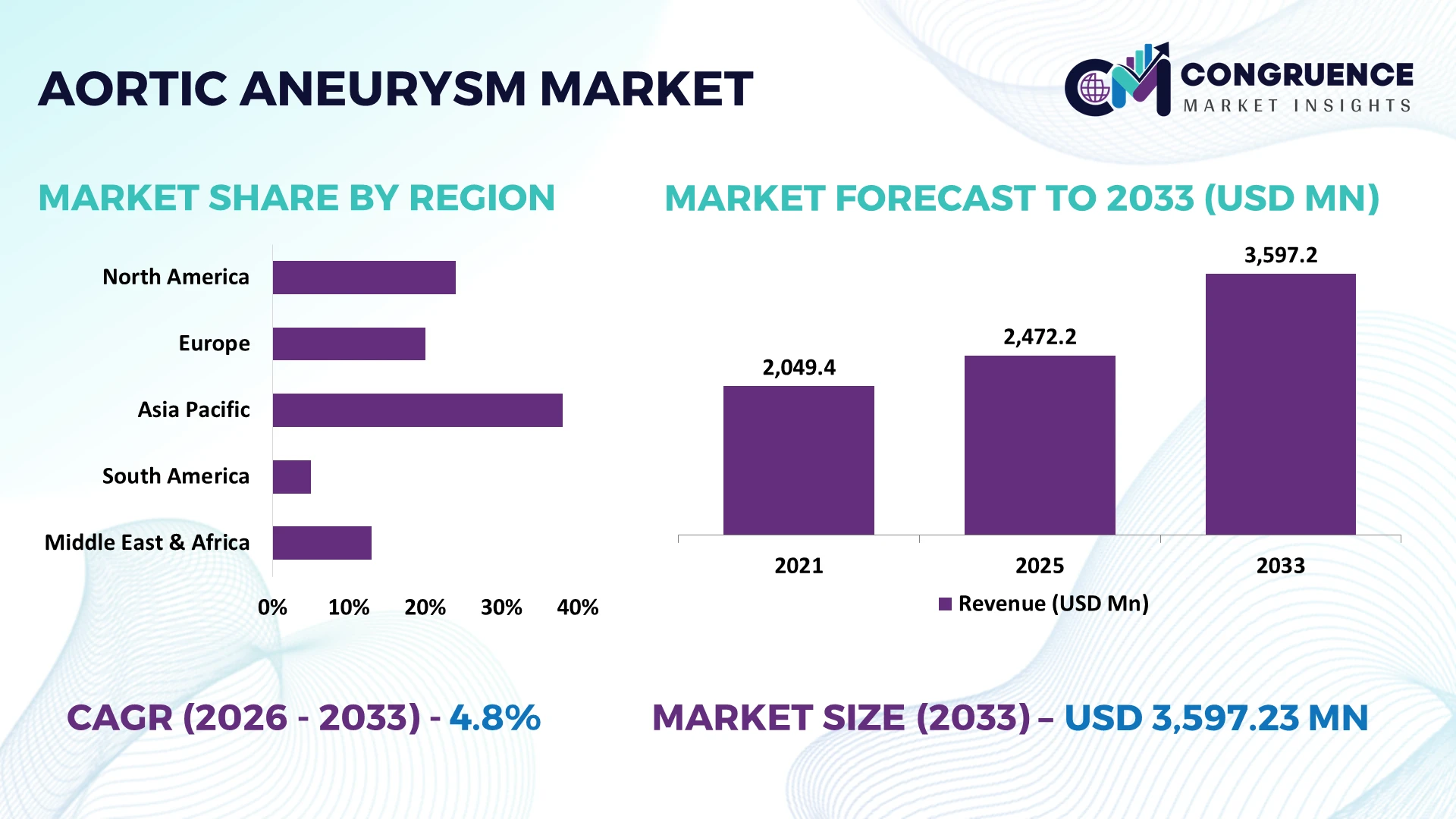
The Global Aortic Aneurysm Market was valued at USD 2472.17 Million in 2025 and is anticipated to reach a value of USD 3597.23 Million by 2033 expanding at a CAGR of 4.8% between 2026 and 2033. Growth is driven by rising adoption of minimally invasive endovascular aneurysm repair (EVAR), broader vascular screening programs, advanced imaging integration, and continuous innovation in stent graft technologies that improve procedural precision and long-term patient outcomes.
The United States leads the global Aortic Aneurysm Market with approximately 38% of advanced endovascular procedure volume, supported by robust cardiovascular care infrastructure, sustained medical technology investments, and widespread use of hybrid operating rooms. Germany follows with nearly 9% share, benefiting from strong vascular surgery expertise and high adoption of image-guided interventions. Continued healthcare resilience despite global medical supply chain realignment and geopolitical trade adjustments has strengthened procedural capacity and technology deployment across leading markets.
Strategic investment should prioritize technologically advanced treatment platforms and high-capacity healthcare systems where clinical adoption continues to accelerate.
Market Size & Growth: USD 2472.17 Million (2025) to USD 3597.23 Million (2033) at 4.8% CAGR, supported by advanced endovascular repair technologies and expanded vascular screening programs.
Top Growth Drivers: EVAR procedures exceed 70% of eligible repairs, AI-assisted imaging improves diagnostic accuracy by 18%, and aging populations continue expanding the treatment pool.
Short-Term Forecast: By 2028, hospital procedural efficiency improves by 15% through digital workflow integration and optimized operating room planning.
Emerging Technologies: AI imaging, next-generation stent grafts, and robotic-assisted vascular interventions enhance procedural precision and reduce treatment complexity.
Regional Leaders: North America surpasses USD 1.35 Billion, Europe exceeds USD 0.95 Billion, and Asia-Pacific reaches USD 0.78 Billion, driven by expanding specialty vascular centers.
Consumer/End-User Trends: More than 65% of complex aneurysm interventions increasingly utilize minimally invasive approaches, reducing hospital stay and recovery time.
Pilot/Case Example: A 2025 hospital vascular modernization program improved procedure planning efficiency by 22% through AI-enabled imaging workflows.
Competitive Landscape: Leading manufacturers collectively account for approximately 55% market share, with Medtronic, Cook Medical, Terumo Aortic, W. L. Gore & Associates, and Endologix maintaining strong portfolios.
Regulatory & ESG Impact: Digital quality monitoring and device traceability programs improve post-market surveillance efficiency by approximately 20% across regulated healthcare systems.
Investment & Funding: More than USD 900 Million supports manufacturing expansion, strategic partnerships, and next-generation vascular device development amid regional supply chain diversification.
Innovation & Future Outlook: Personalized stent graft design, AI-assisted treatment planning, and digital vascular platforms strengthen long-term competitiveness across high-growth healthcare markets.
The Aortic Aneurysm Market is advancing through stronger demand for minimally invasive vascular procedures, AI-enabled diagnostic imaging, and customized endovascular devices that improve procedural precision. More than 60% of leading healthcare institutions continue expanding digital cardiovascular workflows, while regional manufacturing diversification enhances device availability amid evolving regulatory and operational requirements, creating a stronger foundation for the strategic market assessment that follows.
The Aortic Aneurysm Market has become strategically important as healthcare systems prioritize early vascular intervention, value-based care, and minimally invasive treatment pathways to reduce long-term clinical costs. Competition increasingly centers on integrated device portfolios, AI-enabled imaging platforms, and physician training ecosystems rather than standalone products. Ongoing medical supply-chain restructuring and stricter device traceability regulations are encouraging manufacturers to diversify production while strengthening regional manufacturing resilience and inventory planning.
Technology differentiation is accelerating market transformation. Contemporary endovascular aneurysm repair systems reduce average hospital stays by nearly 35% compared with conventional open surgery while lowering perioperative complications through image-guided precision and advanced stent graft deployment. The United States continues leading clinical adoption through extensive hybrid operating room infrastructure, whereas Japan emphasizes next-generation imaging integration and standardized screening protocols to improve procedural consistency. Digital planning software is increasingly shortening preoperative workflow by approximately 20%, enabling hospitals to optimize specialist utilization and operating room scheduling.
Over the next two to three years, hospitals are expected to expand AI-assisted vascular planning and remote multidisciplinary case reviews as procedural volumes increase. Manufacturers are responding through localized production, strategic partnerships with cardiovascular centers, and investments in customized stent graft platforms. A practical example includes integrated imaging-guided EVAR programs that streamline treatment decisions while improving resource allocation. Organizations combining technological innovation with scalable clinical support networks will secure stronger competitive positioning and long-term operational advantage.
Growing preference for endovascular aneurysm repair is reshaping treatment pathways, with minimally invasive procedures representing more than 70% of eligible abdominal aortic aneurysm interventions in advanced healthcare systems. AI-assisted imaging improves anatomical assessment accuracy by nearly 18%, while enhanced recovery protocols reduce average hospitalization by approximately 30%. The United States continues expanding hybrid operating room capacity as hospitals modernize cardiovascular infrastructure and align with evolving quality standards. These improvements increase procedural throughput and physician confidence. In response, leading manufacturers are expanding production capacity, strengthening hospital partnerships, and accelerating innovation in low-profile stent graft systems, creating a durable operational advantage through broader clinical applicability and faster treatment workflows.
Advanced endovascular devices remain associated with procurement costs that are typically 20–30% higher than conventional surgical alternatives, limiting adoption across cost-sensitive healthcare systems. Around 40% of secondary hospitals in developing economies still lack dedicated hybrid operating facilities required for complex aneurysm interventions. Ongoing dependence on specialized imported vascular devices also exposes procurement cycles to international logistics disruptions and component availability pressures. These structural limitations constrain deployment consistency and delay treatment expansion. Manufacturers are reducing operational risk by localizing selected production processes, negotiating long-term procurement agreements with healthcare providers, and broadening regional distribution networks to improve supply reliability and purchasing efficiency.
Personalized vascular treatment supported by artificial intelligence and advanced imaging creates significant opportunities beyond conventional device sales. AI-assisted procedural planning reduces treatment preparation time by approximately 20%, while patient-specific stent graft customization improves anatomical suitability for complex aneurysms by nearly 15%. China is increasing investment in digital hospital infrastructure, accelerating adoption of intelligent cardiovascular planning platforms across leading medical centers. Companies are expanding research collaborations with imaging software developers and cardiovascular institutions while integrating cloud-based clinical planning ecosystems. This shift enables differentiated service models, stronger physician engagement, and recurring digital healthcare value beyond traditional hardware-focused competition.
Sustained market expansion depends on the availability of skilled vascular specialists, integrated imaging systems, and standardized clinical workflows rather than device availability alone. Nearly 25% of healthcare facilities performing vascular procedures continue facing specialist workforce shortages, while advanced imaging integration can extend implementation timelines by over 20% during hospital modernization projects. Germany and other mature healthcare markets continue investing in multidisciplinary vascular centers to improve procedural consistency and long-term patient management. Companies must strengthen physician training, digital simulation platforms, and collaborative clinical education partnerships to ensure scalable deployment, maintain treatment quality, and preserve competitive differentiation as procedural complexity continues to increase.
Advanced Imaging Workflow Integration: Hospitals are integrating AI-assisted vascular imaging with 3D procedural planning, reducing preoperative planning time by nearly 20% while improving anatomical assessment accuracy by around 18%. Updated clinical documentation requirements and digital workflow modernization are accelerating deployment. Device manufacturers are expanding software partnerships and embedding planning platforms into endovascular treatment ecosystems to improve procedural consistency and operating room utilization.
Localized Device Manufacturing Expansion: Supply-chain diversification has become a strategic priority as manufacturers shift 25–30% of selected production and component sourcing closer to major healthcare markets. This restructuring shortens delivery cycles by approximately 15% and improves inventory resilience during logistics disruptions. Companies are establishing regional manufacturing partnerships, strengthening supplier qualification programs, and expanding localized service capabilities to ensure uninterrupted vascular device availability.
Customized Stent Graft Development: Patient-specific endovascular solutions are gaining traction, with customized graft utilization increasing by nearly 16% for anatomically complex aneurysms while procedural adjustments decline by approximately 12%. Advances in digital design and precision manufacturing are improving treatment planning. Manufacturers are investing in modular product platforms, collaborative clinical development, and physician training to accelerate adoption across specialized cardiovascular centers.
Hybrid Vascular Center Expansion: Healthcare providers continue expanding hybrid operating facilities, increasing integrated cardiovascular procedure capacity by approximately 22% while multidisciplinary vascular teams improve workflow efficiency by nearly 17%. Workforce specialization and complex case management are driving this transition. Companies are responding through long-term hospital collaborations, advanced imaging integration, and comprehensive procedural support services that strengthen clinical performance and customer retention.
Abdominal aneurysms account for approximately 62% of the Aortic Aneurysm Market due to higher disease prevalence, well-established screening programs, and broad compatibility with endovascular repair techniques. Their clinical scalability, lower procedural complexity, and shorter recovery periods continue to support widespread adoption across tertiary hospitals. Thoracic aneurysms remain a strategically important segment for specialized cardiovascular centers, where advanced imaging and hybrid surgical capabilities enable effective management of anatomically challenging cases.
Thoracoabdominal aneurysms are the fastest-growing type, with adoption increasing by nearly 14% as branched and fenestrated stent graft technologies improve treatment options for complex anatomy. Manufacturers are expanding product portfolios, strengthening physician training, and collaborating with specialized vascular centers to accelerate deployment. Investment priorities are increasingly shifting toward customized devices that improve procedural precision, reduce intervention complexity, and expand patient eligibility without compromising long-term clinical outcomes.
Endovascular Repair represents the leading application with approximately 56% market share, driven by lower perioperative risk, reduced hospital stays, and greater procedural efficiency than conventional open surgery. Diagnostic imaging remains fundamental to treatment planning, with CT angiography and vascular ultrasound enabling earlier aneurysm detection and more accurate intervention strategies across advanced healthcare facilities.
Postoperative Monitoring is the fastest-growing application, expanding at an estimated 16% annual adoption rate as hospitals integrate remote monitoring platforms, digital imaging follow-up, and standardized surveillance protocols. Open Surgery continues to serve patients with anatomically unsuitable cases, maintaining its strategic importance despite slower procedural growth. Companies are investing in AI-enabled imaging integration, digital follow-up platforms, and hospital partnerships to improve long-term patient outcomes while optimizing operational efficiency.
Hospitals account for approximately 58% of end-user demand because of their comprehensive vascular infrastructure, hybrid operating rooms, multidisciplinary cardiovascular teams, and emergency treatment capabilities. Their ability to perform complex aneurysm procedures and manage postoperative care continues to concentrate high-value clinical activity. Cardiac Centers maintain a strong position by providing specialized expertise and advanced endovascular treatment for complex vascular conditions.
Ambulatory Surgical Centers are the fastest-growing end-user segment, with adoption rising by approximately 15% as minimally invasive procedures become increasingly standardized and operationally efficient. Specialty Clinics continue expanding their role in aneurysm diagnosis, patient surveillance, and referral management, strengthening integrated care pathways. Manufacturers are responding through customized device portfolios, physician education initiatives, strategic partnerships, and service-based support models tailored to each healthcare setting.
North America accounted for the largest market share at 41% in 2025 however, Asia-Pacific is expected to register the fastest growth, expanding at a CAGR of 6.2% between 2026 and 2033.
Advanced Vascular Infrastructure Sustains Market Leadership
North America remains the largest regional market due to its extensive cardiovascular care infrastructure, widespread adoption of endovascular aneurysm repair, and strong integration of AI-assisted imaging platforms. The region contributes approximately 41% of global demand, supported by high screening rates and well-established reimbursement systems. More than 75% of eligible aneurysm procedures are performed using minimally invasive techniques across leading healthcare institutions. Continuous investment in hybrid operating rooms and digital surgical planning has improved procedural efficiency by nearly 18%. Medical device manufacturers are strengthening partnerships with hospital networks while expanding physician education programs and localized technical support, reinforcing clinical standardization and accelerating deployment of next-generation vascular technologies.
United States Market Outlook: The United States dominates the regional market through its concentration of advanced cardiovascular centers, strong medical device innovation ecosystem, and broad adoption of digital vascular planning technologies. More than 80% of tertiary hospitals performing complex aneurysm interventions utilize hybrid operating suites, while increasing investment in AI-enabled imaging and customized stent graft platforms continues improving procedural precision, operational efficiency, and long-term patient management across integrated healthcare systems.
Clinical Standardization Accelerates Treatment Efficiency
Europe maintains a strong position through standardized vascular treatment pathways, high clinical expertise, and widespread adoption of advanced endovascular procedures. The region accounts for approximately 29% of global market activity, supported by established screening programs and coordinated cardiovascular care networks. Hybrid operating room capacity has expanded by nearly 15% across major healthcare systems, improving procedural scheduling and multidisciplinary collaboration. Regulatory alignment has encouraged broader implementation of digital device traceability and structured post-treatment surveillance. Manufacturers continue expanding regional partnerships with university hospitals and vascular research centers while investing in physician training and advanced stent graft technologies to strengthen long-term clinical outcomes.
Germany Market Outlook: Germany leads the European market through its advanced hospital infrastructure, highly specialized vascular surgery centers, and strong medical technology manufacturing base. Nearly 70% of complex aneurysm procedures are concentrated within certified cardiovascular institutions, while continuous investment in image-guided intervention systems and multidisciplinary treatment models supports high procedural quality and sustained innovation across the vascular care ecosystem.
Healthcare Expansion Drives Rapid Deployment
Asia-Pacific is emerging as the fastest-expanding regional market, supported by healthcare infrastructure modernization, rising cardiovascular disease awareness, and increasing availability of advanced vascular procedures. The region represents approximately 22% of global demand, with major healthcare providers expanding hybrid operating facilities and specialist vascular centers. Hospital investments have increased advanced imaging deployment by nearly 20%, improving diagnosis and treatment planning. Growing domestic production of cardiovascular devices is strengthening supply resilience and reducing procurement timelines. Companies are expanding manufacturing capacity, forming strategic partnerships with tertiary hospitals, and increasing physician training initiatives to accelerate adoption across rapidly developing healthcare systems.
China Market Outlook: China is strengthening its leadership through extensive hospital modernization, domestic medical device manufacturing expansion, and accelerated digital healthcare adoption. More than 60% of leading cardiovascular hospitals have integrated advanced imaging platforms into vascular intervention workflows, while national investment in specialized cardiovascular care continues expanding access to minimally invasive aneurysm treatment and supporting local innovation capabilities.
Healthcare Modernization Supports Specialized Care
South America is experiencing steady market development through improving cardiovascular healthcare infrastructure and greater access to specialized vascular treatment. The region contributes approximately 5% of global demand, with public and private hospitals expanding advanced diagnostic capabilities and endovascular procedure availability. Hybrid cardiovascular facilities have increased by nearly 12% across leading metropolitan healthcare networks, improving treatment accessibility for complex aneurysm cases. Budget limitations and uneven specialist distribution remain operational challenges, encouraging manufacturers to strengthen regional distribution partnerships, physician education programs, and technical support services to improve deployment consistency.
Brazil Market Outlook: Brazil represents the region's largest market due to its extensive hospital network, growing cardiovascular specialist base, and increasing investment in minimally invasive vascular procedures. Large urban healthcare institutions continue expanding hybrid operating capabilities, while collaborative initiatives between healthcare providers and medical technology companies improve physician training and broaden access to advanced aneurysm treatment solutions.
Strategic Healthcare Investment Reshapes Capacity
The Middle East & Africa market is advancing through healthcare modernization initiatives, expanding specialist cardiovascular services, and increased investment in advanced medical infrastructure. The region accounts for approximately 3% of global demand, with major healthcare providers strengthening vascular surgery capabilities and integrating advanced imaging technologies. New tertiary healthcare projects have increased specialized cardiovascular treatment capacity by nearly 14%, supporting improved patient access. International partnerships and medical technology procurement programs continue strengthening clinical capabilities while enhancing long-term healthcare resilience. Companies are prioritizing regional distribution, clinical education, and strategic collaborations with major healthcare institutions to improve operational readiness.
Saudi Arabia Market Outlook: Saudi Arabia leads regional development through sustained healthcare investment, rapid hospital modernization, and adoption of advanced cardiovascular technologies under national healthcare transformation initiatives. More than 65% of complex vascular interventions are concentrated within major tertiary hospitals, while continued expansion of specialized cardiac centers and digital clinical infrastructure supports broader deployment of advanced aneurysm treatment pathways.
The Aortic Aneurysm Market is led by Medtronic, W. L. Gore & Associates, Cook Medical, Terumo Aortic, and Endologix, with these global technology leaders competing directly against regional vascular device manufacturers focused on value-driven procurement and localized supply. The top five companies collectively control approximately 68% of the market through broad endovascular portfolios, clinical evidence, and hospital relationships. Competition is increasingly based on stent graft innovation, imaging compatibility, procedural customization, and manufacturing resilience rather than price alone. AI-assisted planning platforms improve procedural efficiency by nearly 18%, while low-profile delivery systems reduce procedure time by approximately 15%, creating measurable clinical advantages. Companies are strengthening competitive positions through manufacturing expansion, strategic hospital partnerships, physician training, and vertical integration across design, production, and post-procedure support. The competitive landscape is shifting toward integrated vascular ecosystems where digital planning and customized devices outperform conventional offerings. Regulatory validation, long clinical qualification cycles, and specialist physician adoption remain significant entry barriers. Sustained leadership requires continuous innovation, reliable supply chains, strong clinical evidence, and comprehensive hospital support capabilities.
Medtronic
W. L. Gore & Associates
Cook Medical
Terumo Aortic
Endologix
MicroPort Scientific Corporation
Artivion, Inc.
Bentley Innomed GmbH
JOTEC GmbH
Cordis
Lombard Medical
Braile Biomédica
Lifetech Scientific Corporation
Artificial intelligence, advanced endovascular devices, and high-resolution imaging are redefining aneurysm diagnosis and intervention. AI-assisted imaging improves anatomical assessment accuracy by approximately 18% while reducing preoperative planning time by nearly 20%. More than 60% of leading cardiovascular centers now integrate three-dimensional imaging into treatment planning, enabling physicians to select patient-specific devices with greater precision. These technologies improve operating room efficiency, reduce workflow variation, and strengthen procedural consistency across multidisciplinary vascular teams.
Next-generation branched and fenestrated stent grafts are replacing conventional device designs for anatomically complex aneurysms. Compared with earlier-generation systems, modern low-profile delivery platforms shorten procedure time by approximately 15% and reduce access-related complications by nearly 12%. Manufacturers integrating digital planning software with customized implant design gain stronger competitive differentiation because hospitals increasingly prioritize complete procedural ecosystems instead of standalone devices. Cloud-enabled clinical collaboration platforms further accelerate multidisciplinary treatment decisions and improve specialist coordination across healthcare networks.
Between 2026 and 2028, digital twins, predictive procedural simulation, and AI-guided intraoperative navigation are expected to become standard capabilities within advanced vascular programs. Companies investing in software-device integration, automated manufacturing, and data-driven clinical support will improve deployment speed, optimize physician adoption, and strengthen long-term competitive positioning as healthcare providers increasingly demand integrated, technology-enabled treatment platforms instead of conventional hardware-focused solutions.
August 2024 Terumo India launched the TREO® Abdominal Stent-Graft System for endovascular aneurysm repair, introducing dual active fixation technology for complex anatomies. The platform supports treatment across multiple anatomical configurations, improving procedural flexibility and expanding advanced EVAR adoption in India. Source: Terumo India
October 2025 Terumo Aortic partnered with Bentley to conduct a U.S. clinical study combining the Fenestrated TREO® device with the BeFlared FEVAR bridging stent system. The customized platform supports up to five fenestrations, strengthening treatment options for complex abdominal aneurysms and advancing FDA clinical development. Source: Terumo Aortic
January 2026 Terumo Aortic initiated the RapidLink™ pivotal IDE study across the United States and Europe, targeting enrollment of up to 150 patients at 30 clinical centers. The study strengthens evidence generation while accelerating adoption of simplified hybrid aortic arch repair technologies. Source: Terumo
March 2025 Medtronic highlighted continued expansion of its ADVANCE randomized EVAR clinical trial comparing Endurant™ II/IIs with competing endovascular systems to improve aneurysm sac regression outcomes. The study evaluates one-year procedural performance, reinforcing evidence-based technology differentiation in advanced aortic repair. Source: Medtronic
This report provides a comprehensive assessment of the Aortic Aneurysm Market across abdominal, thoracic, and thoracoabdominal aneurysms, covering diagnosis, open surgery, endovascular repair, and postoperative monitoring. It evaluates demand across hospitals, cardiac centers, ambulatory surgical centers, and specialty clinics while analyzing deployment trends across North America, Europe, Asia-Pacific, South America, and the Middle East & Africa. More than 60% of advanced treatment activity is concentrated in minimally invasive endovascular procedures, reflecting the industry's ongoing technological transition.
The report examines competitive positioning, technology adoption, AI-enabled imaging integration, customized stent graft innovation, and digital vascular planning between 2026 and 2033. It also evaluates company strategies including manufacturing expansion, strategic partnerships, clinical ecosystem development, and product innovation. The analysis supports investment prioritization, regional expansion planning, portfolio optimization, supply-chain decision-making, and competitive benchmarking while identifying emerging treatment segments and operational opportunities across evolving global cardiovascular healthcare systems.
| Report Attribute/Metric | Report Details |
|---|---|
Market Revenue in 2025 | USD 2472.17 Million |
Market Revenue in 2033 | USD 3597.23 Million |
CAGR (2026 - 2033) | 4.8% |
Base Year | 2025 |
Forecast Period | 2026 - 2033 |
Historic Period | 2021 - 2025 |
Segments Covered | By Type
By Application
By End-User
|
Key Report Deliverable | Revenue Forecast, Growth Trends, Market Dynamics, Segmental Overview, Regional and Country-wise Analysis, Competition Landscape |
Region Covered | North America, Europe, Asia-Pacific, South America, Middle East, Africa |
Key Players Analyzed | Medtronic, W. L. Gore & Associates, Cook Medical, Terumo Aortic, Endologix, MicroPort Scientific Corporation, Artivion, Inc., Bentley Innomed GmbH, JOTEC GmbH, Cordis, Lombard Medical, Braile Biomédica, Lifetech Scientific Corporation |
Customization & Pricing | Available on Request (10% Customization is Free) |




