
Reports
The Global Anti-obesity Drugs Market was valued at USD 33,898.1 Million in 2025 and is anticipated to reach a value of USD 147,710.4 Million by 2033 expanding at a CAGR of 20.2% between 2026 and 2033. Growth is driven by rapid GLP-1 adoption, broader obesity-treatment eligibility, oral incretin development, expanding reimbursement, and large-scale manufacturing investments.
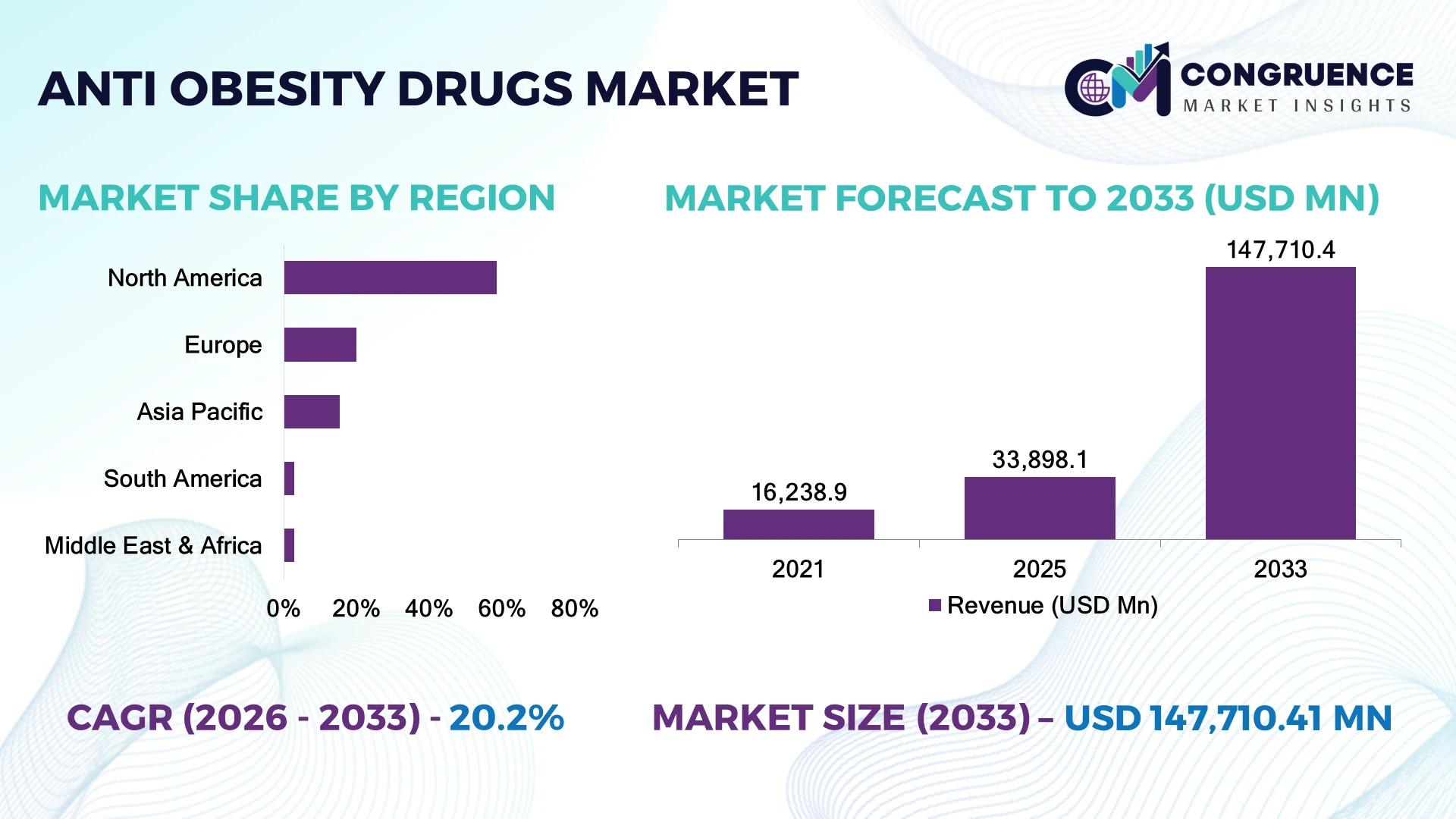
The United States represents approximately 55–60% of global anti-obesity drug demand, supported by high GLP-1 utilization, private insurance coverage, telehealth distribution, and intensive pharmaceutical investment. Eli Lilly committed an additional USD 4.5 billion to Indiana manufacturing in 2026, while Novo Nordisk is expanding injectable production in Brazil with an approximately USD 1 billion-equivalent investment. U.S. demand therefore remains substantially larger than most European markets, while oral GLP-1 launches are widening treatment accessibility. U.S. obesity-drug access negotiations in 2025–2026 are also reshaping pricing and distribution strategies.
Strategically, manufacturers should prioritize scalable peptide capacity, oral formulations, differentiated efficacy, and geographically resilient supply chains.
Market Size & Growth: USD 33.90 billion in 2025 to USD 147.71 billion by 2033 at 20.2% CAGR, driven by GLP-1 adoption and expanding treatment access.
Top Growth Drivers: GLP-1 therapies 55%, obesity prevalence 35%, broader reimbursement 25%.
Short-Term Forecast: By 2028, oral formulations can reduce injection-related treatment friction by approximately 20–30%, while automated peptide manufacturing improves production efficiency by 15–25%.
Emerging Technologies: Oral GLP-1s, dual/triple agonists, once-monthly formulations, precision dosing, and digital adherence platforms are reshaping treatment pathways.
Regional Leaders: North America, Europe, and Asia-Pacific are projected to reach approximately USD 75 billion, USD 30 billion, and USD 27 billion by 2033, respectively.
Consumer/End-User Trends: GLP-1-based therapies represent more than 60% of modern prescription anti-obesity treatment demand, with convenience increasingly influencing treatment selection.
Pilot/Case Example: 2026 oral semaglutide commercialization demonstrates the shift from injectable to oral obesity treatment, with weekly U.S. prescriptions reaching approximately 265,000 by July.
Competitive Landscape: Novo Nordisk and Eli Lilly dominate branded GLP-1 competition, while Roche, Amgen, Pfizer, and AstraZeneca advance differentiated next-generation pipelines.
Regulatory & ESG Impact: Broader reimbursement initiatives are increasing access, while oral and lower-dose formulations can reduce injection-device requirements and treatment logistics.
Investment & Funding: More than USD 10 billion in recent manufacturing commitments from major producers is strengthening peptide, injectable, and oral-drug capacity.
Innovation & Future Outlook: CagriSema, retatrutide, oral GLP-1s, amylin combinations, and lean-mass-preserving therapies are shifting competition toward differentiated efficacy and convenience.
The Anti-obesity Drugs Market is increasingly defined by GLP-1 therapies, next-generation incretin combinations, oral delivery, and scalable peptide manufacturing. North America remains the principal commercial center, while Europe and Asia-Pacific are expanding access through reimbursement development and local commercialization. In 2026, manufacturing localization has become strategically important as Eli Lilly expands U.S. capacity and Novo Nordisk strengthens production outside Europe. These shifts make supply security, formulation differentiation, and patient-access economics central to competitive strategy.
The Anti-obesity Drugs Market has become strategically important because obesity treatment is shifting from a lifestyle-management category toward long-term pharmacological care involving high-efficacy incretin therapies. The competitive landscape is moving beyond first-generation injectable GLP-1s toward oral formulations, higher-dose regimens, combination mechanisms, and therapies designed to improve tolerability and preserve lean mass. At the same time, reimbursement and government access programs are becoming central commercial variables.
Oral delivery represents a significant technology shift versus injectable treatment, removing injection administration and potentially reducing treatment friction by approximately 20–30%. Injectable products still benefit from established manufacturing and clinical experience, while oral platforms require specialized formulation and absorption technologies. The United States remains the largest commercial market, whereas Europe emphasizes reimbursement discipline and Asia-Pacific increasingly combines rising treatment access with localized pharmaceutical capacity.
During 2026–2028, manufacturers are directing capital toward peptide capacity, oral drug manufacturing, automated production, and late-stage obesity pipelines. Lilly's multi-billion-dollar U.S. manufacturing expansion illustrates this capacity-first strategy, while Novo Nordisk is expanding production in Brazil. Competitive advantage will increasingly depend on simultaneously delivering differentiated clinical outcomes, convenient administration, reliable supply, and sustainable patient-access economics.
GLP-1 and incretin-based therapies are redefining pharmacological obesity management, with GLP-1-led products representing more than 60% of modern prescription anti-obesity drug demand and injectable therapies accounting for approximately 80–85% of current utilization. Rising treatment persistence and broader eligibility are shifting obesity care from short-term intervention toward chronic management. In the United States, expanding payer coverage and employer-led obesity programs are increasing addressable treatment populations. At the same time, manufacturers are investing heavily in peptide capacity, fill-finish facilities, and next-generation formulations. Eli Lilly and Novo Nordisk are expanding manufacturing footprints to reduce supply constraints. The non-obvious advantage is manufacturing scale: peptide capacity is increasingly becoming a competitive moat alongside clinical efficacy.
Peptide manufacturing, sterile fill-finish, and specialized delivery-device capacity remain major constraints, particularly for high-volume GLP-1 products. Active pharmaceutical ingredient and injectable capacity can represent approximately 40–50% of manufacturing complexity, while fill-finish bottlenecks can extend production lead times by 10–20%. In the United States, rapid prescription growth has periodically pressured availability of specific strengths and presentations. Europe faces additional reimbursement and budget-management constraints, limiting access despite strong clinical demand. Companies are responding through vertically integrated peptide production, contract manufacturing agreements, regional capacity expansion, and alternative oral formulations. The strategic issue is increasingly supply elasticity: companies with redundant API, device, and fill-finish capacity can capture demand more reliably than competitors dependent on a single manufacturing corridor.
Oral GLP-1 and next-generation multi-agonist therapies create a major opportunity by removing injection-related barriers and expanding treatment convenience. Oral formulations can potentially reduce administration friction by 20–30%, while combination mechanisms targeting GLP-1, GIP, glucagon, or amylin pathways are designed to improve weight reduction and metabolic outcomes. India, Brazil, and Southeast Asia offer substantial untapped treatment populations as obesity screening and specialist care expand. Pharmaceutical companies are accelerating oral peptide delivery, higher-dose formulations, and combination pipelines while developing partnerships around manufacturing and digital patient support. A non-obvious opportunity lies in differentiated adherence economics: easier administration can improve treatment persistence, strengthening long-term product value even when competing therapies offer similar clinical efficacy.
The expansion of chronic obesity pharmacotherapy creates operational challenges around adherence, dose escalation, adverse-event management, monitoring, and long-term patient support. Discontinuation rates can reach approximately 20–40% in real-world settings, while gastrointestinal adverse effects frequently influence dose persistence. Healthcare systems must also manage obesity treatment alongside diabetes, cardiovascular disease, and other metabolic conditions, increasing clinical coordination requirements. In the United States, rapid demand growth is placing additional pressure on primary-care capacity and obesity-specialist availability. Pharmaceutical companies are responding with patient-support programs, digital adherence tools, titration guidance, and combination therapies designed to improve tolerability. The long-term competitive challenge is therefore not simply achieving weight reduction; manufacturers must demonstrate durable outcomes, manageable treatment pathways, and scalable patient support across fragmented healthcare systems.
Oral Treatment Gains Momentum: Oral incretin therapies are moving obesity treatment beyond injectable delivery, with administration convenience potentially reducing treatment friction by 20–30%. Oral products are particularly relevant for patients reluctant to use injections and for primary-care prescribing. Pharmaceutical companies are expanding oral peptide programs and investing in specialized absorption technologies, while regulatory attention increasingly focuses on long-term safety and cardiovascular outcomes.
Multi-Agonist Pipelines Intensify: Pharmaceutical R&D is shifting toward dual and triple mechanisms targeting GLP-1, GIP, glucagon, and amylin pathways. Next-generation candidates increasingly target weight reduction exceeding 20% in clinical development, compared with lower efficacy from earlier pharmacotherapies. Companies are prioritizing differentiated combinations, higher-dose regimens, and lean-mass preservation to establish defensible positions beyond first-generation GLP-1 products.
Manufacturing Moves Upstream: Producers are expanding peptide synthesis, sterile fill-finish, and device capacity closer to major demand centers. Manufacturing localization can reduce supply-chain exposure by approximately 10–20% and shorten replenishment cycles by 15–25%. U.S. capacity expansion is accelerating as manufacturers seek greater control over critical inputs, while European and Asian facilities remain important for global production diversification.
Patient Support Becomes Digital: Pharmaceutical companies are integrating telehealth, dose-titration guidance, adherence reminders, and connected health platforms into obesity-treatment pathways. Digital support can reduce administrative follow-up workload by approximately 15–25% and improve visibility into treatment persistence. The non-obvious shift is that patient-support infrastructure is becoming part of product differentiation, particularly as competing therapies achieve increasingly similar efficacy profiles.
GLP-1 receptor agonists and GLP-1/GIP dual agonists collectively represent approximately 65–70% of global anti-obesity drug demand, reflecting superior clinical efficacy, established prescribing pathways, and expanding reimbursement. Traditional therapies, including lipase inhibitors and centrally acting combinations, retain roughly 20–25% share because of lower-cost positioning and longer market availability. GLP-1/GIP dual agonists are the fastest-shifting category, supported by stronger weight-loss outcomes and broader metabolic benefits. Injectable formulations remain dominant at approximately 80–85%, although oral therapies are rapidly gaining attention as manufacturers address injection fatigue and access barriers.
The commercial distinction is increasingly based on efficacy, tolerability, dosing convenience, and manufacturing scalability rather than mechanism alone. Companies are expanding peptide capacity while investing in oral delivery, multi-agonist pipelines, and next-generation combination therapies. The strategic implication is significant: established injectable products provide scale, but oral and multi-mechanism platforms are attracting disproportionate R&D investment as manufacturers seek differentiated positions through 2026–2028.
The World Health Organization's December 2025 guideline conditionally supports long-term GLP-1 therapy for adults with obesity and identifies semaglutide, liraglutide, and tirzepatide as relevant therapies, while emphasizing affordability, manufacturing capacity, and health-system readiness.
Chronic obesity and weight management represents approximately 70–75% of anti-obesity drug utilization, reflecting the shift toward long-term pharmacological management rather than short-duration weight-loss interventions. Obesity-related metabolic-risk management contributes roughly 15–20%, while cardiovascular-risk reduction and other comorbidity-linked applications account for approximately 8–12%. Chronic weight management remains the mature core application, but metabolic and cardiovascular applications are gaining importance as clinical evidence expands the value proposition of incretin therapies beyond weight reduction.
The fastest-shifting use case is integrated obesity management involving pharmacotherapy alongside behavioral intervention and metabolic monitoring. This model strengthens treatment persistence and expands the role of obesity medicines within primary and specialist care. In India, 2025 clinical guidance supports tirzepatide where a 15–20% weight-loss target is pursued and semaglutide or tirzepatide for 10–15% targets. Companies are therefore developing patient-support programs, digital monitoring, combination therapies, and broader metabolic indications to increase treatment utility and institutional adoption.
The 2025 WHO guideline frames GLP-1 treatment as part of comprehensive, lifelong obesity care incorporating behavioral support, rather than medication-only management, reinforcing the shift toward integrated chronic-care pathways.
Hospitals and specialist obesity-care providers account for approximately 45–50% of anti-obesity drug utilization, supported by diagnostic infrastructure, complex-patient management, and established prescribing pathways. Primary-care and endocrinology practices contribute roughly 30–35%, while telehealth and direct-to-consumer-supported channels represent approximately 15–20% and are the fastest-shifting access model. Hospital-led prescribing remains concentrated around patients with significant comorbidities, whereas primary care increasingly manages broader obesity populations through standardized pharmacotherapy protocols.
Telehealth-enabled prescribing is reshaping access by combining consultations, prescription management, adherence monitoring, and home delivery. Digital channels can reduce administrative friction by approximately 15–25% and expand treatment access beyond specialist centers. Pharmaceutical companies are responding through patient-support platforms, provider education, pharmacy partnerships, and digitally enabled adherence programs. The commercial opportunity increasingly depends on connecting drug supply with longitudinal care infrastructure, particularly as WHO guidance emphasizes health-system preparedness and equitable access to GLP-1 therapies.
WHO reported in 2025 that more than 1 billion people globally live with obesity, while current GLP-1 production is projected to reach fewer than 10% of those who could benefit by 2030, highlighting the scale of unmet treatment access.
North America accounted for the largest market share at 58.5% in 2025 however, Asia-Pacific is expected to register the fastest growth, expanding at a CAGR of 23.1% between 2026 and 2033.
GLP-1 commercialization and manufacturing expansion reinforce U.S. market dominance
North America represents approximately 58.5% of the global Anti-obesity Drugs Market, with the United States accounting for more than 90% of regional demand. High obesity prevalence, extensive specialist prescribing, telehealth distribution, and strong private-sector reimbursement support concentrated GLP-1 utilization. Injectable incretin therapies represent approximately 80–85% of current regional use, while oral formulations are expanding treatment options. The U.S. manufacturing base is also becoming strategically important as pharmaceutical companies localize peptide and fill-finish capacity. Eli Lilly's Indiana expansion adds substantial manufacturing capability across active pharmaceutical ingredients and injectable products, strengthening domestic supply resilience. Large pharmacy networks and digitally enabled obesity-care providers further accelerate patient access. Manufacturers are prioritizing domestic capacity, differentiated dosing, and payer partnerships as competition shifts from product availability toward reliable supply and treatment affordability.
United States Market Outlook: The United States is the clear commercial and innovation center for anti-obesity drugs, combining the world's largest GLP-1 prescribing base with extensive pharmaceutical manufacturing and clinical infrastructure. Approximately 55–60% of global anti-obesity drug demand is concentrated in the country. Major manufacturers are expanding peptide production, injectable fill-finish, and oral formulation capabilities while telehealth channels broaden access beyond specialist obesity clinics.
Reimbursement discipline increasingly shapes obesity-drug commercialization
Europe accounts for approximately 19–21% of global Anti-obesity Drugs demand, with Germany, the United Kingdom, France, Italy, and Spain representing major treatment markets. Unlike the United States, market access is strongly influenced by national reimbursement decisions, health-technology assessments, and budget controls. Germany and the United Kingdom have comparatively sophisticated obesity-care infrastructure, while adoption varies substantially across public healthcare systems. GLP-1 and dual-agonist therapies increasingly enter structured obesity-management pathways rather than purely private-pay channels. Manufacturers are strengthening health-economic evidence, patient-support programs, and local medical partnerships to demonstrate long-term value. Oral therapies also have strategic importance because they can simplify administration and potentially reduce treatment friction for broader primary-care populations.
Germany Market Outlook: Germany provides one of Europe's strongest pharmaceutical and healthcare infrastructures, combining extensive specialist care with advanced reimbursement assessment and clinical research capabilities. Obesity medicines increasingly require robust evidence around sustained weight reduction and health outcomes to secure institutional uptake. The country's pharmaceutical manufacturing base also supports clinical development, packaging, and distribution, making Germany important for both commercialization and regional supply-chain coordination.
Rising treatment access and local pharmaceutical capacity reshape adoption
Asia-Pacific represents approximately 15–17% of global Anti-obesity Drugs demand, with China, Japan, South Korea, Australia, and India forming the principal markets. China contributes roughly 35–40% of regional demand and is strengthening domestic pharmaceutical manufacturing, clinical development, and obesity-treatment infrastructure. Japan and South Korea have sophisticated healthcare systems supporting incretin adoption, while India offers a substantially larger untreated population and expanding specialist access. Oral formulations and lower-cost alternatives are strategically important because affordability remains a stronger purchasing determinant than in the United States. Pharmaceutical companies are increasing local clinical activity, manufacturing partnerships, and distribution coverage. Domestic production of APIs and finished medicines is also gaining strategic value as manufacturers seek to reduce dependence on imported pharmaceutical inputs.
China Market Outlook: China is the leading Asia-Pacific market because of its large population, expanding obesity-treatment demand, and rapidly developing pharmaceutical manufacturing ecosystem. Domestic companies are increasing participation in incretin development and commercialization, while multinational manufacturers are strengthening local clinical and distribution capabilities. China also provides substantial manufacturing depth for pharmaceutical ingredients, supporting regional supply resilience and potentially improving access to newer obesity therapies.
Brazil anchors incretin adoption through private healthcare expansion
South America represents approximately 4–5% of global Anti-obesity Drugs demand, with Brazil accounting for roughly 65–70% of regional consumption. Brazil combines a large obesity-affected population with established private healthcare, pharmaceutical distribution, and specialist-prescribing infrastructure. GLP-1 therapies increasingly dominate premium obesity treatment, while affordability and reimbursement remain important barriers outside private insurance networks. São Paulo and Rio de Janeiro concentrate specialist clinics, pharmaceutical distribution, and higher-value private healthcare activity. Manufacturers are expanding pharmacy partnerships, medical education, and patient-support programs while strengthening local distribution. The non-obvious opportunity is the growth of structured obesity management through private clinics, where digital follow-up and home delivery can reduce treatment friction and expand access without requiring specialist visits for every interaction.
Brazil Market Outlook: Brazil is the principal South American market because of its large healthcare system, established pharmaceutical industry, and concentration of private obesity-care services. Major metropolitan centers support specialist prescribing and premium GLP-1 utilization, while national pharmacy networks provide broad distribution. Pharmaceutical companies are increasingly using patient-support programs and localized commercial partnerships to address affordability, adherence, and treatment continuity.
Healthcare modernization creates premium obesity-treatment opportunities
Middle East & Africa represents approximately 3–4% of global Anti-obesity Drugs demand, with Saudi Arabia, the UAE, South Africa, Turkey, and Israel serving as important markets. Gulf countries have comparatively high obesity burdens and are investing in advanced hospitals, metabolic clinics, digital health infrastructure, and specialist care. Saudi Arabia and the UAE together account for more than 50% of regional demand, supported by higher healthcare spending and stronger access to premium medicines. GLP-1 therapies are increasingly incorporated into specialist weight-management programs, while private hospitals and pharmacy chains provide important commercialization channels. Pharmaceutical companies are strengthening distributor partnerships, medical education, and cold-chain logistics. Regional healthcare modernization creates a strong platform for differentiated therapies, particularly where integrated metabolic-care programs are expanding.
Saudi Arabia Market Outlook: Saudi Arabia is the region's most strategically significant anti-obesity drug market because of healthcare modernization, high metabolic disease burden, and substantial investment in specialist medical infrastructure. Riyadh and Jeddah concentrate advanced hospitals and metabolic-care services. Premium GLP-1 therapies are increasingly relevant within private healthcare, while digital consultations and pharmacy distribution improve treatment access. Manufacturers benefit from partnerships with healthcare networks and localized patient-support programs.
Novo Nordisk and Eli Lilly lead the market, competing on GLP-1/GIP efficacy, manufacturing scale, dosing convenience, and payer access. Roche, Amgen, and Pfizer represent pipeline challengers, while regional drugmakers compete through affordability and localized distribution. The top five players are estimated to represent roughly 75–80% of branded anti-obesity drug value. Competition centers on efficacy, with leading candidates targeting roughly 15–25% weight reduction, while oral formulations seek to reduce injection friction and expand primary-care use. Supply capacity is equally decisive: leading manufacturers are committing multi-billion-dollar investments, while localized production can reduce exposure to constrained peptide and fill-finish capacity. Lilly is expanding U.S. manufacturing, Novo is strengthening Brazil production, and challengers are advancing oral and multi-agonist platforms. The competitive shift is moving toward differentiated efficacy, oral delivery, manufacturing control, and payer economics. High clinical-development costs, regulatory requirements, and manufacturing complexity remain major entry barriers. Winning requires clinical differentiation, scalable supply, and access.
Novo Nordisk A/S
Eli Lilly and Company
Roche Holding AG
Amgen Inc.
Pfizer Inc.
AstraZeneca PLC
Merck & Co., Inc.
Boehringer Ingelheim International GmbH
Viking Therapeutics, Inc.
Structure Therapeutics Inc.
Zealand Pharma A/S
Altimmune, Inc.
Innovent Biologics, Inc.
Injectable GLP-1/GIP therapies remain the core technology, with weekly dosing improving treatment convenience versus older daily regimens. Dual-agonist mechanisms target broader metabolic pathways and can deliver approximately 10–20% greater weight-loss performance versus earlier single-mechanism approaches in comparable development settings. Automated peptide synthesis and high-throughput fill-finish systems can improve manufacturing efficiency by 5–10%. Leading manufacturers increasingly integrate formulation development with dedicated API and fill-finish capacity to protect supply.
Oral small-molecule GLP-1 platforms represent the most disruptive technology shift for 2026–2028. Clinical-stage oral candidates have demonstrated approximately 10–12% weight reduction in Phase 2/3 studies, while eliminating injection administration. Oral delivery can reduce administration friction by an estimated 20–30% and expand prescribing into primary care. Lilly, Novo Nordisk, Roche, and emerging biotech developers benefit from this transition through differentiated dosing and broader patient accessibility.
Next-generation multi-agonists, including GLP-1/glucagon and GLP-1/GIP/glucagon combinations, are integrating efficacy with cardiometabolic benefits. These platforms target approximately 15–25% weight reduction in advanced development programs. Continuous formulation optimization, digital titration support, and patient-monitoring integration can improve adherence by 5–10%. Between 2026 and 2028, competitive advantage will increasingly depend on combining efficacy, oral convenience, scalable manufacturing, and durable treatment support.
May 2026 Eli Lilly committed $4.5 billion across Indiana manufacturing sites, taking total Indiana investment since 2020 above $21 billion. The expansion strengthens API capacity and supports supply security for obesity medicines through 2028. Source: lilly.com
April 2025 Novo Nordisk announced an 8 billion Danish kroner expansion of its Montes Claros, Brazil site, adding aseptic production, warehousing and quality infrastructure. The project is expected to create 600 permanent jobs, strengthening regional GLP-1 supply. Source: novonordisk.com
July 2025 Reuters reported Eli Lilly’s Mounjaro launch in India generated nearly 88,000 units in June, while Novo Nordisk’s Wegovy recorded 1,788 units. The divergence highlights accelerating demand and intensifying competition across India’s obesity-treatment market. Source: reuters.com
December 2025 WHO issued its first global guideline supporting conditional long-term GLP-1 use for adult obesity, while noting costs, capacity and equity constraints. The guidance strengthens structured chronic-care adoption and raises pressure for broader manufacturing and access. Source: who.int (World Health Organization)
The Anti-obesity Drugs Market report covers major therapy types, including GLP-1 receptor agonists, GLP-1/GIP dual agonists, lipase inhibitors, centrally acting therapies, and emerging multi-agonist platforms. Application coverage spans chronic weight management, obesity-related metabolic conditions, cardiovascular-risk management, and integrated obesity care, while end-user analysis includes hospitals, specialist clinics, primary-care providers, pharmacies, and digitally enabled treatment channels.
The report evaluates North America, Europe, Asia-Pacific, South America, and Middle East & Africa, with country-level analysis of major pharmaceutical markets and manufacturing hubs. It assesses injectable versus oral adoption, peptide manufacturing, advanced drug-delivery technologies, multi-agonist development, and digital treatment support. With GLP-1 therapies representing the dominant treatment class and emerging oral platforms targeting 10–12%+ weight reduction in clinical development, the study supports investment planning, market-entry decisions, manufacturing expansion, competitive positioning, partnership evaluation, and strategic direction through 2026–2033.
| Report Attribute/Metric | Report Details |
|---|---|
|
Market Revenue in 2025 |
USD 33,898.1 Million |
|
Market Revenue in 2033 |
USD 147,710.4 Million |
|
CAGR (2026 - 2033) |
20.2% |
|
Base Year |
2025 |
|
Forecast Period |
2026 - 2033 |
|
Historic Period |
2021 - 2025 |
|
Segments Covered |
By Type
By Application
By End-User
|
|
Key Report Deliverable |
Revenue Forecast, Growth Trends, Market Dynamics, Segmental Overview, Regional and Country-wise Analysis, Competition Landscape |
|
Region Covered |
North America, Europe, Asia-Pacific, South America, Middle East, Africa |
|
Key Players Analyzed |
Novo Nordisk A/S, Eli Lilly and Company, Roche Holding AG, Amgen Inc., Pfizer Inc., AstraZeneca PLC, Merck & Co., Inc., Boehringer Ingelheim International GmbH, Viking Therapeutics, Inc., Structure Therapeutics Inc., Zealand Pharma A/S, Altimmune, Inc., Innovent Biologics, Inc. |
|
Customization & Pricing |
Available on Request (10% Customization is Free) |




