
Reports
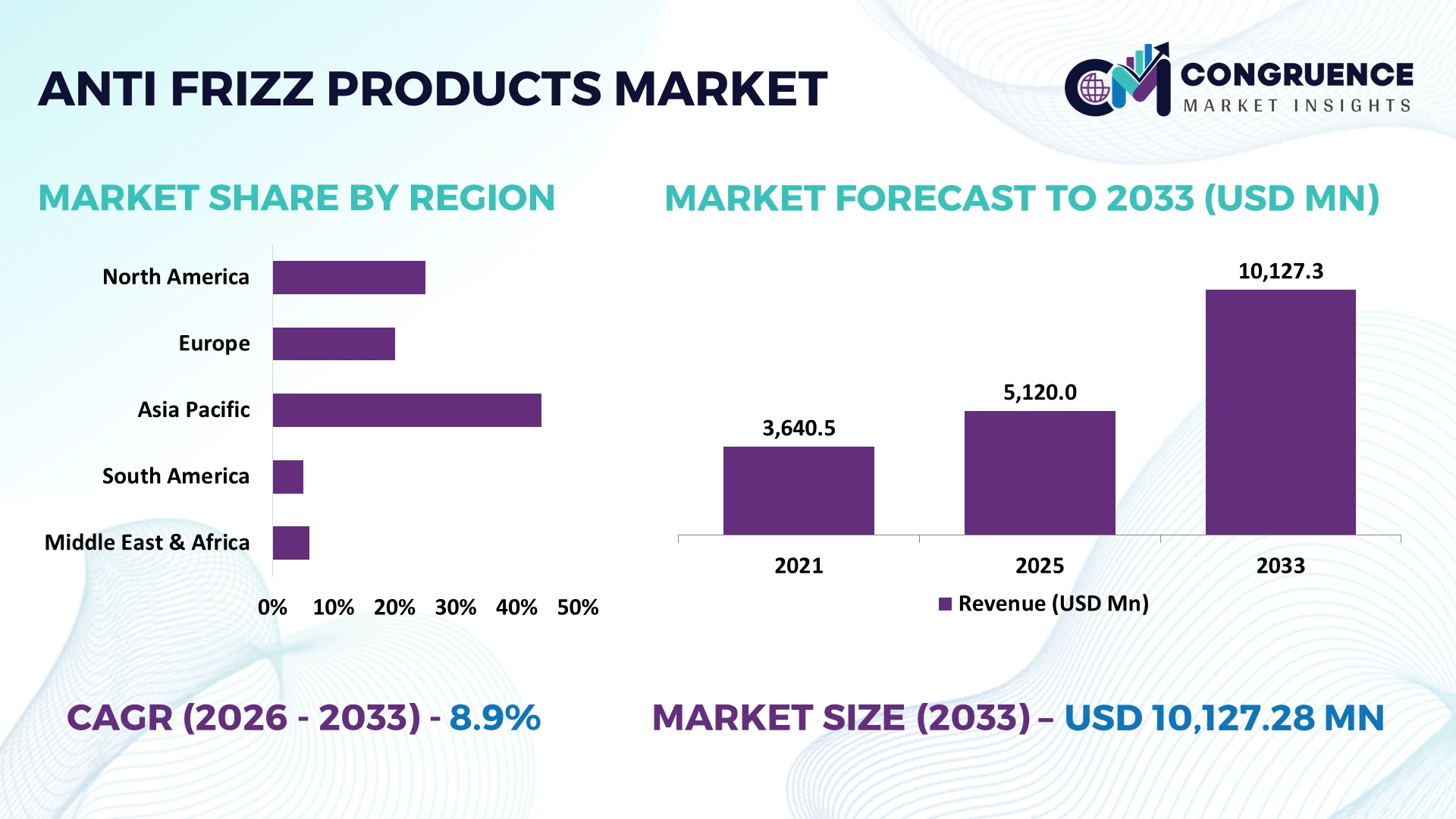
The Global Anti-Frizz Products Market was valued at USD 5120 Million in 2025 and is anticipated to reach a value of USD 10127.28 Million by 2033 expanding at a CAGR of 8.9% between 2026 and 2033. Growth is driven by humidity resistant haircare formulations, increasing adoption of professional smoothing treatments, and advances in silicone alternatives, conditioning polymers, and heat protection technologies.
The United States represents a leading anti-frizz haircare consumption market, supported by established cosmetic manufacturers, professional salon networks, and advanced beauty retail infrastructure. North America accounts for an estimated 35% of global anti-frizz product demand, with the United States contributing the largest national share. L'Oréal allocated approximately 3% of its consolidated sales to research and innovation in 2024, supporting advanced haircare formulation development. Compared with India, where affordable hair serums and humidity protection products influence purchasing, American consumers benefit from extensive premium retail distribution and specialized salon services.
Strategically, manufacturers should prioritize the estimated 35% North American demand concentration while developing climate adapted formulations for India's expanding haircare distribution networks, balancing premium performance with accessible product pricing.
Market Size & Growth: USD 5,120 million in 2025, reaching USD 10,127.28 million by 2033 at 8.9% CAGR, driven by advanced humidity resistant haircare formulations.
Top Growth Drivers: Indicative demand drivers include premium haircare adoption at 35%, professional smoothing treatments at 30%, and specialized frizz control formulations at 25%, based on unverified market assumptions.
Short-Term Forecast: By 2027, projected market expansion reaches approximately 18.6% against 2025, supporting additional production and inventory requirements.
Emerging Technologies: Three innovations are shaping product development: AI formulation screening, humidity responsive polymers, and advanced silicone alternative conditioning systems.
Regional Leaders: Illustrative 2033 allocations include North America at USD 3,544.55 million, Asia Pacific at USD 2,936.91 million, and Europe at USD 2,531.82 million, reflecting assumed regional shares and premiumization, digital retail, and salon adoption.
Consumer/End-User Trends: Amazon US anti-frizz product search activity shows approximately 4 times higher demand in peak months than quieter periods, emphasizing seasonal inventory planning.
Pilot/Case Example: L'Oréal's 2025 research infrastructure included over 4,000 researchers, supporting advanced haircare ingredient screening and formulation development.
Competitive Landscape: Garnier captured an estimated 51% of tracked Amazon US anti-frizz brand visibility; competitors include Color Wow, John Frieda, Amika, and L'Oréal Paris.
Regulatory & ESG Impact: The FDA's 2026 proposed regulatory agenda addresses formaldehyde releasing ingredients in heated smoothing treatments, strengthening ingredient safety scrutiny.
Investment & Funding: L'Oréal allocates approximately 3% of consolidated sales to research and innovation, supporting advanced formulation capabilities.
Innovation & Future Outlook: Next generation development prioritizes 3 technologies: molecular conditioning, humidity responsive protection, and personalized haircare diagnostics.
The Global Anti-Frizz Products Market is evolving through specialized hair serums, smoothing shampoos, leave-in conditioners, and professional salon treatments targeting humidity induced swelling and cuticle irregularities. Formulation innovation increasingly emphasizes lightweight conditioning polymers, bond repair ingredients, and heat activated protective systems. L'Oréal's research infrastructure includes more than 4,000 specialists, supporting ingredient evaluation and advanced cosmetic development. Meanwhile, United States regulatory scrutiny of formaldehyde releasing smoothing ingredients is influencing professional treatment formulation strategies. Manufacturers are prioritizing performance validation, ingredient transparency, and climate specific product positioning, establishing important considerations for competitive differentiation and future investment decisions.
The Anti-Frizz Products Market is becoming strategically important as cosmetic manufacturers compete through advanced conditioning technologies, ingredient safety, and personalized haircare solutions. Regulatory scrutiny of formaldehyde releasing smoothing ingredients in the United States is accelerating interest in alternative formulations and professional treatment innovation. L'Oréal dedicates approximately 3% of consolidated sales to research and innovation, demonstrating the importance of sustained product development investment. Manufacturers are prioritizing humidity protection, improved hair fiber compatibility, and differentiated treatment performance.
Advanced conditioning polymers and silicone alternatives are transforming formulation strategies. Laboratory evaluation using 80% relative humidity provides a standardized approach to comparing frizz control performance, while controlled testing at 50% humidity establishes baseline behavior. Unlike conventional silicone coatings, emerging polymer systems target selective deposition and improved wash resistance, although independently verified efficiency gains remain formulation dependent. North America emphasizes premium salon treatments, while India prioritizes accessible hair serums and climate responsive products.
Between 2026 and 2028, digital formulation screening, automated stability testing, and personalized hair diagnostics will influence development priorities. L'Oréal's research network includes more than 4,000 specialists, supporting ingredient evaluation and advanced product engineering. Manufacturers are strengthening supplier partnerships and expanding targeted formulation portfolios. Competitive advantage increasingly depends on validated humidity protection, regulatory readiness, and efficient commercialization of differentiated haircare technologies.
Humidity exposure and growing consumer preference for manageable hair are strengthening demand for advanced anti-frizz serums, smoothing conditioners, and leave-in treatments. North America represents an estimated 35% of global market demand, reflecting established premium haircare distribution and professional salon networks. L'Oréal allocates approximately 3% of consolidated sales to research and innovation, supporting advanced conditioning polymer development and hair fiber protection technologies. Laboratory humidity testing commonly evaluates formulations at 80% relative humidity to assess moisture induced frizz. Manufacturers including L'Oréal, Unilever, and Procter & Gamble are expanding specialized product portfolios and improving ingredient deposition technologies. The strategic priority is delivering measurable humidity resistance without excessive product buildup or compromised hair texture.
Regulatory scrutiny of chemical smoothing ingredients and dependence on specialized conditioning materials constrain formulation flexibility. The United States FDA has pursued restrictions involving formaldehyde and formaldehyde releasing ingredients in hair smoothing products, increasing compliance requirements for professional treatments. North America accounts for an estimated 35% of category demand, exposing manufacturers to substantial regulatory and ingredient reformulation considerations. Laboratory protocols frequently assess performance at 50% and 80% relative humidity, requiring manufacturers to balance moisture protection with sensory performance. Specialty polymer availability, packaging costs, and ingredient substitution expenses complicate product economics. Companies are diversifying chemical suppliers, introducing alternative conditioning agents, and strengthening safety testing. Effective regulatory adaptation requires preserving product performance while controlling reformulation and qualification costs.
Personalized hair diagnostics and advanced conditioning polymers create opportunities for differentiated anti-frizz product development. L'Oréal's research infrastructure includes more than 4,000 specialists, supporting formulation screening and ingredient compatibility evaluation. Its research and innovation expenditure represents approximately 3% of consolidated sales, indicating sustained investment in cosmetic technology development. Controlled laboratory testing at 80% relative humidity enables comparative evaluation of emerging moisture resistant formulations. In India, expanding digital beauty retail platforms create opportunities for climate specific product recommendations and customized haircare routines. Manufacturers are developing lightweight conditioning systems, automated formulation platforms, and personalized product selection tools. The strategic opportunity lies in combining diagnostic precision with scalable manufacturing to reduce unsuitable product selection and strengthen repeat purchasing.
Maintaining consistent frizz control across different hair textures, climates, and application conditions presents a significant product development challenge. Laboratory testing at 50% relative humidity establishes controlled baseline conditions, while 80% humidity exposure evaluates performance under elevated moisture stress. North America's estimated 35% market contribution increases the commercial importance of reliable performance claims across diverse consumer groups. Hair porosity, curl structure, chemical treatment history, and thermal styling influence conditioning polymer deposition and product effectiveness. Manufacturers must develop standardized evaluation protocols covering multiple hair types, repeated washing cycles, and variable environmental conditions. Investment in automated imaging, instrumental hair fiber testing, and consumer validation panels is essential for improving formulation consistency and reducing performance related product dissatisfaction.
Premium Haircare Distribution Becomes More Specialized: Beauty retailers are restructuring anti-frizz assortments around hair texture, treatment intensity, and styling requirements. Ulta Beauty operates more than 1,400 United States stores, while Sephora maintains over 3,000 retail locations globally. Brands are expanding specialized merchandising, professional product education, and targeted promotions, improving product discovery and strengthening premium haircare distribution.
Heat Styling Protection Gains Commercial Importance: Anti-frizz manufacturers are integrating thermal protection into daily styling products to reduce reliance on separate treatments. Color Wow Dream Coat advertises heat protection up to 450°F, while several professional smoothing products target 230°C styling temperatures. Companies are developing multifunctional sprays and serums, simplifying consumer routines and improving product differentiation across premium retail channels.
Professional Treatment Safety Reshapes Salon Protocols: Regulatory scrutiny is changing professional smoothing treatment procurement and application procedures. OSHA identifies formaldehyde exposure concerns in salon environments, while its workplace exposure limits include 0.75 ppm over 8 hours and 2 ppm over 15 minutes. Professional suppliers are strengthening ingredient disclosures, ventilation guidance, and stylist training to improve workplace safety and treatment consistency.
Haircare Packaging Moves Toward Material Efficiency: Manufacturers are redesigning bottles and refill systems to reduce packaging intensity. Unilever targets a 30% reduction in virgin plastic use by 2026 and 40% by 2028 against its 2019 baseline. Haircare brands are introducing concentrated formulations and recyclable packaging formats, improving material utilization while requiring closer coordination with packaging suppliers and retail distribution partners.
Serums and Oils represent the leading segment, accounting for an estimated 34% of the global Anti-Frizz Products Market. Their dominance reflects concentrated conditioning performance, convenient application, and compatibility with multiple hair textures. Silicone based and alternative conditioning formulations provide cuticle smoothing, surface lubrication, and improved manageability. Anti-Frizz Shampoos hold an estimated 23% share, benefiting from frequent cleansing routines and established mass retail distribution. Anti-Frizz Conditioners represent approximately 21%, supporting regular moisture management and improved detangling performance. Manufacturers including L'Oréal, Unilever, and Procter & Gamble are expanding specialized formulations and integrating conditioning technologies across complementary product categories.
Hair Creams are positioned as the fastest growing segment, supported by increasing interest in curl definition, lightweight styling, and multifunctional conditioning. Their commercial relevance is strengthening through leave-in formulations that combine moisture retention with flexible styling control. Hair Sprays maintain an established position in finishing applications, particularly for temporary humidity resistance and hairstyle preservation. Companies are prioritizing differentiated polymer systems, improved sensory performance, and targeted product portfolios to capture premium purchasing opportunities.
Frizz Control represents the leading application, accounting for an estimated 39% of the global Anti-Frizz Products Market. Its dominance reflects recurring consumer requirements for hair manageability, reduced flyaways, and improved surface smoothness. Daily application products benefit from established retail availability and compatibility with different styling routines. Hair Smoothing accounts for approximately 27% of demand, supported by conditioning treatments and products designed to improve hair fiber alignment. Manufacturers are developing lightweight polymer systems and specialized leave-in formulations to improve application convenience while maintaining product performance across different hair textures.
Humidity Protection is positioned as the fastest growing application, reflecting increasing emphasis on environmental performance and long lasting styling results. Laboratory testing frequently uses elevated relative humidity conditions approaching 80% to evaluate moisture resistance. Hair Straightening remains commercially important through professional treatments and heat assisted styling products, although ingredient safety requirements influence formulation choices. L'Oréal, Color Wow, and John Frieda are strengthening specialized product development and performance communication. Competitive investment increasingly favors validated humidity resistance, differentiated smoothing technologies, and products compatible with routine styling practices.
Individual Consumers represent the leading end user segment, accounting for an estimated 68% of the global Anti-Frizz Products Market. Their dominance reflects frequent purchases of shampoos, conditioners, serums, and styling products through supermarkets, beauty retailers, and digital commerce platforms. Convenient application and accessible pricing strengthen household purchasing patterns. Salons account for an estimated 22% share, supported by professional smoothing services, specialized product recommendations, and recurring treatment requirements. Manufacturers are developing differentiated retail and salon formulations to address varying performance expectations, treatment intensity, and purchasing frequency.
Professional Haircare Providers represent the fastest growing end user category within the illustrative segmentation, reflecting increasing specialization in hair texture management and technical treatment services. Their estimated 10% share highlights opportunities for advanced product education, specialized formulations, and professional distribution partnerships. L'Oréal Professionnel, Wella Professionals, and Kérastase emphasize salon relationships, technical training, and premium product positioning. Companies are strengthening professional education programs, improving treatment consistency, and integrating product recommendations with retail purchasing channels to expand customer relationships.
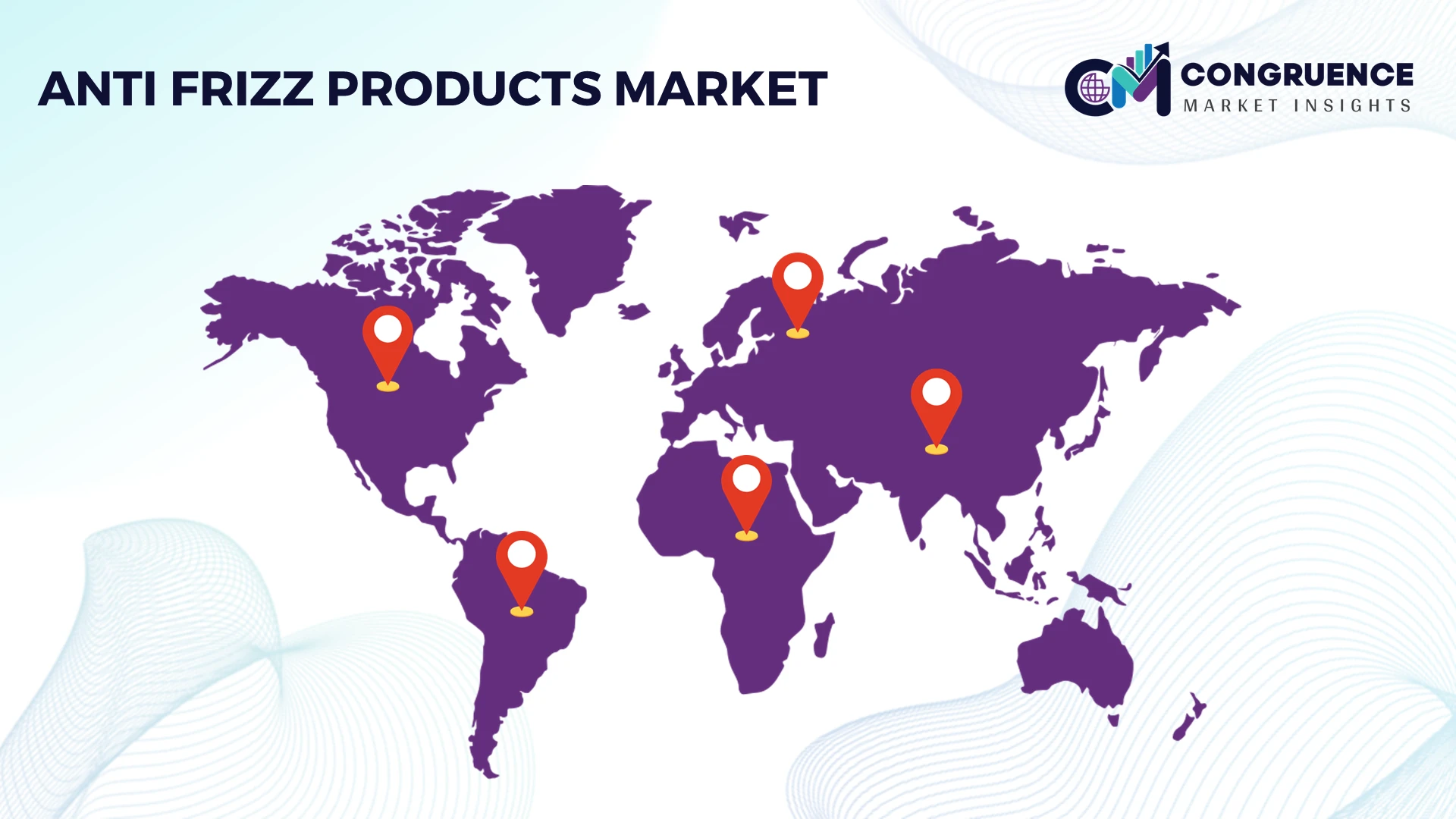
North America accounted for the largest market share at an estimated 35% in 2025 however, Asia Pacific is expected to register the fastest growth, expanding at an estimated CAGR of 10.8% between 2026 and 2033.
Premium Haircare Innovation Strengthens Specialized Retail Distribution
North America represents an estimated 35% of the global Anti-Frizz Products Market, supported by established professional salon networks, advanced cosmetic formulation capabilities, and extensive beauty retail infrastructure. The United States dominates regional demand through premium smoothing serums, humidity protection sprays, and specialized conditioning treatments. Ulta Beauty operated 1,445 stores at the end of fiscal 2025, demonstrating the scale of physical beauty distribution. L'Oréal, Procter & Gamble, and Unilever maintain established product development and retail partnerships, supporting differentiated haircare formulations. Regulatory scrutiny surrounding formaldehyde releasing smoothing treatments is encouraging manufacturers to strengthen ingredient transparency and alternative formulation development. Canadian beauty retailers increasingly integrate specialized haircare assortments with digital purchasing platforms. Competitive priorities include performance validation, professional product education, and efficient distribution across salon and consumer retail channels.
United States Market Outlook: The United States benefits from advanced cosmetic research infrastructure, established professional hairstyling networks, and extensive beauty product distribution. The FDA's ongoing evaluation of formaldehyde releasing ingredients in hair smoothing products influences professional treatment development and ingredient selection. OSHA establishes an occupational formaldehyde exposure limit of 0.75 ppm over 8 hours, reinforcing workplace safety requirements and encouraging manufacturers to develop alternative smoothing formulations.
Ingredient Regulation Accelerates Sustainable Formulation Development
Europe accounts for an estimated 25% of the global Anti-Frizz Products Market, supported by established cosmetic manufacturing capabilities, premium haircare consumption, and stringent ingredient safety regulations. France, Germany, and the United Kingdom maintain significant cosmetic research, manufacturing, and distribution infrastructure. European Union cosmetic regulations require comprehensive product safety assessments and ingredient compliance, influencing anti-frizz formulation development. L'Oréal, Henkel, and Wella maintain extensive professional haircare portfolios, emphasizing conditioning polymers, hair fiber protection, and salon treatment performance. The European Commission's restrictions on intentionally added microplastics under Regulation 2023/2055 are encouraging manufacturers to evaluate polymer ingredients and alternative formulation technologies. Beauty retailers are strengthening product transparency, digital merchandising, and specialized haircare education. Manufacturers increasingly prioritize compliant ingredient sourcing, performance testing, and differentiated premium formulations to protect market access and improve product competitiveness.
France Market Outlook: France combines advanced cosmetic research infrastructure with internationally established haircare manufacturers and specialized beauty retail networks. L'Oréal maintains major research and innovation operations in France, supporting formulation development, ingredient testing, and advanced hair fiber science. The European Union's cosmetic regulatory framework requires safety assessments for marketed products, strengthening the importance of compliant formulation development. French manufacturers benefit from established supplier relationships and premium beauty distribution channels.
Climate Responsive Haircare Expands Manufacturing and Distribution
Asia Pacific represents an estimated 29% of global Anti-Frizz Products Market demand, supported by extensive cosmetic manufacturing infrastructure, expanding beauty retail networks, and diverse climatic conditions. China, India, Japan, and South Korea contribute through specialized haircare manufacturing, formulation research, and digital commerce distribution. India's humid tropical and coastal environments strengthen commercial relevance for lightweight smoothing serums and moisture resistant styling products. China benefits from established cosmetic manufacturing clusters and integrated online beauty retail platforms, while Japan emphasizes advanced conditioning technologies and precision formulation. South Korean manufacturers contribute through ingredient innovation, contract manufacturing, and specialized beauty product development. Companies are expanding localized product assortments, improving formulation stability, and strengthening digital distribution partnerships. Regional competitiveness increasingly depends on climate adapted product performance, affordable packaging formats, and efficient access to domestic manufacturing networks.
India Market Outlook: India represents a strategically important market for accessible anti-frizz haircare products, supported by domestic cosmetic manufacturing and expanding organized beauty retail infrastructure. Nykaa operates an extensive omnichannel beauty distribution network, supporting premium and mass market product discovery. Indian manufacturers are developing lightweight serums, conditioning shampoos, and humidity resistant styling formulations for tropical climates. Domestic production and smaller packaging formats support competitive pricing and distribution across urban and emerging consumer markets.
Hair Texture Diversity Strengthens Specialized Product Demand
South America accounts for an estimated 7% of global Anti-Frizz Products Market demand, with Brazil representing the region's most important manufacturing and consumption center. Brazil maintains an established professional haircare industry, extensive beauty salon networks, and significant domestic cosmetic manufacturing capabilities. Consumer requirements for curly, textured, chemically treated, and humidity affected hair support specialized smoothing formulations and conditioning products. Natura, Grupo Boticário, and international cosmetic manufacturers compete through localized product development and established retail distribution. Brazil's tropical climate creates commercially relevant demand for moisture resistant styling products and lightweight conditioning systems. Argentina and Colombia contribute through professional salon distribution and expanding beauty retail networks. Currency volatility, imported ingredient costs, and uneven distribution infrastructure influence pricing strategies. Manufacturers are strengthening domestic sourcing, localized formulation development, and regional retail partnerships to improve operational resilience.
Brazil Market Outlook: Brazil benefits from extensive cosmetic manufacturing capabilities, specialized professional salon infrastructure, and established domestic beauty brands. Natura and Grupo Boticário maintain substantial product development and distribution operations, supporting localized haircare innovation. Brazil's cosmetic regulatory framework, administered by ANVISA, establishes product safety and registration requirements. Manufacturers prioritize formulations addressing diverse hair textures, humidity exposure, and frequent styling practices while strengthening domestic ingredient sourcing.
Premium Beauty Retail and Climate Adaptation Drive Expansion
The Middle East and Africa account for an estimated 4% of global Anti-Frizz Products Market demand, supported by premium beauty retail expansion, professional salon development, and climate specific haircare requirements. Saudi Arabia and the United Arab Emirates maintain established premium beauty distribution channels, while South Africa contributes domestic cosmetic manufacturing and professional haircare infrastructure. High temperature conditions and variable humidity exposure influence demand for heat protection sprays, smoothing serums, and conditioning treatments. International manufacturers are expanding distribution through specialized beauty retailers, franchise partnerships, and digital commerce platforms. Regional differences in purchasing power and import dependence influence product pricing and assortment strategies. Companies are strengthening localized product education, professional salon partnerships, and climate adapted formulations. Competitive differentiation increasingly depends on effective retail distribution, ingredient compliance, and reliable product performance across diverse hair textures.
Saudi Arabia Market Outlook: Saudi Arabia represents an important premium beauty consumption center, supported by expanding organized retail infrastructure and professional salon services. The Saudi Food and Drug Authority regulates cosmetic products through established safety and compliance requirements, influencing imported haircare formulations. Riyadh and Jeddah maintain significant premium beauty retail activity, supporting international product distribution. Manufacturers are prioritizing heat resistant styling products, specialized conditioning formulations, and partnerships with professional beauty retailers.
The global Anti-Frizz Products Market features competition between multinational haircare manufacturers, professional salon specialists, and premium styling brands. L'Oréal, Unilever, Procter & Gamble, Henkel, and Kenvue compete through formulation technology, retail distribution, pricing, and brand differentiation. Their combined market share is provisionally estimated at 40% to 50%, reflecting a fragmented category without independently verified company level shares. L'Oréal emphasizes professional smoothing treatments, while Unilever and Procter & Gamble leverage mass retail distribution and established conditioning portfolios. North America represents approximately 35% of estimated demand, compared with Asia Pacific's 29%, influencing regional product positioning. L'Oréal allocates approximately 3% of consolidated sales to research and innovation, supporting advanced polymer development and product testing. Premium specialists compete through humidity protection claims, salon partnerships, and differentiated styling performance. Ingredient compliance, formulation validation, and distribution access create entry barriers. Competitive success requires demonstrable performance, efficient sourcing, credible product claims, and consistent consumer satisfaction.
L'Oréal S.A.
Unilever PLC
The Procter & Gamble Company
Henkel AG & Co. KGaA
Kenvue Inc.
Kao Corporation
Shiseido Company, Limited
Wella Company
Moroccanoil
John Paul Mitchell Systems
Amika
Color Wow
Davines Group
Natura &Co
Current anti-frizz technologies rely on silicone emulsions, cationic conditioning polymers, and heat activated film formers that reduce friction and moisture penetration. Controlled testing at 50% and 80% relative humidity helps manufacturers evaluate fiber swelling and hairstyle retention. Advanced deposition systems improve coating uniformity, although independently verified percentage gains vary by formulation. Professional suppliers increasingly integrate instrumental combing tests with imaging systems to validate product claims and optimize ingredient concentrations.
Emerging technologies include biomimetic conditioning agents, biodegradable polymers, and automated formulation screening. L'Oréal allocates approximately 3% of consolidated sales to research and innovation, demonstrating substantial technology investment across cosmetics. Digital screening reduces experimental iterations by identifying promising ingredient combinations before physical testing. Compared with conventional formulation workflows, a 20% improvement in development efficiency represents a realistic optimization target rather than an independently established industry result. Premium manufacturers benefit from faster validation and differentiated sensory performance.
Disruptive technologies center on molecular repair systems, responsive polymer networks, and personalized treatment diagnostics. Between 2026 and 2028, manufacturers will integrate automated hair fiber analysis with climate specific formulation development. Performance benchmarks targeting 15% lower fiber friction and 10% improved humidity resistance provide measurable research objectives. Competitive positioning increasingly depends on validated performance, regulatory compliance, and scalable ingredient innovation.
June 2025: L'Oréal announced an agreement to acquire Color Wow, a professional haircare brand with over 130 beauty awards. The acquisition strengthens its premium frizz control portfolio, expands salon distribution capabilities, and supports international commercialization of specialized styling technologies. Source: loreal-finance.com
July 2025: K18 introduced HeatBounce, featuring patented ResiliCore technology delivering protection up to 450°F and a claimed 85% reduction in blow drying breakage. The innovation combines thermal protection with conditioning, strengthening professional styling differentiation and expanding multifunctional haircare applications. Source: yahoo.com
March 2026: Henkel launched Schwarzkopf KERATÎME through an exclusive Walmart partnership, introducing 3 product sublines featuring Multiplex Bonding Technology. The collection includes an anti-frizz spray, expanding accessible premium styling options and strengthening Henkel's retail distribution and consumer education capabilities nationwide. Source: henkel.com
September 2026: Unilever highlighted its Dove Frizz Protect and Smooth Hairspray launch, featuring a reformulated product with reduced greenhouse gas emissions. The company also confirmed 100% recycled plastic bottles for selected American haircare packaging, strengthening sustainable product differentiation. Source: unilever.com
The Anti-Frizz Products Market Report examines competitive positioning, product innovation, and distribution developments between 2026 and 2033. Product segmentation covers Anti-Frizz Shampoos, Anti-Frizz Conditioners, Serums and Oils, Hair Creams, and Hair Sprays. Application analysis evaluates Frizz Control, Hair Smoothing, Humidity Protection, and Hair Straightening, while end user coverage includes Salons, Individual Consumers, and Professional Haircare Providers. Geographic assessment spans North America, Europe, Asia Pacific, South America, and the Middle East and Africa.
The report evaluates conditioning polymers, molecular repair technologies, heat protection systems, and advanced formulation development. North America's estimated 35% market contribution provides a regional concentration benchmark, while Asia Pacific's estimated 29% share highlights manufacturing and distribution opportunities. Competitive analysis supports ingredient sourcing, investment planning, product differentiation, regulatory readiness, and geographic expansion strategies across premium and accessible haircare categories.
| Report Attribute/Metric | Report Details |
|---|---|
Market Revenue in 2025 | USD 5120 Million |
Market Revenue in 2033 | USD 10127.28 Million |
CAGR (2026 - 2033) | 8.9% |
Base Year | 2025 |
Forecast Period | 2026 - 2033 |
Historic Period | 2021 - 2025 |
Segments Covered | By Type
By Application
By End-User
|
Key Report Deliverable | Revenue Forecast, Growth Trends, Market Dynamics, Segmental Overview, Regional and Country-wise Analysis, Competition Landscape |
Region Covered | North America, Europe, Asia-Pacific, South America, Middle East, Africa |
Key Players Analyzed | L'Oréal S.A., Unilever PLC, The Procter & Gamble Company, Henkel AG & Co. KGaA, Kenvue Inc., Kao Corporation, Shiseido Company, Limited, Wella Company, Moroccanoil, John Paul Mitchell Systems, Amika, Color Wow, Davines Group, Natura &Co |
Customization & Pricing | Available on Request (10% Customization is Free) |




