
Reports
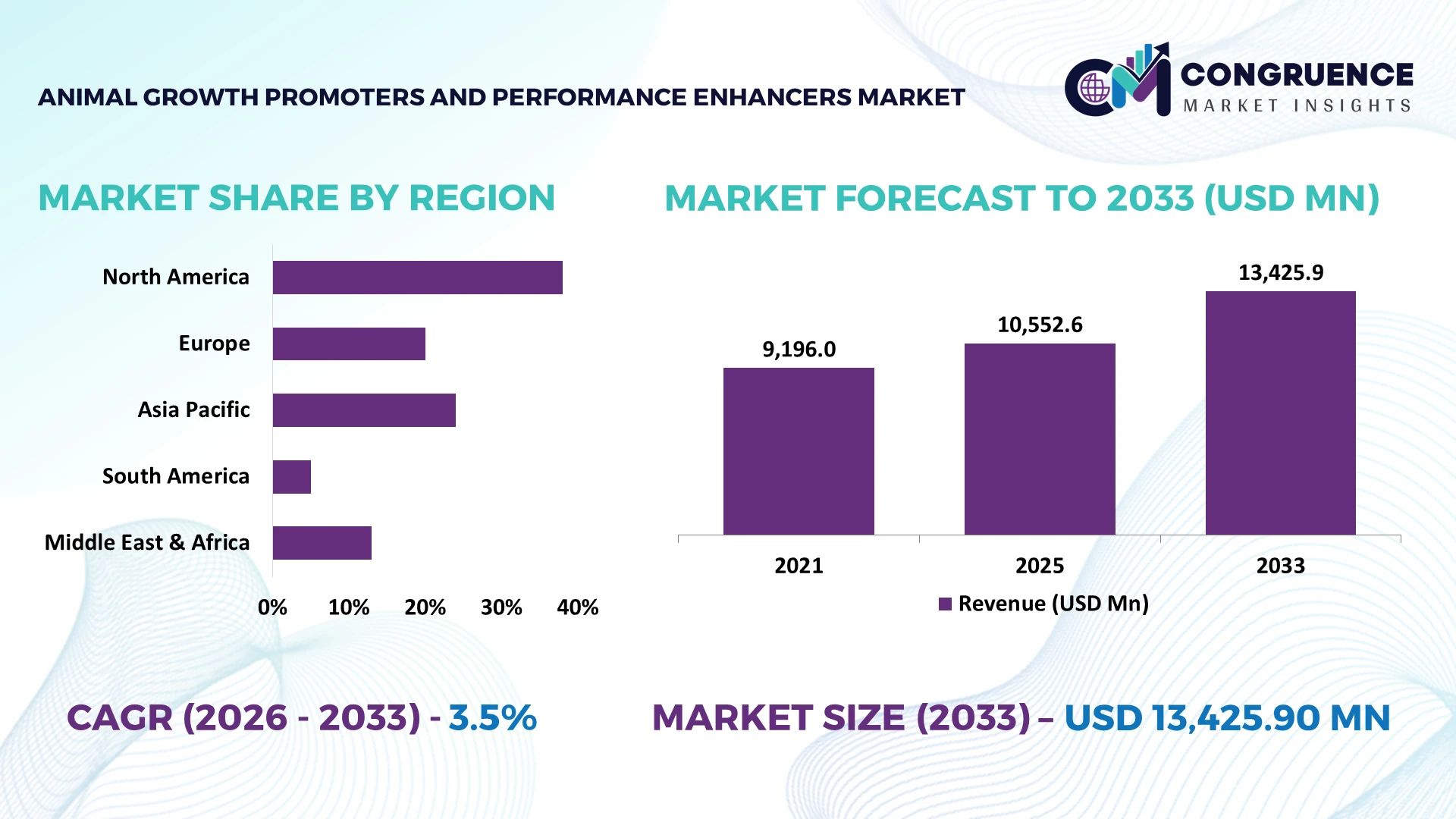
The Global Animal Growth Promoters and Performance Enhancers Market was valued at USD 10552.6 Million in 2025 and is anticipated to reach a value of USD 13425.9 Million by 2033 expanding at a CAGR of 3.5% between 2026 and 2033. Growth is driven by antibiotic-free feed additives, precision livestock nutrition, enzyme supplementation, and increasing adoption of probiotics and phytogenic performance enhancers in intensive poultry and swine production.
The United States maintains a leading position in advanced animal performance enhancer development, supported by commercial feed manufacturing, biotechnology investment, and precision livestock nutrition. US commercial feed production exceeds 230 million metric tons annually, while China produces more than 300 million metric tons of industrial feed. American producers increasingly integrate enzyme formulations, direct-fed microbials, and digital feed optimization into poultry, swine, and cattle operations. China's restrictions on antibiotic growth promoters since 2020 have accelerated alternative additive development, strengthening international competition in microbial feed technologies.
Strategically, China's 2020 antibiotic feed restrictions and the United States' industrial feed manufacturing scale exceeding 230 million metric tons establish regulatory compliance, biological additive performance, and supply-chain localization as decisive competitive priorities.
Market Size & Growth: USD 10,552.6 million in 2025, reaching USD 13,425.9 million by 2033 at 3.5% CAGR, supported by microbial feed additives and precision nutrition.
Top Growth Drivers: Global feed output increased 2.9%, Asian production expanded 5.0%, and African feed manufacturing rose 11.5% in 2025, expanding additive integration opportunities.
Short-Term Forecast: By 2028, feed producers targeting 3% improvement in feed conversion efficiency will prioritize validated enzymes, probiotics, and precision supplementation.
Emerging Technologies: Three advancing technologies include microbiome-targeted probiotics, encapsulated phytogenic compounds, and AI-assisted feed formulation for species-specific performance optimization.
Regional Leaders: Asia produced 559.3 million metric tons of feed, North America 288.6 million, and Europe 274.1 million in 2025, supporting differentiated additive adoption.
Consumer/End-User Trends: Poultry represented 42.7% of global feed production in 2024, reinforcing demand for intestinal health additives and nutrient utilization technologies.
Pilot/Case Example: A 2025 global feed industry assessment recorded 40.136 million additional metric tons of feed production, expanding the addressable volume for performance enhancers.
Competitive Landscape: DSM-Firmenich, Cargill, ADM, Novonesis, and Alltech compete through enzyme technologies, microbial formulations, distribution capabilities, and livestock nutrition partnerships.
Regulatory & ESG Impact: US medically important veterinary antimicrobial sales remained 27% below their 2015 peak in 2024, reinforcing antimicrobial stewardship priorities.
Investment & Funding: Commercial feed production reached 1.44 billion metric tons across 142 surveyed countries, supporting investment in fermentation capacity and feed additive manufacturing.
Innovation & Future Outlook: Precision nutrition platforms increasingly target 2%–5% feed efficiency improvements through advanced enzymes, microbial consortia, and data-driven formulation.
The Animal Growth Promoters and Performance Enhancers Market is shifting toward targeted nutritional interventions across poultry, swine, cattle, and aquaculture production. Advanced probiotics, exogenous enzymes, organic acids, and phytogenic formulations support intestinal health, nutrient absorption, and feed conversion performance. Global compound feed production increased 2.9% in 2025, expanding the industrial base for additive incorporation. China's restrictions on antibiotic growth promoters and European veterinary antimicrobial regulations are encouraging alternative formulation strategies. Precision feeding, microbiome analytics, and protected bioactive ingredients are reshaping product differentiation, establishing important considerations for future investment and competitive positioning.
Animal growth promoters and performance enhancers are becoming strategically important as livestock producers prioritize feed conversion efficiency, antibiotic stewardship, and predictable animal productivity. Feed accounts for approximately 60%–70% of poultry production costs, making nutritional efficiency central to commercial competitiveness. China's 2020 prohibition on antibiotic growth promoters in feed accelerated the transition toward probiotics, organic acids, and enzyme based alternatives. Manufacturers are restructuring additive portfolios around gut health, nutrient digestibility, and species specific formulations to address changing veterinary regulations and procurement requirements.
Technology differentiation increasingly influences purchasing decisions. Precision enzyme supplementation can improve feed conversion ratios by 2%–5% under optimized conditions compared with conventional unsupplemented formulations. The United States emphasizes integrated nutrition programs and advanced fermentation technologies, while China concentrates on large scale microbial additive manufacturing. European producers prioritize regulatory compliance and validated antibiotic alternatives. These differences influence formulation investment, product registration, and regional distribution strategies.
During 2026–2028, commercial adoption will increasingly favor microbiome targeted additives, automated feed formulation, and measurable livestock performance outcomes. Novonesis and DSM-Firmenich are expanding biological innovation capabilities, while integrated poultry producers are incorporating enzyme and probiotic combinations into feeding programs. Competitive leadership will depend on demonstrable feed efficiency, reliable biological ingredient supply, and consistent performance across intensive production systems.
Restrictions on antibiotic growth promoters are accelerating adoption of microbial and enzyme based performance enhancers. China's 2020 feed antibiotic prohibition redirected livestock nutrition toward probiotics, organic acids, and phytogenic compounds. Feed represents 60%–70% of poultry production costs, making feed conversion improvements commercially significant. Controlled feeding trials have demonstrated 2%–5% improvements in feed efficiency with selected enzyme formulations, supporting measurable reductions in feed consumption per kilogram of animal weight gain. In the United States, poultry integrators increasingly evaluate additive combinations through controlled production trials. Companies including Novonesis and DSM-Firmenich are advancing microbial strains, enzyme technologies, and targeted nutritional formulations. The strategic advantage lies in converting relatively small improvements in nutrient utilization into substantial operational savings across intensive livestock production.
Animal performance enhancer manufacturers face structural exposure to agricultural feedstocks, fermentation substrates, and specialized ingredient processing. Feed represents approximately 60%–70% of intensive poultry production costs, limiting producers' willingness to adopt expensive additives without measurable performance improvements. Corn and soybean meal account for substantial portions of compound feed formulations, exposing procurement budgets to agricultural commodity volatility. A 10% increase in additive procurement costs directly weakens product economics unless feed conversion benefits offset expenditure. China's large fermentation manufacturing base creates competitive pressure on imported microbial products, while energy intensive drying and encapsulation increase production expenses. Suppliers are responding through localized fermentation, diversified substrate sourcing, long term procurement agreements, and concentrated formulations that reduce transportation and handling costs.
Precision livestock nutrition creates opportunities for performance enhancers that deliver measurable improvements under specific production conditions. Feed conversion improvements of 2%–5% translate into substantial resource savings for integrated poultry and swine operations, while advanced phytase formulations improve phosphorus utilization and reduce dependence on inorganic phosphate supplementation. Selected enzyme programs have demonstrated phosphorus excretion reductions exceeding 20% under controlled feeding conditions. India offers opportunities through expanding commercial poultry production and increasing adoption of formulated feed. Companies are investing in microbiome profiling, protected probiotics, and digitally optimized additive combinations to differentiate products by animal age, feed composition, and production environment. The strategic opportunity lies in performance based nutrition contracts supported by measurable farm level outcomes rather than standardized additive volumes.
Maintaining consistent additive performance across livestock species, feed formulations, and production environments remains a critical commercialization challenge. Poultry gastrointestinal temperatures approach 40–42°C, while feed pelleting commonly exposes ingredients to temperatures of 75–90°C, creating stability requirements for microbial cultures and enzymes. Experimental probiotic viability losses can exceed 50% during unsuitable thermal processing, reducing effective delivery to the digestive tract. Differences in intestinal microbiota, feed composition, and animal health status further complicate reproducible performance. European regulatory requirements demand species specific efficacy and safety documentation, increasing validation complexity. Manufacturers must invest in microencapsulation, thermostable enzyme engineering, controlled feeding trials, and advanced quality assurance systems. Long term competitiveness depends on reliable biological activity throughout manufacturing, storage, and animal digestion.
Thermostable Additives Reshape Feed Processing: Feed manufacturers are adopting heat-resistant enzyme and microbial formulations compatible with pelleting temperatures of 75–90°C. Advanced protective coatings target bacterial survival above 80% during processing, depending on formulation and exposure conditions. Companies including Novonesis are developing robust biological ingredients that withstand industrial feed manufacturing, improving dosage consistency and reducing post-pelleting supplementation requirements.
Phytogenic Formulations Gain Commercial Traction: European livestock nutrition suppliers are expanding standardized botanical extracts containing essential oils, tannins, and plant-derived bioactive compounds. Experimental phytogenic supplementation has demonstrated 3%–6% improvements in selected poultry performance indicators. Companies including Delacon are refining encapsulation and ingredient standardization, improving product stability and supporting consistent dosing across commercial feed manufacturing systems.
Aquaculture Nutrition Shifts Toward Functional Additives: Salmon and shrimp producers are integrating specialized functional ingredients into high-density feeding programs. Norwegian salmon feed formulations commonly contain more than 30% plant-derived ingredients, increasing attention to digestive tolerance and nutrient utilization. DSM-Firmenich and other nutrition suppliers are developing aquaculture-specific additives that support intestinal resilience and reduce performance variability associated with alternative protein ingredients.
Traceable Feed Additives Strengthen Procurement Controls: European feed manufacturers are implementing enhanced ingredient traceability under established feed safety requirements. FAMI-QS certification incorporates 2 principal operational priorities: feed safety and quality management, while batch identification enables traceability across production stages. Suppliers are upgrading digital documentation, audit systems, and manufacturing controls to improve regulatory readiness and reduce procurement disruption.
Antibiotics represent an indicative 30%–35% share of the global Animal Growth Promoters and Performance Enhancers Market, reflecting established veterinary applications and extensive distribution networks. However, their role as growth promoters is restricted or prohibited in major markets, including the European Union and China. The United States prohibits medically important antibiotics for growth promotion, shifting approved uses toward veterinary supervised disease management. These regulatory distinctions are influencing product portfolios and limiting the commercial relevance of traditional antibiotic growth promotion. Manufacturers are increasingly separating therapeutic antimicrobial products from nutritional performance enhancers to align with regional compliance requirements.
Probiotics represent the fastest advancing type, supported by commercial interest in gut microbiota management and non-antibiotic performance improvement. Selected probiotic trials demonstrate 2%–5% improvements in feed conversion efficiency under controlled conditions. Prebiotics support beneficial microbial populations, while Enzymes improve nutrient digestibility and reduce undigested feed components. Hormonal Promoters retain relevance in permitted cattle production systems, particularly in the United States, but face restrictions elsewhere. Companies are investing in microbial strain development, enzyme formulation, and species specific product validation to strengthen differentiated nutritional portfolios.
Feed Efficiency represents an indicative 30%–35% share of the global market, supported by its direct influence on livestock production economics and measurable nutritional performance. Commercial poultry and swine operations evaluate additives through feed conversion ratios, nutrient digestibility, and weight gain relative to feed intake. Enzyme supplementation can improve feed conversion by 2%–5% in selected production trials, providing quantifiable benefits for integrated producers. Growth Improvement remains closely associated with feed efficiency but emphasizes average daily gain and production cycle performance. Manufacturers are developing targeted formulations that optimize nutrient release and maintain consistent performance across different grain based diets.
Disease Prevention represents the fastest advancing application, reflecting increasing attention to intestinal health, pathogen management, and preventive livestock nutrition. Meat Production remains a major application across poultry, swine, and cattle systems, while Milk and Egg Production emphasizes lactation efficiency, laying performance, and nutrient utilization. Selected probiotic interventions have demonstrated improvements exceeding 5% in specific egg production indicators under experimental conditions. Companies are expanding functional additive portfolios and strengthening farm trial partnerships to demonstrate application specific outcomes and improve purchasing confidence.
Poultry Farms represent the leading end-user category, with an indicative 35%–40% share of the global market. Their position reflects intensive production cycles, standardized feeding programs, and widespread commercial use of nutritional additives. Poultry accounted for approximately 42.7% of global compound feed production in 2024, creating substantial opportunities for enzyme, probiotic, and prebiotic incorporation. Integrated poultry operations prioritize measurable flock performance, feed utilization, and production consistency. Manufacturers are developing formulations tailored to broiler growth stages and laying hen nutrition, while expanding technical support for large commercial farming operations.
Aquaculture Farms represent the fastest advancing end-user category, supported by intensive fish and shrimp farming and greater use of formulated functional feeds. Livestock Farms maintain established demand across cattle and swine operations, where additive selection depends on production objectives and regulatory conditions. Animal Feed Manufacturers serve as critical industrial purchasing and distribution channels, incorporating performance enhancers into compound feed formulations. Specialized aquaculture probiotics have demonstrated feed conversion improvements exceeding 5% in selected trials. Suppliers are expanding species specific product portfolios, feed mill partnerships, and technical advisory services to strengthen commercial adoption.
Asia-Pacific accounted for the largest indicative market share at 38% in 2025 however, Asia-Pacific is expected to register the fastest growth, expanding at an indicative CAGR of 4.8% between 2026 and 2033.

Precision Livestock Nutrition and Advanced Feed Additive Commercialization
North America accounts for an indicative 25% share of the global animal growth promoters and performance enhancers market, supported by industrial livestock production, advanced feed manufacturing, and biotechnology commercialization. The United States dominates regional consumption through integrated poultry, swine, and cattle operations, while Canada contributes specialized animal nutrition manufacturing and dairy productivity technologies. Regional compound feed production reached approximately 288.6 million metric tons in 2025, establishing substantial industrial capacity for nutritional additive incorporation. American manufacturers emphasize enzyme supplementation, direct-fed microbials, and targeted feed formulations designed to improve nutrient utilization. Feed conversion improvements of 2%–5% in selected enzyme trials reinforce the commercial relevance of performance-based supplementation. Companies including Cargill, ADM, and Alltech are expanding biological formulation capabilities and technical partnerships to strengthen differentiated livestock nutrition programs.
United States Market Outlook: The United States maintains a leading position through its integrated livestock supply chains, established veterinary infrastructure, and specialized feed additive manufacturers. The FDA's Veterinary Feed Directive framework requires veterinary oversight for medically important antimicrobials administered through feed. Commercial producers increasingly prioritize approved nutritional alternatives, microbial stability, and documented animal performance. Large poultry integrators provide scalable environments for evaluating additive efficacy across standardized feeding programs.
Regulatory Compliance Accelerates Functional Feed Additive Innovation
Europe represents an indicative 22% share of the global market, supported by advanced animal nutrition research, established compound feed manufacturing, and stringent veterinary regulatory requirements. European feed production reached approximately 274.1 million metric tons in 2025, supporting substantial demand for nutritional additives across poultry, swine, and dairy operations. The European Union has prohibited antibiotic growth promoters since 2006, encouraging development of probiotics, prebiotics, and enzyme-based performance technologies. Regulatory restrictions on veterinary antimicrobial use have further strengthened preventive nutrition strategies. Denmark, Germany, France, and the Netherlands concentrate important fermentation, feed formulation, and animal nutrition capabilities. Companies including DSM-Firmenich and Novonesis are developing microbial and enzymatic technologies for species-specific applications. Competitive differentiation increasingly depends on documented efficacy, regulatory authorization, manufacturing traceability, and compatibility with established European feed safety standards.
Germany Market Outlook: Germany offers a strategically important market through its industrial feed manufacturing infrastructure, biotechnology capabilities, and substantial livestock production base. The country maintains approximately 10 million cattle and more than 20 million pigs, supporting specialized nutritional requirements across dairy, swine, and beef production. Feed manufacturers prioritize digestibility improvement, nutrient utilization, and regulatory compliance, creating opportunities for validated enzyme and microbial additive formulations.
Industrial Feed Expansion and Biological Additive Manufacturing Leadership
Asia-Pacific holds the largest indicative market share at 38%, supported by intensive livestock production, expanding commercial feed manufacturing, and large-scale animal nutrition supply chains. Regional feed production reached approximately 559.3 million metric tons in 2025, exceeding North American production by nearly 94%. China dominates regional industrial feed manufacturing, while India contributes expanding poultry and dairy production capabilities. Japan emphasizes specialized feed formulations and advanced animal health technologies, whereas Southeast Asian producers prioritize aquaculture nutrition and commercial poultry productivity. China's prohibition on antibiotic growth promoters in feed since 2020 has accelerated commercial development of microbial and enzyme-based alternatives. Regional suppliers are expanding fermentation capacity, localized ingredient sourcing, and species-specific formulations. Competitive positioning increasingly depends on manufacturing scale, distribution efficiency, and consistent performance across diverse feeding systems.
China Market Outlook: China represents the region's largest industrial feed manufacturing base, producing more than 300 million metric tons of commercial feed annually. Its extensive swine and poultry sectors create substantial demand for probiotics, enzymes, and specialized nutritional formulations. Domestic manufacturers are strengthening microbial fermentation capabilities and developing locally sourced biological ingredients. Regulatory restrictions on antibiotic growth promotion have reinforced investment in feed efficiency technologies and non-antibiotic nutritional alternatives.
Export-Oriented Livestock Production Strengthens Nutritional Efficiency Demand
South America represents an indicative 10% share of the global animal growth promoters and performance enhancers market, supported by intensive poultry production, commercial swine farming, and export-oriented livestock operations. Brazil dominates regional industrial demand through extensive poultry and beef production, while Argentina contributes established cattle and feed manufacturing capabilities. Brazil exported approximately 5.3 million metric tons of chicken meat in 2024, reinforcing the importance of feed efficiency and consistent livestock productivity. Regional manufacturers increasingly incorporate enzymes, probiotics, and specialized nutritional additives into commercial feeding programs. Agricultural commodity volatility creates procurement pressure, encouraging suppliers to develop formulations compatible with locally available corn and soybean meal. Companies including Cargill and ADM maintain important feed industry relationships, supporting ingredient distribution and technical nutrition services. Commercial competitiveness depends on measurable animal performance and efficient additive procurement.
Brazil Market Outlook: Brazil is strategically important through its globally competitive poultry, swine, and cattle industries. The country's soybean production and corn supply chains provide a strong foundation for industrial feed manufacturing. Brazilian poultry exporters serve more than 150 international markets, creating requirements for consistent production performance and veterinary compliance. Feed additive suppliers are strengthening local distribution, formulation support, and partnerships with integrated livestock producers to improve nutritional efficiency.
Poultry Industrialization and Feed Manufacturing Infrastructure Expansion
The Middle East & Africa region represents an indicative 5% share of the global market, supported by commercial poultry expansion, livestock productivity initiatives, and increasing industrial feed manufacturing investment. African compound feed production expanded by approximately 11.5% in 2025, reflecting greater manufacturing activity across established and emerging livestock economies. Saudi Arabia emphasizes domestic poultry production and food security, while Egypt maintains substantial commercial feed manufacturing and poultry operations. South Africa contributes established animal nutrition research and feed processing capabilities. Regional producers face variable ingredient availability, import dependence, and production conditions that influence additive performance. Manufacturers are responding through localized distribution, heat-stable formulations, and technical partnerships with feed mills. The strategic opportunity lies in improving livestock productivity while reducing exposure to imported feed ingredients and inconsistent nutritional quality.
Saudi Arabia Market Outlook: Saudi Arabia is advancing domestic poultry production under its Vision 2030 food security objectives. National poultry self-sufficiency has exceeded 70%, supporting continued investment in commercial livestock production and feed manufacturing. High ambient temperatures increase the importance of nutritional consistency, ingredient stability, and controlled feeding systems. Feed additive suppliers are targeting integrated poultry operations through specialized formulations, technical advisory services, and local distribution partnerships.
DSM-Firmenich, Cargill, ADM, Novonesis, and Alltech compete through biological innovation, formulation expertise, and integrated livestock nutrition distribution. Their combined market share is indicatively estimated at 35%–40%, reflecting fragmentation across regulated veterinary products and nutritional additives. DSM-Firmenich emphasizes specialized enzymes and microbial technologies, while Novonesis competes through fermentation capabilities and biological strain development. Cargill and ADM leverage established feed manufacturing relationships, whereas Alltech differentiates through nutritional research and farm advisory services. Selected enzyme formulations improve feed conversion efficiency by 2%–5%, while phytase supplementation can reduce phosphorus excretion by more than 20% under controlled conditions. Companies are expanding fermentation partnerships, developing protected probiotic formulations, and integrating technical services with feed supply contracts. Regulatory authorization, microbial stability, and species-specific validation create substantial entry barriers.
DSM-Firmenich AG
Cargill, Incorporated
Archer Daniels Midland Company (ADM)
Novonesis A/S
Alltech, Inc.
Elanco Animal Health Incorporated
Zoetis Inc.
Kemin Industries, Inc.
Adisseo
Phibro Animal Health Corporation
Evonik Industries AG
Lallemand Inc.
Nutreco N.V.
De Heus Animal Nutrition
Current technologies center on exogenous enzymes, direct-fed microbials, and protected nutritional additives that improve nutrient availability and livestock productivity. Phytase supplementation can reduce phosphorus excretion by 20%–40% under suitable feeding conditions, while selected multienzyme formulations improve feed conversion efficiency by 2%–5%. Commercial feed manufacturers integrate these ingredients through automated microdosing systems, enabling precise inclusion across high-volume poultry and swine production. Compared with unsupplemented diets, enzyme-enhanced formulations deliver measurable nutrient utilization improvements, strengthening feed economics.
Emerging technologies include microbiome-targeted probiotics, thermostable bacterial strains, and microencapsulated phytogenic compounds. Advanced protective coatings improve microbial survival during pelleting temperatures approaching 85°C, while selected probiotic trials demonstrate 3%–6% improvements in growth performance. AI-assisted formulation platforms integrate ingredient composition, animal age, and feeding conditions to optimize additive selection. Integrated livestock producers benefit from more consistent biological performance and reduced formulation variability.
Disruptive innovation increasingly combines metagenomic profiling, precision fermentation, and real-time livestock monitoring. During 2026–2028, manufacturers will prioritize strain-specific validation, automated additive dosing, and digitally connected feed mills. Suppliers offering verified biological efficacy and scalable fermentation capacity will gain competitive advantages over conventional standardized additive manufacturers.
September 2025: ADM and Alltech announced a North American animal feed joint venture combining 43 feed mills across the United States and Canada. The agreement consolidates manufacturing capabilities, technical expertise, and distribution networks to strengthen livestock nutrition services. Source: investors.adm.com
August 2025: DSM-Firmenich inaugurated its first Indian feed additive plant in Jadcherla, covering 11,200 square meters. The facility manufactures mycotoxin management products alongside an existing premix operation, strengthening localized production, ingredient availability, and service responsiveness for livestock producers. Source: dsm-firmenich.com
June 2025: Novonesis completed its €1.5 billion acquisition of DSM-Firmenich's Feed Enzyme Alliance stake, integrating research, manufacturing, and commercial distribution. The transaction strengthens direct control over enzyme technologies and expands customer access across global livestock nutrition markets and production systems. Source: novonesis.com
May 2024: Elanco announced FDA clearance for Bovaer, a dairy feed ingredient capable of reducing enteric methane emissions by approximately 30%. Its commercialization introduced measurable environmental performance benefits and potential carbon credit opportunities for American dairy producers. Source: reuters.com
The Animal Growth Promoters and Performance Enhancers Market Report evaluates industry structure, livestock nutrition technologies, regulatory developments, and competitive strategies between 2026 and 2033. Type segmentation covers Antibiotics, Probiotics, Prebiotics, Enzymes, and Hormonal Promoters. Application analysis examines Growth Improvement, Feed Efficiency, Disease Prevention, Meat Production, and Milk and Egg Production. End-user assessment includes Poultry Farms, Livestock Farms, Aquaculture Farms, and Animal Feed Manufacturers. The report evaluates additive efficacy, nutrient utilization, formulation stability, and commercial deployment across intensive livestock production systems.
Geographic coverage includes North America, Europe, Asia-Pacific, South America, and the Middle East & Africa, examining manufacturing capabilities, regulatory restrictions, and adoption patterns. Technology analysis addresses precision fermentation, protected probiotics, advanced enzymes, and digital feed optimization. Competitive benchmarking supports investment allocation, product development, geographic expansion, and strategic partnerships across established and emerging animal nutrition applications.
| Report Attribute/Metric | Report Details |
|---|---|
Market Revenue in 2025 | USD 10552.6 Million |
Market Revenue in 2033 | USD 13425.9 Million |
CAGR (2026 - 2033) | 3.5% |
Base Year | 2025 |
Forecast Period | 2026 - 2033 |
Historic Period | 2021 - 2025 |
Segments Covered | By Type
By Application
By End-User
|
Key Report Deliverable | Revenue Forecast, Growth Trends, Market Dynamics, Segmental Overview, Regional and Country-wise Analysis, Competition Landscape |
Region Covered | North America, Europe, Asia-Pacific, South America, Middle East, Africa |
Key Players Analyzed | DSM-Firmenich AG, Cargill, Incorporated, Archer Daniels Midland Company (ADM), Novonesis A/S, Alltech, Inc., Elanco Animal Health Incorporated, Zoetis Inc., Kemin Industries, Inc., Adisseo, Phibro Animal Health Corporation, Evonik Industries AG, Lallemand Inc., Nutreco N.V., De Heus Animal Nutrition |
Customization & Pricing | Available on Request (10% Customization is Free) |