
Reports
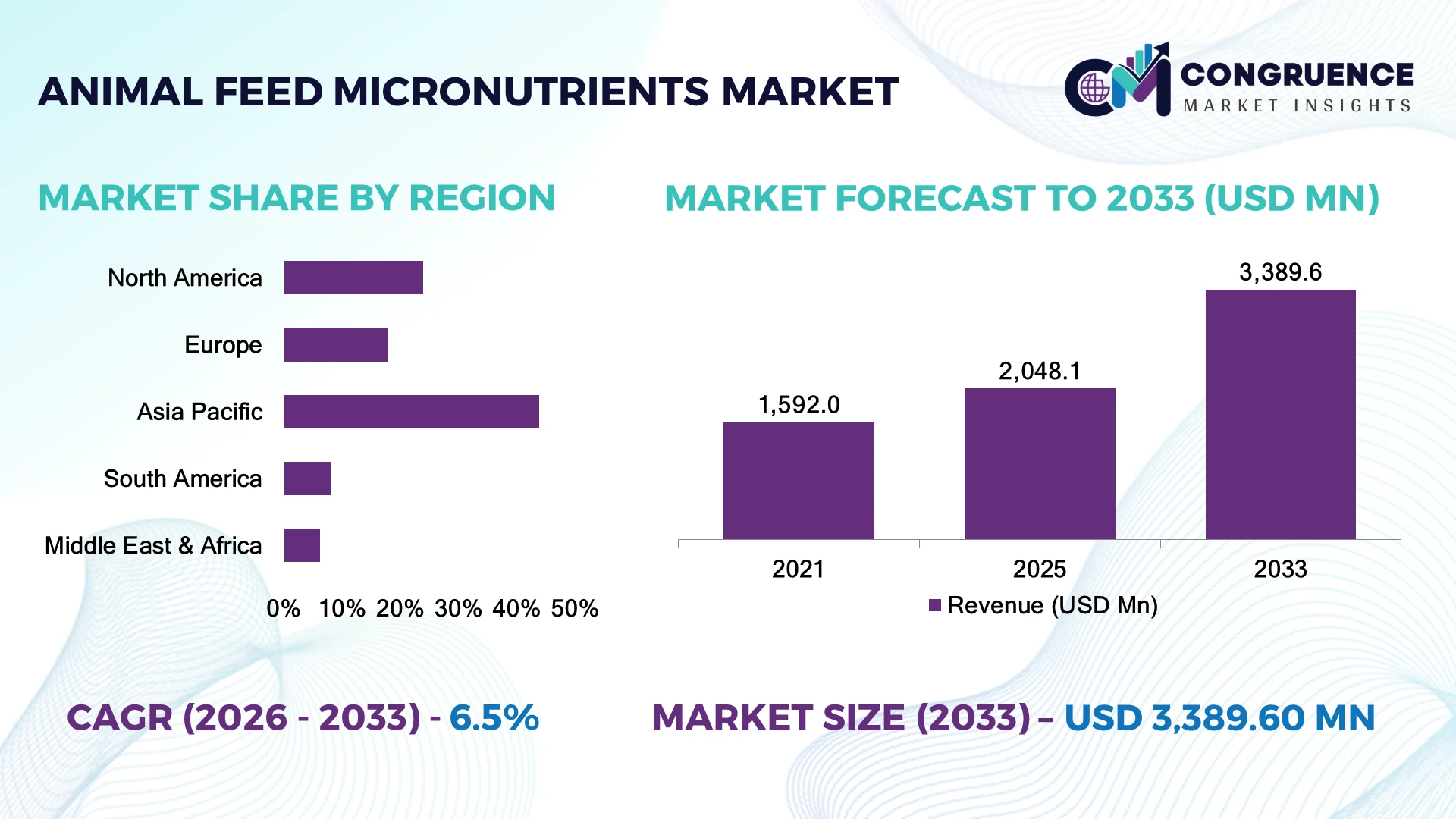
The Global Animal Feed Micronutrients Market was valued at USD 2,048.1 Million in 2025 and is anticipated to reach a value of USD 3,389.6 Million by 2033 expanding at a CAGR of 6.5% between 2026 and 2033. Growth is being driven by precision mineral nutrition, higher-performance livestock production, increasing use of organic and chelated trace minerals, and tighter control of nutrient efficiency and environmental loading.
China dominates the feed-consumption base, producing 330.1 million metric tons of feed in 2025, versus 267.4 million metric tons in the U.S.; its feed output increased 4.8%, while India reached 57.7 million tons with 4.5% growth. Regulatory modernization in Europe, including new trace-mineral authorizations, is accelerating formulation innovation and higher-value micronutrient adoption.
Strategically, suppliers should prioritize China, India, and high-efficiency livestock systems while expanding differentiated chelated and species-specific formulations.
Market Size & Growth: USD 2,048.1 million in 2025 to USD 3,389.6 million by 2033 at 6.5% CAGR, driven by precision nutrition and higher feed-efficiency requirements.
Top Growth Drivers: Precision feeding 31%; mineral fortification 27%; livestock productivity optimization 22%.
Short-Term Forecast: By 2028, precision-formulated micronutrient use is projected to improve feed-conversion efficiency by 4–6% in intensive production systems.
Emerging Technologies: Chelated minerals, nano-minerals, and digital feed-formulation platforms are advancing nutrient bioavailability and formulation accuracy by approximately 5–10%.
Regional Leaders: Asia-Pacific is projected to exceed USD 1.6 billion; North America approaches USD 700 million; Europe exceeds USD 500 million, with increasing specialty-mineral adoption.
Consumer/End-User Trends: Approximately 30% of intensive livestock operations increasingly prioritize trace-mineral optimization alongside conventional vitamin-mineral premixes.
Pilot/Case Example: 2025 precision-mineral feeding programs demonstrated approximately 5% lower mineral wastage while maintaining targeted nutrient delivery.
Competitive Landscape: Leading suppliers such as DSM-Firmenich, BASF, Zinpro, Kemin, and Nutreco compete through formulation science, chelation, distribution, and species-specific solutions.
Regulatory & ESG Impact: EU feed-additive controls increasingly emphasize safety and environmental performance, strengthening demand for higher-bioavailability minerals that can reduce excessive mineral excretion.
Investment & Funding: Global producers are directing millions of dollars toward specialty-mineral capacity, premix integration, localized supply chains, and partnerships with feed manufacturers.
Innovation & Future Outlook: By 2028, smart formulation, organic trace minerals, targeted delivery, and species-specific mineral programs will increasingly replace broad, fixed-dose supplementation strategies.
Animal Feed Micronutrients are becoming increasingly important in poultry, swine, dairy, aquaculture, and livestock formulations where mineral bioavailability directly influences growth, immunity, reproduction, and feed conversion. Chelated zinc, selenium, copper, manganese, and iron are gaining attention, with specialty formulations increasingly representing a higher-value share of mineral supplementation. In 2026, supply-chain resilience and stricter feed-additive controls are encouraging manufacturers to diversify mineral sources and strengthen regional premix production.
The strategic relevance of the Animal Feed Micronutrients Market is shifting from basic nutritional supplementation toward measurable feed-efficiency management. Producers are under pressure to extract greater output from each feed unit while controlling mineral losses, animal-health variability, and production costs. This makes micronutrient selection increasingly important for integrated feed companies, livestock producers, and specialty nutrition suppliers competing on biological performance.
Technology is accelerating this transition. Chelated and organic minerals generally provide stronger bioavailability than conventional inorganic salts, enabling targeted formulations and potentially reducing inclusion levels by approximately 5–15% for selected applications. Digital feed-formulation systems further improve batch precision by approximately 3–7% compared with manual formulation workflows. Europe is moving faster on regulatory qualification and specialty formulations, while China, India, and Brazil offer greater volume opportunities through expanding intensive livestock production.
During 2026–2028, companies are expected to prioritize species-specific premixes, precision mineral dosing, localized manufacturing, and alternative sourcing. A practical deployment model combines farm performance data with automated formulation software to adjust mineral inclusion according to species, production stage, and feed composition. Suppliers that combine validated bioavailability, dependable sourcing, and formulation expertise will gain stronger positioning as micronutrients become a core lever for feed efficiency rather than a commodity input.
Precision livestock nutrition is shifting micronutrient procurement toward targeted formulations, supported by feed analytics and improved premix dosing. Chelated and organic mineral use is estimated to be expanding at 7–9% annually in premium feed formulations, while automated micro-dosing can reduce formulation variance by 15–20%. In the United States, tighter feed-efficiency economics are encouraging integrators to optimize zinc, selenium, iron, copper, and manganese inclusion rather than simply increasing dosage. Producers are responding through formulation partnerships, premix capacity expansion, and investment in traceability systems. The strategic advantage is moving from micronutrient volume toward bioavailability and feed-conversion performance, allowing suppliers with formulation expertise to command stronger margins and deeper contracts.
Animal feed micronutrients remain exposed to volatility in mineral salts, energy-intensive processing, and imported raw materials. Price movements for zinc and copper inputs can exceed 10% during supply disruptions, while logistics and energy expenses can add 5–8% to premix manufacturing costs. China’s position in global mineral processing creates additional procurement sensitivity for manufacturers dependent on concentrated sourcing networks. These pressures compress margins for standardized premixes and complicate long-term pricing agreements with feed mills. Companies are responding through multi-country sourcing, contracted inventories, localized blending, and substitution toward higher-bioavailability forms that require lower inclusion rates. The non-obvious constraint is not absolute mineral scarcity but formulation economics: suppliers unable to stabilize delivered cost risk losing high-volume feed contracts.
Higher-bioavailability micronutrients create an opportunity to capture value through lower inclusion rates and improved livestock performance. Chelated minerals can reduce required inclusion by roughly 10–20% in selected formulations, while precision premix systems can improve dosing consistency by 15% or more. In India, Brazil, and Southeast Asia, intensifying poultry and aquaculture production is increasing demand for customized mineral blends rather than commodity-grade inputs. Companies are expanding R&D around organic minerals, encapsulation, and species-specific formulations, while feed producers are adopting digital formulation platforms. The strongest opportunity lies in combining micronutrient products with formulation intelligence, creating performance-linked solutions that reduce waste, improve nutrient utilization, and strengthen supplier integration with large feed manufacturers.
Scaling advanced micronutrient solutions across poultry, swine, cattle, and aquaculture requires precise control of bioavailability, antagonistic interactions, and species-specific nutritional requirements. Formulation errors of even 5–10% in trace-mineral inclusion can affect nutrient balance, while inconsistent premix homogeneity can undermine performance across large production batches. Brazil and the United States are also seeing greater pressure for documented feed traceability, increasing data requirements throughout manufacturing and distribution. Companies must integrate laboratory testing, automated batching, formulation software, and technical field support to maintain consistency. The long-term competitive risk is therefore operational rather than purely technological: suppliers with weak quality-control infrastructure struggle to replicate performance across geographically dispersed feed mills and customized production environments.
Chelated Mineral Adoption Accelerates Organic and chelated mineral formulations are gaining traction as producers target 10–20% lower inclusion rates while maintaining nutrient availability. Premium feed manufacturers are increasing use of amino-acid complexes and organic trace minerals, particularly where mineral antagonism affects absorption. Suppliers are responding with expanded specialty-mineral portfolios and technical formulation support.
Automated Premix Dosing Expands Automated micro-dosing systems are increasingly integrated into feed mills, reducing formulation variance by approximately 15–20% and improving batch reproducibility. Labor shortages and tighter quality-control requirements are accelerating equipment upgrades in the United States and Europe. Micronutrient suppliers are adapting packaging, particle sizing, and premix specifications for automated handling.
Traceability Becomes Commercial Standard Digital batch tracking is expanding as feed manufacturers strengthen origin verification and quality documentation. Traceability coverage across premium feed operations is estimated at more than 60%, with QR-linked batch records and laboratory documentation becoming more common. Companies are integrating supply-chain data with formulation platforms to reduce recall exposure and strengthen customer qualification.
Species-Specific Premixes Gain Ground Customized blends for poultry, swine, dairy, and aquaculture are replacing standardized mineral packages in higher-value production systems. Customized formulations can reduce unnecessary micronutrient inclusion by 8–15% while aligning dosing with production stage and feed composition. Suppliers are responding through application laboratories, feed-mill partnerships, and digitally supported formulation services.
Inorganic trace minerals remain the leading type in the global animal feed micronutrients market, accounting for an estimated 58% share, supported by established procurement channels, lower unit costs, and compatibility with high-volume premix production. Zinc, iron, manganese, copper, selenium, and iodine remain core formulations, with zinc and manganese together representing roughly 35% of conventional trace-mineral usage. Their mature position contrasts with organic and chelated minerals, which are the fastest-growing type as feed manufacturers prioritize bioavailability, lower inclusion rates, and reduced mineral excretion. Organic forms are estimated to expand their formulation penetration by approximately 8–10% annually in premium livestock and aquaculture feeds. Companies are therefore shifting investment toward chelation technology, hydroxy-mineral systems, and species-specific blends while maintaining inorganic capacity for cost-sensitive markets.
The strategic divide is increasingly between commodity-scale mineral suppliers and specialty nutrition companies competing on absorption, formulation precision, and environmental efficiency. Organic trace minerals carry higher acquisition costs but can support 10–20% lower inclusion in selected formulations, encouraging premium feed producers to rebalance procurement toward performance-based products. Remaining forms, including mineral salts and specialized complexes, retain relevance where stability, price, or regulatory specifications dominate purchasing decisions.
In 2025, Alltech reported that its Bioplex organic trace-mineral portfolio was available in more than 85 countries, demonstrating the expanding commercial infrastructure for chelated copper, zinc, manganese, and iron across livestock and aquaculture applications.
Poultry is the leading application, representing an estimated 42% market share, reflecting high feed-conversion sensitivity, intensive production cycles, and continuous use of standardized premixes. Broiler and layer operations require tightly controlled zinc, manganese, selenium, copper, and iron levels, making micronutrient consistency operationally important. Swine follows with approximately 24%, supported by intensive commercial production and increasing emphasis on reproductive performance and feed efficiency. Aquaculture is the fastest-growing application, with demand expanding as producers optimize mineral nutrition under controlled feeding systems and species-specific formulations. Companies are increasing investment in water-stable mineral complexes, customized premixes, and technical partnerships with feed manufacturers.
Ruminant applications remain strategically important because dairy and beef producers increasingly connect micronutrient supplementation with fertility, immunity, and productivity. Poultry remains more standardized and volume-oriented, whereas aquaculture and premium dairy formulations are shifting toward customized mineral programs. This creates a two-speed market: commodity premixes compete primarily on delivered cost, while specialty suppliers compete on bioavailability and measurable production outcomes. The business implication is clear—application-specific formulation capability increasingly determines pricing power and customer retention.
FAO’s December 2025 agricultural production update continued to track livestock, poultry, fisheries, and aquaculture production across global markets, reinforcing the expanding data infrastructure available for species-specific feed and micronutrient planning.
Commercial feed mills represent the leading end-user, accounting for approximately 55% of global animal feed micronutrient demand because they purchase minerals at scale, operate automated batching systems, and supply integrated livestock producers. Integrated animal producers account for roughly 27%, benefiting from tighter control over formulation, procurement, and production performance. Independent livestock farms represent the fastest-growing end-user group, particularly in India, Brazil, and Southeast Asia, where commercializing farm nutrition practices is increasing demand for standardized premixes and technical formulation support. Companies are responding with tiered pricing, smaller-pack formats, distributor networks, and field nutrition services.
Feed mills remain highly price-sensitive and prioritize consistency, inventory reliability, and batch compatibility, while integrated producers increasingly evaluate micronutrients through feed-conversion, fertility, mortality, and environmental-performance metrics. Independent farms are moving from basic mineral supplementation toward application-specific products, although purchasing remains more fragmented. This shift is strategically important because suppliers can use farm-level technical services to create direct customer relationships that complement traditional feed-mill distribution. Specialty manufacturers are therefore expanding application laboratories, digital formulation tools, and local partnerships to capture higher-value demand beyond standardized premix contracts.
The 2025 Poultry Nutrition & Feed Survey highlighted continuing changes in feed-formulation strategies, sustainability initiatives, and antibiotic-free production, indicating that commercial nutrition decisions are increasingly linked to feed efficiency, health management, and production economics.
Asia-Pacific accounted for the largest market share at 43.8% in 2025 however, Middle East & Africa is expected to register the fastest growth, expanding at a CAGR of 7.4% between 2026 and 2033.
Precision nutrition and integrated feed manufacturing are strengthening specialty-mineral demand
North America maintains a high-value position in the Animal Feed Micronutrients Market because of sophisticated compound-feed production, intensive poultry and livestock operations, and established premix distribution. The United States produced approximately 267.4 million metric tons of animal feed in 2025, representing about 18.6% of global output, although production declined 0.8% year over year. Large feed mills increasingly use automated batching, laboratory testing, and formulation software to control trace-mineral inclusion. Demand is shifting from commodity mineral salts toward chelated and specialty formulations that support feed efficiency and nutrient utilization. Suppliers are expanding application laboratories, technical partnerships, and regional blending capabilities, with procurement increasingly linked to formulation consistency and traceability rather than unit price alone.
United States Market Outlook: The United States remains the region's principal demand center, supported by large-scale poultry, swine, dairy, and beef production and highly integrated feed manufacturing. Its 267.4 million metric tons of feed production in 2025 demonstrates substantial micronutrient consumption potential. Advanced batching systems and precision formulation are increasingly embedded in commercial feed operations, while domestic suppliers benefit from established distribution and technical-service networks. The strategic opportunity is strongest in premium mineral complexes, formulation optimization, and products that improve nutrient utilization without increasing inclusion rates.
Regulatory pressure is accelerating the shift toward efficient mineral utilization
Europe's Animal Feed Micronutrients Market is shaped by stringent feed-safety requirements, environmental policies, traceability, and pressure to reduce nutrient excretion. EU27 industrial compound-feed production was forecast at approximately 147.5 million tonnes in 2025, with poultry feed reaching 50.7 million tonnes and increasing 1.5%. These conditions favor micronutrient products that deliver higher bioavailability at controlled inclusion levels. Germany, Spain, France, and the Netherlands remain important manufacturing centers, although regulatory differences are reshaping production economics. Suppliers are investing in organic minerals, precision premixes, and documentation systems to support compliance and sustainability objectives. The competitive advantage increasingly rests on demonstrating measurable nutritional efficiency rather than simply supplying standardized mineral blends.
Germany Market Outlook: Germany represents a strategically important European market because of its advanced feed-manufacturing infrastructure, concentrated livestock production, and strong quality-control requirements. Its cattle-feed production was forecast to increase approximately 3% in 2025, contrasting with declines in several neighboring markets. German feed manufacturers increasingly emphasize formulation precision, traceability, and efficient mineral utilization. This environment favors suppliers offering technically differentiated premixes, organic trace minerals, and automated dosing compatibility. Companies with localized technical support and reliable compliance documentation are positioned to secure longer-term relationships with commercial feed manufacturers.
Feed-scale concentration is shifting investment toward precision nutrition
Asia-Pacific is the largest production base for animal feed and therefore the most important volume market for micronutrients. China produced approximately 330.1 million metric tons of feed in 2025, up 4.8%, while India reached 57.7 million tonnes, increasing 4.5%. China, India, Vietnam, Japan, and other major production centers are expanding commercial poultry, swine, dairy, and aquaculture systems, increasing demand for standardized premixes and species-specific mineral formulations. The region's feed output reached approximately 559.3 million tonnes in 2025, creating substantial downstream micronutrient demand. Suppliers are responding through local manufacturing, distributor partnerships, and formulation centers, while premium producers increasingly adopt organic and chelated minerals to improve nutrient utilization and production consistency.
China Market Outlook: China is the most strategically significant country in Asia-Pacific, producing approximately 330.1 million metric tons of animal feed in 2025 and accounting for roughly 23% of global output. Its large poultry and swine sectors create substantial recurring demand for zinc, manganese, selenium, copper, and iron. The country's extensive feed-mill network also supports rapid deployment of automated dosing and digital formulation technologies. Domestic manufacturing scale provides cost advantages, while specialty suppliers are increasingly targeting high-performance premixes, aquaculture nutrition, and organic mineral applications. Companies able to combine local production with formulation expertise are best positioned to capture China's increasingly segmented feed-nutrition demand.
Integrated livestock production is strengthening demand for customized mineral programs
South America is anchored by Brazil's large poultry, swine, beef, and aquaculture industries, making it a significant micronutrient consumption center. Brazil produced approximately 89.9 million metric tons of feed in 2025, increasing 2.8%, while the country's mineral-supplement industry represents an important downstream market. Poultry and beef production remain particularly influential in shaping procurement volumes. However, disease events and export restrictions can rapidly alter feed demand, as demonstrated by the 2025 avian-influenza disruption to poultry trade. Companies are therefore strengthening local inventory, supplier diversification, and application-specific formulation capabilities. The strategic shift is toward resilient domestic supply chains and higher-value mineral solutions that support feed efficiency, immunity, and production consistency.
Brazil Market Outlook: Brazil is the dominant South American market, supported by globally significant poultry, beef, swine, and feed-production industries. The country produced approximately 89.9 million metric tons of feed in 2025, with output rising 2.8% despite disruption from avian influenza. Its integrated protein-production structure creates consistent demand for micronutrient premixes across poultry, swine, cattle, and aquaculture. Domestic mineral-supplement manufacturing also strengthens supply availability. Suppliers are increasingly prioritizing regional warehousing, localized blending, and technical partnerships with large feed producers to reduce exposure to logistics interruptions and improve responsiveness to changing livestock-production conditions.
Food-security investment is creating new feed-production infrastructure
Middle East & Africa is transitioning from import-dependent feed procurement toward localized livestock and poultry production, creating new opportunities for micronutrient suppliers. Saudi Arabia is a key investment hub, where government-backed food-security initiatives are supporting modern poultry and feed facilities. In September 2025, two major poultry and feed-production plants were inaugurated in the Riyadh region, while an integrated poultry breeding project exceeding USD 200 million was launched in Al-Jouf with planned annual capacity of 15 million parent-stock chicks. These investments strengthen demand for premixes, trace minerals, and feed-quality systems. Companies are positioning through local partnerships, technical distribution networks, and integrated supply contracts, particularly for poultry, dairy, and aquaculture applications.
Saudi Arabia Market Outlook: Saudi Arabia offers the strongest strategic platform in the region because Vision 2030-linked food-security investment is accelerating domestic poultry, feed, and aquaculture infrastructure. The Al-Jouf poultry breeding project alone carries investment exceeding USD 200 million and targets annual production of 15 million parent-stock chicks. The country is also developing aquaculture opportunities across 15 identified coastal locations, including feed mills and hatcheries. This expanding production ecosystem is increasing demand for consistent micronutrient inputs and specialized formulations. Suppliers with local technical support, reliable inventory, and partnerships across integrated feed and livestock operations are positioned to benefit most from the country's localization strategy.
Cargill, DSM-Firmenich, ADM, Nutreco, and Zinpro compete as global scale leaders, while Alltech, Novus, Kemin, BASF, and regional specialists challenge them through organic minerals and formulation expertise. The top five players hold approximately 44% combined share, indicating moderate concentration. Competition centers on price, bioavailability, supply reliability, and customization, with specialty mineral premiums reaching 10–25% and chelated products delivering 2–3 times higher absorption than selected inorganic forms. Cargill emphasizes integrated sourcing and production capacity, DSM-Firmenich focuses on formulation science, ADM leverages agricultural integration, while Zinpro and Alltech differentiate through proprietary performance minerals. Companies are expanding production, forming biotechnology partnerships, acquiring specialty portfolios, and integrating technical services. The competitive shift is moving from commodity minerals toward high-value, bioavailable formulations and precision nutrition. Entry barriers include regulatory dossiers, formulation IP, technical validation, and global distribution. Winning requires scalable supply, proven efficacy, and application-specific innovation.
Cargill, Incorporated
Archer Daniels Midland Company (ADM)
DSM-Firmenich AG
BASF SE
Nutreco N.V.
Alltech, Inc.
Zinpro Corporation
Novus International, Inc.
Kemin Industries, Inc.
Phibro Animal Health Corporation
Balchem Corporation
Adisseo
Orffa International Holding B.V.
Biochem Zusatzstoffe Handels- und Produktionsgesellschaft mbH
Chelation technology is reshaping premium micronutrient formulations by improving mineral bioavailability and reducing unnecessary inclusion. Organic and amino-acid chelates can provide 2–3 times higher absorption than selected inorganic forms, enabling lower dosing and potentially reducing mineral excretion by 10–20%. Adoption is strongest in premium poultry, swine, dairy, and aquaculture programs, where feed efficiency and environmental performance directly influence margins. Manufacturers are investing in proprietary chelation chemistry, encapsulation, and species-specific formulations to differentiate beyond commodity pricing.
Precision dosing and automated premix systems are becoming increasingly important as feed mills integrate digital formulation, batch monitoring, near-infrared analysis, and automated material handling. Automated production can reduce formulation variance by approximately 15–20%, while real-time ingredient analysis improves consistency and minimizes over-supplementation. Large integrated feed producers benefit most because they can connect micronutrient optimization with production data, procurement, and quality-control workflows. This creates a competitive advantage for suppliers offering integrated formulation services rather than standalone ingredients.
Between 2026 and 2028, AI-assisted formulation, microbiome analytics, advanced encapsulation, and sensor-enabled feed manufacturing will move from selective deployments toward broader commercial integration. Companies combining traceability with precision mineral dosing can target 5–10% lower formulation waste and stronger batch consistency. The immediate technology priority is therefore not a single disruptive mineral, but integration of bioavailable ingredients, automated dosing, and decision analytics into one nutrition platform.
November 2025 Cargill completed its Engerwitzdorf, Austria expansion, lifting micronutrition capacity 50% to 30,000 metric tons annually. Automation now covers 90% of labor across picking, mixing, and loading, improving throughput, safety, and supply reliability for European customers. Source: Cargill
September 2024 Novus International partnered with Ginkgo Bioworks to develop advanced feed additives using enzyme-development capabilities. The collaboration targets more efficient, cost-effective production and supports new solutions for chickens, pigs, and cows, strengthening innovation pipelines as feed margins tighten. Source: Novus International
November 2025 Biochem and BASF agreed on Biochem’s acquisition of BASF’s global glycinate business, expanding Biochem’s organic trace-mineral portfolio and distribution reach. The transaction strengthens access to high-bioavailability mineral solutions and supports lower trace-element excretion across livestock nutrition programs. Source: BASF
February 2026 Cargill opened a new dairy feed plant in Wazirabad, Punjab, with annual capacity of 400,000 tons and more than 1,000 direct and indirect jobs. The facility strengthens localized feed supply and supports India’s expanding dairy-production infrastructure. Source: Cargill
The Animal Feed Micronutrients Market Report evaluates demand across trace minerals, vitamins, amino acids, enzymes, and other micronutrient categories, with analysis spanning poultry, swine, ruminants, aquaculture, and other livestock applications. Coverage includes dry premixes, liquid formulations, specialty mineral complexes, chelated products, and emerging bioavailable nutrition technologies. The report assesses commercial feed mills, integrated producers, and independent livestock operations across North America, Europe, Asia-Pacific, South America, and Middle East & Africa.
The study examines formulation trends, precision dosing, automated premix manufacturing, digital nutrition platforms, bioavailability improvements, supply-chain localization, and sustainability-linked mineral optimization. Competitive analysis covers major multinational suppliers and specialty innovators, with attention to product positioning, production capacity, partnerships, technology investment, and regional expansion. The findings support procurement planning, capacity investment, market-entry decisions, portfolio optimization, competitive positioning, and strategic expansion priorities through 2033.
| Report Attribute/Metric | Report Details |
|---|---|
|
Market Revenue in 2025 |
USD 2,048.1 Million |
|
Market Revenue in 2033 |
USD 3,389.6 Million |
|
CAGR (2026 - 2033) |
6.5% |
|
Base Year |
2025 |
|
Forecast Period |
2026 - 2033 |
|
Historic Period |
2021 - 2025 |
|
Segments Covered |
By Type
By Application
By End-User
|
|
Key Report Deliverable |
Revenue Forecast, Growth Trends, Market Dynamics, Segmental Overview, Regional and Country-wise Analysis, Competition Landscape |
|
Region Covered |
North America, Europe, Asia-Pacific, South America, Middle East, Africa |
|
Key Players Analyzed |
Cargill, Incorporated, Archer Daniels Midland Company (ADM), DSM-Firmenich AG, BASF SE, Nutreco N.V., Alltech, Inc., Zinpro Corporation, Novus International, Inc., Kemin Industries, Inc., Phibro Animal Health Corporation, Balchem Corporation, Adisseo, Orffa International Holding B.V., Biochem Zusatzstoffe Handels- und Produktionsgesellschaft mbH |
|
Customization & Pricing |
Available on Request (10% Customization is Free) |




