
Reports
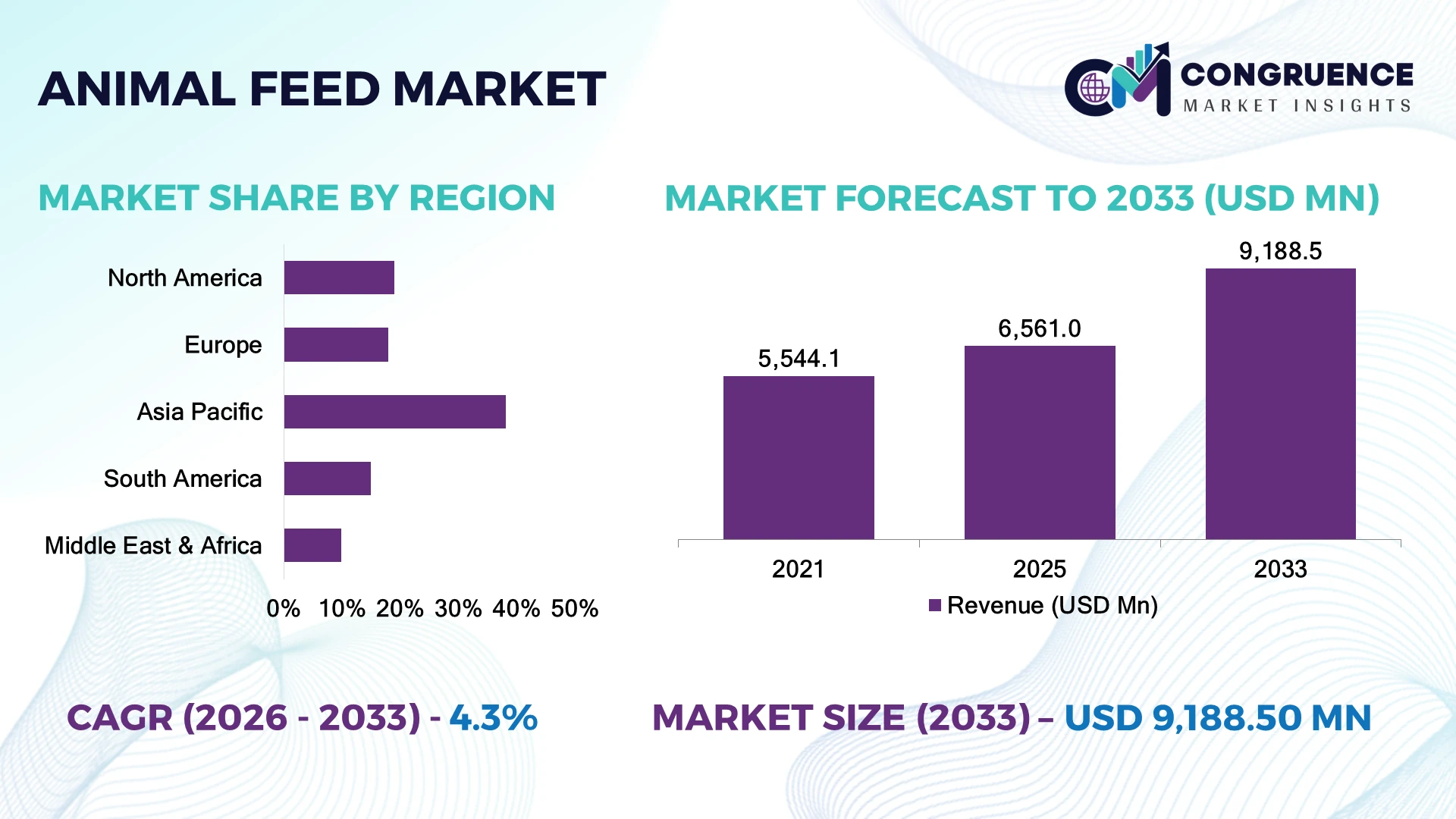
The Global Animal Feed Market was valued at USD 6,561.0 Million in 2025 and is anticipated to reach a value of USD 9,188.5 Million by 2033 expanding at a CAGR of 4.3% between 2026 and 2033. Precision nutrition, automated formulation, feed enzymes, amino-acid optimization, and tighter antibiotic-use controls are strengthening feed-efficiency investments across livestock and aquaculture production.
China remained the dominant feed-production country in 2025 with 330.06 million metric tons, growing 4.8%, compared with 267.38 million metric tons in the U.S., which declined 0.8%; China, the U.S., and Brazil together accounted for 47.7% of global feed production. Geopolitical commodity disruptions are accelerating local sourcing, inventory resilience, and automated feed-mill investments.
Strategic implication feed producers that combine ingredient security, precision formulation, and automated processing will gain stronger cost and operational positioning.
Market Size & Growth: USD 6,561.0 million in 2025 to USD 9,188.5 million by 2033 at 4.3% CAGR, supported by precision nutrition and automated feed formulation.
Top Growth Drivers: Aquaculture 4.7%, broiler feed 3.7%, and swine feed 3.0% are strengthening high-growth production segments.
Short-Term Forecast: By 2028, precision feeding targets 8%+ lower production costs through optimized nutrient allocation and automated ration management.
Emerging Technologies: AI formulation, IoT feeders, predictive analytics, microbiome solutions, and automated dosing are improving feed conversion and formulation accuracy.
Regional Leaders: Asia Pacific at about USD 3.5 billion, North America near USD 2.0 billion, and Europe around USD 1.7 billion by 2033, with automation adoption accelerating.
Consumer/End-User Trends: Poultry represented 36.4% of market share, while amino acids accounted for 31.3%, highlighting efficiency-led feed formulation.
Pilot/Case Example: 2026 precision-feeding research achieved more than 8% lower production costs, 25% lower protein and phosphorus intake, and up to 40% lower nutrient excretion.
Competitive Landscape: Cargill leads major poultry-feed categories at approximately 8.5% share, competing with ADM, Nutreco, CP Foods, and New Hope Group.
Regulatory & ESG Impact: Precision feeding can reduce greenhouse-gas emissions by 6%, strengthening demand for resource-efficient nutrition systems.
Investment & Funding: Cargill invested ₹300 crore in a 400,000-ton annual-capacity Indian dairy-feed facility, emphasizing localized production and automation.
Innovation & Future Outlook: AI, alternative proteins, nutrigenomics, metagenomics, and adaptive feeding are shifting competition toward measurable efficiency and sustainability.
The Animal Feed Market is increasingly centered on poultry, swine, dairy, aquaculture, and precision nutrition applications. Poultry accounted for 36.4% of the market in 2025, while global feed production reached approximately 1.44 billion metric tons and aquaculture feed increased 4.7%. Supply-chain restructuring and advanced processing are pushing producers toward localized manufacturing and data-driven formulation, setting the foundation for strategic industry transformation.
Animal feed is becoming strategically important because feed efficiency directly influences livestock profitability, production resilience, and environmental performance. Precision feeding has demonstrated more than 8% lower production costs, approximately 25% lower protein and phosphorus intake, and up to 40% lower nutrient excretion, turning digital nutrition into a measurable operating advantage.
Supply-chain restructuring is becoming equally important. China produced 330.06 million metric tons of feed in 2025 versus 267.38 million metric tons in the U.S., while India reached 57.73 million metric tons, highlighting substantial differences in production scale and industrialization. Commodity-security measures and geopolitical trade tensions are encouraging manufacturers to diversify sourcing and strengthen domestic feed infrastructure.
Over the next 2–3 years, manufacturers will prioritize automated mills, AI formulation, specialty additives, and localized capacity. A 400,000-ton annual-capacity feed facility in India demonstrates the shift toward large-scale regional production, while feed-mill consolidation in North America is strengthening operational efficiency. Companies integrating ingredient security with precision nutrition and automated production will establish the strongest long-term competitive positioning.
Precision nutrition is becoming a primary growth driver as livestock producers seek measurable improvements in feed conversion and nutrient utilization. Precision pig-feeding systems can reduce production costs by more than 8%, protein and phosphorus intake by approximately 25%, and nutrient excretion by up to 40%. Global feed production increased 2.9% in 2025, while broiler feed output rose 3.7%, reinforcing demand for high-efficiency formulations. China and India are expanding automated feed infrastructure as livestock production becomes increasingly industrialized. Companies are responding through AI formulation, sensor-based feeding, enzymes, amino acids, and automated dosing. The strategic advantage is that precision nutrition enables higher animal output without proportionally increasing ingredient consumption, strengthening margins while improving resource efficiency.
Volatility in corn, soybean meal, protein ingredients, and energy costs continues to constrain feed manufacturers. China imports approximately 80% of the soybeans it consumes, creating substantial exposure to international commodity flows and geopolitical trade disruptions. Commodity-cycle pressures are also encouraging major nutrition companies to pursue hundreds of millions of dollars in structural cost reductions. These pressures directly affect formulation costs, inventory planning, and producer margins when feed prices cannot immediately reflect ingredient inflation. Companies are reducing exposure through multi-origin procurement, longer-term supply contracts, alternative protein meals, localized processing, and inventory buffers. The strategic constraint is procurement flexibility: manufacturers with diversified ingredient portfolios can protect margins faster than operators dependent on a narrow commodity basket.
Alternative proteins and functional ingredients create a high-value opportunity as producers seek resilience, efficiency, and lower environmental intensity. Precision feeding has demonstrated 6% lower greenhouse-gas emissions, while precision dairy-management strategies have achieved approximately 9.7% lower dietary crude protein and 14% lower manure nitrogen excretion. Fermentation-derived proteins, microbial ingredients, enzymes, phytogenics, postbiotics, and microbiome-targeted solutions are expanding formulation options. Advanced micronutrition facilities are increasing automated production capacity, with one major facility expanding micronutrition capacity by 50% to 30,000 metric tons annually. Companies are positioning through R&D partnerships, specialty-nutrition investments, and localized production. The strongest opportunity lies in combining alternative ingredients with AI-driven formulation rather than commercializing them as standalone commodities.
Scaling AI-enabled feeding across fragmented livestock operations remains a major execution challenge. Modern systems depend on interoperable sensors, reliable connectivity, standardized datasets, laboratory analytics, and skilled operators, while data heterogeneity limits deployment consistency. Recent AI nutrition research reports feed-conversion prediction at R² = 0.74 and residual-feed-intake prediction at R² = 0.76, demonstrating strong potential but also the need for robust data infrastructure. Advanced feed facilities are establishing benchmarks with 90% automation and more than 25,000 annual laboratory analyses. Companies must invest in interoperable platforms, cybersecurity, workforce training, and technical partnerships. The long-term competitive divide will separate operators that merely install automation from those capable of integrating data into continuous formulation, quality-control, and production decisions.
AI-Enabled Feed Formulation: Feed manufacturers are shifting from fixed ration models toward AI-assisted formulation, predictive analytics, and sensor-based optimization, with precision systems delivering more than 8% lower production costs and up to 40% lower nutrient excretion. Companies are integrating laboratory data, animal performance, and environmental variables into automated workflows to improve formulation speed and reduce ingredient overuse.
Soymeal Reduction Reshapes Sourcing: China is reducing soymeal inclusion from 13% in 2023 toward 10% by 2030, creating stronger demand for alternative proteins, synthetic amino acids, and locally sourced ingredients. The shift targets approximately 10 million metric tons of lower soybean imports and is encouraging large producers to reformulate diets while smaller farms manage higher transition costs.
Automated Feed Mills Scale: Large producers are increasing automation across dosing, mixing, quality control, and loading as labor availability and production consistency become operational priorities. Advanced facilities are reaching approximately 90% automation, while laboratory testing volumes can exceed 25,000 analyses annually. Companies are directing capital toward smart mills, robotics, digital traceability, and centralized quality-control systems.
Poultry Leads Digital Adoption: Poultry remains the largest feed-consuming segment, accounting for approximately 42.7% of global feed output, while AI-enabled monitoring is expanding into real-time egg counting, feed-consumption forecasting, and anomaly detection. Field deployment has achieved 100% egg-count accuracy in controlled trials, prompting producers to combine feeding data with flock-management platforms for faster operational decisions.
Compound feed remains the leading type, accounting for approximately 71.8% of the global animal feed market in the latest segment assessment, supported by standardized nutrition, scalable production, and compatibility with intensive livestock systems. Feed concentrates represent the fastest-growing type, expanding as producers seek flexible nutrient correction and species-specific formulations. Fodder and forage remain strategically important for ruminant operations, particularly where pasture and crop-residue availability reduces purchased-feed requirements. Supplements, feed additives, premixes, and specialty feed are gaining importance as producers prioritize gut health, immunity, nutrient utilization, and production consistency.
The mature compound-feed segment is increasingly differentiated through precision formulation rather than volume alone, while concentrates benefit from greater formulation flexibility. Companies are expanding specialty premixes and additive portfolios, with automation improving batch consistency and reducing formulation variability. Feed concentrates are projected to achieve approximately 5.4% growth in the relevant forecast assessment, reinforcing their faster adoption profile. The business implication is a gradual shift in investment from basic feed capacity toward higher-value nutritional customization and precision blending.
Poultry represents the leading application, supported by intensive production cycles, high feed turnover, and widespread reliance on formulated diets. Poultry feed accounted for approximately 42.7% of global feed output, keeping broiler and layer production at the center of feed-mill utilization. Swine remains a major mature application, while ruminant feeding retains substantial importance through dairy and beef operations. Aquaculture is the fastest-growing application, with feed output increasing approximately 4.7% as fish and shrimp producers adopt more nutritionally precise diets. Pet and specialty applications are also expanding through premium formulations and health-focused nutrition.
Growth-promoter applications are shifting toward non-antibiotic alternatives, while performance-enhancement and health-maintenance formulations increasingly incorporate enzymes, probiotics, phytogenics, and functional additives. Reproductive-health applications remain more specialized but are gaining relevance in dairy and breeding-intensive operations. Companies are scaling poultry and aquaculture formulations while investing in species-specific nutrition programs. The key business implication is that application growth increasingly depends on measurable feed-conversion, health, and production outcomes rather than feed volume alone.
Commercial farms remain the dominant end-user group because intensive poultry, swine, dairy, and aquaculture operations purchase feed at substantially higher volumes and require consistent nutritional specifications. Commercial production therefore concentrates procurement power, supports long-term supply agreements, and accelerates adoption of automated feeding and precision formulation. Household farms remain important in emerging markets, particularly where smallholder livestock production is integrated with local agriculture. Animal feed manufacturers form another critical end-user category through captive production, contract manufacturing, and private-label formulations.
Commercial farms are increasingly shifting from basic feed purchasing toward performance-linked nutrition, with more than 8% production-cost reductions demonstrated through precision feeding in intensive systems. Household operations remain more price-sensitive and slower to adopt connected feeding infrastructure, while manufacturers are investing in scalable premix and specialty-feed platforms. Companies are responding with customized formulations, technical advisory services, contract supply agreements, and differentiated pricing. The fastest structural shift is toward data-enabled commercial farms, where feed suppliers increasingly compete through measurable production outcomes rather than product availability alone.
Asia Pacific accounted for the largest market share at 38.1% in 2025 however, North America is expected to register the fastest growth, expanding at a CAGR of 4.3% between 2026 and 2033.

North America accounted for 19.0% of the global animal feed market in 2025, supported by highly industrialized poultry, cattle, dairy, and swine production. The United States remains the principal market, producing approximately 267.38 million metric tons of feed in 2025. Advanced grain-processing infrastructure, integrated livestock operations, automated feed mills, and established nutrition R&D give the region a strong efficiency advantage. Commercial producers are increasingly adopting automated batching, precision formulation, feed-quality analytics, and digital livestock management. The regional market is also characterized by large-scale procurement and vertically integrated supply chains, enabling manufacturers to optimize ingredient sourcing and production scheduling. Companies are prioritizing functional additives and high-efficiency formulations as feed producers shift from volume-led expansion toward productivity-focused nutrition.
United States Market Outlook: The United States remains the leading North American country by market scale, supported by extensive corn and soybean production and a highly developed commercial livestock industry. Its feed sector benefits from advanced milling infrastructure and strong integration between grain suppliers, feed manufacturers, and livestock producers. The country's mature technology ecosystem is accelerating precision nutrition, automated formulation, feed analytics, and specialized additive adoption across large commercial farms.
Europe accounted for 18.0% of the global animal feed market in 2025 and maintains a mature production base centered on Germany, Spain, France, the Netherlands, and other established livestock markets. Feed manufacturers are increasingly adapting formulations to stricter requirements covering feed safety, antimicrobial use, animal welfare, traceability, and environmental performance. Germany and Spain remain important production centers, while specialty nutrition is gaining greater importance than simple volume expansion. Companies are increasing the use of enzymes, amino acids, functional additives, and precision formulation to improve nutrient utilization and reduce production inefficiencies. The region's stringent regulatory environment is accelerating investment in laboratory testing, digital traceability, alternative ingredients, and resource-efficient formulations. This positions Europe as a technology- and compliance-driven market where product differentiation increasingly depends on measurable nutritional and sustainability performance.
Germany Market Outlook: Germany remains a strategically significant European market because of its advanced livestock production systems, established compound-feed manufacturing infrastructure, and strong feed-quality controls. Producers increasingly emphasize precise nutritional specifications, functional additives, and sustainable ingredient sourcing. The country's regulatory environment is encouraging manufacturers to strengthen traceability and formulation accuracy while reducing dependence on inputs associated with higher environmental impacts.
Asia Pacific accounted for 38.1% of the global animal feed market in 2025, making it the largest regional market. China produced approximately 330.06 million metric tons of feed in 2025, while India produced about 57.73 million metric tons, demonstrating the region's substantial production concentration. China, India, Japan, South Korea, and Southeast Asian markets combine large livestock populations with expanding commercial poultry, swine, dairy, and aquaculture operations. Feed manufacturers are increasing investment in automated mills, precision formulation, amino acids, enzymes, and feed-safety systems. China is also strengthening domestic ingredient efficiency as soybean dependence becomes a strategic supply-chain concern. Companies are therefore balancing high-volume feed production with higher-value nutritional solutions, creating a dual market structure that combines scale-driven manufacturing with accelerating technological modernization.
China Market Outlook: China is the most strategically significant country in the Asia-Pacific animal feed market and produced approximately 330.06 million metric tons in 2025. Its enormous swine, poultry, and aquaculture industries generate substantial recurring feed demand. Modernization of commercial livestock production is increasing adoption of automated feed mills, precision nutrition, biosecurity systems, and nutritionally optimized formulations. Domestic feed-efficiency initiatives are also encouraging manufacturers to reduce ingredient waste and improve protein utilization.
South America accounted for 15.0% of the global animal feed market in 2025, with Brazil serving as the principal production and consumption hub. The region benefits from abundant corn and soybean availability, strong poultry and swine industries, and extensive beef production. Brazil produced approximately 89.90 million metric tons of animal feed in 2025, supporting its position as a major global livestock and feed-production center. Feed manufacturers are investing in automated milling, grain storage, formulation systems, and integrated logistics to support export-oriented meat production. Argentina also contributes through its livestock and agricultural base. However, commodity-price volatility and transportation constraints continue to influence procurement economics. Companies are responding through localized sourcing, storage expansion, long-term ingredient contracts, and vertically integrated production systems.
Brazil Market Outlook: Brazil is the dominant South American country for animal feed production, supported by large poultry, swine, cattle, and grain industries. The country produced approximately 89.90 million metric tons of feed in 2025, reflecting its substantial industrial base. Extensive domestic soybean and corn availability strengthens feed-manufacturing competitiveness, while integrated meat producers are expanding automated feed production to support high-volume livestock operations and export markets.
The Middle East & Africa accounted for 9.9% of the global animal feed market in 2025, representing the smallest of the five major regional markets but an increasingly important infrastructure-development opportunity. Commercial poultry, dairy, cattle, and aquaculture production are strengthening demand for standardized compound feed, particularly in countries pursuing greater domestic food security. Gulf economies are investing in controlled livestock production and feed-storage infrastructure, while South Africa provides a comparatively mature commercial feed-manufacturing base. Dependence on imported grains, oilseeds, and protein ingredients remains a structural constraint, increasing the importance of inventory management and diversified procurement. Companies are responding by expanding localized milling capacity, improving storage systems, establishing supply agreements, and integrating feed production with poultry and dairy operations. The strategic priority is supply resilience rather than simple production expansion.
Saudi Arabia Market Outlook: Saudi Arabia is the strategically significant Middle Eastern market because food-security programs are supporting expansion of poultry, dairy, aquaculture, and livestock infrastructure. Commercial producers are strengthening domestic feed supply and investing in modern storage and processing systems to reduce exposure to imported finished feed. Automated feed production and specialized nutritional formulations are becoming increasingly relevant as producers seek consistent animal performance under challenging climatic conditions.
Cargill, ADM, Nutreco, De Heus, and regional integrated producers compete across compound feed, specialty nutrition, additives, and vertically integrated livestock supply chains. The top five players together account for approximately 20% of the market, leaving room for regional cost leaders and specialized innovators. Competition centers on formulation technology, ingredient security, pricing, delivery reliability, and customization. Precision nutrition and specialty additives increasingly command 10–15% premium positioning versus basic formulations, while automated mills can improve processing efficiency by 5–10%. Cargill and ADM emphasize global sourcing and science-led nutrition; De Heus expands regional manufacturing; Nutreco strengthens specialty nutrition; and integrated Asian producers compete through scale and supply-chain control. The competitive shift is moving from feed-volume competition toward measurable feed-conversion performance, traceability, and supply resilience. High capital requirements, technical expertise, regulatory compliance, and ingredient procurement networks raise entry barriers. Winning requires scale plus differentiated nutrition technology, reliable sourcing, localized capacity, and measurable customer outcomes.
Archer Daniels Midland Company
Nutreco N.V.
De Heus Animal Nutrition
Charoen Pokphand Foods PCL
New Hope Group
Alltech, Inc.
Kemin Industries, Inc.
ForFarmers N.V.
Land O’Lakes Purina Feed
Evonik Industries AG
BASF SE
Adisseo
Godrej Agrovet Limited
AI formulation and precision nutrition are moving feed mills beyond fixed-ration systems. NIR spectroscopy, cloud analytics, and algorithmic formulation can reduce ingredient variability and improve formulation accuracy, while precision feeding has demonstrated more than 8% lower production costs. Adoption is strongest among integrated poultry, dairy, and swine operators.
Automation is replacing manual batching, dosing, weighing, and quality checks. Advanced mills can reach about 90% automation, improving throughput, consistency, and labor productivity versus legacy processes. Digital traceability and connected sensors strengthen batch control, while automated systems reduce process variability and support faster response to ingredient-quality changes. Large integrated producers benefit first because they can connect mill and farm data.
Biotechnology is reshaping feed performance through enzymes, probiotics, amino acids, microbiome solutions, and alternative proteins. Evonik’s Ecobiol probiotic demonstrates up to 46% faster outgrowth than competing products, while MetAMINO has a carbon footprint about 35% below the industry average for comparable methionine sources. By 2026–2028, competitive advantage will increasingly favor companies combining digital formulation with functional nutrition, automated mills, and verified sustainability metrics. Producers that integrate these technologies now can improve feed efficiency, strengthen supply resilience, and differentiate through measurable animal-performance outcomes. This combination supports faster qualification and more responsive procurement decisions.
February 2026 Cargill opened a dairy feed plant in Punjab, India, investing ₹300 crore with 400,000 metric tons annual capacity. The expansion strengthens localized dairy nutrition supply and supports India’s feed self-reliance while extending Cargill’s South Asian manufacturing footprint further. Source: cargill.com
September 2025 De Heus opened a Punjab feed factory after investing about USD 17 million, providing 180,000 kMT installed capacity with expansion potential to 240,000 kMT. Automated multi-species production strengthens local supply and expands De Heus’ Indian platform significantly. Source: deheus.com
September 2025 ADM introduced Digest Carb at SPACE 2025, a feed solution designed to improve rumen fermentation and fiber utilization. The formulation supports ration optimization and can substitute fibrous materials for higher-energy grains, strengthening dairy-feed economics and formulation flexibility. Source: adm.com
June 2025 Evonik announced technical upgrades at its Singapore and Antwerp methionine facilities, requiring 6–7-week production shutdowns. The measures target catalyst replacement, energy efficiency, and sustainability, strengthening long-term production reliability while maintaining global MetAMINO supply across three manufacturing hubs. Source: evonik.com
The Animal Feed Market Report covers the industry across feed additives, species applications, and major end-user groups, with analysis spanning poultry, cattle, swine, aquaculture, and pet nutrition. Coverage evaluates amino acids, feed enzymes, vitamins, antioxidants, antibiotics, acidifiers, and other functional nutrition categories, alongside compound-feed and specialty-feed deployment.
The report analyzes North America, Europe, Asia Pacific, South America, and Middle East & Africa, with country-level emphasis on China, the United States, India, Brazil, Germany, and Saudi Arabia. It evaluates precision formulation, automated feed mills, NIR analysis, probiotics, alternative proteins, digital traceability, and sustainability technologies. With poultry representing 36.4% of market value and amino acids accounting for 31.3%, the analysis identifies investment priorities, expansion opportunities, competitive positioning, supply-chain risks, and technology pathways supporting strategic decisions from 2026 to 2033.
| Report Attribute / Metric | Details |
|---|---|
| Market Revenue (2025) | USD 6,561.0 Million |
| Market Revenue (2033) | USD 9,188.5 Million |
| CAGR (2026–2033) | 4.3% |
| Base Year | 2025 |
| Forecast Period | 2026–2033 |
| Historic Period | 2021–2025 |
| Segments Covered |
By Type
By Application
By End-User
|
| Key Deliverables | Revenue Forecast; Market Trends; Growth Drivers & Restraints; Technology Insights; Segmentation Analysis; Regional Insights; Competitive Landscape; Regulatory & ESG Overview; Recent Developments |
| Regions Covered | North America; Europe; Asia-Pacific; South America; Middle East & Africa |
| Companies Profiled | Cargill, Incorporated; Archer Daniels Midland Company; Nutreco N.V.; De Heus Animal Nutrition; Charoen Pokphand Foods PCL; New Hope Group; Alltech, Inc.; Kemin Industries, Inc.; ForFarmers N.V.; Land O’Lakes Purina Feed; Evonik Industries AG; BASF SE; Adisseo; Godrej Agrovet Limited |
| Customization & Pricing | Available on Request (10% Customization Free) |




