
Reports
The Global Angle Grinder Market was valued at USD 2435 Million in 2025 and is anticipated to reach a value of USD 3231.29 Million by 2033 expanding at a CAGR of 3.6% between 2026 and 2033. Growth is driven by the rapid shift toward cordless brushless grinders, higher-capacity lithium-ion batteries, and compact high-torque tools used in metal fabrication, construction, automotive repair, and infrastructure maintenance.
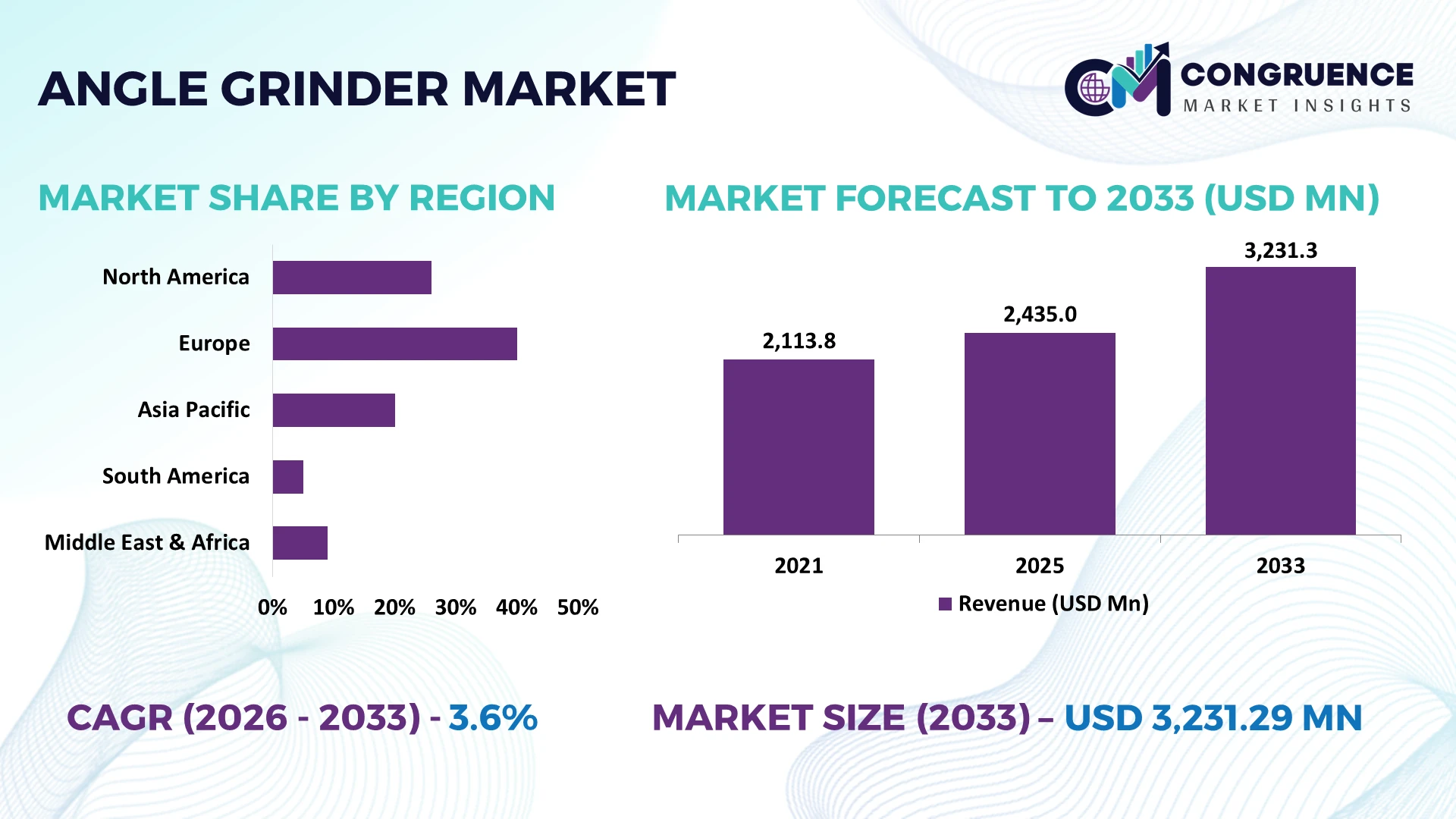
China remains the leading country for angle grinder manufacturing and consumption, supported by its extensive metalworking and construction base, while India is strengthening adoption through infrastructure and industrial investment. China represents approximately 28% of global demand versus about 8% for India. In 2026, U.S.-China trade tensions are accelerating supply-chain diversification and localized component sourcing.
Strategically, manufacturers should prioritize China for production scale while targeting India, the United States, and Germany for premium cordless and brushless product expansion.
Market Size & Growth: USD 2.435 billion in 2025 is projected to reach USD 3.231 billion by 2033 at a 3.6% CAGR, supported by cordless and brushless technology adoption.
Top Growth Drivers: Cordless platforms account for 65%; brushless motors 64.7%; metalworking applications 35.7%.
Short-Term Forecast: By 2028, advanced cordless platforms are targeting 15% higher productivity through improved battery efficiency and motor output.
Emerging Technologies: AI-enabled safety controls, brushless motors, and high-density lithium-ion batteries are accelerating professional-grade grinder development.
Regional Leaders: China leads manufacturing; the United States drives premium cordless adoption; Germany maintains strong industrial-tool demand.
Consumer/End-User Trends: Professional users represent approximately 45–50% of premium cordless grinder consumption in mature markets.
Pilot/Case Example: 2025 cordless platform development achieved up to 44% higher power output than comparable pneumatic equipment, improving jobsite flexibility.
Competitive Landscape: Bosch holds approximately 15% share, alongside Makita, Stanley Black & Decker, Techtronic Industries, and Hilti.
Regulatory & ESG Impact: Battery-powered grinders reduce dependence on pneumatic systems and onsite power infrastructure, supporting lower operational emissions.
Investment & Funding: More than USD 130 million in manufacturing investment is strengthening power-tool capacity and improving supply-chain resilience.
Innovation & Future Outlook: Connected safety, higher-voltage batteries, thermal management, and platform-compatible tools are defining the next competitive cycle.
The Angle Grinder Market is gaining demand from metal fabrication, construction, automotive repair, and industrial maintenance, where cordless mobility and brushless motors improve productivity. Brushless systems represented approximately 64.7% of lithium-battery grinder demand in 2025. In 2026, localized sourcing and battery-platform compatibility are becoming important procurement criteria as manufacturers respond to supply-chain disruptions and increasingly fragmented global production.
The Angle Grinder Market is becoming strategically important as manufacturers compete on cordless performance, battery-platform compatibility, safety, and productivity rather than basic cutting and grinding capability. The shift toward brushless motors and lithium-ion platforms is changing procurement priorities across fabrication, construction, automotive servicing, and industrial maintenance. Supply-chain restructuring in 2026 is also pushing manufacturers toward localized component sourcing and multi-country production.
Brushless cordless grinders typically deliver around 10–20% higher energy efficiency than comparable brushed systems while reducing maintenance requirements through fewer wear components. Germany and the United States are moving faster toward premium connected and battery-powered tools, while China and India remain stronger in volume manufacturing and cost-sensitive deployment. Over the next 2–3 years, professional cordless penetration is positioned to increase by roughly 10–15 percentage points as battery capacity, charging speed, and tool interoperability improve.
A practical deployment example is construction contractors replacing pneumatic or corded grinders with shared 18V–40V battery platforms, reducing cable management and setup requirements. Companies are responding through battery ecosystem partnerships, localized assembly, and expanded brushless portfolios. Competitive advantage will increasingly depend on total operating cost, platform interoperability, and jobsite productivity rather than tool price alone.
The strongest growth driver is the transition from corded and pneumatic equipment toward high-performance cordless grinders. Brushless platforms typically improve energy efficiency by 10–20%, while modern lithium-ion systems can reduce setup-related downtime by approximately 15%. In the United States and Germany, professional contractors increasingly favor shared battery platforms across multiple power tools, strengthening repeat purchases and ecosystem lock-in. In 2026, manufacturers are expanding higher-voltage platforms and faster charging systems to address heavy-duty fabrication requirements. Companies are therefore investing in battery technology, thermal management, and motor optimization rather than competing solely on rotational speed. The non-obvious advantage is recurring ecosystem revenue: compatible batteries, chargers, and accessories can increase customer retention beyond the initial grinder purchase.
Battery-intensive grinders remain constrained by elevated component costs, thermal-management requirements, and dependence on lithium-ion supply chains. Battery packs can represent roughly 25–35% of the system cost for premium cordless tools, while high-power applications place additional demands on cells, electronics, and cooling systems. China remains a critical manufacturing base for battery and electronic components, creating exposure to logistics disruptions and trade-policy changes. Companies are reducing this pressure through dual sourcing, localized assembly, longer supplier contracts, and standardized battery platforms. The key operational constraint is not grinder availability itself but maintaining consistent power output, charging performance, and component economics across markets with different sourcing structures.
The strongest opportunity lies in combining brushless motors, connected diagnostics, advanced batteries, and automated safety features. Smart monitoring can reduce unplanned tool downtime by approximately 10–15%, while improved battery management can extend usable operating cycles by around 15%. The United States offers strong potential for connected professional tools, while India presents an attractive opportunity for compact, durable grinders serving construction and fabrication workshops. Manufacturers are increasingly developing common battery architectures across drills, saws, grinders, and impact tools, creating ecosystem-based purchasing rather than standalone-tool decisions. A particularly valuable opportunity is predictive maintenance: usage data can help fleet operators identify battery degradation and excessive tool loading before productivity losses become operationally significant.
Scaling cordless angle grinders into demanding industrial applications requires consistent power delivery, thermal control, battery safety, and operator compatibility. High-load grinding can increase thermal stress by more than 20% compared with intermittent light-duty use, placing greater pressure on cooling architecture and battery management. Workforce variation also remains significant, with training and safe handling directly affecting tool utilization and service life. Germany's stricter industrial safety expectations and the United States' emphasis on jobsite compliance are increasing the importance of integrated protection features. Companies must therefore invest in electronic controls, thermal diagnostics, ergonomic design, and operator training. The strategic challenge is achieving higher power without sacrificing runtime, safety, durability, or platform compatibility across diverse operating environments.
Cordless Fleet Standardization: Professional buyers are consolidating tools around shared 18V–40V battery platforms, with cordless models already representing about 32% of broader grinder demand and U.S. cordless penetration near 60%. Manufacturers are expanding compatible grinders, chargers, and accessories to increase fleet utilization and reduce replacement friction.
Brushless Motor Conversion: Brushless systems accounted for approximately 64.7% of lithium-battery angle-grinder demand in 2025, reflecting stronger efficiency and lower maintenance requirements. Manufacturers are replacing brushed architectures with electronic controls and thermal protection, while higher copper and steel input costs are accelerating designs that extract more output from existing battery capacity.
Faster Disc Changeover: Tool-free disc systems are moving into professional workflows, with some quick-change designs reducing accessory-change time by up to 80% versus conventional flange systems. Germany and the United States are seeing stronger professional adoption, encouraging manufacturers to integrate spindle-lock improvements, safety controls, and accessory ecosystems rather than compete only on motor power.
Safety-Led Product Redesign: Workplace incidents are pushing manufacturers toward kickback control, restart protection, braking, and ergonomic redesign. A 2025 Australian workplace investigation involving a 9-inch grinder intensified scrutiny of high-torque equipment. Companies are responding with electronic protection and application-specific models, turning safety performance into a measurable procurement criterion rather than a compliance afterthought.
Electric angle grinders remain the leading type, holding approximately 58.2% of the market in 2025 because they provide consistent power, established infrastructure compatibility, and reliable performance for heavy-duty fabrication and construction. Cordless models are the fastest-shifting category, with U.S. adoption reaching approximately 60% and broader cordless grinder penetration approaching 32%. Corded products retain an important role where uninterrupted runtime and stable high torque outweigh mobility advantages.
Cordless adoption is particularly strong among contractors and maintenance teams that value rapid deployment, while pneumatic grinders remain relevant in specialized workshops requiring compact air-powered equipment. Pneumatic tools retain a niche position where compressed-air infrastructure already exists, whereas electric products benefit from simpler deployment. Manufacturers are prioritizing 18V–40V platforms, brushless motors, and interchangeable battery ecosystems, shifting investment toward recurring platform compatibility rather than standalone tool sales.
Metal Grinding leads the defined application mix at approximately 35.7%, reflecting intensive use in fabrication, welding, structural steel preparation, and industrial maintenance. Cutting remains closely linked to construction and fabrication workflows, while Polishing and Surface Preparation serve more specialized finishing requirements. Metal-processing demand is strongest where grinders operate repeatedly across weld removal, edge correction, and material preparation.
Cutting represents the fastest operational shift as cordless platforms increasingly replace corded equipment for mobile fabrication and installation work. The transition reduces cable handling and improves deployment speed, while Surface Preparation is gaining relevance in refurbishment and coating workflows. Companies are responding with higher-torque battery systems, variable-speed controls, dust-management accessories, and application-specific discs. The strategic opportunity is to bundle grinders with consumables and accessories, capturing workflow value rather than relying on tool replacement cycles alone.
Construction represents the dominant end-user group, accounting for approximately 42.8% of cordless angle-grinder demand in 2025. High deployment volumes across structural steel, concrete preparation, installation, and renovation keep grinders embedded in daily jobsite workflows. Metal Fabrication follows at about 29.5%, while Automotive accounts for roughly 17.9%, reflecting concentrated use in workshops and repair operations.
Construction also represents the strongest adoption shift toward cordless platforms because mobility, rapid setup, and reduced cable management directly affect crew productivity. Automotive buyers increasingly favor compact brushless models, while Manufacturing and Shipbuilding continue prioritizing durable high-output equipment for repetitive operations. Companies are responding with customized battery platforms, contractor fleet programs, and industry-specific grinder configurations. The non-obvious advantage is fleet standardization: shared batteries across tools can influence brand selection as strongly as grinder performance.
Europe accounted for the largest market share at 39.9% in 2025 however, Asia-Pacific is expected to register the fastest growth, expanding at a CAGR of 5.5% between 2026 and 2035.

Cordless Professionalization Reshapes Contractor Demand
The United States anchors North American demand through professional construction, metal fabrication, automotive repair, and infrastructure maintenance. Premium cordless systems are gaining ground as contractors prioritize battery interoperability, electronic braking, and reduced setup time. The U.S. market represented approximately 25% of global demand in 2025, while Canada maintains concentrated consumption across mining, energy infrastructure, and commercial construction. Major manufacturers are expanding 18V–40V battery platforms and professional grinder portfolios, strengthening ecosystem-based purchasing and reducing equipment changeover requirements.
United States Market Outlook: The United States remains the region's primary technology and deployment center, supported by large contractor fleets and infrastructure modernization. Professional users increasingly prioritize brushless motors, kickback control, electronic braking, and battery compatibility. More than 60% of professional cordless-tool users in key construction segments increasingly rely on shared battery platforms, encouraging manufacturers to expand compatible grinders, chargers, and accessories while strengthening recurring ecosystem demand.
Safety Compliance Drives Premium Tool Adoption
Europe maintains the strongest market position, supported by Germany's industrial manufacturing base, construction activity, and preference for durable professional equipment. Demand is increasingly shaped by workplace-safety requirements, vibration control, energy efficiency, and cordless modernization. Germany, France, and the United Kingdom represent important professional-tool markets, while industrial users increasingly favor brushless motors and integrated safety electronics. Manufacturers are expanding premium cordless ranges and application-specific accessories, with professional-grade products commanding stronger positioning where durability and compliance influence procurement.
Germany Market Outlook: Germany is Europe's most strategically significant manufacturing market, combining automotive production, machinery manufacturing, metalworking, and advanced construction activity. Professional procurement increasingly favors grinders incorporating brushless motors, electronic braking, vibration reduction, and dust-management features. Approximately 60% of professional German tool users prioritize durability and safety performance in equipment selection, supporting premium positioning and encouraging manufacturers to invest in higher-specification cordless platforms.
China-Led Manufacturing Meets Rapid Tool Adoption
Asia-Pacific combines extensive manufacturing capacity with expanding construction and industrial-tool consumption. China represents an estimated 50–55% of regional angle-grinder demand and approximately 70–80% of regional production, supported by dense supply chains for motors, electronics, castings, batteries, and final assembly. India is developing a secondary manufacturing base, while Japan, South Korea, and Australia show stronger premium-tool adoption. Manufacturers are increasingly combining high-volume production with brushless platforms, localized sourcing, and battery-compatible product families to improve export competitiveness and shorten lead times.
China Market Outlook: China remains the critical production and export hub, with manufacturing clusters supplying branded and OEM equipment across international markets. Approximately 70–80% of regional angle-grinder unit production is concentrated within Chinese manufacturing networks. Companies are expanding brushless and cordless portfolios while improving component localization. The combination of manufacturing scale, supplier density, and export infrastructure gives Chinese producers a significant cost and speed advantage.
Brazil Anchors Industrial and Infrastructure Demand
South America remains smaller than the major industrial markets but offers concentrated opportunities through Brazil's construction, metalworking, automotive, mining, and infrastructure activities. Brazil represents the principal demand center, while Argentina and Colombia provide secondary industrial and construction applications. Corded electric grinders retain relevance because of lower acquisition costs and straightforward servicing, whereas cordless adoption is increasing among mobile contractors. Manufacturers are responding through distributor partnerships, localized inventory, and value-oriented product configurations. Local availability is increasingly important as import lead times and currency fluctuations influence purchasing decisions.
Brazil Market Outlook: Brazil offers the strongest country-level opportunity because of its large industrial base and extensive construction and mining activity. Metal fabrication and equipment maintenance account for a substantial share of professional grinder usage. Companies are balancing durable corded models with entry-level cordless platforms, while distributor networks remain essential for reaching fragmented workshops and contractors outside major industrial centers.
Infrastructure Modernization Supports Premium Tool Deployment
Saudi Arabia and the United Arab Emirates are driving higher-specification tool demand through construction, industrial diversification, energy projects, and large infrastructure programs. South Africa provides a separate demand base linked to mining, fabrication, construction, and industrial maintenance. Premium grinders are gaining preference where demanding site conditions require durability, thermal protection, and consistent output. Cordless systems are also becoming more relevant where mobility reduces dependence on fixed electrical infrastructure. Manufacturers are strengthening distributor networks, project-based sales, and local inventory to support large contractors and infrastructure projects.
Saudi Arabia Market Outlook: Saudi Arabia is the region's strongest strategic market because large infrastructure and industrial-diversification projects are increasing requirements for professional cutting, grinding, and fabrication equipment. Construction and industrial projects are generating sustained demand for high-output tools, with cordless deployment gaining traction for mobile maintenance activities. Manufacturers are positioning through distributor partnerships, project-focused sales, and higher-performance battery platforms designed for demanding operating environments.
Bosch, Makita, Stanley Black & Decker, Techtronic Industries, and Hilti compete primarily as global technology and professional-tool leaders, while regional OEMs compete through cost, customization, and manufacturing speed. The top five players collectively command approximately 45% of the organized market, creating a moderately concentrated structure. Competition centers on battery-platform compatibility, brushless performance, pricing, and supply-chain control. Brushless grinders can improve energy efficiency by 10–20%, while cordless platforms can reduce setup time by approximately 15%. Companies are expanding manufacturing capacity, forming battery-ecosystem partnerships, and integrating motors, electronics, and battery systems to protect margins. The competitive shift is moving from standalone tool sales toward integrated cordless ecosystems, increasing customer switching costs. Cost-focused Asian manufacturers pressure premium brands on pricing, while established players counter through technology and service networks. High tooling requirements, safety compliance, distribution access, and battery-platform investment remain significant entry barriers. Winning requires superior battery ecosystems, reliable supply, differentiated performance, and strong professional distribution.
Bosch
Makita Corporation
Stanley Black & Decker
Techtronic Industries
Hilti Corporation
DEWALT
Metabo
Hitachi Koki
Ingersoll Rand
Atlas Copco
Snap-on
Festool
Koki Holdings
FLEX Power Tools
Brushless motor technology is now the central performance upgrade in professional angle grinders, replacing conventional brushed architectures with electronically controlled motors that reduce mechanical losses and maintenance. Brushless systems can improve energy efficiency by approximately 10–20% and extend operating life by around 15%. Adoption is strongest in premium cordless platforms, where manufacturers integrate electronic braking, overload protection, and thermal monitoring to improve productivity and safety.
Lithium-ion battery platforms are transforming tool deployment by removing cables and compressed-air dependencies. Modern 18V–40V systems can deliver approximately 15% higher usable productivity than older battery architectures through improved energy density and thermal management. More than 60% of professional cordless-tool users in developed markets increasingly favor shared battery platforms. Bosch, Makita, DEWALT, and Milwaukee benefit from ecosystem lock-in as compatible batteries, chargers, and accessories influence purchasing decisions.
Between 2026 and 2028, connected diagnostics, adaptive power control, and smarter battery-management systems will become more commercially important. Digital monitoring can reduce unplanned downtime by approximately 10–15%, while automated load control can improve runtime by roughly 8–12%. Manufacturers investing now in integrated electronics, software-enabled diagnostics, and modular battery architecture will gain stronger fleet relationships, higher utilization, and greater differentiation against cost-focused OEMs.
October 2024 Bosch introduced four 5-inch and two 6-inch angle grinders, including brake and X-LOCK models; X-LOCK enables accessory changes up to 5X faster. The expansion strengthened Bosch’s 18V portfolio and targeted faster, safer professional workflows across construction and fabrication. Source: bosch-press.com
January 2024 Milwaukee introduced the M18 FUEL 125 mm Safety Grinder with AUTOSTOP kickback control, dual-trigger activation, and a permanent side handle. The launch embedded electronic safety into cordless grinding, strengthening compliance-focused differentiation for professional jobsites and heavy-duty applications overall. Source: milwaukeetool.eu
May 2026 Makita launched two 40V max 5-inch XGT flathead grinders delivering 13-amp corded-equivalent power and up to 45% more access in tight spaces. The redesign improves maneuverability and expands cordless penetration in constrained fabrication and maintenance applications globally. Source: makitatools.com
April 2025 Harbor Freight added a 12V brushless cordless right-angle die grinder to its HERCULES professional line, reaching 25,000 RPM with four operating modes. The launch broadens value-focused cordless competition across grinding, polishing, sanding, and deburring workflows for professionals. Source: harborfreight.com
The Angle Grinder Market report covers Corded, Cordless, Pneumatic, and Electric types, with detailed assessment across Metal Grinding, Cutting, Polishing, and Surface Preparation applications. End-user analysis includes Construction, Automotive, Metal Fabrication, Manufacturing, and Shipbuilding, enabling buyers to identify demand concentration, technology adoption, and application-specific purchasing priorities.
Geographic coverage spans North America, Europe, Asia-Pacific, South America, and Middle East & Africa, with country-level analysis focused on manufacturing capacity, industrial deployment, infrastructure activity, and cordless adoption. The report evaluates brushless motors, lithium-ion platforms, safety electronics, quick-change systems, and connected-tool technologies. With cordless models approaching 60% adoption in the U.S. market, the analysis helps companies assess product positioning, expansion priorities, competitive differentiation, supply-chain localization, and investment opportunities through 2033.
| Report Attribute/Metric | Report Details |
|---|---|
Market Revenue in 2025 | USD 2435 Million |
Market Revenue in 2033 | USD 3231.29 Million |
CAGR (2026 - 2033) | 3.6% |
Base Year | 2025 |
Forecast Period | 2026 - 2033 |
Historic Period | 2021 - 2025 |
Segments Covered | By Type
By Application
By End-User
|
Key Report Deliverable | Revenue Forecast, Growth Trends, Market Dynamics, Segmental Overview, Regional and Country-wise Analysis, Competition Landscape |
Region Covered | North America, Europe, Asia-Pacific, South America, Middle East, Africa |
Key Players Analyzed | Bosch, Makita Corporation, Stanley Black & Decker, Techtronic Industries, Hilti Corporation, DEWALT, Metabo, Hitachi Koki, Ingersoll Rand, Atlas Copco, Snap-on, Festool, Koki Holdings, FLEX Power Tools |
Customization & Pricing | Available on Request (10% Customization is Free) |




