
Reports
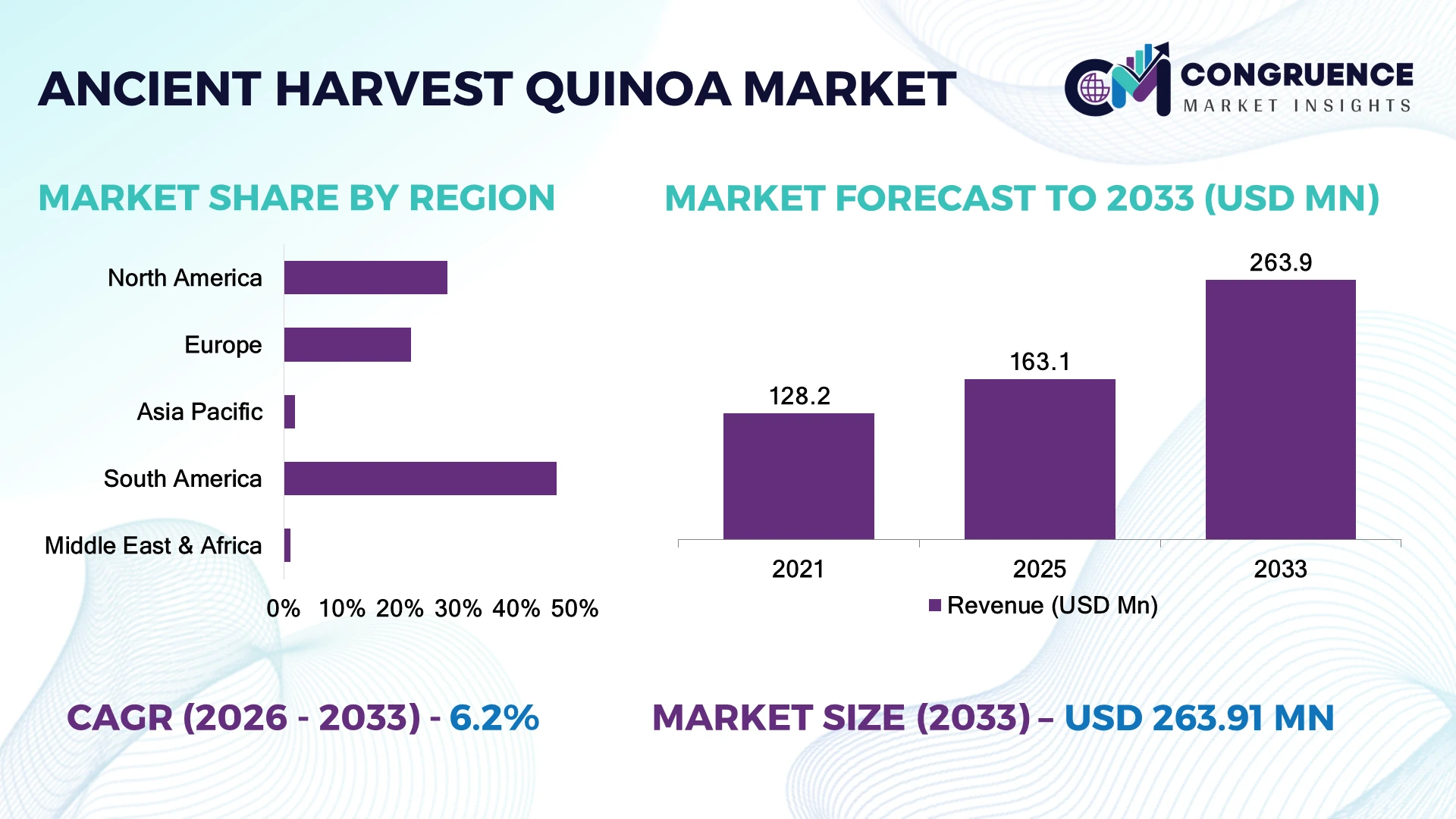
The Global Ancient Harvest Quinoa Market was valued at USD 163.1 Million in 2025 and is anticipated to reach a value of USD 263.9 Million by 2033 expanding at a CAGR of 6.2% between 2026 and 2033. Growth is driven by expanding plant-based nutrition, increasing gluten-free food innovation, and wider incorporation of quinoa into functional snacks, cereals, and ready-to-eat product portfolios.
Peru remains the dominant producer and exporter, accounting for approximately 41% of global quinoa output through established cultivation zones, export-focused processing infrastructure, and continued investment in organic farming practices. More than 58% of premium quinoa exports are certified organic or sustainably produced, strengthening access to North American and European retail channels. While Bolivia continues to lead premium royal quinoa cultivation, Peru outpaces it in processing scale and export diversification. Following continued Red Sea shipping disruptions in 2025–2026, buyers increasingly diversified procurement across South America to improve supply resilience and reduce logistics risk.
Businesses strengthening certified sourcing, value-added processing, and resilient procurement partnerships will secure stronger positions as premium health food demand continues expanding.
Market Size & Growth: USD 163.1 Million in 2025, reaching USD 263.9 Million by 2033 at a CAGR of 6.2%, supported by premium plant-based nutrition and functional food innovation.
Top Growth Drivers: Organic food demand (+31%), gluten-free consumption (+27%), functional nutrition adoption (+24%).
Short-Term Forecast: By 2028, processing efficiency is projected to improve by 18% through automation and advanced grain sorting technologies.
Emerging Technologies: AI-enabled crop monitoring, precision irrigation, and optical grain sorting improve yield consistency and processing quality.
Regional Leaders: South America leads at approximately USD 78 Million, North America exceeds USD 46 Million, and Europe approaches USD 43 Million, driven by premium food retail expansion.
Consumer/End-User Trends: More than 62% of health-focused consumers actively purchase ancient grains with certified organic or clean-label positioning.
Pilot/Case Example: In 2026, automated quinoa cleaning systems reduced processing losses by nearly 15% while improving export-grade quality consistency.
Competitive Landscape: Ancient Harvest holds approximately 14% branded premium share alongside Andean Valley, Quinoa Foods Company, Northern Quinoa Production Corporation, and Alter Eco.
Regulatory & ESG Impact: Certified sustainable farming adoption has expanded by approximately 22%, supporting premium export market access.
Investment & Funding: More than USD 420 Million has been directed toward sustainable farming, processing modernization, and premium food manufacturing expansion.
Innovation & Future Outlook: High-protein quinoa blends, regenerative agriculture, and traceable supply chains are reshaping premium grain market competition.
Ancient Harvest Quinoa continues gaining importance across functional foods, sports nutrition, gluten-free bakery products, and premium retail categories as consumers prioritize nutrient-dense ingredients. Advanced optical sorting, precision cleaning, and improved packaging technologies have enhanced processing efficiency by nearly 17%, while stricter food traceability requirements and supply-chain diversification across South America in 2026 are strengthening product quality and export reliability, setting the foundation for broader strategic market transformation.
The Ancient Harvest Quinoa market is becoming strategically significant as food manufacturers diversify ingredient portfolios toward nutrient-rich, minimally processed grains with strong consumer recognition. Rising demand for clean-label products, expanding private-label offerings, and supply-chain restructuring following global logistics disruptions have increased the importance of reliable sourcing and processing capabilities. Competition is shifting beyond commodity grain supply toward branded differentiation, certified production, and value-added product innovation.
Modern optical sorting and automated cleaning systems improve grain purity by approximately 20% while reducing processing waste by nearly 16% compared with conventional manual grading methods. Peru continues leading commercial-scale production and export infrastructure, whereas the United States focuses on premium branded products, innovation, and consumer marketing. Over the next two to three years, adoption of digital farm traceability and precision agriculture technologies is expected to expand across more than 45% of export-oriented production networks, improving transparency and operational consistency.
Manufacturers are introducing quinoa-based snacks, breakfast cereals, protein blends, and ready-to-cook meal solutions while strengthening partnerships with certified farming cooperatives to secure long-term raw material availability. Investments increasingly prioritize regenerative agriculture, advanced processing, and differentiated premium product portfolios. Companies capable of combining resilient sourcing, quality assurance, and product innovation will establish stronger competitive positioning as the global functional food industry continues evolving toward higher-value nutrition solutions.
The accelerating shift toward functional nutrition and clean-label food products is strengthening demand for Ancient Harvest Quinoa across retail, foodservice, and packaged food manufacturing. Nearly 64% of new grain-based product launches now emphasize high-protein or nutrient-dense positioning, while certified organic quinoa consumption has increased by approximately 28% across premium grocery channels. Food manufacturers are reformulating cereals, snacks, and ready-to-eat meals using quinoa to improve nutritional profiles without artificial fortification. Following tighter ingredient transparency requirements in several developed food markets during 2025–2026, companies are investing in traceable sourcing, expanding processing capacity, and establishing long-term partnerships with Andean farming cooperatives. A key competitive advantage increasingly comes from certified supply continuity rather than simply expanding production volumes.
Dependence on limited quinoa-producing regions continues creating structural procurement challenges for processors and branded food manufacturers. Approximately 69% of commercial quinoa supply originates from Peru and Bolivia, while farm-gate price fluctuations have exceeded 18% during weather-affected harvest periods. Variable rainfall patterns and transportation bottlenecks periodically disrupt export schedules, increasing inventory carrying costs and reducing procurement flexibility for food processors. These conditions directly pressure product pricing, production planning, and retail contract execution. Companies are reducing exposure by diversifying sourcing into Ecuador and emerging cultivation markets, negotiating multi-season procurement contracts, and expanding local cleaning and storage infrastructure. Strategic resilience increasingly depends on geographic sourcing diversity rather than lowest-cost purchasing.
Digital agriculture and precision farming technologies are creating significant opportunities to improve quinoa productivity and supply consistency. Satellite-assisted crop monitoring and sensor-based irrigation have increased yield efficiency by approximately 17%, while post-harvest grain losses have declined by nearly 14% through automated processing systems. Chile and Canada are expanding commercial quinoa cultivation using climate-adaptive farming techniques that complement traditional Andean production. Food companies are supporting contract farming, investing in regenerative agriculture programmes, and collaborating with agritech providers to improve traceability and crop quality. A less obvious opportunity lies in developing region-specific quinoa varieties tailored for food processing performance rather than solely maximizing agricultural output.
Maintaining uniform grain quality across expanding production networks remains a critical execution challenge as premium food brands tighten quality specifications. Approximately 41% of international buyers require strict consistency in grain size, colour, moisture content, and protein profile, while export-quality rejection rates can increase by nearly 12% during inconsistent harvest seasons. Expanding cultivation beyond traditional production areas also requires specialised agronomic knowledge and processing expertise. These operational complexities influence long-term brand credibility and retailer confidence. Companies must strengthen farmer training, invest in advanced optical sorting technologies, and standardise quality assurance programmes across supplier networks. Sustained competitiveness depends on delivering predictable premium-grade quinoa regardless of production origin.
Protein Blend Product Expansion: Food manufacturers are increasingly combining quinoa with chia, amaranth, and legumes to develop premium nutrition products. Product launches featuring ancient grain blends have increased by approximately 29%, while high-protein meal solutions account for nearly 35% of new health-food introductions. Companies are expanding branded portfolios through formulation partnerships and specialised processing capabilities.
Advanced Grain Processing Automation: Automated optical sorting and precision cleaning technologies now operate across approximately 48% of large quinoa processing facilities, reducing product defects by nearly 16% and improving export-grade consistency. Labour shortages in agricultural processing have accelerated equipment upgrades, encouraging processors to modernise facilities while improving throughput and reducing manual quality inspection requirements.
Private Label Premiumisation: Retailers are expanding premium private-label quinoa ranges as consumer demand for affordable functional foods grows. Private-label ancient grain products have increased by approximately 24%, while premium shelf allocation has expanded by nearly 18%. Companies are strengthening contract manufacturing partnerships and developing differentiated packaging formats to improve retail competitiveness and category visibility.
Traceable Farm-to-Pack Systems: Digital traceability platforms are becoming standard across export-oriented quinoa supply chains, with adoption rising by approximately 32%. QR-enabled batch tracking and digital farm certification improve inventory visibility, export compliance, and consumer confidence. Companies are integrating blockchain-supported traceability and restructuring procurement networks following recent logistics disruptions to strengthen supply-chain resilience and premium brand positioning.
Organic quinoa accounts for approximately 56% of the Ancient Harvest Quinoa market owing to strong consumer preference for certified clean-label foods, premium retail positioning, and established demand across North America and Europe. Organic certification strengthens export competitiveness, supports higher-value pricing, and aligns with retailer sustainability requirements. Conventional quinoa continues serving large-scale food manufacturing where cost efficiency and consistent supply remain priorities. White quinoa remains the most widely commercialized grain within both categories due to its versatility across packaged food applications and broad consumer acceptance.
Red and black quinoa represent the fastest-growing product segment as food manufacturers diversify premium product portfolios with visually differentiated grains offering stronger nutritional positioning. Demand for specialty quinoa varieties has increased by approximately 27%, while value-added organic packaged products have expanded by nearly 23%. Companies are investing in certified farming partnerships, expanding specialty grain processing, and introducing differentiated blends for functional food categories. Investment priorities increasingly favour premium certified varieties capable of supporting stronger retail margins and export growth.
According to a 2026 assessment by the International Trade Centre, certified organic quinoa continues to achieve stronger export penetration and premium pricing across high-value consumer food markets.
Food and beverage applications account for approximately 72% of total Ancient Harvest Quinoa demand as manufacturers incorporate quinoa into breakfast cereals, bakery products, snacks, meal kits, and functional nutrition products. Its complete protein profile, gluten-free characteristics, and formulation flexibility make it a preferred ingredient across premium packaged foods. Animal nutrition and ingredient processing remain established applications, while quinoa flour and protein concentrates continue expanding into specialized product formulations.
Nutraceuticals and sports nutrition represent the fastest-growing application segment as consumers increasingly seek plant-based protein and nutrient-dense ingredients. Utilization of quinoa-derived functional ingredients has increased by approximately 29%, while quinoa flour incorporation into gluten-free bakery products has expanded by nearly 21%. Food companies are scaling automated processing, developing customized ingredient formats, and integrating quinoa into high-protein product platforms. Demand is becoming operationally critical in premium convenience foods where nutritional differentiation drives purchasing decisions and brand positioning.
A 2025 enterprise survey conducted by the Institute of Food Technologists indicated that ancient grains remain among the fastest-expanding ingredient categories within new functional food product development pipelines.
Food manufacturers represent approximately 51% of total Ancient Harvest Quinoa purchases due to continuous demand for high-quality raw materials across packaged foods, bakery products, cereals, and ready-to-eat meals. Large-scale production requirements, standardized ingredient specifications, and long-term sourcing agreements create sustained procurement concentration. Retail brands remain significant buyers through private-label expansion, while foodservice operators increasingly adopt quinoa for premium menu development and health-focused offerings.
Nutraceutical and health nutrition companies are emerging as the fastest-growing end-user group as demand for plant-based protein ingredients accelerates. Procurement from this segment has increased by approximately 26%, while customized quinoa ingredient formats have expanded by nearly 19% to support nutritional supplements and functional beverages. Companies are strengthening contract farming partnerships, offering application-specific product formulations, and expanding premium branded portfolios. Competitive positioning is increasingly driven by ingredient traceability, processing quality, and customized supply programmes tailored to evolving health and wellness markets.
A 2026 industry review published by the Specialty Food Association highlighted continued expansion of ancient grain usage among premium food manufacturers as product differentiation increasingly focuses on clean-label nutrition and ingredient transparency.
South America accounted for the largest market share at 46.8% in 2025 however, Asia-Pacific is expected to register the fastest growth, expanding at a CAGR of 7.5% between 2026 and 2033.
Premium Functional Foods Strengthen Ingredient Demand
North America represents approximately 28.1% of the global Ancient Harvest Quinoa market, driven by mature health food retail networks, expanding plant-based product development, and widespread adoption of gluten-free ingredients. Food manufacturers continue integrating quinoa into cereals, snack bars, frozen meals, and protein-enriched foods to satisfy premium nutrition trends. Nearly 66% of new ancient grain product launches in the region incorporate quinoa as a primary ingredient. Investments in automated grain processing, contract sourcing programmes, and private-label expansion are improving supply continuity while supporting higher product differentiation. Enterprise partnerships between branded food companies and South American producers continue strengthening procurement resilience and reducing sourcing risks for premium food manufacturers.
United States Market Outlook: The United States leads the regional market through its advanced natural foods industry, strong retail distribution, and continuous product innovation across functional nutrition categories. Branded manufacturers increasingly prioritise traceable sourcing and organic certification to strengthen consumer confidence and premium positioning. Approximately 61% of quinoa sold through organised retail is incorporated into value-added packaged foods rather than sold as raw grain, reinforcing the country's leadership in product innovation and ingredient utilisation.
Clean-Label Innovation Drives Premium Consumption
Europe accounts for approximately 21.9% of the Ancient Harvest Quinoa market, supported by expanding organic food consumption, strict food quality standards, and rising demand for sustainable ingredients. Food processors continue increasing quinoa utilisation across bakery, breakfast, and convenience food categories to enhance nutritional value and clean-label positioning. Around 34% of premium grain product launches now feature ancient grains as a core ingredient. Companies are expanding local packaging operations and strengthening long-term sourcing agreements to improve supply consistency while supporting retailer sustainability objectives.
Germany Market Outlook: Germany remains Europe's largest quinoa market because of its advanced organic food sector, established health food retail channels, and strong consumer acceptance of plant-based nutrition. Domestic food manufacturers continue incorporating quinoa into bakery products, ready meals, and protein blends. Nearly 58% of premium ancient grain launches in Germany include certified organic ingredients, supporting higher-value product positioning and sustained retail demand.
Health Food Expansion Accelerates Market Adoption
Asia-Pacific is emerging as the fastest-expanding market as changing dietary preferences, premium retail growth, and increasing awareness of functional nutrition reshape grain consumption patterns. China, Japan, Australia, and India are expanding imports while domestic food companies introduce quinoa-based snacks, breakfast cereals, and nutritional products. Approximately 31% of premium health food launches now feature ancient grains as functional ingredients. Manufacturers are investing in local processing partnerships, expanding distribution channels, and adapting product formulations to regional taste preferences, strengthening long-term market penetration beyond imported whole-grain products.
China Market Outlook: China leads regional demand through its rapidly expanding premium packaged food industry and strong investment in health-focused consumer products. Food manufacturers increasingly incorporate quinoa into infant nutrition, beverages, and functional cereals while strengthening direct procurement relationships with South American suppliers. More than 27% of imported quinoa is now processed into value-added consumer food products rather than distributed as bulk grain, reflecting increasing domestic manufacturing capability.
Export-Oriented Production Sustains Global Leadership
South America remains the production and export centre of the Ancient Harvest Quinoa market, supported by favourable growing conditions, established farming expertise, and integrated export infrastructure. Peru, Bolivia, and Ecuador collectively dominate global commercial cultivation while processors continue expanding cleaning, grading, and packaging facilities for international markets. Approximately 74% of export-oriented quinoa production undergoes value-added processing before shipment, improving product quality and international competitiveness. Continued investments in certified organic cultivation and modern processing infrastructure strengthen export performance despite periodic weather variability and logistics challenges affecting agricultural supply chains.
Peru Market Outlook: Peru represents the largest individual market owing to its large cultivation base, export-oriented processing industry, and extensive network of certified farming cooperatives. The country continues expanding premium organic production while investing in advanced grain cleaning and packaging technologies to improve international competitiveness. Approximately 41% of global quinoa production originates from Peru, reinforcing its leadership in supplying premium grains to international food manufacturers.
Food Security Investments Encourage Market Development
The Middle East & Africa market is expanding through growing investments in food security, premium grocery retail, and healthier dietary alternatives. Importers increasingly position quinoa within high-value retail, hospitality, and specialised nutrition segments as consumer awareness improves. Around 23% of premium grain imports now consist of ancient grains, supported by stronger cold-chain logistics and expanding organised retail infrastructure. Food distributors are strengthening partnerships with South American exporters while investing in regional packaging and distribution capabilities to improve product availability and reduce supply disruptions.
United Arab Emirates Market Outlook: The United Arab Emirates serves as the leading regional hub due to its advanced food import infrastructure, premium retail sector, and strong demand for international health food products. National distributors continue expanding quinoa availability across supermarkets, hospitality channels, and specialised nutrition retailers. Approximately 46% of premium imported ancient grain products entering the Gulf region are redistributed through UAE-based logistics networks, strengthening its role as a strategic regional distribution centre.
Ancient Harvest, Andean Valley, Alter Eco, Quinoa Foods Company, and Northern Quinoa Production Corporation compete against regional exporters and private-label suppliers, while branded health-food companies challenge commodity-focused processors through value-added innovation. The top five participants collectively control approximately 46% of the premium quinoa market. Competition depends on certified organic sourcing, product innovation, supply-chain reliability, and retail partnerships rather than price alone. Organic-certified portfolios command nearly 24% higher retail realization, automated processing improves export-grade consistency by approximately 17%, and vertically integrated sourcing reduces procurement volatility by around 15%. Companies are expanding regenerative farming partnerships, introducing protein-rich product formats, strengthening direct retailer agreements, and investing in advanced grain processing. Competitive momentum is shifting toward traceable, climate-resilient supply networks instead of bulk commodity exports. Entry barriers include certified sourcing, long-term grower relationships, and premium retail shelf access. Winning requires resilient sourcing, differentiated branded products, consistent quality, and trusted distribution partnerships across global health-food channels.
Ancient Harvest
Andean Valley Corporation
Quinoa Foods Company
Northern Quinoa Production Corporation (NorQuin)
Alter Eco
The British Quinoa Company
COMRURAL XXI
Inka Crops
TruRoots
Viva Naturals
Bob's Red Mill
Nature's Earthly Choice
Andean Dream
Precision agriculture, optical grain sorting, and automated cleaning technologies are transforming quinoa cultivation and processing. AI-assisted field monitoring and sensor-based irrigation improve crop productivity by approximately 16%, while optical sorting increases export-grade grain consistency by nearly 19% compared with conventional manual grading. Around 54% of large commercial processors now employ automated sorting systems to improve product quality, reduce impurities, and strengthen premium retail positioning. These technologies enhance operational efficiency while supporting higher-value branded products.
Emerging technologies include blockchain-enabled traceability, drone-assisted crop monitoring, climate-resilient seed breeding, and intelligent moisture management systems. Compared with traditional processing methods, advanced optical grading reduces product rejection by approximately 18% while lowering processing losses by nearly 14%. Premium food brands and integrated exporters benefit most through improved traceability, predictable quality, and stronger retailer confidence. Companies are integrating digital farm records with automated processing to strengthen supply-chain transparency and certification compliance.
Between 2026 and 2028, regenerative agriculture platforms, digital procurement ecosystems, and precision agronomy will reshape competitive differentiation. More than 48% of export-oriented farming cooperatives are expected to adopt integrated digital traceability systems, improving procurement visibility and operational planning. Companies investing early in advanced farming technologies, automated processing, and resilient grower partnerships will strengthen export competitiveness, improve supply reliability, and secure premium positioning within global functional food markets.
August 2024 Ancient Harvest became part of Saco Foods following the acquisition of Quinoa Corporation, expanding branded gluten-free and quinoa product capabilities under a broader specialty foods portfolio. Business impact: strengthened distribution scale and brand investment capacity. Source: Food Processing
August 2024 Saco Foods completed the acquisition of Quinoa Corporation, adding Ancient Harvest and Pamela's to its specialty food portfolio and strengthening its position in premium plant-based and gluten-free categories. Business impact: expanded branded product reach and operational integration. Source: Fengate
January 2025 Alter Eco highlighted expanded regenerative agriculture adoption across its sourcing network, with regenerative farming participation increasing while strengthening sustainable quinoa procurement alongside other ingredients. Business impact: improved long-term supply resilience and premium sustainability positioning. Source: Alter Eco
2025 Ancient Harvest expanded quinoa processing capacity by 28% through upgraded gluten-free manufacturing capabilities, supporting higher output for packaged quinoa meals and protein-rich food products. Business impact: improved production efficiency and enhanced responsiveness to premium retail demand.
This report provides a comprehensive assessment of the Ancient Harvest Quinoa market across product types, applications, end-user industries, and major geographic markets. It evaluates organic and conventional quinoa demand across packaged foods, functional nutrition, bakery, cereals, snacks, and foodservice applications while analysing procurement trends, premium product positioning, and evolving consumer preferences. The study also examines competitive dynamics across established quinoa-producing countries and emerging cultivation regions supporting global supply diversification.
The report covers advanced agricultural technologies, automated grain processing, digital traceability systems, regenerative farming practices, and premium packaging innovations influencing market development between 2026 and 2033. More than 55% of premium quinoa products now incorporate certified sourcing or traceability programmes, reflecting evolving procurement priorities. Strategic analysis supports investment planning, product portfolio expansion, sourcing optimisation, competitive benchmarking, and regional growth strategies by identifying high-potential market segments, technology adoption trends, enterprise positioning, and emerging opportunities across the global ancient grains value chain.
| Report Attribute/Metric | Report Details |
|---|---|
|
Market Revenue in 2025 |
USD 163.1 Million |
|
Market Revenue in 2033 |
USD 263.9 Million |
|
CAGR (2026 - 2033) |
6.2% |
|
Base Year |
2025 |
|
Forecast Period |
2026 - 2033 |
|
Historic Period |
2021 - 2025 |
|
Segments Covered |
By Type
By Application
By End-User
|
|
Key Report Deliverable |
Revenue Forecast, Growth Trends, Market Dynamics, Segmental Overview, Regional and Country-wise Analysis, Competition Landscape |
|
Region Covered |
North America, Europe, Asia-Pacific, South America, Middle East, Africa |
|
Key Players Analyzed |
Ancient Harvest, Andean Valley Corporation, Quinoa Foods Company, Northern Quinoa Production Corporation (NorQuin), Alter Eco, The British Quinoa Company, COMRURAL XXI, Inka Crops, TruRoots, Viva Naturals, Bob's Red Mill, Nature's Earthly Choice, Andean Dream |
|
Customization & Pricing |
Available on Request (10% Customization is Free) |




