
Reports
The Global Analytical Instrumentation Market was valued at USD 58000 Million in 2025 and is anticipated to reach a value of USD 87006.94 Million by 2033 expanding at a CAGR of 5.2% between 2026 and 2033. Growth is driven by stricter pharmaceutical quality-control requirements, expanding biopharmaceutical R&D, semiconductor process monitoring, and rapid adoption of AI-enabled laboratory automation.
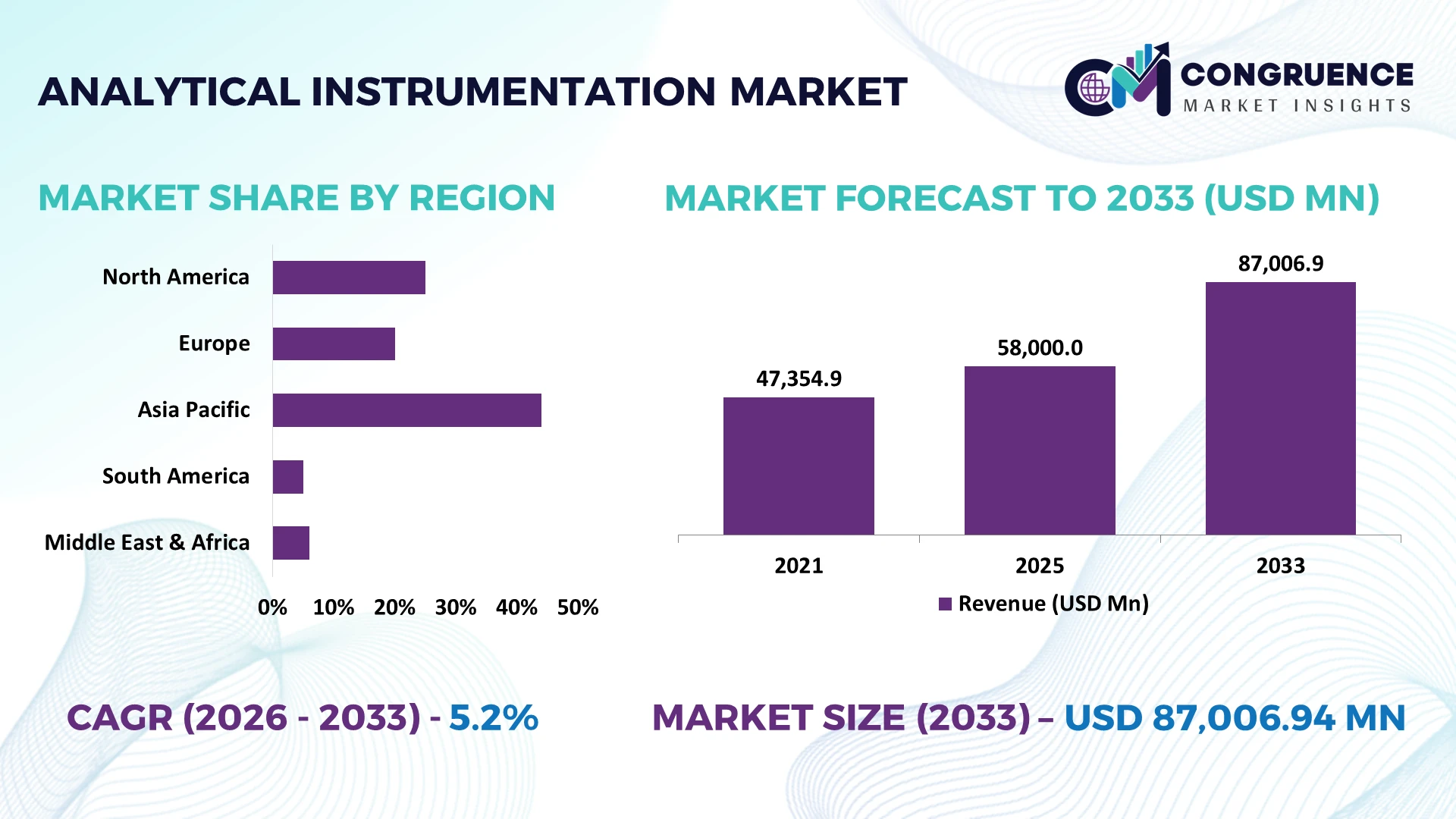
The United States remains the dominant analytical instrumentation market, supported by pharmaceuticals, biotechnology, clinical diagnostics, semiconductor manufacturing, and environmental testing. North America held approximately 47% of global market activity in 2025, while the U.S. represented nearly 80% of regional demand. U.S. laboratories increasingly deploy automated chromatography, mass spectrometry, and spectroscopy systems, supported by substantial pharmaceutical and semiconductor investment. Compared with Europe, the U.S. benefits from deeper biopharmaceutical R&D spending and faster laboratory automation adoption. Geopolitical supply-chain diversification following U.S.-China trade restrictions is also encouraging localized analytical testing capacity.
Strategic implication: suppliers should prioritize high-precision, AI-enabled platforms in the U.S. while expanding automated systems across Asian manufacturing and research hubs.
Market Size & Growth: USD 58,000 million in 2025 to USD 87,006.94 million by 2033 at a 5.2% CAGR, driven by pharmaceutical R&D and advanced laboratory automation.
Top Growth Drivers: Pharmaceutical testing at 38%, life-sciences applications at 47%, and instrument-based workflows at approximately 64%.
Short-Term Forecast: By 2030, automated workflows are expected to reduce manual handling by 10–15% and improve laboratory throughput by 15–20%.
Emerging Technologies: AI analytics, robotic sample handling, cloud-connected LIMS, and advanced mass spectrometry are expanding automated analytical workflows, with AI engagement reaching approximately 78% across surveyed laboratories.
Regional Leaders: North America is projected to reach about USD 42.1 billion, Asia Pacific USD 20.6 billion, and Germany approximately USD 6.4 billion, with Asia Pacific showing accelerating automation adoption.
Consumer/End-User Trends: Pharmaceutical and biotechnology applications represented approximately 33.5% of demand in 2025, reinforced by precision testing and accelerated drug-development workflows.
Pilot/Case Example: In 2025, major analytical-instrument suppliers expanded U.S. manufacturing capacity, with investments reaching approximately USD 2 billion to strengthen domestic production and supply resilience.
Competitive Landscape: Leading suppliers include Thermo Fisher Scientific, Agilent Technologies, Danaher, Shimadzu, and Waters, with leading players collectively controlling a substantial portion of high-end analytical instrumentation demand.
Regulatory & ESG Impact: Tighter pharmaceutical and environmental testing requirements are increasing demand for trace-level detection, while automated systems reduce sample-processing waste and manual intervention by approximately 10–15%.
Investment & Funding: Analytical-instrumentation investment is increasingly concentrated in AI, laboratory automation, biopharma testing, and localized manufacturing, with multi-billion-dollar expansion programs strengthening regional supply chains.
Innovation & Future Outlook: Next-generation platforms are integrating AI interpretation, autonomous sampling, cloud connectivity, and high-resolution detection, shifting competition toward faster results, predictive maintenance, and digitally integrated laboratory ecosystems.
Demand is concentrated across pharmaceutical quality control, biotechnology research, clinical diagnostics, food testing, environmental monitoring, and semiconductor manufacturing, where high-precision detection directly supports compliance and process optimization. AI-assisted analysis and automated sample preparation are reducing manual intervention while improving reproducibility, with laboratory automation adoption advancing by approximately 15–20% across technology-intensive workflows. Recent innovation is shifting toward compact mass spectrometers, high-resolution chromatography, connected spectroscopy, and software-integrated instruments. Geopolitical supply-chain diversification is also encouraging regional manufacturing and localized testing capacity, strengthening demand for resilient analytical platforms and creating a transition toward more automated, digitally connected laboratory operations.
Analytical instrumentation is becoming strategically important because measurement accuracy increasingly determines product quality, regulatory compliance, and production economics across pharmaceuticals, semiconductors, biotechnology, and advanced materials. Automated instruments can reduce sample-processing time by 20–40% versus manual workflows while improving repeatability. The shift toward localized manufacturing after global supply-chain disruptions is also increasing demand for domestic testing and quality-control capacity, particularly in the United States and China.
Over the next 2–3 years, AI-assisted interpretation, robotic sample preparation, high-resolution mass spectrometry, and connected laboratory platforms are expected to move from selective deployment toward broader enterprise adoption. U.S. pharmaceutical and semiconductor facilities are prioritizing automated analytical workflows, while China and India are expanding domestic laboratory infrastructure and instrument manufacturing. This creates a measurable contrast between mature automation markets and rapidly modernizing production hubs.
Companies are responding by increasing R&D spending on software-integrated instruments, establishing local manufacturing partnerships, and bundling hardware with analytics and service contracts. A pharmaceutical quality-control laboratory, for example, can combine automated chromatography with digital sample tracking to reduce manual intervention and improve batch-release consistency. Competitive positioning will increasingly depend on instrument precision, automation depth, interoperability, service responsiveness, and the ability to deliver lower operating costs alongside compliance performance.
AI-enabled analytical workflows are accelerating adoption as laboratories seek higher throughput without proportional workforce expansion. Automated sample preparation can reduce manual handling by 20–30%, while algorithm-assisted interpretation can shorten selected analytical workflows by 15–25%. In the United States, pharmaceutical manufacturers are integrating chromatography, spectroscopy, and mass spectrometry with laboratory information systems to improve traceability. Regulatory emphasis on data integrity is reinforcing this transition. Companies are responding through software partnerships, instrument upgrades, and integrated automation platforms rather than standalone hardware purchases. A non-obvious advantage is the ability to standardize analytical procedures across multiple facilities, reducing variation between laboratories and strengthening centralized quality-control governance.
High acquisition costs and complex integration remain significant barriers, particularly for smaller laboratories and emerging manufacturing facilities. Advanced mass spectrometry and chromatography systems can require 15–25% higher initial investment than conventional configurations, while installation, validation, and specialist training can add another 10–20% to deployment expenditure. In India, dependence on imported high-end components exposes laboratories to currency fluctuations, logistics disruptions, and longer service cycles. Companies are mitigating these pressures through multi-year procurement contracts, localized servicing, component diversification, and modular upgrades. The key operational constraint is not instrument pricing alone but total cost of ownership, because maintenance, calibration, software compatibility, and downtime directly influence laboratory productivity.
Connected analytical instruments create an opportunity to convert laboratory equipment from standalone assets into continuously monitored production intelligence systems. Predictive-maintenance platforms can reduce unplanned equipment downtime by approximately 10–20%, while automated data capture can cut manual documentation activity by 20–30%. Japan and South Korea are well positioned for advanced deployment because semiconductor and precision-manufacturing facilities already operate highly automated inspection environments. Companies are investing in cloud-enabled software, edge analytics, and instrument-to-LIMS connectivity, while partnerships between equipment manufacturers and laboratory-software providers are expanding integrated offerings. A less visible opportunity lies in recurring software and service revenue, allowing manufacturers to monetize analytics, remote diagnostics, calibration, and workflow optimization beyond the initial instrument sale.
Long-term deployment increasingly depends on interoperability, cybersecurity, and specialist expertise rather than instrument availability alone. Connecting multiple analytical platforms can require 15–30% additional integration effort where legacy systems lack standardized interfaces, while cybersecurity controls can increase implementation complexity by 10–15% in connected laboratories. U.S. pharmaceutical sites and European research facilities are therefore prioritizing standardized data architectures, validated software environments, and controlled access frameworks. Companies must invest in API-enabled instruments, cybersecurity engineering, workforce training, and cross-platform partnerships to maintain consistent operations. The strategic challenge is ensuring that automation does not create isolated technology silos, because fragmented data flows can offset productivity gains and weaken enterprise-wide quality management.
AI-Linked Instrument Control: Laboratories are connecting analytical instruments with AI-assisted interpretation, reducing manual data review by 15–25% and shortening selected workflows by 10–20%. U.S. pharmaceutical companies are integrating automated chromatography and mass spectrometry with digital records to strengthen traceability, while vendors are expanding software partnerships and remote-monitoring capabilities.
Localized Supply Chains: Instrument manufacturers are shifting selected production and servicing closer to end users as geopolitical tensions and component shortages expose logistics vulnerabilities. Localized procurement can reduce equipment lead times by 10–20% and service delays by 15%. U.S. and Indian suppliers are expanding regional servicing, component sourcing, and calibration networks to improve operational continuity.
Compact Platforms Gain Ground: Smaller laboratories are adopting benchtop mass spectrometers, portable spectroscopy, and compact chromatography systems, with space requirements falling 20–40% versus conventional installations. Decentralized testing is increasing demand for faster point-of-use analysis in food, environmental, and clinical workflows. Companies are responding with modular instruments, simplified interfaces, and lower-maintenance configurations.
Automation Reshapes Workflows: Automated sample preparation and robotic handling are increasingly replacing repetitive laboratory tasks, reducing manual intervention by 20–30% and improving throughput by 15–25%. Workforce shortages and stricter documentation requirements are accelerating deployment in pharmaceutical laboratories. Instrument suppliers are bundling robotics, software, and service agreements, creating integrated workflows rather than standalone equipment sales.
Chromatography remains the leading type, accounting for approximately 30–35% of analytical instrumentation demand because of broad pharmaceutical, chemical, food, and environmental applications, scalable throughput, and established regulatory workflows. Spectroscopy follows as a mature, versatile technology, while microscopy and electrochemical instruments retain strong roles in materials characterization and process monitoring. Mass spectrometry is the fastest-growing type, supported by high-sensitivity detection, biomarker analysis, pharmaceutical impurity profiling, and increasingly automated workflows. Companies are prioritizing high-resolution platforms, integrated software, and faster sample processing, with advanced systems improving analytical throughput by roughly 15–25%.
Elemental and thermal analysis serve specialized applications but remain strategically important for metals, polymers, catalysts, and advanced materials. Investment is shifting toward instruments that combine multiple analytical capabilities, reducing laboratory footprint and workflow duplication by approximately 10–20%. This favors vendors capable of integrating chromatography, spectroscopy, and mass spectrometry with centralized data-management platforms.
Drug testing represents one of the largest application areas, supported by pharmaceutical quality control, toxicology, clinical workflows, and regulatory testing requirements. Demand is concentrated in laboratories requiring high sensitivity, reproducibility, and rapid identification of compounds. Environmental testing is emerging as a faster-expanding application as laboratories strengthen monitoring of contaminants and industrial emissions. Automated testing can reduce manual processing by approximately 20–30%, while advanced detection platforms can shorten selected analytical cycles by 15–20%.
Chemical analysis, food testing, and material testing remain established applications, with adoption tied to process verification and product-quality requirements. Clinical diagnostics and research increasingly require higher-throughput analytical workflows, particularly in the United States, Germany, Japan, and India. Companies are responding with application-specific configurations, automated sample preparation, and software-integrated instruments. The operational shift is toward centralized testing platforms capable of handling larger sample volumes while maintaining traceability, which strengthens demand for scalable analytical ecosystems rather than isolated instruments.
Pharmaceutical companies represent the dominant end-user group, accounting for approximately 30–35% of analytical instrumentation demand because manufacturing, formulation, stability testing, impurity profiling, and quality control require continuous analytical verification. Research laboratories follow closely, while chemical companies and food manufacturers maintain recurring demand for process and product characterization. Pharmaceutical facilities increasingly favor automated systems that can reduce manual intervention by 20–30% and improve testing throughput by approximately 15–25%.
Research laboratories are among the fastest-expanding end-user groups as biotechnology, advanced materials, and translational research increase demand for high-resolution analytical platforms. Hospitals and clinical laboratories are adopting more automated diagnostic workflows, while environmental laboratories are expanding testing capacity for contaminants and regulatory compliance. Academic institutes remain important for foundational research but generally operate under tighter capital constraints. Companies are responding with application-specific bundles, leasing models, service contracts, and institutional partnerships, while prioritizing modular systems that allow laboratories to scale analytical capacity without replacing entire platforms.
North Americabold accounted for the largest market share at 47% in 2025 however, Asia-Pacificbold is expected to register the fastest growth, expanding at a CAGR of 6.1% between 2026 and 2033.
Automation and precision testing strengthen U.S.-led dominance
North America maintains the largest analytical instrumentation footprint, supported by pharmaceutical manufacturing, biotechnology research, semiconductor production, clinical diagnostics, and environmental testing. The United States concentrates most regional deployment across Boston, California, New Jersey, and major pharmaceutical manufacturing corridors. Approximately 47% regional contribution reflects strong laboratory infrastructure and high-value instrument utilization. Pharmaceutical companies are integrating chromatography, mass spectrometry, and spectroscopy with laboratory information systems, reducing manual processing by roughly 20–30%. Instrument manufacturers are expanding service networks and software partnerships to support connected laboratories, while Canada contributes through mining, environmental analysis, and biotechnology applications.
United States Market Outlook: The United States remains the principal regional demand center because of its dense pharmaceutical, biotechnology, semiconductor, and research ecosystem. High-resolution analytical platforms are increasingly integrated into automated quality-control laboratories. Advanced facilities are targeting 15–25% higher testing throughput through robotics, automated sample preparation, and digital workflow management. Pharmaceutical and biotechnology clusters are increasing demand for mass spectrometry, chromatography, and spectroscopy systems. Instrument suppliers are strengthening domestic service networks, software integration, and application-specific partnerships to capture recurring enterprise demand and improve equipment utilization.
Regulatory precision accelerates laboratory modernization
Europe's analytical instrumentation demand is shaped by stringent pharmaceutical quality requirements, environmental monitoring, advanced materials research, and laboratory modernization. Germany, France, the United Kingdom, Switzerland, and Italy provide concentrated demand through pharmaceutical, chemical, food, and industrial research clusters. European laboratories are increasingly prioritizing automated sample preparation and traceable data management, with workflow automation reducing repetitive handling by approximately 15–25%. Sustainability requirements are encouraging lower-solvent analytical methods and energy-efficient equipment. Manufacturers are responding through instrument refurbishment, service partnerships, software integration, and localized technical support. Germany's chemical and pharmaceutical base creates particularly strong demand for chromatography, spectroscopy, and elemental analysis systems.
Germany Market Outlook: Germany combines advanced chemical manufacturing, pharmaceutical production, automotive materials research, and industrial quality-control infrastructure. Analytical systems are deeply embedded in production laboratories, where automated testing and process characterization support high-volume manufacturing. Approximately 20% productivity improvement from workflow automation is strengthening investment in integrated analytical platforms. German manufacturers are prioritizing energy-efficient laboratory equipment, automated quality-control systems, and digitally connected instruments supporting traceability across production sites. Suppliers with strong calibration, validation, and technical-service capabilities are positioned to address the country's highly regulated industrial laboratories.
Manufacturing scale drives rapid analytical deployment
Asia-Pacific is becoming the major expansion center for analytical instrumentation as China, Japan, South Korea, and India increase semiconductor, pharmaceutical, biotechnology, chemical, and advanced-materials production. China represents the largest deployment base, while Japan and South Korea contribute advanced semiconductor and precision-manufacturing applications. India is expanding pharmaceutical and laboratory infrastructure, increasing demand for chromatography, spectroscopy, and mass spectrometry. Automated analytical workflows can improve testing throughput by approximately 15–25%, supporting high-volume production environments. Instrument manufacturers are localizing service operations, establishing distribution partnerships, and increasing regional assembly to shorten lead times. Semiconductor capacity expansion is also increasing demand for high-sensitivity analytical systems used in contamination control and materials characterization.
China Market Outlook: China combines extensive pharmaceutical, chemical, electronics, materials, and semiconductor manufacturing capacity with increasing domestic analytical-equipment development. Local suppliers are expanding product portfolios while international companies strengthen partnerships and service infrastructure. Domestic laboratory automation is advancing across high-volume industrial facilities, supporting demand for chromatography, spectroscopy, mass spectrometry, and elemental analysis. Semiconductor and advanced-materials production is increasing requirements for contamination detection and high-resolution characterization. Companies are expanding local manufacturing, technical-support networks, and application laboratories to reduce equipment lead times and improve customer responsiveness against established international suppliers.
Brazil-led testing demand expands with industrial modernization
South America's analytical instrumentation demand is concentrated in Brazil, Argentina, Chile, and Colombia, with pharmaceuticals, food processing, mining, agriculture, petrochemicals, and environmental monitoring supporting recurring instrument utilization. Brazil provides the region's largest industrial and laboratory base, while Chile generates specialized demand through mining and materials analysis. Approximately 15–20% of laboratory workflows remain candidates for further automation, creating opportunities for sample-handling and connected analytical systems. Import dependency remains an operational constraint, particularly for high-end mass spectrometry and chromatography equipment. Companies are responding through distributor partnerships, regional service centers, multi-year maintenance contracts, and localized technical training to reduce equipment downtime and improve lifecycle economics.
Brazil Market Outlook: Brazil's diversified pharmaceutical, food, chemical, mining, and agricultural industries create broad analytical-instrument demand. Environmental testing and quality-control laboratories are expanding instrument utilization, while major industrial facilities increasingly favor automated testing. Service coverage and spare-parts availability remain important purchasing criteria because imported equipment can face longer replacement cycles. Food safety, agricultural testing, mining characterization, and pharmaceutical quality control provide multiple demand channels, allowing suppliers to deploy application-specific systems. Companies with local technical support and distributor coverage can strengthen equipment uptime and customer retention.
Industrial diversification drives laboratory infrastructure investment
Middle East and Africa demand is increasingly connected to industrial diversification, petrochemical processing, pharmaceuticals, food safety, mining, water testing, and environmental compliance. Saudi Arabia and the United Arab Emirates are strengthening laboratory and industrial infrastructure as economic diversification programs expand non-oil activities. Advanced analytical platforms are being deployed in centralized testing laboratories, with automation improving sample throughput by approximately 15–20%. South Africa remains important for mining, environmental testing, and research applications. Companies are responding through distributor networks, local service partnerships, laboratory modernization projects, and bundled maintenance agreements. Water-quality monitoring and petrochemical characterization provide stable demand, while high equipment costs and specialist workforce requirements shape procurement decisions.
Saudi Arabia Market Outlook: Saudi Arabia is strengthening analytical testing infrastructure alongside pharmaceutical, chemical, food, water, and industrial diversification programs. New laboratory capacity is increasing demand for chromatography, spectroscopy, elemental analysis, and automated sample preparation. Suppliers are emphasizing local technical support and partnerships to improve deployment reliability and reduce dependence on overseas servicing. Petrochemical testing remains an important application, while environmental and water-analysis requirements create additional demand for high-sensitivity instruments. Companies are positioning through application laboratories, training programs, service agreements, and localized distribution networks supporting long-term enterprise adoption.
Thermo Fisher Scientific, Danaher, Agilent Technologies, Waters, and Shimadzu compete primarily as global technology leaders, while regional manufacturers compete through localization, pricing, and specialized applications. The top five players collectively command approximately 30–35% of the market, leaving substantial space for specialized suppliers. Competition centers on analytical sensitivity, automation, software integration, service coverage, and total ownership cost. Automated platforms can improve laboratory throughput by 15–25%, while integrated workflows can reduce manual handling by 20–30%. Global leaders are expanding through portfolio integration, software partnerships, and vertical capabilities, while regional suppliers emphasize localized servicing and application customization. Supply-chain localization is becoming a competitive differentiator as customers prioritize shorter service cycles and component availability. High validation requirements, installed-base relationships, and specialist expertise remain significant entry barriers. Winning requires differentiated technology, dependable service infrastructure, application expertise, and scalable digital integration.
Thermo Fisher Scientific
Danaher Corporation
Agilent Technologies
Waters Corporation
Shimadzu Corporation
Bruker Corporation
PerkinElmer
Mettler Toledo International
HORIBA
JEOL
Sartorius
Bio-Rad Laboratories
Anton Paar
Hitachi High-Tech
Analytical instrumentation is shifting from standalone measurement systems toward connected, automated platforms. AI-assisted chromatography and spectroscopy can reduce data-review workload by 15–25%, while automated sample preparation cuts manual handling by 20–30%. Adoption is strongest in pharmaceutical and biotechnology laboratories, where integrated instruments, LIMS, and analytics improve traceability, testing speed, and release decisions. Connected platforms also enable centralized monitoring across multi-site laboratory networks, strengthening equipment utilization and reducing duplicated analytical work.
Emerging high-resolution mass spectrometry, compact ICP-MS, intelligent chromatography, and robotic workflows are raising analytical performance. Compared with conventional workflows, automated systems can deliver approximately 15–25% higher throughput and 10–20% lower labor intensity. Adoption is strongest in high-volume pharmaceutical and semiconductor laboratories. Technology leaders with integrated software ecosystems benefit as customers increasingly prefer interoperable platforms combining measurement, data processing, and workflow control rather than isolated instruments.
Between 2026 and 2028, AI-driven interpretation, predictive maintenance, multi-attribute testing, and lower-footprint instruments will gain operational importance. Predictive analytics can reduce unplanned equipment downtime by approximately 10–15%, while automated workflows improve repeatability and workforce productivity. Companies should prioritize interoperable instruments, automation-ready architectures, and software partnerships now. Competitive advantage will increasingly favor vendors combining precision hardware, intelligent analytics, consumables, and lifecycle services into validated workflows that improve throughput, compliance, and total laboratory productivity.
May 2026 Agilent launched the 9500 Triple Quadrupole ICP-MS, reducing acquisition time by more than 33% and improving trace-analysis throughput. The development strengthens faster routine testing and supports laboratories requiring higher analytical productivity.
March 2025 PerkinElmer introduced the QSight 500 LC/MS/MS, supporting more than 25,000 continuous analyses without cleaning. The system reduces maintenance interruptions and strengthens high-throughput contaminant and PFAS testing capabilities for regulated laboratories.
October 2025 Waters launched Charge Detection Mass Spectrometry for complex biotherapeutics, reducing sample requirements by 100 times for selected analyses. The technology improves characterization efficiency and lowers material requirements for advanced therapy development.
April 2024 Shimadzu opened three North American R&D laboratories across Maryland, Boston, and California. The expansion strengthens regional analytical-instrument development, customer collaboration, prototype testing, and pharmaceutical-focused technology commercialization.
The Analytical Instrumentation Market Report covers seven major types: chromatography, spectroscopy, mass spectrometry, microscopy, electrochemical instruments, elemental analysis, and thermal analysis. Application coverage includes chemical analysis, drug testing, food testing, environmental testing, material testing, clinical diagnostics, and research. End-user analysis evaluates pharmaceutical companies, chemical companies, food manufacturers, environmental laboratories, hospitals, academic institutes, and research laboratories.
The report evaluates North America, Europe, Asia-Pacific, South America, and Middle East & Africa, with country-level analysis across major industrial and technology hubs. It assesses AI-enabled analytics, laboratory automation, high-resolution detection, connected instruments, and compact platforms alongside deployment patterns and competitive positioning. Coverage across 7 technology categories, 7 applications, and 7 end-user groups supports investment planning, market-entry strategy, expansion decisions, partnership targeting, and technology prioritization. The 2026–2033 assessment identifies emerging demand areas, operational shifts, competitive pressures, and long-term laboratory modernization priorities.
| Report Attribute/Metric | Report Details |
|---|---|
Market Revenue in 2025 | USD 58000 Million |
Market Revenue in 2033 | USD 87006.94 Million |
CAGR (2026 - 2033) | 5.2% |
Base Year | 2025 |
Forecast Period | 2026 - 2033 |
Historic Period | 2021 - 2025 |
Segments Covered | By Type
By Application
By End-User
|
Key Report Deliverable | Revenue Forecast, Growth Trends, Market Dynamics, Segmental Overview, Regional and Country-wise Analysis, Competition Landscape |
Region Covered | North America, Europe, Asia-Pacific, South America, Middle East, Africa |
Key Players Analyzed | Thermo Fisher Scientific, Danaher Corporation, Agilent Technologies, Waters Corporation, Shimadzu Corporation, Bruker Corporation, PerkinElmer, Mettler Toledo International, HORIBA, JEOL, Sartorius, Bio-Rad Laboratories, Anton Paar, Hitachi High-Tech |
Customization & Pricing | Available on Request (10% Customization is Free) |




