
Reports
The Global Amphibious Excavators Market was valued at USD 395.2 Million in 2025 and is anticipated to reach a value of USD 715.4 Million by 2033 expanding at a CAGR of 7.7% between 2026 and 2033. Growth is driven by expanding coastal protection projects, inland waterway dredging, wetland restoration programs, and flood-control infrastructure modernization across high-risk regions.
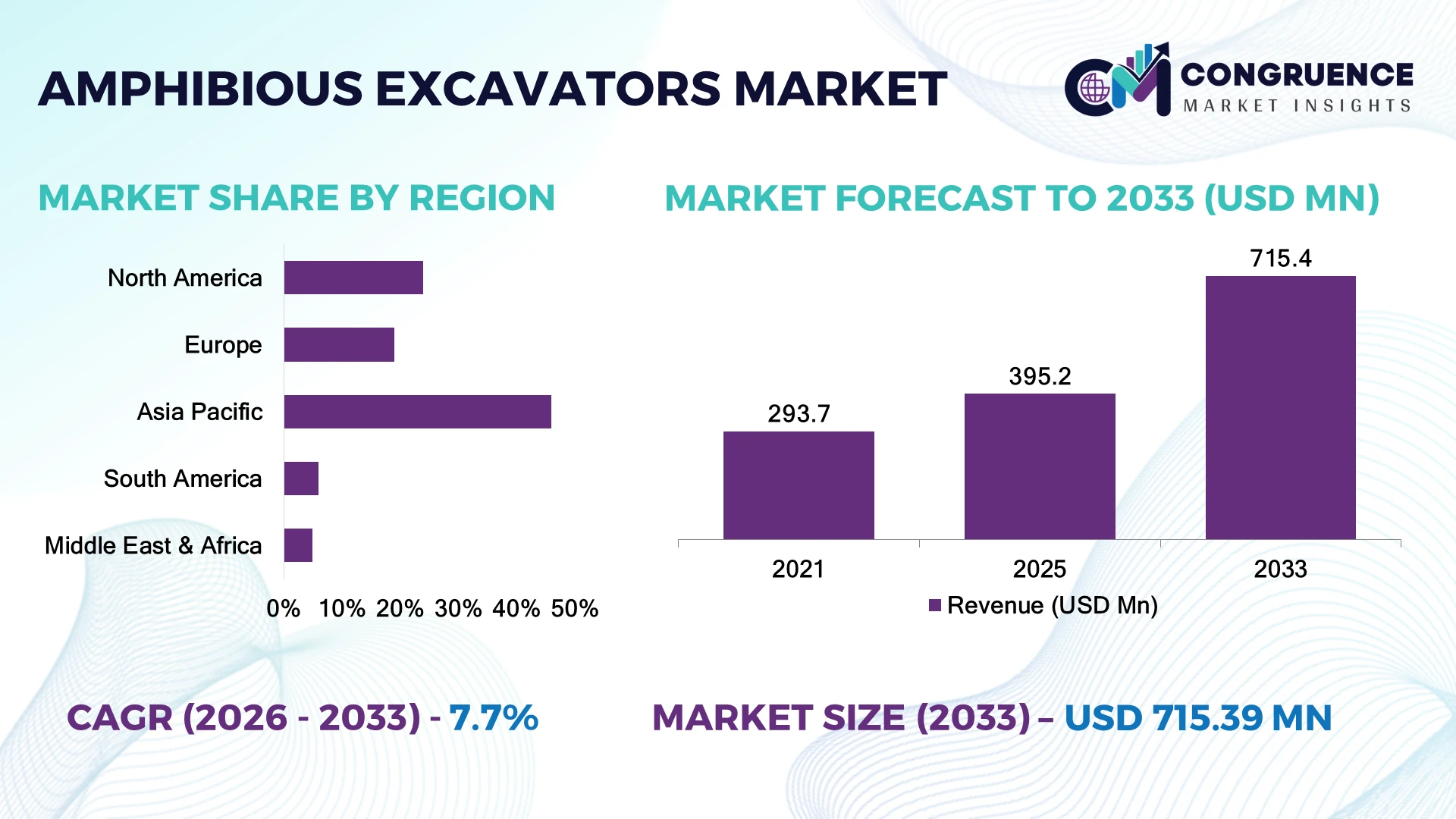
China dominates the global amphibious excavators landscape with approximately 34% of manufacturing capacity, supported by large-scale river engineering, port expansion, and wetland rehabilitation projects exceeding USD 20 billion annually. Japan maintains stronger adoption of precision amphibious hydraulic systems, while China deploys nearly 2.3× more units for large infrastructure works. Increasing automation integration has improved operating efficiency by nearly 18%, reinforcing Asia's leadership in specialized heavy equipment deployment.
Strategically, manufacturers should prioritize localized production, intelligent machine upgrades, and government-backed infrastructure programs to strengthen competitive positioning.
Market Size & Growth: USD 395.2 Million in 2025, projected to reach USD 715.4 Million by 2033, supported by 7.7% CAGR and accelerating dredging equipment modernization.
Top Growth Drivers: Coastal infrastructure projects (+24%), wetland restoration spending (+19%), and inland waterway dredging activity (+17%) continue expanding demand.
Short-Term Forecast: By 2028, automated hydraulic control systems are expected to improve operational efficiency by approximately 16% while reducing fuel consumption by 11%.
Emerging Technologies: AI-assisted excavation, GPS-guided machine control, and predictive maintenance platforms reduce downtime by nearly 20%.
Regional Leaders: Asia Pacific (~USD 280 Million), Europe (~USD 145 Million), and North America (~USD 118 Million) lead adoption through infrastructure modernization and environmental rehabilitation.
Consumer/End-User Trends: More than 58% of government water-management contractors now prioritize amphibious equipment for challenging terrain operations.
Pilot/Case Example: In 2024, a Southeast Asian flood-management project reduced dredging completion time by 22% through amphibious excavator deployment.
Competitive Landscape: Leading manufacturers collectively account for approximately 48% market share, including Wilco Manufacturing, EIK Engineering, Hitachi Construction Machinery, Caterpillar, and Doosan.
Regulatory & ESG Impact: Environmental restoration regulations have increased wetland rehabilitation projects by nearly 21%, accelerating specialized equipment procurement.
Investment & Funding: More than USD 1.2 billion has been committed globally toward water infrastructure upgrades, strengthening equipment manufacturing partnerships.
Innovation & Future Outlook: Hybrid powertrains, telematics, and autonomous assistance functions are redefining next-generation amphibious construction equipment.
Amphibious excavators are increasingly deployed across flood-control engineering, mining support, marshland restoration, and port maintenance where conventional machines cannot operate efficiently. Advanced telematics, intelligent hydraulic controls, and remote fleet monitoring are improving machine utilization by nearly 18%. Rising environmental restoration programs and resilient infrastructure investments are also reshaping procurement strategies, setting the stage for broader strategic market development.
Amphibious excavators have become strategically important as governments and infrastructure developers prioritize climate-resilient construction, flood mitigation, and ecological restoration. Infrastructure modernization programs, expanding dredging requirements, and stricter environmental compliance are encouraging contractors to replace conventional equipment with specialized floating excavation systems. Supply-chain localization for hydraulic components is also improving delivery reliability and production flexibility.
Modern GPS-assisted amphibious excavators complete precision dredging operations nearly 18% faster than conventional crawler excavators while reducing fuel consumption by approximately 12% in waterlogged environments. China continues leading high-volume deployment through large river-management programs, whereas Northern European countries focus on technologically advanced machines equipped with intelligent monitoring and emissions-optimized hydraulic systems. Fleet digitalization is expected to expand significantly over the next two to three years as contractors increase operational transparency.
Manufacturers are strengthening dealer networks, investing in smart machine platforms, and forming engineering partnerships to support customized infrastructure projects. A recent wetland rehabilitation deployment demonstrated measurable improvements in project productivity while minimizing environmental disturbance. Companies emphasizing equipment intelligence, localized service capabilities, and sustainable engineering solutions are positioned to strengthen long-term competitiveness across global infrastructure markets.
Large-scale river restoration, flood-defense upgrades, and coastal resilience investments are accelerating deployment of amphibious excavation equipment. Nearly 62% of newly approved dredging projects in major Asian economies now include specialized floating excavation machinery, while intelligent hydraulic systems improve operating efficiency by approximately 18%. China continues expanding inland waterway development under major infrastructure initiatives, increasing demand for high-capacity amphibious platforms. Equipment manufacturers are responding through production expansion, advanced telematics integration, and partnerships with engineering contractors to deliver customized solutions. The combination of environmental restoration policies and resilient infrastructure investment is strengthening long-term equipment utilization while improving contractor productivity and project execution efficiency.
Specialized pontoons, sealed hydraulic assemblies, and corrosion-resistant structures increase acquisition costs by nearly 30% compared with conventional crawler excavators. Imported hydraulic components still represent over 40% of critical system requirements for several manufacturers, exposing production schedules to logistics disruptions. Global steel price fluctuations and marine-grade material costs continue affecting manufacturing margins and procurement planning. Companies are responding by localizing component sourcing, negotiating long-term supplier agreements, and redesigning platforms for modular maintenance. Improving domestic manufacturing ecosystems remains essential for reducing operational costs and strengthening deployment scalability across infrastructure and environmental restoration projects.
Demand for digitally connected amphibious equipment is creating significant opportunities across smart infrastructure and ecological restoration projects. AI-enabled fleet monitoring has improved machine utilization by approximately 20%, while predictive maintenance reduces unplanned downtime by nearly 17%. Japan continues investing in intelligent hydraulic technologies, supporting advanced machine automation for precision dredging operations. Manufacturers are expanding R&D programs, integrating autonomous assistance functions, and collaborating with software providers to develop connected construction ecosystems. Beyond traditional dredging, growing applications in renewable energy sites, wetland conservation, and disaster recovery create diversified revenue opportunities through specialized equipment innovation and integrated service offerings.
Operating amphibious excavators requires specialized technical expertise, yet certified operators remain limited across several emerging infrastructure markets. Training requirements increase deployment preparation time by approximately 25%, while advanced digital control systems require continuous software updates and technical support. Integration with digital fleet-management platforms also demands reliable connectivity across remote project locations, creating operational consistency challenges. Equipment manufacturers are investing in operator training centers, digital simulation platforms, and expanded after-sales engineering services to improve workforce readiness. Successfully combining skilled personnel, intelligent machine management, and reliable infrastructure support will determine long-term competitiveness and deployment consistency across increasingly sophisticated engineering environments.
Smart Telematics Fleet Expansion Modern amphibious excavators are increasingly equipped with cloud-based telematics, GPS machine guidance, and predictive maintenance platforms. Fleet connectivity has increased by approximately 32% over the past two years, while remote diagnostics reduce unexpected downtime by nearly 18% and maintenance planning time by 15%. Labor shortages across Japan and Northern Europe are accelerating digital fleet management adoption. Manufacturers are expanding software partnerships, integrating machine analytics into equipment portfolios, and offering subscription-based monitoring services that improve utilization while reducing lifecycle operating costs.
Hybrid Powertrain Integration Accelerates Hybrid hydraulic systems and fuel-efficient engines are becoming standard in premium amphibious excavators as emission regulations tighten. Fuel consumption has declined by nearly 14%, while idle emissions have been reduced by approximately 20% through intelligent power management systems. China's environmental compliance policies and public infrastructure modernization are encouraging contractors to replace aging fleets earlier than planned. Equipment suppliers are restructuring product portfolios, scaling hybrid production, and collaborating with engine manufacturers to improve operational efficiency without compromising excavation performance.
Localized Component Manufacturing Growth Companies are reducing dependence on imported hydraulic assemblies by expanding domestic production and regional supplier ecosystems. Local sourcing of structural components has increased by approximately 26%, while delivery lead times have fallen by nearly 19%. Continuing supply-chain disruptions have encouraged manufacturers to establish dual-sourcing strategies and regional fabrication centers. This operational shift improves production continuity, strengthens inventory resilience, and enables faster response to infrastructure project schedules requiring specialized amphibious equipment.
Modular Platform Customization Rising Contractors increasingly demand configurable excavator platforms for dredging, marshland restoration, mining support, and disaster recovery projects. Nearly 37% of newly delivered machines now include modular attachments, while equipment changeover times have improved by approximately 21%. Australian mining contractors and Southeast Asian water-management agencies are requesting application-specific configurations instead of standardized equipment. Manufacturers are expanding engineering collaboration with attachment suppliers, accelerating customized production workflows, and shortening project deployment cycles through flexible platform architectures.
Hydraulic Amphibious Excavators represent the leading segment with an estimated 68% market share due to superior digging precision, higher lifting capacity, and seamless integration with intelligent hydraulic control systems. Their ability to operate efficiently across marshlands, rivers, and coastal engineering projects makes them the preferred choice for government infrastructure and dredging contractors. Mechanical Amphibious Excavators remain relevant for cost-sensitive applications and basic excavation projects but are gradually losing share as operational efficiency becomes a higher procurement priority. Hydraulic models also represent the fastest-growing segment as contractors increasingly adopt GPS guidance, telematics, and automated hydraulic optimization. More than 54% of newly procured amphibious excavators incorporate intelligent control features, while precision excavation accuracy has improved by approximately 17%. Manufacturers are expanding premium product lines, strengthening dealer support, and investing in advanced hydraulic technologies to capture higher-value infrastructure projects, while mechanical equipment continues serving localized maintenance and utility applications where acquisition cost remains the primary purchasing factor.
Based on application, Dredging accounts for approximately 44% of total demand, supported by expanding river maintenance, harbor deepening, and flood-control initiatives. Continuous investments in navigation infrastructure and sediment management sustain equipment utilization throughout the year. Wetland Restoration represents the fastest-growing application as governments strengthen ecosystem rehabilitation programs and climate adaptation strategies. More than 28% of recently approved environmental engineering projects include specialized amphibious excavation equipment to minimize ecological disturbance. Mining Support, Disaster Recovery, and Pipeline Construction continue expanding their operational relevance through specialized deployment requirements. Automated machine guidance has improved excavation productivity by nearly 16%, while project completion times have declined by approximately 14% across complex waterlogged construction sites. Equipment manufacturers are developing application-specific attachment packages, expanding engineering partnerships, and customizing machine configurations to improve operational flexibility across multiple project categories, strengthening long-term utilization beyond traditional dredging activities.
Government Agencies remain the dominant end-user group with an estimated 47% share, driven by large-scale flood-control infrastructure, inland waterway maintenance, coastal protection, and environmental restoration programs. Their procurement volume is supported by long-term public infrastructure planning and national resilience initiatives. Construction Contractors represent the fastest-growing buyer segment as private engineering firms secure increasing numbers of specialized infrastructure and rehabilitation contracts requiring amphibious excavation capabilities. Mining Companies, Oil & Gas Operators, and Environmental Service Providers continue expanding equipment adoption for site access, pipeline maintenance, marshland operations, and remediation activities. Contractor purchases have increased by approximately 23%, while customized equipment specifications now account for nearly 35% of procurement requests. Manufacturers are strengthening direct sales networks, offering application-focused service agreements, and developing flexible financing solutions to improve customer retention while expanding their presence across both public-sector and commercial infrastructure markets.
Asia-Pacific accounted for the largest market share at 46% in 2025 however, North America is expected to register the fastest growth, expanding at a CAGR of 8.4% between 2026 and 2033.

North America accounts for approximately 24% of the global amphibious excavators market, supported by expanding flood-control projects, inland waterway maintenance, and coastal resilience initiatives. Demand is strengthening across the United States and Canada as contractors replace aging excavation fleets with intelligent amphibious equipment capable of operating in environmentally sensitive terrain. More than 42% of large public dredging contracts now specify advanced machine guidance and telematics integration. Federal investments in port modernization and wetland restoration continue increasing equipment deployment across strategic infrastructure corridors. Manufacturers are strengthening dealer networks, expanding aftermarket services, and introducing digitally connected platforms that improve machine utilization, reduce maintenance downtime, and support higher operational productivity.
United States Market Outlook: The United States leads regional deployment through extensive river engineering, coastal restoration, and navigation maintenance programs. Gulf Coast states and the Mississippi River basin remain major equipment utilization centers, while advanced telematics adoption has exceeded 48% among newly commissioned amphibious excavators. Contractors increasingly prioritize intelligent hydraulic systems and predictive maintenance capabilities to improve project execution efficiency. Equipment suppliers continue investing in regional service centers, operator training programs, and localized inventory to support faster fleet availability and long-term infrastructure modernization.
Europe represents approximately 19% of the global market, driven by environmental rehabilitation, inland waterway modernization, and strict ecological compliance requirements. Governments are expanding dredging and wetland restoration activities while prioritizing low-impact construction technologies. Nearly 36% of newly procured amphibious excavators include hybrid hydraulic systems and digital monitoring capabilities that improve operational control in protected environments. Infrastructure modernization across river transport networks is encouraging replacement of older machinery with technologically advanced equipment. Manufacturers are collaborating with engineering contractors to deliver customized excavation platforms that support sustainable project execution and higher operational precision.
Netherlands Market Outlook: The Netherlands remains Europe's most strategically important market due to its advanced water-management infrastructure and continuous coastal protection programs. Delta engineering projects and extensive canal maintenance create sustained demand for specialized amphibious equipment. More than 40% of national water infrastructure projects involve operations within saturated or marshland environments. Equipment suppliers are expanding engineering partnerships and developing customized dredging configurations to support long-term environmental resilience and efficient waterway maintenance.
Asia-Pacific contributes approximately 46% of global demand, supported by extensive river management, port expansion, flood-control infrastructure, and wetland rehabilitation projects. China, Japan, South Korea, and Southeast Asian countries continue investing heavily in resilient infrastructure that requires specialized amphibious excavation equipment. Regional manufacturers account for nearly 52% of global production capacity, while automated hydraulic systems have improved excavation productivity by approximately 18%. Strong manufacturing ecosystems, expanding export activity, and localized supply chains reinforce the region's leadership. Companies continue increasing production capacity, introducing intelligent machine technologies, and strengthening regional distribution networks.
China Market Outlook: China dominates regional manufacturing and deployment through large-scale inland waterway engineering, coastal infrastructure construction, and environmental restoration initiatives. Domestic manufacturers benefit from integrated supply chains and high production efficiency, enabling competitive equipment exports across Asia and Africa. Approximately 34% of global manufacturing capacity is concentrated in China, while increasing adoption of intelligent construction equipment supports greater operating precision and project efficiency across national infrastructure programs.
South America accounts for approximately 6% of the global market, with demand supported by river dredging, mining infrastructure, hydroelectric maintenance, and flood-management activities. Countries across the continent are increasing investment in navigation channels and environmental rehabilitation projects requiring amphibious excavation capabilities. Deployment of specialized equipment has increased by nearly 15% across major water infrastructure programs during recent years. Despite logistics constraints and uneven equipment availability, manufacturers are expanding dealer partnerships and strengthening regional service capabilities to improve equipment accessibility and maintenance support.
Brazil Market Outlook: Brazil leads regional demand through extensive river systems, mining operations, and hydroelectric infrastructure requiring specialized excavation equipment. The Amazon basin and major inland waterways generate continuous demand for dredging and environmental maintenance activities. More than 45% of regional amphibious excavator deployment is concentrated within Brazil. Equipment suppliers continue expanding technical support networks and localized maintenance capabilities to improve operational reliability across remote project locations.
Middle East & Africa represents approximately 5% of the global market, driven by expanding coastal development, desalination infrastructure, flood-control systems, and port modernization projects. Governments are investing in resilient marine infrastructure while increasing deployment of specialized excavation equipment for shoreline stabilization and environmental engineering. Approximately 22% of newly planned coastal engineering projects now specify amphibious machinery for complex operating environments. Manufacturers are strengthening regional partnerships, improving equipment availability, and expanding technical service capabilities to support growing infrastructure requirements across diverse operating conditions.
Saudi Arabia Market Outlook: Saudi Arabia leads regional investment through large-scale coastal development, industrial port expansion, and water infrastructure modernization initiatives. Major economic diversification programs continue increasing demand for specialized construction equipment capable of operating in challenging shoreline environments. Intelligent machine deployment has expanded by approximately 17% across newly awarded marine infrastructure projects. Equipment manufacturers are prioritizing regional partnerships, service infrastructure, and operator training to support long-term project execution and equipment reliability.
Competition is led by Wilco Manufacturing, EIK Engineering, Waterking BV, Ultratrex Machinery, and Wetland Equipment, while global construction equipment OEMs such as Caterpillar and Hitachi Construction Machinery compete through specialized project solutions rather than dedicated product portfolios. Global engineering specialists compete against regional manufacturers on technology, customization, and delivery speed, whereas cost-focused suppliers challenge premium brands through localized production. The top five dedicated amphibious excavator manufacturers collectively account for approximately 58% of global market activity. Competition increasingly centers on intelligent hydraulics, telematics integration, and modular platform flexibility, with digital fleet features improving operating efficiency by nearly 18% and localized sourcing reducing delivery lead times by approximately 20%. Companies are expanding manufacturing capacity, forming engineering partnerships, and vertically integrating attachment production to strengthen project execution. Rising technical certification requirements and specialized engineering expertise remain major entry barriers. Winning requires application-specific innovation, resilient supply chains, responsive aftermarket support, and rapid customization for complex infrastructure and environmental projects.
EIK Engineering Sdn. Bhd.
Waterking BV
Ultratrex Machinery Sdn. Bhd.
Wetland Equipment Company
Marsh Buggies Incorporated
REMU Oy
Bell Dredging Pumps
Hitachi Construction Machinery Co., Ltd.
Caterpillar Inc.
Komatsu Ltd.
Kobelco Construction Machinery Co., Ltd.
XCMG Group
SANY Heavy Industry Co., Ltd.
Advanced hydraulic control systems, intelligent telematics, and GPS-guided excavation are transforming amphibious excavator operations. Closed-loop hydraulic optimization improves digging precision by approximately 18% while reducing fuel consumption by nearly 12%. Around 55% of newly delivered premium machines now integrate remote fleet monitoring, enabling predictive maintenance and real-time operational diagnostics. Contractors benefit from higher equipment utilization, faster troubleshooting, and improved project scheduling across dredging and environmental restoration operations.
Hybrid powertrains, modular pontoon platforms, and AI-assisted machine control are replacing conventional mechanical systems. Compared with legacy hydraulic configurations, integrated intelligent systems improve operating productivity by nearly 20% while lowering maintenance interventions by approximately 15%. Manufacturers with strong software integration capabilities gain competitive advantage through lower lifecycle costs and enhanced fleet visibility. Companies are increasingly combining telematics, machine learning, and digital service platforms to differentiate premium equipment from lower-cost alternatives.
Between 2026 and 2028, autonomous excavation assistance, digital twins, and cloud-connected maintenance ecosystems are expected to become mainstream across major infrastructure projects. Smart machine adoption is projected to exceed 65% of new premium deployments, enabling more consistent excavation accuracy, faster project execution, and improved asset management. Companies investing early in intelligent automation, cybersecurity, and connected equipment platforms will strengthen competitive positioning and long-term customer retention.
April 2025 – Hitachi Construction Machinery unveiled its first LANDCROS solutions at bauma 2025, introducing the LANDCROS Connect Fleet Management System and LANDCROS Innovation Studios to enhance fleet visibility and mining productivity. The platform supports management of mixed-brand equipment across construction fleets, strengthening the company's digital equipment ecosystem. Source: www.hitachicm.com
September 2024 – Hitachi Construction Machinery announced that its Indonesian manufacturing facility would begin mass production of 120-ton class ultra-large hydraulic excavators, significantly expanding heavy excavator manufacturing capability for global mining customers and improving supply responsiveness. Source: www.hitachicm.com
January 2024 – Hitachi Construction Machinery began accepting orders for the ZAXIS-7G hydraulic excavator series across Southeast Asia, expanding its latest excavator platform with improved fuel efficiency, operator comfort, and advanced hydraulic performance to strengthen its regional construction equipment portfolio. Source: www.hitachicm.com
January 2024 – Hitachi Construction Machinery opened a Remote Support Center for its Mining Dump Truck Autonomous Haulage System, enabling continuous remote operational support for autonomous mining fleets and strengthening the company's intelligent mining solutions portfolio.
This report provides comprehensive analysis of the global amphibious excavators market across equipment types, key applications, end-user industries, competitive dynamics, technology evolution, and regional performance. Coverage includes hydraulic and mechanical amphibious excavators deployed across dredging, wetland restoration, mining support, disaster recovery, pipeline construction, and related infrastructure activities. The study evaluates demand patterns across government agencies, construction contractors, mining companies, environmental service providers, and industrial operators while assessing deployment trends across North America, Europe, Asia-Pacific, South America, and the Middle East & Africa.
The report examines intelligent hydraulics, hybrid powertrains, telematics, predictive maintenance, and modular platform innovations shaping future equipment development. More than 55% of premium equipment deployments now incorporate connected technologies, reflecting accelerating digital transformation across specialized construction fleets. Strategic insights support product development, market expansion, investment prioritization, competitive benchmarking, partnership evaluation, procurement planning, and long-term business positioning across the evolving amphibious excavators industry between 2026 and 2033.
| Report Attribute / Metric | Details |
|---|---|
| Market Revenue (2025) | USD 395.2 Million |
| Market Revenue (2033) | USD 715.4 Million |
| CAGR (2026–2033) | 7.7% |
| Base Year | 2025 |
| Forecast Period | 2026–2033 |
| Historic Period | 2021–2025 |
| Segments Covered |
By Type
By Application
By End-User
|
| Key Deliverables | Revenue Forecast; Market Trends; Growth Drivers & Restraints; Technology Insights; Segmentation Analysis; Regional Insights; Competitive Landscape; Regulatory & ESG Overview; Recent Developments |
| Regions Covered | North America; Europe; Asia-Pacific; South America; Middle East & Africa |
| Companies Profiled | Wilco Manufacturing LLC; EIK Engineering Sdn. Bhd.; Waterking BV; Ultratrex Machinery Sdn. Bhd.; Wetland Equipment Company; Marsh Buggies Incorporated; REMU Oy; Bell Dredging Pumps; Hitachi Construction Machinery Co., Ltd.; Caterpillar Inc.; Komatsu Ltd.; Kobelco Construction Machinery Co., Ltd.; XCMG Group; SANY Heavy Industry Co., Ltd. |
| Customization & Pricing | Available on Request (10% Customization Free) |




