
Reports
The Global Ammonium Nitrate Explosive Market was valued at USD 2,190.5 Million in 2025 and is anticipated to reach a value of USD 2,796.5 Million by 2033 expanding at a CAGR of 3.1% between 2026 and 2033. Growth is driven by expanding surface mining, quarrying, coal and metal extraction, infrastructure excavation, and conversion toward bulk emulsion and automated blasting systems that improve fragmentation consistency and loading productivity.
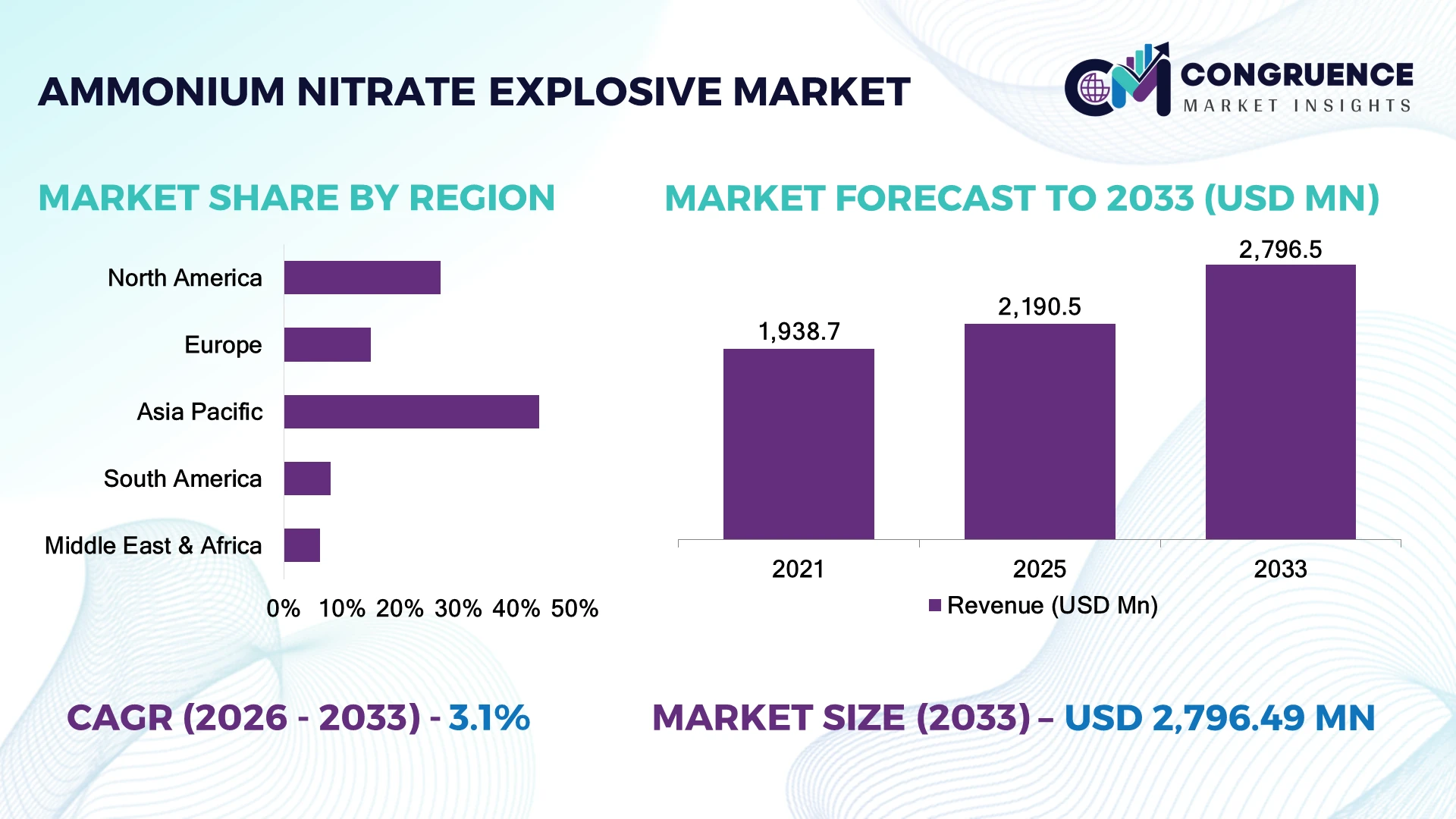
India is emerging as a major ammonium nitrate explosives market, with technical ammonium nitrate capacity of 587 KTPA at a leading producer and approximately 600,000 tonnes of annual explosives-industry requirement nationally. India’s mining segment represents about 57.6% of ammonium nitrate demand, while Australia maintains integrated production through a facility producing around 400,000 tonnes annually for mining and quarry applications.
India’s 2025 regulatory amendments and tighter controls following global explosive-safety concerns are accelerating traceability, licensed handling, and domestic supply-chain planning. Strategically, producers should prioritize secure AN feedstock, localized bulk-explosive manufacturing, digital blast optimization, and regulatory-compliant distribution networks.
Market Size & Growth: USD 2.19 Billion in 2025 to USD 2.80 Billion by 2033 at 3.1% CAGR, supported by mining expansion and automated bulk blasting.
Top Growth Drivers: Mining 57.6%; infrastructure 18%; quarrying 14%.
Short-Term Forecast: By 2028, digital blast optimization can improve fragmentation consistency by 8–12% and reduce avoidable drilling and blasting losses.
Emerging Technologies: Bulk emulsion systems, electronic initiation, AI-assisted blast design, and automated charging are reshaping advanced mining operations.
Regional Leaders: Asia-Pacific approaches USD 1.25 Billion; North America USD 0.65 Billion; Europe USD 0.42 Billion, with Asia-Pacific accelerating localized explosive production.
Consumer/End-User Trends: Mining accounts for approximately 57.6% of Indian ammonium nitrate demand, reinforcing bulk AN-based explosives as the dominant industrial application.
Pilot/Case Example: 2025 low-carbon ammonium nitrate blasting in Spain demonstrated commercial deployment of renewable-hydrogen-derived AN, linking explosive performance with lower-carbon procurement.
Competitive Landscape: Orica leads globally with an estimated 15% share, competing with Dyno Nobel, Enaex, Austin Powder, and MAXAM.
Regulatory & ESG Impact: India extended selected explosives and ammonium-nitrate licence validity from 5 to 10 years, reducing renewal frequency and supporting longer-term investment planning.
Investment & Funding: Orica’s Kooragang Island expansion is designed to increase AN production capability from 500 KT/year to 750 KT/year, strengthening regional mining supply resilience.
Innovation & Future Outlook: 2026–2028 priorities center on low-carbon AN, electronic initiation, automated bulk loading, digital blast analytics, and integrated mine-to-blast service models.
The Ammonium Nitrate Explosive Market is concentrated in mining, quarrying, coal extraction, metal mining, and infrastructure excavation, with mining representing more than half of demand in major emerging markets. Bulk emulsions, electronic initiation, and digital blast monitoring are gaining traction as operators target 8–12% better fragmentation consistency. Regulatory tightening is simultaneously strengthening domestic sourcing and traceability, creating a clear transition toward integrated explosive-service models.
Ammonium nitrate explosives are becoming strategically important because mining productivity increasingly depends on controlled fragmentation, reliable explosive availability, and compliant handling. Mining represents 57.6% of India's ammonium nitrate market, while large producers are integrating AN manufacturing with bulk explosive services. Supply-chain localization is becoming more important as governments tighten controls over storage, transport, licensing, and diversion.
Technology is shifting from conventional ANFO toward bulk emulsion, electronic initiation, and digitally optimized blast design. Advanced systems can improve fragmentation consistency by roughly 8–12% while reducing avoidable drilling and secondary-breakage requirements. Australia benefits from vertically integrated AN production, while India is expanding domestic technical-grade AN capacity and tightening regulatory oversight through 2025–2026 amendments.
Over the next 2–3 years, producers and mining contractors will prioritize localized AN capacity, automated charging, electronic initiation, and lower-carbon feedstocks. A practical deployment model links on-site bulk manufacturing with digital blast monitoring, allowing operators to adjust loading and fragmentation performance using measured field data. Companies that combine secure feedstock, compliant logistics, advanced blasting technology, and mine-site technical services will hold the strongest competitive position.
Expansion of coal, iron ore, copper, and quarrying activity is increasing consumption of ammonium-nitrate-based commercial explosives, with mining accounting for approximately 58% of demand in India. Bulk explosive systems are also gaining preference because they improve consistency and reduce manual handling requirements by roughly 10–15%. Australia’s Kooragang Island facility produces about 400,000 tonnes of industrial-grade ammonium nitrate annually for mining and quarry applications. Companies are strengthening integrated AN production, site-based supply agreements, and digital blast-management capabilities. The strategic shift is toward controlling the material-to-blast value chain rather than selling commodity-grade inputs independently.
Ammonium nitrate supply remains sensitive to ammonia and nitric-acid availability, while licensed storage, transportation, and inventory controls increase operating complexity. Feedstock and energy costs can represent more than 60% of production economics at integrated chemical facilities, while transport restrictions can add 10–15% to delivered-cost exposure in distant mining locations. India’s regulatory framework requires licensing across manufacture, conversion, transport, possession, import, and export, creating additional compliance checkpoints. Companies are responding through localized production, contracted feedstock, regional inventories, and vertically integrated supply chains. The non-obvious constraint is that excess inventory is not a simple buffer: regulated storage capacity itself limits how much supply security producers can economically maintain.
Digital blast-management platforms are creating opportunities beyond ammonium nitrate supply by connecting electronic initiation, fragmentation analytics, fleet data, and production monitoring. Mining operators deploying advanced digital workflows are targeting approximately 8–12% improvement in fragmentation consistency and 5–10% higher equipment utilization. India and Australia are particularly attractive as large open-pit mines increasingly integrate explosives supply with technical services. Companies are investing in analytics partnerships, automated quality monitoring, and integrated mine-service contracts. A non-obvious opportunity is converting blast-performance data into recurring service revenue: suppliers can use measured fragmentation and downstream productivity to justify premium contracts rather than competing primarily on explosive-material pricing. Regulatory digitization is reinforcing this shift by increasing the value of traceable material movements.
Long-term competitiveness increasingly depends on integrating explosive supply with mine planning, drilling, fleet dispatch, and production analytics. Legacy operations can have 20–30% lower data connectivity than digitally integrated mines, creating inconsistent blast-performance measurement and limiting predictive optimization. Skilled technical personnel are also constrained, with specialist workforce shortages increasing commissioning and training requirements by roughly 10–15% at complex operations. India’s evolving ammonium-nitrate rules and the 2026 regulatory amendments further increase the importance of documented transport and custody controls. Companies are responding through standardized digital platforms, workforce partnerships, remote monitoring, and integrated contractor models. The strategic challenge is ensuring technology improves operational visibility without creating fragmented systems across drilling, blasting, compliance, and production workflows.
Regulatory Traceability Tightens: India’s 2025–2026 regulatory changes are increasing emphasis on licensed movement and accountability across the ammonium nitrate supply chain. Licence validity was extended from 5 to 10 financial years in 2025, reducing administrative frequency while strengthening structured compliance planning.
Integrated Supply Gains Priority: Mining companies increasingly favor suppliers combining AN production, logistics, technical services, and blast management. Australia’s Kooragang Island produces around 400,000 tonnes annually, illustrating the value of integrated domestic capacity for reducing external supply exposure.
Digital Blast Monitoring Expands: Mining operators are connecting blast-planning and production systems to improve fragmentation consistency by approximately 8–12% and equipment utilization by 5–10%. Suppliers are responding with analytics-led service contracts, shifting commercial value from material volumes toward measurable mine productivity.
Supply Security Becomes Strategic: Geopolitical and logistics disruptions are encouraging producers to localize ammonium nitrate capacity and diversify transport arrangements. Companies are targeting 10–15% greater supply-buffer resilience while avoiding excessive regulated inventory. The emerging advantage is regional production paired with digitally documented custody, improving continuity without materially expanding storage exposure.
ANFO represents the leading product type at approximately 55–58% of ammonium-nitrate-based explosive demand, supported by low material cost, established supply chains, and straightforward deployment in dry blast holes. Emulsion explosives account for roughly 28–35% and are gaining share where wet-hole performance, energy consistency, and controlled blasting justify higher system costs. Water-gel and slurry formulations retain approximately 8–14% in specialized applications. The mature ANFO segment remains strongest in large surface mines and quarrying operations, while emulsion adoption is accelerating in technically demanding sites.
The fastest-growing shift is toward bulk emulsion and site-mixed systems, particularly in Australia, India, and large metal mines, where automated delivery improves consistency and reduces manual handling exposure. Companies are expanding mobile manufacturing units, upgrading pumping infrastructure, and integrating blast-management services. The investment implication is clear: ANFO remains the volume anchor, but emulsion platforms increasingly capture higher-value contracts through performance, site adaptability, and integrated service models.
A 2026 peer-reviewed study evaluated 115 controlled blasts at an operational open-cast coal mine in India using drone photogrammetry, AI-based predictive modeling, and automated image analysis, demonstrating the growing role of digital measurement in explosive-performance evaluation.
Coal mining represents the leading application at approximately 42% of ammonium-nitrate explosive demand, supported by high-frequency blasting across large surface operations and continuous overburden removal. Metal mining follows at roughly 37%, while quarrying and non-metal mining account for about 21%. Coal operations prioritize cost-efficient bulk blasting and consistent fragmentation, whereas metal mines increasingly favor higher-performance formulations where deeper benches, harder ore, and tighter fragmentation specifications increase the value of blast optimization.
Metal mining is the fastest-changing application, particularly across copper, iron ore, gold, and critical-mineral operations. Digital blast planning, electronic initiation, and automated loading are strengthening adoption, with advanced workflows targeting approximately 8–12% better fragmentation consistency and 5–10% improvement in downstream equipment utilization. Companies are increasingly linking explosives contracts with drilling, blasting analytics, and mine-productivity services. This shifts purchasing from price-per-tonne toward measurable cost-per-tonne-of-rock and downstream productivity outcomes.
India’s mining application accounted for 57.6% of ammonium nitrate demand in 2026, reflecting the material’s concentration in mineral extraction and infrastructure-linked blasting requirements.
Mining companies represent the dominant end-user group at approximately 60% of ammonium nitrate explosive consumption because large open-pit and underground operations require recurring blasting across production benches, overburden, and ore bodies. Explosives manufacturers and specialist blasting contractors collectively account for roughly 25%, while quarry operators and construction-related users contribute about 15%. Large mining companies increasingly prefer integrated supply agreements covering material, delivery, blast engineering, and performance monitoring rather than standalone product procurement.
Specialist blasting contractors are the fastest-expanding buyer group as mine operators outsource technically complex loading, blast design, and site services. Adoption of mobile manufacturing units and digital blast monitoring can reduce selected manual handling requirements by 10–15% while improving supply responsiveness. In Australia, India, and Latin America, suppliers are therefore building long-term mine-site partnerships and localized service networks. The competitive implication is that manufacturers with technical-service capabilities can defend margins more effectively than suppliers competing solely on ammonium nitrate volume.
A 2025 industry assessment identified mining as the largest end-use sector for industrial explosives, with mining-related applications accounting for the majority of global consumption and reinforcing the importance of recurring mine-site supply contracts.
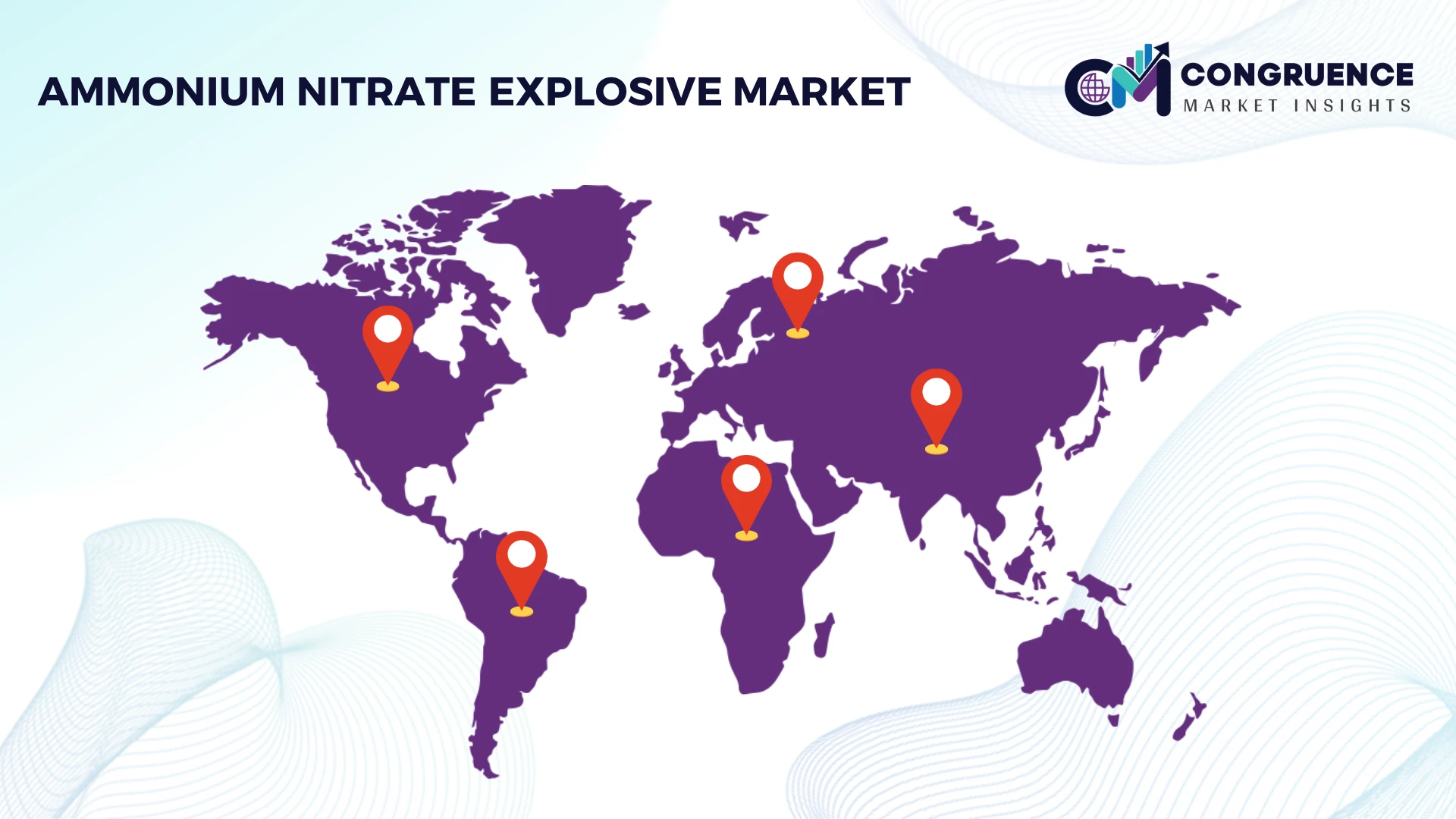
Asia-Pacific accounted for the largest market share at 43.8% in 2025 however, Middle East & Africa is expected to register the fastest growth, expanding at a CAGR of 4.7% between 2026 and 2033.
Supply diversification strengthens mining and quarrying resilience
North America represents approximately 27% of global ammonium nitrate explosive demand, anchored by large-scale metal mining, coal production, aggregates, and construction activity in the United States and Canada. The region benefits from established AN manufacturing, extensive distributor networks, and high adoption of bulk delivery and electronic initiation systems. Dyno Nobel operates more than 1.2 million tonnes of ammonium nitrate capacity globally, with dedicated North American manufacturing supporting mining and quarry customers. In March 2026, Orica agreed to acquire Nelson Brothers’ U.S. explosives business while pursuing diversified AN contracts, adding four emulsion plants and mobile manufacturing units. This strengthens local availability and shifts competition toward integrated supply, site services, and operational resilience.
United States Market Outlook: The United States remains the region’s largest market, supported by copper, gold, iron ore, aggregates, coal, and infrastructure excavation. Dyno Nobel maintains AN manufacturing in Wyoming and Missouri, while its North American business serves mining and quarry markets through direct supply and distributors. The company’s 25-year ammonia agreement for up to 200,000 short tons annually demonstrates the importance of securing upstream feedstock for explosive-grade AN production.
Low-carbon blasting accelerates industrial modernization
Europe accounts for approximately 15% of global ammonium nitrate explosive demand, with France, Spain, Germany, Poland, and the Nordic mining economies providing important consumption centers. Mining modernization, quarrying, infrastructure construction, and decarbonization are reshaping procurement toward lower-carbon AN and digitally controlled blasting. Spain recorded an industrial-scale low-carbon ammonium nitrate blast using renewable-hydrogen-derived AN, establishing a practical pathway for reducing embedded emissions without changing the downstream blasting workflow. Producers are consequently developing lower-carbon feedstock partnerships, advanced initiation systems, and integrated technical services. The commercial implication is a gradual shift from commodity explosive purchasing toward documented blast performance and carbon-intensity management.
Germany Market Outlook: Germany remains strategically important through its aggregates, construction materials, tunneling, and industrial infrastructure base. Tight environmental requirements are encouraging greater precision in drilling and blasting to reduce overbreak, material waste, and secondary processing. Suppliers with electronic initiation, digital blast planning, and lower-emission AN formulations can differentiate beyond conventional price-based procurement.
Mining scale reinforces integrated explosive supply chains
Asia-Pacific commands approximately 43.8% of global ammonium nitrate explosive demand, supported by coal, iron ore, copper, gold, quarrying, and major infrastructure projects across Australia, India, Indonesia, and China. India alone has an estimated annual explosives-industry AN requirement of approximately 600,000 tonnes, underscoring the region’s unusually large industrial consumption base. Australia combines domestic AN manufacturing with sophisticated mobile bulk-explosive deployment, while India is strengthening regulatory controls and indigenous supply. Producers are expanding localized manufacturing, site-based delivery, and digital blast services to reduce transport exposure. The strategic advantage is increasingly vertical integration from AN production through mine-site blasting rather than dependence on merchant supply.
India Market Outlook: India is a strategically significant market because coal, iron ore, limestone, and infrastructure excavation generate recurring blasting requirements. The explosives industry consumes approximately 600,000 tonnes of AN annually, creating a substantial domestic supply base. Regulatory tightening under the 2025 Ammonium Nitrate Amendment Rules is simultaneously increasing the importance of licensed handling, traceability, and controlled distribution.
Copper and iron-ore expansion strengthens bulk blasting demand
South America contributes approximately 8% of global ammonium nitrate explosive demand, with Brazil, Chile, and Peru accounting for most industrial consumption. Copper, iron ore, gold, lithium, and large quarrying operations create sustained requirements for bulk ANFO, emulsions, and site-based blasting services. Chile and Peru are particularly important because high-altitude and hard-rock mines increasingly require controlled fragmentation and reliable explosive delivery. Dyno Nobel maintains initiating-system manufacturing capabilities in Chile and Mexico, supporting localized service coverage. Companies are expanding mobile manufacturing, technical blasting partnerships, and regional inventory positions to reduce import-cycle exposure. The key opportunity is linking explosive supply with mine productivity rather than competing solely on delivered material cost.
Brazil Market Outlook: Brazil is the region’s largest diversified opportunity, supported by iron ore, gold, aggregates, cement, and infrastructure development. Large open-pit mines favor bulk explosive delivery and automated loading because production schedules require consistent fragmentation across extensive bench areas. Suppliers with local technical teams, mobile manufacturing capability, and integrated initiation systems can improve responsiveness while reducing dependence on imported finished explosives.
Mining localization accelerates domestic AN investment
Middle East & Africa represents approximately 6% of global ammonium nitrate explosive demand, with Saudi Arabia, South Africa, Morocco, and the UAE providing major industrial opportunities. Mining diversification, phosphate extraction, quarrying, and large infrastructure programs are increasing requirements for locally available AN-based explosives. Saudi Arabia is particularly significant because ammonium nitrate has historically been imported while mining localization programs are encouraging domestic production. A planned 350,000-tonne-per-year low-density AN facility at Ras Al-Khair illustrates the scale of backward-integration investment. Companies are pairing domestic AN capacity with mobile manufacturing and blasting services, reducing imported-feedstock exposure and improving delivery reliability.
Saudi Arabia Market Outlook: Saudi Arabia offers the strongest strategic opportunity through phosphate, gold, copper, quarrying, and large-scale industrial development. Ma’aden has identified ammonium nitrate production as a localization opportunity, while local projects are targeting substantial domestic AN capacity. The shift toward domestic feedstock is strategically important because it reduces exposure to international shipping and strengthens control over explosive manufacturing inputs.
Orica, Dyno Nobel, Enaex, Austin Powder, and MAXAM compete through integrated explosive supply, mine-site services, and regional manufacturing. The top five are estimated at about 45% combined share. Competition centers on price, delivery reliability, and technology, with digital blasting improving productivity 5–10%. Producers are expanding mobile manufacturing units, securing ammonia contracts, forming mine-site partnerships, and integrating initiation systems with bulk explosives. The competitive shift is toward control of feedstock and blast-performance data rather than standalone product sales. Entry barriers remain high because TAN plants require capital, licensing, safety infrastructure, hazardous-material logistics, and feedstock security. Regional players pressure global leaders through localized inventory and customization, while technology-focused suppliers differentiate through automation. Winners will combine secure AN supply, advanced blasting systems, local service capability, and measurable mine productivity. Scale advantages matter, but responsiveness determines contract retention: customers favor suppliers that can guarantee compliant delivery, site support, and fragmentation outcomes across mining jurisdictions.
Orica Limited
Dyno Nobel
Enaex S.A.
Austin Powder Company
MAXAM
Solar Industries India Limited
AEL Mining Services
EPC Groupe
Forcit Group
BME Mining
Sasol Mining Explosives
Yara International ASA
Modern ammonium nitrate explosive technology is shifting from conventional ANFO toward bulk emulsion, electronic initiation, automated loading, and digital blast analytics. Bulk systems can improve loading consistency by 8–12%, while electronic initiation can improve fragmentation control by 5–10%. Adoption is strongest in large open-pit mines, where integrated blasting platforms increasingly connect drill data with blast design.
Mobile manufacturing units and automated delivery systems reduce manual handling and improve site responsiveness. Compared with conventional fragmented workflows, connected blast platforms can raise equipment utilization by 5–10% through better timing, loading, and fragmentation feedback. Orica and Enaex benefit from integrated explosives, initiation, and digital-service portfolios, while regional producers compete through localized supply and lower delivered cost.
During 2026–2028, AI-assisted blast optimization, autonomous delivery, low-carbon ammonium nitrate, and real-time fragmentation measurement will gain importance. Orica’s Hunter Valley Hydrogen Hub uses a 50 MW electrolyser and targets 7.5% lower natural-gas feedstock demand. Companies acting now can secure lower-carbon production, stronger supply resilience, and differentiated mine-site performance. Deployment is moving from equipment toward interoperable mine platforms, with leading operations targeting 10% faster blast-cycle decisions.
July 2026 Orica reached final investment decision on the Hunter Valley Hydrogen Hub, committing A$245–283 million through 2029. The 50 MW electrolyser targets 4,700 tonnes of renewable hydrogen, supporting lower-carbon ammonia and ammonium nitrate production and strengthening Australian supply resilience. Source: Orica (Orica)
April 2026 Orica managed a Western Australian ammonia outage by securing alternative ammonia and ammonium nitrate through inventory and diversified manufacturing. East Coast plants resumed by 1 April, demonstrating supply-chain redundancy and protecting mining customers from disruption during feedstock constraints. Source: Orica (Orica)
April 2024 Dyno Nobel commissioned a $20 million Moranbah decarbonisation project targeting up to 12% reduction in global operational greenhouse-gas emissions against its 2020 baseline. The project lowers ammonium nitrate footprint and supports lower-carbon explosives for Australian mining operations customers. Source: Dyno Nobel (Dyno Nobel)
June 2026 Enaex and N.A.N. GreenMet signed an India joint venture focused on blasting solutions for infrastructure and mining. The partnership combines global blasting technology with local execution, targeting emulsions, detonators, and precision services across India’s resource and infrastructure projects. Source: Indian Infrastructure (Indian Infrastructure)
The Ammonium Nitrate Explosive Market Report covers ANFO, bulk emulsion, water-gel, slurry, and other ammonium-nitrate-based formulations across coal mining, metal mining, quarrying, construction, tunneling, and infrastructure blasting. End-user coverage includes mining companies, blasting contractors, quarry operators, construction enterprises, and industrial users across North America, Europe, Asia-Pacific, South America, and Middle East & Africa.
The report evaluates electronic initiation, automated charging, mobile manufacturing units, digital blast optimization, low-carbon ammonium nitrate, and integrated mine-site services. Mining accounts for approximately 60% of global industrial explosive consumption in major markets, while leading suppliers increasingly combine product supply with technical services. The analysis supports investment planning, capacity expansion, supply-chain localization, partnership selection, competitive positioning, and technology prioritization through 2026–2033.
| Report Attribute/Metric | Report Details |
|---|---|
|
Market Revenue in 2025 |
USD 2,190.5 Million |
|
Market Revenue in 2033 |
USD 2,796.5 Million |
|
CAGR (2026 - 2033) |
3.1% |
|
Base Year |
2025 |
|
Forecast Period |
2026 - 2033 |
|
Historic Period |
2021 - 2025 |
|
Segments Covered |
By Type
By Application
By End-User
|
|
Key Report Deliverable |
Revenue Forecast, Growth Trends, Market Dynamics, Segmental Overview, Regional and Country-wise Analysis, Competition Landscape |
|
Region Covered |
North America, Europe, Asia-Pacific, South America, Middle East, Africa |
|
Key Players Analyzed |
Orica Limited, Dyno Nobel, Enaex S.A., Austin Powder Company, MAXAM, Solar Industries India Limited, AEL Mining Services, EPC Groupe, Forcit Group, BME Mining, Sasol Mining Explosives, Yara International ASA |
|
Customization & Pricing |
Available on Request (10% Customization is Free) |




