
Reports
The Global Amidoamine Market was valued at USD 2122.68 Million in 2025 and is anticipated to reach a value of USD 4017.09 Million by 2033 expanding at a CAGR of 8.3% between 2026 and 2033. Growth is supported by expanding epoxy curing agent production, rising corrosion protection requirements, and higher consumption of specialty surfactants across industrial coatings, water treatment, and oilfield chemical applications.
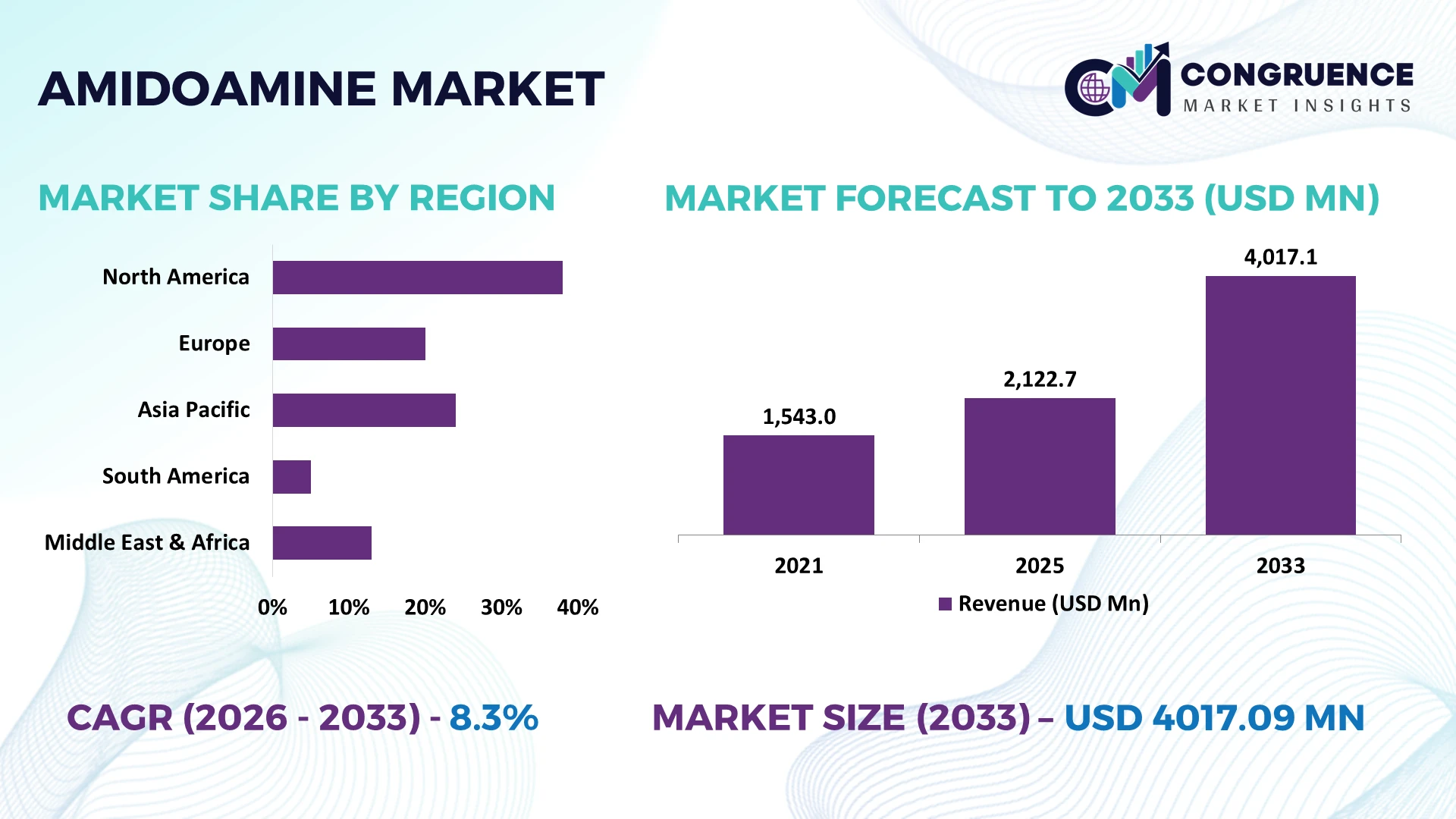
China remains the dominant manufacturing hub, accounting for approximately 38% of global production capacity, supported by integrated chemical clusters and sustained investments in specialty chemicals serving coatings, construction, and energy sectors. India continues expanding downstream chemical capacity by over 9% annually, while Europe prioritizes low-emission formulations under tightening industrial sustainability regulations, strengthening advanced amidoamine adoption across high-performance applications.
Strategic investment in regional manufacturing and sustainable specialty formulations strengthens supply resilience while improving access to high-growth industrial end-use sectors.
Market Size & Growth: USD 2122.68 Million in 2025 reaching USD 4017.09 Million by 2033 at 8.3% CAGR, supported by advanced epoxy systems and specialty chemical manufacturing expansion.
Top Growth Drivers: Industrial coatings demand +12%, corrosion protection chemicals +10%, and water treatment additives +9% continue accelerating global market expansion.
Short-Term Forecast: By 2027, production efficiency improves by 15% through automation, reducing batch processing costs and improving manufacturing consistency.
Emerging Technologies: AI-enabled process control, automated blending, and advanced bio-based intermediates improve quality while reducing production variability by approximately 18%.
Regional Leaders: Asia-Pacific exceeds USD 1800 Million, North America approaches USD 820 Million, and Europe surpasses USD 760 Million, driven by specialty coatings, infrastructure renewal, and sustainable chemical adoption.
Consumer/End-User Trends: More than 62% of industrial coating formulators prioritize high-performance curing agents with improved corrosion resistance and longer service life.
Pilot/Case Example: In 2026, a specialty chemical facility implemented automated reaction monitoring, improving production yield by 14% while reducing material waste.
Competitive Landscape: Leading manufacturers collectively control nearly 42% of global supply, with competition focused on product performance, formulation expertise, regional expansion, and customized solutions.
Regulatory & ESG Impact: Low-VOC product development expands by 20% as environmental regulations encourage sustainable industrial chemical formulations across major manufacturing regions.
Investment & Funding: More than USD 850 Million supports specialty chemical capacity expansion, joint ventures, and resilient regional supply chains amid global manufacturing diversification.
Innovation & Future Outlook: Next-generation bio-based amidoamine technologies and digital manufacturing platforms accelerate premium product development while strengthening long-term industrial competitiveness.
Amidoamine products continue gaining importance across protective coatings, adhesives, oilfield chemicals, and water treatment formulations where higher durability and chemical resistance remain essential. Manufacturers increasingly adopt bio-based feedstocks and automated production technologies, improving process efficiency by nearly 16%. Regional supply-chain diversification and stricter environmental compliance are reshaping sourcing strategies, creating stronger opportunities for high-performance specialty formulations and setting the stage for broader strategic market evaluation.
Amidoamine is becoming strategically important as manufacturers strengthen supply-chain resilience, expand specialty chemical portfolios, and align with evolving industrial performance standards. Rising demand for advanced epoxy curing agents in infrastructure rehabilitation, offshore assets, and industrial equipment is shifting procurement toward higher-value formulations with consistent quality. The ongoing diversification of chemical manufacturing beyond single-country sourcing is encouraging companies to establish localized production networks and long-term raw material partnerships to improve delivery reliability and operational flexibility.
Modern automated reaction control systems reduce batch variability by approximately 18% while lowering energy consumption by nearly 12% compared with conventional batch-processing methods, improving production consistency for specialty formulations. China maintains leadership through integrated chemical manufacturing ecosystems and large-scale downstream processing, whereas Germany emphasizes high-purity specialty grades supported by advanced process engineering and stricter environmental compliance. Over the next two to three years, digital manufacturing adoption is expected to exceed 35% among large specialty chemical producers, improving production traceability and quality assurance.
A recent deployment of continuous process monitoring in specialty amidoamine production shortened quality validation cycles by approximately 20%, enabling faster product qualification for industrial coatings and adhesives. Companies are responding through capacity optimization, regional manufacturing expansion, and collaborative technology partnerships focused on sustainable process improvements. These initiatives strengthen competitive positioning by combining reliable supply, operational efficiency, and differentiated specialty product capabilities.
Demand for durable protective coatings is accelerating amidoamine consumption across infrastructure, marine, energy, and manufacturing applications where corrosion resistance and chemical durability remain critical. More than 60% of heavy-duty epoxy coating formulations utilize advanced curing technologies, while automated coating production improves formulation consistency by nearly 15%. India's industrial expansion and China's specialty chemical integration continue strengthening downstream demand for high-performance intermediates. In response, manufacturers are expanding specialty production lines, investing in process automation, and forming technical partnerships with coating formulators. This structural shift enhances product customization, shortens commercialization timelines, and reinforces long-term competitiveness in industrial performance materials.
Volatility in fatty acids and specialty amine feedstocks continues pressuring production economics and inventory planning. Raw material costs fluctuate by approximately 10–18% during supply disruptions, while logistics expenses remain around 8% above pre-disruption operating levels in several international trade corridors. Dependence on imported intermediates creates procurement uncertainty for manufacturers in countries with limited domestic chemical integration. Companies are mitigating exposure through supplier diversification, localized sourcing agreements, and multi-year procurement contracts while investing in process optimization to reduce material intensity. Strengthening procurement resilience has become a decisive operational priority for maintaining stable production and protecting industrial customer commitments.
Bio-based feedstocks and digital manufacturing are creating differentiated opportunities across specialty amidoamine production. Advanced process automation improves batch efficiency by nearly 17%, while digital quality monitoring reduces off-specification output by approximately 14%. Japan and South Korea are increasing investment in precision specialty chemicals supporting high-performance coatings and electronic materials. Manufacturers are expanding research into renewable raw materials, AI-assisted formulation optimization, and collaborative product development with downstream industries. A notable strategic opportunity lies in premium low-emission curing systems, enabling higher-value product portfolios while supporting increasingly stringent industrial sustainability and performance requirements.
Maintaining consistent product quality while scaling specialty production remains a significant execution challenge. Multi-stage synthesis processes can increase production cycle times by nearly 20%, while quality deviations above 5% significantly affect downstream coating performance and customer qualification timelines. Germany and the United States continue enforcing tighter product consistency and environmental compliance standards, increasing validation requirements for specialty formulations. Companies must invest in advanced analytical systems, workforce training, digital manufacturing platforms, and integrated quality management to achieve scalable production. Organizations that successfully combine operational precision with manufacturing flexibility will secure stronger competitive differentiation in high-performance specialty chemical markets.
Advanced Process Automation Expands Automated reaction control and digital batch monitoring are becoming standard across specialty chemical plants, reducing batch variability by nearly 18% and lowering energy consumption by 12%. Tightened product quality requirements and skilled labor shortages are accelerating automation investments, prompting manufacturers in Germany and Japan to modernize production lines and integrate predictive process analytics for higher operational consistency.
Bio-Based Feedstock Transition Producers are increasing renewable raw material integration, with bio-based feedstock utilization rising approximately 16% across new formulation programs while solvent consumption declines by around 10%. Environmental compliance initiatives and customer sustainability targets are driving portfolio restructuring, leading companies to expand partnerships with renewable chemical suppliers and develop differentiated low-emission amidoamine grades for industrial coatings.
Regional Supply Network Diversification Supply-chain resilience has become a strategic priority as manufacturers reduce dependence on single-country sourcing. Dual-sourcing strategies have increased by nearly 20%, while localized inventory programs shorten delivery lead times by approximately 15%. Indian specialty chemical producers are expanding export-oriented capacity, whereas European manufacturers prioritize regional procurement agreements to strengthen operational continuity during logistics disruptions.
Performance-Driven Product Customization End users increasingly demand application-specific amidoamine formulations for corrosion protection and advanced epoxy systems, with customized product portfolios expanding by nearly 22% and formulation development cycles shortening by 14%. Companies are strengthening technical partnerships, deploying AI-assisted formulation optimization, and establishing customer-focused innovation centers to accelerate qualification and improve industrial application performance.
Oleic-Based amidoamines lead the market with an estimated 41% share due to balanced viscosity, superior curing performance, and compatibility with industrial epoxy formulations. Their widespread integration into coatings and corrosion protection systems enables scalable production and stable manufacturing economics. Synthetic grades remain essential for specialized industrial applications requiring higher chemical resistance, while Tall Oil-Based products continue serving cost-sensitive markets with established processing infrastructure. Companies are expanding oleic-based production capacity and strengthening downstream formulation partnerships to improve supply responsiveness.
Bio-Based amidoamines represent the fastest-growing segment as manufacturers respond to environmental compliance requirements and customer preference for renewable chemical inputs. Adoption of bio-based formulations is increasing by approximately 15%, while investment in renewable feedstock development has expanded by nearly 18%. Producers are accelerating product innovation, qualifying new raw materials, and optimizing manufacturing processes to improve commercial viability. The market is gradually shifting from conventional performance-driven purchasing toward solutions balancing sustainability, durability, and process efficiency.
Epoxy Curing Agents account for approximately 46% of total demand, supported by extensive use in protective coatings, adhesives, composite materials, and industrial flooring. Their superior mechanical strength and corrosion resistance sustain high deployment across infrastructure and manufacturing projects. Corrosion inhibitors remain a mature application supporting energy, marine, and industrial equipment, while surfactants maintain stable consumption in specialty chemical formulations. Manufacturers continue scaling production and improving formulation consistency through automated process control.
Water Treatment is emerging as the fastest-growing application, with adoption increasing by nearly 14% as industrial facilities strengthen water reuse and chemical treatment capabilities. Fuel Additives continue expanding in specialized transportation and industrial sectors requiring enhanced operational reliability. Companies are introducing application-specific formulations, expanding technical service capabilities, and integrating digital quality monitoring to improve customer performance. Demand is increasingly concentrated in industries requiring longer equipment life, lower maintenance requirements, and higher process reliability.
The Chemical Industry represents approximately 39% of total amidoamine demand because of its extensive use in specialty formulations, coatings, and downstream intermediates requiring consistent product quality. Construction remains a major consumer through epoxy flooring, structural coatings, and infrastructure rehabilitation projects, while Oil & Gas maintains stable procurement for corrosion protection under demanding operating conditions. Manufacturers increasingly provide customized formulations and long-term supply agreements to strengthen customer retention across these high-volume sectors.
Water Treatment is the fastest-growing end-user category, with industrial deployment increasing by nearly 13% as manufacturing facilities modernize treatment systems and improve operational sustainability. Automotive manufacturers are also increasing demand for advanced coatings and adhesive systems supporting lightweight vehicle production. Companies are expanding application engineering services, establishing regional technical support centers, and forming collaborative partnerships with industrial customers. Competitive positioning increasingly depends on specialized formulations delivering operational durability, regulatory compliance, and reliable large-scale supply.
Asia-Pacific accounted for the largest market share at 46.8% in 2025 however, Middle East & Africa is expected to register the fastest growth, expanding at a CAGR of 9.4% between 2026 and 2033.
Advanced Specialty Chemicals Strengthen Industrial Competitiveness
North America represents a mature amidoamine market supported by advanced specialty chemical manufacturing, large-scale epoxy resin production, and sustained demand from infrastructure rehabilitation, industrial coatings, and water treatment applications. The region contributes approximately 24% of global demand, with the United States accounting for the majority of downstream consumption. Increased automation across specialty chemical facilities has improved production efficiency by nearly 16%, while integrated manufacturing and logistics networks continue reducing supply lead times. Companies are expanding high-performance product portfolios through technology collaborations and process optimization, particularly for corrosion-resistant coatings and industrial adhesive systems. Continued investment in domestic specialty chemical manufacturing is reinforcing regional supply security and accelerating commercialization of premium formulations.
United States Market Outlook: The United States remains the regional leader because of its integrated chemical manufacturing base, advanced research capabilities, and strong industrial coatings sector. More than 65% of North American specialty epoxy formulation capacity is concentrated in the country, supporting stable amidoamine consumption. Manufacturers continue investing in automated production systems, digital quality monitoring, and customer-specific formulation development to strengthen competitiveness across construction, energy, transportation, and infrastructure applications.
Sustainability Standards Reshape Specialty Chemical Production
Europe maintains a strong position through technologically advanced chemical manufacturing, strict environmental compliance, and high demand for sustainable industrial formulations. The region accounts for approximately 22% of global consumption, supported by established coatings, automotive, and engineering industries. Low-emission formulation programs have increased by nearly 18%, encouraging manufacturers to adopt renewable feedstocks and cleaner production technologies. Chemical producers are modernizing processing facilities while strengthening partnerships with downstream coating and adhesive manufacturers to improve product performance and regulatory alignment. Operational efficiency, resource optimization, and specialty product differentiation remain central competitive priorities across the regional value chain.
Germany Market Outlook: Germany leads the European market through its highly integrated specialty chemical ecosystem and advanced industrial manufacturing capabilities. More than 30% of the region's specialty chemical production is concentrated within Germany, supported by continuous investment in process innovation and sustainable manufacturing technologies. Companies are expanding technical collaboration with coating formulators and industrial customers to accelerate commercialization of advanced amidoamine solutions while maintaining stringent quality and environmental standards.
Manufacturing Scale Drives Global Leadership
Asia-Pacific remains the largest production and consumption center due to extensive chemical manufacturing capacity, expanding infrastructure projects, and strong industrial coatings demand. The region contributes nearly 47% of global market activity, supported by integrated supply chains across China, India, Japan, and South Korea. Export-oriented specialty chemical production has increased by approximately 14%, while new downstream manufacturing investments continue strengthening regional competitiveness. Companies are expanding production facilities, improving process automation, and enhancing local sourcing networks to support stable industrial supply. The combination of manufacturing scale and cost-efficient operations reinforces the region's leadership across multiple application sectors.
China Market Outlook: China dominates regional production through extensive chemical clusters, integrated feedstock availability, and large downstream industrial demand. Approximately 38% of global amidoamine manufacturing capacity is located in China, enabling efficient supply to coatings, construction, marine, and energy industries. Domestic producers continue expanding specialty chemical capacity while investing in digital manufacturing platforms and environmentally optimized production technologies to improve operational efficiency and international competitiveness.
Infrastructure Investment Supports Industrial Demand
South America is strengthening its position through infrastructure modernization, mining activity, and industrial maintenance projects requiring advanced corrosion protection materials. The region contributes approximately 5% of global demand, with industrial coating deployment increasing by nearly 11% across major manufacturing sectors. Chemical suppliers are improving local distribution capabilities and forming regional partnerships to reduce delivery times and enhance customer support. While logistics infrastructure and imported raw material dependence remain operational constraints, expanding industrial investment continues supporting gradual market development. Companies increasingly prioritize localized inventory management and application-specific product offerings to improve responsiveness.
Brazil Market Outlook: Brazil serves as the principal market because of its diversified industrial economy, expanding construction activity, and significant mining and energy sectors. Industrial maintenance spending continues supporting demand for protective coatings and specialty chemical formulations. Manufacturers are strengthening domestic distribution networks, establishing technical service centers, and increasing collaboration with industrial customers to improve product deployment efficiency and long-term supply reliability.
Energy Infrastructure Accelerates Specialty Chemical Investment
The Middle East & Africa market is gaining strategic importance through energy infrastructure expansion, industrial diversification, and increasing investment in corrosion management technologies. The region represents approximately 6% of global demand, while industrial maintenance activity has expanded by nearly 13% across energy-intensive facilities. National industrial development programs are encouraging greater localization of specialty chemical supply and stronger collaboration between regional distributors and international manufacturers. Companies are investing in technical support capabilities and specialized product portfolios to address demanding operating environments where long-term asset protection remains essential.
Saudi Arabia Market Outlook: Saudi Arabia leads the regional market through large-scale petrochemical operations, industrial expansion initiatives, and continuous investment in downstream manufacturing. Industrial facilities continue adopting advanced corrosion protection systems to improve equipment reliability across refining and processing operations. Manufacturers are expanding regional warehousing, technical service capabilities, and strategic partnerships while supporting localized specialty chemical production aligned with national industrial diversification objectives.
The market is characterized by competition between global specialty chemical leaders including Evonik Industries, Huntsman Corporation, Croda International, Kao Corporation, Akzo Nobel, and regional formulation specialists serving localized industrial demand. The top five participants collectively control approximately 44% of global supply through integrated manufacturing and broad application portfolios. Global producers compete on formulation performance and technical support, while regional suppliers challenge through pricing advantages typically 8–12% lower and faster customer delivery. Product customization improves customer retention by nearly 15%, whereas vertically integrated sourcing lowers feedstock procurement costs by approximately 10%. Companies are expanding specialty production, forming downstream partnerships, investing in automated process technologies, and strengthening regional distribution networks to secure industrial customers. Competitive intensity is shifting toward sustainable formulations, digital manufacturing, and greater control over specialty feedstocks through supply-chain integration and selective acquisitions. High qualification requirements, technical formulation expertise, and raw material integration remain major entry barriers. Winning requires differentiated performance, reliable supply, operational efficiency, and rapid customer-focused innovation.
Evonik Industries AG
Huntsman Corporation
Croda International Plc
Kao Corporation
Akzo Nobel N.V.
BASF SE
Arkema S.A.
Clariant AG
Cargill, Incorporated
Solvay S.A.
Ingevity Corporation
Emery Oleochemicals
KLK OLEO
Wilmar International Limited
Advanced process automation, AI-enabled reaction control, and continuous manufacturing are reshaping amidoamine production by improving batch consistency and reducing operating costs. Automated process control lowers batch variability by approximately 18% while reducing energy consumption by nearly 12%. Around 38% of large specialty chemical facilities have integrated digital manufacturing platforms to strengthen process monitoring, quality traceability, and predictive maintenance. These technologies deliver faster qualification cycles and improved production reliability for industrial coating and specialty chemical customers.
Bio-based feedstock processing, advanced catalytic synthesis, and inline analytical monitoring represent the next technology wave. Compared with conventional batch production, digitally controlled continuous systems improve production efficiency by nearly 20% and shorten quality validation by approximately 16%. Global specialty manufacturers benefit most because integrated operations accelerate commercialization while reducing material losses. Companies are combining renewable feedstocks with intelligent manufacturing platforms to meet evolving industrial performance and environmental requirements without compromising product consistency.
Between 2026 and 2028, digital twins, machine-learning process optimization, and advanced formulation analytics will become mainstream competitive differentiators. Adoption is expected to exceed 50% among leading producers investing in smart manufacturing infrastructure. Companies acting early will achieve superior production flexibility, stronger quality assurance, faster customer customization, and greater resilience against raw material volatility, creating lasting operational and competitive advantages across high-performance specialty chemical markets.
April 2026 Evonik Industries inaugurated expanded specialty amine production in Nanjing through a double-digit-million-euro capacity expansion supporting epoxy and polyurethane applications. The project strengthens regional supply security and manufacturing resilience for high-performance amidoamine-based curing agents.
August 2025 Evonik Industries transitioned all epoxy curing agent production sites to 100% renewable electricity, delivering an estimated 30% annual reduction in Scope 1 and 2 emissions. The shift improves sustainability performance while supporting lower-carbon amidoamine production for industrial coatings.
April 2026 Evonik Industries launched the Ancamine® 2873 ultra-low-emission epoxy curing agent, engineered for reliable curing at temperatures as low as 5°C. The innovation enhances cold-weather coating productivity while enabling high-solids formulations with improved corrosion protection. Source: SpecialChem https://www.specialchem.com
May 2026 Evonik Industries introduced Ancamine® 2868 and Ancamine® 2844 fast-cure epoxy curing technologies across the Americas, enabling significantly faster thin-film curing for industrial coatings. The launch improves formulation flexibility and accelerates maintenance turnaround in demanding operating environments. Source:https://www.rubberworld.com
The report provides comprehensive coverage of the global amidoamine market across Oleic-Based, Tall Oil-Based, Synthetic, and Bio-Based product categories, together with detailed assessment of epoxy curing agents, corrosion inhibitors, fuel additives, water treatment, and surfactant applications. It evaluates demand across the chemical industry, oil & gas, construction, water treatment, and automotive sectors while analyzing competitive positioning across North America, Europe, Asia-Pacific, South America, and the Middle East & Africa. More than 40% of the analysis focuses on specialty industrial applications and downstream value-chain developments.
The study examines manufacturing technologies, process automation, renewable feedstock integration, digital quality control, and advanced formulation trends influencing operational performance between 2026 and 2033. It also delivers strategic insights into regional production shifts, supply-chain resilience, investment priorities, company benchmarking, competitive strategies, emerging niche opportunities, and technology adoption patterns, enabling informed decisions on capacity expansion, product development, market entry, partnership strategy, and long-term competitive positioning.
| Report Attribute/Metric | Report Details |
|---|---|
Market Revenue in 2025 | USD 2122.68 Million |
Market Revenue in 2033 | USD 4017.09 Million |
CAGR (2026 - 2033) | 8.3% |
Base Year | 2025 |
Forecast Period | 2026 - 2033 |
Historic Period | 2021 - 2025 |
Segments Covered | By Type
By Application
By End-User
|
Key Report Deliverable | Revenue Forecast, Growth Trends, Market Dynamics, Segmental Overview, Regional and Country-wise Analysis, Competition Landscape |
Region Covered | North America, Europe, Asia-Pacific, South America, Middle East, Africa |
Key Players Analyzed | Evonik Industries AG, Huntsman Corporation, Croda International Plc, Kao Corporation, Akzo Nobel N.V., BASF SE, Arkema S.A., Clariant AG, Cargill, Incorporated, Solvay S.A., Ingevity Corporation, Emery Oleochemicals, KLK OLEO, Wilmar International Limited |
Customization & Pricing | Available on Request (10% Customization is Free) |




