
Reports
The Global Ambient Light Sensor Market was valued at USD 354.7 Million in 2025 and is anticipated to reach a value of USD 575.2 Million by 2033 expanding at a CAGR of 6.23% between 2026 and 2033. Growth is anchored in the shift from discrete brightness detection toward spectral and flicker-aware sensing that supports display color fidelity, camera white balance, and human-centric lighting control across mobile and automotive platforms.
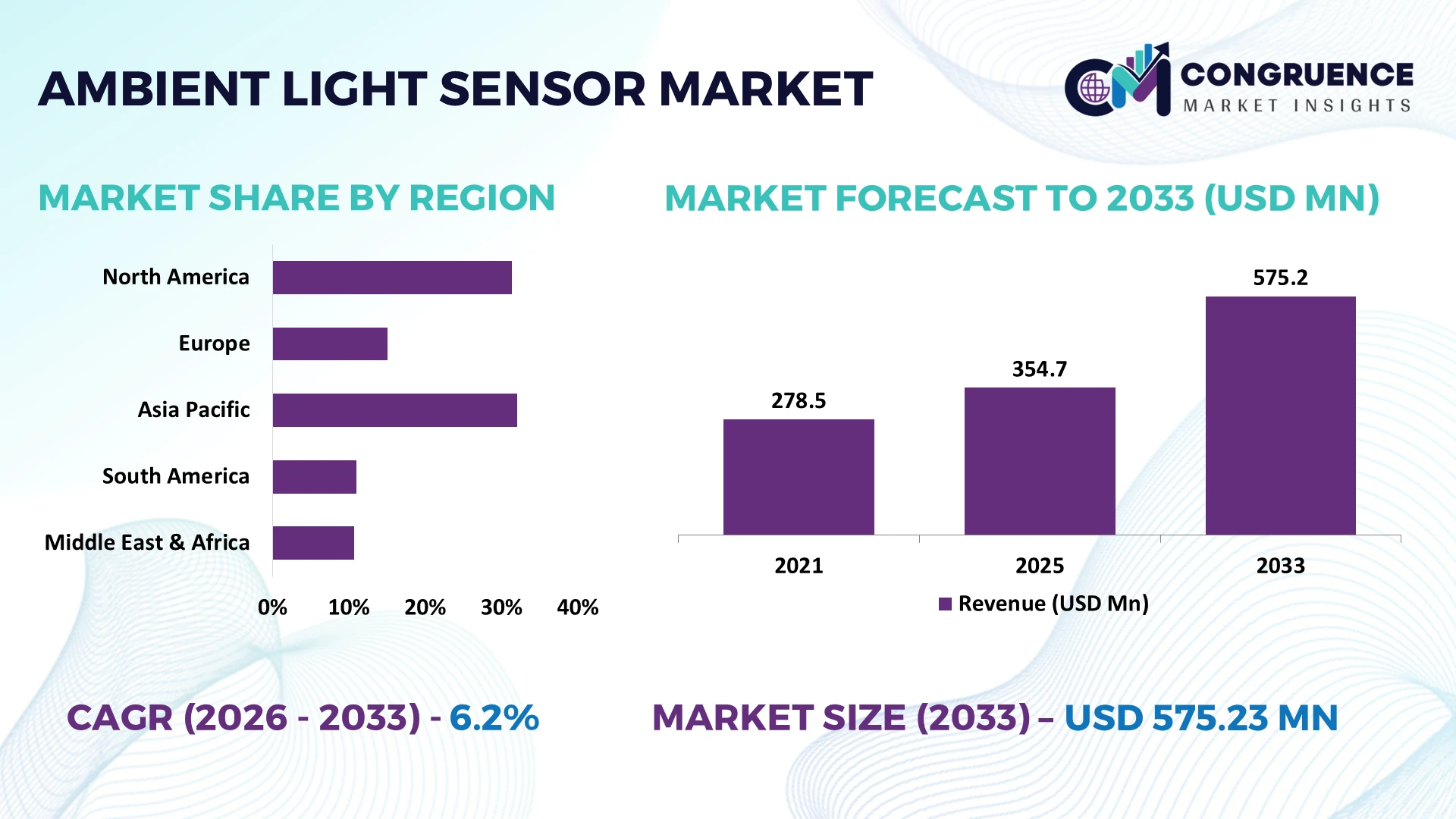
China commands approximately 45% of global ALS consumption, concentrated in smartphone assembly and display manufacturing clusters across Shenzhen and Suzhou, while North America holds 31.3% revenue share led by automotive sensor qualification and industrial automation investment . Taiwan's foundry ecosystem, producing 63.8% of global semiconductors, provides proximate access to advanced mixed-signal nodes critical for next-generation digital ALS designs .
Strategic implication, suppliers must prioritize spectral differentiation and automotive-grade qualification to defend margin as commodity-tier discrete sensors face design-out pressure.
Market Size & Growth: Valued at USD 1 billion in 2025 with 11.2% CAGR toward USD 3 billion by 2035; growth is propelled by automotive electrification multiplying ALS nodes per vehicle platform .
Top Growth Drivers: Smartphone replacement cycles at 1.24 billion units annually (2024), EV sales exceeding 17 million units, and EU display regulation mandating automatic brightness control .
Short-Term Forecast: By 2027, advanced digital ALS adoption in mid-tier smartphones rises to 35% of handset BOMs, reducing per-unit calibration costs by approximately 12%.
Emerging Technologies: Multispectral color temperature sensing, AI-driven adaptive lighting algorithms, and behind-display optical packaging dominate next-generation product roadmaps .
Regional Leaders: Asia Pacific leads with structural manufacturing proximity; North America at 31.3% share driven by automotive qualification; Europe at 15.0% anchored by regulatory compliance demand .
Consumer/End-User Trends: Display brightness applications hold 38.0% revenue share; camera and imaging ALS demand grows at 10.5% CAGR as computational photography requires precise ambient context .
Pilot/Case Example: ams-OSRAM reported 7% year-over-year semiconductor portfolio growth in February 2025, driven by mobile sensor rebound and spectral sensing adoption .
Competitive Landscape: ams-OSRAM leads with 28% revenue share; Broadcom holds 13.5%; top five suppliers collectively control 59.7% of market revenue .
Regulatory & ESG Impact: EU Regulation 2019/2013 grants 10% on-mode power reduction credit for displays with ALS-based automatic brightness control, creating structural compliance demand .
Investment & Funding: U.S. CHIPS Act allocates USD 52.7 billion to domestic foundries, shortening sensor lead times for North American automotive and industrial customers .
Innovation & Future Outlook: Behind-display ALS and SoC-integrated ambient estimation reshape competitive boundaries; suppliers must convert spectral complexity into defensible design wins rather than volume-dependent strategies .
The Ambient Light Sensor Market is pivoting from volume-driven brightness management toward value-driven optical intelligence. Demand concentrates in smartphone display calibration, automotive adaptive lighting, and commercial building automation. ams-OSRAM's spectral sensor portfolio and the broader industry push toward flicker detection and color temperature sensing signal a 35% increase in per-device sensor content among premium handsets. Supply chain localization under the U.S. CHIPS Act and EU Chips Act is reshaping qualification cycles, creating both opportunity and competitive pressure for established suppliers. This transition sets the stage for strategic decisions around spectral differentiation and regional manufacturing alignment.
Ambient light sensing has moved from a commodity component to a strategic differentiator in device competitiveness. The global supply-chain restructuring catalyzed by semiconductor localization policies—particularly the U.S. CHIPS Act and EU Chips Act—is forcing sensor suppliers to reevaluate foundry partnerships and regional qualification pathways, with North American automotive Tier-1s increasingly demanding domestic-content ALS solutions to meet procurement mandates .
Technologically, advanced digital ALS with spectral discrimination delivers measurably superior performance over legacy phototransistors: behind-display architectures achieve accurate color temperature detection at approximately 15% lower system power than discrete analog alternatives requiring separate proximity modules. Regionally, Asia Pacific's manufacturing density enables rapid design-to-production cycles, while Europe's regulatory framework—specifically EU 2019/2013—creates predictable compliance-driven demand that insulates display-sector ALS volumes from consumer spending volatility .
A practical deployment example is ams-OSRAM's integration of flicker detection alongside ambient and color sensing in a single die for premium smartphone platforms, reducing board footprint and enabling camera exposure synchronization. Companies are responding by prioritizing R&D toward multispectral arrays and deepening partnerships with display driver IC vendors to secure design-in positions. Strategic conclusion: competitive advantage now hinges on spectral accuracy and automotive qualification depth, not unit volume—suppliers without advanced optical portfolios will face accelerating margin compression in commodity tiers.
Demand is structurally shifting from single-channel brightness detection to multi-channel spectral and flicker-aware sensing. Smartphone OEMs are adopting advanced digital ALS to support display color temperature alignment and camera white balance, with advanced digital devices projected to capture 30.9% revenue share by 2035 . Automotive electrification adds a distinct multiplier: EV platforms integrate more ALS nodes per vehicle for adaptive headlamps, OLED dashboards, and cabin ambient lighting, with global EV sales exceeding 17 million units in 2024 . Companies are responding by co-developing sensor-display driver integrated solutions and expanding automotive qualification capacity in Taiwan and South Korea to shorten design cycles for Tier-1 customers.
High-volume smartphone SoC platforms increasingly incorporate ambient light estimation via ISP firmware using primary CMOS image sensor data, reducing discrete-ALS content in sub-USD-150 handset tiers . This substitution pressure is concentrated in entry-level consumer electronics where spectral accuracy and low-power standby operation are not critical differentiators. The global optoelectronics category recorded a 0.5% sales decline in the first half of 2025, underscoring headwinds in cost-sensitive segments . Suppliers are mitigating exposure by diversifying toward automotive and industrial applications with longer design cycles and higher qualification barriers, while localizing mature-node foundry partnerships in China and Taiwan to protect margin on volume-tier products.
Bezel-less device design is creating non-obvious demand for ultra-thin ALS capable of operating behind display panels, a segment valued at USD 675.18 million in 2025 and expanding as full-screen handset penetration rises . Commercial building automation presents a parallel opportunity: Signify's connected light point installed base reached 139 million units in Q3 2024, creating a scalable platform for occupancy-integrated ambient sensing . Companies are positioning through R&D in optical filtering and dark cover material compatibility, with suppliers targeting South Korean and Japanese display manufacturers for early design-in partnerships. The untapped opportunity lies in retrofit-compatible sensor modules for existing commercial lighting infrastructure, where installation cost—not sensor price—remains the primary adoption barrier.
Integrating ALS into bezel-less and full-screen architectures forces sensors behind display panels or within restricted apertures, severely constraining light intake and compromising measurement accuracy . Engineering teams must employ intricate packaging techniques and higher-performance components, escalating production costs and reducing yields for cost-sensitive device tiers. Foundry concentration in mature mixed-signal nodes adds a structural bottleneck: fabless ALS suppliers face capacity allocation risk as automotive and industrial customers demand long-term supply commitments. Companies must solve this through multi-foundry qualification strategies and investment in advanced packaging capabilities, particularly in Taiwan and Singapore, to maintain deployment consistency across consumer and automotive product lines simultaneously.
Behind-Display Spectral Sensing Scales OLED under-display spectral sensing is moving from concept to production, with ams-OSRAM's five-channel architecture resolving screen-emission interference that degraded legacy RGB sensors. The technology enables accurate color temperature reconstruction behind dark cover glass, eliminating bezel apertures in premium handsets. Chinese and South Korean display manufacturers are qualifying these sensors for flagship 2026 platforms, compressing bezel dimensions while maintaining lux accuracy. Suppliers are restructuring optical filter supply chains toward wafer-level interference coating partners in Taiwan to support volume ramp.
Automotive Qualification Becomes Competitive Moat AEC-Q100 qualification is emerging as the decisive procurement filter for automotive ALS, with Vishay's VEML4031X00 achieving first-mover status in rectangular automotive-grade packages in May 2025 . The device delivers 0.0026 lx/ct sensitivity behind dark glass across −40 to +110°C, enabling bezel-less center displays. German and Japanese Tier-1 suppliers now mandate automotive-qualified ALS for adaptive headlamp and HUD backlight control. Non-qualified consumer sensor vendors face exclusion from EV platform design cycles, forcing consolidation toward automotive-focused product lines.
SoC Substitution Reshapes Commodity Tier High-volume smartphone ISP firmware now estimates ambient lux from primary camera data, displacing discrete ALS in sub-USD-150 handset tiers. This substitution is concentrated where spectral accuracy and continuous low-power standby are non-critical. Sensor suppliers are responding by shifting volume allocation toward premium Android flagships and automotive programs, while repurposing mature-node foundry capacity for industrial and commercial building automation customers requiring standalone reliability.
Flicker Detection Expands Beyond Display Flicker-aware ALS is transitioning from smartphone camera synchronization to commercial lighting compliance and industrial machine vision. Building automation deployments in Germany and the U.S. now require flicker flagging for LED driver diagnostics and occupancy analytics. ams-OSRAM's TCS3448 integrates 14-channel spectral sensing with 50/60 Hz flicker detection and buffered data output for external frequency calculation . This expands ALS from brightness management into lighting quality assurance, opening commercial retrofit demand not dependent on consumer replacement cycles.
Digital ambient light sensors commanded 58% share in 2025, anchored by integrated ADCs, microcontroller compatibility, and precise lux detection essential for OLED and high-resolution display calibration . The segment's dominance reflects the industry-wide migration from analog phototransistor outputs to I²C-addressable digital architectures that simplify display driver integration and reduce calibration overhead. Analog phototransistor devices retain relevance in cost-sensitive industrial and appliance applications, though their share erodes as display specifications demand spectral resolution beyond simple brightness detection.
The fastest-growing type is multispectral digital sensing, where five-channel and 14-channel devices reconstruct ambient light composition for camera white balance, CCT adjustment, and flicker classification. Photodiode-based architectures generated USD 455 million in 2025 and underpin advanced digital designs through low dark current and CMOS integration compatibility . Companies are responding by consolidating analog and digital portfolios under unified platforms—ams-OSRAM's TCS3448 exemplifies this with 11 visible channels plus NIR and flicker detection in a 3.1 × 2.0 mm package . Investment priorities are shifting from commodity digital ALS capacity toward spectral filter deposition and advanced packaging capabilities.
Smartphone applications hold approximately 50% of ambient light sensor demand, reflecting the massive volume of global handset production and the critical role of ALS in display brightness, camera white balance, and battery optimization . This concentration creates scale advantages for suppliers with established handset OEM relationships but exposes them to smartphone replacement cycle volatility and commodity-tier design-out pressure from ISP-based light estimation.
The fastest-growing application is environmental context detection, projected to expand at 12.9% through 2035 as ALS integrates with motion, proximity, and color sensors in fusion systems for AR/VR devices, wearables, and adaptive user interfaces . This shift moves ALS from a standalone brightness component to a contextual awareness node, requiring tighter synchronization with other sensor inputs and higher spectral fidelity. Automotive applications represent a parallel growth vector, with adaptive headlamps and cabin lighting systems integrating multi-zone ALS for localized brightness control. Companies are adapting by co-developing reference designs with display driver IC vendors and positioning spectral sensors as camera subsystem enablers rather than discrete components.
Consumer electronics remains the dominant end-user group, absorbing the majority of ALS units through smartphone, tablet, and laptop production. China's 45% share of global ALS consumption is structurally tied to this segment, concentrated in Shenzhen and Suzhou handset and display manufacturing clusters . The scale advantage is undeniable, but pricing pressure and ISP substitution in entry-tier devices compress margins for non-differentiated suppliers.
Automotive end-users represent the fastest-growing buying group, driven by EV platform electrification multiplying ALS nodes per vehicle for adaptive lighting, display dimming, and cabin environment management. Automotive procurement demands AEC-Q100 qualification, extended temperature range, and supply continuity commitments that exclude commodity consumer sensor vendors. Companies are targeting this segment through dedicated automotive product lines and qualification investments—Vishay's VEML4031X00 and ams-OSRAM's automotive portfolio expansion exemplify this repositioning. Industrial and commercial building automation end-users offer steadier demand with longer design cycles, particularly for occupancy-integrated lighting controls in European and North American retrofit projects. Future demand is shifting from unit-volume consumer placements toward value-density automotive and infrastructure deployments, requiring suppliers to restructure qualification capabilities and customer engagement models accordingly.
Asia-Pacific accounted for the largest market share at 32% in 2025 however, Europe is expected to register the fastest growth, expanding at a CAGR of 8.8% between 2026 and 2033 .
North America held 31.3% of global ALS revenue in 2025, concentrated in automotive cockpit display and adaptive lighting programs across Michigan, Ontario, and California . The region's competitive position rests on AEC-Q100 qualification infrastructure and Tier-1 supplier proximity rather than volume manufacturing. U.S. sensor demand reached USD 247.5 million in 2025, driven by premium handset display calibration and EV platform sensor content expansion . Research activity at U.S. semiconductor firms accelerates multispectral and flicker-aware ALS development, with automotive HMI digitization creating defensible design-win pipelines. Companies are investing in domestic qualification labs to compress automotive design cycles.
United States Market Outlook: The U.S. accounts for over 80% of North American ALS value, anchored by automotive OEM sensor specifications and Department of Energy efficiency standards promoting automatic lighting controls . Smart building adoption across commercial real estate adds retrofit demand for occupancy-integrated ALS modules.
Europe contributed approximately 15.0% of global ALS revenue in 2025, with demand structurally shaped by EU Regulation 2019/2013 granting power reduction credits for ALS-equipped displays . German automotive Tier-1 suppliers and building automation integrators represent the region's core deployment concentration, particularly for adaptive headlamp and daylight harvesting applications. The regulatory framework creates predictable compliance-driven volume insulated from consumer spending volatility. ams-OSRAM's December 2024 collaboration with Valeo on intelligent cabin lighting protocols exemplifies European supplier positioning toward interoperable optical architectures . Companies are prioritizing EU-based qualification and local inventory to meet procurement mandates.
Germany Market Outlook: Germany leads European ALS deployment through automotive lighting control and commercial building retrofit activity. The country's Tier-1 supplier ecosystem mandates AEC-Q100 qualification for cabin sensing, creating stable demand for automotive-grade devices.
Asia-Pacific commanded 32% of global ALS revenue in 2025, anchored by China's 45% share of global unit consumption and Taiwan's foundry concentration in mixed-signal nodes . Shenzhen and Suzhou handset assembly clusters drive volume demand for digital ALS, while South Korean display manufacturers are qualifying behind-display spectral sensors for flagship platforms. The region's scale advantage is transitioning from commodity brightness detection toward multispectral and flicker-aware architectures, with local suppliers like Sensortek gaining share in mid-tier consumer applications . Companies are expanding wafer-level optical filter capacity in Taiwan to support spectral sensor ramp.
China Market Outlook: China generated USD 218 million in ALS value in 2025, supported by domestic handset OEM design cycles and government building efficiency standards mandating automatic lighting controls . Local suppliers now exceed 55% shipment share in consumer-grade ALS, reducing import dependence.
South America represented 11% of global ALS market share in 2025, with demand concentrated in Brazilian smartphone assembly and Chilean commercial building automation projects. The region's adoption trajectory is constrained by limited domestic semiconductor infrastructure and reliance on imported sensor modules, though smart city initiatives in São Paulo and Santiago are creating retrofit opportunities for daylight harvesting controls. Automotive applications remain nascent, with ALS content per vehicle trailing North American and European platforms. Companies are approaching the region through distribution partnerships rather than direct qualification investment, prioritizing cost-competitive digital sensors for consumer and light commercial segments.
Brazil Market Outlook: Brazil accounts for the majority of South American ALS demand, driven by smartphone manufacturing incentives under the Manaus Free Trade Zone and commercial lighting retrofit activity. Local assembly operations provide volume access but limited design-win influence.
The Middle East & Africa region held 10.7% of global ALS market share in 2025, with demand concentrated in UAE and Saudi Arabian smart building and infrastructure modernization programs. NEOM and Red Sea development projects specify adaptive lighting controls with ALS integration for energy optimization and occupant comfort, creating specification-led demand insulated from consumer electronics cycles. South African commercial building automation adds modest volume. The region's limited domestic manufacturing base means sensor procurement flows through European and Asian distribution channels, with suppliers competing on qualification documentation and delivery reliability rather than local production presence.
United Arab Emirates Market Outlook: The UAE leads regional ALS adoption through smart city infrastructure and premium commercial real estate specifications requiring daylight-responsive lighting control. Government building efficiency mandates and tourism infrastructure investment sustain demand for integrated occupancy-ambient sensing modules.
ams-OSRAM leads with 28% revenue share, competing against Broadcom (13.5%) and Vishay (6.9%) in a moderately concentrated field where the top five suppliers control 59.7% collectively . Competition bifurcates sharply: global leaders defend premium automotive and spectral-sensing tiers through qualification depth and optical integration, while Sensortek and regional Chinese suppliers attack commodity consumer volume on price and design-cycle speed . Technology differentiation drives premium positioning, with multispectral and flicker-aware architectures commanding specification preference in flagship handsets. Supply chain localization is reshaping competitive boundaries—U.S. CHIPS Act and EU Chips Act incentives pressure suppliers to qualify domestic foundry partners, creating entry barriers for fabless challengers lacking multi-region manufacturing footprints. The decisive competitive shift is from unit-volume leadership toward application-specific qualification and spectral accuracy, where ams-OSRAM’s full-stack optical portfolio and Vishay’s automotive-grade first-mover status create defensible moats. Winning requires automotive qualification depth, spectral differentiation, and regional supply redundancy—commodity digital ALS vendors face accelerating margin compression.
ams-OSRAM AG
Broadcom Inc.
Vishay Intertechnology, Inc.
STMicroelectronics N.V.
Texas Instruments Incorporated
ROHM Co., Ltd.
Renesas Electronics Corporation
Sensortek Technology Corp.
Lite-On Technology Corporation
ON Semiconductor Corporation
Panasonic Holdings Corporation
Sharp Corporation
Melexis NV
Everlight Electronics Co., Ltd.
Current production is dominated by digital I²C ALS with integrated ADCs, delivering 15–20% lower system power than analog phototransistor architectures through duty-cycled measurement and interrupt-driven wake-up . Behind-display sensing represents the most consequential integration shift: Vishay’s VEML4031X00 achieves 0.0026 lx/ct sensitivity behind dark cover glass in a 0.6 mm profile, enabling bezel-free industrial designs that legacy aperture-based sensors cannot support .
Emerging multispectral and flicker-aware architectures deliver measurable performance gains—ams-OSRAM’s TCS3410 resolves 1 mlux ambient light while running flicker detection concurrently at 290 μA, a 40% power reduction versus discrete two-sensor implementations . Automotive-grade qualification is becoming the decisive technology gate, with AEC-Q100 devices commanding specification preference across EV cabin and display platforms.
Disruptive 2026–2028 trajectory centers on sensor fusion and edge AI preprocessing, where ALS integrates with proximity and color channels for contextual awareness. Suppliers with spectral filter deposition capabilities and automotive qualification depth capture premium margin; commodity digital vendors face design-out pressure from ISP-based estimation. The competitive beneficiary is ams-OSRAM, whose full-stack optical portfolio spans emitter, receiver, and algorithm layers .
May 2025 — Vishay Intertechnology launched the VEML4031X00, the industry’s first AEC-Q100 qualified rectangular ambient light sensor, featuring 0.0026 lx/ct sensitivity and a 4.38 mm × 1.45 mm footprint for bezel-less automotive displays . Source: vishay.com
August 2025 — ams-OSRAM’s TCS3410 ambient light and flicker detection module received the 2025 AIoT Innovation Technology Product Award, with commercial deployment exceeding 10 million units across major smartphone and action-camera platforms . Source: eet-china.com
December 2025 — Vishay’s VEML4031X00 earned the 2025 AspenCore World Electronics Achievement Award in the Sensor category, recognizing its automotive-qualified rectangular architecture and behind-glass sensitivity performance . Source: theglobeandmail.com
February 2025 — Silicon Labs issued End-of-Life notification for its Si114x and Si115x optical sensor families, exiting the ambient light sensor product line to concentrate investment on wireless IoT portfolios, with last-order date set for September 2025 . Source: digikey.com
This report delivers comprehensive coverage across sensor types—light-to-digital, light-to-current, light-to-frequency, and light-to-voltage—with segmentation by application spanning smartphones, automotive displays, building automation, and wearables. End-user analysis covers consumer electronics, automotive, industrial, and commercial segments, with adoption metrics and deployment patterns quantified across each tier.
Regional analysis addresses Asia-Pacific’s manufacturing concentration, North America’s automotive qualification depth, Europe’s regulation-driven demand, and emerging infrastructure programs across South America and the Middle East. Technology coverage includes behind-display spectral sensing, flicker detection, and automotive-grade qualification pathways, with competitive positioning mapped across the top suppliers controlling 59.7% of revenue. The report supports investment planning through segment-level adoption trends, expansion strategy via regional qualification requirements, and competitive benchmarking against automotive design-win pipelines and spectral portfolio depth for the 2026–2033 horizon.
| Report Attribute / Metric | Details |
|---|---|
| Market Revenue (2025) | USD 354.7 Million |
| Market Revenue (2033) | USD 575.2 Million |
| CAGR (2026–2033) | 6.23% |
| Base Year | 2025 |
| Forecast Period | 2026–2033 |
| Historic Period | 2021–2025 |
| Segments Covered |
By Type
By Application
By End-User
|
| Key Deliverables | Revenue Forecast; Market Trends; Growth Drivers & Restraints; Technology Insights; Segmentation Analysis; Regional Insights; Competitive Landscape; Regulatory & ESG Overview; Recent Developments |
| Regions Covered | North America; Europe; Asia-Pacific; South America; Middle East & Africa |
| Companies Profiled | ams-OSRAM AG; Broadcom Inc.; Vishay Intertechnology, Inc.; STMicroelectronics N.V.; Texas Instruments Incorporated; ROHM Co., Ltd.; Renesas Electronics Corporation; Sensortek Technology Corp.; Lite-On Technology Corporation; ON Semiconductor Corporation; Panasonic Holdings Corporation; Sharp Corporation; Melexis NV; Everlight Electronics Co., Ltd. |
| Customization & Pricing | Available on Request (10% Customization Free) |




