
Reports
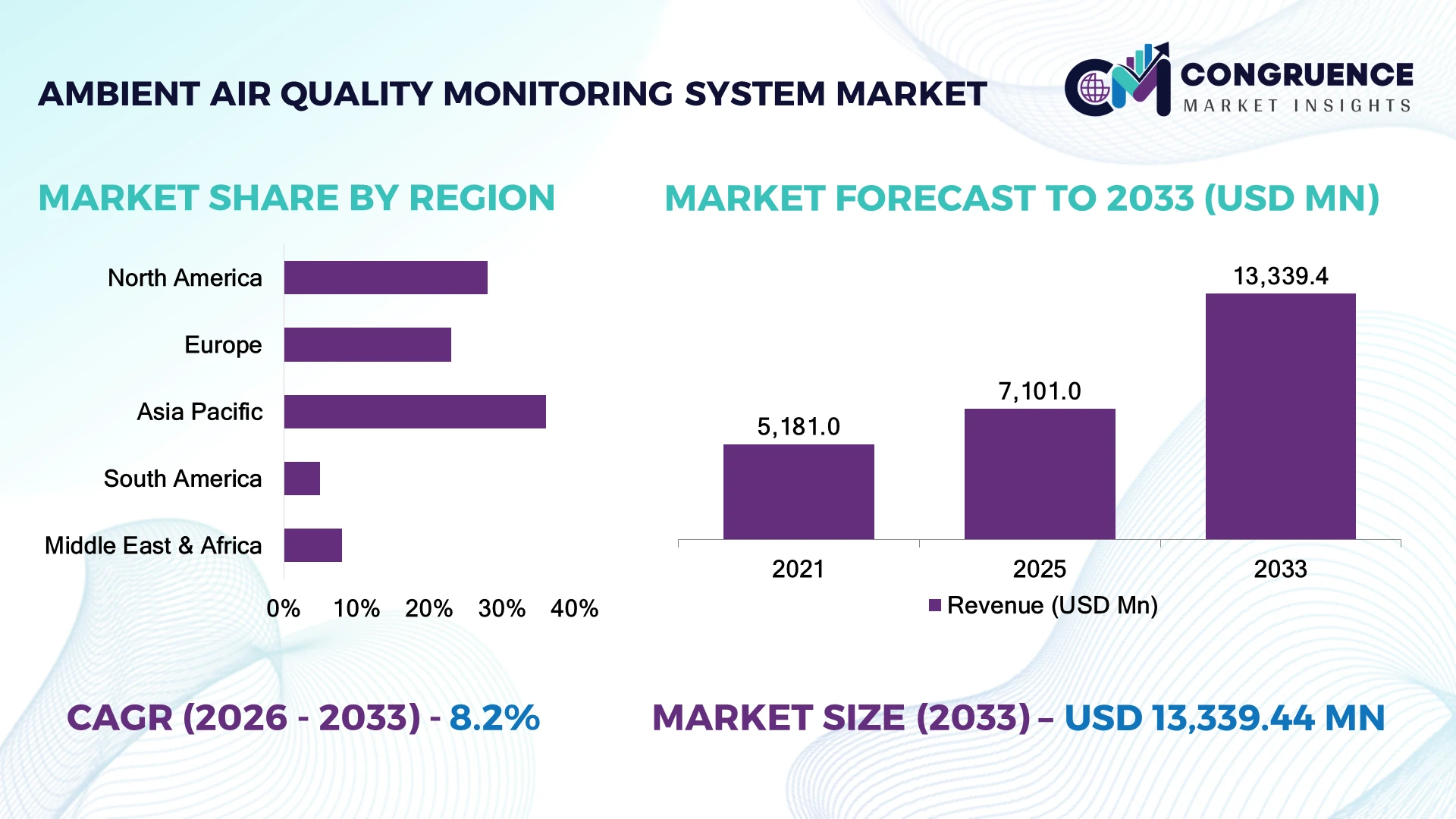
The Global Ambient Air Quality Monitoring System Market was valued at USD 7,101.0 Million in 2025 and is anticipated to reach a value of USD 13,339.4 Million by 2033 expanding at a CAGR of 8.2% between 2026 and 2033. Stricter particulate-matter limits, continuous emissions monitoring, industrial digitization, and deployment of AI-enabled sensor networks are accelerating replacement of conventional manual monitoring infrastructure.
China dominates deployment, supported by large-scale industrial monitoring and urban pollution-control programs, with an estimated 30%+ share of global installations; the country operates extensive PM2.5 monitoring networks across major cities, while the U.S. combines EPA-grade monitoring with rapidly expanding low-cost sensor networks. India is scaling urban monitoring under the National Clean Air Programme, creating a faster deployment trajectory than many mature markets. Geopolitical supply-chain realignment is also encouraging localized sensor and electronics sourcing.
The strategic priority is shifting toward interoperable, real-time monitoring platforms that combine regulatory compliance with predictive environmental intelligence.
Market Size & Growth: Market value reaches USD 13,339.4 Million by 2033 from USD 7,101.0 Million in 2025, with an 8.2% CAGR driven by continuous monitoring and AI-enabled environmental analytics.
Top Growth Drivers: Urban air-quality regulation contributes 30%+ of deployment momentum, industrial emissions monitoring 25%+, and smart-city digitization 20%+.
Short-Term Forecast: By 2028, connected monitoring deployments are positioned to improve data availability by 20–30%, while automated calibration and remote diagnostics reduce servicing requirements by 10–15%.
Emerging Technologies: AI-based anomaly detection, IoT sensor networks, edge analytics, and compact optical particle sensors are replacing fragmented monitoring workflows.
Regional Leaders: Asia-Pacific is projected to exceed USD 6.0 Billion, North America USD 3.3 Billion, and Europe USD 2.8 Billion by 2033, led respectively by urban networks, industrial compliance, and environmental regulation.
Consumer/End-User Trends: Municipal and industrial users increasingly favor connected systems, with networked monitoring adoption estimated above 50% in newly commissioned urban projects.
Pilot/Case Example: 2024 smart-monitoring deployments in Indian urban corridors demonstrated 15–20% faster identification of pollution hotspots through networked sensor data and centralized analytics.
Competitive Landscape: Leading suppliers collectively control an estimated 35–40% of the market, with Thermo Fisher Scientific, 3M, Siemens, HORIBA, and TSI competing through sensor accuracy, software integration, and service coverage.
Regulatory & ESG Impact: Tighter particulate and industrial-emissions controls are increasing continuous-monitoring requirements, while digital reporting can reduce manual data-processing workloads by 20%+.
Investment & Funding: Global environmental-monitoring investment is increasingly directed toward sensor manufacturing, AI analytics, and smart-city partnerships, with individual infrastructure programs frequently exceeding USD 100 Million.
Innovation & Future Outlook: Next-generation platforms will combine multi-pollutant sensing, edge computing, predictive analytics, and automated calibration, shifting competition from standalone instruments toward integrated environmental intelligence platforms.
Ambient Air Quality Monitoring System Market demand is concentrating around smart cities, industrial emissions control, transportation corridors, and public-health surveillance. AI-enabled sensors increasingly combine particulate, gaseous, and meteorological measurements, while connected architectures can improve monitoring coverage by 20% or more versus isolated stations. Regulatory reporting requirements and localized electronics sourcing are also reshaping procurement strategies, creating a stronger transition toward scalable digital monitoring ecosystems.
Ambient Air Quality Monitoring System technology is becoming strategically important because environmental data is moving from periodic compliance documentation to real-time operational intelligence. Manufacturers, utilities, municipalities, and transportation authorities increasingly use continuous measurements to identify emissions hotspots, optimize interventions, and demonstrate environmental performance. Regulatory modernization is reinforcing this shift, particularly across China, India, the United States, and European markets.
Technology economics are also changing deployment models. Compact optical and IoT-enabled sensors can deliver substantially higher spatial coverage than conventional reference stations, while automated remote diagnostics can reduce field-service requirements by roughly 10–20%. China emphasizes large-scale network deployment, the United States prioritizes high-accuracy regulatory infrastructure alongside supplemental sensors, and India is expanding distributed urban monitoring through smart-city and clean-air initiatives.
Over the next 2–3 years, networked installations are positioned to increase monitoring coverage by 15–25%, supported by edge analytics and automated data validation. A practical deployment model combines fixed reference stations with dense low-cost sensor nodes around industrial corridors, enabling faster identification of localized pollution events. Companies are therefore prioritizing software partnerships, sensor localization, cloud platforms, and municipal contracts. Competitive advantage will increasingly depend on turning monitoring data into actionable environmental intelligence rather than selling instruments alone.
Stricter particulate and industrial-emission monitoring requirements are accelerating continuous digital measurement. Urban pollution-control programs are driving connected monitoring adoption above 50% in several newly developed municipal networks, while automated data transmission can cut manual reporting workloads by 20% or more. India’s expansion of city-level monitoring and China’s extensive urban air-quality infrastructure demonstrate the scale of this transition. The cause is clear: regulators require faster, more granular evidence, pushing operators beyond periodic sampling. Companies are responding with IoT-enabled analyzers, remote calibration, cloud dashboards, and multi-pollutant platforms. A non-obvious advantage is that dense sensor networks provide operational intelligence for identifying localized emission sources, allowing industrial operators to prioritize corrective actions instead of applying broad, costly interventions.
High-end reference-grade analyzers remain expensive to deploy and maintain, particularly when networks require multiple pollutants, calibration equipment, communications infrastructure, and specialized technicians. Hardware, installation, and servicing can account for 40% or more of lifecycle expenditure in complex monitoring networks, while calibration and field maintenance can represent 10–15% of annual operating costs. Developing markets such as India face additional infrastructure and technician constraints outside major cities. Semiconductor and electronic-component supply disruptions have also exposed dependence on specialized imported components. Companies are reducing exposure through localized assembly, multi-supplier procurement, modular sensor architectures, and longer-term component contracts. The key operational limitation is not sensor availability alone; it is achieving reference-quality performance at a deployment cost that supports dense geographic coverage.
Distributed sensor networks offer an important opportunity to expand coverage without replicating the cost structure of conventional reference stations. IoT-connected nodes can increase spatial monitoring density by 20–30%, while edge analytics can reduce unnecessary cloud data transmission by approximately 15–25%. India’s expanding urban monitoring infrastructure and Southeast Asian industrial hubs provide strong opportunities for modular deployments. AI-based calibration, digital twins, and predictive pollution mapping are emerging as differentiators. Companies are investing in sensor miniaturization, software partnerships, and integrated environmental-data platforms rather than standalone hardware. The strongest opportunity lies in hybrid networks that combine regulatory-grade stations with dense supplemental sensors, enabling municipalities and industrial operators to obtain localized pollution intelligence without proportionally increasing infrastructure expenditure.
Large-scale monitoring networks face persistent integration challenges involving sensor interoperability, data quality, cybersecurity, communications reliability, and workforce capability. Networks containing hundreds of connected devices can experience 5–10% annual maintenance or replacement requirements depending on environmental exposure and hardware quality, while inconsistent calibration can materially affect cross-site comparability. Industrial zones with heat, humidity, dust, and corrosive pollutants place additional pressure on sensor durability. Companies must therefore invest in standardized communication protocols, automated quality assurance, secure device management, and predictive maintenance. The long-term challenge is maintaining consistent data integrity as networks expand rapidly across cities and industrial corridors. Providers that solve interoperability and lifecycle management will secure stronger customer retention than vendors competing primarily on initial equipment price.
Distributed Sensor Networks Expand: Municipal and industrial monitoring is shifting from centralized stations toward dense connected networks, with portable and low-cost deployments improving spatial coverage by 20–30%. India is expanding city-level monitoring, while U.S. agencies increasingly combine regulatory monitors with supplemental sensor networks. Companies are responding with modular hardware, remote calibration, and cloud-based data integration, reducing dependence on expensive standalone stations.
AI Data Validation Accelerates: AI-assisted anomaly detection and automated quality control are becoming embedded in monitoring workflows, reducing manual data screening by an estimated 15–25% and accelerating pollution-event identification by 20%+. European networks are increasingly combining station observations with interpolation and modeling, while providers are integrating machine learning into analytics platforms. This shifts competition from instrument accuracy alone toward data reliability and actionable intelligence.
Real-Time Public Access Grows: Governments are expanding near-real-time public reporting, increasing demand for continuously connected monitoring infrastructure. Europe now provides data access from more than 3,500 monitoring stations, while India’s SAFAR system delivers location-specific forecasts 1–3 days ahead. Companies are strengthening APIs, dashboards, mobile interfaces, and automated alerts, turning monitoring equipment into recurring digital-service platforms.
Reference-Sensor Integration Deepens: Hybrid architectures combining reference-grade analyzers with lower-cost sensors are gaining traction, allowing operators to expand coverage without duplicating high-cost infrastructure. Continuous systems already represent more than 55% of broader air-quality monitoring deployments, reinforcing demand for automated measurement and calibration. Companies are increasingly pairing hardware with validation software and managed services, creating a non-obvious shift toward network performance rather than individual-device sales.
Fixed ambient monitors lead the market with approximately 62% share, supported by continuous operation, reference-grade accuracy, permanent installation, and suitability for regulatory networks. Their ability to provide standardized long-duration datasets makes them dominant across urban monitoring corridors and industrial hotspots. Portable ambient monitors follow as the more flexible alternative, particularly where authorities need temporary assessments, mobile hotspot identification, or rapid investigations. Fixed systems typically command higher infrastructure spending, while portable units reduce deployment complexity and enable faster site-to-site coverage.
Portable ambient monitors represent the fastest-growing type, with deployment momentum supported by demand for localized monitoring and lower installation requirements. Portable adoption is estimated to expand by 20%+ in newly distributed monitoring programs, while fixed networks remain the backbone for compliance-grade measurement. Companies are responding through lighter sensor packages, wireless connectivity, battery optimization, and hybrid fixed-portable platforms. The strategic implication is a shift from station density alone toward complementary architectures that combine permanent reference points with mobile measurement capability.
Government & Public Infrastructure represents the leading application at approximately 48% share, reflecting large-scale deployment by municipalities, environmental authorities, and public infrastructure operators. Demand concentrates around urban air-quality networks, regulatory compliance, public alerts, and pollution-source assessment. Industrial Facilities rank second and are increasingly important as manufacturers, power plants, and chemical operators strengthen continuous environmental reporting. Government deployments prioritize network reliability and geographic coverage, while industrial buyers emphasize uptime, data traceability, and operational integration.
Industrial Facilities represent the fastest-growing application, with adoption increasingly supported by tighter emissions controls and localized monitoring requirements. Industrial deployment is expanding at an estimated 15–20% pace in high-emission corridors as companies move from periodic assessments toward continuous environmental intelligence. Commercial & Residential applications remain smaller but are gaining relevance through building and community monitoring, while Research & Academia supports sensor validation and atmospheric studies. Companies are therefore expanding modular offerings and software integration, positioning monitoring systems as operational infrastructure rather than standalone measurement equipment.
Government Agencies dominate with approximately 52% share because they operate national and municipal monitoring networks, procure reference-grade stations, and require standardized datasets for environmental enforcement and public-health management. Their procurement behavior favors long-term contracts, network interoperability, calibration support, and regulatory-grade performance. The Industrial Sector follows closely, using monitoring systems for emissions oversight, environmental reporting, ESG programs, and community-impact management. Government buyers prioritize scale and compliance, whereas industrial buyers increasingly prioritize automation and integration with facility-management systems.
The Industrial Sector represents the fastest-growing end-user group, with connected monitoring adoption increasing by an estimated 15–20% across emissions-intensive operations. Commercial Sector demand is also strengthening as property operators and large facilities integrate environmental monitoring into smart-building platforms, while Others includes research and specialized monitoring organizations. Companies are responding with sector-specific configurations, subscription-based analytics, service partnerships, and integrated sensor platforms. The non-obvious competitive shift is toward recurring data-management and maintenance contracts, allowing vendors to monetize installed networks beyond initial equipment sales.
Asia-Pacific accounted for the largest market share at 36% in 2025 however, Asia-Pacific is expected to register the fastest growth, expanding at a CAGR of 9.4% between 2026 and 2033.
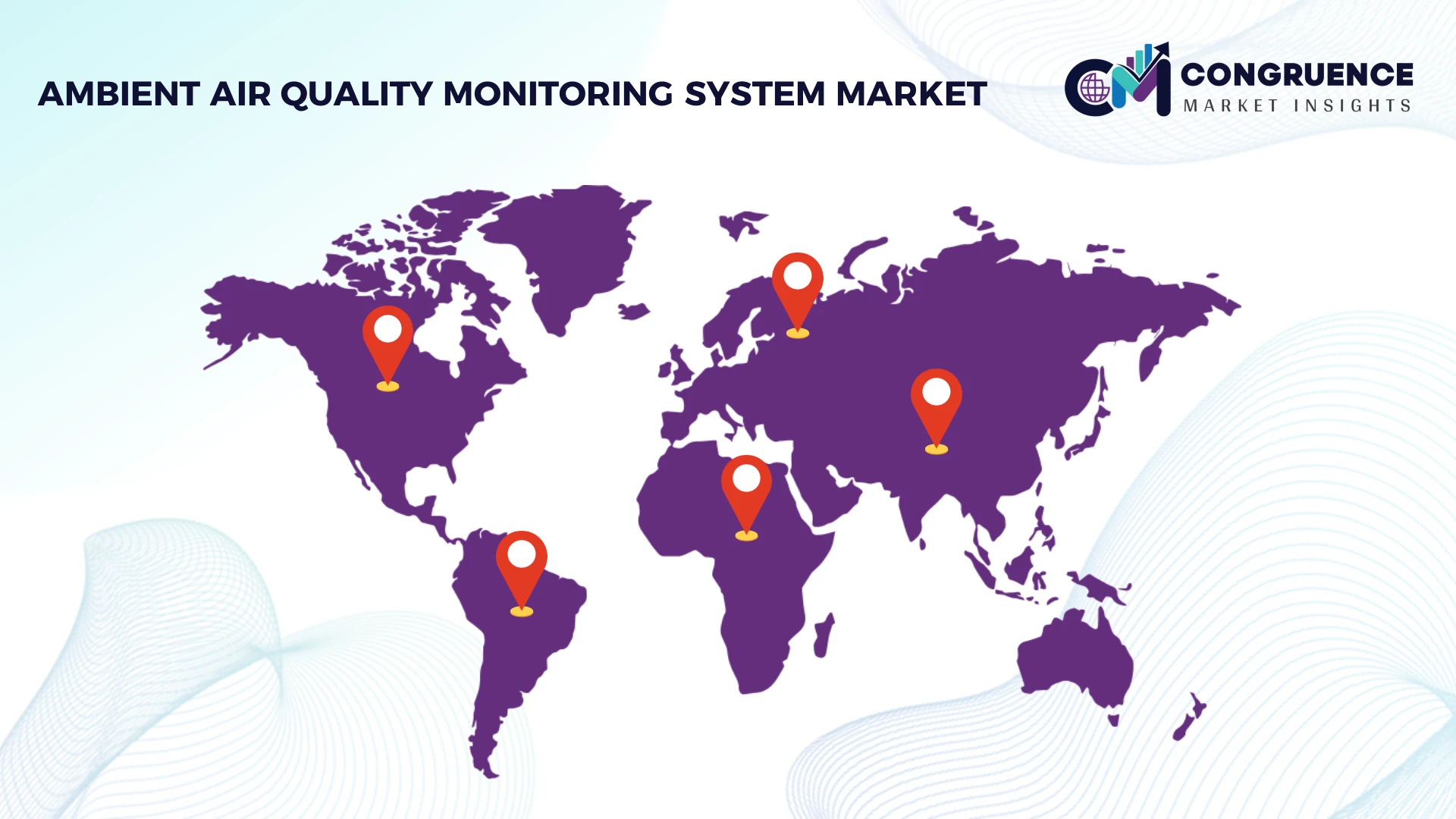
North America held approximately 28% of the global market in 2025, supported by established regulatory monitoring, industrial emissions surveillance, and advanced environmental-data infrastructure. The United States represents the regional deployment center, with state, local, tribal, and federal networks covering criteria pollutants, near-road locations, hazardous air pollutants, and specialized monitoring sites. Continuous PM2.5 systems and automated Federal Equivalent Methods are increasingly integrated with forecasting and public reporting workflows. More than 50% of newly upgraded monitoring configurations increasingly emphasize continuous or connected measurement rather than manual sampling. Companies are responding through sensor modernization, cloud-enabled analytics, automated quality assurance, and partnerships with municipalities and environmental agencies. The strategic opportunity is strongest in network modernization, where legacy stations are being supplemented with connected sensors rather than replaced outright.
United States Market Outlook: The United States remains the region’s technology and procurement anchor, supported by thousands of ambient monitoring locations and the EPA’s national Air Quality System. Federal, state, and local agencies increasingly combine regulatory-grade instruments with near-road, multipollutant, and specialized networks, creating sustained demand for interoperability, automated validation, cybersecurity, and lifecycle service capabilities.
Europe represented approximately 23% of the global market in 2025, with demand concentrated around regulatory monitoring, urban pollution management, industrial compliance, and sustainability reporting. More than 3,500 monitoring stations contribute hourly information to European air-quality platforms, creating one of the world’s most extensive standardized monitoring ecosystems. The shift toward hourly PM2.5, PM10, ozone, nitrogen dioxide, and sulfur dioxide reporting is increasing demand for automated data processing and interoperable monitoring architectures. European requirements aligned with tighter air-quality objectives are encouraging authorities to improve spatial coverage and data accessibility. Companies are prioritizing low-maintenance analyzers, digital dashboards, calibration services, and software integration. A notable structural shift is the growing combination of physical station measurements with modeled geographic datasets, allowing operators to extend analytical coverage beyond individual monitoring locations.
Germany Market Outlook: Germany is a strategically important European market because of its dense industrial base, mature environmental infrastructure, and strong municipal monitoring capabilities. Automotive manufacturing, chemicals, power generation, logistics, and urban transportation create multiple monitoring requirements. Deployment increasingly emphasizes continuous particulate and gaseous-pollutant measurement, while digital reporting and network integration strengthen demand for advanced analyzers and automated data-management platforms.
Asia-Pacific accounted for approximately 36% of the global market in 2025, making it the largest regional market by deployment scale. China and India are the principal demand centers, supported by industrialization, urban population density, environmental enforcement, and expansion of smart-city infrastructure. China’s extensive city monitoring architecture supports large-volume procurement, while India is increasing continuous monitoring coverage across major urban and industrial locations. Connected and distributed sensor deployments are growing by an estimated 20%+, particularly where authorities require localized pollution mapping. Manufacturers are simultaneously strengthening regional assembly, sensor localization, and electronics supply chains to reduce exposure to international component disruptions. Companies are expanding through government contracts, technology partnerships, and integrated hardware-software offerings. The region’s non-obvious advantage is its ability to deploy large sensor fleets rapidly, generating scale efficiencies in installation, data management, and maintenance.
China Market Outlook: China represents the largest individual deployment base within Asia-Pacific, supported by extensive urban environmental-monitoring infrastructure and a large industrial emissions footprint. Heavy manufacturing, chemicals, power generation, transportation, and construction sustain demand for continuous monitoring. The country’s large domestic electronics ecosystem also supports faster localization of sensors, communications modules, and data platforms, strengthening supplier responsiveness and deployment scalability.
South America represented approximately 5% of the global market in 2025, with deployment concentrated around major metropolitan areas, mining operations, energy facilities, transport corridors, and industrial clusters. Brazil accounts for the largest share of regional activity, supported by official monitoring networks and increasing digital access to real-time air-quality information. Connected monitoring is gaining traction as authorities seek faster pollution-event detection and more transparent public reporting. Automated stations are increasingly preferred for high-priority locations, while portable systems support temporary industrial and urban assessments. Deployment density remains below North American and European levels, creating infrastructure-led expansion opportunities but also increasing installation and maintenance requirements. Companies are responding through local partnerships, modular monitoring platforms, remote diagnostics, and service-based contracts. The strategic priority is improving coverage efficiency rather than simply increasing the number of conventional stations.
Brazil Market Outlook: Brazil provides the strongest regional opportunity because of its industrial concentration, urban population, mining activity, and established environmental-monitoring infrastructure. Government platforms provide real-time access to official station information, while states such as Espírito Santo operate automated systems measuring gases, particulate matter, and meteorological variables hourly. This supports continued demand for connected analyzers, data platforms, and specialized industrial monitoring services.
Middle East & Africa accounted for approximately 8% of the global market in 2025, with demand concentrated in Gulf states, major African metropolitan areas, oil and gas facilities, petrochemical complexes, construction zones, and large transportation corridors. Investment is increasingly directed toward smart-city infrastructure and environmental intelligence rather than isolated monitoring equipment. The United Arab Emirates and Saudi Arabia are prominent adoption centers, while African markets remain more concentrated around capital cities and industrial sites. Connected monitoring deployments are estimated to expand by 15–20% in priority urban and industrial programs as authorities seek continuous pollution visibility. Companies are responding with ruggedized analyzers, wireless sensor networks, centralized dashboards, and environmental-management partnerships. Harsh heat, dust, and remote operating environments are strengthening demand for durable equipment and remote diagnostics, making lifecycle reliability a key procurement differentiator.
Saudi Arabia Market Outlook: Saudi Arabia is strategically significant because of its large oil and gas, petrochemical, construction, and urban-development footprint. Major infrastructure modernization programs are increasing requirements for environmental surveillance around industrial zones and rapidly expanding cities. Monitoring suppliers are positioning through ruggedized equipment, centralized analytics, and project partnerships, while continuous data availability is becoming increasingly important for environmental compliance and large-scale development management.
The competitive landscape pits Thermo Fisher Scientific, HORIBA, Teledyne, ENVEA, and TSI against regional instrument makers and lower-cost sensor specialists. Global OEMs compete on regulatory accuracy and installed-service networks, while technology suppliers emphasize distributed sensing, software, and deployment speed. The top five players are estimated to hold about 35–40% combined share, leaving room for specialists. Competition centers on technology performance, lifecycle cost, supply availability, customization, and integration. Connected systems can reduce servicing requirements by 10–20%, while modular sensor architectures can lower deployment costs by 15–25% versus reference-grade networks. Companies are expanding portfolios, partnering with municipalities and industrial operators, localizing components, and integrating cloud analytics with analyzers. The competitive shift is moving from standalone hardware toward integrated monitoring platforms and recurring data services. High regulatory certification requirements, calibration expertise, and installed networks remain entry barriers. Winning requires validated measurement performance, scalable connectivity, rapid deployment, and dependable lifecycle support across operating environments.
Thermo Fisher Scientific
HORIBA
Teledyne Technologies
ENVEA
TSI Incorporated
Siemens
3M
Acoem
Vaisala
Aeroqual
Ecotech
Emerson Electric
Campbell Scientific
Envirotech Online
Ambient monitoring is shifting from standalone reference analyzers toward hybrid architectures combining regulatory-grade instruments, optical particle counters, electrochemical sensors, IoT connectivity, and edge analytics. Newer systems can deliver minute-level or real-time measurements, while automated diagnostics reduce field interventions by roughly 10–20%. Adoption is strongest in connected municipal and industrial networks.
Advanced spectroscopy is improving pollutant specificity. Cavity Attenuated Phase Shift (CAPS) directly measures NO2 without catalytic conversion, reducing maintenance complexity versus legacy chemiluminescence approaches. Optical aerosol systems now measure broad particle-size distributions continuously, supporting faster source characterization. Distributed sensor nodes can increase spatial coverage by 20–30% while lowering installation intensity per location.
From 2026–2028, AI-assisted calibration, predictive diagnostics, secure cloud APIs, and multimodal sensor fusion will become more important than hardware alone. Thermo Fisher, HORIBA, Teledyne, ENVEA, Siemens, and TSI benefit from installed-base integration because they can combine instrumentation, software, connectivity, and service. The competitive advantage shifts toward platforms that validate data automatically, integrate legacy equipment, and shorten response times. Companies investing now gain stronger interoperability, lower lifecycle servicing requirements, and faster deployment across regulatory, industrial, roadside, and smart-city networks. Procurement is also favoring open communications, remote configuration, and modular sensor replacement, reducing downtime when component supply chains tighten rapidly.
July 2024 Thermo Fisher Scientific launched the 5014iQ and 5030iQ particulate monitors, combining beta attenuation and nephelometry; the 5030iQ provides minute-by-minute measurements and received U.S. EPA approval, strengthening precision monitoring deployment. Source: thermofisher.com
April 2025 ENVEA launched the OPM250 optical aerosol analyzer, measuring particles from 0.178–29.4 μm and 100% of particles in real time; its low-power architecture targets urban, industrial, and mobile monitoring, expanding high-resolution particulate analysis. Source: envea.global
June 2026 HORIBA’s AP-380 Air Quality Monitor received type approvals from international certification bodies, including U.S. EPA recognition; the ppb-to-ppm continuous platform strengthens regulatory deployment and international commercialization of high-sensitivity ambient monitoring. Source: horiba.com
January 2026 Teledyne Technologies acquired DD-Scientific, adding electrochemical gas-sensor capabilities covering trace gases for ambient air and emissions monitoring; the transaction expands Teledyne’s sensing portfolio and strengthens vertical integration across environmental instrumentation. Source: teledyne.com
The report evaluates the global Ambient Air Quality Monitoring System market across Fixed Ambient Monitors and Portable Ambient Monitors, with application coverage spanning Government & Public Infrastructure, Industrial Facilities, Commercial & Residential, and Research & Academia. End-user analysis covers Government Agencies, Industrial Sector, Commercial Sector, and Others, enabling assessment of procurement intensity, deployment models, and adoption priorities.
Geographic coverage includes North America, Europe, Asia-Pacific, South America, and Middle East & Africa, with country-level analysis emphasizing the United States, Germany, China, India, Brazil, and Saudi Arabia. The scope evaluates reference-grade analyzers, sensor-based monitoring, particulate measurement, spectroscopy, IoT connectivity, edge analytics, cloud platforms, and automated diagnostics. Competitive assessment covers 10+ influential companies and examines technology positioning, partnerships, deployment expansion, localization, and lifecycle services to support investment planning, market entry, expansion priorities, and competitive positioning through 2033.
| eport Attribute / Metric | Details |
|---|---|
| Market Revenue (2025) | USD 7,101.0 Million |
| Market Revenue (2033) | USD 13,339.4 Million |
| CAGR (2026–2033) | 8.2% |
| Base Year | 2025 |
| Forecast Period | 2026–2033 |
| Historic Period | 2021–2025 |
| Segments Covered |
By Type
By Application
By End-User
|
| Key Deliverables | Revenue Forecast; Market Trends; Growth Drivers & Restraints; Technology Insights; Segmentation Analysis; Regional Insights; Competitive Landscape; Regulatory & ESG Overview; Recent Developments |
| Regions Covered | North America; Europe; Asia-Pacific; South America; Middle East & Africa |
| Companies Profiled | Thermo Fisher Scientific; HORIBA; Teledyne Technologies; ENVEA; TSI Incorporated; Siemens; 3M; Acoem; Vaisala; Aeroqual; Ecotech; Emerson Electric; Campbell Scientific; Envirotech Online |
| Customization & Pricing | Available on Request (10% Customization Free) |




