
Reports
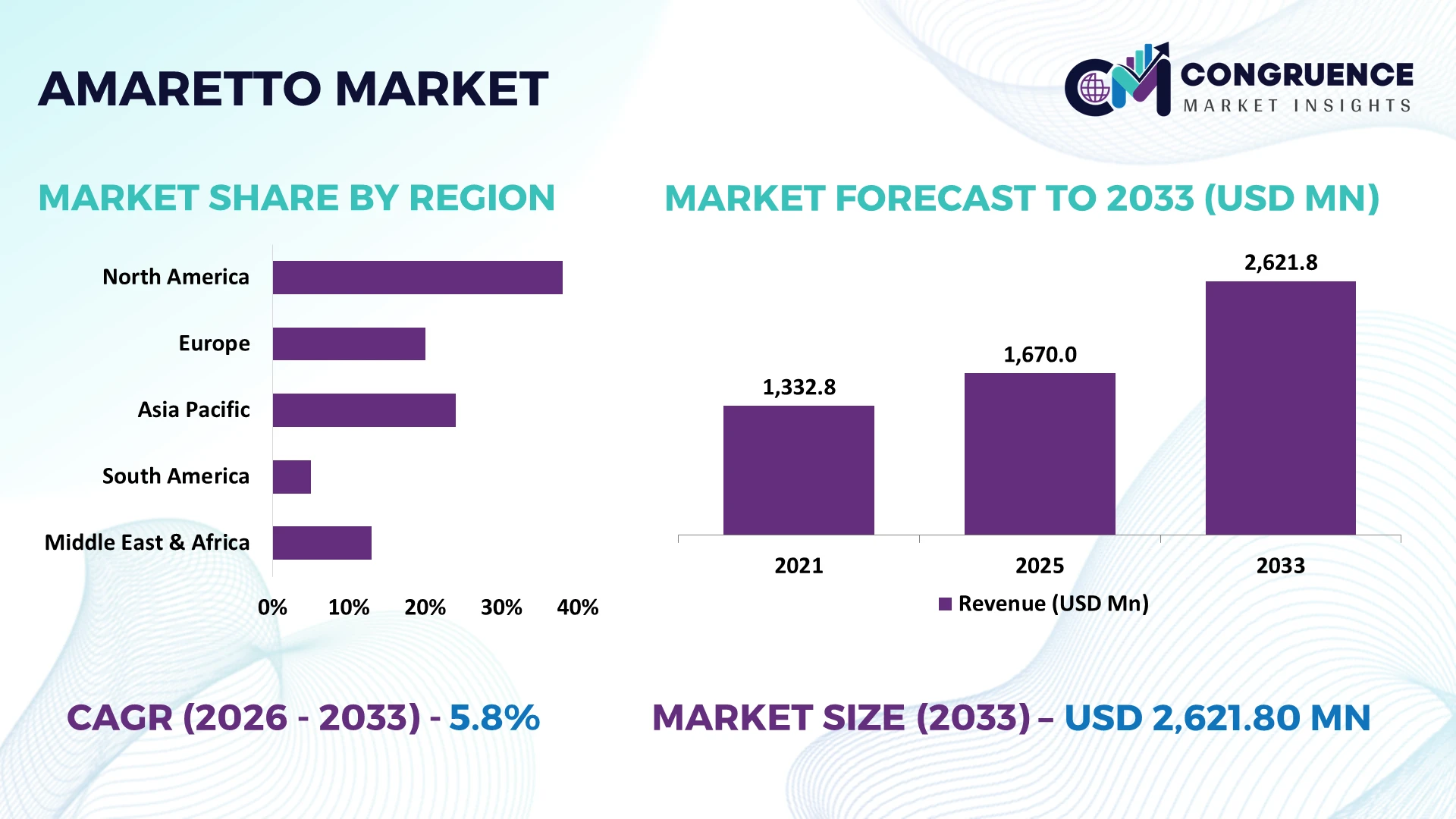
The Global Amaretto Market was valued at USD 1670 Million in 2025 and is anticipated to reach a value of USD 2621.8 Million by 2033 expanding at a CAGR of 5.8% between 2026 and 2033. Growth is supported by premium craft spirits, expanding cocktail culture, premium hospitality channels, and innovation in low-sugar and flavored amaretto formulations aligned with evolving consumer preferences.
Italy remains the dominant producer, accounting for approximately 42% of global amaretto production capacity, supported by established distilleries, premium beverage exports, and continued investment in automated bottling systems with production efficiency improving by nearly 16% since 2023. Compared with the United States, where premium cocktail consumption has expanded by around 11%, Italy retains stronger manufacturing leadership despite changing global trade dynamics following European supply chain adjustments and tariff discussions in 2026. Strategic investment in premium production and export resilience strengthens long-term competitive positioning across global beverage markets.
Market Size & Growth: USD 1670 Million in 2025, reaching USD 2621.8 Million by 2033 at 5.8% CAGR, supported by premium spirits innovation and automated distillation processes.
Top Growth Drivers: Premium alcoholic beverage consumption (+18%), cocktail culture expansion (+15%), and premium retail distribution growth (+12%) continue accelerating market demand.
Short-Term Forecast: By 2028, automated bottling and packaging reduce production costs by approximately 10% while improving operational efficiency by 14%.
Emerging Technologies: AI-driven quality inspection, smart fermentation monitoring, and automated filling systems improve production consistency by nearly 17%.
Regional Leaders: Europe exceeds USD 980 Million, North America approaches USD 720 Million, and Asia Pacific surpasses USD 510 Million, supported by premium beverage adoption and regional distribution expansion.
Consumer/End-User Trends: Nearly 37% of premium spirit consumers increasingly prefer craft liqueurs with authentic heritage positioning and lower-sugar product options.
Pilot/Case Example: In 2026, digital production monitoring at premium distilleries improved batch consistency by 15% while reducing ingredient waste by 9%.
Competitive Landscape: Italy-based producers collectively control approximately 41% of premium market share, with Disaronno, Luxardo, Lazzaroni, DeKuyper, and Bols maintaining strong global distribution.
Regulatory & ESG Impact: Lightweight glass packaging and energy-efficient production reduce packaging emissions by approximately 13%, supporting evolving environmental compliance across international markets.
Investment & Funding: More than USD 220 Million has been directed toward premium facility expansion, export partnerships, and advanced production modernization amid global supply chain diversification.
Innovation & Future Outlook: Premium botanical blends, alcohol-free alternatives, and digital manufacturing systems strengthen product differentiation and accelerate high-growth international market expansion.
The Amaretto Market continues advancing through premium flavor innovation, sustainable packaging, and digitally monitored production systems that improve manufacturing precision by approximately 15%. Demand remains strongest across premium hospitality, cocktail applications, and specialty retail channels. Ongoing supply-chain diversification and evolving labeling requirements in international trade are encouraging producers to strengthen operational resilience, setting the stage for broader strategic expansion and competitive positioning.
The Amaretto Market has become strategically important as premium spirits manufacturers compete through product differentiation, digital production, and export resilience rather than volume alone. Premiumization, evolving consumer preferences, and supply-chain restructuring after global logistics disruptions are reshaping sourcing and distribution strategies. Producers are strengthening almond and apricot kernel procurement networks while investing in automated quality assurance to improve production consistency and strengthen competitive positioning across hospitality and retail channels.
Modern AI-assisted blending and automated bottling systems improve batch consistency by approximately 16% while lowering production waste by nearly 11% compared with conventional manual quality inspection. Italy continues to lead through established distillation expertise and export-oriented manufacturing, whereas the United States records faster adoption of premium ready-to-drink cocktail applications and digital retail platforms. During the next two to three years, automated production deployment is expected to exceed 48% among premium manufacturers, with traceability technologies becoming standard across export-focused facilities.
A practical example includes premium distilleries integrating digital inventory monitoring with smart production scheduling, reducing stock imbalances by approximately 13% while improving fulfillment reliability. Companies are expanding strategic partnerships with distributors, investing in sustainable packaging, and strengthening premium product portfolios. Businesses that combine production efficiency, supply resilience, and brand innovation will secure stronger long-term competitive advantage in the evolving global spirits industry.
Premium alcoholic beverage consumption continues shifting toward authentic heritage brands, with premium liqueur purchases increasing by approximately 18% and premium cocktail menu penetration rising by nearly 15% across hospitality channels. Italy has accelerated investment in automated distillation, digital quality monitoring, and sustainable bottling, improving manufacturing efficiency by around 14%. At the same time, evolving packaging regulations encourage recyclable glass adoption and production modernization. The combination of premium positioning and operational efficiency enables producers to strengthen export competitiveness while maintaining consistent product quality. Companies are responding through premium product launches, manufacturing upgrades, distribution partnerships, and limited-edition offerings targeting high-value retail and hospitality segments. A notable strategic advantage lies in combining traditional recipes with digital manufacturing controls to preserve authenticity while increasing production scalability.
Production remains exposed to fluctuations in almond, apricot kernel, sugar, and glass packaging costs, with selected agricultural inputs experiencing price swings exceeding 12% during adverse harvest cycles. Premium glass bottle expenses have increased by nearly 9% in several European manufacturing hubs due to higher energy and transportation costs. These structural pressures compress operating margins and complicate long-term production planning for export-oriented manufacturers. Companies are reducing supply dependency by diversifying ingredient sourcing, negotiating multi-year procurement contracts, and increasing localized packaging partnerships. Italian producers are also expanding supplier networks to minimize disruptions associated with geopolitical trade adjustments. Strong procurement discipline increasingly differentiates producers capable of protecting profitability while maintaining premium product positioning.
Consumer preference for premium, flavored, and lower-sugar spirits continues expanding, with premium craft liqueur adoption increasing by approximately 19% and digital beverage retail transactions rising by nearly 17%. Japan and South Korea present attractive opportunities through premium gifting culture and specialty beverage retail expansion. Companies are introducing AI-supported formulation optimization and precision flavor development that shorten product testing cycles by about 13%. Investment in recyclable packaging and premium ready-to-drink cocktail formats further broadens addressable demand. Strategic collaborations between distilleries, hospitality operators, and specialty retailers strengthen market access while enhancing brand visibility. A less obvious opportunity lies in leveraging digital consumer analytics to develop localized flavor variants that improve customer retention and premium pricing potential.
Expanding production without compromising traditional flavor profiles remains a major execution challenge for premium manufacturers. Automated facilities require skilled technical personnel, while digital quality management implementation increases operational complexity. Approximately 21% of premium producers continue reporting workforce capability gaps related to advanced production technologies, and traceability compliance requirements have expanded by nearly 14% across export markets. These evolving standards increase investment requirements for process validation, documentation, and digital monitoring infrastructure. Companies are addressing these issues through workforce training, technology partnerships, and integrated production management platforms that improve manufacturing visibility. Maintaining authentic product identity while scaling automated operations will remain a decisive competitive factor for established producers targeting long-term international market leadership.
Smart Production Quality Control Premium distilleries are deploying AI-assisted batch monitoring and automated filling systems, improving production consistency by approximately 16% while reducing ingredient losses by nearly 10%. Labor shortages across Italy and stricter export quality expectations are accelerating digital workflow adoption. Manufacturers are integrating predictive maintenance, automated inspection, and centralized production analytics while expanding technology partnerships to standardize quality across multiple production facilities and shorten release cycles.
Premium Portfolio Diversification Demand is shifting toward flavored, lower-sugar, and ready-to-drink variants, with premium flavored launches increasing by approximately 18% and ready-to-drink portfolio expansion exceeding 14% during 2026. Companies are restructuring product development pipelines around consumer analytics instead of seasonal launches. This operational shift enables faster commercialization, broader retail placement, and stronger premium positioning while reducing dependence on conventional product portfolios.
Sustainable Packaging Transition Lightweight glass adoption has increased by approximately 15%, while recycled packaging material utilization has expanded by nearly 13% as producers respond to environmental regulations and higher transportation costs. Packaging redesign lowers logistics weight, improves warehouse efficiency, and reduces handling expenses. Distilleries are investing in recyclable packaging partnerships and modern bottling infrastructure to strengthen export competitiveness without altering premium product presentation.
Digital Distribution Optimization Enterprise beverage distributors have improved inventory forecasting accuracy by approximately 17% through integrated retail analytics, while direct digital ordering volumes have increased by nearly 20%. Companies are synchronizing production scheduling with real-time demand data to minimize stock imbalances. A less obvious trend is the growing use of digital demand forecasting for premium seasonal collections, allowing producers to optimize manufacturing capacity while reducing excess inventory.
Original Amaretto remains the dominant product category, accounting for approximately 49% of total market demand because of its established brand recognition, consistent flavor profile, and broad compatibility across cocktails, desserts, and culinary applications. Large-scale production efficiencies and standardized formulations enable manufacturers to maintain reliable quality while optimizing distribution costs. Cream variants continue strengthening premium gifting and seasonal consumption, whereas Flavored Amaretto expands consumer choice through fruit, spice, and botanical infusions. Producers are investing in premium packaging, formulation refinement, and broader international retail distribution to reinforce category leadership.
Ready-to-Drink Amaretto represents the fastest-growing segment, with adoption increasing by nearly 18% as convenience-oriented consumers seek premium cocktail experiences without preparation. Companies are expanding automated filling capacity, partnering with beverage distributors, and launching portable packaging formats targeting hospitality and retail channels. Flavored products are also gaining momentum among younger consumers, while Original variants remain the benchmark for premium positioning. Investment priorities increasingly balance heritage offerings with innovative product extensions that broaden customer reach and improve portfolio resilience.
Cocktails remain the leading application, representing approximately 46% of total demand due to widespread deployment across bars, premium restaurants, and hospitality venues. Mixologists increasingly incorporate Amaretto into signature beverages, while automated beverage preparation systems improve serving consistency by approximately 12%. Beverage Mixing is emerging as the fastest-growing application, supported by premium home consumption trends and digital retail expansion that have increased specialty mixer purchases by nearly 15%. Producers are collaborating with hospitality groups and beverage distributors to strengthen product visibility.
Desserts and Baking continue providing stable institutional demand, particularly across premium bakeries and specialty food manufacturers using Amaretto for flavor differentiation. Culinary applications are expanding within gourmet restaurants as chefs incorporate premium liqueurs into sauces and confectionery. Companies are introducing application-specific packaging, recipe collaborations, and hospitality training programs to strengthen adoption across professional food preparation environments. Demand is increasingly shifting toward integrated food-and-beverage experiences where premium ingredients support higher customer engagement and menu differentiation.
Bars & Pubs remain the largest end-user segment, accounting for approximately 41% of purchasing activity due to high serving frequency, extensive cocktail menus, and recurring premium beverage demand. Digital inventory systems have improved beverage stock accuracy by approximately 14%, enabling operators to optimize procurement and reduce product waste. Hotels represent the fastest-growing buyer group as premium tourism, luxury hospitality, and curated beverage experiences expand across major international destinations. Manufacturers are strengthening distributor partnerships and customized promotional programs for hospitality operators.
Restaurants, Retail Stores, and Food Service Providers continue expanding their role through diversified consumption occasions. Retail stores are increasing premium shelf allocation by nearly 13% as consumers purchase higher-value spirits for home entertainment, while food service providers integrate Amaretto into desserts and specialty beverage programs. Companies are responding with tailored packaging formats, pricing strategies, and channel-specific product portfolios that improve operational flexibility. Competitive positioning increasingly depends on serving multiple purchasing ecosystems rather than relying exclusively on traditional hospitality demand.
Europe accounted for the largest market share at 41.8% in 2025 however, Asia-Pacific is expected to register the fastest growth, expanding at a 7.2% between 2026 and 2033.

Premium Hospitality and Digital Distribution Expansion
North America represents approximately 28% of the global Amaretto market, supported by strong premium spirits consumption, an advanced hospitality industry, and expanding digital retail infrastructure. The United States and Canada continue increasing demand for premium liqueurs through cocktail culture, specialty beverage retailing, and high-end food service channels. More than 46% of premium spirit purchases are now influenced by digital product discovery and online beverage platforms, encouraging producers to strengthen omnichannel distribution. Beverage distributors are investing in automated warehouse systems and demand forecasting tools, improving inventory efficiency by nearly 15%. Strategic partnerships between premium distillers and hospitality operators continue expanding premium menu offerings while improving supply consistency across commercial channels.
United States Market Outlook: The United States remains the regional demand center because of its extensive restaurant, hotel, and premium retail ecosystem. Premium cocktail consumption continues increasing across metropolitan hospitality hubs, while automated beverage inventory systems have improved procurement accuracy by approximately 16%. Producers are expanding partnerships with beverage distributors, premium retailers, and hospitality chains while introducing limited-edition product portfolios tailored to evolving consumer preferences.
Traditional Manufacturing Supported by Modernization
Europe maintains the strongest production and export position through established distillation expertise, premium brand heritage, and advanced manufacturing infrastructure. The region contributes nearly 42% of global production, with automated bottling, precision quality control, and sustainable packaging becoming operational priorities. Approximately 52% of premium producers have integrated digital production monitoring to strengthen product consistency and export compliance. Environmental packaging regulations are accelerating investments in lightweight glass and energy-efficient manufacturing systems. Companies continue strengthening export logistics and production modernization to preserve traditional product identity while improving manufacturing productivity.
Italy Market Outlook: Italy remains the industry's manufacturing and innovation center, supported by internationally recognized premium brands, advanced distillation expertise, and established export infrastructure. Nearly 60% of domestic premium producers have adopted automated production monitoring and digital traceability systems to improve quality assurance and regulatory compliance. Continued investment in premium packaging, export logistics, and sustainable production reinforces Italy's long-term leadership within the global Amaretto industry.
Premium Lifestyle Consumption Accelerates Expansion
Asia-Pacific is strengthening its strategic position through expanding premium beverage consumption, modern retail infrastructure, and growing hospitality investments. Premium imported liqueur demand has increased by approximately 19%, while organized specialty beverage retail continues expanding across major urban markets. International producers are increasing local distribution partnerships and investing in premium marketing strategies to improve brand penetration. Digital commerce platforms account for nearly 34% of premium spirits transactions in several leading markets, enabling faster product availability and stronger consumer engagement. Premium hospitality and tourism development continue supporting wider commercial adoption.
Japan Market Outlook: Japan leads regional premium Amaretto consumption through sophisticated hospitality standards, premium gifting culture, and specialty beverage retail. Premium imported liqueur placement has expanded by approximately 14% across upscale restaurants and cocktail establishments. Beverage companies continue collaborating with distributors and luxury hospitality operators while introducing premium packaging formats designed for high-value retail and seasonal consumer demand.
Premium Consumption Gains Momentum
South America is gradually strengthening premium liqueur demand through hospitality expansion, urban consumer spending, and specialty beverage retail development. Brazil and neighboring markets continue increasing premium cocktail offerings, while organized distribution networks improve product availability across commercial establishments. Premium imported spirit sales have expanded by approximately 12%, supported by investments in hospitality modernization and premium retail formats. Supply-chain efficiency remains uneven because of logistics costs and import complexity, encouraging distributors to optimize warehousing and regional procurement partnerships. Companies continue prioritizing premium branding and localized distribution to strengthen long-term market presence.
Brazil Market Outlook: Brazil represents the region's primary commercial opportunity because of its large hospitality sector, expanding premium beverage culture, and growing organized retail infrastructure. Premium beverage distribution efficiency has improved by nearly 11% through logistics modernization and stronger distributor partnerships. International producers continue expanding premium product portfolios while collaborating with restaurants, hotels, and beverage wholesalers to improve nationwide availability.
Hospitality Investment Drives Premium Demand
The Middle East & Africa market is developing through premium hospitality investments, international tourism growth, and expanding luxury food service infrastructure. Premium hotel developments and upscale dining establishments are increasing demand for imported specialty beverages where regulations permit commercial distribution. Hospitality investment has expanded by approximately 15% across major tourism destinations, encouraging beverage suppliers to strengthen premium distribution capabilities. Companies are focusing on specialized import partnerships, efficient logistics management, and premium positioning to improve operational reach while adapting to country-specific regulatory frameworks and market conditions.
United Arab Emirates Market Outlook: The United Arab Emirates serves as the regional premium hospitality hub through luxury tourism, international hotel development, and sophisticated food service operations. Premium beverage distribution networks have expanded by approximately 13% within hospitality-focused commercial channels. International suppliers continue strengthening strategic partnerships with licensed distributors, premium hotels, and fine-dining operators while investing in efficient logistics and premium brand visibility.
Global premium producers including Disaronno, Luxardo, Lazzaroni, DeKuyper, and Bols compete directly against regional craft distillers and private-label beverage manufacturers. The top five participants collectively control approximately 58% of the market through established distribution, premium branding, and manufacturing scale. Competition centers on product authenticity, flavor innovation, supply-chain resilience, and packaging efficiency rather than price alone. Automated production improves manufacturing efficiency by nearly 15%, while digital demand forecasting reduces inventory imbalance by approximately 12%, giving technologically advanced producers a measurable operational advantage. Leading companies are expanding international distribution, forming hospitality partnerships, introducing flavored and ready-to-drink variants, and increasing vertical integration across production and packaging. Regional producers compete through localized recipes and niche premium positioning, while global leaders leverage export infrastructure and brand recognition. Strict quality regulations, premium ingredient sourcing, and established distribution networks create significant entry pressure. Sustained success requires premium differentiation, operational efficiency, reliable sourcing, and continuous product innovation.
Disaronno International
Luxardo S.p.A.
Paolo Lazzaroni & Figli S.p.A.
DeKuyper Royal Distillers
Lucas Bols N.V.
Gozio Distilleria
Illva Saronno S.p.A.
Hiram Walker & Sons
Marie Brizard Wine & Spirits
Fratelli Francoli S.p.A.
Adriatico Amaretto
Bepi Tosolini Distillery
Digital production technologies are redefining premium amaretto manufacturing through AI-assisted quality inspection, automated fermentation monitoring, and smart bottling systems. Automated optical inspection improves batch consistency by approximately 16%, while predictive maintenance reduces equipment downtime by nearly 11%. Around 54% of premium European distilleries have integrated digital production monitoring into daily operations, enabling tighter process control, improved traceability, and faster compliance with evolving export requirements.
Emerging technologies between 2026 and 2028 include digital twin production modeling, blockchain-enabled ingredient traceability, and AI-driven flavor optimization. Blockchain-based sourcing verification reduces ingredient authentication time by roughly 18%, while AI-supported formulation testing shortens product development cycles by approximately 14%. Compared with conventional manual quality management, integrated smart production environments improve operational efficiency by nearly 19% while lowering production waste by about 12%. Producers also increasingly connect enterprise resource planning platforms with warehouse automation to improve inventory synchronization and export fulfillment.
Disruptive competitive advantage is shifting toward manufacturers combining traditional distillation expertise with intelligent production ecosystems. Premium producers deploying advanced automation gain stronger quality consistency, faster product launches, and improved supply resilience than smaller manual producers. Companies investing early in digital manufacturing, sustainable packaging technologies, and data-driven production planning are expected to strengthen international competitiveness, premium brand differentiation, and operational flexibility through 2028.
April 2025 Disaronno celebrated its 500-year anniversary through a global brand campaign highlighting heritage, premium positioning, and international consumer engagement across multiple markets. The initiative marked 500 years of brand history, reinforcing worldwide premium visibility and strengthening long-term brand equity. Source: https://disaronno.com/en/news/
October 2025 Disaronno launched the 500 Years Limited Edition bottle, introducing commemorative premium packaging for global distribution. The special edition recognized the brand's 500-year milestone, supporting premium portfolio differentiation and increasing collector and retail interest worldwide.
May 2026 Disaronno Group completed its corporate rebranding from Illva Saronno Holding, reporting 2025 turnover growth of 3% while restructuring operations into Spirits, Wines, and Ingredients divisions. The move strengthened global brand alignment and organizational scalability across international markets.
June 2026 Disaronno Group finalized the acquisition of Amaro Averna and Zedda Piras, expanding its international spirits portfolio across nearly 160 countries. The completed acquisition enhanced portfolio diversification, strengthened priority market positioning, and accelerated long-term premium spirits expansion. Source: https://disaronnogroup.com
This report provides comprehensive analysis of the global Amaretto market across Original, Cream, Ready-to-Drink, and Flavored product categories, together with detailed evaluation of Cocktails, Desserts, Baking, Beverage Mixing, and Culinary applications. It further assesses demand across Bars & Pubs, Restaurants, Hotels, Retail Stores, and Food Service Providers while examining deployment trends across North America, Europe, Asia-Pacific, South America, and the Middle East & Africa. The assessment incorporates technology adoption, digital manufacturing, packaging innovation, and supply-chain modernization influencing more than 50% of premium producers.
The study evaluates competitive positioning, production strategies, distribution evolution, premium product innovation, and operational efficiency shaping the market between 2026 and 2033. It highlights enterprise expansion strategies, partnership activity, automation deployment, and sustainability initiatives while identifying emerging premium product niches, digital retail opportunities, and evolving hospitality demand. The report supports investment prioritization, market entry planning, product portfolio optimization, and long-term competitive strategy through detailed segmentation, regional benchmarking, technology assessment, and company-level strategic analysis.
| Report Attribute/Metric | Report Details |
|---|---|
Market Revenue in 2025 | USD 1670 Million |
Market Revenue in 2033 | USD 2621.8 Million |
CAGR (2026 - 2033) | 5.8% |
Base Year | 2025 |
Forecast Period | 2026 - 2033 |
Historic Period | 2021 - 2025 |
Segments Covered | By Type
By Application
By End-User
|
Key Report Deliverable | Revenue Forecast, Growth Trends, Market Dynamics, Segmental Overview, Regional and Country-wise Analysis, Competition Landscape |
Region Covered | North America, Europe, Asia-Pacific, South America, Middle East, Africa |
Key Players Analyzed | Disaronno International, Luxardo S.p.A., Paolo Lazzaroni & Figli S.p.A., DeKuyper Royal Distillers, Lucas Bols N.V., Gozio Distilleria, Illva Saronno S.p.A., Hiram Walker & Sons, Marie Brizard Wine & Spirits, Fratelli Francoli S.p.A., Adriatico Amaretto, Bepi Tosolini Distillery |
Customization & Pricing | Available on Request (10% Customization is Free) |




