
Reports
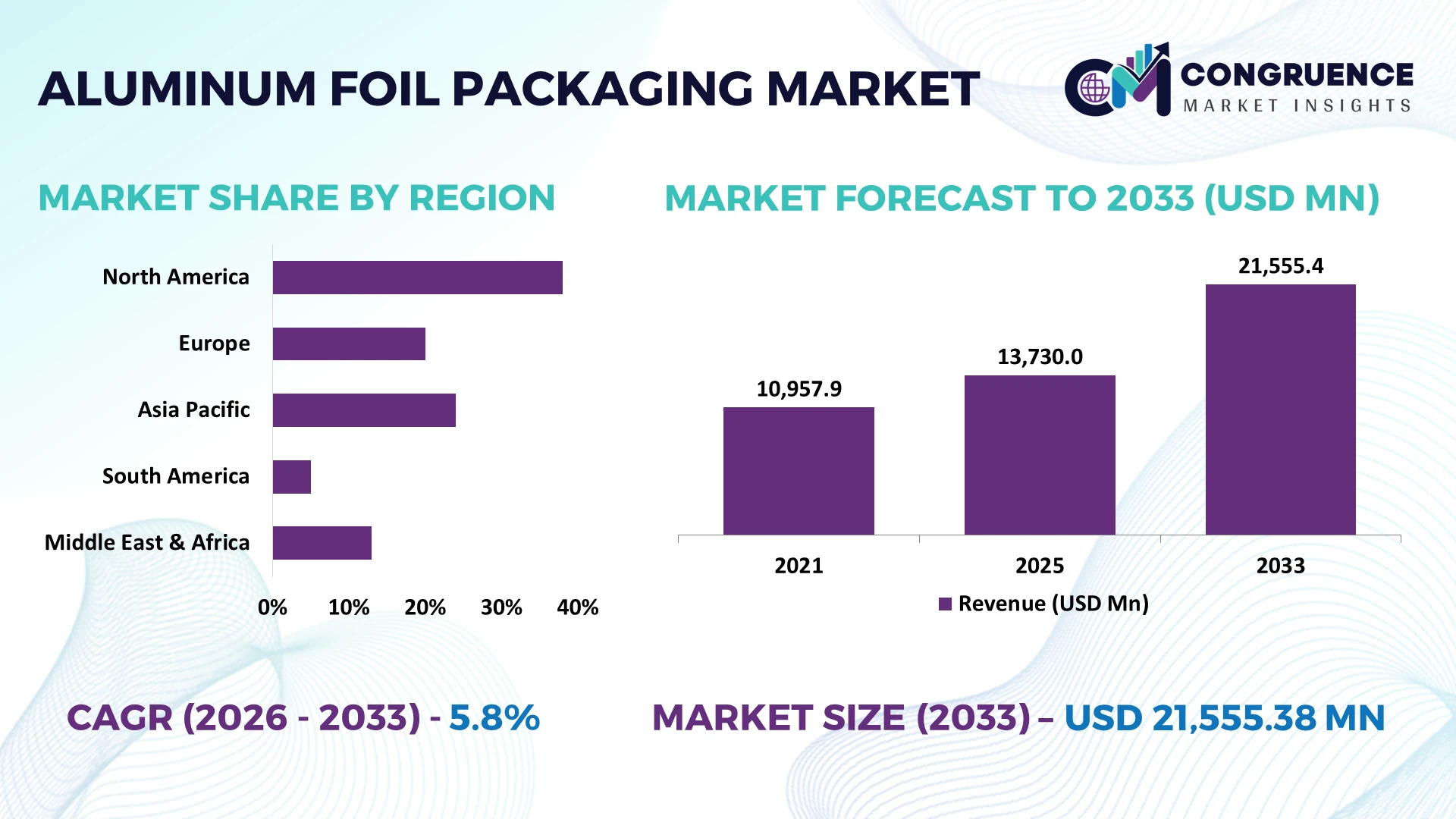
The Global Aluminum Foil Packaging Market was valued at USD 13730 Million in 2025 and is anticipated to reach a value of USD 21555.38 Million by 2033 expanding at a CAGR of 5.8% between 2026 and 2033. Growth is driven by lightweight high-barrier packaging replacing heavier laminates, rising pharmaceutical blister-pack production, and aluminum’s recyclability advantages in food and healthcare applications.
China remains the dominant aluminum foil manufacturing hub, accounting for over 60% of global aluminum foil output capacity, supported by large-scale investments in rolling, coating, and converting technologies serving food, beverage, pharmaceutical, and electronics industries. India is expanding capacity rapidly, while European producers prioritize recycled-content and energy-efficient foil. U.S.-China trade measures are accelerating regional supply-chain diversification.
Strategically, manufacturers should prioritize high-barrier grades, recycled-content capability, and geographically diversified converting capacity to capture resilient global aluminum foil packaging demand.
Market Size & Growth: USD 13.73 billion in 2025 is projected to reach USD 21.56 billion by 2033 at a 5.8% CAGR, driven by high-barrier pharmaceutical and food packaging.
Top Growth Drivers: Pharmaceutical packaging contributes 18% growth momentum, food applications 15%, and recyclable-packaging adoption 12%.
Short-Term Forecast: By 2028, advanced foil converting is expected to reduce material waste by 4% and improve production efficiency by 6%.
Emerging Technologies: AI inspection, automated rolling control, and nano-engineered barrier coatings are improving defect detection and packaging performance by 3–7%.
Regional Leaders: Asia-Pacific is projected near USD 12 billion, Europe near USD 4.5 billion, and North America near USD 3.8 billion, supported by pharmaceutical and sustainable-packaging adoption.
Consumer/End-User Trends: Recyclable and lightweight packaging preferences are increasing adoption by approximately 8% across major packaged-food applications.
Pilot/Case Example: A 2024 automated foil-converting deployment achieved approximately 10% lower production waste through real-time thickness and defect monitoring.
Competitive Landscape: China-led capacity represents more than 60% of global foil output, with major competition from Novelis, Hindalco, UACJ, RUSAL, and Amcor.
Regulatory & ESG Impact: Recycled-content initiatives and packaging-waste regulations are targeting approximately 10–20% reductions in virgin-material dependence across selected packaging supply chains.
Investment & Funding: More than USD 2 billion in recent capacity expansion and modernization activity is strengthening rolling, coating, recycling, and pharmaceutical-grade foil supply.
Innovation & Future Outlook: Next-generation barrier coatings, thinner gauges, recycled aluminum, and AI-enabled production are shifting competition toward 5–10% better material efficiency and resilient regional supply networks.
The aluminum foil packaging market is expanding across pharmaceutical blister packs, food pouches, dairy lids, ready-to-eat meals, and flexible laminates, where high barrier performance and lightweight construction remain critical. Approximately 70% of aluminum packaging applications benefit from foil’s protection against moisture, oxygen, and light. Capacity diversification following U.S.-China trade tensions is strengthening regional supply resilience, supporting the next phase of strategic market development.
Aluminum foil packaging is becoming strategically important because packaging performance now directly influences pharmaceutical stability, food shelf life, material efficiency, and supply-chain resilience. Manufacturers are restructuring sourcing and converting footprints as trade-policy changes and tighter packaging-waste requirements increase the value of localized production, recycled aluminum, and secure foil supply.
Technology is reshaping operating economics. AI-enabled inspection and automated gauge control can reduce material defects and process waste by 5–8% versus conventional manual inspection, while advanced rolling systems support thinner gauges without sacrificing barrier performance. China continues to lead production scale, whereas Germany, Japan, and the United States emphasize precision grades, automation, and recycled-content integration. Over the next 2–3 years, automated quality control adoption across large converting facilities is expected to approach 30–40%.
In practical deployment, pharmaceutical foil producers are pairing high-speed converting lines with digital inspection to maintain consistent barrier and seal performance. Companies are directing investment toward thinner-gauge development, recycling partnerships, localized converting capacity, and long-term aluminum procurement contracts. The strongest competitive position will come from combining material efficiency, automated quality assurance, sustainable inputs, and supply-chain control rather than competing on foil volume alone.
Pharmaceutical packaging is a major structural driver as aluminum foil provides near-total protection against moisture, oxygen, light, and contamination. Blister and strip-pack applications are expanding alongside stricter product-protection requirements, with pharmaceutical applications contributing approximately 18% of incremental demand and high-barrier structures improving shelf-life protection by 10–15% in sensitive formulations. India’s expanding pharmaceutical manufacturing base is strengthening demand for cold-form and lidding foil. Producers are responding through pharmaceutical-grade coating lines, precision rolling, and converter partnerships. The non-obvious advantage is qualification consistency: tighter thickness control reduces sealing failures and material rejection, giving suppliers with automated inspection a measurable procurement advantage.
Aluminum foil production remains exposed to electricity intensity and primary aluminum price volatility, creating direct pressure on converting margins. Energy can represent roughly 15–20% of manufacturing costs, while raw aluminum typically accounts for more than 60% of total material expenditure. European producers face additional pressure from elevated energy costs and decarbonization requirements. Supply disruptions or abrupt metal-price movements can therefore compress margins and complicate fixed-price customer contracts. Companies are reducing exposure through recycled aluminum sourcing, multi-country procurement, longer-term supply agreements, and energy-efficient rolling equipment. A critical operational insight is that localized recycling capacity increasingly functions as both an ESG asset and a cost-buffering mechanism.
Digital converting offers a high-value opportunity as manufacturers integrate machine vision, predictive maintenance, automated gauge control, and closed-loop process optimization. AI-based inspection can reduce defect-related waste by 5–8%, while predictive maintenance can improve equipment availability by approximately 3–6%. India and Southeast Asian manufacturing hubs are particularly attractive for new pharmaceutical and food-packaging capacity. At the same time, recycled aluminum adoption is accelerating as brand owners pursue lower embodied-carbon packaging. Companies are investing in sensor-enabled production lines, recycling partnerships, and R&D for thinner gauges. The strategic opportunity lies in converting fewer raw-material inputs into higher-performing structures while maintaining barrier and sealing specifications.
Thinner foil development creates a complex execution challenge because material reduction must not compromise puncture resistance, barrier integrity, sealing performance, or high-speed converting stability. Advanced lightweight structures can target 5–10% material reduction, but process variability can increase scrap rates by 2–4% when equipment is not properly calibrated. Japanese and German manufacturers are addressing this pressure through precision rolling, inline metrology, and automated defect detection. Workforce capability is another constraint as digital production requires technicians skilled in process analytics and equipment integration. Companies must therefore combine automation investment with workforce training and supplier collaboration. The decisive challenge is achieving material-light packaging at industrial scale without transferring savings into higher rejection or downtime costs.
Container-Led Format Shift: Foil containers remain a major packaging format, supported by strong use in ready-to-eat meals, takeaway food, catering, and heat-resistant applications. Their share exceeds 50% in leading product assessments, while manufacturers are improving forming precision and reducing material use by 3–5% through thinner-gauge designs.
Pouch Adoption Accelerates: Foil pouches are the fastest-growing flexible format, with adoption supported by lightweight construction, high-barrier protection, resealability, and lower transport intensity. Pouch demand is advancing at approximately 4–5% annually in current industry assessments, prompting converters to expand multilayer lamination and automated filling compatibility.
Pharmaceutical Foil Intensifies: Pharmaceutical packaging is strengthening its position as blister and high-barrier formats expand. The segment represents roughly 25–30% in several current market assessments, while stricter drug-protection requirements are increasing demand for precision-coated foil. Producers are expanding qualified pharmaceutical-grade lines and traceability systems.
Recycling Reshapes Procurement: European packaging regulations and tighter recycled-content expectations are pushing converters toward higher secondary-aluminum usage. Companies are targeting recycled inputs of 15–30% where specifications permit, while long-term scrap contracts and localized recycling partnerships reduce exposure to primary aluminum supply volatility.
Foil Containers represent the leading type among the specified formats, with approximately 51–54% share in current product-level assessments. Their dominance reflects scalability, thermal resistance, structural rigidity, recyclability, and compatibility with ready-to-eat meals, takeaway food, catering, and oven-to-table applications. Companies continue investing in high-speed forming equipment and lightweighting programs, with gauge optimization delivering approximately 3–5% material savings without changing established filling and heating workflows.
Foil Pouches are the fastest-growing type, supported by lightweight construction, flexible logistics, resealability, and high-barrier performance. Current industry assessments place pouch growth near 4–5%, encouraging converters to expand multilayer lamination and automated filling capabilities. Foil Lids remain strategically important for high-speed sealing, while Foil Trays and Foil Wrappers retain established positions in foodservice and convenience packaging. Investment is shifting toward pouches and precision-engineered containers as manufacturers balance material efficiency with performance.
Food Packaging is the leading application, accounting for approximately 47% of market demand in current assessments. Its scale comes from extensive use in prepared foods, dairy, bakery, confectionery, frozen products, and convenience meals, where aluminum foil provides moisture, oxygen, light, and temperature protection. Beverage Packaging remains comparatively specialized, while Pharmaceutical Packaging is gaining strategic importance because high-barrier foil supports sensitive drug formulations and regulated shelf-life requirements.
Pharmaceutical Packaging is the fastest-growing application, with industry assessments placing its growth near 5% in several markets as blister and strip formats expand. Personal Care Packaging and Household Packaging remain smaller but valuable niches requiring barrier protection and product integrity. Companies are responding through pharmaceutical-grade coating capacity, automated sealing, and application-specific foil specifications. The commercial implication is clear: demand is shifting toward performance-qualified foil rather than undifferentiated commodity material.
Food & Beverage is the dominant end-user group, representing approximately 47% of market demand in current industry assessments. High-volume deployment across prepared foods, dairy, confectionery, frozen meals, takeaway products, and foodservice creates substantial recurring foil consumption. Pharmaceuticals form the fastest-growing major buyer group, supported by blister and high-barrier packaging requirements, while Personal Care, Consumer Goods, and Foodservice maintain more specialized purchasing patterns.
Pharmaceutical demand is strengthening at roughly 5% in current market assessments as manufacturers prioritize moisture resistance, light protection, tamper evidence, and dosage integrity. Food & Beverage buyers emphasize cost, throughput, and lightweighting, whereas pharmaceutical purchasers prioritize qualification and specification consistency. Companies are therefore tailoring foil grades, expanding dedicated production capacity, and forming converter partnerships. The key competitive shift is toward segment-specific product engineering, with pharmaceutical buyers generating higher-value opportunities than conventional volume contracts.
Asia-Pacific accounted for the largest market share at 49.92% in 2025 however, North America is expected to register the fastest growth, expanding at a CAGR of 4.0% between 2026 and 2033.
Pharmaceutical Packaging and Automated Converting Strengthen the U.S.
North America combines mature food-packaging consumption with sophisticated pharmaceutical manufacturing and advanced converting infrastructure. The region accounted for approximately 16% of global aluminum foil packaging demand in 2025 in current market assessments, with the United States representing the dominant country market. Containers remain a major format, while pouches are gaining traction as flexible packaging lines modernize. U.S. producers are investing in automated inspection, lightweight foil structures, and recycling-oriented processing to improve material utilization and supply resilience. Pharmaceutical blister production remains an important deployment concentration, particularly around established healthcare manufacturing clusters. Companies are also strengthening domestic sourcing and long-term metal procurement to reduce exposure to international supply volatility. The strategic shift is toward higher-specification foil, faster conversion, and greater recycled-material integration rather than simple volume expansion.
United States Market Outlook: The United States remains the region’s strongest operational market, supported by extensive food-processing infrastructure, pharmaceutical manufacturing, established retail distribution, and advanced packaging automation. Containers remain a leading format, while pouches are attracting incremental investment. Automated quality-control deployment is improving consistency across high-speed converting operations, strengthening the country’s position in premium and specification-driven foil packaging.
Recyclability Compliance Is Reshaping Packaging Design
Europe is shifting from conventional foil-volume competition toward design-for-recyclability, material efficiency, and closed-loop recovery. The region represented approximately 23% of global aluminum foil packaging demand in 2025, supported by Germany, Italy, France, and the United Kingdom. European foil deliveries reached 892,500 tonnes in 2024, demonstrating the scale of established rolling and converting infrastructure. The Packaging and Packaging Waste Regulation is accelerating redesign activity, with European requirements targeting recyclable packaging and a 60% aluminum recycling target by 2030. Manufacturers are responding through thinner structures, improved sorting compatibility, de-lacquering, recycled-metal procurement, and partnerships across the recycling chain. The non-obvious competitive advantage is regulatory readiness: converters able to document recyclability and recycled-content performance can protect customer relationships while reducing future redesign costs.
Germany Market Outlook: Germany remains a strategically important European manufacturing hub because of its sophisticated packaging machinery ecosystem, pharmaceutical production, food-processing base, and engineering capabilities. German converters are prioritizing precision rolling, automated inspection, and recyclable structures. Strong integration between equipment suppliers and packaging manufacturers supports faster qualification of new foil formats and improves production consistency.
China-Led Manufacturing Scale Reinforces Supply Dominance
Asia-Pacific remains the largest production and consumption center, accounting for approximately 50% of global aluminum foil packaging demand in 2025. China anchors the regional supply chain through extensive rolling capacity, integrated aluminum production, and large domestic food and pharmaceutical markets. India is strengthening its position through expanding pharmaceutical manufacturing and organized food processing, while Japan emphasizes precision grades and high-quality converting. China accounts for roughly 60% of worldwide aluminum foil output, giving regional suppliers significant scale and export leverage. Companies are increasingly investing in thinner-gauge rolling, automated inspection, recycling, and higher-value packaging grades. Supply-chain localization is also encouraging manufacturers to place converting capacity closer to major food and pharmaceutical clusters. The strategic advantage remains the combination of production scale, raw-material access, manufacturing density, and rapidly expanding downstream consumption.
China Market Outlook: China is the region’s dominant manufacturing base, supported by integrated aluminum supply chains and extensive packaging-conversion capacity. Its approximately 60% share of global aluminum foil output provides major scale advantages. Producers are moving beyond commodity foil toward pharmaceutical, food-grade, lightweight, and higher-precision products, while modernization and recycling initiatives increasingly influence new capacity decisions.
Food Processing and Flexible Formats Drive Regional Demand
South America represented approximately 6.6% of global aluminum foil packaging demand in 2025, with Brazil serving as the principal industrial and consumption center. The region’s demand structure is closely connected to processed foods, beverages, dairy, confectionery, and convenience packaging, creating steady requirements for wrappers, trays, lids, and flexible foil laminates. Brazil’s large food-processing base provides the strongest deployment concentration, while Argentina and Chile contribute specialized food and consumer-product applications. Producers are focusing on lightweight structures and localized converting to reduce freight exposure and improve supply responsiveness. Import dependence for selected grades and equipment remains an operational constraint, encouraging distributors and converters to strengthen inventory planning and supplier agreements. The strategic opportunity is to combine local conversion with imported specialty inputs, allowing manufacturers to improve lead times without replicating the full upstream aluminum chain.
Brazil Market Outlook: Brazil is the most strategically significant South American market because of its large packaged-food industry, extensive retail network, and established industrial base. Food processors increasingly use foil-based containers, lids, wrappers, and laminates for shelf-life and thermal-performance requirements. Local converters can strengthen competitiveness by expanding automated forming and securing dependable aluminum supply contracts.
Local Manufacturing Capacity Supports Packaging Modernization
Middle East & Africa accounted for approximately 4.1% of global aluminum foil packaging demand in 2025, with packaging requirements concentrated around food processing, pharmaceuticals, personal care, and household products. Gulf markets are investing in food-manufacturing and logistics infrastructure, while South Africa provides one of the region’s more established packaging-conversion bases. Demand for containers remains significant, with containers representing more than 55% of the regional product mix in current assessments. Manufacturers are strengthening local converting, warehousing, and distributor networks to reduce dependence on long-distance imports. The region’s strategic challenge is uneven recycling infrastructure, which limits recovery economics for smaller foil formats. Companies are therefore prioritizing larger-volume applications, localized partnerships, and efficient logistics. Investment is increasingly directed toward conversion capacity rather than complete upstream aluminum integration, allowing producers to respond faster to food and pharmaceutical packaging demand.
Saudi Arabia Market Outlook: Saudi Arabia offers a strong industrial platform because of expanding food manufacturing, pharmaceutical localization, modern logistics infrastructure, and broader industrial diversification initiatives. Packaging converters benefit from proximity to Gulf distribution markets and large food-processing projects. New capacity focused on forming, laminating, and high-barrier applications can reduce import dependence and improve regional supply responsiveness.
The competitive field is led by Amcor, Novelis, Hindalco, UACJ, and Constantia Flexibles, with global producers competing against specialized regional converters and cost-focused Asian suppliers. The top five players collectively account for approximately 28% of market share, indicating a fragmented structure rather than concentrated control. Competition centers on material pricing, barrier performance, gauge precision, supply reliability, and customization. Automated inspection can improve process efficiency by 5–8%, while lightweighting reduces material consumption by 3–5%. Amcor and Constantia emphasize flexible packaging solutions, while Novelis, Hindalco, and UACJ strengthen metal access and specialty foil capabilities. Asian suppliers compete on scale and lead times, whereas North American and European producers differentiate through qualification, recycling, and application engineering. Competition is shifting toward supply security and recycled-content capability as regulations tighten. High capital intensity, qualification cycles, and integrated rolling capacity remain major entry barriers. Winning requires scale, reliable sourcing, technical customization, and disciplined conversion economics globally.
Amcor plc
Novelis Inc.
Hindalco Industries Limited
UACJ Corporation
Constantia Flexibles
Reynolds Consumer Products
Pactiv Evergreen Inc.
Carcano Antonio S.p.A.
Assan Alüminyum
Laminazione Sottile S.p.A.
Eurofoil Luxembourg S.A.
Zhejiang Mingdao Aluminum Co., Ltd.
Shanghai Metal Corporation
Zhengzhou Eming Aluminium Industry Co., Ltd.
Conventional rolling and converting technologies remain the production backbone, but automated gauge control, inline defect inspection, and precision slitting are becoming increasingly important. Automated inspection can improve defect-detection efficiency by 5–8% versus manual inspection, while closed-loop gauge control can reduce material variation by 2–4%. Deployment is strongest among large-scale pharmaceutical and food converters.
Emerging technologies include lightweight high-strength alloys, advanced coating systems, digital process monitoring, and recycled-aluminum integration. Hindalco’s upgraded light-gauge foil process increases strength without compromising production scalability, while its 3SRC alloy targets stronger semi-rigid containers with higher recycled content. These technologies can deliver 3–6% material-efficiency improvements and strengthen premium-grade positioning. Companies combining rolling, coating, inspection, and recycling gain the clearest supply-chain advantage.
From 2026–2028, disruptive progress will center on AI-assisted quality analytics, predictive maintenance, thinner-gauge structures, and closed-loop recycling. Digital monitoring can reduce unplanned downtime by 2–5%, while advanced lightweighting can lower material intensity by 4–7%. High-volume producers such as Hindalco and UACJ benefit through scale, consistency, and specification control, while smaller converters can differentiate through specialized grades. Acting now secures equipment integration, qualified production capacity, and technology-led cost advantages before precision and sustainability requirements become standard procurement criteria.
January 2026 — Hindalco commissioned a 1.7 lakh-tonne-per-annum flat-rolled and battery-grade aluminium foil facility in Odisha with ₹4,500 crore investment, strengthening high-grade metal supply and reducing India’s dependence on imported flat-rolled products. Source: hindalco.com
May 2025 — Constantia Flexibles inaugurated its expanded Austrian rolling mill following €50 million investment, increasing aluminium foil production by approximately 30% to 90,000 tonnes annually and strengthening European packaging supply resilience. Source: dlpmag.com
June 2025 — Reynolds Consumer Products introduced Air Fryer Cups and Parchment Cooking Bags under Reynolds Kitchens, extending its household packaging portfolio while leveraging Reynolds Wrap’s position as a leading aluminum-foil brand across 95% of U.S. households. Source: reynoldsconsumerproducts.com
July 2026 — Shyam Metalics commenced commercial production at its Sambalpur aluminium foil facility with 18,000-tonne annual capacity, forming part of an ₹800 crore downstream expansion and strengthening domestic premium-grade foil manufacturing capability. Source: economictimes.indiatimes.com
The Aluminum Foil Packaging Market Report covers Foil Pouches, Foil Trays, Foil Lids, Foil Wrappers, and Foil Containers across Food Packaging, Beverage Packaging, Pharmaceutical Packaging, Personal Care Packaging, and Household Packaging. End-user analysis spans Food & Beverage, Pharmaceuticals, Personal Care, Consumer Goods, and Foodservice, enabling assessment of demand concentration, format adoption, and application-specific purchasing behavior.
Geographic coverage includes North America, Europe, Asia-Pacific, South America, and Middle East & Africa, with country-level analysis emphasizing China, the United States, Germany, India, Brazil, and Saudi Arabia. The report evaluates automated inspection, precision rolling, lightweight foil engineering, advanced coatings, recycling integration, and digital converting. Competitive assessment covers major producers, capacity expansion, product specialization, partnerships, and supply-chain positioning, supporting investment planning, manufacturing expansion, procurement strategy, competitive positioning, and technology priorities through 2026–2033.
| Report Attribute/Metric | Report Details |
|---|---|
Market Revenue in 2025 | USD 13730 Million |
Market Revenue in 2033 | USD 21555.38 Million |
CAGR (2026 - 2033) | 5.8% |
Base Year | 2025 |
Forecast Period | 2026 - 2033 |
Historic Period | 2021 - 2025 |
Segments Covered | By Type
By Application
By End-User
|
Key Report Deliverable | Revenue Forecast, Growth Trends, Market Dynamics, Segmental Overview, Regional and Country-wise Analysis, Competition Landscape |
Region Covered | North America, Europe, Asia-Pacific, South America, Middle East, Africa |
Key Players Analyzed | Amcor plc, Novelis Inc., Hindalco Industries Limited, UACJ Corporation, Constantia Flexibles, Reynolds Consumer Products, Pactiv Evergreen Inc., Carcano Antonio S.p.A., Assan Alüminyum, Laminazione Sottile S.p.A., Eurofoil Luxembourg S.A., Zhejiang Mingdao Aluminum Co., Ltd., Shanghai Metal Corporation, Zhengzhou Eming Aluminium Industry Co., Ltd. |
Customization & Pricing | Available on Request (10% Customization is Free) |




