
Reports
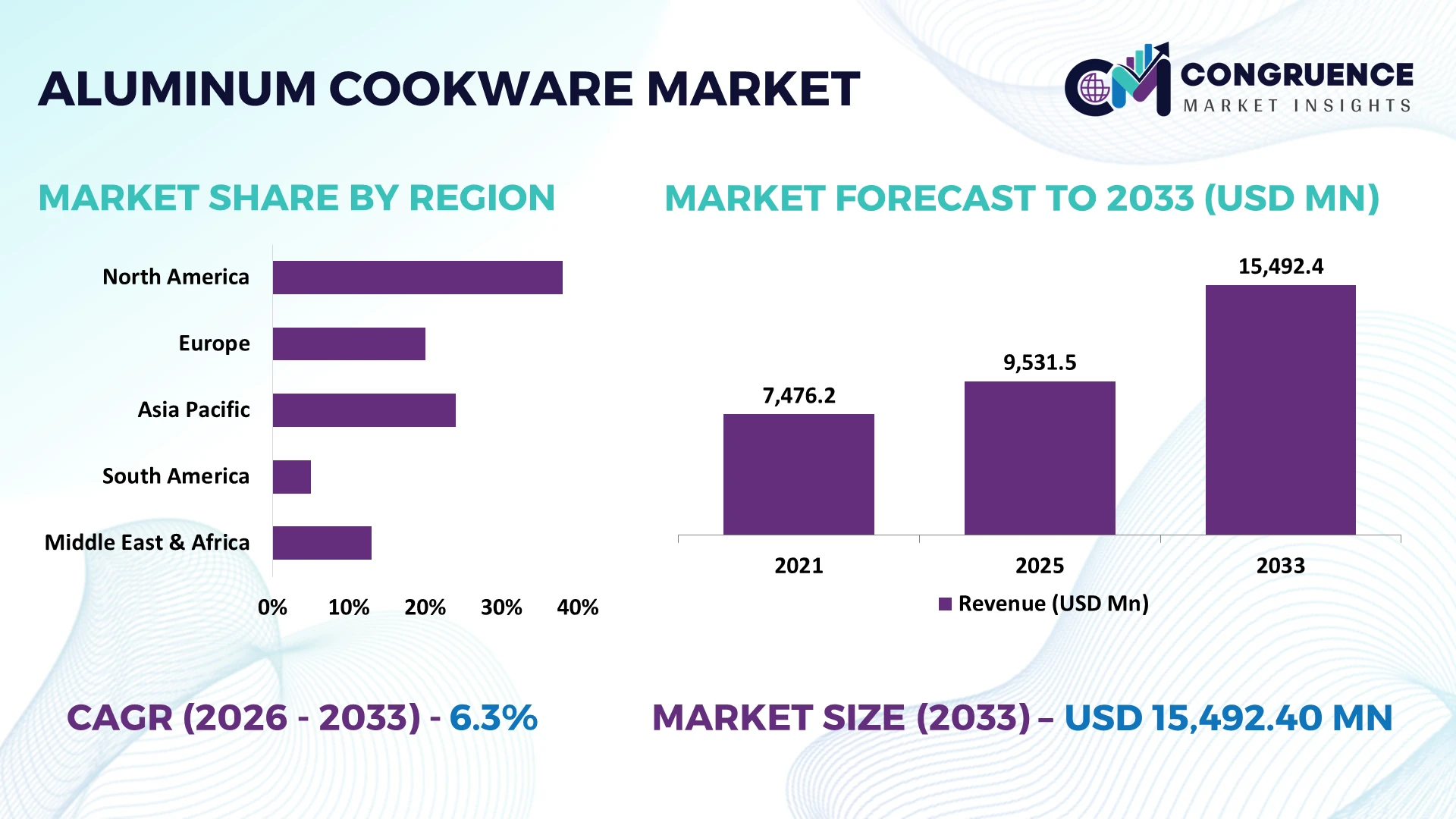
The Global Aluminum Cookware Market was valued at USD 9531.52 Million in 2025 and is anticipated to reach a value of USD 15492.4 Million by 2033 expanding at a CAGR of 6.26% between 2026 and 2033. Growth is driven by induction-compatible aluminum construction, hard-anodized surfaces, PFAS-free coatings, automated forming, and rising replacement of heavier cookware with lightweight multi-layer products.
China anchors global aluminum cookware manufacturing with an estimated 35–40% production share, supported by large aluminum-processing clusters and export-oriented cookware factories. India combines more than 1.4 billion consumers with expanding organized kitchenware manufacturing, while the United States leads premium hard-anodized and induction-ready adoption. U.S.–China tariff and supply-chain tensions are accelerating sourcing diversification toward India, Vietnam, and Southeast Asian production hubs.
Strategically, manufacturers should secure diversified aluminum supply, expand induction-compatible and PFAS-free ranges, and automate forming and coating operations to defend costs while capturing premium replacement demand.
Market Size & Growth: USD 9,531.52 million in 2025 reaches USD 15,492.4 million by 2033 at 6.26%, supported by induction-ready construction and coating upgrades.
Top Growth Drivers: Induction-compatible products contribute approximately 35%, premium non-stick upgrades 30%, and replacement-led household purchases 25% to demand momentum.
Short-Term Forecast: By 2027, automated forming, polishing, and coating lines can improve production efficiency by approximately 10–15%.
Emerging Technologies: Hard anodizing, PFAS-free ceramic coatings, robotic polishing, and induction-bonded stainless bases are reshaping aluminum cookware performance and manufacturing.
Regional Leaders: By 2033, Asia-Pacific approaches USD 7.0 billion, North America USD 3.7 billion, and Europe USD 3.3 billion, with automation, premiumization, and induction adoption respectively.
Consumer/End-User Trends: Induction-compatible cookware exceeds 30% of premium assortment availability across several developed retail channels, strengthening demand for bonded-base aluminum products.
Pilot/Case Example: In 2025, automated cookware finishing lines demonstrated approximately 15–20% productivity improvement through robotic polishing and controlled coating application.
Competitive Landscape: Groupe SEB holds an estimated 12–15% share, competing with Meyer, Newell Brands, Hawkins Cookers, and Tramontina across branded cookware channels.
Regulatory & ESG Impact: Recycled aluminum requires approximately 95% less energy than primary production, strengthening recycled-content procurement and lower-carbon manufacturing strategies.
Investment & Funding: More than USD 500 million in aluminum processing, cookware manufacturing, automation, and capacity initiatives supports regionalized production and supply-chain resilience.
Innovation & Future Outlook: Multi-layer bases, sensor-enabled cookware, recycled aluminum, and advanced coatings target 10–20% performance or manufacturing gains while shifting competition toward durable premium products.
The Aluminum Cookware Market is concentrating demand around non-stick frying pans, pressure cookers, saucepans, induction-ready cookware, and hard-anodized sets. Automated forming, robotic finishing, multi-layer induction bases, and PFAS-free coatings are accelerating product upgrades, while recycled aluminum can reduce production energy requirements by approximately 95%. Trade-policy pressure is simultaneously encouraging diversified Asian sourcing, setting up a more technology- and supply-chain-focused strategic landscape.
Aluminum cookware is becoming strategically important as manufacturers compete on induction compatibility, coating durability, recycled-metal content, and supply-chain resilience rather than basic pan capacity. Production is shifting toward automated forming, robotic polishing, and bonded-base assembly, while U.S.–China trade friction continues encouraging sourcing diversification toward India and Southeast Asia. This restructuring reduces concentration risk and supports faster regional replenishment for branded cookware suppliers.
Automated forming and finishing lines can improve throughput by roughly 10–15% versus labor-intensive legacy processes, while precision coating systems reduce coating waste by approximately 8–12%. China retains scale advantages in aluminum conversion and cookware manufacturing, whereas India is gaining investment through lower labor costs and expanding metal-processing capacity. Europe places greater emphasis on induction-ready products, recycled aluminum, and coating compliance. A practical deployment involves robotic polishing combined with automated spray coating, reducing manual handling and improving finish consistency across high-volume cookware lines.
Through 2026–2028, investment will concentrate on recycled aluminum inputs, PFAS-free coatings, induction-bonded bases, and digitally controlled production. Companies are expanding regional supplier networks and automation partnerships. Competitive advantage will depend on combining material efficiency, compliant coatings, flexible sourcing, and premium product engineering at scalable cost.
Induction-ready construction is reshaping aluminum cookware portfolios because conventional aluminum is not naturally magnetic and requires bonded ferrous bases. In premium retail assortments, induction-compatible cookware now represents more than 30% of available higher-value offerings, while bonded-base designs can improve heating responsiveness by approximately 10–15% versus thicker legacy constructions. Europe and urban India are accelerating adoption as induction cooktops expand in apartments and energy-conscious households. Manufacturers are responding with multi-layer bases, hard-anodized bodies, and optimized heat-spreading geometries. The operational implication is significant: producers that integrate induction bonding into core lines avoid maintaining separate gas-only and electric-only ranges, simplifying SKU architecture while raising average product value and improving compatibility across appliance types.
Aluminum price volatility and dependence on specialty coatings remain structural constraints for cookware manufacturers. Raw aluminum costs can move by more than 15% across commodity cycles, while coating, handle, and bonded-base components together can represent 20–30% of finished-product manufacturing cost. Producers dependent on imported aluminum sheet or non-stick chemicals face added freight and currency exposure, particularly in India, Brazil, and parts of Southeast Asia. Regulatory scrutiny of fluorinated coatings is also increasing reformulation requirements. Companies are reducing risk through recycled-aluminum sourcing, long-term metal contracts, regional component suppliers, and ceramic or alternative non-stick systems. A key operational insight is that coating redesign can affect curing temperature, line speed, and warranty performance simultaneously, making supplier qualification more important than headline raw-material savings.
Recycled aluminum creates a strategic opportunity because producing secondary aluminum requires roughly 95% less energy than primary metal production and can materially reduce embedded manufacturing emissions. Cookware producers using higher recycled content can also lower exposure to primary smelter energy costs and strengthen positioning with retailers seeking lower-carbon household products. Automated scrap recovery and closed-loop remelting can improve internal material utilization by approximately 5–10%, while precision blanking reduces offcut generation further. Manufacturers in India, China, and Europe are investing in recycled alloy procurement, scrap segregation, and traceable metal inputs. The non-obvious opportunity lies in combining recycled aluminum with premium hard-anodized or induction-ready construction, allowing companies to capture both cost efficiency and higher-value positioning instead of treating sustainability solely as a compliance expense.
Scaling premium aluminum cookware requires tighter control across forming, induction-disc bonding, coating, curing, polishing, and quality inspection. Multi-layer cookware can involve 3–5 material interfaces, increasing the risk of warping, delamination, uneven heating, or coating failure when process tolerances drift. Automated lines can improve consistency by 10–15%, but they require skilled maintenance, tooling precision, and reliable thermal-control systems. Smaller manufacturers in India and Southeast Asia often face gaps in advanced bonding equipment and automated finishing capacity, limiting premium-segment scalability. Companies must invest in process monitoring, operator training, inline inspection, and supplier integration. The strategic challenge is not simply adding automation; it is synchronizing metallurgy, coating chemistry, and thermal processing so higher production speed does not increase reject rates or compromise long-term cookware durability.
Induction Bases Become Standardized: Manufacturers are redesigning aluminum pans and pots with bonded magnetic bases as induction penetration rises in urban kitchens. Induction-ready assortments now exceed 30% of premium cookware offerings in several developed channels, while optimized multi-layer bases improve heat distribution by roughly 10–15%. Producers are standardizing base diameters, automating impact bonding, and consolidating gas-and-induction product lines, reducing SKU duplication and improving manufacturing flexibility.
PFAS-Free Coatings Gain Priority: Regulatory scrutiny of fluorinated substances is accelerating ceramic and alternative non-stick coating development. New-generation coating systems can reduce dependence on conventional fluoropolymers while automated spraying lowers coating consumption by approximately 8–12% and improves thickness consistency by 10–15%. Cookware brands are reformulating flagship ranges, qualifying new coating suppliers, and upgrading curing controls to protect durability during the transition.
Robotic Finishing Reduces Labor Exposure: Automated polishing, edge finishing, and visual inspection are moving into higher-volume cookware plants as labor costs and consistency requirements increase. Robotic finishing can raise throughput by approximately 15–20% and reduce manual handling by 20–30%. Chinese and Indian manufacturers are adding programmable finishing cells, allowing faster changeovers between pan sizes while reducing dependence on skilled polishing labor.
Premium Lightweight Designs Expand: Manufacturers are using optimized wall profiles, forged construction, and precision forming to reduce cookware weight without sacrificing rigidity. Material reductions of 8–15% are achievable in selected designs, improving shipping efficiency and consumer handling. Companies are pairing lightweight aluminum bodies with reinforced rims and induction discs, shifting engineering investment toward structural efficiency rather than simply increasing metal thickness.
Aluminum Pans account for approximately 34–37% of type-level demand because frying pans and sauté formats combine high replacement frequency, rapid heat response, scalable manufacturing, and compatibility with non-stick coatings. Their broad household and foodservice applicability supports larger production runs than Aluminum Dutch Ovens or Aluminum Bakeware. Aluminum Pots represent roughly 25–28%, anchored by boiling and simmering applications, while Aluminum Pressure Cookers remain especially important in India and other markets where fuel efficiency and fast meal preparation influence purchasing.
Aluminum Bakeware is the fastest-growing type as home baking, countertop ovens, and commercial bakery activity expand demand for lightweight, thermally conductive trays and molds. Hard-anodized surfaces and reinforced structures improve durability, while induction-bonded bases are increasing the value proposition of Aluminum Pans and Pots. Manufacturers are prioritizing modular cookware sets, automated forming, coating innovation, and pressure-cooker safety systems. Investment is shifting toward categories supporting both premium household use and higher-frequency replacement cycles.
Frying & Sautéing represents an estimated 35–38% of application demand because frying pans are used across household, restaurant, hotel, and catering kitchens with relatively short replacement cycles. Non-stick coatings, lighter pan bodies, and improved induction bases reinforce this position. Boiling & Simmering contributes approximately 27–30%, supported by aluminum pots and Dutch ovens used for soups, sauces, grains, and bulk food preparation. Pressure Cooking remains particularly significant in India, where time-efficient meal preparation supports persistent pressure-cooker ownership.
Baking is the fastest-growing application as home baking and commercial bakery production increase demand for aluminum trays, molds, and sheets with efficient heat transfer. Grilling remains smaller but is gaining relevance through grill pans and stovetop formats. Manufacturers are expanding coating durability, reinforced handles, impact-bonded bases, and oven-compatible designs. Operationally, suppliers increasingly engineer cookware by cooking method rather than material alone, improving product differentiation and allowing higher-margin multifunctional ranges.
Households account for approximately 68–72% of aluminum cookware demand because pots, pans, pressure cookers, bakeware, and Dutch ovens form basic kitchen equipment with recurring replacement cycles. Restaurants represent approximately 14–17%, emphasizing durable pans and pots capable of repeated high-temperature use. Hotels purchase broader cookware assortments but prioritize standardized specifications and supplier reliability, while Institutional Kitchens require high-capacity formats designed for consistent output and intensive cleaning cycles.
Catering Services are the fastest-growing end-user segment as event catering, corporate foodservice, and off-premises meal preparation increase demand for lightweight, transportable cookware. Commercial buyers increasingly favor reinforced handles, thicker-gauge aluminum, stackable designs, and simplified maintenance. Manufacturers are separating household and professional product architectures, offering heavier-duty specifications, bulk procurement terms, and distributor partnerships for commercial kitchens. Future competitive positioning depends on matching material thickness, coating life, and cookware geometry to actual operating intensity rather than extending consumer products into professional environments unchanged.
Asia-Pacific accounted for the largest market share at approximately 44% in 2025 however, Asia-Pacific is expected to register the fastest growth, expanding at a CAGR of approximately 7.4% between 2026 and 2033.
Premium Coatings Reshape Replacement Demand
North America represents approximately 24% of global aluminum cookware demand, led by replacement purchases, premium non-stick products, hard-anodized construction, and growing induction compatibility. The United States dominates regional consumption as households increasingly favor lighter cookware with reinforced bases and durable coatings. Commercial kitchens provide additional demand for thicker-gauge aluminum pans, pots, and bakeware because thermal conductivity supports rapid temperature response. Induction-ready products represent more than 30% of premium cookware assortments across developed retail channels, encouraging manufacturers to expand bonded magnetic-base designs. PFAS scrutiny is simultaneously accelerating ceramic and alternative coating development. Brands are strengthening direct-to-consumer distribution, automated fulfillment, and product differentiation around durability, lighter construction, and multi-cooktop compatibility rather than competing primarily through conventional non-stick positioning.
United States Market Outlook: The United States accounts for approximately 85–90% of North American aluminum cookware demand, supported by extensive mass retail, e-commerce, restaurant, and specialty kitchenware infrastructure. High replacement frequency favors frying pans and cookware sets, while expanding induction installations strengthen demand for magnetic-base aluminum. Suppliers are prioritizing PFAS-free alternatives, premium hard-anodized ranges, and professional-grade products to capture higher-value household and foodservice purchasing.
Induction Adoption Redesigns Product Architecture
Europe contributes approximately 20% of global aluminum cookware demand, with Germany, France, Italy, and the United Kingdom providing the largest consumption and branded manufacturing bases. Induction cooking is structurally important because electrification and energy-efficiency priorities are shifting cookware specifications toward flat, magnetically bonded bases. In mature appliance markets, induction already represents a substantial portion of new electric-hob installations, pushing cookware manufacturers to standardize multi-cooktop compatibility. European producers also face tighter scrutiny of fluorinated substances, packaging, and product durability, accelerating investment in ceramic coatings, recycled aluminum, and replaceable components. Recycled aluminum requires roughly 95% less production energy than primary metal, giving manufacturers a material-efficiency lever alongside environmental benefits. Competitive differentiation increasingly depends on engineering lighter cookware without sacrificing base stability, coating life, or induction performance.
Germany Market Outlook: Germany combines strong induction-cooking adoption, premium household-goods consumption, engineering expertise, and organized retail distribution. Manufacturers compete through precision bases, durable handles, hard-anodized surfaces, and coating performance rather than low-cost aluminum construction. High electricity prices reinforce interest in efficient cooking systems, making rapid heat transfer and induction compatibility important product-development criteria for branded cookware suppliers.
Manufacturing Scale Supports Product Upgrading
Asia-Pacific holds approximately 44% of global aluminum cookware demand and the strongest manufacturing concentration, supported by China's aluminum-processing ecosystem and India's large pressure-cooker and household cookware industry. China produces roughly 60% of global primary aluminum, creating deep upstream capabilities for sheet, disc, casting, forming, and finishing operations. India provides substantial domestic demand alongside export-oriented cookware manufacturing, particularly in pressure cookers, kadais, pots, and hard-anodized products. U.S.–China trade tensions are encouraging international buyers to diversify sourcing toward India and Vietnam, reducing single-country procurement exposure. Manufacturers are adding automated pressing, robotic polishing, induction-base bonding, and controlled coating lines, improving throughput by approximately 10–20%. Scale increasingly benefits suppliers capable of combining competitive conversion costs with international coating, safety, and quality requirements.
China Market Outlook: China remains the region's strongest integrated production hub because cookware factories operate close to major aluminum smelting, rolling, component, coating, and export infrastructure. Its roughly 60% share of global primary aluminum output supports material availability and manufacturing depth. Producers are moving beyond commodity cookware toward forged bodies, induction-compatible bases, automated finishing, and private-label production for international retailers.
Local Manufacturing Defends Accessible Pricing
South America represents approximately 7% of global aluminum cookware demand, with Brazil accounting for around 55–60% of regional consumption. Brazil combines a sizeable household market with domestic aluminum production, cookware manufacturing, restaurant activity, and established kitchenware distribution. Local manufacturing provides an important buffer against exchange-rate volatility affecting imported finished cookware, although specialty coatings, machinery, and selected components remain exposed to external supply chains. Aluminum's lightweight construction and thermal responsiveness support widespread use across household and commercial kitchens. Producers are increasing automated forming and finishing while expanding non-stick, pressure-cooking, and induction-compatible ranges. Regional suppliers also compete through accessible replacement pricing, making material optimization critical. Reducing cookware body weight by approximately 8–15% through engineered profiles can lower material consumption while maintaining structural performance.
Brazil Market Outlook: Brazil anchors South American production through established aluminum conversion, cookware manufacturing, supermarket distribution, and foodservice networks. Domestic access to aluminum supports localized supply, while a population exceeding 200 million provides substantial household replacement demand. Manufacturers emphasize affordable non-stick pans, pressure cookers, cookware sets, and increasingly induction-compatible products, balancing material costs against price-sensitive consumer purchasing.
Hospitality Investment Expands Commercial Demand
Middle East & Africa accounts for approximately 5% of global aluminum cookware demand, with Saudi Arabia, the UAE, South Africa, and Egypt providing key consumption and distribution centers. Gulf hospitality expansion is increasing procurement of durable cookware for hotels, restaurants, institutional kitchens, and catering operations, while population growth supports household replacement demand across African markets. Saudi Arabia's tourism strategy targets 150 million annual visits by 2030, reinforcing kitchen-equipment requirements across expanding hospitality infrastructure. Aluminum cookware benefits from low weight and rapid heat transfer in high-throughput kitchens, although imported branded products face freight and currency exposure. Distributors are expanding private-label sourcing and commercial cookware portfolios, while suppliers increasingly offer thicker-gauge products and reinforced handles. Localized distribution and inventory availability remain stronger competitive advantages than broad assortment depth in fragmented African markets.
Saudi Arabia Market Outlook: Saudi Arabia provides the strongest hospitality-linked opportunity as hotel, restaurant, catering, and institutional foodservice infrastructure expands under tourism and entertainment investment. Large commercial kitchens favor durable pots, pans, and high-capacity cookware designed for repeated use. Suppliers are strengthening distributor partnerships and professional product ranges to serve expanding hotels, restaurants, entertainment venues, and centralized food-production facilities.
Groupe SEB, Meyer Corporation, Newell Brands, Hawkins Cookers and Tramontina compete across branded household cookware, while Asian contract manufacturers pressure established players through lower conversion costs and private-label capacity. The top five groups collectively hold approximately 25–30% of organized aluminum cookware sales, leaving substantial regional fragmentation. Competition centers on coating durability, induction compatibility, price, distribution and manufacturing efficiency. Automated forming and finishing can improve throughput by 10–20%, precision coating reduces material waste by 8–12%, and lightweight engineering can lower aluminum usage by 8–15%. Global brands expand through omnichannel distribution, coating innovation and premium ranges; Indian and Chinese producers emphasize vertical integration, export manufacturing and cost control. Competition is shifting toward PFAS-free surfaces, recycled aluminum and multi-cooktop designs. Tooling investment, coating expertise, quality certification and retailer access create entry pressure. Winning requires scalable manufacturing, dependable coatings, flexible sourcing, recognizable brands and rapid product adaptation across price tiers, cooking technologies and distribution channels worldwide.
Groupe SEB
Meyer Corporation
Newell Brands
Tramontina
Hawkins Cookers Limited
TTK Prestige Limited
The Cookware Company
BergHOFF Worldwide
Fissler GmbH
Ballarini
All-Clad Metalcrafters
Nordic Ware
Neoflam
Zhejiang Supor Co., Ltd.
Current aluminum cookware technology centers on hard anodizing, impact-bonded induction bases, automated deep drawing, robotic polishing, and precision non-stick coating. Automated forming can improve throughput by 10–15%, while controlled spray systems reduce coating consumption by roughly 8–12%. Deployment is strongest among high-volume Chinese, Indian, and European plants, improving dimensional consistency, finish quality, labor productivity, and compatibility across gas, electric, ceramic, and induction cooking platforms.
Emerging systems combine recycled aluminum alloys, ceramic coatings, laser-textured surfaces, and inline machine-vision inspection. Compared with conventional manually finished cookware, robotic polishing and inspection can raise line efficiency by approximately 15–20% while lowering rework. Induction-compatible construction is expanding across premium assortments, and manufacturers integrating alloy control with automated bonding gain faster changeovers, tighter tolerances, and stronger retailer acceptance for multi-cooktop product ranges.
Disruptive pathways include AI-assisted process control, digital twins for forming and coating lines, sensor-based quality monitoring, and closed-loop scrap recovery. Between 2026 and 2028, integrated automation should reduce scrap or rework by 10–15% and shorten changeovers by 15–20%. Vertically integrated producers benefit most because they can coordinate alloy sourcing, forming, coating, and finishing. Investment matters now as coating regulation, labor pressure, and diversified sourcing reward flexible, data-controlled manufacturing systems across increasingly demanding global channels.
July 2024 Meyer Corporation relaunched Rachael Ray Cook + Create enameled aluminum cookware in Orange, including an 11-piece set with triple-layer nonstick construction. The portfolio refresh strengthened color-led differentiation while preserving aluminum’s lightweight thermal performance across retail channels.
February 2025 Tramontina formed a joint venture with Aequs to establish its first manufacturing facility outside the Americas, investing INR800 million within India’s 400-acre Hubballi Durable Goods Cluster, strengthening localized cookware production and global distribution capacity significantly worldwide. Source: rediff.com
July 2025 Groupe SEB’s Tefal partnered with La Poste to expand France’s used-pan collection network to 1,700 points, targeting 20 million pans by 2027. The aluminum loop cuts recycling-related CO2 emissions by over 90% versus virgin production levels. Source: groupeseb.com
February 2025 TTK Prestige launched its complete Triply cookware and cooker range at HT City Unwind Delhi, an event drawing 15,000-plus visitors. The activation combined product rollout with chef-led demonstrations, strengthening premium cookware visibility among urban consumers nationwide.
The Aluminum Cookware Market report covers Aluminum Pots, Aluminum Pans, Aluminum Pressure Cookers, Aluminum Dutch Ovens, and Aluminum Bakeware across Boiling & Simmering, Frying & Sautéing, Pressure Cooking, Baking, and Grilling applications. End-user analysis spans Households, Restaurants, Hotels, Catering Services, and Institutional Kitchens, with households accounting for approximately 68–72% of demand and aluminum pans representing about 34–37% of type-level consumption.
Regional coverage includes North America, Europe, Asia-Pacific, South America, and Middle East & Africa, assessing manufacturing concentration, sourcing shifts, retail adoption, commercial-kitchen demand, and regulatory pressure. Technology coverage includes hard anodizing, induction-base bonding, ceramic coatings, robotic polishing, machine vision, recycled aluminum, and closed-loop scrap recovery. The report supports 2026–2033 investment planning through production benchmarking, supplier diversification, automation prioritization, portfolio optimization, geographic expansion, competitive positioning, and evaluation of emerging PFAS-free and circular-material opportunities.
| Report Attribute/Metric | Report Details |
|---|---|
Market Revenue in 2025 | USD 9531.52 Million |
Market Revenue in 2033 | USD 15492.4 Million |
CAGR (2026 - 2033) | 6.26% |
Base Year | 2025 |
Forecast Period | 2026 - 2033 |
Historic Period | 2021 - 2025 |
Segments Covered | By Type
By Application
By End-User
|
Key Report Deliverable | Revenue Forecast, Growth Trends, Market Dynamics, Segmental Overview, Regional and Country-wise Analysis, Competition Landscape |
Region Covered | North America, Europe, Asia-Pacific, South America, Middle East, Africa |
Key Players Analyzed | Groupe SEB, Meyer Corporation, Newell Brands, Tramontina, Hawkins Cookers Limited, TTK Prestige Limited, The Cookware Company, BergHOFF Worldwide, Fissler GmbH, Ballarini, All-Clad Metalcrafters, Nordic Ware, Neoflam, Zhejiang Supor Co., Ltd. |
Customization & Pricing | Available on Request (10% Customization is Free) |




