
Reports
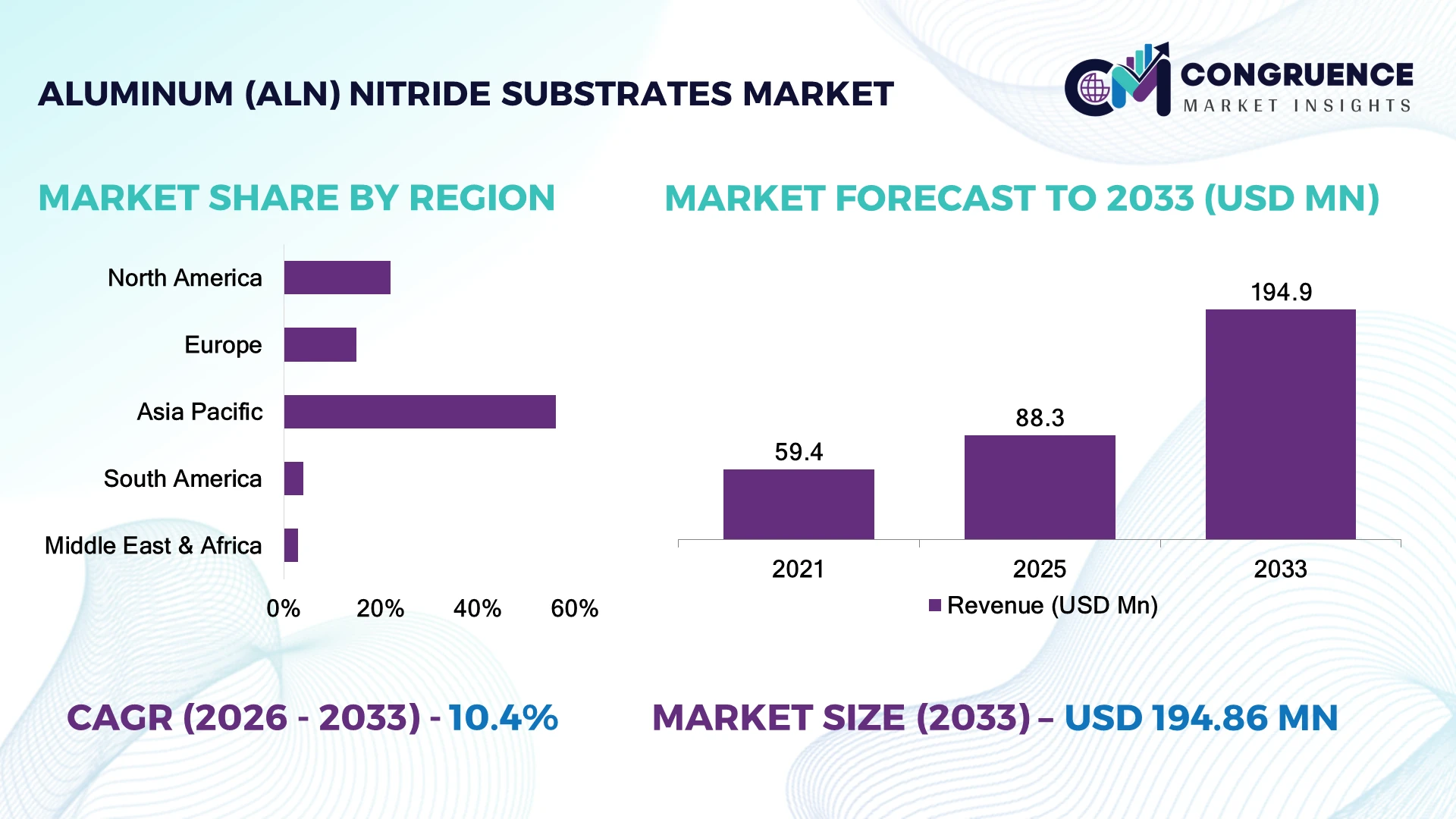
The Global Aluminum (AIN) Nitride Substrates Market was valued at USD 88.3 Million in 2025 and is anticipated to reach a value of USD 194.9 Million by 2033 expanding at a CAGR of 10.4% between 2026 and 2033. Rapid electrification of EV power modules, AI data-center infrastructure, and high-power semiconductor packaging is accelerating demand for high thermal conductivity aluminum nitride substrates.
China dominates the global Aluminum (AIN) Nitride Substrates Market with approximately 46% production capacity, supported by strong investments in semiconductor materials, EV manufacturing, and industrial electronics. Japan follows with nearly 24% capacity, leading in premium ceramic substrate technologies and precision manufacturing. Export diversification after global semiconductor supply-chain realignment has accelerated localization efforts, while AI server deployment and SiC power electronics adoption continue expanding advanced substrate utilization.
The concentration of manufacturing capacity in Asia makes strategic supplier diversification and regional production partnerships essential for long-term competitiveness.
Market Size & Growth: USD 88.3 Million in 2025, reaching USD 194.9 Million by 2033 at 10.4%, supported by expanding SiC and GaN power semiconductor adoption.
Top Growth Drivers: EV power electronics (+35%), AI server deployment (+28%), industrial automation (+22%) are driving substrate demand.
Short-Term Forecast: By 2028, thermal management efficiency is expected to improve by nearly 18% through advanced ceramic processing.
Emerging Technologies: AI-assisted manufacturing, laser ceramic processing, and ultra-high thermal conductivity substrate engineering are strengthening product performance.
Regional Leaders: Asia Pacific (~USD 118 Million), North America (~USD 39 Million), Europe (~USD 28 Million), supported by semiconductor localization and advanced packaging investments.
Consumer/End-User Trends: More than 55% of demand originates from power electronics, EV modules, and telecommunications equipment.
Pilot/Case Example: In 2024, advanced ceramic manufacturing optimization reduced production defects by approximately 15% in high-performance substrate fabrication.
Competitive Landscape: Maruwa holds an estimated 18% market share alongside Rogers Corporation, Toshiba Materials, CeramTec, and Kyocera.
Regulatory & ESG Impact: Energy-efficient ceramic processing has lowered manufacturing energy consumption by nearly 12% while supporting cleaner semiconductor production.
Investment & Funding: More than USD 900 Million has been committed globally toward semiconductor materials expansion and advanced ceramic manufacturing.
Innovation & Future Outlook: Next-generation substrates for AI accelerators, SiC modules, and high-frequency communication systems are reshaping long-term industry strategies.
Aluminum (AIN) Nitride Substrates are becoming increasingly important across electric vehicles, renewable energy inverters, aerospace electronics, and AI computing hardware because of their superior thermal conductivity and electrical insulation. Advanced thin-substrate processing and high-purity ceramic manufacturing continue improving device reliability, while over 40% of new power module designs now incorporate advanced ceramic substrates. Ongoing semiconductor supply-chain localization is further strengthening manufacturing resilience and technology partnerships, setting the stage for broader strategic market developments.
Aluminum (AIN) Nitride Substrates have become strategically important as power electronics continue shifting toward higher operating temperatures and greater power density. Semiconductor supply-chain restructuring and national investments in advanced chip manufacturing are encouraging manufacturers to secure reliable ceramic substrate production. Growing deployment of AI infrastructure, electric mobility, and renewable energy systems continues to elevate the importance of high-performance thermal management materials.
Compared with conventional alumina substrates, aluminum nitride substrates deliver nearly five times higher thermal conductivity, enabling lower operating temperatures and improved device reliability in demanding applications. Japan continues to lead premium substrate innovation, while China maintains larger manufacturing capacity through vertically integrated ceramic production. During the next two to three years, adoption of silicon carbide power modules is expected to expand by more than 30%, strengthening demand for advanced packaging materials.
Manufacturers are expanding production facilities, forming technology partnerships, and investing in automated ceramic processing to improve product consistency and reduce production lead times. Increasing emphasis on localized semiconductor ecosystems and advanced electronics manufacturing is reinforcing long-term competitive positioning, enabling companies with scalable production, material innovation, and resilient supply networks to secure stronger positions across high-value industrial markets.
The transition toward silicon carbide and gallium nitride power devices is substantially increasing demand for aluminum nitride substrates capable of dissipating high thermal loads. More than 60% of next-generation EV inverter platforms now incorporate advanced ceramic substrate technologies, while AI computing infrastructure has increased demand for high-performance thermal management by over 25%. Japan and China continue expanding ceramic manufacturing capacity to support semiconductor localization initiatives. Leading companies are investing in automated sintering technologies, expanding production facilities, and strengthening partnerships with power semiconductor manufacturers to improve product quality, shorten lead times, and secure long-term supply agreements. This integration of materials innovation with semiconductor manufacturing is strengthening competitive differentiation across industrial electronics.
Manufacturing aluminum nitride substrates requires ultra-high-purity powders and precision ceramic processing, increasing production costs and limiting supplier diversity. More than 70% of global high-purity ceramic material processing remains concentrated within a limited number of Asian manufacturing hubs, while energy-intensive sintering contributes nearly 20% of production expenses. Export controls and semiconductor material supply disruptions continue affecting procurement planning for global manufacturers. Companies are responding by diversifying sourcing strategies, establishing localized production facilities, and negotiating long-term raw material contracts to stabilize manufacturing costs and improve operational resilience across strategic supply networks.
Rapid commercialization of AI accelerators, renewable energy converters, and high-frequency communication equipment is creating significant opportunities for advanced aluminum nitride substrate suppliers. More than 45% of new silicon carbide module designs prioritize high thermal conductivity ceramic materials, while automated ceramic manufacturing has improved production efficiency by approximately 16%. Government-backed semiconductor investment programs in India and the United States are encouraging localized materials ecosystems and technology collaboration. Companies are accelerating research into thinner substrates, enhanced surface finishing, and next-generation packaging solutions while expanding partnerships with chip manufacturers to strengthen their presence in high-value application segments.
Maintaining consistent thermal conductivity, dimensional accuracy, and defect-free production remains a significant operational challenge as manufacturers expand output. Premium-grade ceramic substrate production typically requires process yields exceeding 95%, while micron-level dimensional tolerances increase manufacturing complexity. Workforce shortages in advanced ceramic engineering and precision process control continue affecting production scalability in several industrial markets. Companies are investing in AI-driven inspection systems, digital process monitoring, and automated quality control platforms while strengthening technical partnerships with semiconductor equipment suppliers to achieve consistent manufacturing performance and sustain competitiveness in increasingly demanding electronics applications.
Advanced Packaging Standardization Advanced semiconductor packaging is accelerating aluminum nitride substrate deployment as more than 58% of new silicon carbide power modules now require high-thermal-conductivity ceramics. Automated laser machining has reduced processing variation by nearly 18%, while multilayer substrate integration has increased by approximately 24%. Ongoing AI server expansion and advanced chip packaging requirements are encouraging manufacturers in Japan and China to standardize production workflows, expand precision machining capacity, and strengthen long-term material partnerships to improve manufacturing consistency and delivery performance.
Localized Manufacturing Expansion Semiconductor supply-chain restructuring is driving localized ceramic substrate production across strategic manufacturing hubs. More than 32% of new production investments are targeting domestic material capability, while average procurement lead times have declined by around 15% through regional sourcing initiatives. Export-control policies and resilient sourcing strategies are encouraging companies to establish local processing facilities, diversify qualified suppliers, and expand enterprise collaborations, reducing operational risk while improving inventory responsiveness for critical electronic component manufacturers.
Automation Improves Production Quality Smart manufacturing platforms are transforming ceramic substrate fabrication through AI-assisted inspection and digital process monitoring. Automated optical inspection has improved defect detection by nearly 28%, while predictive process controls have reduced production scrap by approximately 14%. Skilled labor shortages in precision ceramics are accelerating factory automation, prompting manufacturers to deploy intelligent quality systems, robotics, and digital production analytics that improve throughput, strengthen process repeatability, and support consistent high-performance substrate manufacturing.
Higher Thermal Performance Focus Product development is increasingly centered on superior thermal conductivity and thinner substrate architectures for compact electronic systems. Nearly 40% of enterprise R&D programs now prioritize advanced heat-dissipation materials, while substrate thickness optimization has improved package efficiency by approximately 17%. Growing adoption of high-density AI processors and electric mobility platforms is encouraging companies to accelerate material innovation, expand collaborative research with semiconductor manufacturers, and commercialize next-generation ceramic solutions optimized for demanding thermal environments.
Based on industry classification, the Aluminum (AIN) Nitride Substrates Market is segmented into Standard Grade Aluminum Nitride Substrates, High-Purity Aluminum Nitride Substrates, Thin-Film Aluminum Nitride Substrates, and Others. High-Purity Aluminum Nitride Substrates account for approximately 47% of market demand due to superior thermal conductivity, excellent electrical insulation, and compatibility with silicon carbide and gallium nitride devices. Their widespread integration into power electronics, automotive modules, and advanced semiconductor packaging supports continued leadership. Standard Grade substrates remain important for industrial electronics where balanced performance and manufacturing efficiency are prioritized. Thin-Film Aluminum Nitride Substrates represent the fastest-growing segment as miniaturized electronics and advanced chip packaging continue expanding. Adoption has increased by nearly 27% across high-frequency communication modules, while enterprise investment in precision ceramic processing has grown by approximately 22%. Manufacturers are expanding thin-substrate production capabilities, improving surface finishing technologies, and strengthening partnerships with semiconductor packaging companies to address evolving thermal management requirements and strengthen competitive positioning.
Based on application, the Aluminum (AIN) Nitride Substrates Market is segmented into Power Electronics, Automotive Electronics, Telecommunications, Aerospace & Defense, Industrial Equipment, and Others. Power Electronics lead the market with an estimated 43% share because of widespread deployment in silicon carbide inverters, industrial drives, and renewable energy systems. High thermal conductivity and electrical insulation enable reliable operation under demanding conditions, making aluminum nitride substrates a preferred material. Automotive Electronics continues strengthening as electrified vehicle platforms increase semiconductor content across powertrain architectures. Automotive Electronics is the fastest-growing application segment, supported by expanding electric vehicle production and next-generation onboard power management. More than 35% of new EV inverter platforms now utilize advanced ceramic substrates, while demand for compact thermal management solutions has increased by nearly 24%. Companies are scaling manufacturing, integrating automated inspection technologies, and expanding collaboration with automotive semiconductor suppliers. Telecommunications, Aerospace & Defense, and Industrial Equipment continue adopting premium ceramic substrates for high-frequency reliability and mission-critical electronic systems.
Based on end-user, the Aluminum (AIN) Nitride Substrates Market is segmented into Semiconductor Manufacturers, Automotive Industry, Telecommunications Companies, Aerospace & Defense Organizations, Industrial Equipment Manufacturers, and Others. Semiconductor Manufacturers represent the dominant buyer group with approximately 48% market share due to extensive deployment in power modules, RF devices, and advanced chip packaging. Large-scale wafer fabrication and advanced packaging investments continue increasing procurement volumes. Automotive manufacturers remain major purchasers as electric mobility platforms require greater thermal management capability across power electronics. The Automotive Industry represents the fastest-growing end-user segment as electrification strategies and high-voltage architectures continue expanding globally. Procurement of advanced ceramic substrates has increased by nearly 29%, while demand for high-performance power modules has grown by approximately 25%. Companies are strengthening automotive partnerships, offering application-specific substrate solutions, and expanding localized manufacturing capabilities. Telecommunications Companies, Aerospace & Defense Organizations, and Industrial Equipment Manufacturers continue increasing adoption for high-reliability electronic systems requiring stable thermal performance and long operational life.
Asia-Pacific accounted for the largest market share at 56% in 2025 however, North America is expected to register the fastest growth, expanding at a CAGR of 11.2% between 2026 and 2033.
North America held approximately 22% of the global Aluminum (AIN) Nitride Substrates Market in 2025, driven by expanding semiconductor fabrication, electric vehicle power electronics, and AI computing infrastructure. The United States continues to strengthen domestic advanced packaging capabilities through semiconductor manufacturing initiatives, increasing demand for premium ceramic substrates. More than 35% of newly announced power semiconductor production lines in the region are designed for silicon carbide devices requiring high-performance thermal management materials. Enterprise investment in automated packaging facilities and strategic partnerships between semiconductor manufacturers and ceramic component suppliers is improving supply resilience while reducing procurement dependence on overseas production.
United States Market Outlook: The United States remains the region's largest market due to its strong semiconductor ecosystem, advanced defense electronics, and electric mobility investments. More than 70% of North American advanced semiconductor manufacturing capacity is concentrated in the country, supported by expanding wafer fabrication and packaging facilities. Companies continue investing in domestic ceramic material qualification, automated manufacturing technologies, and long-term supplier partnerships to strengthen production security and accelerate commercialization of next-generation power electronics.
Europe represented around 15% of the global Aluminum (AIN) Nitride Substrates Market in 2025, supported by industrial automation, automotive electrification, and sustainable semiconductor manufacturing initiatives. Strong regulatory emphasis on energy-efficient technologies is encouraging wider adoption of advanced ceramic substrates in industrial power modules and renewable energy systems. More than 30% of newly developed automotive power electronics programs incorporate wide-bandgap semiconductor technologies requiring enhanced thermal management. Manufacturers are strengthening regional production capabilities through collaborative research, process modernization, and advanced ceramic engineering investments.
Germany Market Outlook: Germany leads the European market through its automotive manufacturing strength, industrial electronics leadership, and precision engineering expertise. The country accounts for nearly 32% of Europe's power electronics manufacturing activity, supported by leading automotive OEMs and industrial automation companies. Continuous investment in silicon carbide module production, research collaborations, and advanced materials development strengthens demand for premium aluminum nitride substrates across mobility and industrial applications.
Asia-Pacific accounted for approximately 56% of the global Aluminum (AIN) Nitride Substrates Market in 2025, making it the largest regional market through extensive semiconductor manufacturing, ceramic processing expertise, and integrated electronics supply chains. China, Japan, South Korea, and Taiwan collectively dominate substrate production, supplying global automotive, industrial, and telecommunications manufacturers. More than 65% of global aluminum nitride ceramic processing capacity is concentrated within the region. Continuous factory expansion, export-oriented manufacturing strategies, and increasing investment in high-purity ceramic materials are strengthening operational efficiency and reinforcing the region's leadership in advanced electronic materials.
China Market Outlook: China represents the largest national market owing to its extensive semiconductor ecosystem, electric vehicle production, and ceramic manufacturing capacity. The country contributes nearly 46% of global aluminum nitride substrate production capacity and continues expanding localized semiconductor material supply chains. Investments in automated ceramic manufacturing, precision sintering technologies, and advanced packaging facilities are improving production efficiency while supporting both domestic electronics manufacturers and international export demand.
South America accounted for approximately 4% of the global Aluminum (AIN) Nitride Substrates Market in 2025, reflecting gradual adoption across industrial automation, renewable energy equipment, and automotive electronics manufacturing. Demand is increasing as manufacturers modernize production facilities and integrate higher-efficiency power electronics into industrial operations. More than 18% of newly commissioned industrial automation projects in major manufacturing hubs now utilize advanced power semiconductor technologies. Regional dependence on imported ceramic materials remains a limitation, encouraging companies to establish stronger distribution partnerships and improve localized technical support capabilities.
Brazil Market Outlook: Brazil leads the regional market through its diversified manufacturing sector, expanding automotive production, and renewable energy investments. The country accounts for approximately 45% of South America's industrial electronics output, supporting growing demand for advanced thermal management materials. Manufacturers are strengthening relationships with global semiconductor suppliers while investing in industrial modernization initiatives that improve deployment of high-performance electronic systems across automotive and energy applications.
Middle East & Africa represented approximately 3% of the global Aluminum (AIN) Nitride Substrates Market in 2025, supported by increasing investment in industrial infrastructure, telecommunications modernization, and smart manufacturing initiatives. Demand is strengthening across power infrastructure, aerospace electronics, and digital industrial projects requiring reliable thermal management solutions. More than 20% of newly developed industrial digitalization projects within key Gulf economies incorporate advanced power electronic systems. Companies are expanding regional distribution networks, establishing technical partnerships, and improving application engineering support to strengthen market accessibility and deployment efficiency.
Saudi Arabia Market Outlook: Saudi Arabia is the region's most strategically significant market due to large-scale industrial diversification, smart manufacturing programs, and advanced infrastructure investment. Industrial modernization initiatives continue expanding demand for high-performance power electronics across energy, manufacturing, and automation sectors. Ongoing localization programs and partnerships with international technology companies are accelerating deployment of advanced electronic systems while strengthening long-term opportunities for premium ceramic substrate suppliers.
The Aluminum (AIN) Nitride Substrates Market is led by Maruwa, Kyocera, Toshiba Materials, CeramTec, and Rogers Corporation, with global technology leaders competing against regional ceramic specialists and cost-focused Asian manufacturers. The top five players collectively control approximately 61% of the global market through proprietary ceramic processing, high-purity material expertise, and long-term semiconductor supply agreements. Competition centers on thermal conductivity, manufacturing precision, customization, and delivery reliability rather than price alone. Premium suppliers achieve nearly 20% higher production yields through automated ceramic processing, while vertically integrated manufacturers reduce procurement lead times by approximately 18%. Companies are expanding production capacity, forming partnerships with power semiconductor manufacturers, investing in precision sintering technologies, and integrating upstream ceramic powder processing to strengthen supply security. Competitive momentum is shifting toward advanced packaging compatibility and localized manufacturing as semiconductor supply chains diversify. High capital investment, stringent qualification standards, and material purity requirements create substantial entry barriers. Sustainable leadership depends on manufacturing scale, technology differentiation, quality consistency, and resilient customer partnerships.
Kyocera Corporation
Toshiba Materials Co., Ltd.
CeramTec GmbH
Rogers Corporation
Denka Company Limited
CoorsTek Inc.
Ferrotec Holdings Corporation
LEATEC Fine Ceramics Co., Ltd.
Niterra Co., Ltd.
Precision Ceramics USA
Chaozhou Three-Circle (Group) Co., Ltd.
High-purity aluminum nitride processing continues to redefine thermal management for power electronics and AI computing hardware. Advanced pressureless sintering, laser surface finishing, and ultra-fine ceramic powder engineering are improving thermal conductivity while reducing microscopic defects. Automated process control has improved manufacturing consistency by nearly 22%, while high-purity material adoption now exceeds 60% among premium semiconductor packaging applications. These technologies enable greater reliability for silicon carbide and gallium nitride power devices operating under elevated thermal loads.
Digital manufacturing is becoming a competitive differentiator as AI-assisted inspection, machine vision, and predictive process analytics replace conventional manual quality control. Compared with legacy inspection methods, intelligent inspection platforms improve defect detection by approximately 30% while reducing production waste by nearly 15%. Global technology leaders and vertically integrated ceramic manufacturers benefit most by shortening qualification cycles, improving yield stability, and accelerating delivery for advanced electronics customers requiring highly consistent substrate performance.
Between 2026 and 2028, thinner multilayer aluminum nitride substrates, additive ceramic processing, and hybrid packaging technologies are expected to reshape semiconductor packaging. Deployment across advanced power modules is projected to exceed 45%, enabling higher component density, lower thermal resistance, and improved system efficiency. Companies investing early in precision automation, advanced ceramic formulations, and collaborative semiconductor development programs will strengthen operational resilience, accelerate commercialization, and secure competitive advantages as advanced electronics architectures continue evolving.
September 2024 – Kyocera Corporation held the groundbreaking ceremony for a new manufacturing plant in Nagasaki, Japan, to expand production of fine ceramic packages for AI, 5G, and ADAS applications. The facility is designed to increase production capacity by approximately two times, strengthening Kyocera's advanced ceramic packaging supply capability. Source: www.global.kyocera.com
September 2025 – Kyocera Corporation entered a strategic collaboration with Kyoto Fusioneering to jointly develop advanced ceramic materials for fusion power plants, combining ceramic manufacturing expertise with fusion engineering capabilities to accelerate commercialization of next-generation energy materials. The partnership focuses on 100% joint technical development of critical ceramic components. Source: www.global.kyocera.com
September 2025 – CeramTec announced its participation at PCIM Asia 2025, showcasing advanced ceramic substrate solutions for power electronics and semiconductor manufacturing. The company highlighted high-performance substrate technologies supporting next-generation industrial and automotive applications, reinforcing its strategic focus on expanding customer engagement across the Asian semiconductor supply chain. Source: www.ceramtec-group.com
November 2024 – Kyocera Corporation announced its participation in the ASEAN Ceramics Exhibition 2024, presenting innovative fine ceramic solutions for advanced industrial and electronics applications. The initiative strengthened customer collaboration across Southeast Asia and expanded visibility for next-generation ceramic technologies supporting high-performance electronic components.
This report provides a comprehensive assessment of the Aluminum (AIN) Nitride Substrates Market, covering material technologies, competitive positioning, deployment trends, and strategic business developments across the value chain. The analysis evaluates major product types, key applications, end-user industries, and regional markets spanning North America, Europe, Asia-Pacific, South America, and the Middle East & Africa. More than 45% of the assessment focuses on advanced semiconductor packaging, power electronics, and high-performance thermal management applications where adoption continues accelerating.
The report examines evolving manufacturing technologies, supply-chain developments, enterprise strategies, and emerging niche opportunities supporting advanced ceramic materials. It delivers detailed segmentation analysis, regional market intelligence, competitive benchmarking, technology trends, and company profiling to support expansion planning and investment decisions. Business insights include adoption patterns, manufacturing localization, strategic partnerships, innovation priorities, and operational developments expected to influence competitive positioning and long-term market direction between 2026 and 2033.
| Report Attribute / Metric | Details |
|---|---|
| Market Revenue (2025) | USD 88.3 Million |
| Market Revenue (2033) | USD 194.9 Million |
| CAGR (2026–2033) | 10.4% |
| Base Year | 2025 |
| Forecast Period | 2026–2033 |
| Historic Period | 2021–2025 |
| Segments Covered |
By Type
By Application
By End-User
|
| Key Deliverables | Revenue Forecast; Market Trends; Growth Drivers & Restraints; Technology Insights; Segmentation Analysis; Regional Insights; Competitive Landscape; Regulatory & ESG Overview; Recent Developments |
| Regions Covered | North America; Europe; Asia-Pacific; South America; Middle East & Africa |
| Companies Profiled | Maruwa Co., Ltd.; Kyocera Corporation; Toshiba Materials Co., Ltd.; CeramTec GmbH; Rogers Corporation; Denka Company Limited; CoorsTek Inc.; Ferrotec Holdings Corporation; LEATEC Fine Ceramics Co., Ltd.; Niterra Co., Ltd.; Precision Ceramics USA; Chaozhou Three-Circle (Group) Co., Ltd. |
| Customization & Pricing | Available on Request (10% Customization Free) |




