
Reports
The Global Aluminium Scrap Market was valued at USD 55,036.4 Million in 2025 and is anticipated to reach a value of USD 78,267.3 Million by 2033 expanding at a CAGR of 4.5% between 2026 and 2033. Growth is driven by secondary aluminium demand from automotive, construction, packaging, and low-carbon manufacturing, where recycled metal reduces energy requirements substantially versus primary aluminium.
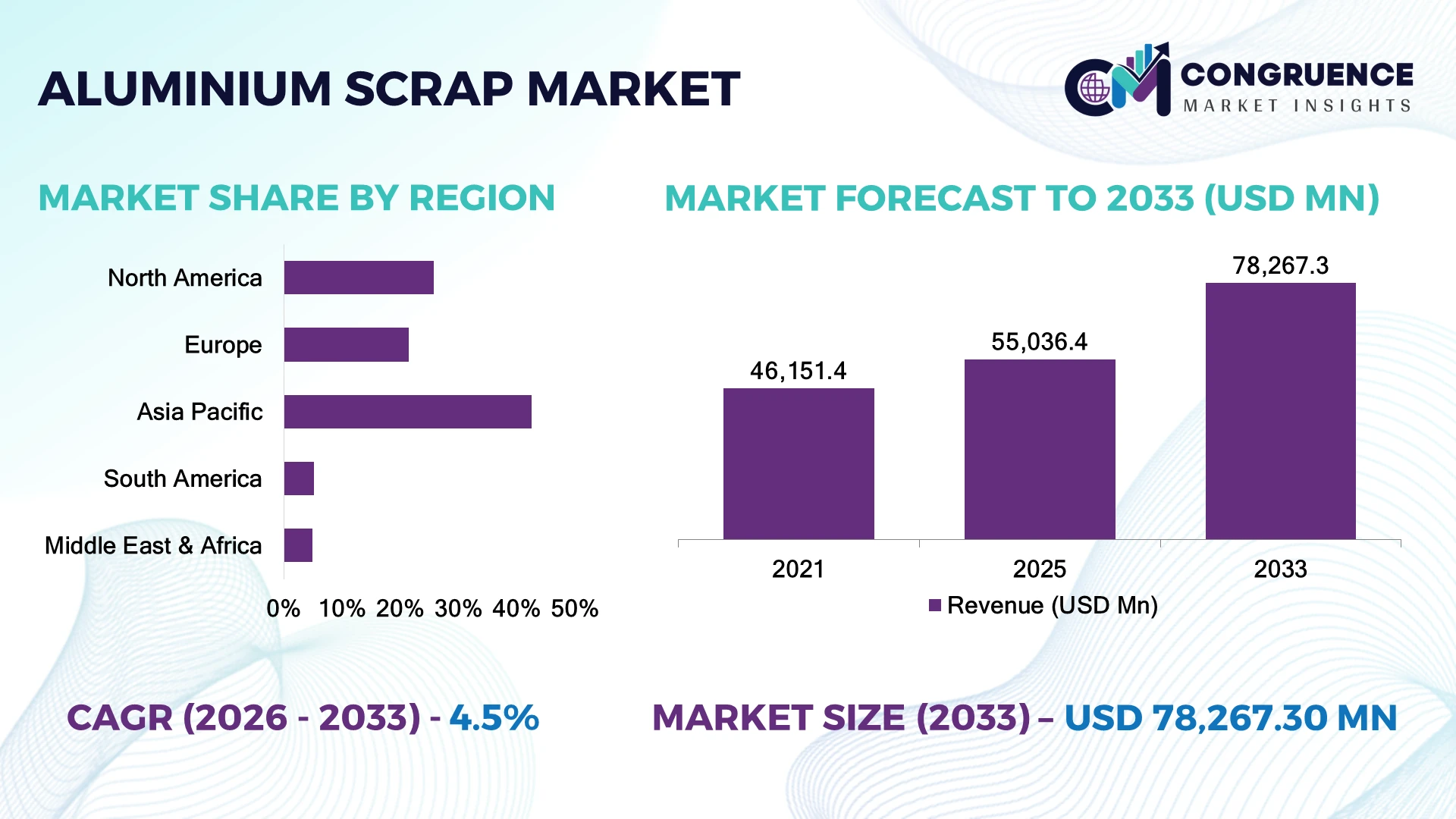
China accounts for approximately 27% of global aluminium scrap consumption, supported by large-scale secondary smelting, automotive components, construction products, and packaging. The United States represents about 16%, with mature collection networks and advanced sorting infrastructure. Secondary aluminium production can require approximately 95% less energy than primary production, strengthening scrap economics as manufacturers respond to carbon-reduction targets. U.S.-China trade restrictions and tighter European critical-material policies are also encouraging regional scrap processing and greater control over domestic recycled-metal supply.
Recyclers and secondary aluminium producers with reliable collection networks, automated sorting, and low-carbon processing capacity will secure the strongest supply positions.
Market Size & Growth: USD 55,036.4 million in 2025 to USD 78,267.3 million by 2033 at 4.5% CAGR, supported by automotive lightweighting, secondary aluminium demand, and decarbonization.
Top Growth Drivers: Automotive demand 5–7%, construction recycling 4–6%, and low-carbon aluminium adoption 7–9%.
Short-Term Forecast: By 2028, automated sorting can improve recovery efficiency 10–15%, while digital yield monitoring reduces processing losses 5–8%.
Emerging Technologies: AI sorting, sensor-based alloy identification, robotic separation, and advanced shredding are improving scrap classification and furnace feed quality.
Regional Leaders: Asia-Pacific approaches USD 35 billion by 2033, Europe USD 16 billion, and North America USD 14 billion, with secondary-metal procurement strengthening across automotive supply chains.
Consumer/End-User Trends: Automotive and transport applications account for approximately 25–30% of demand, with manufacturers increasingly specifying recycled aluminium in component procurement.
Pilot/Case Example: 2025 automated sorting programs achieved approximately 10–15% higher recovery efficiency while reducing mixed-scrap contamination by 5–10%.
Competitive Landscape: Novelis accounts for approximately 8–10% of organized secondary-aluminium demand, competing with Hydro, Constellium, Real Alloy, and China Hongqiao across recycling and remelting networks.
Regulatory & ESG Impact: Recycled aluminium can reduce energy consumption by approximately 95% versus primary production, strengthening compliance with carbon-intensity and recycled-content requirements.
Investment & Funding: More than USD 3 billion is being directed toward recycling plants, remelting capacity, sorting automation, and closed-loop automotive aluminium programs.
Innovation & Future Outlook: Closed-loop recycling, alloy-specific sorting, renewable-powered remelting, digital scrap traceability, and automated quality control will shift competition toward higher recovery yields and verified recycled-metal content.
The Aluminium Scrap Market serves automotive, construction, packaging, aerospace, electrical, machinery, and consumer-goods manufacturers requiring secondary aluminium feedstock. High-quality wrought and cast scrap remain strategically important, while alloy-specific sorting and closed-loop recycling are improving material recovery. Approximately 25–30% of demand is linked to automotive and transport applications. European recycled-content requirements and supply-chain localization are encouraging producers to secure domestic collection, sorting, and remelting capabilities, strengthening the strategic importance of scrap availability and quality.
The Aluminium Scrap Market is becoming strategically important as manufacturers seek lower-carbon metal inputs while controlling exposure to primary aluminium costs, energy intensity, and raw-material supply constraints. Automotive, packaging, construction, and aerospace producers are increasingly treating recycled aluminium as a procurement strategy rather than a secondary material stream. Closed-loop agreements are also strengthening direct relationships between manufacturers, recyclers, and secondary smelters.
Technology is improving the economics of recovery. Sensor-based and AI-assisted sorting can increase usable scrap recovery by approximately 10–15% compared with conventional manual separation, while alloy identification reduces contamination and improves furnace yield. China provides the largest processing scale, Europe emphasizes traceability and recycled-content requirements, and North America benefits from mature collection and remelting infrastructure. These differences are reshaping regional investment priorities.
During 2026–2028, recyclers are expected to increase deployment of robotic sorting, digital scrap tracking, automated alloy recognition, and energy-efficient remelting. Automotive closed-loop programs provide a practical deployment model, allowing production scrap to return directly into component manufacturing. Companies are therefore investing in regional collection networks, upgrading sorting facilities, and forming long-term supply agreements with OEMs. Competitive advantage will increasingly depend on securing consistent scrap volumes, maximizing alloy recovery, and delivering verified low-carbon secondary aluminium at industrial scale.
Automotive lightweighting and recycled-content procurement are strengthening demand for high-quality aluminium scrap, particularly in the United States, Germany, and China. Automotive applications account for approximately 25–30% of secondary aluminium demand, while closed-loop programs can return 70–90% of manufacturing scrap directly into remelting streams. Rising pressure to reduce embedded carbon is accelerating this shift, with recycled aluminium requiring roughly 95% less energy than primary production. Major producers are expanding sorting, remelting, and OEM partnerships to secure consistent feedstock. The strategic shift is from spot scrap purchasing toward contracted material loops, giving recyclers with traceable collection networks stronger volume visibility and improving manufacturers' control over recycled-content specifications.
Mixed scrap quality remains a structural constraint because alloy contamination directly reduces furnace yield and limits suitable end applications. Contamination and non-metallic residues can account for approximately 3–8% of incoming material in poorly segregated streams, while manual sorting can leave 5–10% lower recovery efficiency than automated systems. In China and India, fragmented collection networks increase variability in scrap composition, complicating standardized secondary-metal production. Recyclers are responding with sensor-based sorting, supplier qualification, and longer-term procurement agreements. The key pressure point is not scrap availability but specification consistency: automotive and aerospace buyers require tighter alloy chemistry, making high-quality separated scrap disproportionately more valuable than mixed material.
Sensor-based alloy identification, AI sorting, robotic separation, and digital scrap traceability are creating higher-value recovery opportunities. Automated systems can improve usable-metal recovery by approximately 10–15%, while alloy-specific separation can reduce contamination by 5–10%. European recycled-content requirements are strengthening the commercial value of verified secondary metal, while automotive manufacturers in Germany and the United States are expanding closed-loop procurement. Companies are investing in optical and electromagnetic sorting, digital material passports, and regional processing hubs. A less obvious opportunity is monetizing traceability itself: verified alloy origin and recycled content can differentiate secondary aluminium in premium supply contracts and strengthen long-term relationships between recyclers, smelters, and component manufacturers.
Modern aluminium recycling requires increasingly sophisticated separation, decoating, shredding, and remelting systems as scrap streams become more heterogeneous. Advanced processing can increase recovery efficiency by 10–20%, but complex feedstock preparation can also raise plant energy and maintenance requirements by 5–10%. Labour shortages around skilled furnace and sorting operations are adding commissioning pressure in mature recycling hubs. Companies must integrate automated sorting, furnace-control systems, predictive maintenance, and workforce training to maintain stable throughput. Another long-term challenge is decarbonizing remelting itself: recyclers must combine efficient furnace technology with lower-carbon electricity and optimized thermal management. Competitive sustainability will therefore depend on verified recovery performance rather than recycled content alone.
Automated Sorting Becomes Standard: Optical sensors, electromagnetic separation, and AI-assisted classification are increasingly deployed at large recycling facilities. Automated systems can improve recovery efficiency by approximately 10–15% and reduce manual sorting requirements by 20–30%. North American and European recyclers are upgrading plants to produce cleaner alloy-specific feedstock for automotive and aerospace customers.
Closed-Loop Contracts Expand: Automotive manufacturers are increasingly linking production scrap directly with secondary aluminium producers, reducing reliance on spot-market procurement. Closed-loop systems can return approximately 70–90% of eligible manufacturing scrap into remelting streams. Producers are responding with dedicated collection logistics, segregated storage, and long-term supply agreements that improve feedstock predictability.
Traceability Gains Commercial Value: Digital scrap records and alloy-level tracking are becoming more important as buyers demand verified recycled content and carbon information. Digital identification can reduce material-recording errors by approximately 15–25% and improve batch documentation speed. European processors are integrating traceability into procurement and customer reporting, turning material provenance into a commercial differentiator.
Shredding Technology Improves Yield: High-speed shredders, eddy-current separation, and advanced decoating systems are being integrated into modern recycling lines. Improved preprocessing can increase recoverable aluminium yield by approximately 8–12% while reducing furnace contamination by 5–10%. Recyclers are prioritizing equipment upgrades that extract more usable metal from complex automotive, construction, and packaging scrap streams.
Wrought scrap accounts for approximately 48–52% of the Global Aluminium Scrap Market, supported by its higher alloy consistency, stronger recovery economics, and extensive use in automotive, aerospace, construction, and electrical applications. Cast scrap represents around 30–34%, while mixed and other aluminium scrap contributes approximately 14–20%. Wrought grades are increasingly prioritized by secondary aluminium producers because cleaner, alloy-specific feedstock reduces sorting and remelting complexity and supports more predictable recycled-metal quality. Automated identification and sorting systems can improve recovery rates by approximately 10–15% compared with less automated processing routes, strengthening demand for higher-quality segregated scrap.
Cast scrap remains important because of its substantial presence in automotive components, machinery, and industrial castings, although alloy variability can increase processing requirements. Alloy-specific and processed wrought scrap is expected to gain further importance as manufacturers expand closed-loop recycling programs and seek tighter control over secondary metal chemistry. The increasing requirement for traceable recycled feedstock is also encouraging scrap processors to invest in shredding, sensor-based sorting, decoating, and alloy separation technologies.
More than 30 million tonnes of aluminium scrap are recycled globally each year, while Europe records an overall aluminium recycling efficiency of approximately 81%, highlighting the importance of efficient scrap recovery and segregation.
Automotive applications represent approximately 27–31% of global aluminium scrap demand, followed by construction at around 22–26% and packaging at approximately 18–22%. Automotive demand is supported by the extensive use of aluminium in vehicle bodies, wheels, engine components, structural parts, and battery-related systems. More than 95% of automotive aluminium scrap is recovered and recycled in North America, with the automotive recycling cycle accounting for more than 1.5 million tonnes annually.
Construction remains a major application because aluminium recovered from window frames, façades, roofing, doors, and structural components can be repeatedly recycled while retaining material value. Packaging represents a rapidly evolving application as beverage-can recycling and can-to-can recovery gain attention. Globally, approximately 71% of aluminium cans are recycled, but only about 33% are currently returned into can production, leaving substantial scope for improved collection, sorting, and closed-loop remelting.
Approximately 71% of aluminium cans are recycled globally, but only 33% are converted back into cans, indicating significant untapped potential for higher-value closed-loop recycling.
Secondary aluminium producers account for approximately 42–46% of aluminium scrap consumption, making them the primary demand center for collected, processed, and sorted scrap. Automotive component manufacturers represent around 20–24%, while packaging producers account for approximately 14–18%. Secondary producers increasingly require alloy-specific scrap because controlled feedstock chemistry reduces the need for primary aluminium additions and improves remelting efficiency. Global scrap recycling already exceeds 30 million tonnes annually, creating a substantial industrial feedstock base for secondary aluminium production.
Automotive component manufacturers are among the fastest-evolving end-users, supported by increasing closed-loop procurement agreements with aluminium producers and scrap processors. Packaging manufacturers are similarly expanding recycled-content sourcing, particularly for beverage cans and other high-volume aluminium packaging. Across end-user groups, demand is shifting from opportunistic scrap purchasing toward contracted supply arrangements, documented material quality, and traceable recycled content. This trend benefits processors capable of delivering consistent alloy grades, contamination control, and verifiable recycled-metal inputs.
North American automotive aluminium recycling exceeds 95%, with more than 1.5 million tonnes recovered annually, demonstrating the scale of established closed-loop demand from automotive end-users.
Asia-Pacific accounted for the largest market share at 42.6% in 2025 however, North America is expected to register the fastest growth, expanding at a CAGR of 5.1% between 2026 and 2033.

Domestic scrap availability and closed-loop manufacturing are strengthening regional supply resilience
North America represents approximately 25.8% of the global Aluminium Scrap Market, supported by mature collection networks, large automotive production, established secondary aluminium capacity, and growing demand for domestically sourced recycled metal. The U.S. consumes approximately 5–6 million tonnes of aluminium scrap annually while exporting more than 2 million tonnes, creating a strong commercial incentive to improve domestic processing and retain higher-value feedstock. Automotive recycling is particularly established, with more than 95% of automotive aluminium scrap recovered and recycled. The region is also attracting recycling investment, including a Minnesota expansion that added 55,000 tonnes of secondary billet capacity, taking the facility to 165,000 tonnes annually.
United States Market Outlook: The United States anchors North American scrap demand through its extensive automotive, packaging, aerospace, construction, and defence manufacturing base. Secondary aluminium production reached record levels in 2025, while an estimated 1–2 million tonnes of usable scrap remains landfilled or exported, indicating substantial room for additional domestic recovery, sorting, and remelting capacity.
Circular manufacturing and high-quality alloy recovery are reshaping regional scrap flows
Europe accounts for approximately 21.5% of the global Aluminium Scrap Market and has one of the most developed aluminium recycling ecosystems globally. High collection efficiency, stringent sustainability requirements, and strong demand from automotive, construction, packaging, and transport manufacturers are increasing the value of sorted, traceable scrap. Europe recovers approximately 81% of available aluminium scrap, while recycled aluminium supplies around 40% of regional aluminium demand. Investment is moving toward advanced alloy separation and high-quality post-consumer processing, including a planned expansion in Hannover that would add 110,000 tonnes of annual scrap-sorting capacity and approximately 150,000 tonnes of melting and casting capacity.
Germany Market Outlook: Germany remains a key European processing hub because of its large automotive manufacturing base, engineering industry, established scrap collection infrastructure, and demand for high-strength secondary alloys. EGA Leichtmetall already produces approximately 35,000 tonnes of recycled aluminium annually, using scrap for around 80% of its input material. The planned Hannover expansion is intended to substantially increase domestic high-grade scrap processing capacity.
China's industrial scale is shifting regional demand toward high-volume secondary aluminium processing
Asia-Pacific holds the largest regional position with approximately 42.6% of global Aluminium Scrap Market demand, driven by China's enormous aluminium-processing base, automotive manufacturing, construction activity, packaging production, and expanding secondary aluminium capacity. China alone generates more than 10 million tonnes of aluminium scrap annually, representing roughly one-third of global annual scrap generation. Japan, South Korea, India, and Southeast Asian economies further support regional flows through established collection systems and expanding manufacturing activity. Increasing demand for alloy-specific feedstock is encouraging investment in shredding, sorting, remelting, and quality-control infrastructure, particularly around major manufacturing clusters.
China Market Outlook: China remains the region's largest scrap-generation and processing center, supported by its exceptionally large aluminium fabrication and consumption base. More than 10 million tonnes of scrap are generated annually, providing substantial feedstock for secondary production. The country's concentration of automotive, construction, packaging, and industrial manufacturing also creates strong local demand for recycled aluminium, reducing reliance on long-distance movement of lower-value scrap.
Brazil's highly developed beverage-can recovery system provides a strong circular-economy foundation
South America represents approximately 5.2% of the global Aluminium Scrap Market, with Brazil accounting for the region's strongest collection, processing, and secondary-aluminium ecosystem. The region's scrap market is supported by beverage packaging, automotive components, construction products, and industrial manufacturing, although collection infrastructure remains less consistent outside major urban and industrial centers. Brazil recycled 97.3% of aluminium beverage cans in 2024, equivalent to approximately 417,700 tonnes of recovered material, demonstrating the effectiveness of established collection and recycling networks. Continued formalization of waste collection and expansion of higher-value scrap processing can improve recovery beyond packaging applications.
Brazil Market Outlook: Brazil has a particularly strong position in aluminium recycling because of its extensive collection network, established secondary processing capacity, and high-value beverage-can recovery system. Approximately 60% of aluminium consumed in Brazil originates from recycled material, around twice the global average. Packaging accounted for 32% of transformed aluminium consumption during January–September 2025, reinforcing the country's importance in the regional scrap ecosystem.
Industrial localization is shifting the region from scrap export toward domestic recycling capacity
Middle East & Africa contributes approximately 4.9% of the global Aluminium Scrap Market, with the Gulf region providing the strongest industrial foundation through large aluminium smelters, downstream fabrication clusters, and expanding recycling infrastructure. The Gulf aluminium sector produced approximately 6.5 million tonnes in 2025, equivalent to around 9% of global capacity, creating a substantial industrial base for secondary-metal integration. Recycling infrastructure is also expanding rapidly, including a major UAE facility with 185,000 tonnes of annual recycling capacity designed to convert post-consumer and pre-consumer scrap into lower-carbon aluminium products.
United Arab Emirates Market Outlook: The UAE is emerging as the region's principal aluminium recycling hub through integration of scrap collection, sorting, remelting, and downstream billet production. The country's Al Taweelah facility has annual production capacity of 185,000 tonnes, while its broader recycling infrastructure strengthens domestic scrap utilization and supports higher-value recycled aluminium production.
Novelis, Hydro, Constellium, Emirates Global Aluminium, and Real Alloy compete as integrated recyclers, while scrap processors and metal merchants compete on feedstock access and price. The top five are estimated to control about 20–25% of recycling capacity, with the remainder fragmented. Competition centers on scrap procurement, alloy sorting, processing yield, carbon intensity, and closed-loop supply. Advanced sorting can improve recovery efficiency by 10–15%, while collection-to-remelting models can reduce feedstock dependence by 15–25%. Players are expanding capacity, securing automotive and packaging partnerships, integrating scrap collection, and investing in low-carbon melting. Novelis is strengthening closed-loop automotive systems; Hydro is expanding European recycling; Constellium is increasing recycled-metal input; EGA is building recycling infrastructure. The competitive shift is toward supply control and traceable, high-quality scrap rather than commodity volume. High capital requirements, feedstock access, technology expertise, and qualification create entry barriers. Winning requires secure scrap, efficient sorting, reliable alloy quality, and downstream demand scale.
Novelis Inc.
Norsk Hydro ASA
Constellium SE
Emirates Global Aluminium
Real Alloy
Sims Limited
China Hongqiao Group Limited
Aluminum Corporation of China Limited (CHALCO)
Shandong Nanshan Aluminium Co., Ltd.
Gränges AB
Befesa S.A.
Kuusakoski Recycling
Matalco Inc.
Raffmetal S.p.A.
Aluminium scrap processing is shifting from mechanical sorting toward sensor-based alloy identification, X-ray sorting, eddy-current separation, automated shredding, and digital quality monitoring. These systems can improve recovery efficiency by 10–15% and reduce contamination by 5–10%. Adoption is strongest at secondary smelters and integrated recyclers handling automotive and packaging scrap. Closed-loop digital tracking is also expanding, linking scrap origin, alloy chemistry, processing, and recycled-content certification.
Emerging technologies include AI-assisted sorting, laser-induced breakdown spectroscopy, advanced decoating, and hydrogen-ready remelting furnaces. AI and sensor fusion can reduce sorting errors by 10–20%, while improved decoating can increase usable metal yield by 8–12%. Compared with manual sorting, automated sensor sorting can raise throughput and consistency by approximately 15–25%. These gains favor vertically integrated recyclers with diverse scrap streams because they can justify automation investment and capture value from lower-grade feedstock.
By 2026–2028, competitive advantage will increasingly depend on combining sorting intelligence with high-efficiency melting, traceability, and closed-loop customer platforms. Hydrogen fuel switching can reduce furnace CO2 emissions by up to 90% when replacing equivalent natural-gas use. The priority is technology integration: processors that connect automated identification, alloy control, low-carbon melting, and customer-specific material specifications can secure higher-value scrap streams and improve operating resilience.
January 2026 Novelis commissioned new bag houses at Latchford, advancing a $90 million modernization that will increase annual recycling capacity by 85 kilotonnes. The upgrade strengthens UK beverage-can recovery and prepares operations for the Deposit Return Scheme. Source: Novelis
March 2025 Hydro began construction of its Torija recycling plant in Spain, backed by a €180 million investment. The facility expands post-consumer scrap processing and strengthens Hydro’s integrated low-carbon aluminium supply chain for European automotive and industrial customers. Source: Hydro
June 2026 Constellium reported scrap input reached 47% of total metal input, up 13% from 2024, as its Neuf-Brisach recycling center ramped up. The shift reduces primary-metal dependence and strengthens low-carbon supply for European automotive and packaging customers. Source: Constellium
June 2026 Emirates Global Aluminium inaugurated its Al Taweelah recycling plant with 185,000 tonnes of annual capacity. The facility processes post-consumer scrap into low-carbon billets and T-bars, strengthening domestic recycling and reducing dependence on overseas scrap processing. Source: The National
The Aluminium Scrap Market Report evaluates demand across wrought, cast, mixed, and other scrap categories, with application coverage spanning automotive, construction, packaging, electrical, aerospace, and industrial uses. End-user analysis includes secondary aluminium producers, automotive component manufacturers, packaging producers, construction-material manufacturers, and other industrial consumers. Regional assessment covers North America, Europe, Asia-Pacific, South America, and Middle East & Africa, with country-level analysis of major processing and consumption hubs.
The report examines scrap collection, shredding, sorting, decoating, remelting, alloy separation, automated inspection, and digital traceability technologies. It also evaluates closed-loop recycling, recycled-content requirements, supply-chain localization, and high-value automotive and packaging recovery. Segment shares, processing capacity, adoption patterns, and competitive participation provide practical benchmarks for investment planning, capacity expansion, sourcing strategy, technology deployment, and competitive positioning through 2026–2033.
| Report Attribute/Metric | Report Details |
|---|---|
|
Market Revenue in 2025 |
USD 55,036.4 Million |
|
Market Revenue in 2033 |
USD 78,267.3 Million |
|
CAGR (2026 - 2033) |
4.5% |
|
Base Year |
2025 |
|
Forecast Period |
2026 - 2033 |
|
Historic Period |
2021 - 2025 |
|
Segments Covered |
By Type
By Application
By End-User
|
|
Key Report Deliverable |
Revenue Forecast, Growth Trends, Market Dynamics, Segmental Overview, Regional and Country-wise Analysis, Competition Landscape |
|
Region Covered |
North America, Europe, Asia-Pacific, South America, Middle East, Africa |
|
Key Players Analyzed |
Novelis Inc., Norsk Hydro ASA, Constellium SE, Emirates Global Aluminium, Real Alloy, Sims Limited, China Hongqiao Group Limited, Aluminum Corporation of China Limited (CHALCO), Shandong Nanshan Aluminium Co., Ltd., Gränges AB, Befesa S.A., Kuusakoski Recycling, Matalco Inc., Raffmetal S.p.A. |
|
Customization & Pricing |
Available on Request (10% Customization is Free) |




