
Reports
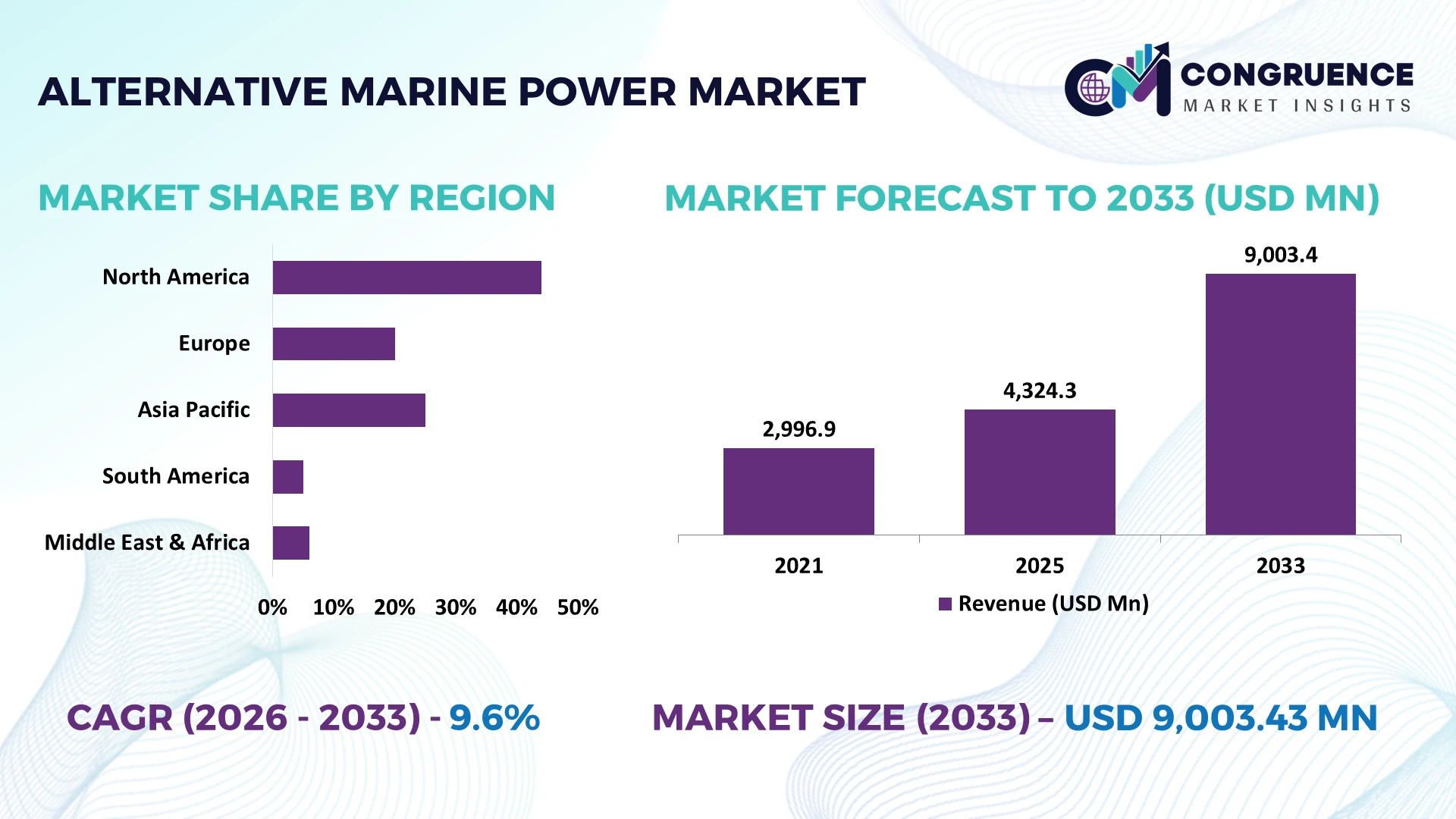
The Global Alternative Marine Power Market was valued at USD 4324.3 Million in 2025 and is anticipated to reach a value of USD 9003.43 Million by 2033 expanding at a CAGR of 9.6% between 2026 and 2033. Port electrification, vessel emission reduction mandates, shore power deployment, battery propulsion, fuel cells, and alternative fuel infrastructure are accelerating investment in advanced marine power systems.
China holds a dominant position in the global alternative marine power landscape, supported by a shipbuilding industry responsible for more than 50% of global commercial shipbuilding output and rapid electrification of coastal vessels. Major ports including Shanghai, Shenzhen, and Ningbo Zhoushan are expanding shore power infrastructure, while Chinese operators are deploying battery electric container ships with battery capacities exceeding 50 MWh. China’s manufacturing scale in batteries, power electronics, and shipbuilding provides a stronger equipment supply base than Japan and South Korea.
The European Union’s FuelEU Maritime framework, which entered application in 2025, strengthens the commercial case for shore power, renewable fuels, batteries, and hybrid propulsion across vessels serving European ports.
For shipowners, ports, and marine equipment suppliers, early control of electrification technology, charging infrastructure, and low emission propulsion supply chains will determine long term competitive positioning.
Market Size & Growth: USD 4,324.3 million in 2025 is projected to reach USD 9,003.43 million by 2033 at 9.6% CAGR, supported by vessel electrification and shore power deployment.
Top Growth Drivers: Shore power expansion, fleet decarbonization, and battery propulsion represent three critical investment drivers, with maritime greenhouse gas reduction policy targeting net zero emissions around 2050.
Short Term Forecast: By 2030, FuelEU Maritime requires a 6% reduction in greenhouse gas intensity versus the regulatory reference level, directly influencing propulsion and fuel selection.
Emerging Technologies: Battery electric propulsion, hydrogen fuel cells, automated energy management, and megawatt scale charging are shifting marine power architecture toward digitally controlled integrated systems.
Regional Leaders: Asia Pacific benefits from China’s more than 50% global shipbuilding share, Europe advances regulated shore power adoption, while North America expands port electrification across major coastal gateways.
End User Trends: Container shipping, ferries, cruise vessels, offshore support vessels, and port operators are increasingly combining shore connection systems with onboard batteries to reduce auxiliary engine operation.
Pilot Case Example: In 2024, COSCO Shipping launched the 10,000 DWT Green Water 01 electric container vessel using more than 50 MWh of swappable battery capacity.
Competitive Landscape: ABB, Wärtsilä, Siemens Energy, Schneider Electric, and MAN Energy Solutions compete across electrical propulsion, automation, energy management, power conversion, and alternative propulsion technologies.
Regulatory & ESG Impact: IMO’s revised strategy targets at least a 20% reduction in international shipping greenhouse gas emissions by 2030 compared with 2008, intensifying technology procurement.
Investment & Funding: Port authorities and governments are directing billions of USD toward maritime decarbonization, with the United States Clean Ports Program alone providing USD 3 billion for zero emission port equipment and infrastructure.
Innovation & Future Outlook: Megawatt charging, modular batteries, fuel cells, digital energy optimization, and renewable fuel compatible engines are moving alternative marine power from individual equipment upgrades toward integrated vessel energy ecosystems.
The Alternative Marine Power Market is increasingly shaped by container vessels, ferries, cruise ships, offshore fleets, and ports seeking lower fuel consumption and reduced berth emissions. Battery swapping, high capacity energy storage, shore connection systems, hydrogen fuel cells, and intelligent power management are expanding the technology mix. International shipping policy targets at least a 20% greenhouse gas reduction by 2030 versus 2008 levels, reinforcing fleet modernization. Growing deployment of integrated electric propulsion and port charging infrastructure is consequently shifting strategic attention toward scalable energy architectures and supply chain readiness.
Alternative marine power is becoming a competitive requirement as shipowners align fleet renewal with tighter emissions rules, port electrification, and fuel diversification. The IMO targets international shipping emissions reductions of at least 20% by 2030 versus 2008, while FuelEU Maritime progressively tightens vessel energy intensity. This regulatory shift is restructuring procurement toward batteries, shore power, fuel cells, power electronics, and renewable fuel compatible propulsion.
Technology economics increasingly favor integrated electric architectures for suitable duty cycles. Battery electric propulsion can convert more than 85% of stored electrical energy into propulsion, compared with roughly 40% to 50% efficiency for conventional marine combustion systems. China combines large shipbuilding capacity with commercial electric vessel deployment, while Norway has established deeper operational experience in battery ferries and charging infrastructure.
Through 2028, deployment will concentrate on ferries, short sea shipping, harbor craft, and vessels with predictable routes. COSCO’s Green Water 01 demonstrates this pathway through modular containerized batteries exceeding 50 MWh. Suppliers are consequently expanding charging partnerships, integrated energy management, and propulsion portfolios. Competitive advantage will increasingly depend on controlling interoperable vessel and port energy ecosystems rather than supplying standalone equipment.
Mandatory emissions reduction is converting alternative marine power from optional efficiency equipment into fleet planning infrastructure. The IMO targets at least 20% lower greenhouse gas emissions by 2030 and 70% by 2050 against 2008, while its 2030 ambition calls for zero or near zero emission fuels to represent at least 5% of shipping energy. FuelEU Maritime simultaneously requires a 6% greenhouse gas intensity reduction by 2030. These thresholds directly strengthen investment in shore connections, batteries, hybrid propulsion, fuel cells, and energy management systems. Norway’s electrified ferry network demonstrates how predictable routes support commercial battery operation. Marine technology suppliers are responding through integrated propulsion platforms, charging partnerships, and renewable fuel compatible engines. The strategic advantage lies in securing compliant vessel architectures before retrofit requirements intensify.
Alternative propulsion remains constrained by uneven charging, bunkering, and shore power infrastructure, particularly outside major container and passenger ports. Battery systems also carry materially lower gravimetric energy density than marine liquid fuels, restricting practical deployment on long distance routes, while shore power installations can require substantial grid reinforcement before berth electrification becomes operational. FuelEU Maritime begins with a 2% greenhouse gas intensity reduction requirement in 2025, yet compliance requirements progressively tighten toward 2030, creating investment timing pressure. In the United States, port electrification must compete for grid capacity alongside industrial and data center loads. Operators are mitigating exposure through dual fuel engines, modular batteries, long term energy contracts, and phased terminal upgrades. Infrastructure compatibility, rather than vessel technology alone, therefore determines whether alternative power investments achieve commercially acceptable utilization.
Modular batteries, megawatt charging, hydrogen fuel cells, digital energy optimization, and renewable fuel compatible engines are creating opportunities beyond conventional vessel replacement. China provides a commercial reference through Green Water 01, which operates with more than 50 MWh of containerized batteries that can be exchanged rather than keeping vessels idle for lengthy charging cycles. Meanwhile, zero and near zero emission fuels are targeted to reach at least 5% of international shipping energy by 2030, with an ambition of 10%. This transition creates demand for interoperable power conversion, onboard microgrids, charging orchestration, and energy as a service models. Suppliers are expanding R&D partnerships across shipyards, battery manufacturers, ports, and utilities. The non obvious opportunity is recurring digital and energy service income after propulsion hardware installation, improving customer retention across vessel lifecycles.
Scaling alternative marine power requires vessel hardware, port grids, charging equipment, software, safety systems, and multiple fuel pathways to function as one reliable architecture. International shipping still transports more than 80% of world merchandise trade by volume, making reliability penalties commercially significant when new propulsion technologies disrupt vessel schedules. Large battery installations exceeding 50 MWh also require sophisticated thermal management, fire protection, state of charge monitoring, and high power electrical integration. South Korea and China possess deep shipbuilding ecosystems, but global deployment requires comparable engineering, maintenance, and emergency response capabilities across destination ports. Companies must therefore invest beyond propulsion equipment into cybersecurity, technician training, remote diagnostics, standardized interfaces, and port partnerships. Long term competitiveness will depend on delivering repeatable system availability across routes, not simply demonstrating technically successful low emission vessels.
Shore Power Moves Into Operations: Major ports are shifting berth electrification from pilot infrastructure toward routine vessel servicing. California requires eligible container, refrigerated cargo, and cruise fleets to control 80% of regulated at berth visits, while EU rules push core ports toward shore electricity availability by 2030. Operators are integrating automated cable management, high voltage connections, and berth scheduling software. Equipment suppliers are standardizing modular substations and partnering with utilities to reduce connection delays and improve asset utilization.
Battery Swapping Changes Vessel Workflows: Containerized energy storage is reducing charging downtime for fixed route vessels. China’s Green Water 01 operates with batteries exceeding 50 MWh and can carry 36 swappable battery containers, enabling depleted units to be exchanged during cargo operations. This separates charging time from vessel turnaround, an important operational advantage over fixed onboard charging. Shipyards and battery suppliers are consequently developing standardized containers, automated energy management, and shore charging ecosystems around predictable coastal routes.
Wind Assistance Returns At Scale: Modern rotor sails, rigid wings, and suction sails are moving from demonstration projects into commercial retrofit programs. Depending on vessel profile and route, wind assistance can reduce propulsion fuel consumption by 5% to 20%, while favorable operating conditions deliver higher savings. Bulk carriers and tankers offer particularly attractive deck configurations for retrofit. Technology developers are combining weather routing with automated sail control, allowing operators to monetize wind resources without restructuring normal bridge workflows.
Hybrid Architectures Broaden Retrofit Options: Shipowners are increasingly combining conventional engines with batteries, power management software, and alternative fuel capability instead of relying on single technology transitions. Battery hybrid configurations can cut fuel consumption by roughly 10% to 20% on variable load duty cycles while improving engine loading and reducing maintenance hours. Ferry and offshore vessel operators are prioritizing modular retrofits, while propulsion suppliers are integrating converters, automation, and predictive energy management into unified packages that preserve operational flexibility.
Shore Power represents the leading type with an estimated 35% market share, reflecting its applicability across container terminals, cruise berths, ferry ports, and other vessels requiring auxiliary electricity while docked. High voltage shore connections can eliminate virtually all onboard auxiliary engine emissions during connected berth periods and substantially reduce local nitrogen oxide and particulate emissions. Mature electrical standards and compatibility with existing vessel power systems support deployment across California, China, and major European ports. Battery Power is advancing beyond ferries into coastal cargo operations as higher capacity lithium ion systems improve route economics.
Fuel Cells represent the fastest developing type as hydrogen and derivative fuel projects progress toward commercial vessel integration. Hybrid Power remains strategically important where operators require combustion engine range combined with electric peak shaving. Wind Assisted Power is gaining traction on bulk carriers and tankers, where modern systems can reduce fuel consumption by 5% to 20% under suitable conditions. Solar Power primarily supports auxiliary loads rather than primary propulsion. Suppliers are therefore directing product investment toward interoperable electrical architectures rather than isolated technologies.
Port Operations account for an estimated 31% share, supported by concentrated electricity demand from berthed vessels, terminal equipment, and emission control requirements. Shore connected vessels can reduce local berth emissions by more than 90% for several regulated pollutants when grid electricity replaces auxiliary engines. Cargo Handling is simultaneously electrifying through battery powered cranes, automated guided vehicles, and terminal tractors, allowing ports to coordinate vessel and landside energy consumption. Auxiliary Power remains a mature application because hotel loads, refrigeration, ventilation, and onboard services can transition without replacing primary propulsion machinery.
Vessel Charging is the fastest developing application as electric ferries and coastal ships require higher power connections and shorter turnaround cycles. Ship Propulsion is moving toward batteries, fuel cells, hybrid drivetrains, and wind assistance, while Offshore Operations favor hybrid systems that manage highly variable loads. Operators are integrating charging schedules with terminal workflows and grid management. Equipment suppliers are scaling megawatt class converters, automated connections, and digital energy controls, making infrastructure utilization increasingly important to project economics.
Container Ships represent the leading end user with an estimated 29% share, reflecting high port frequency, large auxiliary loads, standardized trade routes, and growing access to electrified terminals. China’s Green Water 01 demonstrates the segment’s technology transition with more than 50 MWh of battery capacity and 36 swappable battery containers. Cruise Ships also generate substantial shore power demand because hotel loads continue throughout extended port stays. Tankers and Bulk Carriers are adopting hybrid systems and wind assisted propulsion where long sailing distances make full battery propulsion less practical.
Ferries are the fastest developing end user because fixed routes, frequent port calls, and scheduled dwell periods enable predictable charging. Battery systems can provide more than 85% electrical conversion efficiency, strengthening operating economics on shorter routes. Offshore Vessels increasingly combine batteries with diesel or alternative fuel engines to handle fluctuating propulsion and dynamic positioning loads, while Naval Vessels prioritize resilient integrated electrical systems. Suppliers are responding with vessel specific battery sizing, charging partnerships, modular propulsion packages, and lifecycle service agreements, shifting competition toward complete energy ecosystems.
Asia Pacific accounted for the largest market share at 48.6% in 2025 however, North America is expected to register the fastest growth, expanding at a CAGR of 11.6% between 2026 and 2033.
Port Electrification Moves Into Fleet Scale
North America represents a major alternative marine power deployment center, with the United States concentrating investment around California, New York, New Jersey, Washington, Virginia, and Gulf Coast gateways. Shore power, battery storage, electric cargo equipment, charging systems, and hydrogen infrastructure increasingly form integrated port energy programs rather than isolated installations. The U.S. Clean Ports Program is implementing 51 projects with USD 2.93 billion in funding, including 15 shore power awards and eight vessel related awards. California remains particularly advanced because berth emission requirements established early commercial demand for shore connections. The Port of Los Angeles program alone secured more than USD 411 million for zero emission cargo equipment, charging infrastructure, solar generation, battery storage, and vessel shore power. This concentration gives electrical equipment suppliers substantial opportunities in grid interfaces, converters, charging systems, and lifecycle services.
United States Market Outlook: The United States combines regulatory enforcement with unusually large infrastructure funding, giving suppliers clearer project pipelines than markets relying primarily on voluntary adoption. New York and New Jersey secured more than USD 451 million for clean port technology, while Virginia received more than USD 313 million. Domestic content requirements also favor suppliers capable of localizing electrical equipment, integration, installation, and maintenance capabilities.
Mandatory Shore Power Reshapes Port Investment
Europe is shifting alternative marine power procurement from voluntary decarbonization toward regulated infrastructure deployment. The Alternative Fuels Infrastructure Regulation requires qualifying TEN T maritime ports to provide minimum shore side electricity for seagoing container and passenger vessels by the end of 2029, creating defined investment deadlines for ports, utilities, vessel operators, and electrical suppliers. This framework strengthens demand for high voltage shore connections, cable management, transformers, frequency conversion, and onboard interface systems. Norway, Denmark, Finland, Germany, the Netherlands, and Sweden also provide established ecosystems for battery ferries, hybrid propulsion, charging, and marine energy management. The region represents more than 40% of established alternative marine power deployment, reflecting early cold ironing adoption. Competitive differentiation is now moving toward standardized connections and interoperable systems capable of serving multiple vessel classes rather than proprietary berth solutions.
Norway Market Outlook: Norway remains strategically important because commercial battery propulsion is embedded in scheduled ferry operations rather than limited to demonstrations. Predictable crossings, frequent charging cycles, abundant renewable electricity, and procurement requirements have created a practical testing environment for batteries, automated charging, hybrid systems, and energy management. This operating base gives technology suppliers valuable lifecycle performance data before wider international deployment.
Shipbuilding Scale Accelerates Power Integration
Asia Pacific holds an estimated 48.6% market share, supported by concentrated shipbuilding, high container throughput, port modernization, battery manufacturing, and expanding shore electricity infrastructure. China, South Korea, Japan, and Singapore combine vessel construction capabilities with sophisticated marine electrical systems, allowing alternative power technologies to be incorporated during newbuild design rather than through expensive retrofits. China provides the strongest industrial scale advantage: national shipyards produced 53.69 million DWT in 2025, representing 56.1% of worldwide output, while securing 69% of global new orders by DWT. This manufacturing concentration gives propulsion, battery, converter, and energy management suppliers direct access to exceptionally large newbuild pipelines. Investment is consequently shifting toward factory integrated electrical architectures capable of supporting batteries, shore connections, alternative fuels, and digitally optimized power management throughout vessel operating lives.
China Market Outlook: China’s competitive advantage extends beyond ship construction into batteries, power electronics, charging equipment, and port infrastructure. Its year end 2025 shipbuilding orderbook reached 274.42 million DWT, equivalent to 66.8% of the global total. That pipeline creates substantial opportunities to specify alternative power components during vessel construction, reducing installation complexity compared with later fleet retrofits.
Port Modernization Opens Electrification Demand
South America remains an earlier stage alternative marine power market, but port electrification is moving into practical deployment around major Brazilian gateways. Brazil provides the strongest demand concentration because maritime transport handles more than 95% of the country’s foreign trade, making port energy efficiency strategically relevant to export competitiveness. Santos has introduced onshore power supply for harbor tugboats using electricity generated by the port controlled Itatinga hydroelectric facility. Around 20 tugboats operated by five companies can access the system, replacing diesel auxiliary operation while berthed and reducing associated carbon dioxide emissions by roughly 15%. The region still faces uneven grid capability, capital availability, and limited standardized vessel connections. Suppliers therefore gain stronger commercial positioning through phased electrification packages that combine shore connections, renewable electricity, storage, and digital port management rather than capital intensive full fleet conversion.
Brazil Market Outlook: Brazil is developing the region’s clearest operational pathway through Santos, where renewable electricity, berth electrification, 5G connectivity, vessel traffic management, and digital twin technology are being integrated within one modernization strategy. Planned expansion of shore electricity beyond tugboats creates an addressable pathway toward larger commercial vessels without requiring immediate replacement of existing propulsion systems.
Trade Hubs Accelerate Electrical Modernization
Middle East and Africa adoption is concentrated around large logistics hubs capable of funding charging networks, electric equipment, renewable power integration, and digital energy systems. The UAE provides the clearest deployment model through Jebel Ali Port, where electric internal terminal vehicles expanded from 14 to 146 units within roughly one year. The transition reduces greenhouse gas emissions by more than 10% and is supported by rapid charging infrastructure, demonstrating how port electrification can create demand for power conversion and energy management equipment before widespread vessel electrification. Jebel Ali also introduced 11 electric empty container handlers, extending electrification across yard workflows. Saudi Arabia and South Africa are developing cleaner logistics infrastructure, although deployment remains less concentrated. The strongest commercial route for suppliers is therefore hub led ecosystem development connecting terminal electrification, charging, renewable electricity, and future vessel power requirements.
United Arab Emirates Market Outlook: The UAE combines high container throughput with concentrated infrastructure investment. Electric freight operations at Jebel Ali are designed to progress toward handling 2 million twenty foot containers annually through the full deployment program, while the initial fleet supports more than 204,000 annually. Partnerships linking operators, charging infrastructure, software, and electric mobility providers are establishing a scalable procurement model for broader marine electrification.
ABB, Wärtsilä, Siemens Energy, Schneider Electric, and Cavotec anchor competition against specialist propulsion, charging, and power conversion suppliers. The top five collectively command an estimated 40% share, creating a moderately concentrated structure where global electrical OEMs compete with marine specialists for integrated vessel and port contracts. Technology performance increasingly outweighs equipment pricing: optimized electric propulsion can reduce energy consumption by over 20%, while modern shore connections can eliminate nearly 100% of auxiliary engine use during connected berth periods. Battery hybridization can lower fuel consumption by 10% to 20% on variable load vessels. ABB and Wärtsilä emphasize integrated propulsion and digital energy management, while Cavotec targets automated shore connections and Schneider Electric strengthens port electrical infrastructure. Partnerships with shipyards, utilities, ports, and battery suppliers are replacing standalone equipment sales. Certification, high voltage engineering, vessel integration, and global service coverage remain major entry barriers. Winning requires interoperable technology, proven reliability, rapid commissioning, and lifecycle support.
ABB
Wärtsilä
Siemens Energy
Schneider Electric
Cavotec
Danfoss
Nidec Corporation
Wabtec Corporation
PowerCon
Corvus Energy
Ballard Power Systems
MacGregor
VINCI Energies
ESL Power Systems
Current alternative marine power deployment centers on shore connections, DC grids, battery hybrid propulsion, and energy management. High voltage shore systems transfer up to 20 MVA, while fast charging connections engage in under one minute. Electric drivetrains convert 85% of stored energy into propulsion, versus 40% to 50% for combustion systems, improving utilization by more than 35 percentage points. Ferry operators benefit because frequent port calls support charging cycles.
Emerging technology is moving toward larger marine batteries, megawatt charging, hydrogen fuel cells, and software coordinated hybrid architectures. Aurora Botnia’s battery expansion from 2.2 MWh to 12.6 MWh demonstrates deployment moving beyond auxiliary peak shaving toward propulsion support. Three megawatt hydrogen fuel cells are aboard advanced vessels, while digital power management can reduce generator loading by 10% to 20%. Shipyards integrating systems during newbuild construction gain lifecycle cost advantages over retrofit dependent operators.
Between 2026 and 2028, development will center on mobile energy bunkering, modular batteries, interoperable charging, and megawatt scale fuel cells. Fifty megawatt floating charging concepts indicate infrastructure can move toward vessels instead of requiring fixed berths. Suppliers combining propulsion, storage, automation, diagnostics, and shore interfaces will secure competitive positions globally now as ports and fleets standardize electrical ecosystems.
June 2025 ABB launched its AMXE Marine Motor for electric and hybrid vessels, delivering the company’s highest marine motor power density in a compact water cooled design. The platform reduces installation footprint and expands electrification options for vessels.
June 2025 Feadship’s Breakthrough became the first superyacht supplied with liquid hydrogen in the Netherlands, integrating a 3.2 MW fuel cell system. The milestone validated non combustion onboard power for high load luxury vessels and protected harbor operations.
August 2025 Wärtsilä was selected to integrate Aurora Botnia’s battery expansion from 2.2 MWh to 12.6 MWh, creating the largest operating marine battery hybrid system. The upgrade materially expands electric propulsion capability for scheduled ferry operations sailing cycles.
February 2026 Wasaline completed Aurora Botnia sea trials after expanding battery capacity to 12.6 MWh, nearly five times its previous storage. DNV approved operations, demonstrating large scale hybrid retrofits can be completed with limited service disruption during operations.
The Alternative Marine Power Market report evaluates six technology types: Shore Power, Battery Power, Fuel Cells, Hybrid Power, Wind Assisted Power, and Solar Power. Coverage spans Port Operations, Ship Propulsion, Auxiliary Power, Cargo Handling, Vessel Charging, and Offshore Operations, alongside seven end user groups ranging from container ships to naval vessels. Analysis tracks electrification intensity, infrastructure readiness, retrofit activity, charging deployment, power conversion, and emerging hydrogen integration.
Regional assessment covers North America, Europe, Asia Pacific, South America, and Middle East and Africa, with country level analysis of shipbuilding capacity, port modernization, regulation, and deployment economics. The report also evaluates competitive positioning across electrical OEMs, propulsion specialists, battery suppliers, and shore connection providers. Between 2026 and 2033, these indicators support investment prioritization, partnership selection, manufacturing expansion, technology portfolio planning, and identification of underserved vessel and port electrification opportunities.
| Report Attribute/Metric | Report Details |
|---|---|
Market Revenue in 2025 | USD 4324.3 Million |
Market Revenue in 2033 | USD 9003.43 Million |
CAGR (2026 - 2033) | 9.6% |
Base Year | 2025 |
Forecast Period | 2026 - 2033 |
Historic Period | 2021 - 2025 |
Segments Covered | By Type
By Application
By End-User
|
Key Report Deliverable | Revenue Forecast, Growth Trends, Market Dynamics, Segmental Overview, Regional and Country-wise Analysis, Competition Landscape |
Region Covered | North America, Europe, Asia-Pacific, South America, Middle East, Africa |
Key Players Analyzed | ABB, Wärtsilä, Siemens Energy, Schneider Electric, Cavotec, Danfoss, Nidec Corporation, Wabtec Corporation, PowerCon, Corvus Energy, Ballard Power Systems, MacGregor, VINCI Energies, ESL Power Systems |
Customization & Pricing | Available on Request (10% Customization is Free) |




