
Reports
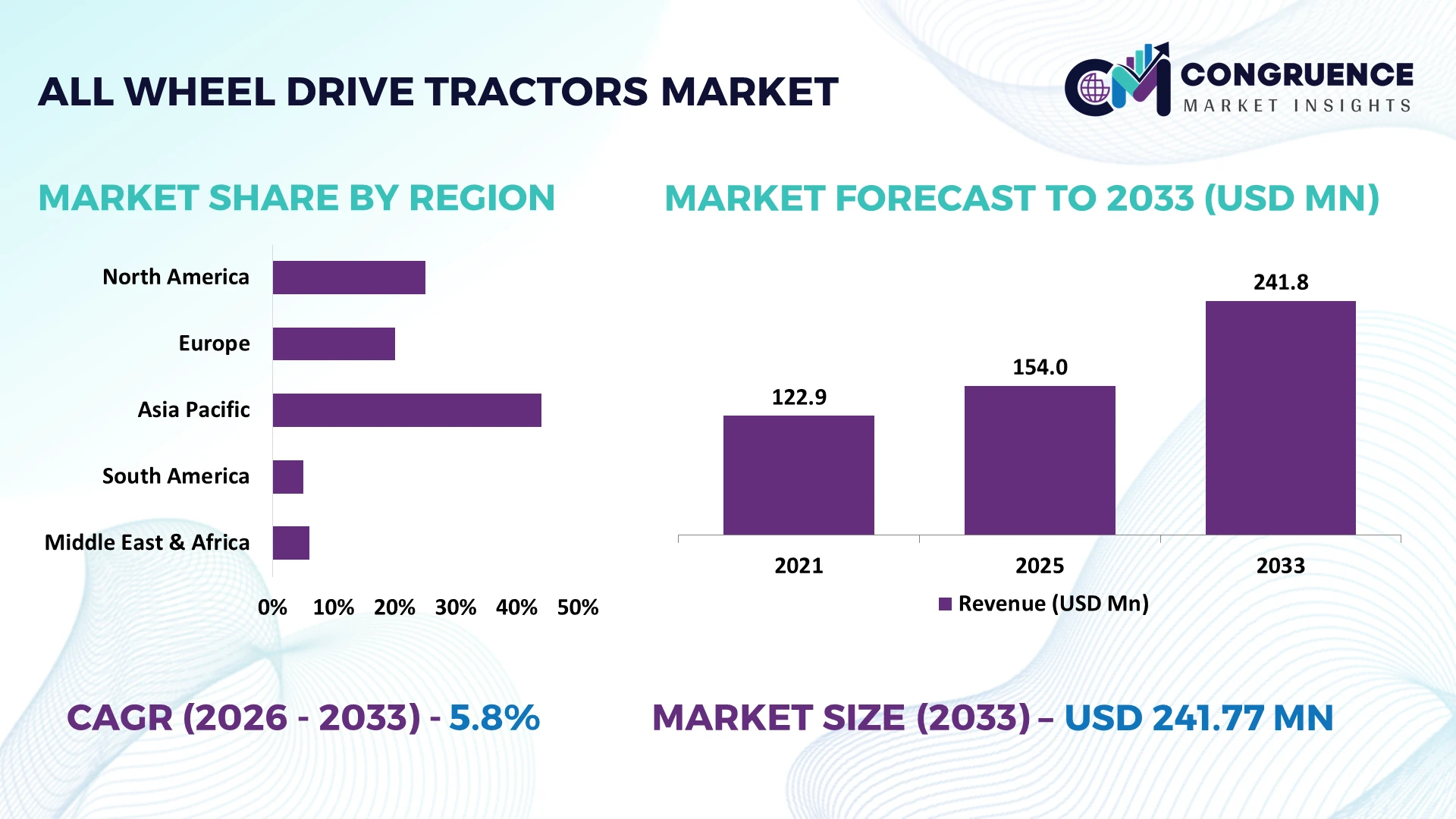
The Global All-wheel Drive Tractors Market was valued at USD 154 Million in 2025 and is anticipated to reach a value of USD 241.77 Million by 2033 expanding at a CAGR of 5.8% between 2026 and 2033. Growth is driven by farm mechanization, higher-horsepower implement use, traction requirements on difficult terrain, precision-agriculture integration, and replacement of two-wheel-drive tractors in intensive farming operations.
India provides the strongest volume base, with annual domestic tractor sales exceeding 900,000 units and four-wheel-drive configurations gaining traction in orchards, wetland farming, haulage, and heavy-implement applications. Agriculture supports roughly 46% of India’s workforce, sustaining mechanization investment, while manufacturers including Mahindra, TAFE, and Sonalika are widening 4WD portfolios. Compared with India’s volume-led market, the United States concentrates more heavily on high-horsepower AWD machinery. Supply-chain diversification following geopolitical trade disruptions is also increasing localization of drivetrains, axles, and electronics.
Manufacturers should prioritize localized 4WD platforms, precision-ready electronics, and application-specific horsepower ranges to convert mechanization spending into defensible dealer-led market share.
Market Size & Growth: USD 154 million in 2025 reaches USD 241.77 million by 2033 at 5.8% CAGR, driven by higher-horsepower mechanization.
Top Growth Drivers: Farm mechanization 38%, heavy-implement adoption 34%, and difficult-terrain productivity 28% underpin AWD tractor purchasing.
Short-Term Forecast: By 2028, automated guidance and traction management can reduce field overlap by approximately 5–10%, improving fuel and input efficiency.
Emerging Technologies: RTK guidance, AI-assisted implement control, telematics, and continuously variable transmissions are strengthening precision AWD platforms.
Regional Leaders: Asia-Pacific approaches USD 115 million, North America USD 62 million, and Europe USD 48 million by 2033, led by precision adoption.
End-User Trends: Indian tractor sales exceed 900,000 units annually, providing substantial conversion potential for 4WD configurations.
Pilot/Case Example: In 2025, centimeter-level RTK systems delivered approximately 2.5-centimeter positioning accuracy, improving repeatable field operations.
Competitive Landscape: Mahindra holds a strong volume position, competing with John Deere, Kubota, CNH, AGCO, and regional specialists across horsepower classes.
Regulatory & ESG Impact: EU agricultural policy allocates 25% of direct payments to eco-schemes, strengthening demand for precision-compatible machinery.
Investment & Funding: India’s agricultural infrastructure framework carries approximately USD 12 billion equivalent financing capacity, supporting mechanization-linked rural assets.
Innovation & Future Outlook: 4-wheel traction, autonomous guidance, and 10% lower overlap are shifting purchasing toward digitally integrated, implement-ready tractor platforms.
The All-wheel Drive Tractors Market serves row-crop farming, orchards, vineyards, wetland cultivation, livestock operations, haulage, and heavy-implement applications where four-wheel traction improves usable drawbar power. Modern platforms increasingly combine electronically controlled transmissions, differential management, RTK guidance, telematics, and automated implement functions; precision positioning can reach approximately 2.5-centimeter accuracy. India provides exceptional mechanization volume, while North American farms emphasize higher-horsepower equipment and European buyers increasingly integrate precision systems with environmental compliance. Localization of axles, transmissions, electronics, and hydraulic components amid continuing geopolitical supply-chain realignment is becoming strategically important, establishing the operating context for investment and competitive positioning.
All-wheel drive tractors are becoming strategically important as farms combine higher-capacity implements with precision operations and tighter labor availability. India sells more than 900,000 tractors annually, creating a large conversion base for 4WD configurations, while manufacturers are localizing transmissions, axles, hydraulics, and electronics to reduce exposure to geopolitical supply-chain disruptions. The market is consequently shifting from traction-focused machinery toward digitally integrated field platforms.
RTK-guided AWD tractors can achieve approximately 2.5-centimeter positioning accuracy, versus operator-dependent conventional steering, reducing field overlap by roughly 5–10% in repetitive operations. India emphasizes affordable mechanization and mid-horsepower versatility; the United States concentrates on high-horsepower row-crop platforms, while Europe combines AWD capability with precision input management. These differences require localized power, implement, and software configurations rather than standardized global portfolios.
Through 2026–2028, automated steering, implement connectivity, telematics, variable-rate control, and intelligent traction management will penetrate more mid-range platforms. A 4WD tractor using RTK guidance can repeat planting and spraying paths while minimizing unnecessary passes. Mahindra, John Deere, Kubota, CNH, and AGCO are expanding connected machinery ecosystems and dealer capabilities. Competitive advantage will depend on combining traction, implement compatibility, digital precision, localized service, and affordable lifecycle economics.
Larger implements and intensified field operations are increasing the value of four-wheel traction because engine power must translate efficiently into usable drawbar performance. India’s annual tractor market exceeds 900,000 units, while agriculture supports approximately 46% of national employment, creating a substantial mechanization base. Properly configured 4WD systems can improve traction by roughly 10–20% under demanding soil conditions compared with equivalent two-wheel-drive operation, particularly during tillage and haulage. Rising labor costs and tighter planting windows are reinforcing demand for machines capable of completing heavier tasks with fewer passes. Mahindra, Sonalika, TAFE, John Deere, and Kubota are expanding 4WD options across additional horsepower bands. Strategically, manufacturers that pair traction with locally relevant implements can capture upgrades without forcing farmers into oversized tractors.
All-wheel drive tractors require front-drive axles, additional differentials, stronger driveline components, larger tires, and more complex maintenance than comparable two-wheel-drive machines. Purchase premiums commonly reach approximately 10–20%, while the additional drivetrain can increase service complexity and replacement-part requirements. This matters in India, where small and marginal holdings account for more than 85% of agricultural holdings and equipment economics depend heavily on annual utilization. Imported electronics, precision receivers, hydraulic components, and specialized driveline parts also remain exposed to currency and international supply-chain movements. Low-utilization farmers struggle to recover the additional 4WD investment despite productivity benefits. Manufacturers are reducing this constraint through localized components, financing programs, shared-equipment channels, modular specifications, and longer service packages. The operational priority is lowering cost per productive tractor-hour rather than simply reducing acquisition price.
The strongest opportunity lies in transferring precision capabilities from high-horsepower tractors into affordable mid-range 4WD platforms. RTK guidance can deliver approximately 2.5-centimeter accuracy and reduce repetitive field overlap by around 5–10%, lowering unnecessary fuel, seed, fertilizer, and chemical application. India’s massive tractor installed base creates an attractive pathway for factory-ready guidance and retrofit systems, while European eco-schemes allocate 25% of direct-payment funding to environmentally beneficial practices, strengthening precision-agriculture economics. Manufacturers can differentiate through ISOBUS connectivity, automated steering, variable-rate application, telematics, and intelligent traction control rather than horsepower alone. John Deere, CNH, AGCO, Mahindra, and Kubota are expanding digital ecosystems and dealer support. The non-obvious opportunity is software-enabled aftermarket value: precision upgrades can generate recurring service relationships throughout a tractor’s working life.
Connected AWD tractors create execution requirements that conventional mechanical platforms avoided. RTK steering, telematics, electronic hydraulics, transmission controllers, sensors, and implement communication must operate reliably across dust, vibration, heat, and inconsistent rural connectivity. Positioning accuracy can reach approximately 2.5 centimeters, but correction-signal interruptions immediately reduce automated guidance performance. In India, more than 85% of agricultural holdings are small or marginal, making specialized technical support difficult to scale economically across dispersed villages. Cybersecurity also becomes relevant as remote diagnostics and machine data increasingly connect tractors with cloud platforms. OEMs must strengthen dealer technician training, offline-capable software, diagnostic tools, interoperable implement standards, and remote support. The decisive challenge is making sophisticated digital functionality serviceable locally; technology that increases workshop dependency can erase the productivity advantage farmers purchased.
Transmission Automation Expands Across Horsepower Classes: Powershift, continuously variable, and electronically controlled transmissions are moving beyond premium tractors into mid-range AWD platforms. Automated gear selection can lower fuel consumption by roughly 5–10% during variable-load work while reducing operator interventions. John Deere, CNH, AGCO, and Kubota are integrating engine-transmission controls, responding to skilled-operator shortages and demand for consistent field productivity across longer working shifts.
Factory Telematics Reshapes Fleet Management: Connected tractors increasingly transmit location, engine hours, fuel consumption, fault codes, and utilization data, giving contractors and large farms visibility across 10–100+ machine fleets. Remote diagnostics can shorten troubleshooting time by 15–30% by identifying faults before technician dispatch. OEMs are expanding cloud dashboards, dealer connectivity, and proactive maintenance programs, turning aftersales support into a measurable equipment-availability advantage.
Compact Four-Wheel Platforms Gain Traction: Specialized farms are shifting toward maneuverable AWD tractors for orchards, vineyards, livestock facilities, and confined material handling. Models below roughly 75 horsepower increasingly combine four-wheel traction with loaders, narrow dimensions, and hydrostatic transmissions. Indian and Japanese manufacturers are widening compact portfolios as farm diversification increases. The non-obvious shift is attachment economics: one compact AWD platform can replace several dedicated low-utilization machines.
Localized Components Reduce Supply Exposure: Manufacturers are increasing regional sourcing of axles, castings, tires, hydraulics, and electronics after semiconductor shortages and geopolitical logistics disruptions exposed centralized supply chains. Localization can shorten component lead times by 10–20% and reduce imported-content exposure. Mahindra, TAFE, Kubota, and global OEMs are strengthening supplier clusters around major production bases, improving inventory responsiveness while supporting faster model customization for local farming conditions.
Utility Tractors account for approximately 38–42% of all-wheel drive tractor demand because they combine moderate horsepower, implement versatility, manageable ownership economics, and suitability across cultivation, haulage, mowing, loading, and livestock operations. Their broad application envelope makes AWD economically defensible across both commercial farms and diversified smaller holdings. Row-Crop Tractors represent a mature high-value category, particularly in the United States, where wide implements and intensive field schedules favor higher horsepower and sophisticated transmissions. Articulated Tractors remain concentrated in large-scale operations requiring maximum traction and drawbar performance.
Compact Tractors are the fastest-growing type as orchards, livestock farms, landscaping operations, and specialized producers require maneuverability without sacrificing four-wheel traction. Compact platforms represent roughly 20–25% of demand, while Orchard Tractors maintain a specialized position through narrow dimensions and low-profile configurations. Manufacturers are expanding hydrostatic transmissions, loaders, enclosed cabins, and attachment compatibility. Investment is shifting toward modular utility and compact platforms because broader implement utilization improves dealer inventory economics and customer asset productivity.
Tillage represents approximately 30–35% of all-wheel drive tractor application demand because primary and secondary soil preparation impose sustained drawbar loads where four-wheel traction directly affects wheel slip, field speed, and implement depth consistency. Plowing remains another traction-intensive application, particularly in heavier soils, while Land Preparation combines leveling and seedbed operations across varied terrain. Properly managed AWD operation can reduce excessive wheel slip by roughly 10–15 percentage points under demanding field conditions, supporting more consistent implement performance.
Planting is the fastest-strengthening application as guidance, section control, and electronically integrated implements increase the value of stable tractor positioning. Harvesting applications rely on AWD where field trafficability deteriorates, while Material Handling benefits from improved stability and traction when loaders operate on loose or uneven surfaces. Manufacturers are integrating automated steering, electronic hydraulic controls, front-linkage systems, and configurable transmissions. Purchasing decisions increasingly evaluate productivity across multiple applications rather than maximum drawbar capability alone, favoring tractors capable of switching efficiently between seasonal workflows.
Large Farms account for approximately 40–45% of all-wheel drive tractor demand because extensive acreage, heavier implements, narrow operating windows, and high annual machine utilization support investment in higher-horsepower AWD platforms. These buyers increasingly specify powershift or continuously variable transmissions, telematics, guidance preparation, and integrated implement controls. Agricultural Contractors form another equipment-intensive segment because individual machines accumulate substantially more annual operating hours than tractors serving single farms, making fuel efficiency, service response, and residual value critical procurement metrics.
Small and Medium Farms are the fastest-expanding buyer group as compact and utility AWD tractors broaden access to four-wheel traction without requiring high-horsepower machinery. Plantations prioritize specialized configurations for orchards and perennial crops, while Government Agricultural Operations support mechanization programs, demonstrations, and institutional farming. Manufacturers are responding with financing, lower-horsepower 4WD variants, attachment packages, dealer-based servicing, and contractor partnerships. The strategic shift is toward utilization-based value: buyers increasingly assess how many seasonal tasks one tractor can economically perform.
Asia-Pacific accounted for the largest market share at 42% in 2025 however, Asia-Pacific is expected to register the fastest growth, expanding at a CAGR of 6.8% between 2026 and 2033.

High-Horsepower Precision Farming Shapes Procurement
North America accounts for approximately 27% of global all-wheel drive tractor demand, supported by large commercial farms, high mechanization intensity, and extensive row-crop production. The United States concentrates deployment across the Midwest, Great Plains, and California, where AWD platforms support large planters, tillage equipment, grain carts, and material handling. Large farms increasingly specify automated steering, powershift or continuously variable transmissions, telematics, and implement connectivity. RTK systems delivering approximately 2.5-centimeter accuracy strengthen the economics of repeatable passes across extensive acreage. Labor availability is also accelerating automation investment because one operator increasingly manages wider implements and digitally coordinated tasks. John Deere, CNH, and AGCO are integrating machine controls, cloud-based fleet monitoring, and dealer diagnostics, shifting competition toward productive field hours rather than horsepower alone.
United States Market Outlook: The United States provides the region’s strongest technology and deployment base through large-scale corn, soybean, wheat, cotton, and specialty-crop operations. Farms exceeding 2,000 acres account for a disproportionate share of agricultural production, supporting high-capacity AWD equipment. Strong dealer networks and established precision-agriculture infrastructure enable rapid deployment of guidance, telemetry, electronically controlled transmissions, and connected implements.
Precision Compliance Reshapes Equipment Investment
Europe represents approximately 23% of global all-wheel drive tractor demand, with Germany, France, Italy, the United Kingdom, and Spain providing substantial deployment. Mechanization is mature, shifting purchasing priorities from basic tractor availability toward fuel efficiency, precision application, operator comfort, and implement interoperability. EU agricultural policy directs 25% of direct payments toward eco-schemes, strengthening incentives for equipment that supports controlled inputs and environmentally focused farming practices. AWD tractors equipped with ISOBUS, automated steering, variable-rate controls, and continuously variable transmissions help operators coordinate field operations while limiting unnecessary passes. Germany and France emphasize high-capacity row-crop platforms, whereas Italy supports substantial specialized tractor demand for vineyards and orchards. AGCO, CNH, CLAAS, SAME Deutz-Fahr, and John Deere are competing through precision integration, efficient transmissions, connected service, and increasingly software-defined machine functions.
Germany Market Outlook: Germany combines intensive agricultural mechanization with strong domestic engineering and machinery distribution. Large cereal, rapeseed, maize, and livestock operations support sophisticated AWD tractors, while domestic manufacturing capabilities strengthen transmission, hydraulic, electronics, and implement integration. Precision guidance with centimeter-level positioning is increasingly relevant as farms pursue lower overlap, controlled traffic, and more consistent field execution.
Mechanization Scale Supports Portfolio Expansion
Asia-Pacific accounts for approximately 42% of global all-wheel drive tractor demand, supported by India’s enormous tractor market, Japanese technology leadership, Chinese agricultural modernization, and mechanization expansion across Southeast Asia. India records more than 900,000 annual domestic tractor sales, providing the region’s largest conversion pool for four-wheel-drive configurations. Japan concentrates advanced compact machinery, automated controls, and specialized rice-farming equipment, while China continues upgrading agricultural equipment toward higher productivity and digital operation. Diverse farm structures favor AWD products ranging from sub-50-horsepower compact tractors to high-horsepower machines for large grain operations. Mahindra, TAFE, Kubota, Yanmar, Sonalika, and global OEMs are widening localized 4WD portfolios, transmission choices, and attachment ecosystems. Local manufacturing is strategically important because affordable drivetrains and dealer service determine whether AWD technology penetrates beyond premium agricultural operations.
India Market Outlook: India provides unmatched tractor-volume economics and a rapidly widening addressable base for 4WD configurations. Small and marginal holdings exceed 85% of operational holdings, making compact dimensions, implement versatility, financing, and service reach decisive. Maharashtra, Punjab, Haryana, Uttar Pradesh, and southern horticultural belts support differentiated applications ranging from haulage and tillage to orchards and wetland operations.
Large-Scale Cropping Sustains High-Power Demand
South America represents approximately 6% of global all-wheel drive tractor demand, led by Brazil and Argentina, where soybean, maize, sugarcane, cotton, and grain operations require high-capacity field machinery. Brazil cultivates more than 45 million hectares of soybeans, creating extensive requirements for traction-intensive land preparation, planting support, haulage, and material movement. Large commercial farms favor high-horsepower AWD and articulated configurations capable of operating wide implements across extensive acreage. Precision guidance and telemetry are increasingly valuable because equipment productivity directly affects narrow planting and harvesting windows. Currency movements, imported electronics, financing conditions, and long dealer distances complicate fleet replacement economics. John Deere, CNH, AGCO, and regional distribution networks are strengthening localized manufacturing, parts inventories, financing programs, and connected maintenance to protect machine availability during peak agricultural seasons.
Brazil Market Outlook: Brazil anchors regional demand through Mato Grosso, Goiás, Paraná, Rio Grande do Sul, and other major agricultural states. Extensive soybean, maize, sugarcane, and cotton production supports high-utilization tractors with substantial drawbar requirements. Domestic machinery manufacturing and localized dealer infrastructure reduce dependence on fully imported equipment, while precision guidance increasingly improves operating consistency across very large fields.
Food-Security Programs Accelerate Mechanization
Middle East & Africa accounts for approximately 2% of global all-wheel drive tractor demand, with South Africa, Türkiye, Morocco, Egypt, Saudi Arabia, and selected East African markets providing concentrated mechanization activity. AWD adoption is strongest where difficult soils, irrigation farming, commercial estates, and heavy implements require dependable traction. South Africa’s large grain and horticultural operations support higher-horsepower machinery, while Morocco and Egypt emphasize irrigation-intensive cultivation and specialized crop production. Government food-security programs are increasing mechanization attention across Gulf states, although water availability and fragmented agricultural structures constrain equipment utilization in several countries. OEMs are responding with durable drivetrains, simplified electronics, heat-resistant cooling packages, financing, and stronger distributor support. The commercial opportunity concentrates around professionally managed farms where higher annual utilization justifies four-wheel-drive ownership economics.
South Africa Market Outlook: South Africa provides the region’s most established commercial-farming environment, supported by maize, wheat, citrus, grapes, and other export-oriented crops. Large operations require reliable traction and long working hours, particularly during compressed planting periods. Established dealer networks favor advanced AWD tractors with guidance, telematics, high-capacity hydraulics, and comprehensive maintenance packages over equipment lacking dependable local support.
Mahindra, John Deere, CNH, AGCO, and Kubota compete through differentiated horsepower coverage, precision technology, dealer strength, and localized production, while TAFE and Sonalika intensify price competition in volume-sensitive markets. The top five suppliers account for approximately 55–60% of global all-wheel drive tractor demand. Premium platforms command roughly 10–20% higher acquisition prices where automated transmissions, guidance, telematics, and implement integration improve field productivity. Localization can reduce selected component lead times by 10–20%, making supply-chain depth increasingly decisive. John Deere and AGCO emphasize digital ecosystems; CNH combines precision systems with broad tractor portfolios; Mahindra and Kubota leverage manufacturing scale and compact-utility specialization. Competition is shifting from mechanical specifications toward software-enabled productivity and lifecycle support. Dealer density, drivetrain engineering, regulatory certification, financing, and parts availability create substantial entry barriers. Winning requires localized cost structures, dependable service, interoperable precision technology, and application-specific AWD platforms globally.
Deere & Company
CNH Industrial
AGCO Corporation
Mahindra & Mahindra
Kubota Corporation
CLAAS
SDF Group
TAFE
Yanmar Holdings
Sonalika Tractors
Argo Tractors
Escorts Kubota
Zetor Tractors
LS Mtron
Current all-wheel drive tractor technology combines electronically managed four-wheel traction with continuously variable transmissions, RTK guidance, telematics, ISOBUS connectivity, and automated hydraulic control. RTK positioning reaches approximately 2.5-centimeter accuracy, while guidance reduces field overlap by 5–10% versus manually steered legacy operation. Variable tire-pressure systems further reduce wheel slip and protect soil, improving usable traction during tillage, planting, and haulage.
Emerging platforms integrate AI-assisted guidance, camera perception, predictive diagnostics, implement automation, and intelligent power distribution. Second-generation autonomous systems now use 16 cameras for 360-degree field visibility, enabling tractors to execute repetitive tillage with reduced operator intervention. Connected diagnostics can shorten troubleshooting by roughly 15–30%, benefiting large farms and contractors where downtime directly disrupts narrow planting windows. OEMs with established dealer networks gain an implementation advantage.
Disruptive development is shifting toward autonomous AWD tractors, software-defined functions, electrified auxiliaries, and cloud-coordinated fleets. Compared with conventional operator-controlled tractors, autonomous platforms extend productive machine hours without proportional labor increases, directly addressing workforce constraints. Between 2026 and 2028, autonomy-ready hardware, centimeter-level guidance, remote software updates, and interoperable implement controls will enter broader horsepower classes. Manufacturers investing now secure recurring software relationships, while farmers gain higher utilization, repeatability, and operational resilience.
August 2024 AGCO introduced Fendt 600 Vario tractors to North America in four models spanning 149–209 horsepower, combining VarioDrive continuously variable transmission with automatic tire-pressure control. The expansion strengthened AGCO’s AWD offering for versatile row-crop, loader, and transport applications. Source: AGCO
January 2025 John Deere unveiled its second-generation autonomous 9RX tractor at CES, using 16 cameras arranged in pods for 360-degree visibility. The AI-enabled system extends autonomous tillage capability, directly addressing labor constraints while enabling faster, higher-capacity field operations. Source: Agriculture
September 2025 CNH completed its largest single agricultural-equipment delivery in India, supplying 234 New Holland tractors and 117 Case IH sugarcane harvesters to Manjra Group. The deployment expanded mechanized sugarcane operations while strengthening CNH’s large-fleet customer presence in Maharashtra. Source: MotorIndia
February 2026 Case IH launched the redesigned Puma tractor series in 155, 165, and 185 horsepower configurations, integrating FieldOps precision technology and CVXDrive or ActiveDrive 8 transmissions. The platform strengthens traction, automation, and operational flexibility across livestock and crop applications. Source: AmericanAgNetwork
The All-wheel Drive Tractors Market Report covers Utility Tractors, Row-Crop Tractors, Orchard Tractors, Compact Tractors, and Articulated Tractors across Plowing, Tillage, Planting, Harvesting, Material Handling, and Land Preparation. End-user analysis includes Large Farms, Small and Medium Farms, Agricultural Contractors, Plantations, and Government Agricultural Operations. Geographic assessment spans North America, Europe, Asia-Pacific, South America, and Middle East & Africa, with Asia-Pacific representing approximately 42% of 2025 demand.
Technology coverage evaluates AWD management, CVTs, RTK guidance, telematics, ISOBUS, AI-assisted automation, autonomous operation, tire-pressure control, and connected diagnostics. The 2026–2033 assessment tracks compact 4WD penetration, precision-ready machinery, localized manufacturing, contractor deployment, and specialized orchard applications. These indicators support equipment investment, portfolio planning, geographic expansion, dealer-network strategy, technology partnerships, and competitive positioning as purchasing shifts toward productive machine hours and integrated digital capabilities.
| Report Attribute/Metric | Report Details |
|---|---|
Market Revenue in 2025 | USD 154 Million |
Market Revenue in 2033 | USD 241.77 Million |
CAGR (2026 - 2033) | 5.8% |
Base Year | 2025 |
Forecast Period | 2026 - 2033 |
Historic Period | 2021 - 2025 |
Segments Covered | By Type
By Application
By End-User
|
Key Report Deliverable | Revenue Forecast, Growth Trends, Market Dynamics, Segmental Overview, Regional and Country-wise Analysis, Competition Landscape |
Region Covered | North America, Europe, Asia-Pacific, South America, Middle East, Africa |
Key Players Analyzed | Deere & Company, CNH Industrial, AGCO Corporation, Mahindra & Mahindra, Kubota Corporation, CLAAS, SDF Group, TAFE, Yanmar Holdings, Sonalika Tractors, Argo Tractors, Escorts Kubota, Zetor Tractors, LS Mtron |
Customization & Pricing | Available on Request (10% Customization is Free) |




