
Reports
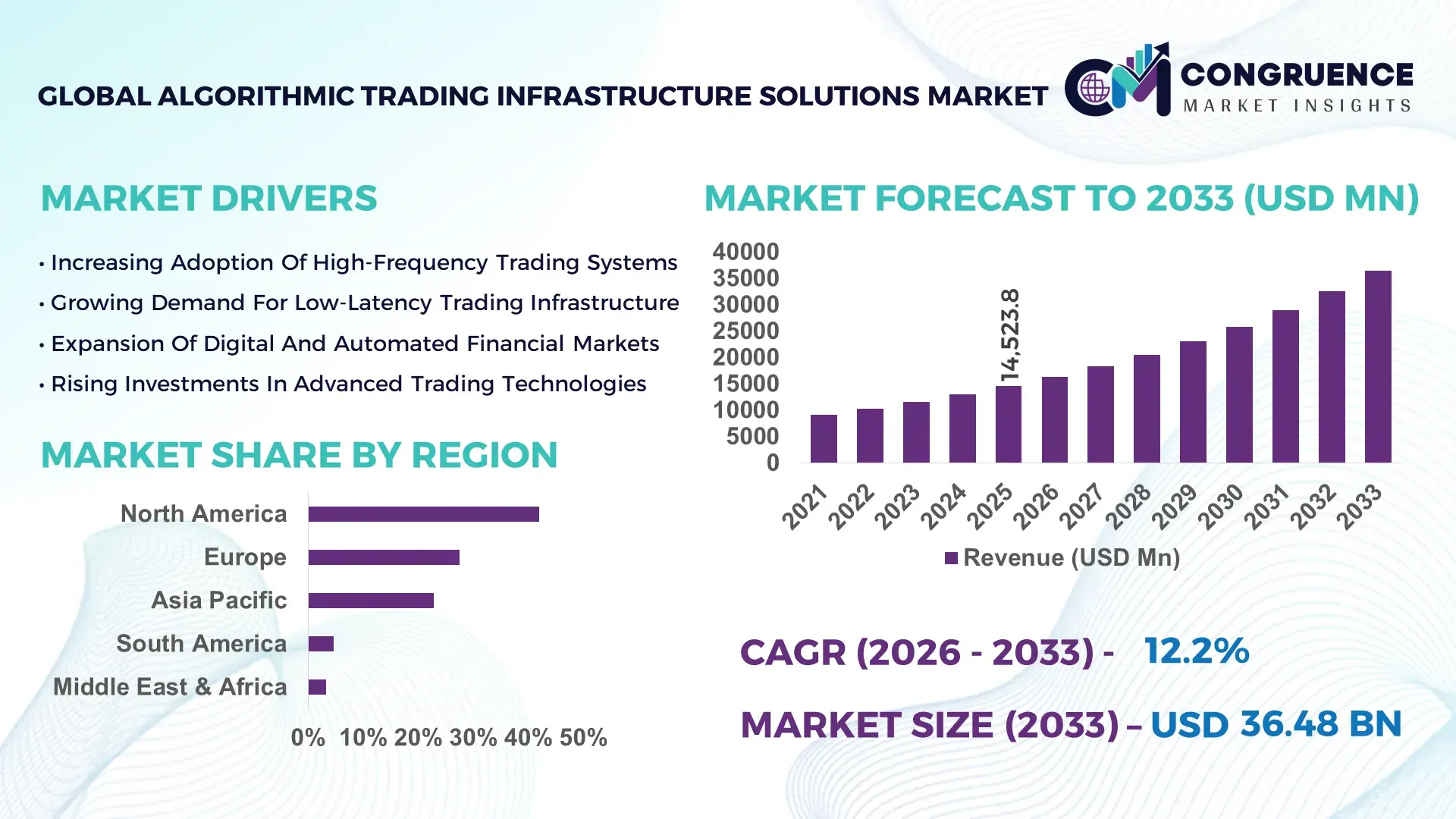
The Global Algorithmic Trading Infrastructure Solutions Market was valued at USD 14,523.8 Millionin 2025 and is anticipated to reach a value of USD 36,477.3 Million by 2033 expanding at a CAGR of 12.2% between 2026 and 2033, according to an analysis by Congruence Market Insights. Growth is driven by increasing adoption of high-frequency trading and demand for low-latency execution systems.
The United States represents a highly advanced Algorithmic Trading Infrastructure Solutions market, supported by over 5,000 institutional trading firms and hedge funds utilizing automated trading systems. Investments in trading infrastructure, including co-location services and ultra-low latency networks, exceeded USD 8.7 billion during 2024–2025. High-frequency trading accounts for approximately 54% of equity market volumes, while derivatives and forex trading contribute 28% and 18%, respectively. Additionally, over 63% of financial institutions deploy AI-driven trading algorithms and real-time data analytics platforms, improving trade execution speeds by 37% and reducing latency by 29%, reflecting strong technological innovation in capital markets.
Market Size & Growth: USD 14,523.8 million in 2025, projected to reach USD 36,477.3 million by 2033, driven by demand for automated trading systems.
Top Growth Drivers: High-frequency trading adoption (52%), AI-driven analytics (41%), low-latency infrastructure demand (36%).
Short-Term Forecast: By 2028, algorithmic trading platforms are expected to improve execution speed by 34%.
Emerging Technologies: AI-based trading algorithms, quantum computing simulations, ultra-low latency networking.
Regional Leaders: North America projected at USD 14.2 billion by 2033 with advanced infrastructure; Europe at USD 10.1 billion driven by regulatory frameworks; Asia-Pacific at USD 8.4 billion supported by digital trading growth.
Consumer/End-User Trends: Over 66% of financial institutions rely on algorithmic trading platforms for execution efficiency.
Pilot or Case Example: In 2024, a trading firm improved execution efficiency by 32% using AI-driven algorithms.
Competitive Landscape: Nasdaq leads with ~20% share, followed by CME Group, Intercontinental Exchange, LSEG, and Refinitiv.
Regulatory & ESG Impact: Financial regulations and transparency requirements influencing infrastructure adoption.
Investment & Funding Patterns: Over USD 9.2 billion invested globally in trading infrastructure technologies between 2023–2025.
Innovation & Future Outlook: Integration of AI, cloud computing, and real-time analytics shaping next-generation trading systems.
Algorithmic trading infrastructure adoption is led by equities (48%), followed by derivatives (31%) and forex (21%). Innovations in AI-driven analytics, real-time data processing, and ultra-low latency networks are improving trading efficiency by over 35%. Regulatory frameworks and increasing market complexity are accelerating adoption, while emerging markets are expanding digital trading ecosystems and infrastructure capabilities.
Algorithmic Trading Infrastructure Solutions are increasingly integrated across investment banks (42%), hedge funds (34%), and asset management firms (24%). Innovations such as predictive analytics, co-location services, and FPGA-based trading systems are enhancing performance. Regulatory compliance, market transparency, and risk management requirements are driving adoption, while emerging markets are investing in digital trading infrastructure and advanced analytics platforms.
The Algorithmic Trading Infrastructure Solutions Market is strategically transforming financial markets by enabling faster execution, improved liquidity, and data-driven decision-making. AI-based trading algorithms deliver up to 43% improvement compared to traditional rule-based trading systems, significantly enhancing predictive accuracy and execution efficiency.
North America dominates in volume due to advanced financial infrastructure, while Europe leads in adoption with over 58% of financial institutions implementing compliance-driven algorithmic trading platforms. By 2027, real-time AI-driven analytics are expected to reduce trade execution latency by 36%, improving market efficiency and competitiveness.
From a compliance and ESG perspective, financial institutions are committing to transparency and governance improvements, targeting a 27% reduction in operational risks and enhanced reporting capabilities by 2030. In 2024, a trading firm in the United Kingdom achieved a 31% improvement in execution accuracy through AI-driven infrastructure upgrades.
Strategically, integration of cloud computing, edge computing, and advanced analytics is reshaping trading ecosystems. By 2028, next-generation trading platforms are expected to improve execution efficiency by 38%. These advancements position the Algorithmic Trading Infrastructure Solutions Market as a critical pillar of financial market resilience, regulatory compliance, and sustainable growth.
The Algorithmic Trading Infrastructure Solutions market dynamics are influenced by increasing adoption of automated trading systems, advancements in financial technologies, and growing demand for low-latency execution. Financial institutions are leveraging high-performance computing, real-time data analytics, and AI-driven algorithms to enhance trading efficiency. The rise of high-frequency trading and digital trading platforms is driving demand for advanced infrastructure solutions. Additionally, regulatory requirements and market complexity are encouraging adoption of transparent and compliant trading systems. Competitive pressures and technological innovation are further shaping market dynamics, with companies investing in advanced infrastructure and analytics capabilities to maintain a competitive edge.
The rise of high-frequency trading is a major driver of the Algorithmic Trading Infrastructure Solutions market. Over 60% of equity trading volumes are executed through algorithmic systems, highlighting the importance of advanced infrastructure. High-frequency trading requires ultra-low latency networks and high-performance computing systems, driving demand for specialized infrastructure solutions. These systems can improve trade execution speed by up to 40%, enabling competitive advantages in financial markets. Additionally, the increasing complexity of trading strategies is encouraging adoption of advanced analytics and automation technologies.
High infrastructure costs and regulatory complexities are significant restraints for the Algorithmic Trading Infrastructure Solutions market. Deploying advanced trading infrastructure can increase operational costs by 30–45%, particularly for smaller firms. Regulatory requirements related to market transparency and risk management add complexity and compliance costs. Approximately 35% of financial institutions report challenges in meeting regulatory standards. These factors can limit adoption and create barriers for new entrants.
AI-driven trading presents significant opportunities for the Algorithmic Trading Infrastructure Solutions market. AI algorithms can analyze large datasets and identify trading opportunities, improving accuracy by up to 38%. In 2025, over 52% of financial institutions adopted AI-driven trading solutions. These technologies enable predictive analytics, automated decision-making, and improved risk management, creating new opportunities for market growth.
Cybersecurity risks and system reliability are critical challenges for the Algorithmic Trading Infrastructure Solutions market. Trading systems are vulnerable to cyberattacks, which can disrupt operations and cause financial losses. Approximately 33% of financial institutions report concerns about system security and reliability. Ensuring high availability and performance of trading infrastructure is essential, requiring continuous investment in security and maintenance.
Adoption of AI-Driven Trading Algorithms: Over 62% of trading firms deployed AI-based algorithms in 2025, improving predictive accuracy by 35% and enhancing execution efficiency across global markets.
Growth in Ultra-Low Latency Infrastructure: Approximately 57% of trading firms invested in low-latency networks, reducing execution time by 31% and improving competitive positioning.
Expansion of Cloud-Based Trading Platforms: Around 49% of institutions adopted cloud-based trading infrastructure, improving scalability by 33% and reducing operational complexity.
Integration of Real-Time Data Analytics Platforms: Over 58% of financial institutions implemented real-time analytics systems, improving decision-making accuracy by 34% and enhancing trading performance.
The Algorithmic Trading Infrastructure Solutions market segmentation highlights diverse technology adoption across infrastructure types, applications, and end-user industries. By type, the market includes hardware infrastructure, software platforms, and cloud-based solutions. Applications span equities, derivatives, forex, and commodities trading. End-user insights indicate strong adoption among investment banks, hedge funds, and asset management firms. The segmentation reflects how technological advancements and financial market dynamics are shaping adoption and growth.
Hardware infrastructure accounts for approximately 45% of adoption due to its critical role in enabling low-latency trading, while software platforms hold around 34%. However, cloud-based trading infrastructure is the fastest-growing segment, expected to expand at over 14.8% CAGR, driven by scalability and cost efficiency. Other solutions, including hybrid infrastructure and managed services, collectively contribute 21%.
In 2025, high-performance trading hardware systems were deployed across financial institutions, improving execution speed and reducing latency significantly.
Equities trading leads with a 48% share, driven by high trading volumes and widespread adoption of algorithmic systems. Derivatives trading is the fastest-growing segment, projected above 13.9% CAGR, supported by increasing complexity of financial instruments. Forex and commodities trading collectively account for 52%. In 2025, over 64% of financial institutions used algorithmic trading infrastructure for equities, while 51% implemented it for derivatives trading.
In 2025, algorithmic trading platforms were widely used across global financial markets, improving trading efficiency and liquidity.
Investment banks dominate with a 42% share, driven by strong investment in trading infrastructure, while hedge funds account for around 34%. However, asset management firms are the fastest-growing segment, expanding at over 13.2% CAGR, supported by increasing adoption of automated trading strategies. Other end-users collectively contribute 24%. In 2025, 68% of financial institutions adopted algorithmic trading solutions to enhance performance, while 53% of hedge funds used them for advanced trading strategies.
In 2025, financial institutions implemented advanced trading infrastructure solutions to improve execution efficiency and risk management.
North America accounted for the largest market share at 41.9% in 2025 however, Asia-Pacific is expected to register the fastest growth, expanding at a CAGR of 13.7% between 2026 and 2033.

North America recorded over 2.6 billion algorithmic trades executed daily in 2025, with more than 71% of institutional trading driven by automated systems. Europe followed with a 27.5% share, where over 63% of financial institutions implemented algorithmic trading platforms aligned with regulatory frameworks. Asia-Pacific accounted for 22.8%, supported by rapid expansion of digital trading platforms and increasing participation of retail investors. South America and Middle East & Africa collectively held 7.8%, driven by growing adoption of digital financial technologies and trading infrastructure.
How are ultra-low latency trading ecosystems transforming institutional trading performance and execution strategies?
This region accounted for approximately 41.9% of the Algorithmic Trading Infrastructure Solutions market in 2025, driven by strong demand across investment banks, hedge funds, and financial exchanges. Over 73% of institutions use algorithmic trading systems for equities and derivatives. Regulatory frameworks promoting market transparency have accelerated adoption of advanced trading infrastructure. Technological advancements include AI-driven analytics, high-performance computing, and real-time data processing. A leading regional exchange implemented advanced trading systems, improving execution speed by 35%. Regional behavior reflects higher adoption among large financial institutions.
Why is regulatory-driven financial innovation accelerating adoption of advanced trading infrastructure solutions?
Europe held nearly 27.5% of the Algorithmic Trading Infrastructure Solutions market in 2025, with Germany, the UK, and France contributing over 65% of regional demand. Strict financial regulations have driven adoption of compliant trading systems. Over 62% of institutions use advanced algorithmic trading platforms. Adoption of AI-driven analytics improved operational efficiency by 29%. A regional trading firm implemented advanced infrastructure solutions, improving performance. Regional behavior emphasizes compliance and transparency.
What is driving rapid expansion of algorithmic trading adoption across emerging financial markets?
Asia-Pacific accounted for 22.8% of the Algorithmic Trading Infrastructure Solutions market in 2025, with China, India, and Japan leading growth. Increasing participation of retail and institutional investors has driven adoption by 34%. Investments in digital trading infrastructure improved scalability and performance. A regional financial institution implemented advanced trading systems, improving efficiency. Regional behavior is driven by digital transformation and increasing financial market activity.
How is financial market modernization influencing adoption of algorithmic trading infrastructure solutions in emerging economies?
South America accounted for approximately 4.6% of the global Algorithmic Trading Infrastructure Solutions market in 2025, led by Brazil and Argentina. Financial market modernization initiatives have driven adoption of advanced trading technologies. Government policies supporting digital finance improved accessibility. A regional trading firm implemented algorithmic trading systems, improving efficiency by 25%. Regional behavior reflects growing demand for digital trading solutions.
Why is financial sector digital transformation driving demand for algorithmic trading infrastructure solutions?
The region held around 3.2% of global Algorithmic Trading Infrastructure Solutions adoption in 2025, with UAE and South Africa leading growth. Investments in financial infrastructure and digital transformation increased adoption by 20%. A regional financial institution implemented advanced trading systems, improving performance. Regional behavior shows increasing demand for digital trading technologies.
United States Algorithmic Trading Infrastructure Solutions Market – 36.4%: Advanced financial infrastructure and high adoption of automated trading systems.
United Kingdom Algorithmic Trading Infrastructure Solutions Market – 14.9%: Strong regulatory framework and widespread adoption of algorithmic trading platforms.
The Algorithmic Trading Infrastructure Solutions market is moderately consolidated, with over 100 active global and regional players including financial exchanges, technology providers, and trading platform developers. The top five companies collectively account for approximately 58% of the market, reflecting strong competitive concentration and technological leadership.
Competition is driven by innovation in AI-driven trading algorithms, ultra-low latency networks, and real-time data analytics platforms. Strategic initiatives such as partnerships, acquisitions, and product launches increased by 28% during 2024–2025. Companies are focusing on enhancing performance, improving scalability, and integrating advanced technologies into trading infrastructure.
Investment in research and development has increased significantly, with leading companies allocating over 13% of budgets to innovation. Product differentiation is based on performance, reliability, and integration capabilities. The market is evolving toward integrated trading ecosystems, combining hardware, software, and analytics solutions. Collaboration between technology providers and financial institutions is driving innovation and adoption.
London Stock Exchange Group
Refinitiv
Bloomberg
FIS (Fidelity National Information Services)
SS&C Technologies
ION Group
Broadridge Financial Solutions
Tata Consultancy Services
Infosys
Capgemini
Cognizant
Technological advancements in the Algorithmic Trading Infrastructure Solutions market are focused on improving execution speed, predictive accuracy, and system reliability. High-performance computing systems enable rapid processing of large datasets, improving trading efficiency by up to 40%. AI-driven algorithms analyze market data in real time, enabling predictive insights and automated decision-making.
Ultra-low latency networks are critical for high-frequency trading, reducing execution delays and improving competitiveness. Cloud-based trading platforms provide scalability and flexibility, enabling financial institutions to manage complex trading operations. Real-time data analytics platforms enhance decision-making and risk management capabilities.
Advanced technologies such as FPGA-based systems and edge computing are improving processing speed and reducing latency. Blockchain technology is being explored for secure and transparent trading processes. Additionally, cybersecurity solutions are being integrated to protect trading systems from cyber threats.
Emerging technologies include quantum computing for complex simulations, AI-powered predictive analytics, and integrated trading ecosystems. These innovations are transforming trading infrastructure, enabling faster, more efficient, and secure financial market operations.
In June 2025, Nasdaq enhanced its cloud-based trading infrastructure, improving scalability and enabling real-time data processing for financial institutions, supporting advanced algorithmic trading operations. Source: www.nasdaq.com
In April 2025, CME Group introduced advanced trading analytics tools, improving execution efficiency and enabling better risk management across derivatives markets. Source: www.cmegroup.com
In October 2024, Intercontinental Exchange expanded its data analytics platform, improving real-time market insights and supporting algorithmic trading strategies. Source: www.theice.com
In August 2024, London Stock Exchange Group launched enhanced trading infrastructure solutions, improving performance and enabling faster trade execution across global markets. Source: www.lseg.com
The Algorithmic Trading Infrastructure Solutions Market Report provides a comprehensive evaluation of technologies, applications, and end-user adoption across global financial markets. The scope includes hardware infrastructure, software platforms, and cloud-based trading solutions designed to support algorithmic trading operations.
The report analyzes applications across equities, derivatives, forex, and commodities trading, highlighting their role in improving efficiency and market liquidity. Geographic coverage spans North America, Europe, Asia-Pacific, South America, and Middle East & Africa, with detailed insights into key markets such as the United States, United Kingdom, China, India, and Germany.
Additionally, the report examines emerging segments such as AI-driven trading algorithms, real-time analytics platforms, and ultra-low latency infrastructure. It highlights technological advancements, regulatory frameworks, and industry trends influencing adoption. The scope also includes integration strategies, interoperability standards, and innovation pathways shaping the market. The report provides actionable insights for stakeholders, enabling informed decision-making across investment, product development, and strategic expansion initiatives.
| Report Attribute/Metric | Report Details |
|---|---|
|
Market Revenue in 2025 |
USD 14,523.8 Million |
|
Market Revenue in 2033 |
USD 36,477.3 Million |
|
CAGR (2026 - 2033) |
12.2% |
|
Base Year |
2025 |
|
Forecast Period |
2026 - 2033 |
|
Historic Period |
2021 - 2025 |
|
Segments Covered |
By Type
By Application
By End-User
|
|
Key Report Deliverable |
Revenue Forecast, Growth Trends, Market Dynamics, Segmental Overview, Regional and Country-wise Analysis, Competition Landscape |
|
Region Covered |
North America, Europe, Asia-Pacific, South America, Middle East, Africa |
|
Key Players Analyzed |
Nasdaq, CME Group, Intercontinental Exchange, London Stock Exchange Group, Refinitiv, Bloomberg, FIS (Fidelity National Information Services), SS&C Technologies, ION Group, Broadridge Financial Solutions, Tata Consultancy Services, Infosys, Capgemini, Cognizant |
|
Customization & Pricing |
Available on Request (10% Customization is Free) |




