
Reports
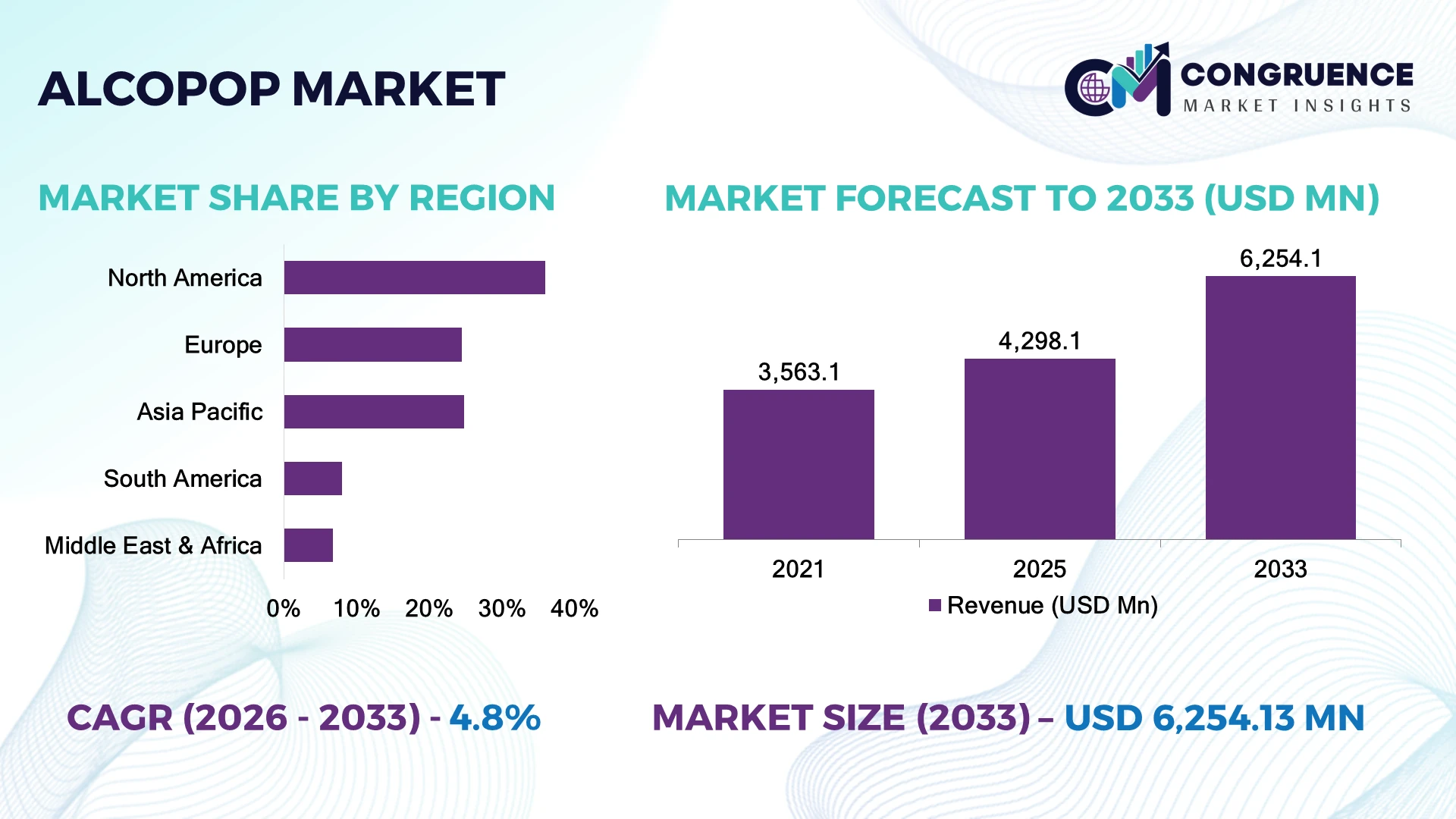
The Global Alcopop Market was valued at USD 4,298.1 Million in 2025 and is anticipated to reach a value of USD 6,254.1 Million by 2033 expanding at a CAGR of 4.8% between 2026 and 2033. Growth is being driven by premium flavor innovation, portable single-serve formats, spirit-based RTDs, and consumers shifting toward convenient, occasion-specific alcoholic beverages.
The United States remains the dominant commercial hub, supported by a mature RTD distribution network and strong canned-cocktail innovation. In 2025, U.S. spirits-based RTDs reached approximately USD 3.8 billion, rising 16.4% year over year, while global beverage-alcohol purchasing increasingly reflected moderation and premiumization. India presents a contrasting high-growth environment, where RTD formats expanded 11% during the first half of 2025 as premium drinking occasions strengthened. The continuing normalization of RTDs amid global trade tensions is accelerating portfolio repositioning toward differentiated formats.
Strategically, producers should prioritize premium RTD innovation, localized flavor profiles, efficient canning capacity, and channel-specific distribution rather than competing solely on volume.
Market Size & Growth: USD 4.30 billion in 2025 to USD 6.25 billion by 2033 at 4.8% CAGR, supported by premium RTDs and convenient single-serve formats.
Top Growth Drivers: Flavor innovation 16.4%, RTD adoption 11%, premiumization 8% are reshaping purchasing priorities across major alcohol markets.
Short-Term Forecast: By 2028, premium RTD portfolios are positioned to improve product-mix contribution by 8–12% as brands expand higher-value canned cocktails.
Emerging Technologies: Digital flavor development, automated canning, and lightweight packaging are improving production consistency by approximately 5–8% while accelerating seasonal launches.
Regional Leaders: North America is projected near USD 2.2 billion, Europe around USD 1.6 billion, and Asia-Pacific approximately USD 1.5 billion, with canned RTDs gaining distribution penetration.
Consumer Trends: Approximately 41% of UK consumers and 27% of U.S. consumers report shopping the broader RTD category, reinforcing convenience-led consumption.
Pilot/Case Example: In 2025, U.S. spirits-based RTDs generated 16.4% sales growth, demonstrating how pre-mixed formats are outperforming traditional alcohol categories.
Competitive Landscape: Large beverage groups including Diageo, Bacardi, Pernod Ricard, Brown-Forman, and Anheuser-Busch InBev are competing with specialist RTD brands through premiumization and distribution scale.
Regulatory & ESG Impact: Moderation is strengthening portfolio diversification, with 44% of UK drinkers reporting use of alcohol-free or low-alcohol products in 2025.
Investment & Funding: RTD captured approximately 50% of beverage-alcohol innovation spending in recent industry tracking, directing investment toward packaging, flavors, and limited releases.
Innovation & Future Outlook: Premium cocktails, lower-ABV variants, variety packs, and recyclable aluminum formats will shift competition toward occasion-specific positioning and faster product rotation.
The Alcopop Market is shifting from traditional sweet, low-ABV flavored drinks toward more sophisticated RTD propositions featuring spirit bases, botanical flavors, reduced-sugar formulations, and premium packaging. Approximately 12.5% of total beverage-alcohol dollar sales were represented by the broader RTD/RTS category by mid-2025, strengthening the strategic importance of convenient formats. In 2026, manufacturers are increasingly balancing flavor experimentation with tighter regulatory scrutiny, packaging efficiency, and shelf-space productivity, creating opportunities for brands that can combine differentiated taste with scalable production and strong retail execution.
The Alcopop Market is becoming strategically relevant because beverage companies are using RTDs to capture occasions that traditional beer, spirits, and wine formats serve less efficiently. The competitive shift is particularly visible in the United States, where spirits-based RTDs reached nearly USD 4 billion in 2025 despite broader softness across beverage alcohol. This is moving investment toward portable formats, premium flavor systems, and faster innovation cycles.
Technology is also changing economics. Automated filling, inline quality inspection, and digitally controlled blending can reduce production variability by approximately 5–8% compared with less automated processes, while lightweight aluminum packaging improves logistics efficiency. North America emphasizes scale and brand distribution, whereas India and other Asian markets are adding demand through premiumization and rapidly expanding modern retail channels.
Over the next 2–3 years, producers are expected to increase variety-pack penetration, lower-sugar formulations, and premium spirit-based recipes while tightening SKU productivity. Companies are responding through co-manufacturing partnerships, localized flavor development, and selective capacity expansion. The strategic winners will be brands that combine recognizable positioning with disciplined innovation, efficient packaging, and distribution strength across high-frequency consumption occasions.
Flavor-led product innovation is reshaping alcopop purchasing, with fruit-forward, botanical, and lower-sugar variants capturing an estimated 35%–40% of new product launches. In the United States, younger legal-drinking-age consumers increasingly favor convenient, ready-to-drink formats, while approximately 20%–25% of category innovation is shifting toward reduced-sugar or lower-calorie formulations. The United Kingdom’s continued expansion of flavored ready-to-drink portfolios reinforces this structural shift. Producers are responding through rapid SKU rotation, contract manufacturing, and partnerships with flavor houses. The non-obvious advantage is shorter innovation cycles: brands that localize flavor profiles can improve shelf relevance without rebuilding core production infrastructure, strengthening distributor negotiations and reducing inventory exposure.
Excise-tax escalation and volatile packaging costs constrain alcopop margins, particularly for products sold in price-sensitive channels. Aluminum, glass, and flavoring inputs can collectively represent roughly 25%–35% of packaged product costs, while taxation can account for more than 20% of retail pricing in heavily regulated markets. The United Kingdom’s alcohol-duty framework and tighter affordability scrutiny increase pricing sensitivity, while currency movements raise imported ingredient costs for smaller producers. Companies are responding through regional sourcing, longer supplier contracts, lightweight cans, and concentrated flavor systems that reduce logistics intensity. The strategic pressure is clear: producers with flexible packaging procurement and localized bottling gain greater margin protection than brands dependent on imported components and centralized manufacturing.
The strongest whitespace lies in low-sugar, functional, and premium alcopop extensions that bridge conventional alcoholic beverages and modern wellness-oriented consumption. Reduced-sugar formulations already represent an estimated 20%–30% of new product development activity, while premium botanical and fruit-infused variants can command substantially higher shelf positioning than standard formulations. In Japan, South Korea, and selected European markets, sophisticated flavor profiles and smaller serving formats create opportunities for differentiated launches. Advances in natural sweeteners, micro-encapsulated flavors, and precision blending are improving sensory consistency while lowering reformulation friction. Producers are investing in R&D partnerships and localized pilot batches, with the strategic opportunity shifting from volume-led distribution toward higher-value occasions and targeted consumer microsegments.
Alcopop producers face increasing execution complexity as labeling, advertising, packaging, and alcohol-duty requirements diverge across countries. Regulatory changes can force 10%–15% or more of a multinational portfolio to undergo packaging or formulation revisions, while fragmented SKU requirements increase artwork, compliance, and inventory-management workloads. Digital-age traceability and stricter responsible-marketing expectations add further operational controls. Australia, the United Kingdom, and the United States illustrate materially different compliance environments, complicating standardized launches. Companies are addressing this through modular packaging systems, centralized regulatory databases, and regional compliance teams. The deeper challenge is maintaining brand consistency while adapting formulations and claims quickly; scalable compliance infrastructure is becoming a competitive capability rather than a back-office function.
Lower-Sugar Formulation Shift Reduced-sugar variants are becoming a core innovation pathway, accounting for an estimated 20%–30% of recent product-development activity. Producers are reformulating with alternative sweeteners and smaller serving sizes, responding to health-conscious purchasing and tightening nutritional scrutiny. The operational benefit is portfolio modernization without abandoning established flavor architectures.
Premium Flavor Architecture Expansion Botanical, tropical, citrus, and layered fruit profiles are moving beyond niche positioning, with premium variants estimated to represent 25%–30% of new launches in mature markets. Flavor houses and beverage producers are shortening development cycles through modular concentrates and localized testing. This enables faster SKU turnover and stronger differentiation at retail.
Smaller Formats Gain Traction Single-serve formats of 250–330 ml are gaining importance as producers target moderation, convenience, and controlled portions. Approximately 15%–20% of new packaging activity is shifting toward smaller-format presentations in selected mature markets. Aluminum lightweighting and regional filling partnerships are helping companies reduce transport intensity while improving cold-chain handling and impulse-channel economics.
Digital-Led Portfolio Optimization Beverage companies are increasingly using retail data, social-commerce signals, and rapid consumer testing to refine alcopop launches, with digitally informed product decisions estimated to influence 20%–25% of innovation pipelines. Supply-chain pressure is encouraging shorter production runs and faster replenishment. The non-obvious shift is from mass SKU deployment toward data-guided micro-market launches that limit inventory risk and improve product-market fit.
Spirits-based alcopops are estimated to hold the leading position at approximately 43% of global demand, supported by stronger flavor intensity, premium positioning, and compatibility with established cocktail brands. Malt-based variants remain commercially important at roughly 34%, benefiting from scalable brewing infrastructure and competitive production economics, while wine-based formats account for about 23% and retain relevance in lighter-alcohol positioning. The strategic divide is widening: mature malt formats compete on distribution efficiency, whereas spirits-based products increasingly compete on brand equity and sensory differentiation.
Spirits-based formats are also the fastest-growing type, with adoption expanding as producers introduce botanical, citrus, tropical, and premium cocktail profiles. Companies are increasing investment in 250–355 ml single-serve formats, with approximately 20%–25% of new launches emphasizing portability or portion control. Malt producers are responding with premium flavor extensions, while wine-based producers are prioritizing lighter formulations and localized blends. Investment is therefore shifting toward flexible filling, flavor development, and premium RTD capabilities.
The Distilled Spirits Council reported in February 2026 that U.S. spirits-based RTD cocktails grew 16.4% in 2025, reaching approximately $3.8 billion, reinforcing the strategic momentum behind spirit-led ready-to-drink formats.
Supermarkets and hypermarkets are estimated to represent the leading application channel at approximately 39% of alcopop sales, reflecting broad assortment, promotional capacity, and established alcohol purchasing behavior. Convenience stores follow at roughly 27%, supported by impulse consumption and single-serve formats, while specialty liquor stores contribute about 18%. Online retail and other channels account for the remainder but are becoming strategically relevant as product discovery shifts toward digital platforms and direct brand engagement.
Online retail is the fastest-growing application, supported by approximately 15%–20% annual increases in digital product discovery and stronger availability of niche flavors and premium formats. Convenience stores are simultaneously expanding chilled single-can displays, while supermarkets increasingly use premium shelf blocks and multipack promotions. Companies are adapting through channel-specific packaging, retailer-exclusive flavors, and digitally supported launches. The business implication is a more fragmented route-to-market: scale remains concentrated in supermarkets, but incremental growth is increasingly generated through convenience-led impulse purchasing and digitally enabled discovery.
IWSR reported in October 2025 that U.S. RTD consumption frequency is increasing particularly among Gen Z and Millennials, while RTD share of total beverage-alcohol servings had risen from 4% in 2019 to 8% in 2024, strengthening the case for differentiated retail execution.
Legal-age younger adults represent the dominant end-user group, estimated at approximately 46% of global alcopop consumption, driven by flavor experimentation, portability, social occasions, and preference for convenient serving formats. Established adult consumers account for roughly 34%, typically favoring familiar brands and moderate-strength products, while older consumers represent about 20% and remain more selective. The contrast is commercially important: younger consumers prioritize novelty and packaging, whereas mature buyers place greater weight on taste consistency and brand trust.
The fastest-growing end-user cohort is younger legal-drinking-age consumers, with consumption frequency and category experimentation increasing as RTDs become integrated into casual social occasions. Approximately 25%–30% of recent product innovation is directed toward flavor variety, lower-sugar positioning, or visually distinctive packaging. Producers are responding with social-first brand activation, smaller formats, flavor collaborations, and premium extensions. The strategic opportunity is not simply acquiring younger buyers but converting trial into repeat purchase through differentiated sensory profiles and reliable availability. Brands with flexible portfolios can serve multiple age-defined consumption occasions without fragmenting production excessively.
IWSR reported in 2025 that 61 million consumers entered the global no-alcohol category across ten major markets between 2022 and 2024, while younger legal-drinking-age consumers increasingly prioritize taste, availability, and brand alongside moderation considerations—evidence of a broader shift toward occasion-specific beverage choice.
North America accounted for the largest market share at 35.9% in 2025 however, Asia-Pacific is expected to register the fastest growth, expanding at a CAGR of 6.2% between 2026 and 2033.

Spirit-Based RTDs Reshape a Mature Consumption Base
North America remains the largest alcopop market, supported by extensive off-trade distribution, strong convenience-store penetration, and sophisticated ready-to-drink manufacturing. The United States accounts for the overwhelming share of regional demand, while Canada maintains an 8% RTD share of total beverage-alcohol servings. In 2025, U.S. RTD volumes faced normalization, but spirit-based cocktails continued gaining strategic importance as producers moved beyond hard seltzers toward premium cocktail formats. Manufacturers are expanding flavor portfolios, lightweight canning, and multipack offerings while retailers are allocating more chilled shelf space to high-velocity RTD brands. The region's operational advantage is its mature contract-packaging and distribution ecosystem, enabling faster national launches than emerging markets. Companies increasingly prioritize premiumization and channel-specific innovation rather than broad SKU proliferation, protecting margins while responding to changing consumption occasions.
United States Market Outlook: The United States remains the region's strategic production and consumption center, combining large-scale beverage manufacturing with advanced retail analytics and national distribution networks. RTDs represented 8% of total beverage-alcohol servings in 2024, creating substantial shelf-space competition. Producers are concentrating investment on spirit-based cocktails, premium flavor systems, and single-serve formats, while established logistics infrastructure supports rapid national rollout.
Premiumization Meets Mature Regulatory Economics
Europe represents approximately 24.5% of global alcopop demand, with the United Kingdom, Germany, and France forming important consumption and distribution centers. The market is more mature than North America, making premium flavor architecture, moderation-oriented formats, and packaging differentiation increasingly important. Germany's RTD volumes grew 4% in 2024, while the United Kingdom recorded 19% new-to-category RTD consumers, demonstrating continued recruitment despite category maturity. Producers are responding through lower-sugar recipes, premium botanical profiles, and localized flavor propositions. Regulatory differences across alcohol taxation, labeling, and advertising increase portfolio-management complexity, favoring companies with regional compliance infrastructure and flexible packaging systems.
United Kingdom Market Outlook: The United Kingdom remains a strategically important market because of its developed convenience channel, strong RTD awareness, and sophisticated premium beverage culture. Approximately 19% of RTD consumers were new to the category in 2024, indicating continued recruitment. Producers are focusing on accessible premium formats, flavor-led innovation, and smaller serves while adapting portfolios to evolving alcohol-duty and responsible-marketing requirements.
Japan-Led Innovation Meets Emerging-Market Scale
Asia-Pacific is positioned as the fastest-growing major market as Japan's highly developed chu-hai ecosystem intersects with rising RTD adoption in India, South Korea, and Southeast Asian urban centers. Japan recorded an RTD share of 13% of total beverage-alcohol servings in 2024, substantially above the 3.5% benchmark across ten major markets. India adds a different growth mechanism through expanding premium beverage consumption and modern retail. Producers are adapting flavor profiles to local preferences, strengthening e-commerce availability, and establishing regional manufacturing partnerships. The strategic advantage is portfolio localization: standardized global recipes often underperform compared with market-specific flavor and alcohol-strength configurations.
Japan Market Outlook: Japan provides the region's strongest RTD innovation platform, supported by mature convenience retail, sophisticated canned-beverage technology, and established consumer familiarity with flavored alcoholic formats. RTDs represented approximately 13% of total beverage-alcohol servings in 2024. Manufacturers continue refining fruit, citrus, tea, and lower-alcohol formulations, while convenience-store distribution enables frequent product rotation and rapid testing of localized SKUs.
Brazil Drives Flavor-Led Category Expansion
South America is led by Brazil, where rising RTD penetration, urban consumption, and modern retail development are creating a stronger platform for alcopop expansion. Brazil recorded 12% RTD volume growth in 2024 and another 10% increase in the first half of 2025, demonstrating stronger momentum than several mature markets. Producers are expanding spirit-based cocktails, fruit-forward formulations, and single-serve cans through supermarkets, convenience stores, and licensed venues. However, inflation and weaker overall beverage-alcohol consumption create pressure on price architecture. Companies are therefore balancing premium innovation with accessible pack sizes and domestic sourcing. The non-obvious opportunity lies in localized production: Brazilian manufacturing can reduce imported-input exposure while enabling faster flavor experimentation and regional distribution.
Brazil Market Outlook: Brazil is the region's most strategically significant market because of its large consumer base, established beverage manufacturing infrastructure, and rapidly developing RTD culture. RTD volumes increased 10% in the first half of 2025, despite broader beverage-alcohol pressure. Producers are prioritizing fruit flavors, spirit-based cocktails, and competitively priced cans, while domestic production improves responsiveness to changing retail demand.
South Africa Anchors Emerging RTD Demand
Middle East & Africa remains a smaller alcopop market, but South Africa is emerging as a significant RTD growth center supported by urban retail development, social consumption occasions, and expanding flavor-led portfolios. RTD volumes in South Africa increased 12% in 2024 and 9% during the first half of 2025, placing the country among the fastest-growing established markets. Producers are expanding locally relevant fruit flavors, convenient can formats, and modern-trade distribution. Regulatory differences and alcohol-availability restrictions across Middle Eastern markets constrain geographic uniformity, making South Africa a more commercially accessible launch platform. Companies are consequently concentrating investment on licensed markets and localized manufacturing rather than pursuing broad regional standardization.
South Africa Market Outlook: South Africa offers the strongest commercial platform in the region, combining established beverage manufacturing, urban retail infrastructure, and rapidly increasing RTD consumption. RTD volumes rose 9% in the first half of 2025, while total beverage-alcohol volume increased 4%. Producers are expanding fruit-forward formulations and convenient formats, positioning domestic production and localized distribution as key competitive advantages.
Global spirits companies such as Diageo, Pernod Ricard, Bacardi, and Beam Suntory compete directly with brewer-led RTD portfolios from AB InBev and regional flavor-focused producers. The top five players are estimated to control approximately 28% of global alcopop and RTD value, leaving substantial fragmentation across local brands. Competition centers on premium positioning, flavor innovation, distribution reach, and packaging economics, with premium RTDs commanding roughly 15%–25% higher price points and spirit-based variants gaining about 3% volume advantage over mature malt formats. Players are expanding through brand extensions, contract manufacturing, retailer partnerships, and localized flavor development. Pernod Ricard is scaling Malibu and Jameson formats, while Diageo is sharpening selective RTD investment. The competitive shift is moving from hard-seltzer scale toward premium cocktails, higher-value occasions, and supply-chain flexibility. Entry barriers include brand recognition, alcohol distribution licenses, shelf access, and formulation expertise. Winning requires differentiated flavors, disciplined pricing, rapid launches, and superior route-to-market execution.
Diageo plc
Pernod Ricard S.A.
Bacardi Limited
Beam Suntory Inc.
Anheuser-Busch InBev SA/NV
The Coca-Cola Company
Heineken N.V.
Molson Coors Beverage Company
Carlsberg Group
Asahi Group Holdings, Ltd.
Brown-Forman Corporation
Constellation Brands, Inc.
Mark Anthony Brands International
Suntory Holdings Limited
Digital formulation platforms, automated blending, and inline quality-control systems are becoming important in alcopop production, particularly for spirit-based RTDs. Automated dosing can improve ingredient consistency by 5%–10% and reduce batch-adjustment requirements by approximately 8%. Producers are integrating machine vision, digital batch records, and predictive maintenance to shorten changeovers. Larger manufacturers benefit most because standardized data architectures allow multiple facilities to reproduce recipes with tighter sensory tolerances.
Emerging technology is shifting toward natural flavor encapsulation, precision carbonation, lightweight aluminum packaging, and lower-energy filling systems. Lightweight cans can reduce packaging material usage by roughly 8%–15%, while advanced flavor systems improve stability and shelf consistency by approximately 10%. Adoption is strongest among premium RTD producers launching multiple seasonal SKUs. Compared with conventional formulation and packaging workflows, digitally coordinated production can improve line efficiency by approximately 12%–18%, creating a meaningful advantage for companies managing high SKU complexity.
Between 2026 and 2028, AI-assisted demand forecasting and automated flavor optimization will become more commercially relevant, allowing producers to align short production runs with retailer-level demand signals. Companies with vertically integrated formulation, packaging, and analytics capabilities will benefit most. The strategic priority is not technology adoption alone but integration across R&D, manufacturing, inventory, and route-to-market systems, enabling faster launches with lower waste and tighter working-capital control.
October 2025 Pernod Ricard relaunched Jameson Ginger & Lime in a 330ml RTD can, up from 250ml, while UK RTDs grew 13% in value. The larger format strengthened convenience positioning and supported wider on-the-go consumption through EFL activation. Source: pernod-ricard.com
July 2025 Bacardi relaunched BREEZER in the UK with three new fruity flavors—Zesty Orange, Zingy Lime, and Crisp Watermelon—using a Manchester activation with 40+ attendees. The move refreshed distribution and repositioned the established RTD for younger occasions. Source: bacardilimited.com
September 2024 Bacardi and Coca-Cola announced BACARDÍ & Coca-Cola RTD, targeting initial European and Mexican launches in 2025. The partnership combined two established brands in a scalable cocktail format, strengthening premium convenience positioning and expanding international RTD distribution. Source: bacardilimited.com
2025 Diageo intensified its selective RTD strategy across priority markets, reporting strong performance from Bulleit, Ketel One Cocktail Collections, and newly launched Casamigos RTDs. The company also targeted $625 million in cost savings, supporting more efficient innovation and commercial execution. Source: diageo.com (www.diageo.com)
The Alcopop Market Report covers the global category across type, application, end-user, and regional dimensions, with emphasis on malt-based, spirit-based, and wine-based formats; supermarkets, convenience stores, specialty retail, and online channels; and younger legal-age, mainstream adult, and premium-oriented consumer groups. Regional analysis spans North America, Europe, Asia-Pacific, South America, and the Middle East & Africa, including high-potential markets such as the United States, United Kingdom, Japan, Brazil, India, and South Africa.
The report evaluates flavor innovation, low-sugar formulations, lightweight packaging, automated filling, digital demand forecasting, premium RTD development, and emerging cocktail formats. It assesses adoption patterns, channel shifts, product launches, competitive positioning, and localized manufacturing strategies. The analysis supports portfolio planning, market-entry decisions, capacity allocation, partnership selection, pricing strategy, and competitive positioning through 2026–2033, with particular attention to premiumization, moderation, and evolving RTD consumption occasions.
| Report Attribute/Metric | Report Details |
|---|---|
|
Market Revenue in 2025 |
USD 4,298.1 Million |
|
Market Revenue in 2033 |
USD 6,254.1 Million |
|
CAGR (2026 - 2033) |
4.8% |
|
Base Year |
2025 |
|
Forecast Period |
2026 - 2033 |
|
Historic Period |
2021 - 2025 |
|
Segments Covered |
By Type
By Application
By End-User
|
|
Key Report Deliverable |
Revenue Forecast, Growth Trends, Market Dynamics, Segmental Overview, Regional and Country-wise Analysis, Competition Landscape |
|
Region Covered |
North America, Europe, Asia-Pacific, South America, Middle East, Africa |
|
Key Players Analyzed |
Diageo plc, Pernod Ricard S.A., Bacardi Limited, Beam Suntory Inc., Anheuser-Busch InBev SA/NV, The Coca-Cola Company, Heineken N.V., Molson Coors Beverage Company, Carlsberg Group, Asahi Group Holdings, Ltd., Brown-Forman Corporation, Constellation Brands, Inc., Mark Anthony Brands International, Suntory Holdings Limited |
|
Customization & Pricing |
Available on Request (10% Customization is Free) |




