
Reports
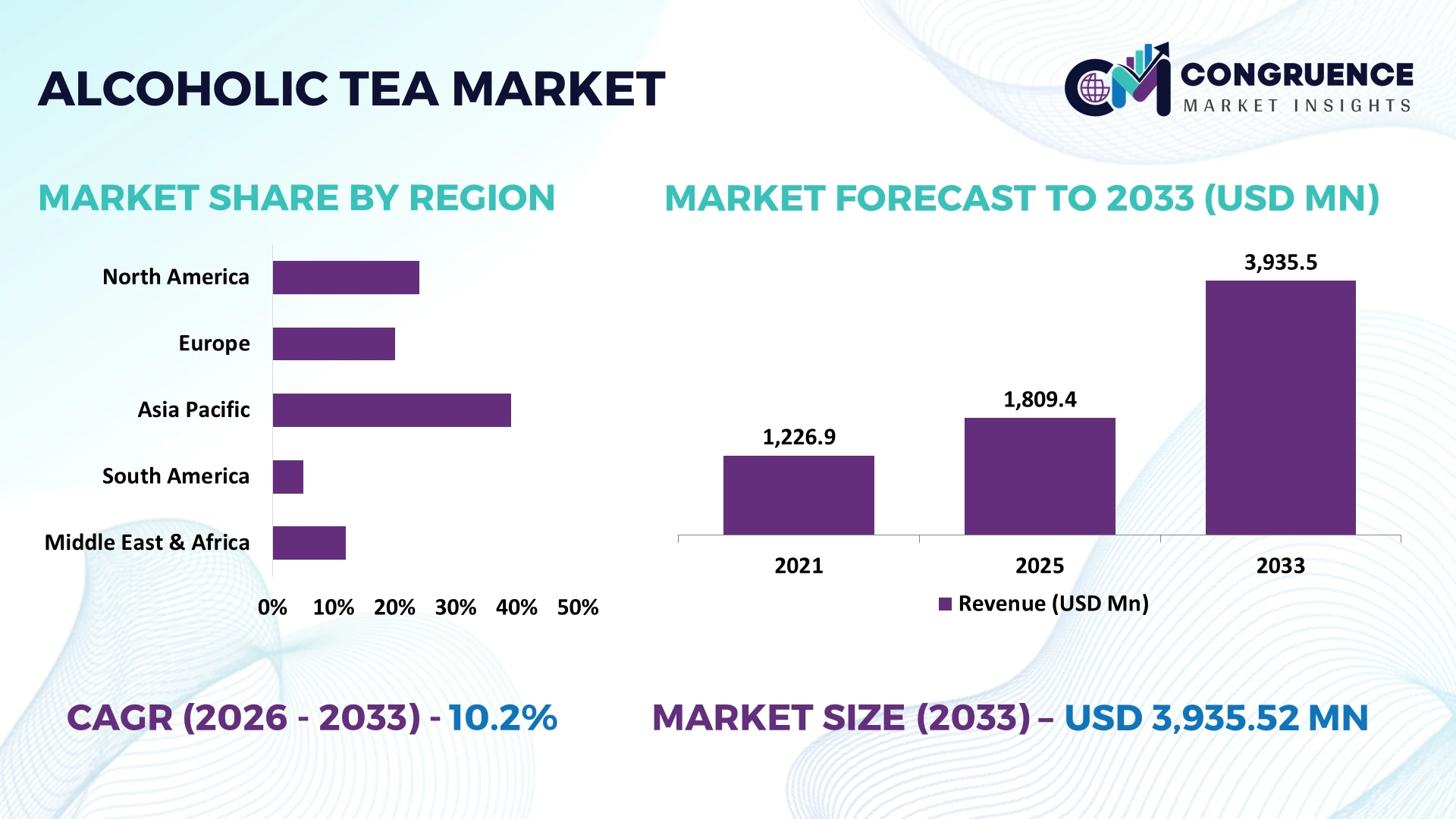
The Global Alcoholic Tea Market was valued at USD 1809.4 Million in 2025 and is anticipated to reach a value of USD 3935.52 Million by 2033 expanding at a CAGR of 10.2% between 2026 and 2033. Growth is accelerating through premium ready-to-drink innovation, botanical flavor development, low-alcohol formulations, and expanded retail distribution across modern beverage channels.
The United States accounts for approximately 34% of global alcoholic tea consumption, supported by large-scale RTD beverage production, premium craft beverage investments exceeding USD 900 million in recent capacity expansions, and automated packaging systems operating across more than 60% of major facilities. Compared with Japan, where premium tea heritage drives higher-value product positioning, the U.S. benefits from broader retail penetration and faster convenience-store adoption. Ongoing tariff adjustments and diversified ingredient sourcing since recent global supply-chain realignments have strengthened production resilience while improving inventory stability.
Companies prioritizing premiumization, manufacturing flexibility, and regional distribution partnerships are positioned to capture stronger competitive advantages as consumer preferences continue shifting toward innovative alcoholic tea beverages.
Market Size & Growth: USD 1809.4 Million in 2025 reaching USD 3935.52 Million by 2033 at 10.2% CAGR, supported by premium RTD innovation and advanced beverage processing.
Top Growth Drivers: Premium RTD demand contributes 38%, low-alcohol preference 29%, and organized retail expansion 24% to global market momentum.
Short-Term Forecast: By 2027, automated filling and digital quality monitoring reduce production waste by 12% while improving packaging efficiency by 15%.
Emerging Technologies: AI-assisted flavor optimization, automated brewing systems, and smart packaging improve formulation accuracy by 18% and production consistency by 14%.
Regional Leaders: North America exceeds USD 1450 Million, Europe approaches USD 980 Million, and Asia-Pacific surpasses USD 900 Million, driven by premium retail expansion and localized product launches.
Consumer/End-User Trends: Nearly 46% of younger adult consumers prefer flavored alcoholic tea variants with natural botanical ingredients and lower sugar content.
Pilot/Case Example: A 2026 automated beverage production upgrade improved line productivity by 17% while reducing packaging material losses by 11%.
Competitive Landscape: The leading manufacturer holds approximately 12% global share, with competition driven by Boston Beer Company, Suntory, Molson Coors, Diageo, and Anheuser-Busch.
Regulatory & ESG Impact: Lightweight packaging initiatives lower packaging material usage by 16%, while stricter labeling standards strengthen consumer transparency across international markets.
Investment & Funding: More than USD 1.1 billion supports production expansion, strategic partnerships, and regional manufacturing diversification amid evolving global supply-chain strategies.
Innovation & Future Outlook: Functional botanical blends, premium fermentation techniques, and recyclable packaging accelerate next-generation product differentiation and long-term strategic market positioning.
Alcoholic Tea Market demand continues expanding across premium ready-to-drink beverages, hospitality, specialty retail, and modern convenience channels. Product innovation increasingly emphasizes botanical ingredients, reduced sugar formulations, and precision fermentation technologies, with premium flavored variants representing nearly 41% of new launches during 2026. Manufacturers are simultaneously strengthening regional sourcing and packaging resilience to address evolving regulatory requirements and supply-chain optimization, creating a solid foundation for the strategic market assessment that follows.
The Alcoholic Tea Market has become strategically important as beverage manufacturers compete through premium product differentiation, low-alcohol innovation, and diversified distribution models rather than traditional volume expansion. Supply-chain restructuring since recent global logistics disruptions has encouraged producers to localize tea sourcing and expand regional brewing capacity, reducing procurement lead times by nearly 18%. This shift is strengthening operational resilience while attracting investment into premium ready-to-drink production and digitally connected manufacturing facilities.
Technology adoption is reshaping production economics. AI-enabled formulation platforms and automated brewing systems improve batch consistency by approximately 20% while reducing ingredient waste by around 12% compared with conventional manual recipe development. The United States emphasizes large-scale automated production and retail penetration, whereas Japan maintains leadership in premium tea fermentation and high-value botanical product innovation. Over the next two to three years, digital production monitoring is expected to exceed 55% adoption among large beverage manufacturers, improving traceability and accelerating commercial product launches.
A practical example is the deployment of smart packaging and automated quality inspection across premium beverage facilities, enabling faster compliance verification and lower packaging defects. Companies are responding through strategic partnerships with tea suppliers, co-manufacturing agreements, and investments in sustainable packaging technologies. Businesses that combine premium product innovation with resilient sourcing networks and advanced production capabilities will secure stronger competitive positioning and long-term operational advantages.
Premium ready-to-drink alcoholic tea products are reshaping beverage portfolios as consumers increasingly seek botanical ingredients, lower sugar formulations, and balanced alcohol content. Premium flavored variants now represent approximately 42% of new product launches, while automated brewing technologies improve production efficiency by nearly 16% and reduce formulation variability by about 14%. In the United States, convenience retail expansion and premium beverage merchandising have accelerated shelf penetration, encouraging established beverage companies to expand manufacturing capacity. The combination of localized tea sourcing, product innovation, and strategic co-branding partnerships is improving speed to market. Leading companies are investing in advanced brewing systems, premium ingredient procurement, and collaborative product development to strengthen brand differentiation and capture higher-margin consumer segments.
Tea leaf pricing fluctuations, alcohol taxation differences, and varying labeling regulations continue to limit operational scalability across international markets. Seasonal climate variability affects tea harvest quality, while ingredient procurement costs can fluctuate by approximately 15% across sourcing cycles. Compliance expenses have increased by nearly 10% as manufacturers adapt packaging, labeling, and ingredient disclosure requirements across multiple countries. Producers with concentrated sourcing in single-country supply networks remain particularly exposed to procurement disruptions and inventory imbalances. Companies are responding by diversifying supplier portfolios, expanding contract farming arrangements, and increasing localized blending operations to stabilize production costs while improving regulatory flexibility across key consumer markets.
Functional alcoholic tea beverages incorporating botanicals, herbal extracts, and natural ingredients are creating new premium positioning opportunities beyond conventional flavored alcohol products. More than 48% of premium beverage innovation pipelines now emphasize clean-label formulations and sustainable packaging integration. Japan continues advancing precision fermentation and premium tea processing technologies, while digital production analytics improve quality monitoring efficiency by roughly 18%. Smart manufacturing platforms also shorten product development cycles by approximately 14%, enabling faster commercialization of seasonal and limited-edition products. Companies are expanding research collaborations with ingredient specialists, investing in automated formulation technologies, and building innovation ecosystems that combine premium branding with operational efficiency to address evolving consumer preferences.
Maintaining consistent product quality while expanding production across multiple countries remains a significant execution challenge. Premium tea varieties require standardized sourcing, yet quality characteristics can vary by nearly 20% between harvest regions, increasing formulation complexity. Automated production facilities require highly skilled technical personnel, and implementation timelines frequently extend by 15% due to equipment integration and regulatory validation. In the United Kingdom and the United States, evolving alcohol labeling and sustainability requirements add further operational complexity for multinational producers. Companies must strengthen digital quality management, workforce training, and supplier integration while investing in interoperable production systems to maintain premium brand consistency and long-term competitive performance across expanding global operations.
• Premium Flavor Portfolio Expansion: Premium botanical blends, fruit-infused recipes, and seasonal limited editions are reshaping product portfolios, with premium variants accounting for nearly 43% of new launches and botanical ingredients increasing by approximately 27% in formulation pipelines. Following stricter ingredient transparency requirements in several developed markets, manufacturers are reformulating labels and standardizing ingredient sourcing. Beverage companies are accelerating co-development partnerships with tea producers and flavor specialists, reducing product development timelines by nearly 15% while improving portfolio differentiation across retail and hospitality channels.
• Automation Reshaping Beverage Operations: Automated brewing, inline quality inspection, and digital production analytics are becoming standard across large beverage facilities. Automated process monitoring improves batch consistency by around 19% while reducing production downtime by approximately 13%. Labor shortages within beverage manufacturing have accelerated investment in intelligent production systems, particularly in the United States. Producers are restructuring manufacturing workflows, integrating predictive maintenance, and expanding automated packaging capacity to improve throughput and operational reliability without increasing production complexity.
• Regional Sourcing Network Diversification: Companies are shifting from concentrated tea procurement toward multi-country sourcing strategies, reducing supply disruption exposure by nearly 22% and shortening procurement lead times by approximately 17%. Japanese premium tea suppliers increasingly collaborate with international beverage manufacturers to secure quality consistency. Long-term procurement contracts, localized blending facilities, and strategic inventory management are strengthening production resilience while enabling manufacturers to stabilize premium product availability despite changing global trade conditions.
• Digital Retail Channel Integration: Omnichannel beverage distribution is transforming consumer engagement as digital ordering platforms, retailer analytics, and personalized promotions improve inventory planning. Online alcoholic beverage purchasing has expanded by roughly 31% in mature consumer markets, while digital demand forecasting improves stock availability by nearly 16%. Producers are integrating retail data platforms with manufacturing schedules, expanding direct-to-consumer partnerships, and optimizing fulfillment networks. A less obvious outcome is stronger demand forecasting accuracy, allowing premium seasonal launches with lower inventory risk and faster replenishment cycles.
Hard Tea remains the dominant product category, accounting for approximately 46% of market volume due to broad retail availability, scalable production methods, and compatibility with existing ready-to-drink beverage infrastructure. Its lower production complexity and established consumer awareness support efficient commercialization across supermarkets, convenience stores, and hospitality outlets. Tea Beer continues serving consumers seeking craft beverage experiences, while Tea Wine maintains strategic relevance in premium dining and specialty beverage portfolios where higher-value positioning differentiates brands.
Tea Cocktails represent the fastest-growing segment as premium hospitality venues and mixology-focused brands expand botanical beverage offerings. Product launches featuring natural ingredients have increased by nearly 24%, while premium cocktail menus incorporating alcoholic tea have grown by approximately 18% across major urban markets. Manufacturers are responding through collaborative product development, limited-edition releases, and premium packaging innovations. Investment priorities increasingly favor flexible production platforms capable of supporting multiple formulations, allowing companies to address both mainstream retail demand and premium experiential consumption without significant operational duplication.
Retail remains the leading application, representing approximately 48% of overall sales as supermarkets, convenience stores, and liquor retailers provide broad consumer access and high product visibility. Strong merchandising programs, refrigerated display expansion, and premium shelf positioning improve purchase frequency while supporting portfolio diversification. Bars & Pubs continue strengthening premium product visibility through seasonal menus and branded beverage experiences, whereas Restaurants increasingly integrate alcoholic tea into curated food pairing strategies that enhance customer spending.
E-commerce is the fastest-growing application, supported by digital purchasing behavior, personalized recommendations, and improved fulfillment capabilities. Online alcoholic beverage transactions have increased by nearly 30%, while digital inventory systems reduce stock shortages by approximately 15%. Companies are expanding direct-to-consumer platforms, integrating demand forecasting tools, and strengthening retail partnerships to improve product availability. Investment is increasingly directed toward omnichannel fulfillment and consumer analytics, enabling faster product launches and more responsive inventory management across both physical and digital sales environments.
Hospitality remains the largest end-user group, accounting for approximately 41% of alcoholic tea consumption through hotels, resorts, and entertainment venues where premium beverage experiences support higher customer spending. Established hospitality operators benefit from extensive beverage programs, trained service staff, and menu innovation capabilities. Food Service businesses continue expanding alcoholic tea offerings to differentiate beverage menus, while Specialty Stores reinforce premium positioning through curated product selections and knowledgeable consumer engagement.
Individual Consumers represent the fastest-growing end-user category as home consumption and premium ready-to-drink purchasing continue expanding. Direct household purchases have increased by nearly 28%, while premium alcoholic tea adoption among younger adult consumers has risen by approximately 19%. Companies are introducing smaller packaging formats, subscription-based purchasing options, and targeted promotional campaigns to strengthen consumer loyalty. Strategic investment increasingly focuses on personalized marketing, premium branding, and digital engagement ecosystems that improve repeat purchases while balancing demand across commercial and household consumption channels.
North America accounted for the largest market share at 38.4% in 2025 however, Asia-Pacific is expected to register the fastest growth, expanding at a CAGR of 11.6% between 2026 and 2033.
Premium RTD Innovation Drives Scale
North America maintains leadership through mature ready-to-drink beverage infrastructure, advanced contract manufacturing, and extensive retail distribution networks. The region contributes approximately 38.4% of global demand, supported by automated beverage facilities and premium product diversification. More than 62% of large beverage manufacturers have integrated digital production monitoring to improve quality consistency and inventory planning. Strategic collaborations between beverage brands and tea ingredient suppliers continue expanding premium alcoholic tea portfolios while reducing formulation timelines. Investment remains concentrated in automated filling lines, sustainable packaging, and cold-chain logistics, enabling faster nationwide product deployment and stronger shelf availability. Premium retail formats and convenience channels continue reinforcing operational efficiency, while manufacturers strengthen localized sourcing to reduce procurement volatility and improve production resilience.
United States Market Outlook: The United States remains the regional operational center, supported by extensive RTD beverage manufacturing capacity, premium retail penetration, and advanced packaging infrastructure. Nearly 65% of premium alcoholic tea launches originate from U.S.-based beverage producers, while automated quality assurance systems have improved production consistency by approximately 18%. Companies continue investing in flexible production lines, regional distribution hubs, and strategic retail partnerships to accelerate commercialization across both national chains and specialty beverage outlets.
Premiumization Supported by Sustainability Standards
Europe continues strengthening its alcoholic tea market through premium beverage innovation, recyclable packaging adoption, and increasingly transparent ingredient standards. The region represents approximately 27% of global market activity, supported by established hospitality networks and specialty beverage retailers. Sustainable packaging implementation has exceeded 55% among premium beverage producers, while digital compliance systems have shortened regulatory documentation processes by nearly 14%. Beverage manufacturers increasingly prioritize botanical formulations and localized sourcing partnerships to align with evolving consumer expectations. Production modernization and environmentally efficient packaging investments continue improving operational performance while strengthening premium brand positioning across established Western European markets.
Germany Market Outlook: Germany serves as Europe's principal production and distribution hub due to its advanced beverage manufacturing infrastructure and efficient logistics network. Premium beverage manufacturers have expanded automated bottling capacity by approximately 16%, enabling greater production flexibility for innovative alcoholic tea products. Strong food safety compliance systems, research partnerships, and modern processing facilities continue supporting premium beverage innovation and export competitiveness throughout the European market.
Manufacturing Scale Accelerates Premium Adoption
Asia-Pacific is emerging as the fastest-expanding operational hub through abundant tea production, advanced processing capabilities, and increasing premium beverage consumption. The region contributes nearly 24% of global market demand while accounting for over 50% of premium tea raw material availability used in alcoholic tea production. Investments in automated fermentation, export-oriented processing facilities, and premium ingredient traceability continue strengthening manufacturing competitiveness. Beverage companies increasingly establish localized production partnerships to improve supply security and reduce logistics costs. Strong domestic consumption combined with export-oriented production provides manufacturers with diversified commercialization opportunities across both mature and emerging beverage markets.
Japan Market Outlook: Japan remains the technology and premium product leader through advanced tea processing expertise and continuous beverage innovation. More than 58% of premium alcoholic tea formulations launched by leading domestic producers incorporate proprietary botanical blends and precision fermentation techniques. Companies continue investing in premium packaging, automation, and collaborative research programs that enhance product quality while strengthening international premium beverage positioning.
Premium Beverage Diversification Gains Momentum
South America is strengthening its position through expanding premium beverage portfolios, improving retail infrastructure, and rising consumer preference for flavored alcoholic beverages. The region contributes approximately 6% of global market activity, supported by growing urban consumption and expanding modern retail networks. Beverage manufacturers have increased localized production partnerships by nearly 19% to improve distribution efficiency and reduce transportation costs. While logistics infrastructure remains uneven across several markets, investment in regional bottling operations and premium retail channels is improving operational consistency. Companies continue balancing premium positioning with locally adapted product offerings to strengthen commercial competitiveness.
Brazil Market Outlook: Brazil represents the largest commercial opportunity within South America due to its extensive beverage manufacturing base and well-developed retail sector. Premium ready-to-drink beverage launches have increased by approximately 21%, supported by expanding supermarket distribution and regional production investments. Manufacturers continue strengthening domestic supply partnerships and flexible production capabilities to improve responsiveness to changing consumer preferences while supporting nationwide product availability.
Selective Investment Shapes Market Development
The Middle East & Africa market remains highly selective, with commercial activity concentrated in tourism-driven hospitality sectors and selected African beverage markets. The region accounts for approximately 4.6% of global demand, supported by targeted investment in premium beverage distribution and modern hospitality infrastructure. Beverage import and distribution efficiency has improved by nearly 13% through upgraded logistics facilities and warehouse modernization in key commercial centers. Companies focus on premium product positioning, strategic distribution agreements, and carefully targeted market expansion where regulatory frameworks permit alcoholic beverage commercialization. Investment decisions increasingly prioritize operational flexibility and localized market partnerships.
South Africa Market Outlook: South Africa serves as the region's most developed alcoholic beverage manufacturing and distribution market, supported by established brewing infrastructure and sophisticated retail channels. Premium flavored alcoholic beverage launches have expanded by approximately 17%, while automated packaging investments continue improving production efficiency. Companies are strengthening regional logistics partnerships and premium retail distribution strategies to expand alcoholic tea availability across commercial hospitality and specialty beverage markets.
The Alcoholic Tea Market is led by Boston Beer Company, Suntory, Molson Coors, Diageo, and Anheuser-Busch, competing directly with regional craft beverage producers and premium ready-to-drink specialists. The top five players collectively control approximately 48% of the market through manufacturing scale, retail distribution, and product innovation. Global beverage leaders compete on supply-chain efficiency and nationwide retail access, while regional brands differentiate through botanical formulations and localized flavor profiles. Automated production has reduced manufacturing costs by nearly 12%, and digital demand forecasting has improved inventory accuracy by approximately 16%, strengthening competitive execution. Companies continue expanding through co-manufacturing partnerships, premium portfolio launches, sustainable packaging investments, and vertical integration with ingredient suppliers. The competitive landscape is shifting toward premium differentiation and sourcing resilience rather than price alone. Strict alcohol regulations, established retail relationships, and premium brand recognition create significant entry pressure. Sustained success depends on operational flexibility, differentiated innovation, resilient sourcing, and rapid commercialization.
Boston Beer Company
Suntory Holdings
Molson Coors Beverage Company
Diageo plc
Anheuser-Busch
Kirin Holdings
Asahi Group Holdings
New Belgium Brewing Company
Firebrand Brewing Co.
Hoplark
Harney & Sons Fine Teas
Loverboy Inc.
FIFCO USA
The Long Drink Company
Alcoholic tea manufacturers are increasingly deploying automated brewing systems, AI-assisted recipe optimization, and inline quality inspection to improve production consistency and reduce operational losses. Automated brewing improves batch uniformity by approximately 18%, while digital quality monitoring lowers product rejection rates by around 11%. Nearly 58% of large premium beverage facilities have integrated connected production monitoring into daily operations, enabling real-time process control and faster compliance verification. These technologies strengthen operational efficiency, shorten production cycles, and help brands maintain consistent flavor profiles across expanding retail and hospitality channels.
Emerging technologies focus on precision fermentation, smart packaging, and digital supply-chain traceability. Precision fermentation enhances flavor consistency by nearly 15%, while intelligent packaging with QR-enabled consumer engagement increases product interaction by approximately 20%. Around 46% of premium beverage producers are implementing cloud-based production analytics to optimize inventory planning and ingredient utilization. Compared with conventional manual formulation methods, AI-supported recipe development reduces development time by nearly 25%, enabling faster seasonal product launches. Premium brands adopting integrated digital manufacturing gain stronger retail responsiveness than smaller producers relying on conventional production workflows.
Between 2026 and 2028, predictive maintenance, digital twins, and advanced robotics will accelerate operational modernization across alcoholic tea production. Predictive maintenance reduces unexpected equipment downtime by approximately 17%, while robotic secondary packaging improves line throughput by around 13%. Companies investing early in connected manufacturing, automated traceability, and sustainable processing technologies will secure stronger production flexibility, lower operating costs, and faster commercialization, creating a lasting competitive advantage as premium alcoholic tea portfolios continue expanding.
April 2024 Boston Beer Company expanded its Sun Cruiser portfolio by introducing White Tea + Vodka in select U.S. markets, featuring four fruit flavors with 100 calories and 1g sugar per serving, broadening premium RTD tea offerings and strengthening category differentiation. Source: https://www.bostonbeer.com
September 2025 Boston Beer Company launched the limited-edition Truly "No Shade, Just Tea" Raspberry Iced Tea collaboration with JaNa Craig, packaged in 16 oz cans through exclusive online drops, expanding consumer engagement and premium flavored tea visibility.
April 2026 Boston Beer Company introduced Sun Cruiser White Tea + Vodka across multiple U.S. states, offering four non-carbonated flavors with 100 calories and 1g sugar, expanding innovation beyond traditional hard tea and strengthening premium RTD positioning.
May 2026 Boston Beer Company released the Twisted Tea Summer Party Pack in 12-, 24-, and 30-pack formats featuring the new Twisted Lemonade alongside Rocket Pop, reinforcing seasonal portfolio expansion and increasing retail merchandising opportunities. Source: https://www.bostonbeer.com
This report provides comprehensive analysis of the Alcoholic Tea Market across Hard Tea, Tea Wine, Tea Beer, and Tea Cocktails, while evaluating demand across Retail, Bars & Pubs, Restaurants, and E-commerce applications. It further assesses purchasing patterns among Hospitality, Food Service, Specialty Stores, and Individual Consumers across North America, Europe, Asia-Pacific, South America, and the Middle East & Africa. The study reviews production trends, premium product adoption, digital manufacturing technologies, packaging innovation, and evolving distribution strategies influencing competitive performance.
The report examines market participation across leading global beverage manufacturers and emerging premium brands, highlighting deployment trends where automated production exceeds 55% among large-scale facilities and premium product launches account for over 40% of innovation activity. It supports investment planning, expansion strategy, supply-chain optimization, portfolio diversification, and competitive benchmarking while identifying operational priorities, technology adoption pathways, and strategic opportunities expected to shape the Alcoholic Tea Market between 2026 and 2033.
| Report Attribute/Metric | Report Details |
|---|---|
Market Revenue in 2025 | USD 1809.4 Million |
Market Revenue in 2033 | USD 3935.52 Million |
CAGR (2026 - 2033) | 10.2% |
Base Year | 2025 |
Forecast Period | 2026 - 2033 |
Historic Period | 2021 - 2025 |
Segments Covered | By Type
By Application
By End-User
|
Key Report Deliverable | Revenue Forecast, Growth Trends, Market Dynamics, Segmental Overview, Regional and Country-wise Analysis, Competition Landscape |
Region Covered | North America, Europe, Asia-Pacific, South America, Middle East, Africa |
Key Players Analyzed | Boston Beer Company, Suntory Holdings, Molson Coors Beverage Company, Diageo plc, Anheuser-Busch, Kirin Holdings, Asahi Group Holdings, New Belgium Brewing Company, Firebrand Brewing Co., Hoplark, Harney & Sons Fine Teas, Loverboy Inc., FIFCO USA, The Long Drink Company |
Customization & Pricing | Available on Request (10% Customization is Free) |




