
Reports
The Global Alcohol Wipes Market was valued at USD 484 Million in 2025 and is anticipated to reach a value of USD 688.29 Million by 2033 expanding at a CAGR of 4.5% between 2026 and 2033. Growth is driven by standardized hospital infection-control protocols, rising use of 60–70%+ alcohol formulations, and expanding single-use disinfection across medical devices, diagnostics, electronics, foodservice, and institutional facilities.
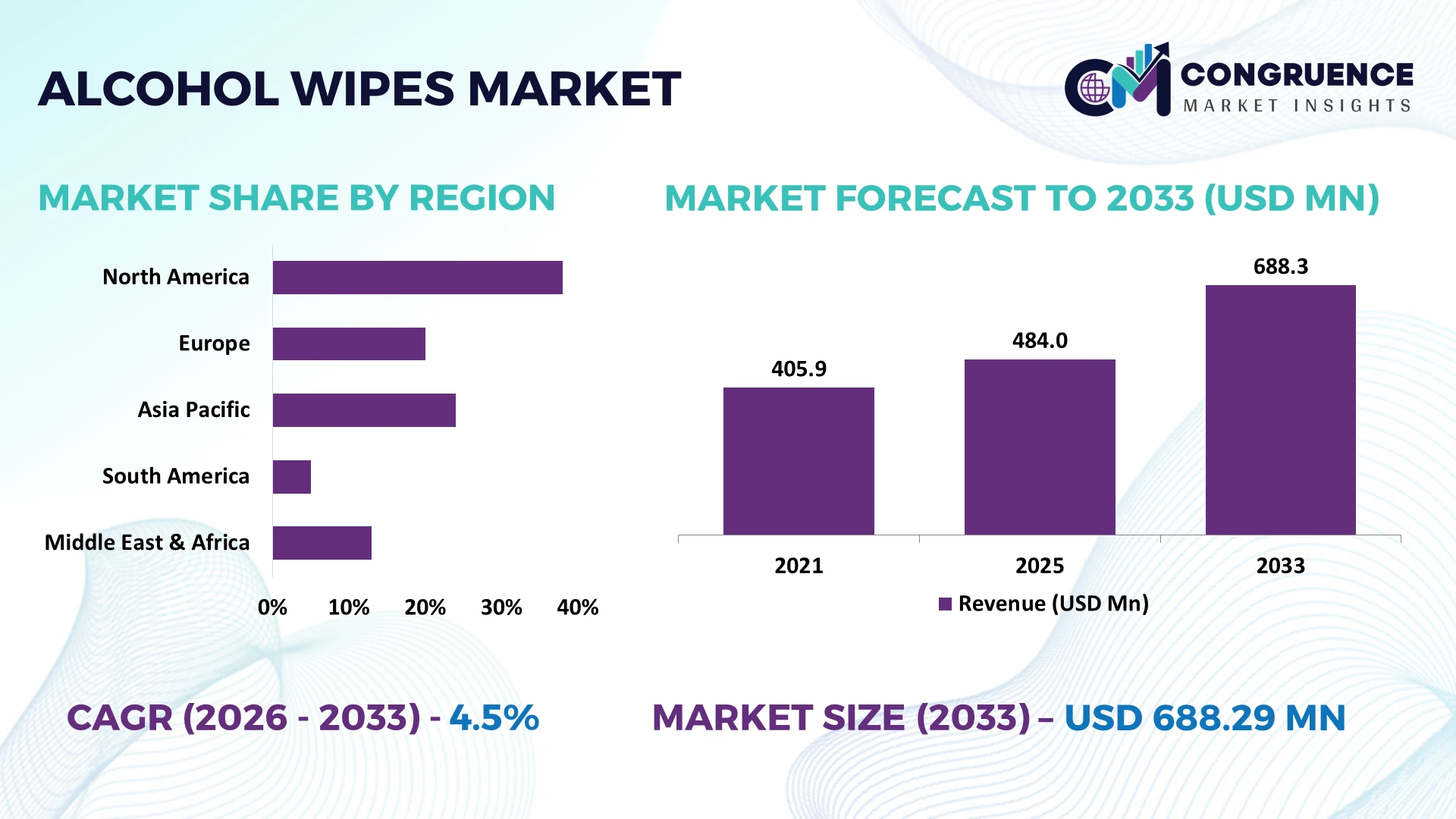
The United States remains the dominant country within North America, a region representing about 40.1% of 2025 alcohol-wipe demand; this equates to roughly USD 194 million against the supplied global baseline. Healthcare, laboratories, pharmaceutical facilities, schools, and commercial cleaning anchor consumption. CDC guidance recognizes sanitizing wipes containing at least 60% alcohol, while 70% isopropyl-alcohol formats remain established in clinical preparation. Compared with Canada, the U.S. benefits from materially larger hospital procurement volumes and broader EPA-regulated surface-disinfection deployment. The post-COVID normalization of institutional hygiene has shifted purchasing from emergency stockpiling toward specification-led replenishment, favoring suppliers with validated efficacy, compliant labeling, automated converting capacity, and reliable North American alcohol and nonwoven sourcing.
For manufacturers and investors, prioritizing U.S. healthcare channels, ≥60% alcohol formulations, and compliant high-throughput production provides the strongest route to defensible Alcohol Wipes Market positioning.
Market Size & Growth: USD 484 million in 2025 advances to USD 688.29 million by 2033 at 4.5%, supported by institutional infection-control procurement and single-use clinical hygiene.
Top Growth Drivers: Healthcare infection-control standardization, 60%+ alcohol efficacy requirements, and expanding commercial sanitation represent the three strongest structural demand drivers.
Short-Term Forecast: By 2028, automated converting and dosing lines are positioned to reduce material losses by approximately 5–8% while improving pack consistency and throughput.
Emerging Technologies: Automated saturation control, vision-based inspection, biodegradable nonwoven substrates, and dual-alcohol formulations are improving dosing accuracy, quality assurance, and product differentiation.
Regional Leaders: North America represents about 40.1%, Asia-Pacific roughly 28%, and Europe around 26%; applying these shares to the 2033 outlook indicates planning values near USD 276 million, USD 193 million, and USD 179 million respectively.
Consumer/End-User Trends: Hand and body sanitizing wipes represented about 32.05% of 2025 category demand, while institutional buyers increasingly specify alcohol concentration, contact time, and substrate compatibility.
Pilot/Case Example: In 2025, CloroxPro introduced Screen+ sanitizing wipes targeting electronics, delivering 99.9% bacterial kill performance while addressing workplace demand for touchscreen-safe cleaning.
Competitive Landscape: Clorox, Reckitt, Cardinal Health, Medline, Kimberly-Clark, GOJO/Purell, and GAMA Healthcare compete through clinical credentials, formulation performance, private-label capacity, and distribution reach.
Regulatory & ESG Impact: CDC guidance establishes at least 60% alcohol for sanitizing hand wipes, while sustainability pressure is accelerating substitution of conventional synthetic substrates with lower-impact and compostable materials.
Investment & Funding: Clorox's approximately USD 570–580 million digital-transformation program strengthens supply-chain, ERP, innovation, and commercial capabilities relevant to its global cleaning and disinfection portfolio.
Innovation & Future Outlook: Dual-alcohol chemistry, automated dosing, recyclable packaging, and application-specific wipes will shift competition from commodity products toward validated, high-performance hygiene platforms through 2033.
Alcohol wipes demand is concentrating across hospitals, diagnostic centers, pharmaceutical facilities, electronics workspaces, hospitality, and institutional sanitation. Products containing at least 60% alcohol retain strong relevance for hand sanitization, while automated saturation control and biodegradable substrates are upgrading manufacturing. EPA-regulated disinfectant procurement in the U.S. reinforces specification-led purchasing, positioning compliant, application-specific wipes as the next strategic battleground.
Alcohol wipes are becoming strategically important as healthcare procurement shifts from basic cleaning consumables toward validated, application-specific infection-control products. U.S. guidance establishes at least 60% alcohol for effective hand-sanitizing formats, while EPA registration governs disinfectant wipes marketed for surfaces. The regulatory shift toward standardized wipe-specific efficacy testing, including ASTM E3363, raises product-development barriers but strengthens differentiation for manufacturers with formulation, testing, and compliance capabilities.
Technology is increasingly separating premium suppliers from commodity converters. Advanced presaturated systems offering 1-minute pathogen contact times can reduce required surface dwell time by 80% versus 5-minute formulations, improving cleaning workflow efficiency in hospitals and laboratories. U.S. institutional deployment emphasizes registered efficacy and rapid contact times, whereas European suppliers face additional substrate redesign pressure because wet wipes containing plastics fall within single-use-plastic marking requirements. These differences increasingly influence localization and material-selection strategies.
Through 2026–2028, investment will concentrate on automated liquid dosing, seal-integrity inspection, low-plastic substrates, and faster-acting formulations. Hospitals deploying 1–3-minute wipes can shorten room-turnover cleaning cycles while reducing protocol variability. Producers are consequently expanding automated converting capacity, strengthening chemical sourcing, and partnering with healthcare distributors. Competitive advantage will increasingly depend on combining validated microbiological performance, production consistency, regulatory readiness, and substrate sustainability.
Healthcare and institutional infection-control requirements remain the strongest structural driver for alcohol wipes. CDC guidance specifies at least 60% alcohol for hand-sanitizing products, while concentrations of 60–95% demonstrate stronger antimicrobial effectiveness than lower-alcohol alternatives. In U.S. healthcare environments, registered surface wipes can carry contact times ranging from 1 to 5 minutes depending on formulation and pathogen claim, directly affecting staff productivity. Standardized efficacy testing under ASTM E3363 is further shifting purchasing toward validated presaturated products rather than loosely specified cleaning wipes. Hospitals, laboratories, ambulances, pharmaceutical facilities, and diagnostics centers therefore prioritize documented concentration, wet-contact performance, and substrate compatibility. Manufacturers are responding through faster-acting chemistry, automated saturation control, expanded healthcare distribution, and regulatory-testing investment. The strategic advantage lies in converting compliance performance into repeat institutional contracts rather than competing primarily on unit price.
Dependence on alcohol feedstocks, synthetic nonwovens, packaging films, and transportation capacity creates a structural margin constraint for alcohol wipe manufacturers. Typical effective sanitizing formulations require 60–95% alcohol, meaning solvent economics materially influence production cost compared with low-active cleaning wipes. At the same time, European rules require specific marking for wet wipes containing plastics, increasing packaging, labeling, and substrate-compliance complexity. Volatile ethanol and isopropanol availability can also tighten when pharmaceutical, chemical, fuel, and sanitation industries compete for the same feedstocks. Because presaturated wipes additionally require moisture-barrier packaging, manufacturers cannot simply substitute lower-cost materials without risking evaporation or efficacy loss. Producers are reducing exposure through dual sourcing, longer chemical-supply contracts, localized converting operations, and cellulose-rich substrate development. Operationally, maintaining formulation stability while lowering material dependency is more valuable than pursuing aggressive capacity additions unsupported by secure inputs.
The strongest opportunity lies in developing alcohol wipes that combine shorter disinfection cycles with lower environmental burden. EPA-listed ready-to-use wipes demonstrate contact times as short as 1 minute, compared with 3–5 minutes for several established formulations, creating potential workflow gains of 67–80% in time-sensitive healthcare environments. Meanwhile, European single-use-plastic requirements are accelerating interest in cellulose, viscose, and other reduced-plastic nonwoven structures. This creates a differentiated opportunity beyond conventional household wipes: high-performance products designed specifically for diagnostic equipment, touchscreen surfaces, pharmaceutical clean zones, ambulances, and rapid patient-room turnover. Producers are investing in automated dosing, substrate engineering, controlled-release saturation, and packaging that limits alcohol evaporation. Partnerships with hospitals and equipment manufacturers can also validate material compatibility. The strategic opportunity is therefore not higher wipe consumption alone, but premiumization around speed, compliance, substrate sustainability, and specialized surface protection.
Scaling alcohol wipes while preserving identical saturation, contact time, seal integrity, and microbiological performance across millions of units remains a critical execution challenge. Effective hand-sanitizing products require at least 60% alcohol, while disinfectant performance depends on keeping surfaces visibly wet for the labeled contact period, which can range from approximately 1 to 5 minutes. Small variations in liquid loading, substrate absorbency, package sealing, or storage temperature can therefore undermine claimed performance. U.S. regulators are also moving toward wipe-specific standardized efficacy evaluation, increasing the importance of reproducible manufacturing rather than formulation strength alone. Companies must integrate gravimetric dosing, machine-vision inspection, leak detection, environmental controls, and tighter supplier qualification into converting lines. Long-term competitiveness depends on proving that high-speed production does not dilute efficacy consistency; scalable quality-control architecture is becoming as strategically important as chemistry innovation itself.
Wipe-Specific Validation Is Tightening: U.S. disinfectant-wipe qualification is shifting toward testing the complete presaturated product rather than extrapolating liquid-formulation results. ASTM E3363 evaluates chemical-to-substrate performance as a packaged unit, while effective hand-sanitizing wipes retain a ≥60% alcohol threshold. Manufacturers are increasing microbiological validation, dosing controls, and package-integrity testing, raising compliance costs but reducing efficacy variability and strengthening institutional procurement credentials.
Individually Wrapped Formats Gain Scale: Single-dose alcohol pads are gaining operational importance in vaccination, diagnostics, diabetes care, and mobile first aid because each sachet limits evaporation and cross-contact. Leading clinical products typically use 70% isopropyl alcohol, while July 2026 U.S. online tracking showed individual prep-pad products reaching about 100,000 monthly units. Converters are expanding high-speed sachet lines and automated counting systems to serve decentralized healthcare workflows.
Substrate Portfolios Are Being Reworked: Synthetic materials still represent more than 80% of alcohol-wipe fabric usage in broader market tracking, but European plastic-marking requirements are accelerating cellulose, viscose, and reduced-plastic alternatives. Natural-material formats are expanding faster than conventional synthetic structures. Suppliers are consequently testing absorbency, tear strength, alcohol compatibility, and moisture retention simultaneously, making substrate engineering increasingly important to both compliance and manufacturing economics.
Clinical Cleaning Becomes Workflow-Based: Hospitals are moving from product-level purchasing toward standardized environmental-cleaning workflows covering patient rooms, treatment areas, equipment, and high-touch surfaces. WHO/UNICEF reported in 2026 that fewer than 60% of healthcare facilities globally achieved basic environmental-cleaning standards. Suppliers are responding with color-coded packs, defined contact-time instructions, dispensing systems, and training partnerships that improve protocol consistency and strengthen recurring institutional contracts.
Alcohol Wipes represent the leading supplied product category, accounting for approximately 31% of demand because they balance broad surface compatibility, scalable converting economics, and use across healthcare, laboratories, first aid, and institutional hygiene. Alcohol Prep Pads follow closely, supported by standardized 70% isopropyl-alcohol formulations for injections and minor procedures. Sterile Alcohol Wipes command higher specification requirements and typically represent about 20–22% of demand, with strongest penetration in invasive procedures, clean clinical environments, and controlled pharmaceutical settings.
Individually Wrapped Wipes are the fastest-expanding format as decentralized diagnostics, diabetes management, vaccination services, and portable medical kits increase single-use requirements. U.S. online sales tracking in July 2026 showed individual alcohol-prep products reaching roughly 100,000 units monthly, illustrating strong convenience-led turnover. Non-Sterile Alcohol Wipes remain important for routine equipment and surface preparation where sterility is unnecessary, preserving a cost advantage over sterile alternatives. Manufacturers are therefore prioritizing automated sachet filling, higher-barrier laminates, and sterile-product validation, shifting capital toward formats that combine dose control, portability, and longer shelf integrity.
Skin Disinfection leads the application mix with an estimated 34% share because alcohol wipes are embedded in injections, venipuncture, minor procedures, vaccination, and routine pre-treatment protocols. Injection Site Preparation represents another mature application, supported by individually wrapped 70% isopropyl pads that provide standardized dosing and rapid evaporation. Medical Equipment Cleaning accounts for approximately 21–23% of usage where manufacturers validate material compatibility with monitors, diagnostic instruments, and non-critical devices.
Surface Disinfection is the fastest-strengthening application as hospitals formalize environmental-cleaning protocols and increase documentation around high-touch surfaces. Products offering 1–3-minute contact periods provide substantial workflow advantages over formulations requiring 5 minutes, especially in patient-room turnover and outpatient settings. First Aid remains smaller but strategically relevant across emergency kits, workplaces, schools, and home healthcare. Suppliers are expanding surface-specific formulations, equipment-safe products, larger institutional canisters, and individually wrapped clinical pads. Investment is increasingly directed toward validated contact-time performance because healthcare buyers prioritize reproducible disinfection outcomes rather than alcohol concentration alone.
Hospitals dominate end-user demand with approximately 38% share because intensive-care units, operating rooms, wards, emergency departments, vaccination services, and diagnostic procedures generate high-frequency wipe consumption. Clinics represent the second-established buyer group, benefiting from smaller pack sizes and individually wrapped pads suited to high patient throughput. Diagnostic Centers account for a growing share as specimen collection, phlebotomy, point-of-care testing, and equipment cleaning require repeatable contamination-control protocols.
Pharmaceutical Facilities are the fastest-growing supplied end-user category as contamination-control programs, controlled manufacturing areas, and equipment-preparation procedures increase demand for validated wipes with consistent saturation and low residue. Research Laboratories similarly prioritize alcohol compatibility, lint control, and packaging integrity where contamination can compromise assays. Institutional procurement increasingly favors bulk contracts, standardized 70% formulations, traceable batches, and application-specific formats. Manufacturers are responding with hospital distributor partnerships, pharmaceutical-grade product lines, differentiated sterile packaging, and volume-based pricing. Competitive positioning is shifting toward suppliers able to serve multiple clinical workflows without compromising validation or supply continuity.
North America accounted for the largest market share at 40.1% in 2025 however, Asia-Pacific is expected to register the fastest growth, expanding at a CAGR of 5.8% between 2026 and 2033.
Clinical Standardization Strengthens Institutional Procurement
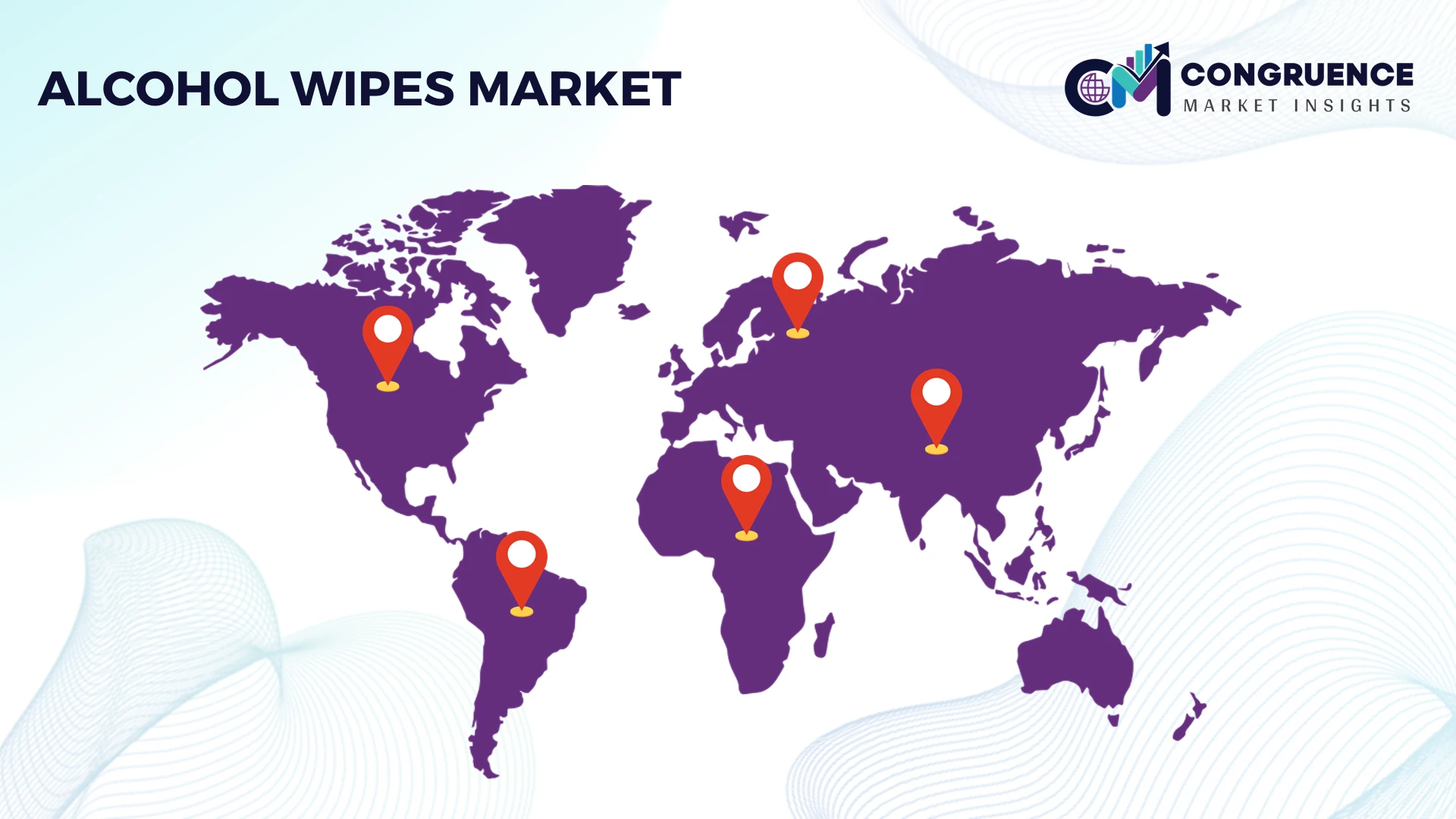
North America represents approximately 40.1% of global alcohol wipes demand, supported by concentrated hospital networks, outpatient facilities, laboratories, pharmaceutical manufacturing, and established infection-prevention procurement. U.S. regulatory frameworks increasingly favor validated, application-specific disinfectant products, reinforcing demand for documented contact times, controlled saturation, and surface compatibility. Alcohol concentrations of 60% or higher remain established for hand-sanitizing applications, while 70% isopropyl formats dominate clinical prep pads. Manufacturers are investing in automated converting, individual sachet packaging, high-barrier films, and faster microbiological validation. Hospital consolidation also favors suppliers capable of fulfilling multi-facility contracts with consistent formulations and traceable production. The operational shift is from emergency hygiene purchasing toward standardized replenishment programs, improving demand visibility for producers with healthcare distribution scale.
United States Market Outlook: The United States leads regional deployment through its large acute-care network, pharmaceutical manufacturing base, diagnostics infrastructure, and regulated disinfectant market. More than 6,000 hospitals create substantial recurring consumption across injection preparation, equipment cleaning, first aid, and environmental hygiene. Suppliers with EPA-aligned surface-disinfection claims and scalable 70% isopropyl-alcohol formats hold a procurement advantage, particularly when integrated with national medical-distribution networks.
Plastic Regulation Reshapes Substrate Strategy
Europe accounts for approximately 26% of global alcohol wipes demand, with healthcare hygiene increasingly intersecting with material sustainability and chemical compliance. The EU Single-Use Plastics framework requires marking for wet wipes containing plastics, making substrate composition commercially important alongside antimicrobial efficacy. Producers are reformulating portfolios around cellulose-rich, viscose, and reduced-plastic nonwovens while maintaining alcohol retention, tear strength, and controlled liquid release. Germany, the United Kingdom, France, Italy, and Spain concentrate hospital and institutional consumption, while pharmaceutical and laboratory applications support higher-specification sterile formats. Manufacturers are redesigning packaging and validating alternative substrates rather than competing solely through alcohol concentration. This transition creates additional qualification expense but rewards suppliers that can combine infection-control performance with lower synthetic-fiber dependency, particularly in institutional tenders incorporating environmental criteria.
Germany Market Outlook: Germany provides a strategically important base through more than 1,800 hospitals, a substantial pharmaceutical manufacturing sector, and highly standardized healthcare procurement. Its infection-prevention requirements support professional-grade disinfection products, while EU plastics policy pushes converters toward lower-plastic substrates. German buyers increasingly reward documented material compatibility and standardized dosing, creating an advantage for technically differentiated clinical-wipe suppliers over commodity importers.
Manufacturing Scale Meets Healthcare Expansion
Asia-Pacific holds approximately 28% of global alcohol wipes demand and combines large nonwoven manufacturing capacity with expanding hospital, diagnostics, pharmaceutical, and consumer-health infrastructure. China supplies substantial spunlace and other nonwoven materials used in wet-wipe converting, giving domestic producers advantages in substrate sourcing, packaging integration, and production scale. Japan maintains stronger penetration of premium hygiene formats, while India is adding healthcare capacity and diagnostic infrastructure that expands institutional consumption. Automated folding, liquid dosing, pouch sealing, and machine-vision inspection are improving high-volume line consistency while reducing dependence on manual quality checks. Suppliers are increasingly locating converting operations near substrate and packaging clusters to compress lead times. The competitive advantage therefore extends beyond low-cost manufacturing toward integrated production ecosystems capable of serving both domestic healthcare channels and export markets.
China Market Outlook: China combines extensive nonwoven manufacturing infrastructure with a hospital network exceeding 38,000 institutions, creating advantages across substrate production, converting, packaging, and distribution. Domestic suppliers can integrate spunlace sourcing with automated wipe lines, shortening procurement cycles. Higher-value opportunities are shifting toward individually packaged, medical-grade, and export-compliant products rather than undifferentiated household formats, encouraging investment in validation and quality automation.
Healthcare Formalization Expands Institutional Demand
South America represents approximately 3–4% of global alcohol wipes consumption, with Brazil accounting for the largest concentration through hospitals, clinics, laboratories, pharmacies, and pharmaceutical production. Institutional demand increasingly favors standardized alcohol concentrations and individually packaged formats rather than manually prepared cotton-and-alcohol alternatives. Brazil's extensive public and private healthcare systems create recurring requirements for injection preparation and clinical hygiene, while Argentina, Colombia, and Chile support smaller but increasingly formalized procurement channels. Local converting can reduce exposure to imported finished wipes, although specialized nonwovens, packaging films, and certain chemical inputs remain supply-chain constraints. Producers are consequently balancing domestic manufacturing with imported substrates and expanding distributor partnerships. Localization is strategically valuable where currency volatility makes finished-product imports less predictable and institutional buyers require dependable replenishment.
Brazil Market Outlook: Brazil anchors regional demand through more than 7,000 hospital establishments and a large pharmaceutical and outpatient-care ecosystem. Domestic alcohol production provides an unusual upstream advantage, although medical-grade substrate and packaging specifications remain critical. Local converters that combine ethanol or isopropanol sourcing with automated sachet production can reduce import exposure and compete more effectively for hospital, pharmacy, and diagnostic contracts.
Healthcare Modernization Raises Specification Levels
Middle East & Africa contributes approximately 3% of global alcohol wipes demand, but procurement quality is becoming more differentiated as Gulf countries modernize hospitals, laboratories, ambulatory facilities, and pharmaceutical production. Saudi Arabia and the UAE lead high-specification institutional adoption, where infection-control programs increasingly favor premeasured, portable wipes over manually prepared disinfectant materials. Saudi healthcare transformation includes substantial hospital and outpatient infrastructure expansion under Vision 2030, supporting standardized consumables procurement. Across parts of Africa, inconsistent distribution, import dependency, and healthcare-resource gaps constrain comparable deployment intensity. International manufacturers are therefore using distributor partnerships and localized inventory rather than immediate large-scale manufacturing. Suppliers that combine stable shelf life, heat-resistant packaging, controlled saturation, and reliable logistics gain an operational advantage in climates where storage conditions can accelerate alcohol evaporation.
Saudi Arabia Market Outlook: Saudi Arabia is the region's most strategically important expansion market, supported by Vision 2030 healthcare modernization and a population exceeding 35 million. New hospitals, specialist facilities, diagnostic networks, and domestic pharmaceutical initiatives are raising procurement standards. Suppliers establishing local distribution, inventory buffers, and healthcare partnerships can outperform import-only competitors where delivery continuity and product stability directly influence institutional purchasing.
Global hygiene leaders such as The Clorox Company, Reckitt, and Kimberly-Clark compete with healthcare specialists including Medline Industries, PDI, and GAMA Healthcare across institutional and clinical channels. The top five suppliers account for approximately 38–42% of market demand, leaving meaningful space for regional converters and private-label manufacturers. Competition centers on validated efficacy, pricing, contact time, substrate performance, and distribution reliability. Fast-acting formulations can reduce labeled disinfection time by 67–80% versus five-minute products, while automated saturation and inspection can lower material losses by roughly 5–8%. Leaders defend hospital contracts through distributor partnerships, application-specific formulations, packaging automation, and integrated nonwoven sourcing. Competition is shifting from commodity alcohol concentration toward complete wipe-system performance, including substrate compatibility and seal integrity. Regulatory testing, microbiological validation, and dependable alcohol sourcing create substantial entry pressure. Winning requires validated efficacy, automated manufacturing, procurement-scale supply continuity, and differentiated formats that deliver measurable workflow advantages for clinical and institutional buyers.
The Clorox Company
Reckitt
Kimberly-Clark Corporation
Medline Industries, LP
PDI, Inc.
GAMA Healthcare Ltd.
Ecolab Inc.
Cardinal Health, Inc.
B. Braun SE
Nice-Pak Products, Inc.
Pal International Ltd.
Schülke & Mayr GmbH
Dynarex Corporation
Uniwipe Europe Ltd.
Current alcohol-wipe technology centers on automated saturation control, high-barrier sachet sealing, and machine-vision inspection. Gravimetric dosing can cut liquid overfill by 4–6%, while vision systems can reduce packaging defects by 20–30%. Adoption is highest on large healthcare converting lines, where 70% isopropyl formats and individually wrapped pads dominate standardized clinical workflows.
Emerging platforms combine plastic-free cellulose substrates, rapid-contact chemistries, and digitally monitored production. One-minute disinfectant wipes improve workflow speed by 50% versus two-minute legacy products, while wood-pulp substrates can eliminate 100% of conventional plastic content. Manufacturers integrating dosing sensors, seal analytics, and automated traceability gain lower scrap rates, faster batch release, and stronger hospital-procurement credibility. This shifts competition toward measurable production control rather than concentration.
Disruptive development through 2026–2028 will focus on closed-loop formulation control, AI-enabled defect detection, and application-specific wipe systems for diagnostics, devices, and controlled environments. AI inspection can raise detection accuracy by 10–15% over manual sampling, while predictive maintenance can improve line uptime by 5–8%. Suppliers with integrated chemistry, substrate, packaging, and data capabilities will outperform commodity converters as buyers prioritize validated contact time, consistency, and sustainability. Acting now matters because qualification cycles are lengthening, and technology investment increasingly determines regulatory readiness, operating cost, and contract retention.
July 2024 Ecolab launched Disinfectant 1 Wipe, a 100% plastic-free, wood-pulp-based hospital disinfectant with one-minute contact time. The launch strengthened sustainable infection-control positioning while reducing single-use plastic dependence across healthcare facilities and improving waste-management economics for institutional buyers. Source: ecolab.com
May 2025 Reynard Health’s 70% alcohol products were released from quarantine after Australian authorities found no linked Achromobacter infections; availability remained constrained by manufacturing-site relocation, highlighting supply resilience requirements and prompting substitute-product allocation across public health services nationwide. Source: health.vic.gov.au
March 2026 Cardinal Health recalled select Webcol Large Alcohol Prep Pads containing 70% isopropyl alcohol after microbial contamination was identified. Distribution had covered the U.S., Puerto Rico, and Japan, forcing quarantine procedures, customer notifications, and tighter quality controls. Source: fda.gov
June 2026 Clorox Healthcare launched Quat Alcohol Disinfecting Wipes with a one-minute contact time and 40% less alcohol than its reference formulation. The innovation targets faster compliance, lower re-wiping burden, and improved healthcare workflow efficiency in high-throughput environments.
The Alcohol Wipes Market report covers product technologies, competitive positioning, segmentation, and geographic deployment across 2026–2033. Type analysis includes alcohol prep pads, standard alcohol wipes, sterile and non-sterile formats, and individually wrapped wipes. Applications span skin disinfection, medical equipment cleaning, surface disinfection, injection-site preparation, and first aid, while end-user coverage includes hospitals, clinics, diagnostic centers, pharmaceutical facilities, and research laboratories.
Regional analysis evaluates North America, Europe, Asia-Pacific, South America, and Middle East & Africa, with North America holding about 40.1% of 2025 demand and Asia-Pacific positioned as the fastest-expanding operating base. Technology coverage includes automated saturation control, machine-vision inspection, rapid-contact chemistries, plastic-free substrates, barrier packaging, and traceability systems. The report supports investment planning, manufacturing expansion, partnership selection, portfolio prioritization, and competitive benchmarking by identifying where clinical standardization, sustainability requirements, and specialized single-use formats are reshaping future demand.
| Report Attribute/Metric | Report Details |
|---|---|
Market Revenue in 2025 | USD 484 Million |
Market Revenue in 2033 | USD 688.29 Million |
CAGR (2026 - 2033) | 4.5% |
Base Year | 2025 |
Forecast Period | 2026 - 2033 |
Historic Period | 2021 - 2025 |
Segments Covered | By Type
By Application
By End-User
|
Key Report Deliverable | Revenue Forecast, Growth Trends, Market Dynamics, Segmental Overview, Regional and Country-wise Analysis, Competition Landscape |
Region Covered | North America, Europe, Asia-Pacific, South America, Middle East, Africa |
Key Players Analyzed | The Clorox Company, Reckitt, Kimberly-Clark Corporation, Medline Industries, LP, PDI, Inc., GAMA Healthcare Ltd., Ecolab Inc., Cardinal Health, Inc., B. Braun SE, Nice-Pak Products, Inc., Pal International Ltd., Schülke & Mayr GmbH, Dynarex Corporation, Uniwipe Europe Ltd. |
Customization & Pricing | Available on Request (10% Customization is Free) |




