
Reports
The Global Airplane Radome Market was valued at USD 604 Million in 2025 and is anticipated to reach a value of USD 872.18 Million by 2033 expanding at a CAGR of 4.7% between 2026 and 2033. Growth is driven by expanding commercial aircraft production, electronically scanned weather radar, Ku/Ka-band satellite connectivity, military sensor modernization, and replacement of metallic structures with RF-transparent composite radomes.
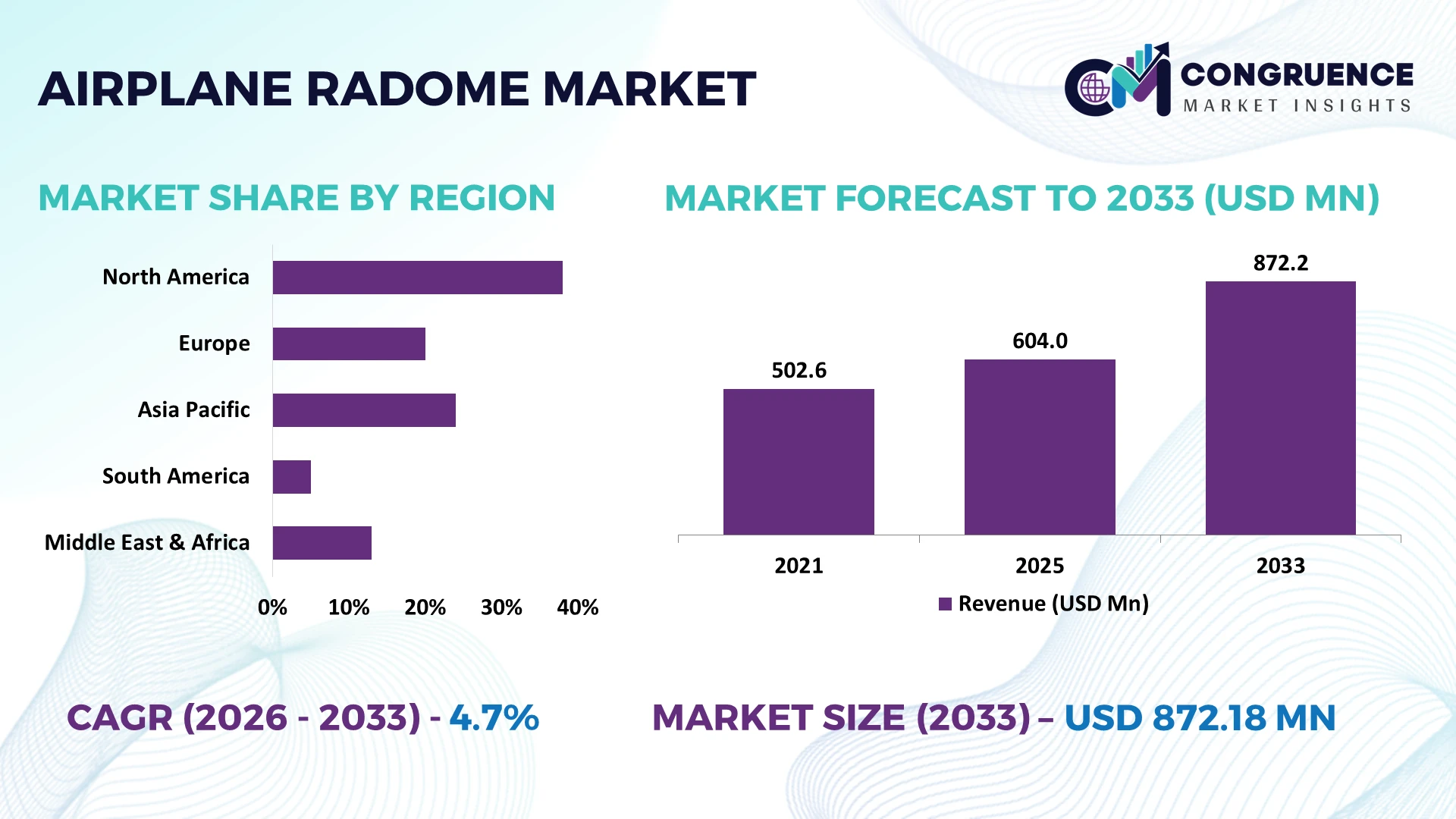
The United States dominates the Airplane Radome Market with an estimated 35% global share, supported by Boeing, General Dynamics, Collins Aerospace, and a defense-aerospace supply chain serving commercial, military, and business aircraft. Boeing delivered 600 commercial aircraft in 2025, versus Airbus’s 793 deliveries from European operations. U.S. defense modernization and Indo-Pacific geopolitical requirements further strengthen demand for advanced radar-protective structures. Airbus delivered approximately 32% more commercial aircraft than Boeing in 2025, highlighting Europe’s production-scale advantage even as the United States retains stronger defense, aftermarket, and advanced sensor-system exposure.
Strategically, suppliers combining lightweight composites, high RF transmissivity, automated manufacturing, and multi-band antenna compatibility will secure stronger positions as aircraft platforms become increasingly connectivity- and sensor-intensive.
Market Size & Growth: USD 604 million in 2025 is projected to reach USD 872.18 million by 2033 at 4.7% CAGR, driven by aircraft production, connectivity upgrades, and radar modernization.
Top Growth Drivers: 11% higher Airbus deliveries, 72% higher Boeing deliveries, and 8% growth in global passenger traffic during 2025 expanded OEM and aftermarket radome requirements.
Short-Term Forecast: By 2028, automated composite processing and optimized sandwich structures are positioned to reduce radome production cycle times by approximately 10–15% across scaled aerospace programs.
Emerging Technologies: Advanced quartz composites, frequency-selective surfaces, automated fiber placement, and multi-band RF-transparent structures are targeting 5–10% weight and electromagnetic-performance improvements over conventional radome architectures.
Regional Leaders: Modeled 2033 demand places North America near USD 305 million, Europe around USD 244 million, and Asia-Pacific approximately USD 218 million, reflecting defense, OEM, and fleet-expansion priorities.
Consumer/End-User Trends: Airlines carried more than 5 billion passengers globally in 2025, intensifying aircraft utilization and supporting replacement demand for weather-radar and connectivity radomes exposed to environmental damage.
Pilot/Case Example: Boeing delivered 600 commercial aircraft in 2025, 72% above 2024, materially increasing factory demand for nose-radome assemblies, radar protection, and aircraft-specific composite structures.
Competitive Landscape: General Dynamics holds an estimated 15% share, competing with Saint-Gobain, Nordam, Meggitt/Parker Hannifin, and Collins Aerospace through RF performance, lightweight materials, qualification expertise, and OEM relationships.
Regulatory & ESG Impact: Lightweight composite radomes delivering approximately 5–10% component-level weight reductions support aircraft mass optimization while stringent lightning-strike, bird-impact, and RF-transparency qualification requirements shape material selection.
Investment & Funding: Boeing committed approximately USD 1 billion to expand 787 production infrastructure in South Carolina, strengthening future demand across composite aerostructures, antennas, radar systems, and associated radome supply chains.
Innovation & Future Outlook: Next-generation radomes combining multi-band transparency, frequency-selective surfaces, embedded sensing, and automated composite manufacturing target 10%+ performance gains while shifting competition toward multifunctional aircraft structures.
Airplane Radome Market demand is concentrating around commercial aircraft production, military radar modernization, weather-radar protection, and high-speed satellite connectivity. Advanced quartz, glass-fiber, and hybrid composites are improving electromagnetic transparency while reducing structural mass by approximately 5–10%. With aerospace supply chains rebuilding production capacity and aircraft adopting Ku/Ka-band connectivity, multifunctional radomes are becoming strategically important components within next-generation avionics architectures.
Airplane radomes are becoming strategically important as aircraft transition toward sensor-intensive, permanently connected platforms requiring reliable radar, SATCOM, and weather-detection performance. Aircraft production recovery is simultaneously restructuring aerospace supply chains around qualified composite capacity and localized sourcing. Airbus delivered 793 commercial aircraft in 2025, while Boeing delivered 600, increasing demand for production-rate stability across nose and antenna radome programs.
Technology is shifting from conventional fiberglass-epoxy structures toward quartz-fiber/cyanate-ester composites, which can maintain insertion loss below 1 dB across Ku-band frequencies while improving thermal stability and electromagnetic transparency. North America retains stronger defense and avionics integration capability, whereas Europe leads commercial aircraft output; Asia-Pacific increasingly concentrates future fleet additions and satellite-connectivity installations.
Through 2026–2028, radome suppliers will prioritize automated composite processing, multi-band transparency, lightning protection, and platform-specific qualification. Boeing’s South Carolina expansion for higher 787 output illustrates how aircraft-rate increases cascade into composite-component capacity requirements. Manufacturers are securing material contracts, expanding autoclave and tooling capacity, and partnering with antenna specialists. Competitive advantage will increasingly depend on delivering qualified lightweight structures that preserve RF performance across multiple frequency bands without disrupting aircraft production schedules.
Commercial aircraft production recovery is the primary structural driver because every new platform requires radar-protective structures while connected aircraft increasingly add SATCOM antenna radomes. Airbus deliveries increased about 4% to 793 aircraft in 2025, while global passenger demand rose more than 5%, reinforcing airline fleet expansion and utilization. High-capacity Ku- and Ka-band connectivity adds another requirement for low-loss composite structures beyond traditional nose weather-radar applications. The industrial shift is moving radomes from passive protective shells toward RF-critical aerodynamic components. Boeing, Airbus suppliers, and avionics integrators are therefore strengthening composite capacity, tooling, material qualification, and antenna partnerships. The non-obvious advantage belongs to suppliers qualified across both weather-radar and connectivity applications because common manufacturing expertise improves plant utilization and reduces dependence on individual aircraft programs.
Radome scalability remains constrained by specialized aerospace-grade quartz fabrics, cyanate-esters, honeycomb cores, controlled curing, and stringent electromagnetic qualification. Quartz-based systems deliver superior RF transparency but carry materially higher processing and raw-material costs than conventional glass-fiber constructions, which still represent roughly 45–50% of broader radome material usage. Aircraft manufacturing also remains supply-sensitive: Airbus increased 2025 deliveries only about 4% despite substantially larger production ambitions, highlighting persistent aerospace component bottlenecks. Radomes cannot readily substitute commodity composite materials because conductive contamination, dielectric variation, or dimensional inconsistency directly affects radar performance. Suppliers are mitigating exposure through dual sourcing, localized material qualification, long-term contracts, and alternative low-dielectric reinforcements. The strategic constraint is therefore not basic composite capacity; it is maintaining repeatable electromagnetic performance while scaling certified aerospace production economically.
Next-generation multifunction radomes create opportunities beyond replacement demand by supporting weather radar, Ku/Ka-band satellite connectivity, electronic sensing, and advanced military apertures within increasingly integrated structures. Modern quartz/cyanate-ester composites can achieve insertion losses below 1 dB across Ku-band frequencies, while lightweight syntactic cores support component mass reductions of approximately 5–10% compared with heavier legacy constructions. China and India are expanding commercial fleets and connectivity infrastructure, creating demand for both line-fit and retrofit antenna enclosures. Future frequency-selective surfaces, embedded diagnostics, automated fiber placement, and digitally optimized wall thickness will strengthen RF performance without multiplying structural interfaces. Suppliers are increasing R&D in low-dielectric materials and collaborating with antenna manufacturers and aircraft OEMs. A particularly attractive opportunity is designing radomes around multiple frequency bands, allowing one qualified structural platform to support successive connectivity upgrades.
Long-term execution becomes harder as radomes must simultaneously satisfy aerodynamic loads, bird-strike resistance, lightning protection, thermal cycling, moisture resistance, and increasingly demanding electromagnetic requirements. Advanced aerospace applications typically require dielectric-loss tangents below approximately 0.01, while high-performance Ku-band structures target transmission losses below 1 dB. Small deviations in thickness, resin content, surface repair, or conductive contamination can distort antenna patterns even when structural integrity remains acceptable. This creates a quality-control challenge as Airbus, Boeing, defense primes, and connectivity providers accelerate production and introduce higher-frequency systems. Manufacturers must invest in automated inspection, RF test chambers, digital process control, workforce specialization, and antenna-radome co-design. The decisive long-term issue is production repeatability: suppliers that cannot reproduce certified electromagnetic behavior across thousands of components will lose competitiveness regardless of their nominal material performance.
Composite Automation Moves Into Production: Aerospace suppliers are increasing automated lay-up, precision curing, and digital inspection as OEM output rises. Airbus delivered 793 aircraft in 2025, up 4%, while Boeing reached 600 deliveries. Automated composite processing is targeting 10–15% shorter production cycles, helping radome suppliers stabilize throughput as aircraft manufacturers rebuild production rates under persistent supply-chain pressure.
Connectivity Radomes Gain Multi-Orbit Capability: Airline connectivity programs are shifting toward Ku/Ka-band terminals supporting multiple satellite orbits. STARLUX began transitioning 48 aircraft to a ViaSat-3-compatible, multi-orbit-ready terminal architecture in 2025, while Aeromexico selected 17 Boeing 787s for advanced connectivity retrofits. Radome specialists are responding with wider-band electromagnetic optimization, thinner laminates, and antenna-radome co-design to reduce retrofit complexity.
Supply Chains Return Toward Integration: Aircraft manufacturers are tightening control over critical aerostructure supply as production stability outweighs pure outsourcing economics. Boeing completed its Spirit AeroSystems acquisition in 2025 while delivering 600 commercial aircraft, its highest annual total since 2018. Radome and composite suppliers are consequently strengthening traceability, dual sourcing, quality automation, and long-term material agreements to meet tighter OEM production discipline.
High-Frequency Performance Raises Quality Standards: Higher-frequency radar and satellite systems make previously acceptable laminate variation increasingly costly. Modern aerospace radomes target transmission losses below approximately 1 dB, while lightweight structures can trim component mass by 5–10%. Manufacturers are expanding RF testing, dielectric characterization, non-destructive inspection, and digital process control; the non-obvious shift is that electromagnetic repeatability is becoming as commercially important as structural certification.
Composite Radomes lead the type segment with an estimated 62% share, reflecting their superior balance of RF transparency, structural strength, corrosion resistance, and weight efficiency. Glass-fiber, quartz-fiber, and low-dielectric resin systems support nose-weather-radar and satellite-communication applications while providing approximately 5–10% component-level weight advantages over heavier legacy constructions. Hybrid Radomes are the fastest-growing type, benefiting from combinations of quartz, advanced cores, conductive protection layers, and frequency-selective structures that accommodate increasingly complex multi-band avionics requirements.
Metal Radomes retain specialized relevance where structural durability outweighs transmission requirements, while Ceramic Radomes serve high-temperature and demanding military applications where thermal stability is critical. Inflatable Radomes remain a niche solution for temporary or specialized deployments rather than mainstream aircraft integration. Suppliers are therefore shifting investment toward automated composite processing, multifunction laminates, and hybrid architectures rather than expanding conventional metallic capacity. This transition favors manufacturers able to combine materials science, RF simulation, and aircraft certification expertise within one development program.
Weather Radar represents the largest application with an estimated 38% share because virtually every transport-category aircraft requires dependable forward weather detection protected by an aerodynamically optimized nose radome. This mature application emphasizes predictable dielectric properties, lightning protection, bird-strike resistance, and repairability. Satellite Communication is the fastest-growing application as airlines move toward high-throughput Ku/Ka-band connectivity and multi-orbit architectures. Connectivity-related radomes are estimated to represent about 27% of current demand, with penetration increasing as airlines retrofit narrow-body and wide-body fleets.
Air Traffic Control applications remain important for specialized airborne surveillance platforms, while Electronic Warfare drives high-specification defense radomes requiring broader frequency coverage, low observability, and complex aperture integration. Navigation Systems sustain smaller but stable requirements around radar-altimeter and mission-sensor protection. Manufacturers are adapting through broadband laminate design, frequency-selective surfaces, automated RF inspection, and closer antenna-supplier partnerships. Investment is moving toward radomes capable of maintaining low insertion loss across multiple frequency bands, reducing the need for separate platform-specific structures.
Commercial Airlines lead end-user demand with an estimated 42% share because large fleets generate continuous requirements for factory-installed nose radomes, SATCOM enclosures, replacement units, and repair services. Airbus and Boeing together delivered 1,393 commercial aircraft during 2025, creating substantial recurring demand across both original equipment and eventual aftermarket cycles. Military Aviation is the fastest-growing end-user segment as governments prioritize advanced radar, electronic warfare, surveillance, and multi-band communications requiring specialized high-performance radomes.
Aircraft Manufacturers remain strategically influential because line-fit qualification determines supplier access across entire production programs, while Business Aviation increasingly adopts compact high-speed connectivity and advanced weather-radar systems. Government Agencies purchase smaller volumes but demand mission-specific configurations for surveillance, research, emergency response, and border operations. Suppliers are responding with OEM-specific engineering, defense-grade customization, long-term repair agreements, and modular broadband designs. Competitive positioning is shifting toward lifecycle relationships: manufacturers supplying the original qualified radome gain an advantage in replacements, modifications, repairs, and connectivity upgrades over an aircraft’s operational life.
North America accounted for the largest market share at 36% in 2025 however, Asia-Pacific is expected to register the fastest growth, expanding at a CAGR of 6.2% between 2026 and 2033.

Defense Modernization Reinforces Composite Leadership
North America accounts for approximately 36% of global Airplane Radome Market demand, anchored by U.S. commercial aircraft production, military modernization, business aviation, and satellite-connectivity retrofits. Boeing delivered 600 commercial aircraft in 2025, materially increasing requirements for nose radomes, antenna fairings, and qualified composite structures. Defense platforms create an additional technology premium through electronic-warfare, surveillance, and multi-band radar requirements. The region also benefits from General Dynamics, Collins Aerospace, Parker Hannifin, Boeing, and specialized composite manufacturers with established qualification capabilities. Boeing’s reintegration of Spirit AeroSystems further signals tighter control over critical aerostructure supply chains. Suppliers are investing in automated composite processing, dielectric testing, lightning-strike protection, and Ku/Ka-band radomes. The operational advantage increasingly lies in combining high production repeatability with low insertion loss rather than competing primarily through component pricing.
United States Market Outlook: The United States combines commercial aircraft manufacturing, the world’s largest defense procurement ecosystem, and extensive business-aviation operations. Boeing’s 2025 commercial output reached 600 aircraft, including 447 737-family deliveries. U.S. radome suppliers consequently benefit from line-fit programs, military sensor upgrades, SATCOM retrofits, and a large aftermarket requiring inspection, repair, replacement, and electromagnetic-performance restoration.
Aircraft Output Drives Material Innovation
Europe represents approximately 28% of global Airplane Radome Market demand, supported by Airbus production, defense aerospace programs, satellite communications, and advanced composite engineering. Airbus delivered 793 commercial aircraft to 91 customers in 2025, including 607 A320-family aircraft, sustaining substantial factory demand for weather-radar and communications radomes. France, Germany, Spain, and the United Kingdom concentrate aerospace manufacturing and qualified material-processing capability. European suppliers increasingly prioritize quartz and glass-fiber composites, low-dielectric resins, automated inspection, and repairability as aircraft connectivity becomes more bandwidth-intensive. Defense modernization adds demand for broadband and electronically optimized structures supporting radar and electronic warfare. Production-rate pressure is simultaneously encouraging longer material contracts and manufacturing automation. Competitive differentiation therefore depends on maintaining electromagnetic consistency while meeting Airbus and defense-prime delivery schedules across geographically distributed production networks.
France Market Outlook: France holds strategic importance through Airbus-related manufacturing, Dassault Aviation, Thales, Safran, and a mature aerospace materials ecosystem. Dassault delivered 38 Falcon business jets in 2025, while French military and commercial programs sustain demand for high-performance RF structures. Expertise spanning business aircraft, combat platforms, radar, and composites supports sophisticated radome engineering and qualification capabilities.
Fleet Scale Accelerates Localization
Asia-Pacific accounts for approximately 25% of Airplane Radome Market demand, with China, India, Japan, Australia, and Singapore expanding aircraft fleets, MRO infrastructure, defense programs, and connectivity deployment. China’s COMAC production ambitions are creating a localized requirement for qualified nose radomes and RF-transparent structures, while India is strengthening domestic aerospace manufacturing through military procurement and commercial supply-chain participation. The region’s commercial fleet is expected to absorb close to half of global new-aircraft requirements over the next two decades, making local qualification strategically important. Japanese expertise in advanced fibers and resins strengthens the materials side of the value chain. Suppliers are expanding regional engineering, maintenance, and composite-processing capabilities rather than relying entirely on imported finished radomes. Localization reduces lead times and provides greater resilience as geopolitical trade controls increase scrutiny around aerospace electronics and specialized materials.
China Market Outlook: China combines rapidly expanding commercial aviation with deliberate aerospace supply-chain localization. COMAC delivered 13 C919 aircraft during 2024, moving the program from initial entry into broader airline deployment. Domestic production creates opportunities for localized composite radomes, radar integration, maintenance capability, and qualified material suppliers as Chinese operators seek greater independence from imported aerospace components.
Brazil Anchors Aerospace Manufacturing Demand
South America contributes approximately 6% of global Airplane Radome Market demand, with Brazil dominating through Embraer manufacturing, executive aviation, defense programs, and one of the world’s largest general-aviation ecosystems. Radome requirements span regional jets, business aircraft, military transports, weather radar, and satellite-connectivity retrofits. Embraer delivered 244 aircraft in 2025, including 91 commercial and 155 executive jets before reconciliation adjustments, reinforcing Brazil’s factory-fit composite demand. Airlines elsewhere in South America add aftermarket requirements, but currency volatility, imported-material dependence, and smaller domestic aerospace supply chains limit localized production. Suppliers therefore emphasize partnerships with Brazilian aerospace manufacturers, MRO providers, and connectivity integrators. The strongest opportunity is not broad manufacturing replication across the continent but concentration around Brazil’s established certification, engineering, and export-oriented aircraft-production ecosystem.
Brazil Market Outlook: Brazil has the region’s strongest competitive foundation through Embraer, aerospace clusters around São José dos Campos, military programs, and extensive executive aviation. Embraer’s E-Jet and Phenom platforms create recurring requirements for weather-radar protection and connectivity structures. Its aircraft operating across global fleets also generates aftermarket radome repair and replacement opportunities extending well beyond domestic demand.
Connectivity Investment Reshapes Retrofit Demand
Middle East & Africa represents approximately 5% of global Airplane Radome Market demand, concentrated around Gulf airline fleets, business aviation, military modernization, and high-speed satellite connectivity. Emirates, Qatar Airways, Etihad Airways, and major Saudi aviation programs operate or are acquiring connectivity-intensive wide-body fleets requiring advanced antenna enclosures alongside conventional nose radomes. Emirates alone operates more than 250 passenger aircraft, creating substantial lifecycle requirements for radome inspection, repair, and replacement. Saudi Arabia’s aviation expansion and defense localization add another industrial pathway, while African demand remains weighted toward airline maintenance, surveillance, humanitarian, and special-mission fleets. Suppliers are strengthening MRO partnerships and regional inventory rather than establishing full-scale radome production immediately. Harsh heat, sand erosion, and high UV exposure also increase the value of durable coatings and predictable RF performance over extended service intervals.
United Arab Emirates Market Outlook: The UAE provides the strongest regional aftermarket platform through Emirates, Etihad Airways, Dubai’s aviation infrastructure, defense procurement, and established MRO capacity. Emirates’ large A380 and Boeing 777 fleets generate recurring requirements for nose-radome maintenance and satellite-connectivity structures. Dubai’s planned five-runway Al Maktoum expansion further reinforces the country’s long-term position as an aviation technology and maintenance hub.
General Dynamics, Parker Hannifin, Saint-Gobain, Collins Aerospace, and NORDAM compete across OEM, defense, connectivity, and aftermarket radome programs, with the top five estimated to control 55% of demand. General Dynamics and Collins emphasize advanced RF performance and defense integration, while NORDAM and Parker leverage aerostructure manufacturing and repair capabilities. Competition increasingly centers on composite weight, transmission efficiency, qualification speed, and supply reliability. Advanced structures deliver approximately 5–10% weight advantages, while high-performance designs target insertion losses below 1 dB. Suppliers are expanding automated composite processing, securing long-term material agreements, partnering with antenna developers, and vertically integrating inspection and repair. The market is shifting from conventional protective structures toward multi-band, connectivity-ready radomes, raising materials and electromagnetic-engineering requirements. Certification expense, specialized dielectric materials, tooling, and OEM qualification remain strong entry barriers. Winning requires repeatable RF performance, scalable manufacturing, rapid certification, lifecycle support, and established aircraft-platform relationships across global programs.
General Dynamics Mission Systems
Parker Hannifin
Saint-Gobain
Collins Aerospace
NORDAM
Meggitt
Lufthansa Technik
Starwin Industries
Jenoptik
FACC
Kaman Corporation
CPI Radant Technologies
Royal Engineered Composites
Current airplane radome technology centers on glass-fiber, quartz-fiber, and low-dielectric composite laminates engineered for weather radar, SATCOM, navigation, and military sensor protection. Composite structures now dominate roughly 60% of installations because they reduce component mass by about 5–10% versus heavier legacy metallic designs while preserving RF transparency. Automated lay-up, precision curing, and digital inspection improve repeatability, lowering rework and production-cycle losses by approximately 8–12%.
Emerging technology is shifting toward wideband and multi-band radomes optimized for Ku-, K-, and Ka-band connectivity, electronically scanned arrays, and advanced AESA radar. Hybrid quartz composites and frequency-selective surfaces can improve transmission efficiency by roughly 3–6% compared with conventional fiberglass constructions. Adoption is rising on connected commercial fleets and next-generation military platforms, benefiting suppliers with integrated RF simulation, materials engineering, and certification capabilities.
Disruptive development focuses on software-optimized electromagnetic design, embedded health monitoring, additive tooling, and multifunctional structures supporting several antennas through one aerodynamic enclosure. By 2026–2028, digital twins and automated RF inspection should cut qualification and validation time by around 10–15%. Suppliers acting now gain faster OEM integration, stronger retrofit positioning, and lower lifecycle costs as aircraft connectivity, sensing, and electronic-warfare architectures require wider bandwidth, lower drag, and repeatable electromagnetic performance across fleets globally worldwide.
September 2024 General Dynamics Mission Systems secured an F-16 radome contract covering 15 units, with performance extending through 2027. The award reinforces sustained military-aircraft replacement demand and demonstrates the high qualification barriers protecting established radome manufacturers in defense programs. Source: highergov.com
February 2025 Airbus selected Gogo Galileo for ACJ Connect Link development, using compact electronically steered antennas designed for smaller, flatter radomes. FDX supports up to 195 Mbps downloads, reducing installation drag and strengthening high-speed LEO connectivity retrofit economics. Source: airbus.com
November 2025 Lufthansa Technik extended its Air Arabia partnership for nose-radome repairs covering five additional years across existing and future fleets. The agreement combines composite inspection and repair expertise, strengthening aftermarket availability and lifecycle support for A320-family operations. Source: lufthansa-technik.com
July 2026 DRDO completed an indigenous radome for India’s Tejas Mk1A, replacing an imported component after meeting structural, mechanical, and electromagnetic requirements. Final flight trials support localization for the 4.5-generation fighter and reduce dependence on foreign aerospace suppliers. Source: theweek.in
The Airplane Radome Market Report analyzes competitive positioning, technology evolution, deployment patterns, and investment priorities from 2026 to 2033. Coverage includes Composite Radomes, Metal Radomes, Ceramic Radomes, Hybrid Radomes, and Inflatable Radomes across Weather Radar, Air Traffic Control, Satellite Communication, Electronic Warfare, and Navigation Systems. Composite Radomes represent approximately 62% of type-level demand, while Weather Radar accounts for about 38% of application deployment.
The report evaluates Commercial Airlines, Military Aviation, Business Aviation, Aircraft Manufacturers, and Government Agencies across North America, Europe, Asia-Pacific, South America, and Middle East & Africa. Technology coverage includes quartz composites, low-dielectric resins, multi-band structures, AESA-compatible radomes, frequency-selective surfaces, automated composite processing, and digital RF inspection. Strategic analysis supports capacity planning, supplier selection, geographic expansion, connectivity-retrofit strategies, defense localization, competitive benchmarking, and identification of emerging multi-band and multifunctional radome opportunities.
| Report Attribute/Metric | Report Details |
|---|---|
Market Revenue in 2025 | USD 604 Million |
Market Revenue in 2033 | USD 872.18 Million |
CAGR (2026 - 2033) | 4.7% |
Base Year | 2025 |
Forecast Period | 2026 - 2033 |
Historic Period | 2021 - 2025 |
Segments Covered | By Type
By Application
By End-User
|
Key Report Deliverable | Revenue Forecast, Growth Trends, Market Dynamics, Segmental Overview, Regional and Country-wise Analysis, Competition Landscape |
Region Covered | North America, Europe, Asia-Pacific, South America, Middle East, Africa |
Key Players Analyzed | General Dynamics Mission Systems, Parker Hannifin, Saint-Gobain, Collins Aerospace, NORDAM, Meggitt, Lufthansa Technik, Starwin Industries, Jenoptik, FACC, Kaman Corporation, CPI Radant Technologies, Royal Engineered Composites |
Customization & Pricing | Available on Request (10% Customization is Free) |




