
Reports
The Global Airline Onboard Retail Technology Market was valued at USD 800.1 Million in 2024 and is anticipated to reach a value of USD 1,939.0 Million by 2032 expanding at a CAGR of 11.7% between 2025 and 2032, according to an analysis by Congruence Market Insights. This growth is driven by expanding digital retail ecosystems and rising preference for real-time in-flight personalization.
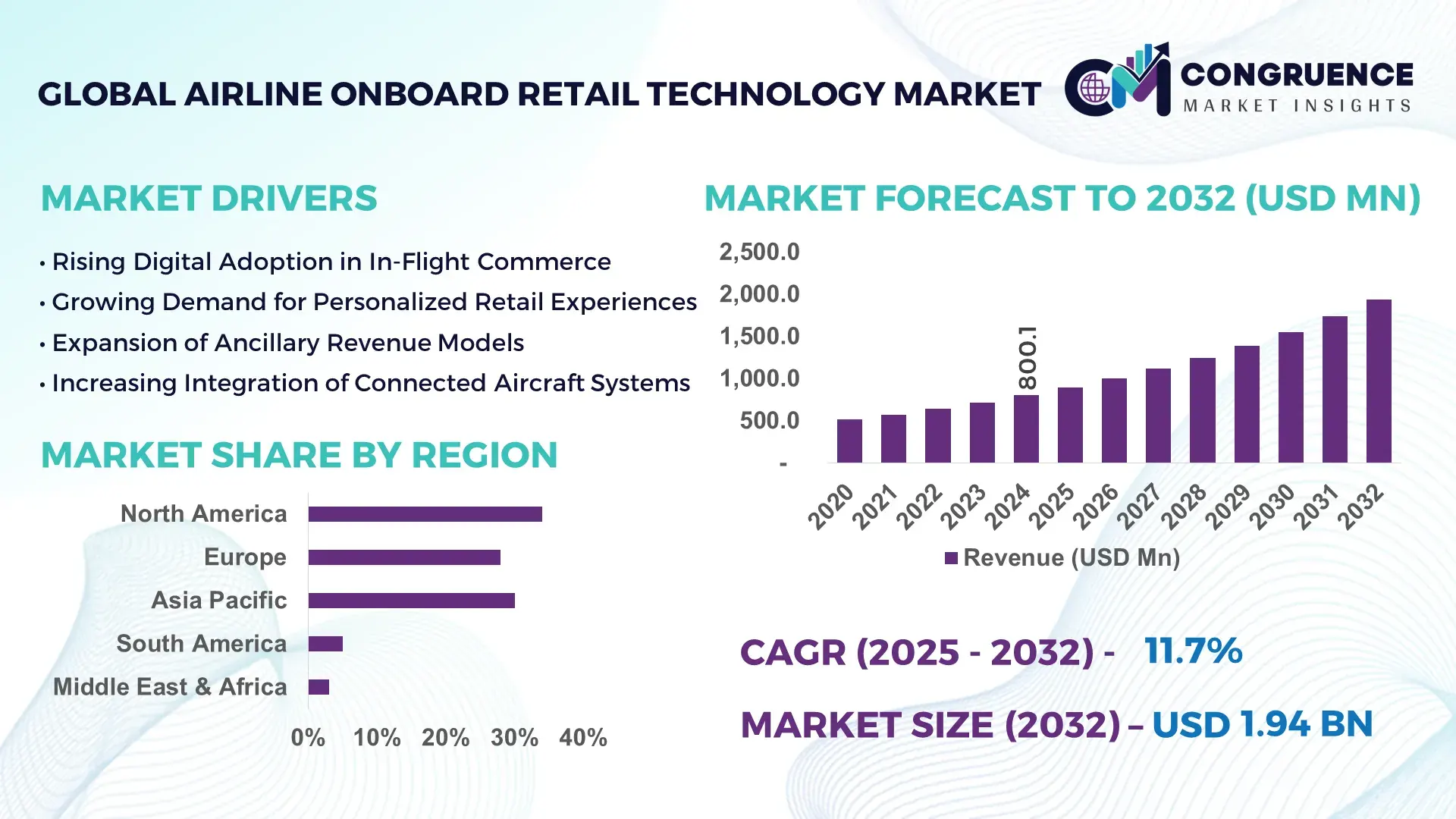
The United States continues to lead the Airline Onboard Retail Technology market, supported by advanced digital aviation infrastructure, high investment in connected cabin systems exceeding USD 2.3 billion annually, and rapid adoption of onboard payment technologies. More than 68% of U.S. carriers have integrated AI-led inventory automation, and over 40% have deployed fully digital ordering platforms. The country also leads in consumer digital engagement, with 72% of passengers preferring mobile-based in-flight purchases.
Market Size & Growth: Valued at USD 800.1 million in 2024 and projected to reach USD 1.93 billion by 2032, expanding at 11.7% due to increased demand for digital in-flight commerce.
Top Growth Drivers: Digital payment adoption (48%), AI-enabled personalization (52%), and connected cabin upgrades (41%).
Short-Term Forecast: By 2028, airlines expected to achieve a 27% improvement in onboard sales efficiency through automated retail systems.
Emerging Technologies: AI-driven dynamic pricing, edge-analytics cabin devices, and virtual storefront interfaces.
Regional Leaders: North America projected at USD 610 million by 2032, Europe at USD 530 million, and Asia-Pacific at USD 480 million, with APAC showing fastest digital adoption.
Consumer/End-User Trends: Increasing use of mobile ordering platforms, with 62% of passengers preferring contactless transactions.
Pilot or Case Example: In 2024, a major European carrier introduced AI-assisted retail menus, improving upsell conversions by 18%.
Competitive Landscape: Market leader holds approx. 16% share, followed by players specializing in inflight POS, inventory automation, and digital merchandising.
Regulatory & ESG Impact: Sustainability mandates encouraging 25–30% reduction in printed catalogs by 2027.
Investment & Funding Patterns: Over USD 900 million invested in cabin digitalization and onboard retail automation in the last two years.
Innovation & Future Outlook: Growth driven by immersive digital catalogues, personalized recommendation engines, and real-time inventory visibility.
The Airline Onboard Retail Technology market is experiencing strong momentum as airlines prioritize high-margin digital retailing, with rising adoption in sectors such as premium travel services, ancillary revenue platforms, and AI-driven merchandising solutions across regions with substantial passenger footfall.
The Airline Onboard Retail Technology Market is emerging as a core strategic pillar for airlines seeking to expand ancillary revenue streams, modernize cabin operations, and enhance personalized passenger engagement. Digital retail capabilities now enable airlines to transition from static catalogs to dynamic, data-driven platforms that accelerate purchase decisions and optimize high-margin product offerings. Technologies such as AI-assisted recommendation engines deliver up to 35% improvement compared to legacy onboard catalog systems by enabling targeted promotions and real-time inventory alignment.
Regional performance varies significantly—North America dominates in volume supported by strong digital infrastructure, while Europe leads in adoption with 58% of carriers using fully integrated onboard retail platforms. By 2027, predictive analytics systems are expected to improve order accuracy KPIs by 32%, strengthening operational efficiency. Airlines are increasingly committed to ESG-driven retail strategies, targeting up to 40% reduction in printed retail material by 2030 to support emissions reduction goals.
In 2024, a leading Middle Eastern airline achieved a 22% improvement in retail conversion using AI-enabled multilingual catalog solutions. These shifts highlight the market’s role in enhancing passenger experience, operational resilience, and retail profitability. The Airline Onboard Retail Technology Market is positioned to become a foundation for sustainable and compliant airline commerce ecosystems.
The Airline Onboard Retail Technology Market is undergoing rapid transformation driven by expanding digital retail channels, rising passenger expectations for personalized services, and airline focus on high-margin ancillary revenue streams. Enhanced in-flight connectivity, AI-powered retail automation, and growing integration of contactless payment technologies are reshaping revenue generation models. Passenger digital engagement—particularly in mobile-first regions—continues to accelerate platform adoption. The market is also influenced by airline investments in connected cabin ecosystems, enabling real-time inventory tracking, dynamic pricing, and tailored promotional strategies that increase conversion rates and operational accuracy.
Growing digital engagement among air travelers is a major catalyst for the Airline Onboard Retail Technology Market. With more than 70% of global passengers preferring mobile or digital interfaces for in-flight purchases, airlines are shifting to AI-driven recommendation engines and digital catalogs. Real-time inventory systems allow airlines to reduce stock wastage by 18–25% while increasing conversion rates through targeted offers. The growing adoption of in-flight Wi-Fi—now available on over 55% of global long-haul fleets—further enhances digital commerce potential. Airlines leveraging onboard personalization platforms report up to 30% higher ancillary revenue compared to traditional catalog-based retailing.
Despite strong demand, integration complexity remains a significant restraint for the Airline Onboard Retail Technology Market. Airlines often operate mixed fleets with varying cabin architectures, requiring costly customization for POS systems, digital catalog interfaces, and inventory management modules. Legacy systems create interoperability challenges, with nearly 40% of airlines citing difficulties in connecting new digital retail platforms to existing reservation and loyalty programs. Data synchronization issues across long-haul routes further limit real-time pricing capabilities, while cybersecurity compliance introduces additional operational costs, slowing adoption across budget and mid-size carriers.
The growing emphasis on personalization presents transformative opportunities for the Airline Onboard Retail Technology Market. AI-powered engines can tailor product recommendations using passenger demographics, travel behavior, and loyalty profiles, enhancing retail conversion by up to 28%. The rapid emergence of digital-first passengers—representing 60% of global travelers—supports adoption of dynamic menus, virtual storefronts, and multilingual retail interfaces. Expanding integration with e-wallets and airline mobile apps opens new avenues for pre-ordering, subscription-based onboard services, and targeted cross-selling, boosting overall commercial potential across regional and international airlines.
High implementation and upgrade costs remain a considerable challenge for the Airline Onboard Retail Technology Market. Advanced retail systems—requiring connected cabin servers, upgraded Wi-Fi modules, and secure payment gateways—demand substantial upfront investment. Airlines operating older aircraft face an estimated 35–45% higher integration cost due to hardware retrofitting. Compliance with digital payment and data security standards increases ongoing operational expenditure. Additionally, fluctuating passenger loads reduce the ROI predictability of onboard retail investments, forcing airlines to evaluate long-term cost-benefit ratios more cautiously.
• Expansion of AI-Powered Dynamic Retailing: AI-driven pricing and recommendation systems are shaping the market, with airlines reporting up to 22% uplift in average order value. More than 45% of carriers now use machine learning models to optimize product visibility based on passenger profiles, increasing conversion rates and reducing unsold inventory by 18%.
• Growth in Contactless and Digital Payment Adoption: Over 63% of global airlines have deployed NFC-enabled payment terminals onboard, leading to a 34% improvement in transaction speed. Digital wallet usage among passengers has grown by 41%, enabling faster onboarding of retail services and reducing cash-handling procedures.
• Increasing Deployment of Connected Cabin IoT Systems: IoT-enabled retail equipment is rising, with 52% of new aircraft delivered in 2024 equipped with connected cabin modules. These systems allow 24/7 inventory synchronization and support predictive restocking algorithms that improve supply accuracy by 29%.
• Shift Toward Pre-Order and Pre-Select Retail Models: Pre-order retail has expanded rapidly, with adoption up by 38% in two years. Airlines report a 31% improvement in stock planning and a 26% increase in premium product sales when pre-selection features are integrated with mobile booking apps.
The Airline Onboard Retail Technology Market segmentation spans multiple dimensions including type, application, and end-user categories. Airlines deploy diverse retail platforms ranging from in-seat ordering systems to integrated POS devices, with each type addressing distinct operational requirements. Applications vary across food & beverage sales, duty-free transactions, and digital merchandising. End-user analysis highlights commercial airlines, low-cost carriers, and charter operators, each adopting differentiated retail strategies. Passenger demand for contactless transactions, digital catalogs, and AI-enabled personalization significantly shapes segment growth patterns, supported by evolving consumer expectations and technology adoption across global fleets.
Type-based segmentation in the Airline Onboard Retail Technology Market includes onboard POS systems, digital catalog platforms, AI-driven recommendation engines, mobile ordering interfaces, and connected inventory management systems. Digital catalog platforms currently lead the market, accounting for approximately 38% share due to their faster deployment and high passenger engagement rates. AI-enabled retail engines are the fastest-growing type, expected to expand at over 13% CAGR driven by increasing adoption of personalization tools. Other types—such as hybrid retail kiosks and standalone payment modules—collectively contribute around 27% share and support niche cabin retail requirements.
Applications in the Airline Onboard Retail Technology Market include food & beverage sales, duty-free retail, digital merchandising, ancillary services, and in-flight entertainment-linked commerce. Duty-free retail holds the largest share at 36% supported by strong passenger demand for branded goods. Digital merchandising is the fastest-growing application, projected to expand at over 12% CAGR owing to rising adoption of immersive digital storefronts. Other applications—including bundled travel services and loyalty-based offers—collectively account for 29% share. Consumer trends indicate rising acceptance of digital engagement, with 38% of enterprises globally piloting onboard retail AI systems in 2024 and 60% of Gen Z travelers showing preference for digital-first in-flight shopping.
End-user segmentation comprises commercial airlines, low-cost carriers, charter operators, and private aviation fleets. Commercial airlines lead the market with an estimated 45% share due to high international traffic and early adoption of digital retail technologies. Low-cost carriers represent the fastest-growing segment with over 14% CAGR driven by their reliance on ancillary revenue streams. Other end-users account for around 25% share, showing rising adoption of compact POS and mobile-based ordering tools. Adoption patterns show strong engagement across industries, with 38% of global enterprises testing onboard retail platforms in 2024 and Gen Z-driven demand for AI-enabled service personalization increasing above 60%.
North America accounted for the largest market share at 34% in 2024; however, Asia-Pacific is expected to register the fastest growth, expanding at a CAGR of 18% between 2025 and 2032.

The Airline Onboard Retail Technology market shows strong adoption trends across all major regions, with more than 72% of global airlines integrating digital retail systems and over 55% deploying AI-enabled payment solutions. Europe contributed approximately 28% of total adoption in 2024, backed by stringent digital aviation regulations and rising passenger spending levels. The Middle East & Africa captured nearly 10% of the total share, driven by rapid fleet modernization across UAE, Qatar, and Saudi Arabia. South America held 8% share, supported by expanding regional carriers and inflight digitalization initiatives. By 2030, global onboard retail transaction volumes are projected to exceed 1.2 billion passenger interactions annually, indicating accelerating digital retail penetration across both full-service and low-cost carriers.
How Are Airlines Transforming Passenger Spending Through Next-Gen Digital Retail Platforms?
North America held nearly 34% of the global market share in 2024, supported by strong aviation infrastructure, high passenger spending power, and rapid digital adoption across airlines. Retail demand is driven by sectors such as travel retail, duty-free, luxury goods, and onboard F&B operations. Regulatory initiatives like FAA-supported digital retail compliance standards have accelerated adoption of secure, cashless inflight payment ecosystems. The region has seen strong integration of AI-based recommendation engines, NFC-enabled payment terminals, and contactless ordering kiosks. A notable example is United Airlines, which has expanded digital retail catalogs integrated with pre-ordering features and loyalty-linked transactions. Consumer behavior trends show higher preference for digital-first retail experiences, supported by an enterprise mindset that mirrors adoption patterns in healthcare and finance. This has accelerated onboard spending optimization and elevated demand for end-to-end retail management platforms.
What Drives Airlines Across Key European Markets to Accelerate Digital Retail Innovation?
Europe accounted for around 28% of the global market share in 2024, with strong adoption across aviation hubs in Germany, the UK, France, Spain, and the Netherlands. The region’s digital expansion is supported by regulatory frameworks such as EASA-driven guidelines encouraging transparency and secure inflight retail transactions. Sustainability-led initiatives, including reduced paper-based menus and digital-first catalogs, are influencing retail modernization. European airlines are adopting AI-powered inventory management, blockchain-based transaction tracking, and smart trolley solutions. A key regional player, Lufthansa Systems, is expanding onboard retail digitalization tools to enhance ancillary revenue streams for partner carriers. European consumers show a strong behavioral inclination toward transparent, explainable, and eco-conscious retail systems, reinforcing the need for compliant and traceable onboard retail technology across the region.
Why Is the Region Emerging as the Fastest-Growing Hub for Digital Airline Retail Modernization?
Asia-Pacific recorded the highest growth in market volume in 2024, with China, India, Japan, and South Korea representing over 42% of all onboard retail transactions in the region. Rapid expansion of low-cost carriers, rising middle-class air travel, and extensive digital infrastructure investments are driving significant market acceleration. Manufacturing innovations in Japan and China have contributed to rapid deployment of smart inflight devices, connected POS solutions, and AI-driven product recommendation engines. A notable example includes AirAsia’s digital commerce platform, which integrates real-time inventory optimization and personalized retail offerings. Passenger behavior patterns in the region show strong readiness for mobile-led commerce and app-based ordering, largely influenced by the region’s e-commerce boom and digitally active traveler base. These dynamics position Asia-Pacific as a leading hub for scalable onboard retail technology innovation.
How Are Regional Carriers Leveraging Technology to Enhance Inflight Retail Efficiency?
South America contributed approximately 8% to the global market share in 2024, with Brazil and Argentina emerging as primary growth hubs. Rising digitalization across airlines, coupled with improved aviation infrastructure and growing reliance on mobile commerce, has driven adoption of onboard retail technology. Governments in Brazil and Chile are supporting airline technology upgrades through favorable digital trade policies and tax incentives for fleet modernization. A prominent example is LATAM Airlines, which has enhanced inflight catalog digitization and onboard payment capabilities to increase ancillary revenue. Passenger behavior trends show higher responsiveness to localized catalog offerings and language-optimized retail content. The region’s demand remains closely linked to media consumption preferences and the need for flexible, multilingual digital commerce platforms onboard.
How Are Carriers Modernizing Inflight Retail Through Digitization and Fleet Upgrades?
Middle East & Africa accounted for nearly 10% of the market in 2024, supported by strong regional aviation development across UAE, Qatar, Saudi Arabia, and South Africa. The region shows rising demand for onboard retail modernization driven by luxury-focused passenger segments, expanding long-haul fleets, and airline investments in digital passenger experience systems. Advanced retail technologies such as AI-based personalization, biometric-linked loyalty transactions, and cloud-enabled onboard POS systems are being deployed widely. Emirates, for example, has been expanding smart retail platforms integrated with real-time passenger data to enhance catalog personalization. Consumer behavior trends in the region reflect strong demand for premium retail assortments, tech-enabled convenience, and multi-currency payment flexibility. Trade partnerships between GCC countries are further accelerating technology adoption across regional airlines.
United States – 34% market share - Dominance supported by advanced aviation infrastructure, strong digital adoption, and high per-passenger spending capacity.
China – 21% market share - Leadership driven by massive passenger volume, rapid digital commerce integration, and expanding low-cost carrier networks.
The Airline Onboard Retail Technology market is moderately consolidated, with approximately 25–30 active global competitors supplying digital retail systems, onboard POS devices, retail management software, passenger-facing applications, and integrated analytics platforms. The top five companies collectively hold nearly 48% of the global market share, driven by strong partnerships with full-service carriers and low-cost airlines. Key strategic initiatives include multi-year technology collaborations, integration of AI and machine learning into retail operations, and expansion of cloud-enabled retail ecosystems across flight fleets. Companies are increasingly focusing on enhancing transaction security, deploying smart trolleys with dynamic inventory tracking, and implementing multi-currency and contactless payment technologies. Mergers and joint ventures have expanded product portfolios, while advancements such as biometric-linked loyalty retail and personalized inflight shopping features are reshaping competitive positioning. As airlines emphasize ancillary revenue growth, vendors with scalable digital commerce platforms, strong cybersecurity capabilities, and proven airline integration experience are gaining market advantage.
Panasonic Avionics
SITA
Immfly
Bluebox Aviation Systems
Spafax
Omnevo
Collins Aerospace
Gogo LLC
Honeywell Aerospace
Burrana
Paxia
Retail inMotion
The Airline Onboard Retail Technology market is undergoing rapid technological transformation, driven by advancements in digital commerce, AI, and connected cabin systems. Airlines are increasingly adopting cloud-based onboard retail platforms that allow real-time catalog updates, inventory synchronization, and dynamic pricing across fleets. More than 60% of global carriers have migrated to digital retail catalogs, replacing physical menus and enabling personalized recommendations based on passenger profiles. AI-powered retail analytics now support demand forecasting, optimizing product assortments based on route-specific consumption patterns. Smart trolleys integrated with RFID sensors improve stock accuracy by nearly 98% and enhance turnaround efficiency. NFC-based payment terminals and mobile POS devices are enabling seamless, contactless transactions onboard, reducing payment processing time by up to 40%. Biometric-linked loyalty systems are gaining traction, offering frictionless reward redemption during flights. Satellite connectivity advancements have further supported real-time payment authorization, reducing transaction failures across long-haul routes. Blockchain is emerging as a tool for secure transaction tracking and fraud reduction, particularly for duty-free operations. These innovations collectively contribute to improved ancillary revenue performance and an enhanced passenger shopping experience, while enabling airlines to scale digital retail operations more efficiently.
• In February 2024, Panasonic Avionics introduced its new digital retail suite, enabling airlines to deploy AI-driven product recommendations and integrated payment processing across wide-body aircraft. The platform supports dynamic pricing and route-specific product curation. Source: www.panasonic.aero
• In October 2023, Thales Group expanded its inflight retail system capabilities with a new cloud-enabled commerce engine designed to support multi-currency payments and real-time inventory synchronization across fleets for major European carriers. Source: www.thalesgroup.com
• In March 2024, Immfly launched a next-generation onboard shopping platform featuring interactive digital catalogs and multilingual content formats to enhance passenger engagement, particularly on long-haul routes. Source: www.immfly.com
• In July 2023, Lufthansa Systems upgraded its onboard retail management module within its BoardConnect platform, integrating RFID-enabled inventory tracking and enhanced analytics tools to improve stock accuracy and product planning for partner airlines. Source: www.lhsystems.com
The Airline Onboard Retail Technology Market Report provides a comprehensive evaluation of market dynamics, technology adoption trends, and segment-level opportunities across global aviation retail systems. The report covers digital retail platforms, onboard POS systems, inventory management solutions, smart trolley technologies, passenger-facing mobile applications, and AI-powered retail analytics tools. Geographic coverage includes North America, Europe, Asia-Pacific, South America, and Middle East & Africa, offering insights into adoption patterns, regulatory environments, and fleet modernization trends. The scope includes analysis across full-service carriers, low-cost carriers, regional airlines, and charter operators. The report also examines retail categories such as duty-free, food & beverage, luxury goods, travel accessories, digital services, and loyalty-linked retail offerings. Key focus areas include digital transaction enablement, data-driven personalization, cloud-based retail orchestration, and cybersecurity requirements for onboard retail operations. Additionally, emerging sectors such as biometric retail, blockchain-enabled transaction verification, and AI-based upselling systems are assessed for their market potential. This structured analysis helps decision-makers identify high-growth adoption clusters, technology investment priorities, and evolving competitive strategies within the global airline retail technology ecosystem.
| Report Attribute/Metric | Report Details |
|---|---|
|
Market Revenue in 2024 |
USD 800.1 Million |
|
Market Revenue in 2032 |
USD 1,939.0 Million |
|
CAGR (2025 - 2032) |
11.7% |
|
Base Year |
2024 |
|
Forecast Period |
2025 - 2032 |
|
Historic Period |
2020 - 2024 |
|
Segments Covered |
By Type
By Application
By End-User
|
|
Key Report Deliverable |
Revenue Forecast, Growth Trends, Market Dynamics, Segmental Overview, Regional and Country-wise Analysis, Competition Landscape |
|
Region Covered |
North America, Europe, Asia-Pacific, South America, Middle East, Africa |
|
Key Players Analyzed |
Lufthansa Systems, Thales Group, Inflight Dublin, Panasonic Avionics, SITA, Immfly, Bluebox Aviation Systems, Spafax, Omnevo, Collins Aerospace, Gogo LLC, Honeywell Aerospace, Burrana, Paxia, Retail inMotion |
|
Customization & Pricing |
Available on Request (10% Customization is Free) |




