
Reports
The Global Aircraft Superalloy Material Market was valued at USD 7111 Million in 2025 and is anticipated to reach a value of USD 9291.69 Million by 2033 expanding at a CAGR of 3.4% between 2026 and 2033. Growth is driven by higher turbine operating temperatures, increased use of nickel-based superalloys in advanced engines, and adoption of single-crystal and powder-metallurgy components that improve creep resistance and component life.
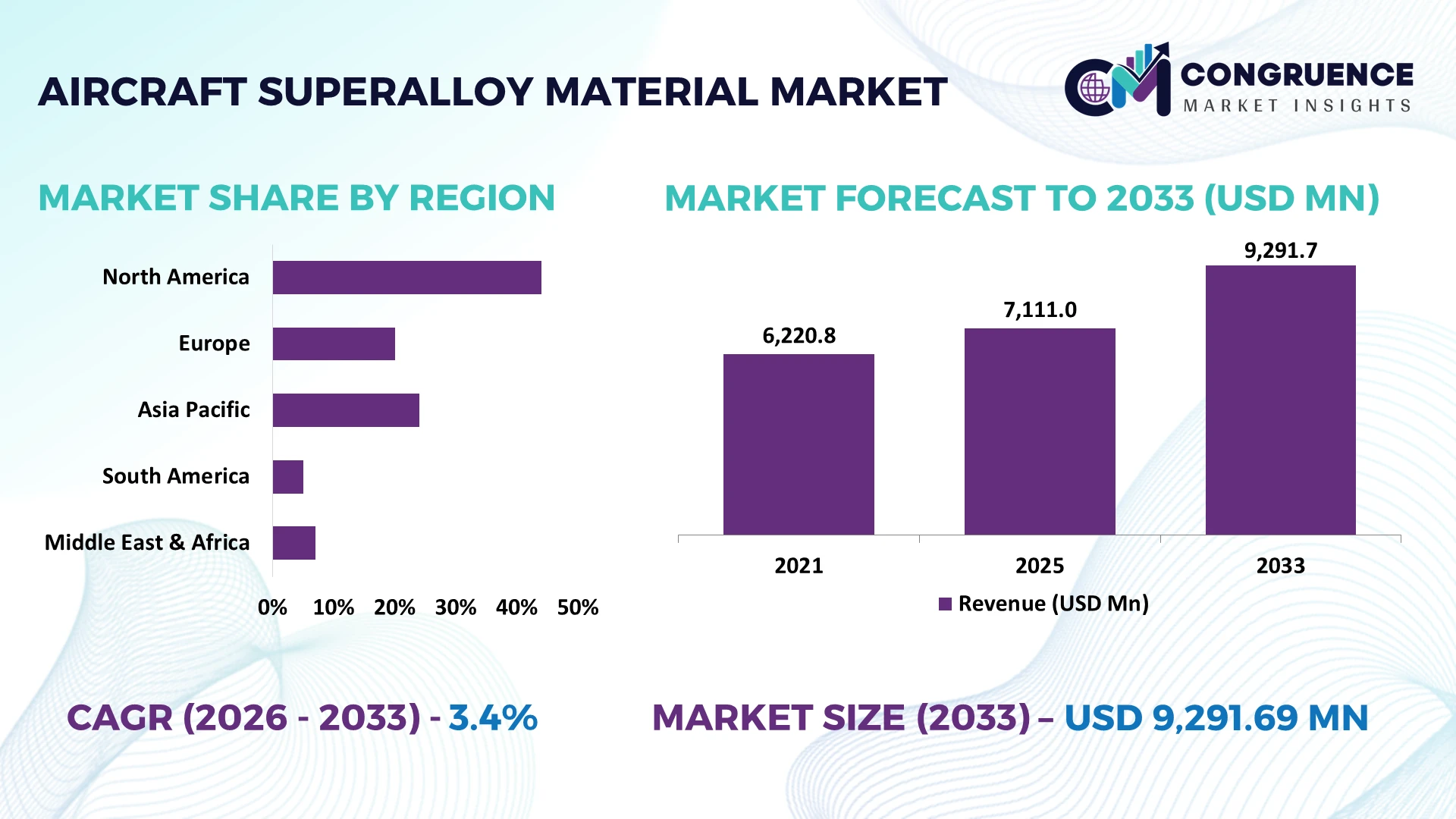
The United States holds the dominant position, representing approximately 38% of global aircraft superalloy production capacity, supported by major commercial-engine, military-engine, and aerospace manufacturing programs. France accounts for nearly 14%, while China contributes about 11% as domestic engine and aerospace-material capacity expands. U.S. aerospace materials investment remains more than 2 times higher than China’s, while geopolitical supply-chain diversification is accelerating regional sourcing of nickel, cobalt, and refractory metals. The U.S. also maintains a stronger concentration of advanced turbine-material qualification capabilities.
Strategically, aerospace manufacturers should prioritize high-temperature alloy development, secure critical-metal supply agreements, and expand qualified additive-manufacturing capacity to strengthen engine-program competitiveness.
Market Size & Growth: USD 7.11 billion in 2025 to USD 9.29 billion by 2033 at 3.4% CAGR, driven by higher-temperature aircraft engines.
Top Growth Drivers: Engine efficiency 31%, fleet modernization 24%, defense aerospace 19%.
Short-Term Forecast: By 2028, advanced manufacturing can reduce material waste by 15% and improve production efficiency by 12%.
Emerging Technologies: AI alloy design, metal additive manufacturing, automated casting, and single-crystal processing are advancing component performance.
Regional Leaders: North America USD 2.9 billion, Asia Pacific USD 2.6 billion, and Europe USD 2.1 billion by 2033, supported by localized aerospace production.
Consumer/End-User Trends: More than 60% of next-generation engine programs emphasize higher-temperature materials for turbine sections.
Pilot/Case Example: 2025 additive-manufacturing initiatives achieved approximately 25% lower material usage for selected complex aerospace components.
Competitive Landscape: North America holds about 38% share, with GE Aerospace, RTX, Safran, Rolls-Royce, and ATI among key participants.
Regulatory & ESG Impact: Critical-material diversification initiatives target up to 50% lower exposure to concentrated supply sources.
Investment & Funding: Over USD 1 billion in aerospace manufacturing investments is supporting advanced materials, automation, engine capacity, and localized production.
Innovation & Future Outlook: Single-crystal alloys, low-rhenium compositions, AI-assisted alloy development, and closed-loop recycling are shifting competition toward lifecycle performance.
Aircraft superalloys are seeing concentrated demand across turbine blades, vanes, disks, combustor components, and exhaust assemblies, where thermal stability and creep resistance directly influence engine performance. Nickel-based grades remain dominant, while powder metallurgy and additive manufacturing are expanding component-design flexibility. Approximately 20%–25% of new material-development activity is increasingly associated with advanced processing and alloy optimization. In 2026, geopolitical supply-chain restructuring and tighter critical-mineral sourcing requirements are strengthening the business case for regionalized production and qualified alternative suppliers.
Aircraft superalloys are becoming a strategic differentiator because turbine temperature capability directly influences engine efficiency, durability, and maintenance intervals. In 2026, aerospace manufacturers are treating nickel, cobalt, and specialty-alloy availability as supply-chain security priorities. Critical-mineral sourcing policies are accelerating supplier diversification, while defense programs increasingly favor qualified domestic material suppliers and resilient production networks.
Technology is reshaping production economics. Laser powder-bed fusion and advanced near-net-shape processing can reduce machining-intensive operations and material waste by approximately 15%–25% for suitable geometries. The United States maintains greater scale in engine-material qualification, while India is strengthening advanced manufacturing capabilities. Emerging bi-metallic superalloy structures also enable expensive nickel alloys to be concentrated in high-temperature zones, reducing overall material consumption.
Over the next 2–3 years, manufacturers are expected to expand additive-manufacturing qualification, digital inspection, and multi-source material contracts, with advanced processing targeting approximately 10%–15% of suitable new component programs. Large aerospace manufacturing investments are increasingly directed toward automation, localized capacity, workforce development, and engine-component availability. Competitive advantage will increasingly depend on combining alloy performance with resilient sourcing and scalable production.
Rising turbine operating temperatures are strengthening demand for nickel-based superalloys with superior creep resistance, oxidation stability, and fatigue performance. Next-generation propulsion programs increasingly require materials capable of sustaining higher thermal loads, while advanced manufacturing can reduce material waste by approximately 15%–25% for suitable complex geometries. In 2026, major aerospace manufacturers are increasing investments in domestic production capacity, automation, and advanced engine-component manufacturing. Companies are responding through alloy R&D, automated inspection, powder-metallurgy capacity, and long-term supplier agreements. The non-obvious advantage is improved lifecycle economics: higher alloy durability can reduce unscheduled maintenance exposure and extend component service intervals, strengthening the value proposition for engine manufacturers and operators.
Aircraft superalloys remain exposed to volatility in nickel, cobalt, chromium, and other alloying inputs, creating procurement pressure for producers operating under fixed aerospace contracts. Critical-mineral supply dependencies remain significant, with several advanced-material inputs experiencing concentrated global processing capacity and elevated sourcing risk. Material-price fluctuations of 10%–20% can materially affect procurement planning for alloy-intensive components, particularly where premium elements are required. These conditions increase inventory requirements and complicate qualification of alternative material grades. Companies are responding through multi-sourcing, strategic procurement contracts, domestic processing investments, and alloy formulations that reduce dependence on expensive elements such as rhenium. The key operational constraint is qualification time, as replacing suppliers requires extensive aerospace testing and certification.
Additive manufacturing creates an opportunity to reduce superalloy consumption by placing expensive high-temperature materials only where thermal or mechanical loading requires them. Advanced bi-metallic structures can support approximately 15%–25% lower material usage in suitable component designs, while digital process monitoring can improve production consistency by around 10%–15%. India is strengthening localized advanced-manufacturing capabilities, while the United States continues expanding aerospace qualification and production infrastructure. Manufacturers that combine alloy design, additive processing, and automated inspection can capture value beyond conventional material supply by offering integrated component-development partnerships. A particularly attractive opportunity lies in hybrid structures that combine lower-cost substrates with nickel-based superalloys at high-temperature interfaces, reducing material intensity without compromising thermal performance.
The principal challenge is converting advanced superalloy processes into repeatable, aerospace-certified production at industrial scale. Additive manufacturing, advanced casting, and powder metallurgy can introduce variability in porosity, grain structure, surface condition, and thermal history, making process qualification more demanding than conventional production. Early-stage industrialization can require 10%–20% greater process-control intensity, while shortages of specialized materials engineers and inspection professionals can constrain throughput. Manufacturers are therefore increasing investment in digital inspection, process monitoring, workforce development, and supplier partnerships. The long-term challenge extends beyond production speed: maintaining identical material properties across multiple facilities is essential for certification, fleet reliability, and global program continuity. Companies that establish standardized qualification frameworks and digitally traceable production processes will hold a stronger position as aerospace programs scale.
Advanced Processing Gains Ground: Additive manufacturing, precision forging, and automated inspection are expanding across aerospace production, with suitable workflows targeting 15%–25% lower material waste and 10%–15% faster component development. Companies are integrating digital process monitoring to improve repeatability and reduce machining-intensive operations.
Supply Chains Move Closer: U.S. aerospace manufacturers are increasing domestic sourcing and supplier redundancy as critical-mineral exposure and geopolitical disruptions reshape procurement. Localized sourcing can reduce selected component lead times by 10%–20%, encouraging long-term contracts, dual sourcing, and regional production expansion.
Engine Durability Takes Priority: High-pressure turbine programs are shifting purchasing toward alloys that extend time-on-wing rather than simply lowering material cost. Approximately 20%–30% of advanced-component development emphasizes durability, thermal resistance, and maintenance reduction, prompting manufacturers to expand high-performance alloy processing and inspection capacity.
India Builds Production Depth: India is moving toward higher-value aerospace manufacturing, with advanced welding, inspection, tooling, and component-production capabilities expanding around established aerospace hubs. Localized manufacturing can reduce selected supply-chain dependence by approximately 15%–20%, encouraging international manufacturers to deepen supplier partnerships and technical-transfer programs.
Nickel-Based superalloys lead the Aircraft Superalloy Material Market with an estimated 68%–72% share because they combine high-temperature strength, oxidation resistance, creep performance, and established compatibility with turbine manufacturing. Their integration across engine hot sections keeps them substantially ahead of Cobalt-Based alloys, which hold approximately 12%–15% share and remain important where thermal fatigue and wear resistance are critical. Iron-Based materials account for around 8%–11%, benefiting from comparatively lower material costs and applications with less extreme thermal exposure.
Titanium-Based materials represent approximately 7%–9% and are positioned as a faster-growing category within suitable lower-temperature aerospace applications because of their weight advantages. Adoption is increasingly linked to lightweight component architectures rather than direct replacement of nickel grades. Manufacturers are prioritizing nickel-alloy optimization, reduced reliance on expensive alloying elements, and hybrid structures. Investment is shifting toward powder metallurgy, advanced casting, and additive processing capable of improving material utilization by approximately 15%–25%.
Aircraft Engines represent the leading application, accounting for an estimated 48%–52% of Aircraft Superalloy Material Market demand because superalloys are indispensable across high-temperature propulsion systems. Turbine Blades follow at approximately 25%–29%, supported by single-crystal and directionally solidified materials designed for extreme thermal environments. Structural Components account for around 12%–15%, while Exhaust Systems contribute approximately 8%–11%, with demand concentrated around thermal cycling and corrosion resistance.
Turbine Blades represent the fastest-growing application as advanced engine architectures increase cooling-channel complexity and require longer component life. Advanced manufacturing can reduce material waste by approximately 15%–25% for suitable geometries, encouraging manufacturers to combine precision casting, additive manufacturing, and automated inspection. Aircraft-engine producers are expanding qualification programs and specialized production capacity, while suppliers are developing advanced blade materials and repair capabilities. The strategic shift is toward performance-per-component rather than material volume, making process capability increasingly important in procurement decisions.
Commercial Aviation represents the leading end-user group with an estimated 43%–47% share, reflecting its large installed fleet, intensive engine utilization, and continuous replacement requirements. Aerospace Manufacturing follows at approximately 25%–29%, supported by new-engine production and component integration. MRO Providers account for around 16%–20%, with demand concentrated on replacement blades, hot-section parts, repairs, and life-extension programs. Military Aviation represents approximately 10%–14%, but its purchasing priorities emphasize durability, availability, and mission readiness rather than unit cost.
Military Aviation is the fastest-growing end-user segment, supported by engine modernization, defense production expansion, and demand for domestically qualified materials. Approximately 20%–30% of new defense-material investment is increasingly directed toward production resilience, advanced processing, and qualification capacity. Commercial buyers emphasize lifecycle economics and maintenance intervals, whereas military programs prioritize secure supply and rapid availability. Manufacturers are responding through dedicated defense capacity, long-term contracts, localized production, and customized alloy development.
North America accounted for the largest market share at 38% in 2025 however, Asia-Pacific is expected to register the fastest growth, expanding at a CAGR of 4.2% between 2026 and 2033.
Domestic production strengthens aerospace supply-chain resilience
North America holds approximately 38% of the global Aircraft Superalloy Material Market, supported by concentrated aircraft-engine manufacturing, defense programs, specialty-metal production, and advanced materials qualification. The United States accounts for the majority of regional demand, with superalloys extensively used in turbine blades, disks, combustor components, and exhaust systems. Advanced manufacturing adoption is targeting 15%–25% lower material waste in suitable geometries. Aerospace manufacturers are expanding domestic forging, casting, machining, additive manufacturing, and inspection capacity to reduce exposure to overseas specialty-metal processing. Supply-chain restructuring is also increasing demand for dual-qualified suppliers and long-term material contracts. The competitive advantage increasingly favors vertically integrated producers controlling alloy development, processing, certification, and component manufacturing.
United States Market Outlook: The United States remains the dominant North American market because of its extensive aircraft-engine manufacturing base, defense procurement programs, specialty-metal infrastructure, and advanced materials research capabilities. More than 60% of regional aerospace-material activity is concentrated around established U.S. aerospace manufacturing corridors. Manufacturers are prioritizing automated inspection, advanced casting, additive manufacturing, and domestic critical-material sourcing to improve production continuity and component availability.
High-performance alloys support engine modernization
Europe represents approximately 29% of global Aircraft Superalloy Material Market activity, anchored by France, Germany, the United Kingdom, Italy, and Spain. France maintains the strongest position through its concentrated aircraft-engine and aerospace manufacturing ecosystem, while Germany contributes advanced component engineering and precision manufacturing. European producers are emphasizing low-defect casting, powder metallurgy, single-crystal turbine technology, and material traceability. Approximately 20%–30% of advanced component-development programs increasingly prioritize higher thermal efficiency and longer service intervals. Sustainability requirements are also encouraging recovery of nickel- and cobalt-containing production scrap. Manufacturers are responding through closed-loop material recovery, automated quality control, supplier partnerships, and localized processing. The region's competitive advantage is shifting toward premium material performance, certification depth, and lifecycle efficiency rather than low-cost production.
France Market Outlook: France remains Europe's most strategically significant country for aircraft superalloys because of its integrated engine, aircraft, and component ecosystem. Its aerospace manufacturing base supports high-volume turbine-component requirements and advanced alloy qualification. More than 50% of France's aerospace-material activity is concentrated around major aviation and propulsion clusters, encouraging suppliers to expand precision casting, forging, inspection, and high-temperature alloy capabilities.
Manufacturing scale accelerates localized aerospace production
Asia-Pacific accounts for approximately 23% of global Aircraft Superalloy Material Market activity and is becoming the fastest-expanding production base as China, Japan, India, and South Korea strengthen aerospace manufacturing capabilities. China represents the largest regional demand center, while Japan maintains strong expertise in precision materials and advanced component production. India is rapidly increasing aerospace manufacturing depth through engine-component production, tooling, welding, and inspection infrastructure. Regional manufacturers are targeting 15%–20% improvements in production efficiency through automation and advanced process monitoring. Increasing localization of aircraft components is encouraging domestic qualification of specialty alloys and reducing reliance on imported materials. The strategic shift is from component assembly toward higher-value material processing, creating opportunities for suppliers with certified metallurgy and scalable production capabilities.
China Market Outlook: China remains the largest Asia-Pacific market for aircraft superalloys, supported by expanding commercial aviation, military aircraft production, and domestic engine-development programs. Advanced manufacturing capacity is increasing across major aerospace industrial clusters, with automated casting, precision forging, and additive processing gaining importance. Local producers are increasingly targeting 10%–15% improvements in material utilization while strengthening domestic alloy qualification and production capabilities.
Brazil anchors regional aerospace material demand
South America represents a smaller but strategically relevant portion of global Aircraft Superalloy Material Market activity, with Brazil accounting for the majority of regional aerospace demand. The country's established aircraft manufacturing ecosystem supports requirements for engine components, structural parts, exhaust systems, and MRO applications. Approximately 55%–60% of regional aerospace-material consumption is concentrated in Brazil, creating a strong supplier base around established aviation manufacturing clusters. Local producers and international suppliers are emphasizing precision machining, component repair, and localized inventory to reduce imported-material lead times by an estimated 10%–15%. Infrastructure limitations and dependence on specialized alloy inputs remain constraints. Companies are responding through distributor partnerships, localized processing, inventory agreements, and technology transfer. Brazil's strategic importance lies in combining aircraft production with expanding maintenance and component-support capabilities.
Brazil Market Outlook: Brazil is the region's most important aerospace manufacturing center, supported by established aircraft production, engineering expertise, MRO infrastructure, and a mature supplier ecosystem. Approximately 60% of South America's aerospace manufacturing activity is concentrated in Brazil. Demand for high-temperature alloys is strengthening as aircraft production, engine servicing, and component localization expand.
Aerospace infrastructure investment accelerates localization
The Middle East & Africa accounts for approximately 10% of global Aircraft Superalloy Material Market activity, with demand concentrated in the United Arab Emirates, Saudi Arabia, Qatar, and South Africa. Gulf aviation hubs are driving requirements for aircraft engines, replacement components, exhaust systems, and MRO materials through fleet expansion and maintenance infrastructure development. MRO facilities are increasingly stocking high-value turbine materials locally, reducing selected component procurement cycles by approximately 10%–20%. Saudi Arabia and the UAE are also investing in aerospace localization, creating opportunities for certified material suppliers and specialized component manufacturers. Companies are responding through MRO partnerships, local warehousing, component-repair capabilities, and technical collaboration. The key structural shift is the transition from an import-dependent market toward localized aerospace services and selected high-value manufacturing activities.
United Arab Emirates Market Outlook: The United Arab Emirates is the region's strongest aerospace hub because of its extensive aviation infrastructure, established MRO ecosystem, international airline presence, and specialized maintenance capabilities. More than 40% of regional commercial-aircraft MRO activity is concentrated in the UAE, supporting recurring demand for turbine materials, replacement components, and certified repair inputs.
GE Aerospace, RTX, Safran, Rolls-Royce, and ATI compete across engine programs, specialty-alloy production, and high-value component supply. These leading groups collectively represent an estimated 45%–50% of the organized market, reflecting concentration around qualified materials, aerospace certification, and established customer relationships. Competition centers on advanced processing, with optimized manufacturing targeting 15%–25% lower material waste, while automation can reduce selected production cycles by 10%–15%. Supply-chain resilience has become equally important as manufacturers expand domestic capacity, secure critical-metal contracts, and qualify alternative suppliers. Engine OEMs compete with specialty-material producers through vertical integration, long-term agreements, and joint-development programs, while regional manufacturers emphasize cost efficiency and customization speed. The competitive shift favors companies controlling alloy formulation, processing, inspection, and certification rather than standalone material suppliers. High qualification costs and stringent aerospace approval requirements create significant entry barriers. Winning requires consistent alloy performance, secure raw-material access, scalable production, rapid qualification, and integrated customer partnerships.
GE Aerospace
RTX
Safran
Rolls-Royce Holdings
ATI Inc.
Carpenter Technology Corporation
Kobe Steel Ltd.
Daido Steel Co., Ltd.
Nippon Yakin Kogyo Co., Ltd.
Proterial, Ltd.
Jiangsu Shagang Group
Baosteel Group
VSMPO-AVISMA Corporation
Mishra Dhatu Nigam Limited
Current aerospace production increasingly combines precision forging, advanced casting, automated inspection, and digital process control. Additive manufacturing reduces material waste by 15%–25% in suitable geometries, while AI-enabled inspection can improve defect detection efficiency by 10%–15%. Adoption is concentrated in advanced engine programs and qualified production cells.
Emerging technologies include single-crystal alloy optimization, powder metallurgy, laser powder-bed fusion, and hybrid material architectures. Compared with conventional machining, additive routes can deliver 20%–30% higher material utilization for complex components. Digital twins and closed-loop monitoring are reaching 10%–15% deployment across advanced manufacturing workflows, improving traceability, qualification speed, and process consistency. Automated powder handling, robotic finishing, and real-time thermal monitoring further reduce manual intervention by approximately 10%, strengthening repeatability for high-value turbine components. Machine-learning models are improving predictive maintenance decisions, with workflows reducing inspection-related downtime by 8%–12%. These capabilities matter most where certification, traceability, and consistent metallurgy determine production economics.
By 2028, disruptive alloy-design platforms, automated manufacturing cells, and integrated inspection systems will increasingly connect design, materials selection, production, and certification. Companies combining proprietary alloys with additive manufacturing gain advantages in weight, customization, and development speed, while vertically integrated suppliers strengthen supply security. The priority is qualifying scalable technologies now, before next-generation engine production accelerates.
March 2025 GE Aerospace committed nearly USD 1 billion to U.S. factories and supply chains, including over USD 100 million for materials and manufacturing. The investment strengthens capacity, supplier capability, and adoption of additive components across engine programs. Source: geaerospace.com
April 2026 Rolls-Royce opened a 350-square-meter additive manufacturing development cell in Bristol for next-generation aircraft-engine components. The facility uses superalloy powders and laser processing to reduce lead times, material waste, and costs while strengthening UK critical defense-manufacturing capabilities. Source: rolls-royce.com
December 2024 Safran secured FAA and EASA certification for more durable CFM LEAP-1A high-pressure turbine hardware, including a stage-one blade. The upgraded hardware targets harsh hot environments and extends engine time-on-wing, strengthening durability economics for global commercial operators. Source: safran-group.com
June 2026 ATI opened a manufacturing and inspection operation in Chihuahua, integrating machining, nondestructive testing, finishing, and quality verification. The facility strengthens forging-flow capacity for next-generation engine components, improving throughput and supply-chain resilience through localized downstream aerospace production. Source: atimaterials.com
The Aircraft Superalloy Material Market report covers Nickel-Based, Cobalt-Based, Iron-Based, and Titanium-Based materials across Aircraft Engines, Turbine Blades, Structural Components, and Exhaust Systems. End-user analysis includes Commercial Aviation, Military Aviation, Aerospace Manufacturing, and MRO Providers, providing a detailed view of material demand, application intensity, purchasing behavior, and production requirements.
Geographic coverage spans North America, Europe, Asia-Pacific, South America, and the Middle East & Africa, with country-level assessment of manufacturing concentration, aerospace infrastructure, technology adoption, and supply-chain localization. The report evaluates advanced casting, powder metallurgy, additive manufacturing, automated inspection, single-crystal processing, and digital production systems. Segment-level comparisons covering approximately 4 material categories, 4 applications, and 4 end-user groups support investment planning, capacity expansion, supplier selection, competitive positioning, and technology prioritization through 2026–2033.
| Report Attribute/Metric | Report Details |
|---|---|
Market Revenue in 2025 | USD 7111 Million |
Market Revenue in 2033 | USD 9291.69 Million |
CAGR (2026 - 2033) | 3.4% |
Base Year | 2025 |
Forecast Period | 2026 - 2033 |
Historic Period | 2021 - 2025 |
Segments Covered | By Type
By Application
By End-User
|
Key Report Deliverable | Revenue Forecast, Growth Trends, Market Dynamics, Segmental Overview, Regional and Country-wise Analysis, Competition Landscape |
Region Covered | North America, Europe, Asia-Pacific, South America, Middle East, Africa |
Key Players Analyzed |
|
Customization & Pricing | Available on Request (10% Customization is Free) |




