
Reports
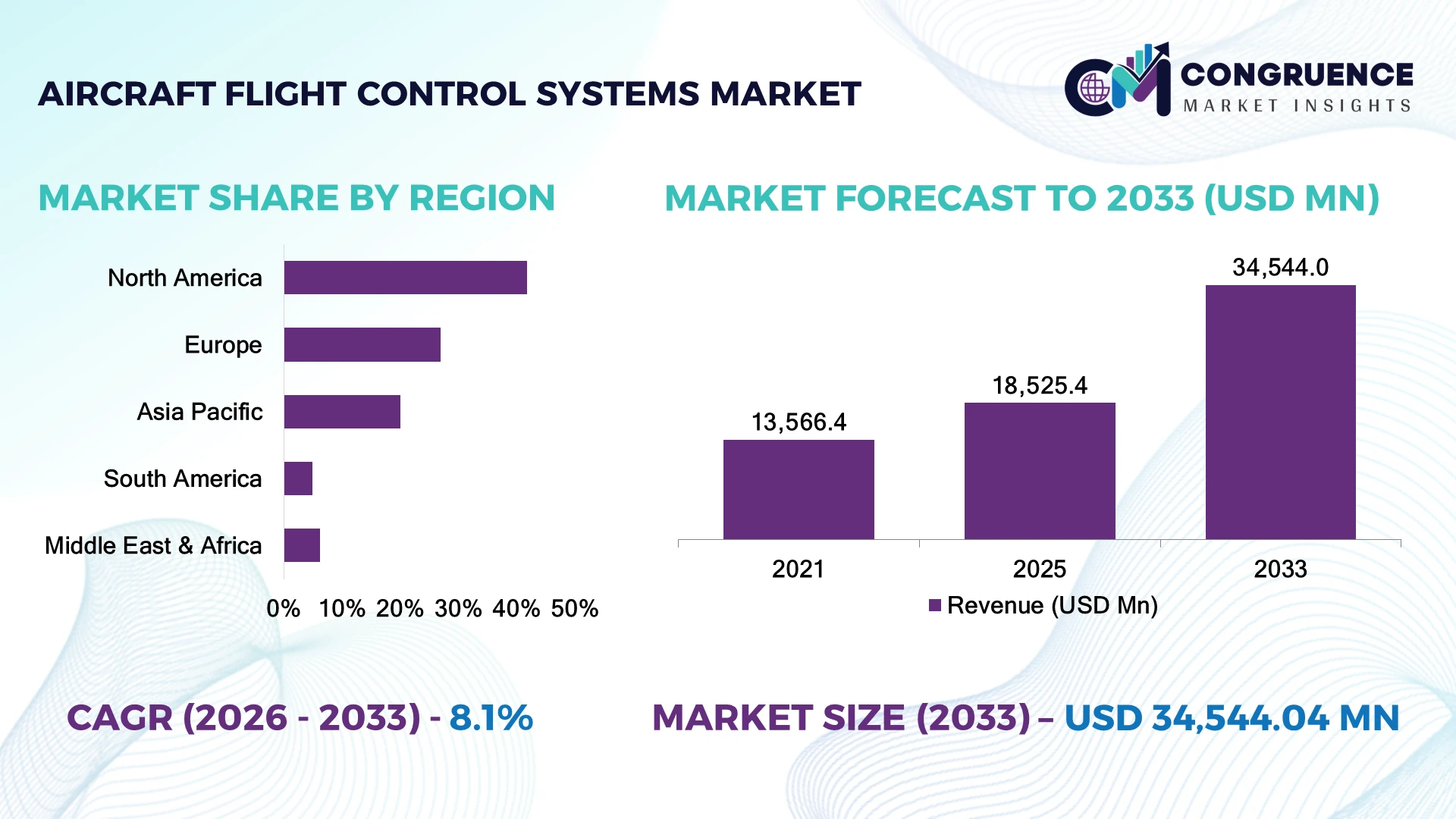
The Global Aircraft Flight Control Systems Market was valued at USD 18,525.4 Million in 2025 and is anticipated to reach a value of USD 34,544.0 Million by 2033 expanding at a CAGR of 8.1% between 2026 and 2033. Growth is being driven by the transition from conventional hydraulic architectures toward fly-by-wire, electromechanical actuation, active-control technologies, and increasingly software-defined flight-control architectures across commercial, military, and advanced-air-mobility platforms.
The United States remains the dominant country market, supported by Boeing, Lockheed Martin, Gulfstream, and a deep avionics supplier base, while India is emerging as a strategic engineering and manufacturing hub. BAE Systems alone reports an installed flight-control base of 15,000 aircraft, while its newer systems are approximately 40% smaller and lighter than five years earlier. India’s 2026 Airbus technology-centre expansion further strengthens engineering localization.
Strategically, suppliers that combine certified flight-control hardware with software, actuation, and lifecycle support are best positioned to capture next-generation platform programs.
Market Size & Growth: USD 18,525.4 Million in 2025 to USD 34,544.0 Million by 2033 at 8.1% CAGR, supported by fly-by-wire integration and electrification.
Top Growth Drivers: Fly-by-wire adoption 38%, electromechanical actuation 27%, military modernization 21%.
Short-Term Forecast: By 2028, digital diagnostics can reduce scheduled inspection workload by 10–15% while automated control-law validation improves engineering efficiency by approximately 15%.
Emerging Technologies: AI-assisted control laws, electromechanical actuators, active inceptors, fly-by-wireless architectures, and autonomous flight-control software are reshaping system design.
Regional Leaders: North America is projected at approximately USD 13.5 billion, Europe at USD 9.2 billion, and Asia-Pacific at USD 7.8 billion, with Asia-Pacific showing faster localization of aerospace engineering.
Consumer/End-User Trends: Commercial aircraft account for approximately 55% of demand, while military platforms contribute about 32%, with increasing adoption of digital FBW and active-control technologies.
Pilot/Case Example: BAE Systems' flight-control portfolio has accumulated more than 150 billion flight hours, while newer architectures have achieved approximately 40% reductions in system size and weight versus earlier generations.
Competitive Landscape: BAE Systems holds an estimated 16% share, competing closely with Collins Aerospace, Safran, Honeywell, and Moog across integrated controls, actuation, and flight-critical electronics.
Regulatory & ESG Impact: Electrified actuation can reduce hydraulic-system dependence and maintenance requirements by approximately 10–20%, supporting lighter aircraft architectures and lower lifecycle resource consumption.
Investment & Funding: Airbus expanded its India engineering footprint with a 5,000-seat Bengaluru technology centre in 2026, reinforcing localization of digital engineering, procurement, and aerospace technology development.
Innovation & Future Outlook: The competitive shift is moving toward smaller, lighter, software-intensive flight-control platforms supporting autonomous aircraft, hybrid-electric propulsion, eVTOL systems, and increasingly distributed aircraft architectures.
The Aircraft Flight Control Systems Market is increasingly centered on fly-by-wire, electromechanical actuation, active inceptors, flight-control computers, and autonomous-control architectures. Approximately 40% system-size and weight reductions achieved in newer architectures demonstrate the direction of innovation. The 2026 supply-chain shift toward localized aerospace engineering, particularly in India, is strengthening the strategic importance of integrated controls development.
Aircraft flight control systems are becoming a strategic differentiator because control architecture increasingly determines aircraft weight, efficiency, software capability, certification complexity, and platform adaptability. The shift from mechanically intensive controls toward digital fly-by-wire and more-electric architectures is accelerating as OEMs pursue lighter aircraft and higher electrical integration. Safran's 2025 acquisition of Collins Aerospace's flight-control and actuation activities, covering systems installed on 180 platforms, demonstrates the strategic value of controlling mission-critical actuation capabilities.
The technology transition is measurable. Modern electromechanical actuators are smaller, lighter, and more power-dense than conventional aerospace hydraulic solutions, while advanced flight-control computers can be approximately 40% smaller and lighter than earlier architectures. Over the next 2–3 years, greater use of predictive diagnostics, distributed computing, and active control is expected to reduce maintenance workload by roughly 10–15% on suitably equipped platforms.
Regional strategies are diverging. U.S. and European suppliers retain certification depth and installed-base advantages, while India is strengthening engineering localization through Airbus's 2026 Bengaluru expansion. Companies are therefore increasing investment in software, actuation, digital engineering, and local production partnerships. Competitive advantage increasingly depends on owning the complete control chain—from sensors and computers through actuators, software, certification, and lifecycle support.
Fly-by-wire adoption is expanding flight-control system content as OEMs prioritize weight reduction, precise control laws, and software-enabled aircraft functionality. Digital architectures can reduce flight-control wiring and mechanical complexity by approximately 15–25%, while advanced actuation can reduce component weight by 10–20%. Military programs are also accelerating adoption of integrated flight-control computers and active-control technologies. Airbus and Boeing continue expanding digital-control architectures across new-generation platforms, while suppliers are investing in high-integrity computing, electromechanical actuation, and software certification. The strategic shift is that flight controls are increasingly becoming a software-defined platform rather than a standalone mechanical subsystem. Companies with control-law, actuator, and certification capabilities are therefore expanding vertically to capture more system value.
Flight-critical certification remains a significant structural constraint because control systems require rigorous verification across hardware, software, redundancy, and failure-management layers. DO-178C and DO-254 compliance can push verification and validation activities to more than 30% of development effort on complex flight-control programs, while redundant architectures can add approximately 15–25% to hardware and integration requirements. Semiconductor and aerospace-electronics supply constraints further complicate production planning, particularly for specialized processors and high-reliability components. U.S. and European suppliers are mitigating exposure through dual sourcing, longer-term component agreements, localized engineering, and reusable certified software architectures. The non-obvious pressure is certification reuse: suppliers that cannot transfer validated design assets across aircraft programs face materially higher engineering effort and slower platform deployment.
Electrification creates an opportunity to replace selected hydraulic and mechanical functions with electromechanical or electro-hydrostatic actuation, improving packaging flexibility and reducing maintenance interfaces. Advanced electric actuation can deliver approximately 10–15% weight savings at subsystem level, while distributed control architectures can reduce wiring and integration requirements by roughly 15%. India is becoming strategically important as aerospace engineering centers expand, creating lower-cost access to software, systems engineering, and digital verification talent. Suppliers are investing in integrated actuator-control units, health monitoring, model-based engineering, and reusable control software. The non-obvious opportunity is aftermarket modernization: digital monitoring and actuator upgrades can extend the useful life of existing aircraft without requiring complete flight-control architecture replacement.
Increasingly software-intensive flight controls introduce integration, cybersecurity, and real-time computing challenges that become harder as aircraft architectures distribute control functions across multiple processors and networks. Software can represent more than 50% of development effort on highly integrated avionics programs, while redundant computing and communication paths can add 20–30% to verification workload. AI-assisted control functions introduce additional validation requirements because deterministic behavior remains essential for safety-critical systems. Companies must therefore invest in formal methods, hardware-in-the-loop testing, digital twins, secure development environments, and specialized certification teams. The strategic challenge is balancing software flexibility with deterministic certification. Suppliers that build reusable verification frameworks can shorten program cycles and improve deployment consistency across multiple aircraft platforms.
Electromechanical Actuation Gains Ground: Aircraft programs are increasingly evaluating electric actuation to reduce hydraulic dependence and simplify maintenance architecture. Subsystem-level weight reductions of approximately 10–15% are achievable in suitable applications, while fewer hydraulic interfaces can reduce maintenance touchpoints by around 5–10%. Suppliers are expanding electromechanical actuator portfolios and integrating sensing, control electronics, and health monitoring.
Control Software Becomes Strategic: Flight-control software is moving from supporting functionality toward a core competitive asset. Model-based development and automated verification can reduce selected engineering workflows by 15–25%, particularly for repeatable control-law testing. OEMs and Tier-1 suppliers are increasing reusable software frameworks and digital engineering teams, allowing validated control functions to transfer more efficiently across aircraft platforms.
Distributed Computing Reshapes Architectures: New aircraft increasingly distribute flight-control processing across interconnected computing resources instead of relying exclusively on isolated controllers. This architecture can reduce dedicated hardware requirements by approximately 10–20% while improving computational flexibility. The trade-off is greater integration complexity, prompting suppliers to strengthen deterministic networking, redundancy management, and hardware-in-the-loop validation.
Digital Maintenance Enters Controls: Embedded health monitoring is becoming more important as operators seek earlier detection of actuator degradation and control-system anomalies. Predictive analytics can reduce selected unscheduled maintenance events by approximately 5–10% when adequate sensor data and maintenance integration are available. In 2026, suppliers are increasingly pairing flight-control hardware with digital service records and condition-monitoring software, turning aftermarket support into a recurring technology differentiator.
Fly-by-wire systems account for approximately 54% of the 2025 Aircraft Flight Control Systems Market, reflecting their integration across commercial jets, fighters, business aircraft, and advanced platforms. Their dominance comes from centralized control laws, redundancy, envelope protection, and lower mechanical complexity. Electromechanical and electro-hydrostatic systems represent about 23% and are the fastest-growing type, supported by aircraft electrification and more-electric architectures. Conventional mechanical flight controls retain roughly 13%, concentrated in smaller and legacy aircraft, while fly-by-light and other emerging architectures represent approximately 10%. The mature segment therefore remains highly scalable, but investment is shifting toward software-defined and electrically actuated architectures.
Electromechanical systems can reduce selected actuator subsystem weight by approximately 10–15% while reducing hydraulic interfaces and maintenance touchpoints. Suppliers are responding through integrated actuator electronics, health monitoring, and partnerships with airframers on next-generation platforms. The strategic implication is a gradual migration from component-level competition toward integrated control-system ownership.
Airbus reported more than 21,000 aircraft in its commercial-aircraft backlog at the end of 2025, providing a substantial future installed base for digitally integrated flight-control architectures.
Commercial aircraft account for approximately 55% of flight-control-system demand, supported by high production volumes and extensive fly-by-wire penetration across narrowbody and widebody fleets. Military aircraft contribute about 32%, with advanced fighters requiring redundant digital control, high-performance actuation, and mission-adaptive functionality. General aviation and business aircraft represent the remaining 13%, with adoption increasingly influenced by avionics modernization and active-control technologies. Commercial platforms therefore provide scale, while military programs generate greater system complexity and higher integration intensity.
Advanced military and next-generation aircraft applications represent the fastest-changing demand pool, with digital flight-control architectures increasingly integrated with mission computers, sensors, and autonomous functions. Electrified actuation can reduce selected subsystem weight by 10–15%, while automated control-law validation can reduce repetitive engineering workload by roughly 15–25%. Companies are responding by expanding integrated avionics portfolios, developing reusable software architectures, and establishing long-term OEM partnerships. The business implication is a widening gap between basic replacement demand and high-value integrated control platforms.
Airbus delivered 793 commercial aircraft in 2025, illustrating the continuing production scale supporting flight-control-system demand across high-volume commercial platforms.
Aircraft OEMs represent approximately 48% of 2025 end-user demand because flight-control architecture is embedded directly into aircraft design, certification, and production programs. Airlines and fleet operators account for approximately 31%, primarily through retrofit, replacement, and lifecycle-support requirements, while defense organizations contribute about 21% through military-platform procurement and modernization. OEM purchasing emphasizes certification, system integration, weight, software compatibility, and production scalability, whereas operators prioritize reliability, maintainability, and lifecycle cost.
Defense organizations are the fastest-changing end-user group as fighter modernization and autonomous-aircraft development increase demand for high-integrity digital controls. Advanced architectures can deliver approximately 10–20% reductions in selected hardware and integration requirements, while predictive monitoring can lower specific unscheduled maintenance workloads by 5–10%. Suppliers are targeting OEMs through platform partnerships and co-development, while operator-focused strategies increasingly emphasize upgrades and digital lifecycle services. The strategic shift is toward multi-year ecosystem relationships rather than transactional component supply.
Boeing delivered 600 commercial airplanes in 2025, reinforcing OEM production programs as a major purchasing channel for integrated flight-control systems and associated actuation technologies.
North America accounted for the largest market share at 41.8% in 2025 however, Asia-Pacific is expected to register the fastest growth, expanding at a CAGR of 9.3% between 2026 and 2033.
Integrated digital controls strengthen the region’s aerospace technology lead
North America represents approximately 41.8% of global Aircraft Flight Control Systems Market demand, supported by the United States’ concentration of commercial-aircraft OEMs, defense primes, avionics suppliers, and MRO infrastructure. Boeing’s commercial and defense programs sustain significant demand for fly-by-wire computers, actuators, control electronics, and software. The U.S. also remains a major center for sixth-generation aircraft development, with the 2026 F/A-XX program reinforcing investment in advanced flight-control architectures. Supply-chain normalization remains important as aircraft production scales. Suppliers are therefore expanding domestic manufacturing, digital engineering, and integrated actuation capabilities. The region’s advantage is increasingly based on certification depth and control-software expertise rather than component volume alone.
United States Market Outlook: The United States remains the principal national market because Boeing, Lockheed Martin, Northrop Grumman, RTX, Honeywell, and Moog anchor a deeply integrated aerospace ecosystem. Boeing’s MQ-25 program reached 14 aircraft under contract in September 2026, reinforcing demand for autonomous and digitally integrated flight-control architectures. The country’s extensive military fleet also creates a substantial modernization and aftermarket opportunity.
Airbus production scale accelerates integrated control-system demand
Europe accounts for approximately 27.0% of global demand, anchored by France, Germany, Spain, and the United Kingdom across commercial aerospace, defense, and helicopter programs. Airbus delivered 793 commercial aircraft in 2025 and entered 2026 with a record 8,754-aircraft backlog, sustaining demand for flight-control computers, actuation, sensors, and software. European suppliers are simultaneously emphasizing more-electric architectures and advanced actuation to reduce aircraft weight and hydraulic dependence. Production bottlenecks, including engine and component shortages, are encouraging deeper supplier coordination and localization. The region’s competitive strength lies in integrated OEM-Tier-1 engineering rather than standalone component manufacturing.
France Market Outlook: France remains Europe’s most strategically important flight-control ecosystem through Airbus, Safran, Dassault Aviation, and a dense network of aerospace engineering suppliers. Safran’s actuation and flight-control activities provide exposure across commercial, military, and helicopter platforms. France also benefits from strong certification expertise and advanced systems engineering, supporting development of electrically actuated and software-intensive flight-control architectures for next-generation aircraft.
Production localization is transforming aerospace engineering capacity
Asia-Pacific accounts for approximately 20.0% of global Aircraft Flight Control Systems Market demand and is becoming the fastest-changing engineering base. China’s expanding commercial and military aircraft programs are increasing domestic demand for flight-control electronics and actuation, while Japan, South Korea, India, and Singapore strengthen specialized aerospace capabilities. India is particularly significant: Airbus inaugurated an 880,000-square-foot Bengaluru technology centre in March 2026 designed for approximately 5,000 employees, integrating engineering, digital transformation, customer services, and procurement. Companies are consequently shifting selected engineering, software, and lifecycle-support activities toward Asian hubs, improving localization while expanding access to technical talent.
India Market Outlook: India is developing into a major aerospace engineering and digital-support hub rather than simply an aircraft assembly location. Airbus’s Bengaluru facility accommodates approximately 5,000 employees and supports engineering, cybersecurity, robotics, AI, procurement, and customer services. Hindustan Aeronautics and the expanding indigenous defense-aircraft ecosystem further strengthen domestic requirements for flight-control computers, actuation, embedded software, and systems integration.
Embraer’s production momentum strengthens regional control-system demand
South America represents approximately 5.0% of global flight-control-system demand, with Brazil accounting for the overwhelming share through Embraer’s commercial, executive, and defense aircraft programs. Embraer delivered 244 aircraft in 2025, an 18% increase from 2024, while its 2026 first-half deliveries reached 109 aircraft, approximately 20% above the corresponding 2025 period. This production momentum supports recurring demand for flight-control computers, actuators, sensors, and associated software. Brazil’s aerospace ecosystem also benefits from local engineering and maintenance capabilities. Suppliers are increasingly aligning with Embraer programs and regional MRO networks, although market scale remains concentrated in a relatively small number of platforms and manufacturers.
Brazil Market Outlook: Brazil is the region’s clear technology and manufacturing center through Embraer’s integrated aerospace ecosystem. The company’s E2 commercial-aircraft program has surpassed 500 firm orders, creating a substantial long-term platform base for digitally integrated flight-control systems. Brazil’s defense portfolio, including KC-390 and A-29 programs, further broadens demand beyond commercial aviation and supports domestic systems-engineering capabilities.
Fleet modernization creates high-value avionics replacement demand
Middle East & Africa represents approximately 6.2% of global flight-control-system demand, with Saudi Arabia, the United Arab Emirates, Qatar, and Israel accounting for most high-value commercial and defense procurement. Saudi Arabia’s aviation expansion is particularly significant: Saudia Group disclosed an order for 10 A330-900 aircraft in 2025, building on a previous 105-aircraft Airbus agreement. New widebody and advanced fighter fleets increase requirements for fly-by-wire controls, high-integrity computing, actuation, and MRO capabilities. Suppliers are increasingly pairing equipment with lifecycle support, predictive maintenance, and localized technical services. The region’s harsh operating environments also increase the value of robust actuation and condition-monitoring technologies.
Saudi Arabia Market Outlook: Saudi Arabia is the region’s most strategically significant market because Vision 2030 is linking fleet expansion with broader aviation infrastructure development. Saudia Group’s 10-aircraft A330-900 order in 2025 added to a 105-aircraft Airbus agreement announced previously, creating a growing installed base for advanced digital flight-control systems. The country’s expanding MRO and aerospace ecosystem also supports localized lifecycle support and component-service opportunities.
BAE Systems, Safran, Moog, Honeywell, and RTX Collins compete as global Tier-1 flight-control and actuation leaders, while Woodward and specialized suppliers compete in electromechanical actuation and control components. The top five players collectively hold approximately 48% of market activity, reflecting high certification barriers and entrenched OEM relationships. Competition centers on technology, reliability, supply security, and customization: advanced architectures can reduce subsystem weight 10–15%, digital verification can cut repetitive engineering effort 15–25%, and localized production can shorten selected supply cycles 10–20%. Safran strengthened vertical integration through its Collins acquisition, while Moog is expanding regional distribution and Honeywell is restructuring aerospace operations around dedicated control-system capabilities. The competitive shift is toward integrated hardware-software portfolios, electrified actuation, and lifecycle support rather than standalone components. Certification, flight-test validation, cybersecurity, and installed-base qualification remain decisive entry barriers. Winning requires platform-level integration, proven reliability, scalable manufacturing, secure software, and long-term OEM partnerships across multiple aircraft programs.
BAE Systems
Safran
Moog Inc.
Honeywell International
RTX
Woodward
Parker Hannifin
Leonardo S.p.A.
Liebherr Group
Thales
Curtiss-Wright Corporation
Eaton
Nabtesco Corporation
Crane Aerospace & Electronics
Fly-by-wire remains the core architecture, but current systems increasingly combine flight-control computers, active inceptors, and electronically controlled actuation. BAE Systems reports an installed base of 15,000 aircraft, indicating mature deployment. Electromechanical and electrohydrostatic actuators can reduce selected subsystem weight by 10–15% and maintenance interfaces by 5–10%, strengthening adoption across commercial and military platforms.
Emerging architectures are moving toward distributed computing, active control, and power-by-wire. Integrated actuator electronics reduce dedicated wiring and interface complexity by approximately 10–20%, while model-based development can reduce repetitive verification effort 15–25%. Active inceptors provide tactile feedback without direct mechanical linkage, improving pilot information flow. Suppliers with validated control laws and reusable software frameworks gain an advantage because certification assets can transfer across related platforms.
From 2026–2028, autonomous-control functions, AI-assisted diagnostics, digital twins, and more-electric aircraft architectures will become increasingly important. Compared with legacy hydraulic-heavy systems, suitable electromechanical configurations can deliver roughly 10–15% subsystem weight improvement while simplifying maintenance. Honeywell’s collaboration with NXP illustrates the shift toward high-performance computing and AI-enabled avionics. BAE Systems benefits from deep control-software heritage, while Moog gains through integrated actuation expertise. The competitive priority is now combining certified hardware, deterministic software, cybersecurity, sensing, and lifecycle analytics into one scalable architecture for OEMs.
July 2025 Safran completed acquisition of Collins Aerospace flight-control and actuation activities, adding approximately 4,000 employees across eight principal facilities and systems installed on 180 platforms. The transaction strengthened vertical integration and positioned Safran for next-generation aircraft programs and global customer support. Source: safran-group.com (Safran)
June 2025 Moog appointed S3 AeroDefense as worldwide distributor for Military Global Sustainment, covering primary and secondary flight-control components. The agreement expanded international aftermarket access and strengthened fleet-readiness support for operators requiring pitch, roll, trim, and actuation solutions globally. Source: moog.com (Moog)
March 2026 Airbus inaugurated its 880,000-square-foot Bengaluru Technology Centre, designed for approximately 5,000 employees. Consolidating engineering, digital, procurement, and customer services strengthens India’s role in Airbus’s global aerospace value chain and expands localized engineering capacity for future aircraft systems. Source: airbus.com (Airbus)
January 2025 Honeywell expanded its partnership with NXP to adapt high-performance computing and AI technologies for aviation. NXP processors support faster real-time processing within Honeywell Anthem, strengthening autonomous-flight capabilities, connectivity, cybersecurity, and operational optimization across next-generation avionics architectures. Source: honeywell.com (Honeywell)
The Aircraft Flight Control Systems Market Report covers fly-by-wire, mechanical, hydraulic, electromechanical, electrohydrostatic, and emerging power-by-wire architectures across commercial aircraft, military aircraft, business aviation, and other specialized platforms. Segmentation evaluates primary flight controls, secondary controls, actuation systems, flight-control computers, active inceptors, and integrated control electronics. Regional analysis covers North America, Europe, Asia-Pacific, South America, and Middle East & Africa, with country-level assessment of production, deployment, modernization, and engineering localization.
The report evaluates mature installed-base demand alongside emerging autonomous controls, AI-assisted diagnostics, digital twins, distributed computing, and more-electric aircraft architectures. Approximately 55% of demand is concentrated in commercial aircraft, while OEMs represent roughly 48% of end-user demand. Competitive assessment covers 14 major companies, certification barriers, supply-chain localization, partnerships, technology differentiation, and lifecycle services, supporting investment planning, expansion strategy, procurement decisions, competitive positioning, and market direction through 2026–2033.
| Report Attribute/Metric | Report Details |
|---|---|
|
Market Revenue in 2025 |
USD 18,525.4 Million |
|
Market Revenue in 2033 |
USD 34,544.0 Million |
|
CAGR (2026 - 2033) |
8.1% |
|
Base Year |
2025 |
|
Forecast Period |
2026 - 2033 |
|
Historic Period |
2021 - 2025 |
|
Segments Covered |
By Type
By Application
By End-User
|
|
Key Report Deliverable |
Revenue Forecast, Growth Trends, Market Dynamics, Segmental Overview, Regional and Country-wise Analysis, Competition Landscape |
|
Region Covered |
North America, Europe, Asia-Pacific, South America, Middle East, Africa |
|
Key Players Analyzed |
BAE Systems, Safran, Moog Inc., Honeywell International, RTX, Woodward, Parker Hannifin, Leonardo S.p.A., Liebherr Group, Thales, Curtiss-Wright Corporation, Eaton, Nabtesco Corporation, Crane Aerospace & Electronics |
|
Customization & Pricing |
Available on Request (10% Customization is Free) |




