
Reports
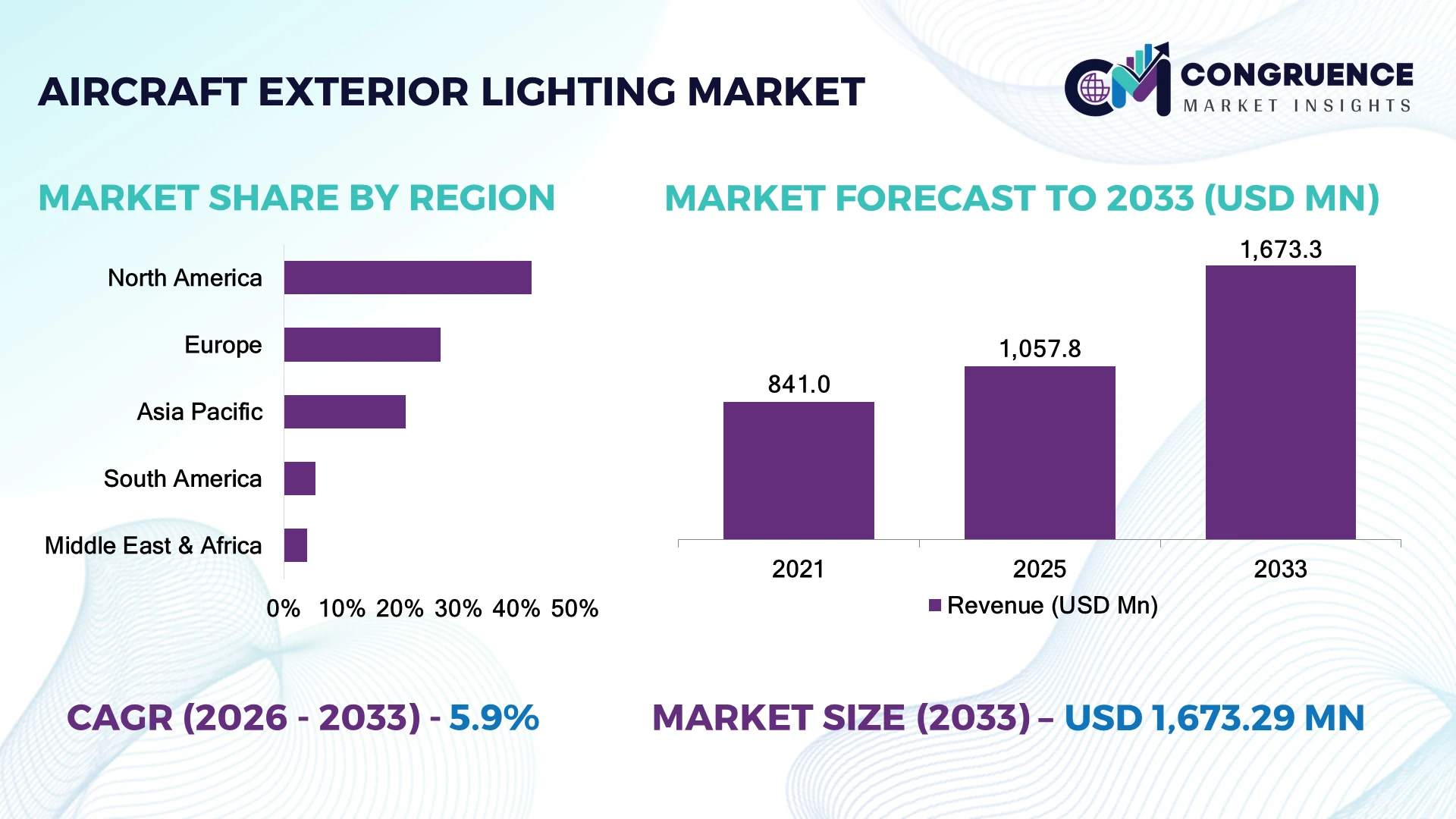
The Global Aircraft Exterior Lighting Market was valued at USD 1,057.8 Million in 2025 and is anticipated to reach a value of USD 1,673.3 Million by 2033 expanding at a CAGR of 5.9% between 2026 and 2033. Growth is being driven by LED replacement of legacy lamps, fleet modernization, rising retrofit activity, and integration of navigation, anti-collision, landing, taxi, and inspection lighting into lightweight assemblies.
The United States remains the dominant country market, representing approximately 33–35% of global aircraft exterior lighting demand and more than 70% of North American aircraft-lighting activity. U.S. aerospace production, MRO infrastructure, and military modernization support high adoption of LED systems, while China is expanding manufacturing capacity and aircraft production. LED penetration exceeds 70% across major aircraft-lighting applications, reinforcing the technology transition.
The strategic priority is to secure certified LED platforms, retrofit programs, and integrated assemblies while strengthening supply resilience for qualified optical and electronic components.
Market Size & Growth: USD 1,057.8 million in 2025 to USD 1,673.3 million by 2033 at 5.9% CAGR, driven by LED retrofits and fleet modernization.
Top Growth Drivers: LED conversion 32%, retrofit demand 27%, new-aircraft deliveries 21%.
Short-Term Forecast: By 2028, LED retrofit programs can reduce lighting power consumption by up to 20–30% across suitable aircraft configurations.
Emerging Technologies: Integrated LED assemblies, NVIS-compatible lighting, adaptive thermal management, and smart condition-monitoring modules are advancing aircraft exterior lighting.
Regional Leaders: North America approaches USD 590 million by 2033, Asia-Pacific approximately USD 470 million, and Europe around USD 410 million, reflecting retrofit and fleet-renewal activity.
Consumer/End-User Trends: Commercial aircraft account for roughly 70% of exterior-lighting demand, with airlines increasingly prioritizing low-maintenance LED systems.
Pilot/Case Example: 2026 LED retrofit programs demonstrate power reductions approaching 85% for selected aircraft lighting configurations versus legacy systems.
Competitive Landscape: Collins Aerospace holds a leading estimated 18–20% position, competing with Honeywell, Safran, Astronics, Oxley, and specialized lighting suppliers.
Regulatory & ESG Impact: LED conversion can reduce lighting power consumption by up to 85% in selected applications while extending operating life toward 50,000 hours.
Investment & Funding: Aerospace lighting investment is increasingly concentrated in multi-million-dollar retrofit, certification, and production programs, with suppliers prioritizing LED platforms and integrated assemblies.
Innovation & Future Outlook: The market is shifting toward lightweight, multifunctional, low-profile lighting assemblies combining illumination, structural integration, thermal management, and condition monitoring.
The Aircraft Exterior Lighting Market is increasingly centered on LED navigation, anti-collision, landing, taxi, logo, and wing-inspection systems. LED technology already represents more than 70% of aircraft-lighting adoption in several mature applications, while integrated assemblies reduce component count and installation complexity. In 2026, retrofit programs, stricter certification requirements, and qualified-component supply constraints are accelerating investment in modular, certified lighting platforms.
Aircraft exterior lighting is becoming strategically important because it sits at the intersection of flight safety, fleet modernization, maintenance economics, and aircraft weight reduction. Navigation, anti-collision, landing, taxi, and inspection lights are safety-critical systems, giving certified suppliers a stronger position than conventional lighting manufacturers. In 2026, airlines and MRO providers are increasingly evaluating LED retrofits as part of broader fleet-efficiency programs rather than treating lighting as an isolated replacement item.
The technology shift is particularly significant. LED systems can reduce power consumption by up to 85% in selected applications and provide operating lives approaching 50,000 hours, substantially improving maintenance economics versus legacy lamp technologies. Integrated assemblies further combine lighting, brackets, wiring, transparencies, and structural interfaces, reducing installation complexity and supporting lower-profile aerodynamic designs.
North America retains the strongest installed-base and MRO advantage, while Asia-Pacific is gaining importance through aircraft production, fleet expansion, and expanding maintenance infrastructure. During 2026–2028, retrofit penetration, smart monitoring, NVIS-compatible systems, and electronically controlled thermal management should become more prominent. Suppliers are therefore increasing investment in certified LED platforms, regional manufacturing, and OEM-MRO partnerships. Competitive advantage will increasingly depend on certification depth, retrofit compatibility, optical performance, component resilience, and lifecycle maintenance economics rather than illumination output alone.
LED conversion is the primary structural driver, with LED systems already accounting for more than 70% of adoption across several mature aircraft-lighting applications. Compared with legacy lamps, selected LED configurations reduce lighting power consumption by 60–85% and extend operating life toward 50,000 hours. U.S. airlines and MRO providers are incorporating lighting replacement into broader fleet refurbishment programs, increasing demand for certified retrofit assemblies. At the same time, aircraft manufacturers are integrating compact LED modules into new platforms to reduce wiring and maintenance interfaces. Suppliers are responding through platform-specific certification, OEM partnerships, and expanded retrofit portfolios. The non-obvious advantage is reduced maintenance exposure: longer lamp life decreases access requirements, making LED particularly valuable where aircraft downtime is operationally expensive.
Aircraft exterior lighting remains constrained by certification complexity and dependence on specialized optical, electronic, and thermal-management components. Certification and validation activities can represent 20–30% of development effort for modified lighting assemblies, while qualified components can account for approximately 15–25% of system cost. Supply disruptions affecting LEDs, power electronics, optical lenses, or aerospace-grade connectors can extend replacement lead times by 10–20%. Smaller suppliers face additional pressure because every aircraft platform requires configuration-specific qualification. Companies are reducing exposure through dual sourcing, longer supplier contracts, regional assembly, and standardized electronics where certification permits. A key operational constraint is that low-cost commercial components cannot simply substitute aerospace-qualified parts without renewed validation, limiting the speed at which manufacturers can respond to procurement volatility.
Aircraft lighting is moving toward electronically controlled and multifunctional assemblies, creating opportunities beyond conventional illumination. Smart lighting architectures can reduce wiring and control interfaces by approximately 15–25%, while integrated LED modules can deliver 20–30% lower maintenance workload in suitable applications. By 2028, condition-monitoring functions, adaptive intensity control, and digital maintenance diagnostics are positioned to gain greater adoption across commercial and military platforms. India, China, and Southeast Asian MRO hubs provide attractive expansion opportunities as aircraft maintenance capacity grows. Suppliers are investing in modular architectures, embedded sensing, and digital interfaces that connect lighting systems with aircraft health-management platforms. The strongest opportunity is converting lighting from a replacement component into a monitored subsystem that generates maintenance data and strengthens aftermarket relationships.
Higher LED density, compact packaging, and multifunctional electronics create thermal-management and integration challenges that directly affect reliability. Junction temperatures exceeding design thresholds can reduce LED service life, while poorly optimized assemblies can increase thermal-management requirements by 10–20%. Integration with aircraft wiring, avionics interfaces, electromagnetic compatibility requirements, and aerodynamic structures adds further engineering complexity. Military platforms introduce additional pressure through night-vision compatibility and demanding environmental conditions. Companies must therefore improve thermal simulation, optical engineering, environmental testing, and modular qualification processes. The non-obvious challenge is balancing higher optical output with lower power consumption without creating localized heat concentrations. Suppliers that combine thermal design with certified electronics and predictive maintenance capabilities will achieve more consistent platform-level performance.
LED Retrofits Become Standardized: Airlines and MRO providers are increasingly replacing legacy lamps with modular LED assemblies, with selected configurations delivering 60–85% lower power consumption and operating lives approaching 50,000 hours. Suppliers are standardizing retrofit kits across aircraft families, reducing installation complexity and improving maintenance planning.
Integrated Assemblies Reduce Interfaces: Exterior lighting manufacturers are combining LEDs, drivers, optics, thermal paths, and mounting structures into single assemblies. Integrated designs can reduce wiring and interface complexity by approximately 15–25%, helping MRO teams shorten installation work. U.S. suppliers are increasingly aligning these designs with platform-specific retrofit requirements.
Thermal Design Gains Priority: Higher-power landing and taxi LEDs are increasing attention on heat dissipation, with optimized thermal architectures targeting approximately 10–20% lower component temperature exposure. Manufacturers are using advanced heat sinks, conductive materials, and simulation-led packaging to improve reliability without increasing assembly size.
Digital Diagnostics Enter Lighting: Condition monitoring is moving into premium aircraft-lighting architectures, enabling fault detection, usage tracking, and maintenance alerts. Digital monitoring can reduce manual inspection requirements by approximately 10–15% for suitable systems. In 2026, suppliers are increasingly integrating sensors and electronic diagnostics into lighting controllers rather than adding separate monitoring hardware.
LED lighting systems lead the Aircraft Exterior Lighting Market with approximately 72% share in 2025, reflecting their superior energy efficiency, longer service life, compact packaging, and compatibility with modern aircraft electrical architectures. Halogen and incandescent systems retain a meaningful installed base, particularly across older aircraft requiring replacement rather than full-system conversion. LED is also the fastest-growing type as airlines and MRO providers prioritize retrofit programs that can reduce lighting power consumption by 60–85% in suitable applications. Companies are increasingly developing platform-specific LED retrofit kits to address aircraft configuration differences.
Xenon and high-intensity discharge systems remain strategically relevant for selected high-output applications, particularly where legacy certification and illumination requirements influence replacement decisions. However, their mature technology position limits expansion compared with LED. Investment is therefore shifting toward integrated LED assemblies, advanced optics, thermal management, and electronically controlled drivers, with suppliers targeting approximately 15–25% reductions in wiring and interface complexity.
Airlines and MRO operators are accelerating LED adoption because modern aircraft lighting programs can extend service intervals substantially, with LED operating lives approaching 50,000 hours compared with significantly shorter legacy lamp replacement cycles.
Navigation lighting represents the leading application at approximately 28% of Aircraft Exterior Lighting Market demand in 2025 because position visibility, regulatory compliance, and continuous operational requirements make navigation systems essential across commercial, military, and general aviation fleets. Landing and taxi lighting follows closely at approximately 25%, supported by high-power illumination requirements and frequent exposure to demanding operating conditions. Landing and taxi lighting is also the fastest-growing application as airlines prioritize LED conversion for power reduction and maintenance efficiency.
Anti-collision lighting accounts for approximately 20%, while wing inspection, logo, and other specialized lighting collectively represent the remaining demand. Companies are increasingly integrating multiple lighting functions into compact assemblies, reducing wiring interfaces by 15–25% and simplifying maintenance access. The business implication is a shift toward multifunctional platforms rather than application-specific components, particularly for new aircraft programs and major cabin or systems refurbishment projects.
FAA aircraft-certification requirements continue to treat navigation and anti-collision lighting as safety-critical equipment, reinforcing continuous replacement demand while LED technology enables lower power consumption and longer maintenance intervals across modernized fleets.
Commercial airlines represent the leading end-user group, accounting for approximately 67% of Aircraft Exterior Lighting Market demand in 2025. Their dominance reflects large installed fleets, continuous utilization, scheduled maintenance cycles, and pressure to reduce aircraft operating costs. Military and defense organizations account for roughly 23%, with demand concentrated around tactical aircraft modernization, night-vision compatibility, and mission-specific lighting. MRO providers represent the fastest-growing procurement channel as retrofit activity expands across aging fleets and operators increasingly outsource component replacement and systems upgrades.
Business and general aviation account for approximately 10%, supported by fleet refurbishment and premium aircraft upgrades. Airlines increasingly favor certified LED kits that combine energy efficiency with simplified maintenance, while MRO organizations prioritize interchangeable assemblies and shorter installation cycles. Suppliers are responding with direct airline contracts, MRO partnerships, platform-specific certification, and regional support centers. Approximately 20–30% of procurement decisions increasingly reflect lifecycle maintenance considerations rather than initial component price alone.
Commercial aviation remains the largest aircraft-lighting customer base, while global fleet utilization and continued aircraft deliveries are increasing the importance of retrofit-ready lighting assemblies within airline and MRO procurement programs.
North America accounted for the largest market share at 42.5% in 2025 however, Asia-Pacific is expected to register the fastest growth, expanding at a CAGR of 7.4% between 2026 and 2033.

Fleet modernization and MRO depth sustain LED replacement leadership
North America represents approximately 42.5% of global Aircraft Exterior Lighting Market demand, supported by the United States' large commercial and military aircraft base, extensive MRO infrastructure, and concentration of aerospace OEMs and Tier-1 suppliers. LED adoption exceeds 75% across newer exterior-lighting installations, while retrofit programs remain active across aging narrowbody and widebody fleets. U.S. airlines and MRO providers increasingly bundle lighting replacement with broader avionics and cabin refurbishment, improving maintenance economics and reducing aircraft downtime. The region also benefits from established certification capabilities and domestic production of optical, electronic, and aerospace-grade components. Suppliers are expanding retrofit portfolios and platform-specific certification programs, while defense modernization provides additional demand for high-intensity, NVIS-compatible, and mission-specific exterior lighting systems.
United States Market Outlook: The United States remains the principal country market, supported by a large installed commercial, business, and military aircraft fleet and one of the world's deepest aerospace manufacturing ecosystems. Boeing and major defense contractors sustain demand for certified exterior-lighting assemblies, while U.S. MRO facilities support extensive retrofit activity. More than 70% LED penetration across major lighting applications is strengthening the replacement cycle for legacy halogen and incandescent systems, particularly in high-utilization commercial fleets.
Aircraft electrification and sustainability priorities accelerate LED modernization
Europe accounts for approximately 27% of global Aircraft Exterior Lighting Market demand, supported by Airbus production, established MRO networks, and strong aerospace manufacturing clusters in France, Germany, Spain, and the United Kingdom. LED systems dominate new-generation aircraft configurations, while European airlines increasingly incorporate lighting upgrades into scheduled maintenance programs. Sustainability objectives are reinforcing demand for lower-power systems, with suitable LED configurations reducing lighting electricity consumption by 60–85%. Airbus production activity and the region's dense supplier ecosystem create opportunities for certified optical, electronic, and integrated lighting assemblies. Manufacturers are emphasizing lightweight designs, thermal optimization, and modular retrofit solutions to address fleet diversity and reduce installation complexity.
France Market Outlook: France holds a strategically important position through Airbus and Safran-linked aerospace manufacturing, engineering, and systems integration capabilities. Toulouse remains a major aircraft-production and engineering hub, supporting close collaboration between OEMs and component suppliers. French aerospace programs increasingly favor lightweight LED assemblies and integrated electrical architectures, while domestic certification expertise reduces development friction for platform-specific lighting systems. This combination strengthens France's role in both new-aircraft production and aftermarket technology development.
Aircraft production expansion strengthens regional lighting supply chains
Asia-Pacific accounts for approximately 21% of global Aircraft Exterior Lighting Market demand and represents the fastest-expanding regional opportunity as commercial fleets, MRO capacity, and indigenous aerospace manufacturing develop. China, Japan, India, South Korea, and Singapore are strengthening aircraft-production and maintenance capabilities, increasing requirements for navigation, landing, taxi, and anti-collision systems. China provides a significant electronics and component-manufacturing base, while India is expanding aerospace engineering and MRO infrastructure. LED adoption is increasingly above 65% across new aircraft-lighting installations, supported by lower power consumption and longer service intervals. Suppliers are responding through localized assembly, distribution partnerships, and platform-specific retrofit programs.
China Market Outlook: China offers the strongest combination of aircraft-production scale and electronics manufacturing capability in Asia-Pacific. Its established supply base for LEDs, semiconductor components, optical materials, and electronic controls supports shorter product-development cycles and competitive component sourcing. The country's expanding commercial aviation fleet and domestic aircraft programs are increasing demand for certified exterior-lighting assemblies. Local suppliers are progressively moving from component production toward integrated LED modules, strengthening their participation in aircraft-system supply chains.
Fleet renewal and Brazil's aerospace ecosystem anchor regional demand
South America represents approximately 5.5% of global Aircraft Exterior Lighting Market demand, with Brazil accounting for the majority of regional activity through its established aerospace manufacturing, airline, and MRO ecosystem. Exterior-lighting demand is concentrated around commercial aircraft refurbishment, regional aviation, and fleet modernization, with LED conversion gaining traction as operators seek lower maintenance frequency. Brazil's aerospace cluster provides a stronger supplier base than neighboring markets, while Argentina, Chile, and Colombia contribute primarily through airline and MRO demand. Approximately 60–65% of newly installed exterior-lighting systems in commercially active fleets are shifting toward LED configurations. Suppliers are strengthening regional distribution and retrofit support to overcome fragmented procurement and certification requirements.
Brazil Market Outlook: Brazil is the principal South American market because of its aerospace manufacturing base, extensive regional aviation network, and established MRO capabilities. São José dos Campos remains a critical aerospace industrial hub, supporting aircraft engineering, production, component integration, and maintenance activities. The presence of Embraer strengthens demand for certified navigation, landing, taxi, and anti-collision lighting. Suppliers with localized technical support and aircraft-specific retrofit capabilities are better positioned to capture aftermarket demand as Brazilian operators modernize aging fleets.
Fleet expansion and premium MRO infrastructure support modernization
Middle East & Africa represents approximately 4% of global Aircraft Exterior Lighting Market demand, with the United Arab Emirates, Saudi Arabia, Qatar, and South Africa accounting for the strongest commercial activity. Gulf carriers operate large long-haul fleets with high utilization, creating recurring requirements for landing, taxi, navigation, and anti-collision lighting replacement. Dubai and Abu Dhabi also provide advanced MRO infrastructure capable of supporting complex aircraft modifications. LED adoption across new installations is approaching 60–65%, while retrofit demand is increasing as airlines prioritize reliability and maintenance efficiency. Suppliers are targeting airline-MRO partnerships, regional inventories, and certified replacement assemblies to shorten aircraft turnaround times and reduce dependence on overseas component availability.
United Arab Emirates Market Outlook: The UAE is the region's most strategically significant market because Dubai and Abu Dhabi combine large airline fleets, advanced airport infrastructure, and sophisticated MRO capabilities. Emirates and other major operators create substantial demand for certified exterior-lighting systems across widebody fleets. Dubai's concentration of aerospace services also supports faster component availability and technical support. Suppliers are increasingly positioning integrated LED retrofit packages and rapid-replacement inventories near major aviation hubs to minimize aircraft ground time.
Collins Aerospace, Honeywell Aerospace, Safran, Astronics, and Oxley compete as the global supplier group, while specialists such as Aveo Engineering compete through niche military, rotorcraft, and retrofit programs. The top five players collectively account for approximately 45% of market value, leaving room for certified specialists. Competition centers on technology, certification, supply reliability, customization, and installed-base support: advanced LED systems command 10–20% premium pricing, while integrated assemblies can reduce wiring and installation complexity by 15–25%. Collins and Honeywell leverage OEM and aftermarket relationships; Safran emphasizes vertically integrated LED systems; Astronics competes through portfolio breadth; Oxley targets high-performance and customized applications. Companies are expanding retrofit catalogs, securing platform certifications, and integrating optical, thermal, electronic, and structural functions into single assemblies. The competitive shift is moving from standalone lamps toward integrated, monitored systems. Certification, qualification cost, and aircraft-specific engineering remain entry barriers. Winning requires certified performance, dependable global support, and retrofit-ready integration today.
Collins Aerospace
Honeywell Aerospace
Safran
Astronics Corporation
Oxley Group
Aveo Engineering
Luminator Aerospace
PWI, Inc.
STG Aerospace
Diehl Aviation
Bruce Aerospace
Satair
Heads Up Technologies
LED remains the technology for aircraft exterior lighting, with adoption above 70% across commercial installations. Modern LED assemblies reduce input power by 50–70% versus legacy lamps while extending operating life into tens of thousands of hours. Integrated anti-collision, navigation, landing, and taxi modules are gaining traction, with combined architectures reducing wiring, brackets, and interfaces by roughly 15–25%. These advantages favor suppliers with certification depth and aircraft-platform integration capabilities.
Thermal-management technology is becoming important as higher-intensity LEDs are packaged into smaller housings. Advanced heat sinking, temperature monitoring, optical control, and electronic current regulation can improve thermal stability by 10–20% and preserve illumination consistency. Embedded health-monitoring functions provide earlier fault detection and can reduce unscheduled inspection requirements by 10–15%. Compared with conventional halogen landing lights, LED systems can deliver more than 70% lower power consumption while providing substantially longer service intervals.
Between 2026 and 2028, competitive focus will shift toward low-profile integrated assemblies, NVIS-compatible systems, digitally monitored modules, and adaptive control. New aircraft programs will benefit, while retrofit specialists gain from plug-and-play certification. Suppliers combining optics, electronics, thermal engineering, and certification expertise will capture higher-value platform positions, while lower-cost lamp manufacturers face increasing pressure as airlines prioritize lifecycle economics.
July 2025 Honeywell highlighted its Urbana, Ohio facility’s advanced aircraft lighting production, including KC-46A tanker systems and a laser-based searchlight. The development strengthens high-performance military lighting capabilities while expanding next-generation exterior visibility and rescue applications and mission systems. Source: honeywell.com (Honeywell)
May 2025 Astronics showcased its latest low-weight, efficient exterior-lighting technologies at Aircraft Interiors Expo, reinforcing integrated LED development across commercial and business aviation. The presentation supports supplier positioning around certified, lightweight lighting platforms and broader fleet modernization programs. Source: astronics.com (Astronics)
January 2025 SAE reaffirmed ARP6253A, its recommended practice covering LEDs and aircraft applications, strengthening qualification guidance for aviation LED systems. The update supports standardized engineering and certification pathways as operators and manufacturers accelerate replacement of legacy lighting technologies. Source: sae.org (StandardsWorks)
January 2026 Astronics reported approximately $100,000 of lighting-related content on Boeing 737 programs and about $230,000 on MQ-25 aircraft, highlighting continued integration of exterior lighting within broader aircraft electrical-system packages across new and upgraded aircraft platform programs globally. Source: astronics.com (Astronics Corporation)
The Aircraft Exterior Lighting Market Report covers LED, halogen, xenon/HID, and other exterior-lighting technologies across navigation, anti-collision, landing and taxi, wing inspection, logo, recognition, and specialized applications. End-user analysis evaluates commercial airlines, military and defense operators, MRO providers, and business/general aviation. Regional coverage spans North America, Europe, Asia-Pacific, South America, and Middle East & Africa, with country-level assessment of manufacturing, fleet modernization, certification, and aftermarket activity.
The report evaluates technology adoption, integrated lighting assemblies, thermal management, NVIS-compatible systems, health monitoring, lightweight optical designs, and retrofit-ready architectures. LED systems represent more than 70% of exterior-lighting installations, while integrated assemblies increasingly reduce wiring and interface complexity by 15–25%. Competitive analysis covers OEM suppliers, specialized lighting manufacturers, certification positioning, partnerships, product innovation, and supply-chain strategies. The findings support investment planning, market-entry decisions, expansion priorities, supplier selection, competitive positioning, and technology roadmaps through 2026–2033.
| Report Attribute/Metric | Report Details |
|---|---|
|
Market Revenue in 2025 |
USD 1,057.8 Million |
|
Market Revenue in 2033 |
USD 1,673.3 Million |
|
CAGR (2026 - 2033) |
5.9% |
|
Base Year |
2025 |
|
Forecast Period |
2026 - 2033 |
|
Historic Period |
2021 - 2025 |
|
Segments Covered |
By Type
By Application
By End-User
|
|
Key Report Deliverable |
Revenue Forecast, Growth Trends, Market Dynamics, Segmental Overview, Regional and Country-wise Analysis, Competition Landscape |
|
Region Covered |
North America, Europe, Asia-Pacific, South America, Middle East, Africa |
|
Key Players Analyzed |
Collins Aerospace, Honeywell Aerospace, Safran, Astronics Corporation, Oxley Group, Aveo Engineering, Luminator Aerospace, PWI, Inc., STG Aerospace, Diehl Aviation, Bruce Aerospace, Satair, Heads Up Technologies |
|
Customization & Pricing |
Available on Request (10% Customization is Free) |




