
Reports
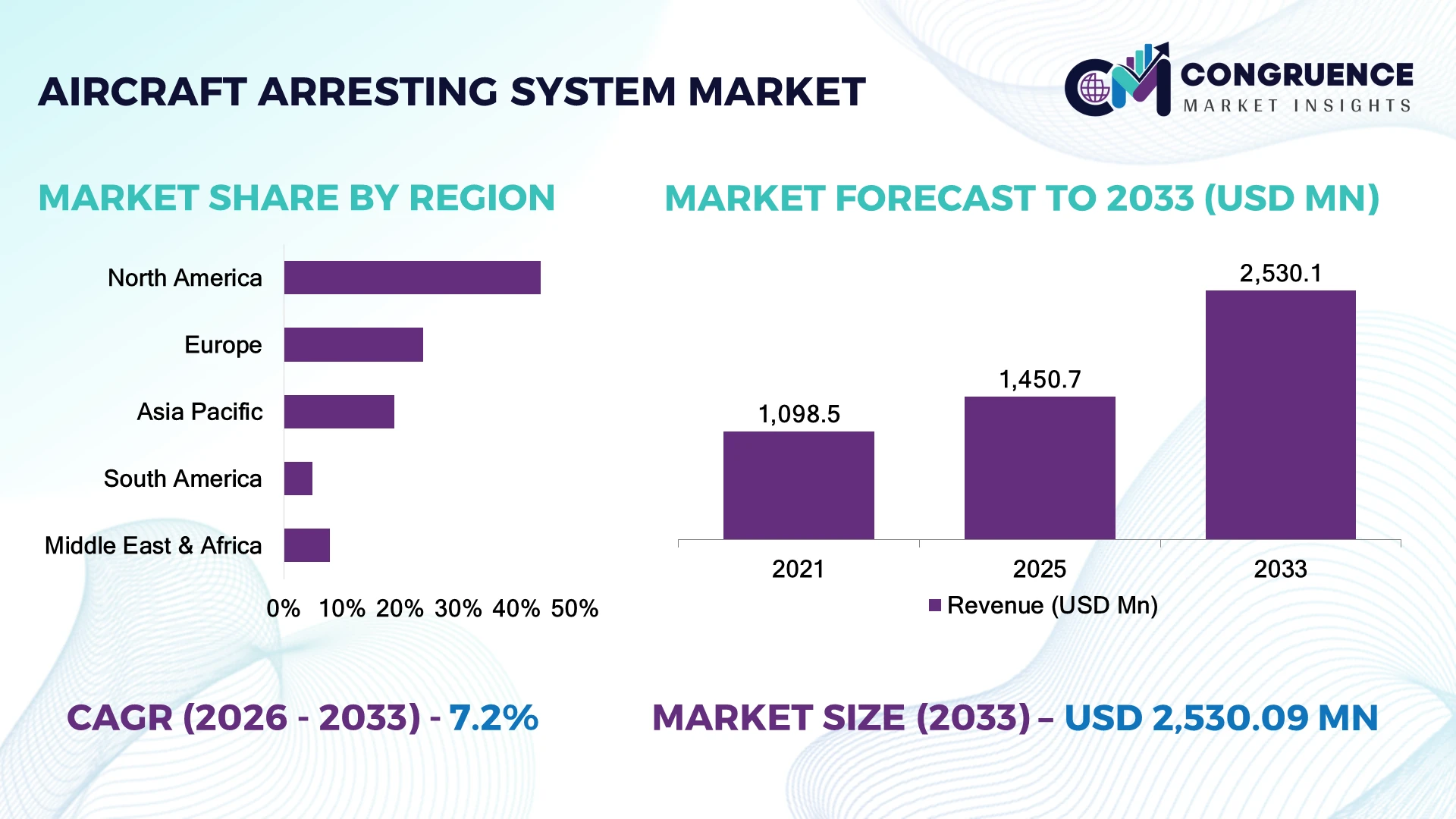
The Global Aircraft Arresting System Market was valued at USD 1,450.7 Million in 2025 and is anticipated to reach a value of USD 2,530.1 Million by 2033 expanding at a CAGR of 7.2% between 2026 and 2033. Growth is driven by runway-safety modernization, fighter-aircraft fleet expansion, land-constrained airport upgrades, and replacement of aging cable-based arresting infrastructure.
The United States remains the dominant country market, supported by military airfields and civil-airport EMAS deployment. As of 2026, the U.S. had 122 EMAS installations across 70 airports, while FAA initiatives had improved runway safety areas at more than 500 commercial-service airports. Europe operates a smaller installed base, while U.S. defense infrastructure maintains extensive BAK-series systems. Geopolitical emphasis on airbase resilience is accelerating modernization priorities.
Suppliers combining rapid-deployment arresting gear, certified energy absorption, retrofit compatibility, and lifecycle maintenance are positioned to capture airport and defense-infrastructure modernization budgets.
Market Size & Growth: USD 1,450.7 million in 2025 to USD 2,530.1 million by 2033 at 7.2% CAGR, supported by runway-safety modernization and defense-airfield upgrades.
Top Growth Drivers: Military-airfield modernization 31%, airport safety upgrades 24%, and aging-system replacement 18% underpin demand.
Short-Term Forecast: By 2028, automated inspection and condition-monitoring workflows can reduce routine maintenance labor by approximately 15%.
Emerging Technologies: EMAS materials, energy-absorbing composites, remote monitoring, and digitally assisted maintenance are improving arresting-system lifecycle management.
Regional Leaders: North America approaches USD 1,050 million by 2033, Europe approximately USD 570 million, and Asia-Pacific about USD 500 million, supported by airbase modernization.
Consumer/End-User Trends: Defense airfields remain the core end-user, while civil airports increasingly deploy EMAS where standard runway safety areas are land-constrained.
Pilot/Case Example: In 2025, two U.S. EMAS systems successfully stopped aircraft during separate runway overruns, demonstrating operational effectiveness without serious injuries.
Competitive Landscape: Runway Safe, Safran, Zodiac Arresting Systems, General Atomics, and Wire Rope Industries compete through certified systems, military integration, and lifecycle support.
Regulatory & ESG Impact: FAA initiatives have improved runway safety areas at more than 500 commercial-service airports, strengthening compliance-driven infrastructure investment.
Investment & Funding: U.S. airport infrastructure programs continue directing billions of dollars toward runway modernization, creating procurement opportunities for arresting systems and related safety equipment.
Innovation & Future Outlook: Reusable energy-absorbing materials, modular arresting systems, remote condition monitoring, and faster retrofit designs are shifting procurement toward lifecycle performance.
Aircraft arresting system demand is concentrated across military airbases, naval aviation facilities, and civil airports with constrained runway safety areas. EMAS installations in the U.S. reached 122 systems across 70 airports by 2026, while BAK-12 modernization remains active across military bases. Lightweight energy-absorbing materials, modular barriers, and condition monitoring are strengthening retrofit economics and creating a clearer transition toward digitally managed runway-safety infrastructure.
Aircraft arresting systems are becoming strategically important as governments modernize military airfields while airports address runway-excursion risk without acquiring large additional land parcels. The operational requirement is particularly significant at legacy airports where highways, railways, water bodies, and developed areas restrict conventional runway safety-area expansion. In the United States, FAA programs have already addressed practicable runway-safety improvements at more than 500 commercial-service airports, creating a substantial installed infrastructure base.
Technology is shifting from conventional cable-based arresting equipment toward engineered materials and more modular systems. EMAS can provide runway-excursion energy management in substantially less space than conventional safety areas, making it particularly valuable at constrained airports. The U.S. installed base reached 122 EMAS systems across 70 airports by 2026, demonstrating established operational deployment rather than experimental adoption.
Over the next 2–3 years, procurement will increasingly emphasize retrofit compatibility, faster installation, condition monitoring, and lifecycle maintenance. The July 2026 BAK-12 overhaul at Shaw Air Force Base illustrates the continuing importance of modernization within military infrastructure. Suppliers are therefore expanding maintenance capabilities, modular designs, material engineering, and defense-airfield partnerships. Competitive advantage will increasingly depend on certified stopping performance combined with installation speed, maintainability, and long-term infrastructure resilience.
Runway-safety modernization is strengthening demand for both EMAS and military cable arresting systems as airports face land constraints and defense airfields sustain aging infrastructure. The U.S. has 122 EMAS installations across 70 airports, while FAA programs have improved practicable runway-safety areas at more than 500 commercial-service airports. Military installations add a recurring replacement cycle; BAK-12 systems typically undergo major replacement around every 10 years. The operational shift is toward engineered, application-specific energy absorption rather than one-size-fits-all barriers. Suppliers are responding with modular EMAS, mobile arresting systems, and certified BAK-12 modernization programs. The non-obvious opportunity is lifecycle replacement: installed systems create recurring inspection, recertification, component, and overhaul demand alongside new installations.
Aircraft arresting-system deployment remains constrained by runway geometry, pavement condition, aircraft mix, and construction access. EMAS projects require engineered beds tailored to runway configuration, while military systems require precise absorber, cable, foundation, and fairlead installation. Installation planning can begin up to 18 months before deployment, and some EMAS projects require extended pavement curing periods. At military bases, BAK-12 systems operate under demanding conditions spanning approximately -40°C to +52°C, increasing maintenance requirements. These constraints raise project-management and commissioning costs and complicate deployment during active flight operations. Suppliers are mitigating exposure through modular installation, phased runway closures, mobile systems, local construction partnerships, and standardized components. The key pressure point is not equipment availability but minimizing runway downtime while preserving certification and performance.
Mobile aircraft arresting systems create a differentiated opportunity for expeditionary airfields, temporary operating locations, and rapidly deployable defense infrastructure. Advanced mobile systems can be installed in approximately 10 minutes on prepared concrete and under 45 minutes on soil, with rapid configurations supporting up to 20 arrestments per hour. Their mobility reduces dependence on permanent civil works and supports distributed aviation operations. The United States and allied defense forces are increasingly emphasizing resilient air operations, strengthening the relevance of rapidly relocatable infrastructure. Suppliers are investing in trailer-mounted absorbers, lightweight components, rapid anchoring, and modular cable assemblies. A further opportunity lies in combining mobile systems with remote inspection and condition monitoring, enabling fewer specialized personnel at austere bases while improving readiness and equipment availability.
Long-term system reliability depends on maintaining precise energy-absorption characteristics despite extreme loads, weather exposure, repeated engagements, and aging components. Modern fixed BAK-12 configurations can absorb up to approximately 126 million ft-lb of energy, while systems support aircraft arrest speeds approaching 190 knots. EMAS installations face additional exposure to jet blast, seasonal temperature changes, moisture, and wildlife activity. The operational challenge is maintaining predictable arresting performance without excessive runway closures. Shaw Air Force Base's 2026 BAK-12 overhaul illustrates the workforce and infrastructure intensity involved in major system renewal. Suppliers must strengthen condition monitoring, component-life tracking, corrosion protection, digital inspection records, and technician training. Competitive advantage increasingly depends on lifecycle readiness, not merely initial stopping performance.
EMAS Deployment Gains Provenance: U.S. installations reached 122 systems across 70 airports by 2026, with two separate runway overruns successfully arrested in September 2025. These operational events are strengthening confidence in engineered-material solutions where conventional safety areas are impractical. Suppliers are emphasizing tailored bed geometry, faster installation, and lifecycle maintenance for constrained airports.
BAK-12 Modernization Remains Active: Shaw Air Force Base completed a major BAK-12 overhaul in July 2026, reflecting the recurring replacement cycle of military arresting infrastructure. Systems support arrest speeds up to 190 knots and energy capacities approaching 126 million ft-lb. Defense suppliers are responding with upgraded absorbers, cables, fairleads, certification support, and maintenance services rather than simple equipment replacement.
Mobile Arresting Gains Strategic Value: Rapidly deployable systems can reach operational configuration in approximately 10 minutes on prepared concrete and under 45 minutes on soil, supporting distributed aviation operations. Rapid-cycle configurations can accommodate up to 20 arrestments hourly. Suppliers are developing trailer-mounted systems, expeditionary anchoring, and lightweight components for austere locations where permanent infrastructure is impractical.
Recycled Materials Enter EMAS: Newer EMAS designs increasingly incorporate alternative energy-absorbing materials, including foamed silica made from recycled glass. Recycled-material content can reach 100% in specialized silica-foam systems, reducing reliance on conventional cement-based construction. The non-obvious shift is that sustainability is becoming an engineering differentiator alongside predictable deceleration, durability, aircraft compatibility, and installation flexibility.
Fixed aircraft arresting systems account for approximately 63% of 2025 demand, supported by their established deployment across military airbases and permanent civil-airport installations. BAK-12-type cable systems remain the dominant configuration because they integrate with existing runway infrastructure and support repeated emergency operations. Mobile systems represent roughly 22% of demand and are the fastest-growing type, driven by expeditionary air operations, temporary runways, and distributed basing requirements. Their rapid deployment capability reduces civil works and relocation requirements, making them increasingly relevant to defense operators.
EMAS and other engineered-material systems account for approximately 15% of demand but have a distinct position in space-constrained civil airports. EMAS can provide aircraft energy absorption where conventional runway safety areas are impractical, shifting procurement toward application-specific engineering rather than standardized infrastructure. Companies are expanding modular cable systems, lightweight mobile barriers, and engineered-material solutions while strengthening installation and maintenance capabilities. The strategic shift is toward portfolios combining permanent infrastructure with rapidly deployable systems.
FAA reported 122 EMAS systems across 70 U.S. airports in 2026, demonstrating established deployment of engineered-material arresting technology alongside conventional cable systems.
Military airfields represent approximately 67% of 2025 aircraft arresting-system demand, reflecting the operational necessity of arresting systems for fighter aircraft and the large installed base of cable barriers across defense runways. The U.S. remains particularly important because tactical fighter bases require dedicated arresting infrastructure, while modernization programs create recurring replacement and certification requirements. Civil airports contribute roughly 25% of demand, concentrated at locations where runway safety areas cannot be expanded because of land, highways, railways, water bodies, or surrounding development. General aviation and specialized aviation facilities comprise the remaining approximately 8%.
Civil-airport applications are the fastest-changing segment because engineered systems provide a practical alternative to major runway reconstruction. Companies are therefore adapting portfolios toward EMAS engineering, modular cable assemblies, site-specific design, and installation services. Military procurement remains replacement-led, whereas civil demand is increasingly triggered by runway-safety compliance and physical site constraints. This distinction is shifting investment toward dual-market platforms that can serve defense durability requirements while meeting civil certification standards.
The U.S. Air Force reported a complete BAK-12 replacement and certification exercise at Shaw Air Force Base in July 2026, illustrating the recurring infrastructure-maintenance requirement across tactical fighter facilities.
Defense organizations account for approximately 68% of 2025 end-user demand, supported by extensive tactical-aircraft infrastructure and mandatory emergency arresting capability at fighter airfields. Their purchasing behavior emphasizes certified stopping performance, interoperability with existing runway systems, lifecycle maintenance, and rapid restoration after deployment. Commercial airport operators represent approximately 24%, with procurement increasingly concentrated at airports where physical expansion of runway safety areas is impractical. General aviation and specialized operators account for the remaining 8% but offer a growing niche for compact and application-specific systems.
Commercial airport operators represent the fastest-changing buyer group as runway-safety programs increasingly evaluate engineered arresting solutions alongside conventional infrastructure upgrades. Defense buyers typically favor standardized, serviceable systems, while airport operators place greater emphasis on footprint, installation disruption, passenger-airport continuity, and site-specific engineering. Suppliers are responding with differentiated configurations, local installation partnerships, lifecycle contracts, and modular components. The strategic implication is that future competitive positioning depends less on a single arresting technology and more on matching system architecture to buyer-specific runway constraints.
The FAA states that runway safety areas can extend 1,000 feet beyond runway ends and reach 500 feet in width, while obstacles such as highways, railways, water, and populated areas can make the full standard impractical.
North America accounted for the largest market share at 44.1% in 2025 however, Asia-Pacific is expected to register the fastest growth, expanding at a CAGR of 8.6% between 2026 and 2033.
Runway-safety modernization sustains a large installed replacement base
North America remains the largest aircraft arresting-system market, supported by extensive U.S. military airfield infrastructure and increasingly engineered runway-safety solutions at constrained airports. The United States represents the overwhelming regional demand concentration, with 122 EMAS systems installed across 70 airports. FAA programs have facilitated runway-safety improvements at more than 500 commercial-service airports, covering approximately 1,000 runway ends. Military demand is additionally supported by recurring BAK-12 refurbishment and certification requirements. Suppliers are therefore balancing new installations with lifecycle services, replacement absorbers, cables, and inspection programs. The region's distinctive advantage is its mature certification ecosystem, which lowers technology-adoption friction once systems satisfy established FAA performance requirements.
United States Market Outlook: The United States combines the world's deepest installed base with strong airport and defense procurement infrastructure. The FAA currently certifies approximately 520 airports under Part 139, creating a substantial regulated operating environment for runway-safety equipment. Defense modernization further supports demand as fighter bases upgrade arresting infrastructure alongside aircraft and airfield systems.
NATO airbase modernization reinforces high-performance infrastructure demand
Europe represents approximately 24% of global aircraft arresting-system demand, with procurement concentrated around major military aviation operators and strategically important NATO airbases. F-35 deployment, eastern-flank readiness, and dispersed air operations are increasing attention on runway resilience and rapid recovery infrastructure. NATO's 2025 Ramstein Flag exercise involved more than 90 aircraft operating from 12 European airbases, highlighting the operational intensity of shared air infrastructure. Suppliers are increasingly positioning certified arresting systems alongside maintenance, modernization, and interoperability services. Demand is more replacement- and defense-led than North America's civil-airport EMAS market, while infrastructure resilience is becoming a stronger procurement criterion.
Germany Market Outlook: Germany is strategically significant because it combines major NATO air infrastructure with established aerospace and defense manufacturing capabilities. Geilenkirchen hosts NATO's AWACS fleet, while German airbases participate in multinational air operations. The concentration of high-readiness aviation infrastructure supports demand for interoperable arresting equipment, inspection services, and modernization programs capable of integrating with existing NATO-standard airfield systems.
Fighter modernization is expanding the installed infrastructure base
Asia-Pacific accounts for approximately 19% of global aircraft arresting-system demand and represents the fastest-changing deployment environment. Japan, India, South Korea, Australia, and China are strengthening fighter-aircraft and airbase infrastructure, creating demand for new and upgraded arresting capabilities. Japan's defense program includes F-35A deployment at Komatsu and F-35B deployment at Nyutabaru, alongside investments in facility resilience and fighter dispersal infrastructure. India is simultaneously modernizing major airbases around newer fighter fleets. Suppliers are responding with cable-system modernization, mobile barriers, and aircraft-specific engineering. The strategic shift is toward infrastructure that supports dispersed operations rather than relying solely on fixed, centralized bases.
India Market Outlook: India is emerging as a strategically important demand center as indigenous aerospace production and fighter modernization increase requirements for compatible airfield infrastructure. The F-39 program demonstrates the country's growing emphasis on advanced combat-aircraft capability and domestic technical capacity. Anápolis-style concentrated fighter operations provide a useful benchmark for Indian programs seeking integrated maintenance, runway-support, and rapid-response infrastructure.
Modern fighter fleets are reshaping specialized airbase requirements
South America represents approximately 5% of global aircraft arresting-system demand, with Brazil accounting for the majority of regional procurement activity. Demand is concentrated around military aviation modernization rather than large-scale civil EMAS deployment. Brazil's transition toward the F-39 Gripen is strengthening requirements for modern airbase infrastructure, aircraft support equipment, and runway safety systems. Ten Gripen aircraft were operational in Brazil by early 2026, while the country's procurement program covers 36 aircraft. Suppliers are benefiting from opportunities linked to modernization, training, maintenance, and infrastructure integration, although procurement cycles remain comparatively concentrated. The principal commercial opportunity lies in pairing equipment sales with technical services and long-term maintenance support.
Brazil Market Outlook: Brazil has the strongest aerospace-industrial ecosystem in South America, supported by Embraer's manufacturing base and technology-transfer arrangements associated with the Gripen program. Anápolis has become a central fighter-operations hub, while other bases support training and exercises. This distributed operating structure creates opportunities for aircraft arresting suppliers offering interoperable systems, maintenance support, and localized technical services.
Airbase modernization drives specialized defense infrastructure investment
Middle East & Africa contributes approximately 8% of global aircraft arresting-system demand, with procurement heavily concentrated in Gulf defense markets. Saudi Arabia, the United Arab Emirates, Qatar, and Israel maintain advanced military aviation infrastructure and operate high-performance fighter fleets requiring robust runway-support systems. New aircraft acquisitions and airbase modernization are increasing demand for compatible arresting equipment, maintenance services, and rapid-repair capabilities. The region's harsh heat, dust, and operating conditions create additional requirements for corrosion protection, component durability, and preventive inspection. Suppliers are increasingly combining equipment packages with lifecycle maintenance and localized service capabilities, making technical support an important differentiator alongside system performance.
Saudi Arabia Market Outlook: Saudi Arabia represents the region's largest addressable defense-airfield opportunity because of its extensive military aviation infrastructure and continued emphasis on advanced combat-aircraft capability. Its operating environment places particular importance on heat tolerance, dust protection, inspection frequency, and component durability. Suppliers able to provide localized maintenance, spare-parts availability, and rapid technical response can address these operational requirements alongside new system procurement.
Runway Safe competes with Zodiac Arresting Systems and General Atomics in engineered-material and military arresting solutions, while Wire Rope Industries and other specialized suppliers compete through cable systems, components, and lifecycle services. The top five players collectively account for approximately 42% of market activity, leaving meaningful space for regional specialists. Technology and certification are decisive: engineered systems can reduce required runway-safety footprints by over 50% versus full-scale land acquisition in constrained sites, while modular deployment can reduce installation disruption by roughly 20–30%. Players are competing through EMAS material innovation, BAK-12 modernization, localized maintenance, defense partnerships, and integrated inspection services. The competitive shift is toward lifecycle contracts and application-specific engineering rather than equipment-only procurement. High certification requirements, aerospace qualification, testing infrastructure, and installed-base relationships create substantial entry barriers. Winning requires certified performance, rapid deployment, dependable component supply, and lifecycle support rather than lowest upfront price.
Runway Safe
General Atomics
Safran
Wire Rope Industries
Zodiac Arresting Systems
ATECH Inc.
ESCO Corporation
Aircraft Arresting Systems Corporation
VORTEX Aviation
Calspan Corporation
Curtiss-Wright Corporation
BAE Systems
Leonardo S.p.A.
QinetiQ
Modern aircraft arresting systems are shifting toward engineered energy absorption, modular cable assemblies, and condition-based maintenance. EMAS installations can reduce required runway-safety footprints by more than 50% where conventional land expansion is impractical, while digital inspection workflows can improve maintenance efficiency by 10–15%. Adoption remains concentrated at constrained civil airports, with 122 U.S. EMAS installations demonstrating established deployment.
Mobile arresting systems are gaining importance for expeditionary operations. Rapid-deployment configurations can achieve setup in approximately 10–45 minutes depending on surface conditions, improving response speed by roughly 70–90% versus conventional permanent construction cycles. Remote condition monitoring, digital service records, and modular absorber components can reduce inspection-related downtime by 5–10%. Defense suppliers benefit most because distributed basing requires reusable, relocatable infrastructure.
Through 2026–2028, advanced materials and predictive monitoring will increasingly differentiate suppliers. Recycled-material EMAS designs can incorporate up to 100% recycled glass-derived silica in specialized configurations, while modern energy absorbers provide more predictable stopping characteristics than older mechanical arrangements. Suppliers combining certified hardware, sensors, analytics, and lifecycle services gain an advantage as procurement shifts toward performance-based support rather than standalone equipment.
July 2026 Runway Safe Defense expanded its military portfolio through a dedicated defense operation supporting fixed, mobile, and EMAS solutions. Its MAAS supports 10-minute concrete deployment and under 45-minute soil installation, strengthening expeditionary recovery readiness at austere locations. Source: runwaysafe.com
July 2026 the U.S. Air Force replaced and certified a BAK-12 aircraft arresting system at Shaw Air Force Base. The ten-year overhaul included absorber, fairlead, and pit work, reinforcing recurring lifecycle demand for military infrastructure and maintenance capability. Source: shaw.af.mil
April 2026 the Wisconsin Air National Guard pursued a sole-source BAK-14 component acquisition from Curtiss-Wright’s ESCO operation. The procurement covered improved barrier arms for Truax Field, highlighting OEM compatibility and reinforcing installed-base advantages in infrastructure programs and procurement. Source: sam.gov
September 2025 FAA reported two EMAS runway-overrun interventions in Chicago and Boca Raton, involving six occupants and no serious injuries. The events strengthened operational validation of engineered-material arresting systems for constrained airports and supported adoption of runway-safety infrastructure. Source: faa.gov
The Aircraft Arresting System Market Report covers fixed, mobile, and engineered-material arresting systems across military airfields, civil airports, and specialized aviation facilities. The analysis evaluates cable barriers, energy absorbers, EMAS configurations, mobile systems, and emerging monitoring technologies, with segmentation by type, application, and end-user. Regional coverage spans North America, Europe, Asia-Pacific, South America, and Middle East & Africa, with country-level assessment of procurement, modernization, deployment, and infrastructure conditions.
The report examines established BAK-series infrastructure alongside rapidly deployable systems, engineered-material solutions, modular components, and digital inspection capabilities. It evaluates approximately 63% fixed-system demand, 67% military-application concentration, and the growing role of constrained-airport EMAS deployment. Competitive analysis covers leading manufacturers, OEM relationships, certification barriers, partnerships, lifecycle services, and technology differentiation, supporting investment planning, geographic expansion, procurement strategy, competitive positioning, and market direction through 2026–2033.
| Report Attribute/Metric | Report Details |
|---|---|
|
Market Revenue in 2025 |
USD 1,450.7 Million |
|
Market Revenue in 2033 |
USD 2,530.1 Million |
|
CAGR (2026 - 2033) |
7.2% |
|
Base Year |
2025 |
|
Forecast Period |
2026 - 2033 |
|
Historic Period |
2021 - 2025 |
|
Segments Covered |
By Type
By Application
By End-User
|
|
Key Report Deliverable |
Revenue Forecast, Growth Trends, Market Dynamics, Segmental Overview, Regional and Country-wise Analysis, Competition Landscape |
|
Region Covered |
North America, Europe, Asia-Pacific, South America, Middle East, Africa |
|
Key Players Analyzed |
Runway Safe, General Atomics, Safran, Wire Rope Industries, Zodiac Arresting Systems, ATECH Inc., ESCO Corporation, Aircraft Arresting Systems Corporation, VORTEX Aviation, Calspan Corporation, Curtiss-Wright Corporation, BAE Systems, Leonardo S.p.A., QinetiQ |
|
Customization & Pricing |
Available on Request (10% Customization is Free) |




