
Reports
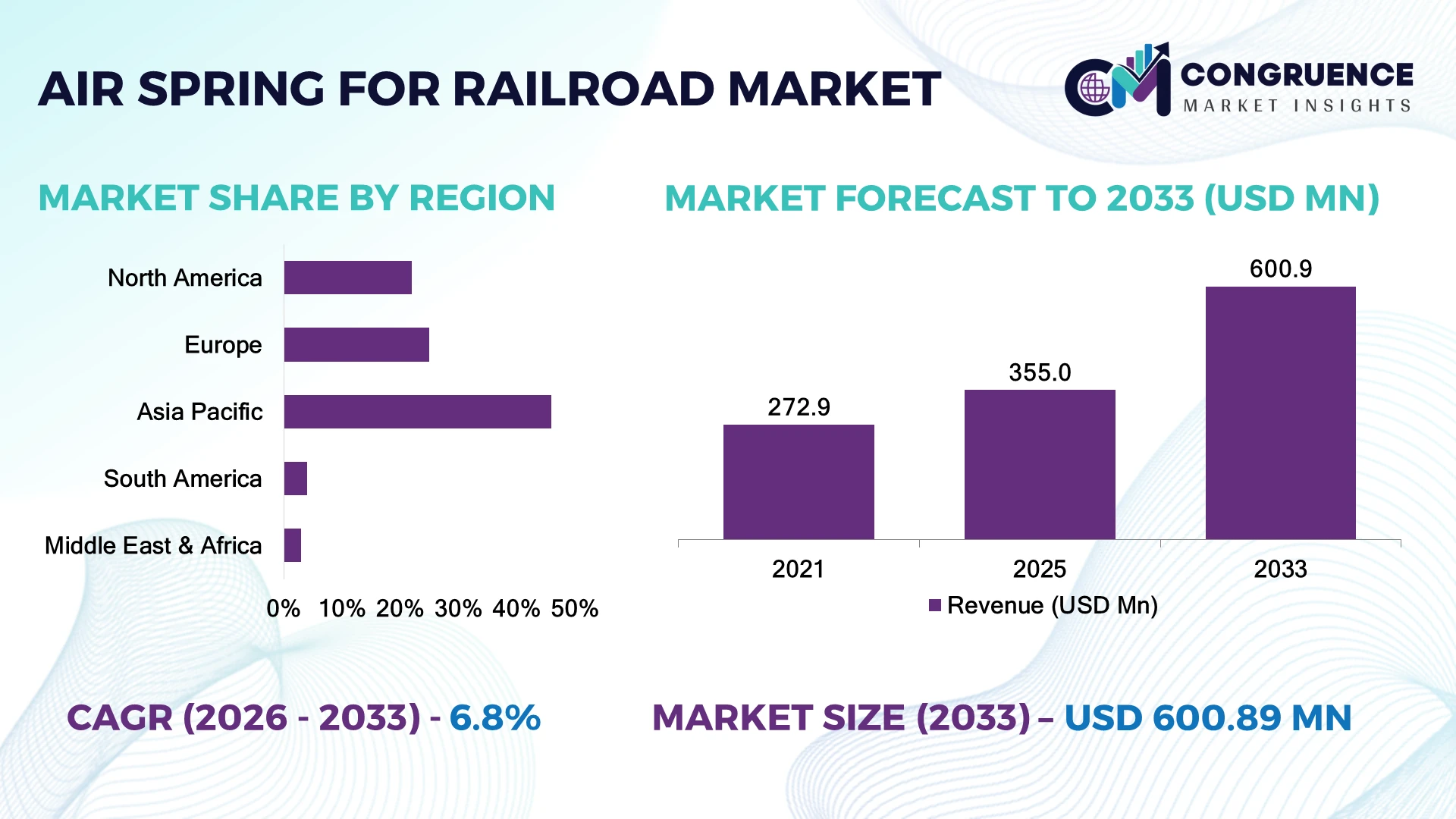
The Global Air Spring for Railroad Market was valued at USD 355 Million in 2025 and is anticipated to reach a value of USD 600.9 Million by 2033 expanding at a CAGR of 6.8% between 2026 and 2033. Growth is driven by expanding high-speed rail infrastructure, modernization of freight rolling stock, and increasing adoption of lightweight suspension systems that improve ride stability and reduce maintenance cycles.
China dominates the global market with approximately 41% of installed rail air spring demand, supported by more than 162,000 km of operational railway infrastructure and continuous investments in metro and high-speed rail expansion. Japan follows with advanced suspension adoption across over 90% of its high-speed passenger fleet, while Germany leads European innovation through premium rail manufacturing and digital maintenance integration. Ongoing rail investments under China's Belt and Road Initiative continue strengthening production capabilities and export competitiveness.
The market favors manufacturers investing in advanced materials, localized production, and predictive maintenance technologies to strengthen long-term competitive positioning.
Market Size & Growth: USD 355 Million in 2025, projected to reach USD 600.9 Million by 2033 at a CAGR of 6.8%, supported by railway fleet modernization and lightweight suspension technologies.
Top Growth Drivers: High-speed rail expansion (+28%), metro infrastructure investments (+22%), predictive maintenance adoption (+31%).
Short-Term Forecast: By 2028, maintenance downtime is expected to decline by nearly 18% through advanced air spring monitoring systems.
Emerging Technologies: Smart sensor-enabled air springs, advanced elastomer compounds, and automated condition monitoring are improving operational reliability.
Regional Leaders: Asia-Pacific (~USD 245 Million), Europe (~USD 118 Million), North America (~USD 92 Million), driven by expanding rail modernization and digital fleet upgrades.
Consumer/End-User Trends: Nearly 64% of newly procured passenger rail vehicles integrate advanced air suspension for enhanced ride comfort and stability.
Pilot/Case Example: In 2024, digital suspension monitoring deployment on selected metro fleets improved maintenance planning efficiency by approximately 20%.
Competitive Landscape: Continental holds an estimated 18% market share alongside Trelleborg, Hutchinson, Sumitomo Riko, and Vibracoustic.
Regulatory & ESG Impact: Lightweight suspension systems reduce component weight by up to 15%, supporting energy-efficient railway operations and stricter emission targets.
Investment & Funding: More than USD 4 billion in rail suspension and rolling stock modernization projects supports regional manufacturing expansion and strategic partnerships.
Innovation & Future Outlook: AI-enabled predictive diagnostics, recyclable elastomer materials, and modular suspension platforms are strengthening next-generation railway competitiveness.
Air Spring for Railroad systems continue gaining traction across high-speed passenger trains, metro networks, freight wagons, and urban transit projects where ride quality and vibration control remain critical. Smart monitoring technologies now reduce unexpected suspension failures by nearly 25%, while recyclable elastomer materials improve lifecycle performance. Ongoing railway electrification, localization strategies, and resilient component supply chains are further accelerating advanced suspension deployment across emerging transportation corridors.
The Air Spring for Railroad Market has become strategically important as governments and rail operators prioritize infrastructure modernization, fleet reliability, and lifecycle cost optimization. Increasing investments in high-speed rail, metro expansion, and freight efficiency are reshaping supplier competition while encouraging localized manufacturing and resilient supply-chain networks. Infrastructure modernization programs across Asia and Europe continue accelerating procurement of advanced suspension technologies.
Modern air spring systems equipped with embedded monitoring sensors improve maintenance efficiency by nearly 20% compared with conventional suspension assemblies while extending service intervals and reducing unplanned maintenance events. Asia-Pacific leads large-scale deployment through expanding railway infrastructure, whereas Europe focuses on premium engineering, sustainability, and digital asset management. Over the next two to three years, predictive maintenance integration is expected to exceed 40% across newly manufactured premium rail vehicles.
Rail operators increasingly deploy intelligent suspension systems on metro and intercity fleets to enhance passenger comfort and operational consistency under varying track conditions. Manufacturers are expanding regional production, strengthening OEM collaborations, and investing in advanced elastomer technologies to improve durability and localization. These strategies position suppliers to achieve stronger competitive differentiation, greater operational resilience, and long-term relevance in the evolving global railway ecosystem.
Rail operators are replacing conventional suspension systems with advanced air springs to improve passenger comfort, reduce vibration, and lower lifecycle maintenance requirements. More than 65% of newly manufactured passenger rail coaches now incorporate air suspension, while predictive maintenance solutions have reduced suspension-related service interruptions by nearly 20%. China continues expanding high-speed rail corridors, and India's railway modernization initiatives are increasing procurement of advanced rolling stock equipped with intelligent suspension technologies. This structural transition is improving fleet availability and operational efficiency, encouraging manufacturers to expand localized production, invest in durable elastomer materials, and strengthen OEM partnerships. A notable strategic outcome is the growing integration of digital condition monitoring, allowing companies to shift from reactive maintenance toward data-driven asset management while improving long-term contract competitiveness.
The market continues to face pressure from fluctuating prices of synthetic rubber, engineered polymers, and specialty steel components used in air spring assemblies. Raw material costs have experienced fluctuations exceeding 18% over recent procurement cycles, while logistics expenses remain approximately 12% above pre-disruption levels in several manufacturing corridors. Germany and Japan, which rely on precision component sourcing, continue facing extended procurement timelines for specialized elastomer compounds. These conditions compress supplier margins, delay production schedules, and complicate inventory planning for OEMs. Companies are mitigating these challenges through localized sourcing, multi-supplier procurement strategies, and long-term material supply agreements. An emerging operational advantage lies in redesigning components for material efficiency without compromising fatigue resistance or product durability.
The integration of intelligent sensors, cloud-based diagnostics, and AI-enabled predictive maintenance is transforming air springs into connected railway components rather than standalone mechanical products. Digital monitoring platforms can reduce inspection frequency by approximately 30% while improving maintenance scheduling accuracy by nearly 25%. South Korea and China are accelerating deployment of digitally connected railway infrastructure, encouraging suppliers to develop integrated suspension monitoring solutions compatible with fleet management platforms. Companies are increasing R&D investment, collaborating with railway software providers, and expanding digital service portfolios alongside hardware offerings. A valuable strategic opportunity is the creation of recurring service revenue through predictive maintenance subscriptions, strengthening customer retention beyond traditional replacement component sales.
Expanding globally requires air spring manufacturers to comply with diverse railway specifications, certification frameworks, and rolling stock architectures across multiple countries. More than 35% of engineering customization efforts are dedicated to adapting products for different vehicle platforms, while qualification processes can extend deployment timelines by over 20%. Cross-border interoperability requirements and evolving railway safety standards increase engineering complexity, particularly for suppliers serving multinational OEMs. These execution challenges affect manufacturing efficiency, certification costs, and product scalability despite growing market demand. Companies must invest in modular engineering platforms, standardized testing capabilities, and collaborative development programs with rolling stock manufacturers. Strengthening engineering interoperability will become a decisive competitive advantage as international railway procurement increasingly favors globally compatible suspension solutions.
Digital Suspension Intelligence Expands Rail operators are integrating sensor-enabled air spring assemblies to enable continuous condition monitoring and predictive maintenance. More than 35% of newly procured premium passenger coaches now include integrated suspension diagnostics, while maintenance planning accuracy has improved by nearly 22%. Germany and Japan are accelerating digital fleet management through onboard analytics, reducing inspection intervals and minimizing unscheduled maintenance. Manufacturers are partnering with rail software providers to integrate suspension health data into centralized asset management platforms, improving fleet utilization and maintenance efficiency.
Localized Manufacturing Gains Momentum Supply-chain disruptions and procurement risks are encouraging manufacturers to establish production closer to major railway manufacturing hubs. Local sourcing of elastomer compounds has increased by approximately 28% among leading suppliers, while component delivery times have declined by nearly 18%. China and India continue expanding domestic railway component ecosystems, enabling faster production cycles and improved inventory resilience. Companies are restructuring supplier networks, increasing dual-source procurement, and expanding regional production capacity to strengthen operational continuity.
Lightweight Materials Drive Performance Advanced elastomer formulations and reinforced composite materials are replacing heavier suspension components across modern rolling stock. Lightweight air spring assemblies reduce component weight by up to 15% while improving vibration isolation and extending maintenance intervals by approximately 20%. Railway manufacturers are standardizing modular suspension architectures to simplify vehicle integration and reduce assembly complexity. Suppliers are accelerating material innovation and collaborating with OEMs to improve durability without increasing lifecycle costs.
Lifecycle Service Models Emerge Air spring suppliers are expanding beyond component manufacturing by offering maintenance analytics, refurbishment programs, and long-term service agreements. Nearly 40% of large railway operators now evaluate lifecycle support capabilities alongside product performance during procurement. Increasing labor shortages and stricter asset reliability targets are driving demand for performance-based maintenance contracts. Companies are scaling digital service teams, strengthening aftermarket partnerships, and developing refurbishment capabilities to improve customer retention and recurring operational value.
Secondary Air Springs account for approximately 63% of the global market due to their critical role in improving passenger comfort, vibration isolation, and ride stability across metro systems, high-speed trains, and intercity coaches. Their ability to minimize lateral movement, reduce cabin vibration, and support higher operating speeds makes them the preferred solution for modern rolling stock. Primary Air Springs remain essential for axle-level load distribution and structural shock absorption, particularly in freight applications where durability and heavy-load performance are operational priorities. Manufacturers continue optimizing elastomer compounds and reinforcement technologies to improve fatigue resistance by nearly 18% while extending maintenance intervals. Primary Air Springs represent the fastest-evolving segment as freight operators increasingly modernize wagon suspension systems to improve asset utilization and reduce maintenance costs. Adoption within upgraded freight platforms has increased by approximately 20% over recent procurement cycles, encouraging suppliers to expand modular product portfolios compatible with multiple vehicle platforms. Companies are investing in advanced rubber formulations, lightweight reinforcement materials, and localized production to improve manufacturing efficiency while supporting railway fleet modernization. Investment priorities continue shifting toward longer service life, simplified replacement procedures, and digitally compatible suspension architectures.
Passenger Trains account for approximately 54% of the Air Spring for Railroad Market as rail operators prioritize ride comfort, vibration isolation, noise reduction, and operational reliability across metro, regional, and intercity services. Modern passenger coaches increasingly integrate advanced air suspension to improve stability at higher operating speeds while lowering maintenance frequency. Nearly 68% of newly manufactured premium passenger coaches are equipped with air spring suspension systems, while digital monitoring integration has increased by approximately 27% across new fleet procurements. Companies are strengthening partnerships with rolling stock manufacturers, expanding localized engineering capabilities, and introducing modular suspension platforms to support diverse passenger vehicle configurations. High-Speed Trains represent the fastest-growing application, driven by expanding rail infrastructure projects in China, India, and several European countries. Advanced suspension systems improve ride stability by nearly 25% at operating speeds exceeding 250 km/h, making them essential for next-generation rail platforms. Freight Trains continue providing stable replacement demand as operators modernize heavy-haul wagons to reduce track wear and improve cargo protection. Manufacturers are expanding production capacity, improving predictive maintenance compatibility, and developing higher-durability elastomer technologies to address evolving operational requirements across all application segments.
Railway Operators represent approximately 57% of total demand due to continuous investments in fleet modernization, passenger comfort enhancement, and maintenance optimization. Large public and private operators increasingly procure advanced suspension systems to improve operational reliability while reducing lifecycle maintenance requirements. More than 60% of replacement air spring purchases originate from fleet maintenance and modernization programs, while predictive maintenance deployment has expanded by nearly 30% among major passenger operators. Suppliers are responding through long-term service agreements, customized maintenance packages, and integrated monitoring solutions that strengthen customer retention and improve operational performance. OEMs (Rolling Stock Manufacturers) are the fastest-growing end-user segment as new railway vehicle production expands across China, India, and Eastern Europe. Manufacturers increasingly integrate advanced air spring systems during vehicle assembly to improve performance, simplify certification, and reduce installation complexity. Aftermarket & Maintenance Service Providers remain strategically important as aging rail fleets require scheduled suspension replacement and refurbishment. Companies are strengthening distribution networks, investing in regional service centers, and developing standardized replacement solutions that reduce maintenance downtime while improving spare-parts availability across global railway networks.
Asia-Pacific accounted for the largest market share at 46% in 2025 however, North America is expected to register the fastest growth, expanding at a CAGR of 7.2% between 2026 and 2033.

North America represents approximately 22% of the global Air Spring for Railroad Market, supported by freight rail modernization, passenger transit upgrades, and increasing adoption of predictive maintenance technologies. Rail operators are replacing aging suspension systems with advanced air spring assemblies to improve operational reliability, reduce track wear, and extend vehicle service intervals. Transit authorities continue investing in metro and commuter rail expansion, while freight operators prioritize suspension upgrades for higher axle loads and improved cargo protection. More than 30% of newly modernized passenger rail vehicles now incorporate sensor-enabled suspension systems that support condition-based maintenance. OEMs and component manufacturers are strengthening regional production capabilities and expanding long-term maintenance partnerships to improve supply-chain resilience and reduce delivery lead times.
United States Market Outlook: The United States remains the largest market in North America due to its extensive freight rail infrastructure, expanding passenger transit modernization programs, and strong domestic rolling stock manufacturing base. The country operates more than 220,000 km of freight rail infrastructure, creating continuous demand for suspension replacement and fleet upgrades. Railway operators are accelerating predictive maintenance deployment and collaborating with component suppliers to improve fleet reliability, while manufacturers continue expanding localized engineering and aftermarket service capabilities.
Europe accounts for approximately 25% of the global market, supported by extensive railway electrification, high-speed rail expansion, and stringent operational safety standards. Passenger comfort, energy efficiency, and lifecycle optimization continue driving procurement of advanced air spring systems across regional and intercity fleets. Fleet modernization programs increasingly prioritize lightweight suspension technologies that reduce maintenance requirements while improving operational performance. Cross-border railway interoperability initiatives are encouraging suppliers to develop standardized suspension platforms compatible with multiple rolling stock manufacturers. Companies continue investing in advanced elastomer technologies and digital maintenance capabilities to strengthen long-term operational efficiency across European railway networks.
Germany Market Outlook: Germany leads the European market through its advanced railway engineering capabilities, globally recognized rolling stock manufacturers, and strong industrial supply chain. More than 60% of the country's long-distance passenger fleet has undergone modernization incorporating advanced suspension technologies. German manufacturers continue investing in digital asset management, automated production systems, and next-generation elastomer research to strengthen export competitiveness and improve product durability across international railway programs.
Asia-Pacific holds the largest share of the Air Spring for Railroad Market at approximately 46%, driven by extensive railway infrastructure expansion, large-scale rolling stock production, and rapid metro network development. The region benefits from integrated manufacturing ecosystems that support cost-efficient production and faster deployment of advanced suspension technologies. High-speed rail expansion, urban transit investment, and freight corridor modernization continue accelerating procurement of premium air spring assemblies. More than 55% of newly produced passenger rail vehicles in the region utilize advanced air suspension systems. Manufacturers are expanding production facilities, increasing automation, and strengthening supplier ecosystems to meet rising domestic and export demand.
China Market Outlook: China dominates the regional market through the world's largest high-speed rail network, extensive metro construction activity, and vertically integrated railway manufacturing industry. The country operates over 48,000 km of high-speed rail infrastructure, creating sustained demand for advanced suspension systems across new rolling stock and replacement markets. Domestic manufacturers continue expanding production capacity, investing in intelligent manufacturing, and strengthening export partnerships under international railway infrastructure initiatives.
South America represents approximately 4% of the global market, with demand primarily driven by freight railway modernization and selective urban rail investments. Mining, agriculture, and bulk commodity transportation continue supporting replacement demand for durable suspension systems capable of operating under challenging conditions. Railway operators are gradually upgrading aging freight wagons to improve operational efficiency and reduce maintenance requirements. Infrastructure investment remains concentrated in strategic freight corridors, while modernization programs encourage suppliers to strengthen regional distribution and technical support capabilities. Manufacturers are increasingly focusing on localized servicing and long-term maintenance agreements to improve customer support despite infrastructure limitations.
Brazil Market Outlook: Brazil remains the largest South American market owing to its extensive freight railway network serving mining and agricultural industries. Continuous investments in heavy-haul railway infrastructure and logistics modernization are supporting increased adoption of high-performance suspension systems. Railway operators are prioritizing maintenance optimization and wagon modernization, while suppliers expand regional inventories and technical service networks to improve equipment availability and operational efficiency.
Middle East & Africa account for approximately 3% of the global market, supported by expanding metro systems, intercity railway development, and government-backed infrastructure investment programs. Urban mobility initiatives and national logistics strategies are increasing procurement of modern rolling stock equipped with advanced suspension technologies. Large railway construction projects continue creating opportunities for OEMs and component suppliers, while operators increasingly emphasize lifecycle maintenance and operational reliability. International partnerships and localized assembly initiatives are improving technology transfer and strengthening regional supply capabilities. Companies are positioning through strategic collaborations and regional service expansion to support long-term railway development.
Saudi Arabia Market Outlook: Saudi Arabia leads the regional market through substantial investment in railway infrastructure, metro development, and national logistics transformation initiatives. Major rail expansion projects continue increasing demand for modern passenger rolling stock equipped with advanced suspension technologies. The country's industrial localization strategy is encouraging international manufacturers to establish partnerships, strengthen regional service capabilities, and support future railway manufacturing and maintenance operations through long-term infrastructure development programs.
The Air Spring for Railroad Market is led by Continental AG, Trelleborg AB, Hutchinson SA, Sumitomo Riko Company Limited, and Vibracoustic, which primarily compete against regional suspension manufacturers and specialized rubber engineering suppliers. The top five players collectively account for approximately 58% of the global market, reflecting moderate consolidation with strong technology differentiation. Competition centers on suspension durability, fire-safe elastomer compounds, lightweight designs, digital monitoring integration, and localized supply chains rather than price alone. Sensor-enabled suspension systems improve maintenance efficiency by nearly 20%, while lightweight air spring assemblies reduce component weight by up to 15%, creating measurable operational advantages. Leading suppliers are expanding regional production, strengthening OEM partnerships, investing in predictive maintenance technologies, and vertically integrating rubber compounding capabilities to secure supply continuity. Increasing certification requirements and railway safety compliance create significant entry barriers for new manufacturers. Companies that combine engineering innovation, localized manufacturing, lifecycle service capabilities, and long-term OEM relationships remain best positioned to outperform established competitors.
Trelleborg AB
Hutchinson SA
Sumitomo Riko Company Limited
Vibracoustic SE
Bridgestone Corporation
TOYO TIRE Corporation
Freudenberg Group
GMT Rubber-Metal-Technic Ltd.
Bilz Vibration Technology AG
BOGE Rubber & Plastics Group
Phoenix Air Springs Pvt. Ltd.
Digitalization is reshaping railway suspension systems through embedded sensors, predictive diagnostics, and intelligent monitoring platforms. Around 38% of newly specified premium passenger rolling stock incorporates condition-monitoring capability, reducing unexpected suspension failures by nearly 25%. Real-time pressure monitoring and remote diagnostics enable operators to optimize maintenance intervals while improving fleet availability. OEMs benefit from higher service reliability, while operators gain lower lifecycle maintenance costs and improved operational planning.
Advanced elastomer compounds, lightweight composite reinforcement, and modular air spring architectures are replacing conventional rubber-based designs. Compared with traditional suspension assemblies, next-generation air spring systems reduce component weight by approximately 15% while extending fatigue life by nearly 20%. Manufacturers including global technology leaders are integrating fire-resistant materials, modular designs, and digital compatibility to strengthen product differentiation and simplify installation across multiple rolling stock platforms.
Between 2026 and 2028, AI-enabled predictive maintenance, digital twins, and connected fleet management platforms are expected to accelerate deployment across new railway programs. More than 45% of premium rail fleets are projected to integrate intelligent suspension monitoring, creating competitive advantages for suppliers offering complete hardware, software, and lifecycle service ecosystems rather than standalone mechanical components.
February 2025 – Continental AG launched its updated Material-driven Railway Solutions portfolio, expanding OEM-quality air spring systems, refurbishment services, and EN 45545-compliant fire protection solutions for railway operators. The company also reported refurbishment lead times up to 50% faster, strengthening lifecycle maintenance and fleet availability. Source: www.assets.continental-industry.com
June 2024 – Trelleborg Industrial AVS continued expanding its Metalastik® Air Spring Systems portfolio for railway applications, highlighting optimized lateral flexibility, enhanced vibration isolation, and longer service intervals for metro and high-speed rolling stock. The latest engineering platform delivers up to 30% greater lateral displacement capability, improving passenger comfort and suspension durability. Source: www.trelleborg.com
September 2024 – Hutchinson reinforced its railway mobility portfolio by promoting advanced elastomer-based suspension and vibration-control technologies for rolling stock manufacturers, emphasizing lightweight materials and predictive maintenance compatibility. The company's latest engineered elastomer solutions reduce vibration transmission by up to 20%, supporting longer component life and lower maintenance requirements.
January 2025 – Sumitomo Riko Company Limited highlighted continued expansion of its anti-vibration and rubber engineering technologies for transportation applications, investing in higher-performance elastomer materials that improve fatigue resistance by approximately 15% under demanding operating conditions. The initiative strengthens long-term supply capability for railway and mobility customers.
This report provides comprehensive analysis of the global Air Spring for Railroad Market across Primary Air Springs and Secondary Air Springs, covering Passenger Trains, Freight Trains, and High-Speed Trains as key application segments. It further evaluates demand across Railway Operators, OEMs (Rolling Stock Manufacturers), and Aftermarket & Maintenance Service Providers while assessing competitive positioning across North America, Europe, Asia-Pacific, South America, and the Middle East & Africa. The study also examines adoption patterns, deployment trends, digital suspension technologies, lightweight materials, and predictive maintenance integration shaping modern railway operations.
The report analyzes market dynamics, competitive benchmarking, regional manufacturing trends, procurement strategies, and technology adoption influencing business decisions between 2026 and 2033. It evaluates operational developments, investment priorities, and innovation strategies while tracking approximately 58% market concentration among leading suppliers. The analysis supports expansion planning, supplier selection, product development, partnership strategies, and long-term competitive positioning by identifying high-potential application areas, evolving customer requirements, and emerging opportunities across established and developing railway markets.
| Report Attribute / Metric | Details |
|---|---|
| Market Revenue (2025) | USD 355 Million |
| Market Revenue (2033) | USD 600.9 Million |
| CAGR (2026–2033) | 6.8% |
| Base Year | 2025 |
| Forecast Period | 2026–2033 |
| Historic Period | 2021–2025 |
| Segments Covered |
By Type
By Application
By End-User
|
| Key Deliverables | Revenue Forecast; Market Trends; Growth Drivers & Restraints; Technology Insights; Segmentation Analysis; Regional Insights; Competitive Landscape; Regulatory & ESG Overview; Recent Developments |
| Regions Covered | North America; Europe; Asia-Pacific; South America; Middle East & Africa |
| Companies Profiled | Continental AG; Trelleborg AB; Hutchinson SA; Sumitomo Riko Company Limited; Vibracoustic SE; Bridgestone Corporation; TOYO TIRE Corporation; Freudenberg Group; GMT Rubber-Metal-Technic Ltd.; Bilz Vibration Technology AG; BOGE Rubber & Plastics Group; Phoenix Air Springs Pvt. Ltd. |
| Customization & Pricing | Available on Request (10% Customization Free) |




