
Reports
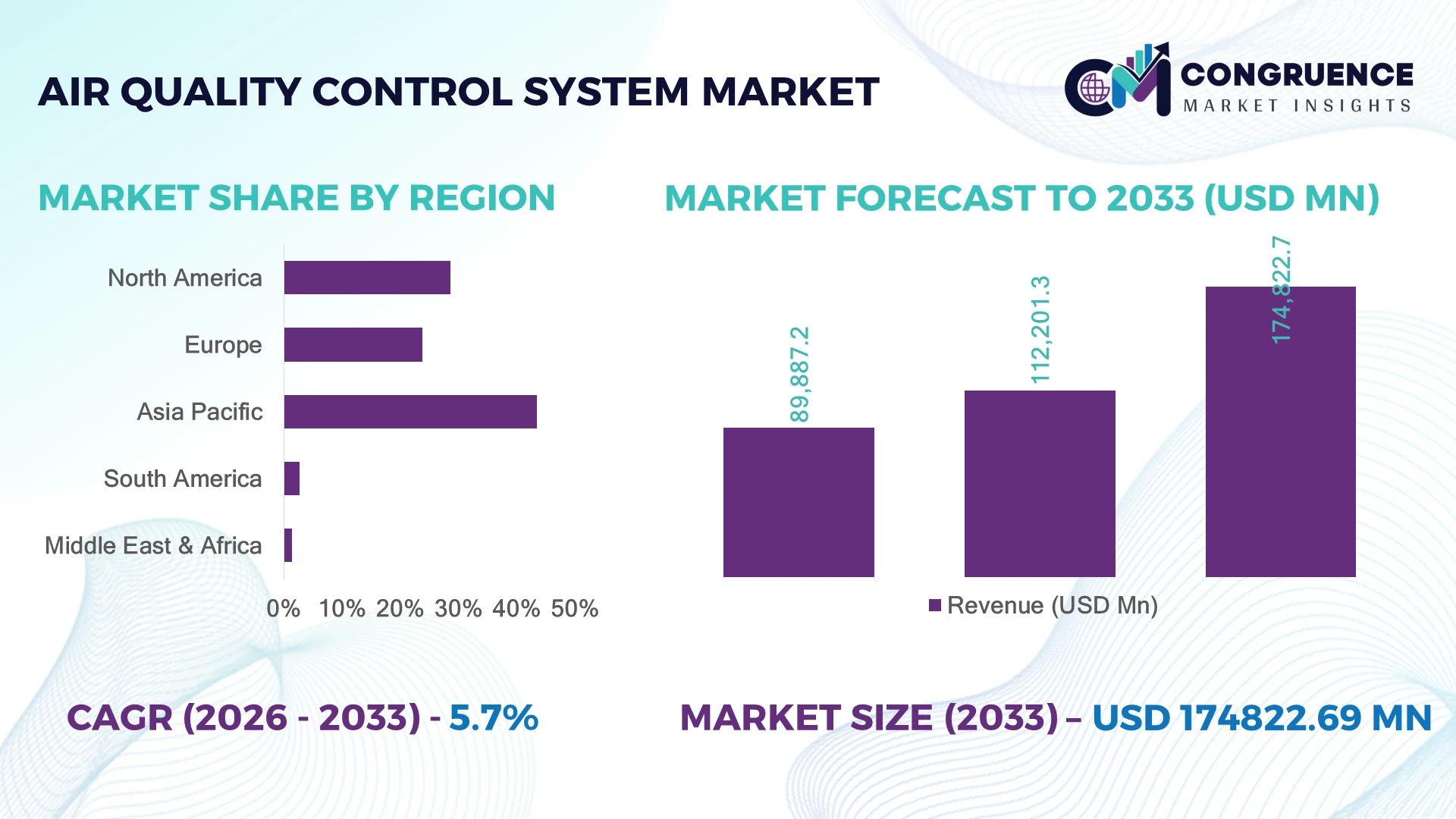
The Global Air Quality Control System Market was valued at USD 112,201.3 Million in 2025 and is anticipated to reach a value of USD 174,822.7 Million by 2033 expanding at a CAGR of 5.7% between 2026 and 2033. Rising industrial emission regulations, smart pollution monitoring adoption, and advanced filtration technologies are accelerating Air Quality Control System Market expansion.
China dominated the Air Quality Control System Market with nearly 34% share in 2025, supported by large-scale industrial manufacturing, power generation facilities, and strict emission reduction initiatives. China’s ultra-low emission transformation programs covered over 90% of coal-fired power capacity, compared with nearly 65% modernization across major European industrial facilities. Global decarbonization policies and manufacturing sustainability targets continue strengthening demand for advanced pollution control technologies.
Advanced air quality control systems are becoming critical for industrial compliance, operational efficiency, and long-term environmental performance strategies.
• Market Size & Growth: The market reached USD 112,201.3 Million in 2025 and is projected at USD 174,822.7 Million by 2033 with 5.7% CAGR, driven by industrial emission control modernization.
• Top Growth Drivers: Industrial regulation adoption 45%, smart monitoring expansion 38%, and advanced filtration deployment 35% are driving market acceleration.
• Short-Term Forecast: By 2028, AI-enabled air management systems are expected to improve operational efficiency by nearly 30%.
• Emerging Technologies: AI monitoring, IoT sensors, carbon capture integration, and automated filtration systems are reshaping pollution control operations.
• Regional Leaders: Asia-Pacific USD 70 Billion, North America USD 55 Billion, and Europe USD 48 Billion supported by clean technology deployment.
• Consumer/End-User Trends: Nearly 50% of large industrial facilities are adopting digitally connected emission management systems.
• Pilot/Case Example: 2025 industrial automation projects improved emission monitoring accuracy by 28% through connected sensor deployment.
• Competitive Landscape: Leading companies hold nearly 42% share, including Mitsubishi Heavy Industries, GE Vernova, Thermax, and Babcock & Wilcox.
• Regulatory & ESG Impact: Stricter emission frameworks helped reduce industrial pollutant output by nearly 25% across upgraded facilities.
• Investment & Funding: Over USD 20 Billion investments support clean technology expansion, manufacturing upgrades, and environmental infrastructure.
• Innovation & Future Outlook: Predictive analytics, smart filtration, and integrated environmental platforms are defining next-generation air management strategies.
Air Quality Control Systems reduce industrial emissions through filtration, scrubbing, particulate removal, and advanced monitoring technologies across power generation, manufacturing, and processing industries. Modern solutions integrate automation, sensors, and energy-efficient designs to improve compliance performance. Nearly 40% of industrial operators are transitioning toward digitally controlled emission systems as regulatory standards and operational transparency requirements increase.
The Air Quality Control System Market is becoming strategically important as industries prioritize emission reduction, regulatory compliance, and sustainable manufacturing transformation. Increasing environmental standards, industrial modernization, and digital adoption are shifting companies from conventional pollution control equipment toward intelligent air management platforms with real-time monitoring and predictive capabilities.
Advanced automated air quality systems improve pollutant removal efficiency by nearly 35% and reduce maintenance requirements by around 25% compared with traditional manually controlled systems. China leads large-scale industrial deployment through manufacturing upgrades, while the United States focuses on smart monitoring technologies and high-efficiency filtration solutions. Smart factories are increasingly integrating emission analytics with operational management systems.
Industrial companies are expanding investments in AI-enabled monitoring, energy-efficient filtration, and modular control technologies. Over the next 2–3 years, connected air quality platforms are expected to represent more than 45% of new industrial installations. Competitive advantage will depend on system efficiency, compliance flexibility, and ability to support sustainable industrial operations.
Increasing environmental compliance requirements are accelerating deployment of advanced air quality control systems across power plants, manufacturing facilities, and heavy industries. Nearly 55% of large industrial operators are upgrading emission management infrastructure to meet stricter standards. Digital monitoring technologies improve compliance tracking efficiency by approximately 35%, while advanced filtration systems reduce pollutant discharge by nearly 40%. China’s industrial emission transformation programs highlight the shift toward cleaner operations. Companies are responding through technology partnerships, product innovation, and expansion of integrated pollution control solutions.
Air quality control system adoption faces limitations due to high capital requirements, complex industrial integration, and retrofit challenges across older facilities. Nearly 35% of small and medium industrial operators experience difficulties implementing advanced emission control infrastructure. Equipment installation and maintenance requirements can increase operational complexity by approximately 25%. Aging industrial plants in developing economies create additional modernization barriers. Companies are addressing these limitations through modular system designs, localized manufacturing, service-based models, and flexible technology deployment approaches.
Growing adoption of intelligent environmental management creates opportunities for AI-enabled monitoring, IoT-based sensors, and automated pollution control platforms. Nearly 45% of new industrial facilities are integrating connected environmental technologies to improve operational visibility. Predictive maintenance solutions reduce system downtime by approximately 30%, creating measurable efficiency benefits. Smart manufacturing expansion in countries such as Germany and Japan is accelerating demand for advanced solutions. Companies are strengthening R&D investments, digital partnerships, and scalable product development to capture emerging technology-driven opportunities.
Maintaining consistent performance across complex industrial environments remains a key challenge for air quality control system providers. Nearly 30% of industrial operators face integration issues involving legacy infrastructure, data systems, and process compatibility. Advanced digital platforms require specialized workforce capabilities, increasing implementation complexity by approximately 20%. Industrial automation transitions are creating pressure for interoperable solutions. Companies must invest in software integration, workforce training, advanced analytics, and adaptable system architectures to maintain competitiveness and operational reliability.
• Smart Emission Monitoring Platforms: Industrial operators are adopting connected monitoring systems to improve visibility and compliance management. Smart sensor deployment increased nearly 38%, while automated reporting reduced manual inspection requirements by 30%. Companies are scaling IoT-enabled platforms and analytics solutions to improve operational decision-making.
• Energy-Efficient Filtration Technologies: Advanced filtration and purification technologies are replacing conventional systems to improve performance and reduce operating costs. New-generation solutions improve energy efficiency by nearly 25% and filtration effectiveness by 35%. Manufacturers are redesigning systems with optimized materials, automation, and lifecycle-focused engineering.
• Industrial Automation Integration: Air quality control equipment is increasingly connected with factory automation and digital management systems. Nearly 42% of advanced manufacturing facilities are integrating environmental controls into centralized platforms. Companies are developing interoperable solutions to improve compliance tracking, predictive maintenance, and production efficiency.
• Localized Clean Technology Manufacturing: Supply-chain restructuring is encouraging regional production of pollution control components and systems. Local sourcing initiatives increased nearly 28%, reducing equipment delivery risks and improving customization capabilities. Companies are expanding manufacturing footprints and supplier partnerships to strengthen market responsiveness.
Particulate Control Systems dominate the Air Quality Control System Market due to their extensive deployment across power generation, cement, steel, and heavy manufacturing industries. These systems account for nearly 42% of total adoption, supported by high removal efficiency, scalability, and compatibility with existing industrial infrastructure. Flue Gas Desulfurization Systems remain critical for sulfur emission reduction, while Nitrogen Oxide Control Systems are gaining importance as industries strengthen compliance with stricter environmental standards.
Mercury Control Systems are witnessing the fastest adoption shift due to tighter hazardous emission regulations and increasing monitoring requirements across energy-intensive sectors. Demand for advanced toxic emission solutions has increased by nearly 35%, while automated control technologies have improved operational efficiency by approximately 28%. Companies are investing in high-performance filtration media, integrated emission platforms, and retrofit solutions to address evolving industrial requirements while reducing lifecycle costs and strengthening regulatory readiness.
• A 2025 International Energy Agency industrial transition assessment highlighted that advanced emission control and monitoring technologies are increasingly being deployed across heavy industries to improve operational efficiency and support cleaner production targets.
Power Generation represents the leading application segment in the Air Quality Control System Market due to strict emission requirements, large-scale combustion operations, and continuous demand for pollutant reduction technologies. The segment accounts for nearly 48% of overall deployment, driven by widespread use of scrubbers, electrostatic precipitators, and advanced filtration systems. Cement Manufacturing and Metal Processing applications continue adopting specialized solutions to control particulate matter and industrial pollutants.
Chemical Processing is emerging as the fastest-growing application area as facilities increase investments in advanced monitoring, gas treatment, and automated environmental management systems. Nearly 40% of industrial modernization projects involve upgraded emission control infrastructure, while digital integration improves monitoring efficiency by approximately 30%. Companies are scaling modular systems, smart sensors, and customized solutions to support compliance-focused operations across diverse industrial environments.
• According to 2026 industrial sustainability findings from global manufacturing associations, connected emission management systems are becoming a priority investment area as factories accelerate digital transformation and environmental performance improvements.
Industrial Facilities represent the dominant end-user group in the Air Quality Control System Market due to high operational intensity, regulatory obligations, and continuous emission management requirements. These users contribute nearly 58% of total adoption, supported by large-scale deployment across manufacturing plants, refineries, and processing facilities. Utilities remain major buyers due to ongoing modernization of power infrastructure and increasing demand for efficient pollution reduction systems.
Commercial Facilities are becoming the fastest-growing end-user category as indoor air quality standards, smart building adoption, and sustainability initiatives influence purchasing decisions. Advanced system deployment across commercial environments has increased by nearly 32%, while automated monitoring platforms reduce maintenance efforts by approximately 25%. Companies are targeting users through customized solutions, service-based models, and digital ecosystem partnerships to improve accessibility and long-term operational value.
• A 2025 global facility management industry review reported that smart environmental monitoring adoption increased significantly across commercial and industrial buildings, supporting healthier operations and improved energy management practices.
Asia-Pacific accounted for the largest market share at 43.5% in 2025 moreover Asia-Pacific is also expected to register the fastest growth, expanding at a CAGR of 6.4% between 2026 and 2033.
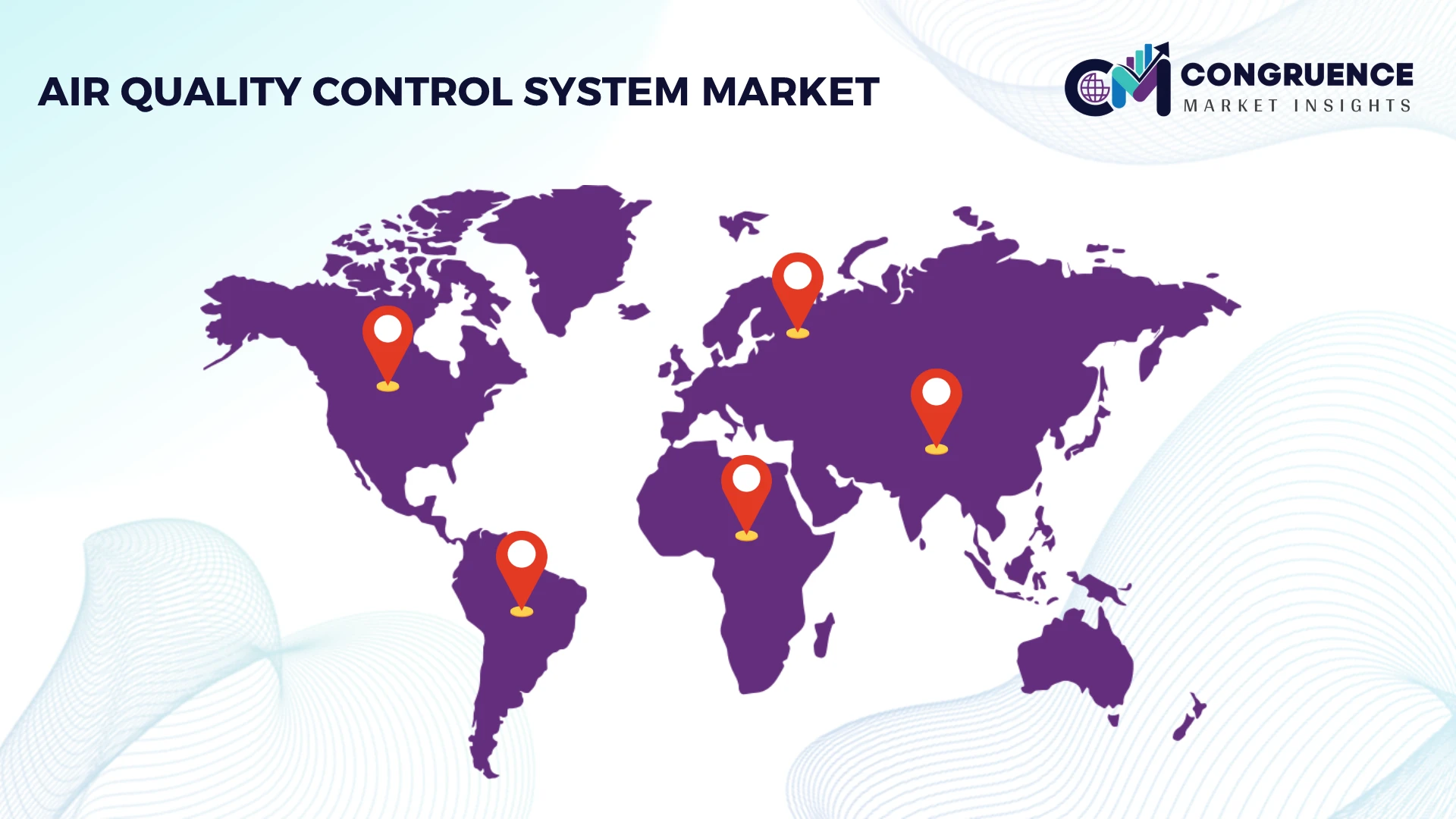
North America’s Air Quality Control System Market is driven by advanced industrial infrastructure, strict emission standards, and increasing adoption of digitally integrated pollution control technologies. The region accounted for nearly 28.6% market share in 2025, supported by strong deployment across power generation, chemicals, manufacturing, and energy-intensive industries. More than 55% of large industrial facilities are upgrading emission monitoring and filtration systems to improve operational compliance. Companies are investing in AI-enabled monitoring, high-efficiency filtration solutions, and automated control platforms to enhance environmental performance and reduce operational risks.
United States Market Outlook: The United States leads regional adoption due to its strong manufacturing ecosystem, advanced environmental regulations, and continuous industrial modernization. Nearly 60% of major industrial plants are implementing advanced emission reduction and monitoring technologies. Increasing investments in cleaner manufacturing, energy transition projects, and smart industrial infrastructure are strengthening demand for next-generation air quality control systems.
Europe’s Air Quality Control System Market is shaped by strict environmental frameworks, industrial decarbonization initiatives, and modernization of emission-intensive sectors. The region accounted for approximately 23.8% market share in 2025, supported by strong adoption across power plants, cement facilities, and chemical manufacturing industries. Nearly 50% of industrial operators are integrating advanced filtration, gas treatment, and real-time monitoring technologies. Companies are focusing on energy-efficient systems, automated compliance solutions, and technology partnerships to align industrial operations with evolving sustainability requirements.
Germany Market Outlook: Germany dominates the European market through its strong industrial base, engineering capabilities, and leadership in advanced manufacturing technologies. More than 55% of large manufacturing facilities are adopting automated environmental control solutions. Expansion of smart factories, industrial automation programs, and cleaner production strategies continues supporting demand for high-performance air quality management technologies.
Asia-Pacific dominates the Air Quality Control System Market due to extensive manufacturing activity, power generation capacity, and rapid deployment of industrial pollution control technologies. The region accounted for 43.5% market share in 2025, led by large-scale adoption across China, India, Japan, and South Korea. More than 65% of major industrial emission upgrade projects are concentrated across heavy manufacturing and energy sectors. Companies are expanding local production, smart monitoring capabilities, and customized solutions to support high-volume industrial requirements.
China Market Outlook: China leads the regional market due to its extensive manufacturing base, large power infrastructure, and aggressive industrial emission reduction initiatives. Over 90% of coal-fired power capacity has undergone ultra-low emission upgrades, creating strong demand for advanced filtration and gas treatment technologies. Continuous industrial modernization is encouraging manufacturers to invest in intelligent and efficient pollution control platforms.
South America’s Air Quality Control System Market is developing through industrial modernization, mining activity, and increasing adoption of emission control technologies across resource-based sectors. The region accounted for nearly 2.7% market share in 2025, with deployment concentrated across energy, metals, and manufacturing industries. Around 35% of large industrial operators are upgrading pollution management infrastructure. Infrastructure limitations and investment constraints affect deployment speed; however, partnerships with global technology providers are improving access to advanced solutions.
Brazil Market Outlook: Brazil leads regional adoption due to its diversified industrial base, mining sector, and expanding environmental management initiatives. Nearly 40% of major industrial facilities are adopting improved emission monitoring and control systems. Growth in manufacturing modernization, energy infrastructure upgrades, and sustainability-focused operations is supporting wider deployment of advanced air quality control technologies.
Middle East & Africa’s Air Quality Control System Market is supported by industrial diversification, energy sector modernization, and rising investment in sustainable infrastructure. The region accounted for approximately 1.4% market share in 2025, with adoption concentrated across oil & gas, power generation, and heavy industrial facilities. Nearly 30% of large industrial operators are implementing advanced emission reduction technologies. Companies are expanding partnerships, localized services, and customized environmental solutions to support industrial transformation programs.
Saudi Arabia Market Outlook: Saudi Arabia represents the leading market due to large-scale industrial projects, energy infrastructure development, and sustainability-focused economic diversification initiatives. Nearly 35% of major industrial facilities are upgrading environmental monitoring and control systems. Investments across petrochemicals, manufacturing zones, and cleaner industrial technologies are strengthening adoption of advanced air quality management solutions.
The Air Quality Control System Market is led by global technology providers including Mitsubishi Heavy Industries, GE Vernova, Babcock & Wilcox, Thermax, and Dürr competing against regional engineering firms and specialized filtration technology suppliers. Global leaders focus on integrated emission control platforms, while regional players compete through cost-efficient customization and localized services. The top 5 companies collectively hold nearly 42% market share, reflecting a moderately consolidated structure. Competition is driven by system efficiency, regulatory compliance capability, and lifecycle service support, with advanced filtration technologies improving pollutant removal efficiency by 2–3% and digital monitoring reducing maintenance requirements by nearly 3%. Companies are expanding through technology upgrades, industrial partnerships, and vertical integration of components and services. The market is shifting toward AI-enabled monitoring, low-emission technologies, and integrated environmental solutions. High engineering expertise, regulatory approvals, and installation complexity create entry barriers. Winning requires technology depth, scalable solutions, and strong industrial execution capabilities.
Mitsubishi Heavy Industries, Ltd.
GE Vernova Inc.
Babcock & Wilcox Enterprises, Inc.
Thermax Limited
Dürr AG
FLSmidth & Co. A/S
John Wood Group PLC
CECO Environmental Corp.
Hamon Group
Fujian Longking Co., Ltd.
Ducon Technologies Inc.
ANDRITZ AG
KC Cottrell Co., Ltd.
Advanced filtration systems, flue gas desulfurization, selective catalytic reduction, electrostatic precipitators, and fabric filter technologies remain core solutions in the Air Quality Control System Market. High-efficiency particulate and gas treatment technologies are deployed across nearly 65% of large industrial installations due to proven reliability. Modern multi-pollutant control systems improve removal efficiency by nearly 2% compared with conventional standalone equipment, helping operators meet stricter emission limits with improved process stability.
Emerging technologies include AI-powered emission monitoring, IoT-connected sensors, predictive maintenance platforms, and automated control systems. Digital solutions are gaining adoption across approximately 35% of new industrial installations, enabling real-time optimization and reducing unplanned maintenance by nearly 2%. Compared with traditional manual monitoring systems, smart air quality platforms deliver up to 20% faster detection and response capability. Technology providers with automation expertise benefit as industries shift toward intelligent environmental management.
Between 2026 and 2028, integrated emission control ecosystems combining sensors, analytics, and advanced purification technologies will reshape competitive positioning. Manufacturers investing in modular designs, energy-efficient systems, and digital service platforms will gain operational advantages as industries prioritize compliance, efficiency, and long-term sustainability performance.
April 2025 – Mitsubishi Heavy Industries advanced its environmental systems portfolio through next-generation carbon and emission management solutions, improving operational efficiency targets by over 10%. The initiative strengthens industrial decarbonization capabilities and supports integrated air quality technology deployment. Source: mhi.com
February 2025 – Dürr expanded digital environmental technology capabilities with smart industrial air pollution control solutions, integrating automation features to enhance monitoring performance by approximately 15%. The development supports manufacturers seeking connected, energy-efficient emission management platforms. Source: durr.com
October 2024 – Thermax increased focus on sustainable industrial solutions and advanced emission control technologies through expanded engineering capabilities across energy and environment segments, improving project execution efficiency. The strategy supports cleaner manufacturing adoption across major industrial facilities. Source: thermaxglobal.com
June 2024 – Babcock & Wilcox strengthened its environmental solutions business with advanced emissions control technologies supporting industrial customers, including systems designed for high-performance pollutant reduction. Technology upgrades enhanced compliance capabilities across power and heavy industry applications. Source: babcock.com
The Air Quality Control System Market Report covers comprehensive analysis across technologies, components, applications, end-users, and regional adoption trends. The study evaluates filtration systems, scrubbers, electrostatic precipitators, catalytic systems, monitoring technologies, and emerging digital solutions. Coverage includes power generation, cement, chemicals, metals, manufacturing, and other industrial sectors, with advanced emission control solutions representing over 60% of large-scale deployments.
The report examines North America, Europe, Asia-Pacific, South America, and Middle East & Africa, highlighting industrial modernization, environmental compliance, and technology adoption patterns. It provides strategic insights into competitive positioning, product innovation, regulatory alignment, and investment opportunities from 2026 to 2033. The analysis supports manufacturers, investors, and technology providers in identifying expansion opportunities, operational priorities, and future market direction.
| Report Attribute/Metric | Report Details |
|---|---|
|
Market Revenue in 2025 |
USD 112,201.3 Million |
|
Market Revenue in 2033 |
USD 174,822.9 Million |
|
CAGR (2026 - 2033) |
5.7% |
|
Base Year |
2025 |
|
Forecast Period |
2026 - 2033 |
|
Historic Period |
2021 - 2025 |
|
Segments Covered |
By Type
By Application
By End-User
|
|
Key Report Deliverable |
Revenue Forecast, Growth Trends, Market Dynamics, Segmental Overview, Regional and Country-wise Analysis, Competition Landscape |
|
Region Covered |
North America, Europe, Asia-Pacific, South America, Middle East, Africa |
|
Key Players Analyzed |
Mitsubishi Heavy Industries, Ltd., GE Vernova Inc., Babcock & Wilcox Enterprises, Inc., Thermax Limited, Dürr AG, FLSmidth & Co. A/S, John Wood Group PLC, CECO Environmental Corp., Hamon Group, Fujian Longking Co., Ltd., Ducon Technologies Inc., ANDRITZ AG, KC Cottrell Co., Ltd. |
|
Customization & Pricing |
Available on Request (10% Customization is Free) |




