
Reports
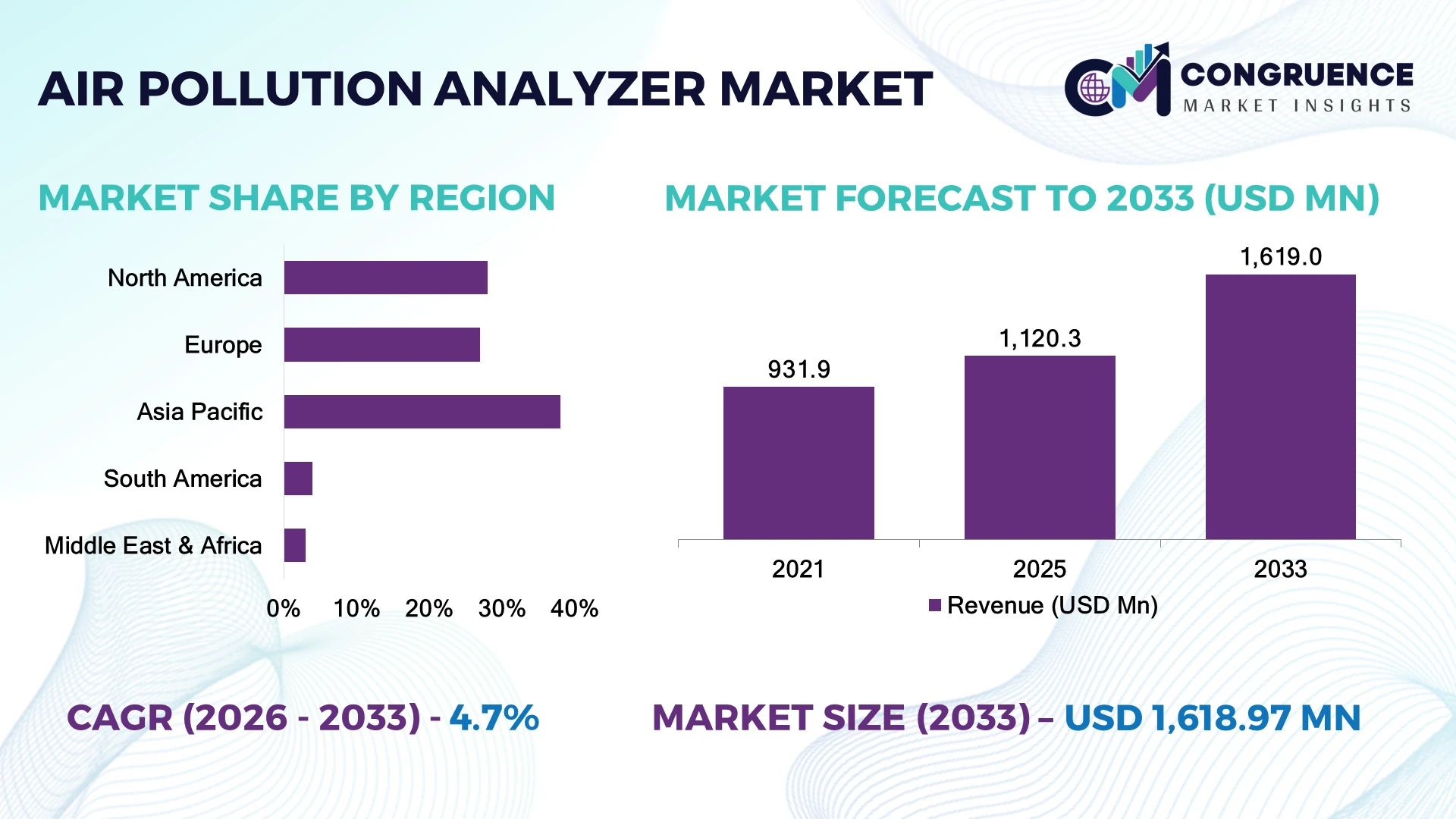
The Global Air Pollution Analyzer Market was valued at USD 1,120.3 Million in 2025 and is anticipated to reach a value of USD 1,619.0 Million by 2033 expanding at a CAGR of 4.71% between 2026 and 2033. Growth is driven by stricter industrial emission monitoring mandates, expanding continuous ambient air quality networks, and rapid deployment of real-time multi-gas sensing technologies across power, manufacturing, and urban infrastructure.
China dominates the global landscape with approximately 34% of installed industrial air quality monitoring capacity, supported by investments exceeding USD 8 billion in environmental monitoring infrastructure and widespread deployment across power generation, steel, cement, and petrochemical industries. Compared with India, where adoption is accelerating through Smart City and clean-air initiatives, China operates over 2,700 national monitoring stations, enabling broader real-time compliance and automated emissions management.
The market increasingly rewards manufacturers that combine high-accuracy sensing, digital connectivity, and regulatory compliance into scalable monitoring platforms.
Market Size & Growth: USD 1,120.3 Million in 2025, reaching USD 1,619.0 Million by 2033 at 4.71% growth, supported by advanced emissions compliance technologies.
Top Growth Drivers: Industrial emission monitoring (+31%), urban air-quality infrastructure (+27%), continuous environmental compliance (+22%).
Short-Term Forecast: By 2028, automated monitoring systems improve operational efficiency by nearly 24% through remote diagnostics and predictive maintenance.
Emerging Technologies: AI-based analytics, IoT-enabled analyzers, and laser spectroscopy enhance measurement accuracy by over 20%.
Regional Leaders: Asia-Pacific (~USD 610 Million), North America (~USD 355 Million), Europe (~USD 320 Million), driven by industrial modernization and regulatory deployment.
Consumer/End-User Trends: More than 58% of industrial facilities prefer continuous online monitoring over periodic manual testing.
Pilot/Case Example: In 2024, smart emissions monitoring deployment at a large industrial cluster reduced manual inspection requirements by approximately 35%.
Competitive Landscape: Thermo Fisher Scientific leads with an estimated 16% market share alongside ABB, Siemens, HORIBA, and Emerson.
Regulatory & ESG Impact: Industrial compliance programs lowered monitored emission exceedance events by nearly 18% across regulated facilities.
Investment & Funding: More than USD 2.5 billion has been directed toward environmental monitoring infrastructure through public-private expansion programs.
Innovation & Future Outlook: Cloud-connected analyzers, edge computing, and predictive diagnostics are reshaping next-generation environmental monitoring platforms.
Air Pollution Analyzer Market demand continues expanding across industrial manufacturing, power generation, environmental laboratories, and urban monitoring networks as organizations prioritize continuous emissions verification. AI-enabled diagnostics, portable multi-gas analyzers, and cloud-based monitoring platforms are improving operational visibility, while nearly 45% of new installations integrate remote connectivity. Strengthened environmental compliance frameworks and diversified sensor supply chains continue supporting broader deployment across developed and emerging economies, setting the stage for evolving strategic priorities.
Air pollution analyzers have become strategically important as governments, utilities, and industrial operators strengthen emissions accountability and modernize environmental monitoring infrastructure. Digital compliance programs, expanding smart-city investments, and industrial decarbonization initiatives are accelerating deployment across manufacturing, energy, transportation, and municipal air-quality networks. Companies increasingly compete through software integration, remote diagnostics, and lifecycle service capabilities rather than standalone hardware.
Modern laser-based and AI-assisted analyzers deliver approximately 25% faster detection cycles and reduce calibration downtime by nearly 18% compared with conventional monitoring systems. North America emphasizes advanced digital compliance platforms and industrial automation, while Asia-Pacific focuses on expanding monitoring coverage across rapidly growing industrial zones and metropolitan regions through large-scale infrastructure deployment.
Manufacturers are strengthening regional production, expanding calibration service networks, and partnering with environmental agencies and industrial operators to improve long-term system performance. A recent deployment across an integrated manufacturing complex enabled continuous remote monitoring while reducing manual inspection frequency and improving reporting consistency. Over the next two to three years, higher software integration, predictive maintenance, and interoperable monitoring ecosystems will strengthen competitive positioning through greater operational efficiency, regulatory readiness, and long-term environmental performance.
Industrial emission compliance requirements and digital environmental governance are accelerating deployment of advanced air pollution analyzers across manufacturing, power generation, and process industries. More than 62% of newly installed industrial monitoring systems now incorporate continuous emissions monitoring, while AI-assisted diagnostics reduce manual calibration frequency by nearly 22% and improve measurement consistency by approximately 18%. China's ultra-low emission standards and the U.S. Environmental Protection Agency's continuous compliance framework are encouraging facilities to modernize legacy monitoring assets. This regulatory shift is increasing demand for integrated analyzer platforms with remote connectivity. Leading manufacturers are expanding local production, strengthening software capabilities, and forming technology partnerships to deliver end-to-end compliance solutions. Companies that combine precision sensing with digital analytics are securing stronger positions in long-term industrial contracts.
High acquisition costs, specialized calibration requirements, and dependence on precision sensing components continue limiting broader deployment, particularly among mid-sized industrial operators. Imported optical modules and analytical sensors account for nearly 45% of critical system components, while annual calibration and maintenance expenses represent approximately 15% of total ownership costs. Supply disruptions affecting semiconductor-based detectors and infrared optical components have extended equipment delivery schedules in several manufacturing markets. These constraints slow project implementation and increase operational planning complexity for environmental compliance programs. Manufacturers are reducing exposure by localizing component sourcing, establishing regional calibration centers, negotiating long-term supplier agreements, and redesigning platforms with modular architectures that improve serviceability and reduce maintenance dependency.
Cloud-connected environmental intelligence platforms are transforming air pollution analyzers from standalone instruments into integrated decision-support systems. Nearly 48% of new industrial installations now require remote monitoring functionality, while predictive maintenance algorithms reduce unplanned service interventions by approximately 20%. India's Smart Cities Mission and Japan's investment in intelligent industrial infrastructure are expanding demand for connected environmental monitoring ecosystems. Companies are increasing investment in AI-enabled analytics, digital twin integration, and edge computing to improve operational visibility and regulatory reporting efficiency. An emerging opportunity lies in subscription-based monitoring services that combine hardware, software, calibration, and compliance management into scalable business models, creating recurring customer relationships beyond equipment sales.
Successful deployment increasingly depends on seamless integration with industrial automation systems, environmental management platforms, and enterprise reporting software rather than analyzer performance alone. Around 36% of industrial facilities experience extended commissioning timelines because of compatibility issues between legacy control systems and modern digital monitoring platforms, while demand for qualified environmental instrumentation engineers has increased by nearly 28%. Germany's highly automated industrial facilities illustrate the growing complexity of integrating multi-vendor monitoring infrastructure with centralized compliance systems. Companies must strengthen software interoperability, cybersecurity architecture, workforce training, and lifecycle support capabilities through strategic partnerships and digital engineering investments. Organizations that simplify deployment and integration will achieve stronger operational consistency and long-term competitive differentiation.
AI-Driven Predictive Monitoring Industrial operators are integrating AI-based analytics into continuous emission monitoring workflows, with nearly 46% of newly deployed analyzers supporting predictive diagnostics and automated fault detection. Digital calibration routines reduce maintenance interventions by approximately 21%, while automated reporting shortens compliance documentation time by almost 30%. China's environmental digitization programs and stricter industrial inspections are accelerating adoption. Manufacturers are expanding cloud software portfolios and partnering with industrial automation providers to deliver intelligent monitoring ecosystems that improve uptime and reduce manual engineering workloads.
Portable Analyzer Deployment Expands Demand is shifting toward compact portable analyzers as environmental audits, emergency response teams, and industrial maintenance groups require rapid on-site measurements. Portable systems now account for nearly 34% of annual equipment deployments, while field inspection productivity has improved by roughly 27% through wireless data synchronization. Tightened workplace safety regulations and infrastructure maintenance programs are encouraging mobile monitoring strategies. Companies are scaling lightweight product platforms, strengthening battery technologies, and integrating smartphone-enabled interfaces to improve operational flexibility across distributed industrial facilities.
Multi-Gas Platform Standardization Industrial enterprises are replacing multiple single-parameter instruments with integrated multi-gas analyzer platforms capable of monitoring up to eight pollutants simultaneously. Approximately 52% of large manufacturing facilities now prioritize unified monitoring architecture, reducing installation complexity by nearly 18% and lowering long-term maintenance inventories. Germany's industrial modernization initiatives are reinforcing standardized environmental monitoring infrastructure. Equipment suppliers are redesigning modular analyzer platforms, expanding interoperability with industrial control systems, and simplifying lifecycle servicing through standardized sensor configurations.
Local Manufacturing Strengthens Supply Chains Environmental monitoring suppliers are increasing domestic assembly and regional component sourcing to improve delivery reliability and reduce dependence on imported precision components. More than 38% of manufacturers have expanded localized production or supplier qualification programs, while procurement lead times have declined by approximately 16%. Ongoing semiconductor availability improvements and government-supported manufacturing incentives are reshaping sourcing strategies. Companies are investing in regional calibration centers, supplier diversification, and modular product architectures that strengthen resilience while improving customer response times.
The market is segmented into Continuous Air Pollution Analyzers, Portable Air Pollution Analyzers, Fixed Ambient Air Pollution Analyzers, Stack Emission Analyzers, and Multi-Gas Air Pollution Analyzers. Continuous Air Pollution Analyzers remain the leading segment, accounting for approximately 38% of global deployments due to uninterrupted emissions monitoring, regulatory compliance, and seamless integration with industrial automation platforms. Their scalability and high operational reliability make them the preferred choice across power plants, refineries, and heavy manufacturing facilities. Multi-Gas Air Pollution Analyzers represent the fastest-growing segment as industries increasingly consolidate multiple monitoring functions into a single platform, reducing maintenance requirements by nearly 20% and lowering installation complexity by approximately 18%. Portable analyzers continue gaining traction for environmental inspections, while Fixed Ambient Air Pollution Analyzers support municipal monitoring networks and Stack Emission Analyzers remain essential for regulated industrial facilities. Manufacturers are prioritizing modular sensor platforms, AI-enabled diagnostics, and remote calibration capabilities while expanding partnerships with industrial automation providers. Investment priorities increasingly favor integrated monitoring systems that improve compliance efficiency, simplify maintenance, and support enterprise-wide environmental data management.
The market is segmented into Industrial Emission Monitoring, Ambient Air Quality Monitoring, Indoor Air Quality Monitoring, Environmental Research, and Regulatory Compliance Monitoring. Industrial Emission Monitoring represents the largest application segment with an estimated 42% share, supported by mandatory emissions verification across power generation, cement, steel, petrochemical, and chemical manufacturing facilities. Continuous monitoring reduces compliance reporting delays by approximately 25% while improving operational visibility through automated emissions tracking. Ambient Air Quality Monitoring is the fastest-growing application as governments expand urban monitoring infrastructure and smart environmental networks. Indoor Air Quality Monitoring is also gaining importance in commercial buildings and healthcare facilities, whereas Environmental Research and Regulatory Compliance Monitoring continue supporting scientific studies and public-sector environmental programs. Equipment suppliers are expanding cloud-connected monitoring platforms, integrating AI-assisted reporting tools, and strengthening long-term service contracts. Companies increasingly customize analyzer configurations for application-specific requirements, enabling faster deployment and improved operational efficiency across diverse environmental monitoring environments.
The market is segmented into Power Generation, Oil & Gas, Chemical & Petrochemical, Government & Environmental Agencies, Manufacturing Industries, Research Institutes, and Commercial Facilities. Power Generation accounts for approximately 35% of total equipment demand because large thermal power facilities require continuous emissions verification and strict environmental compliance. Manufacturing Industries represent the fastest-growing end-user group as digital factory initiatives and automated environmental reporting become standard operational requirements. Oil & Gas and Chemical & Petrochemical companies continue investing in advanced analyzer platforms for process optimization and emissions management, while Government & Environmental Agencies expand national monitoring infrastructure. Research Institutes and Commercial Facilities increasingly deploy compact analyzers for specialized monitoring and indoor environmental assessment. Manufacturers are introducing application-specific product portfolios, flexible service agreements, and integrated software ecosystems tailored to different customer requirements. Strategic partnerships with utilities, industrial operators, and environmental agencies are strengthening market access while enabling broader deployment across critical infrastructure and regulated industrial sectors.
Asia-Pacific accounted for the largest market share at 38% in 2025 however, Asia-Pacific is expected to register the fastest growth, expanding at a CAGR of 5.63% between 2026 and 2033.

North America remains a highly developed air pollution analyzer market driven by strict emissions regulations, advanced industrial automation, and widespread adoption of continuous monitoring systems. The region holds approximately 28% of global market share, supported by strong deployment across power generation, oil & gas, chemical processing, and manufacturing facilities. More than 70% of large industrial plants utilize automated emissions monitoring solutions integrated with digital reporting platforms. The United States and Canada are upgrading legacy monitoring infrastructure through AI-enabled diagnostics, cloud connectivity, and predictive maintenance technologies. Companies are expanding calibration networks, strengthening software capabilities, and forming partnerships with industrial automation providers to improve compliance efficiency and operational reliability.
United States Market Outlook: The United States leads North American demand due to its extensive industrial base, Environmental Protection Agency compliance requirements, and advanced monitoring infrastructure. More than 2,600 major industrial facilities operate continuous emissions monitoring systems, particularly across utilities, refineries, and chemical plants. Technology providers are focusing on AI-based analytics, remote diagnostics, and integrated environmental management platforms to support large-scale industrial compliance operations.
Europe represents approximately 27% of the global market, supported by stringent environmental regulations, industrial decarbonization initiatives, and advanced manufacturing infrastructure. Countries such as Germany, the United Kingdom, and France are replacing traditional monitoring equipment with connected analyzer systems that support automated compliance reporting and real-time emissions tracking. Nearly 64% of new industrial monitoring installations incorporate digital connectivity features, improving operational transparency and reducing manual reporting requirements. The European industrial sector is increasingly adopting modular analyzer platforms, multi-gas monitoring systems, and software-driven environmental solutions. Manufacturers are expanding partnerships with automation companies and investing in low-maintenance technologies to address evolving sustainability requirements and industrial modernization priorities.
Germany Market Outlook: Germany remains the strongest European market due to its advanced manufacturing ecosystem, process industries, and Industry 4.0 adoption. Around 60% of major industrial facilities utilize integrated environmental monitoring platforms connected with plant automation systems. German enterprises are investing in precision analyzers, digital environmental reporting, and smart factory integration to improve compliance performance and operational efficiency.
Asia-Pacific dominates the global air pollution analyzer market with approximately 38% market share due to rapid industrialization, large manufacturing capacity, and expanding environmental monitoring infrastructure. China, Japan, South Korea, and India are driving demand through investments in smart environmental networks, industrial compliance systems, and urban air-quality programs. China operates more than 2,700 national air monitoring stations and continues expanding emissions monitoring across steel, cement, power, and petrochemical industries. More than 55% of new monitoring deployments in major industrial markets include remote connectivity and automated reporting capabilities. Companies are increasing regional manufacturing capacity, localizing supply chains, and developing AI-integrated analyzer platforms to address large-scale industrial requirements.
China Market Outlook: China represents the largest country-level market due to its extensive industrial base, strict pollution-control initiatives, and large-scale environmental infrastructure investments. The country’s monitoring ecosystem covers thousands of industrial facilities and urban locations, supported by government-led clean air programs. Domestic and international manufacturers are expanding production capabilities, technology partnerships, and digital monitoring solutions to strengthen their position in one of the world's most active environmental technology markets.
South America accounts for approximately 4% of the global market, with demand concentrated across mining, energy, petrochemical, and manufacturing industries. Brazil, Chile, and Argentina are increasing environmental monitoring adoption as industrial operators strengthen emissions management practices. Around 40% of newly deployed systems support continuous monitoring functions, particularly in mining operations, power facilities, and large industrial plants. Infrastructure limitations and technical service availability remain key considerations, but modernization initiatives are improving adoption potential. Companies are expanding distributor networks, developing regional maintenance capabilities, and offering customized analyzer solutions suited to local industrial requirements. Partnerships with industrial operators are becoming increasingly important for improving deployment efficiency and after-sales support.
Brazil Market Outlook: Brazil leads South America's air pollution analyzer demand due to its diversified industrial economy, mining activities, energy infrastructure, and environmental compliance requirements. Large industrial operators are increasingly adopting automated monitoring systems to improve emissions reporting and operational control. Companies are strengthening local technical support networks and service partnerships to address deployment challenges across geographically distributed industrial facilities.
The Middle East & Africa market represents approximately 3% of global installations, supported by refinery modernization, petrochemical expansion, power infrastructure development, and growing environmental governance initiatives. Saudi Arabia, the UAE, and South Africa are increasing adoption of advanced monitoring technologies across energy and industrial facilities. Nearly 35% of new environmental monitoring projects include digital connectivity and automated compliance features. Large-scale industrial transformation programs are encouraging investment in intelligent analyzer platforms, centralized environmental management systems, and remote monitoring capabilities. Equipment suppliers are expanding regional service operations, forming local partnerships, and improving technical support infrastructure to strengthen market penetration.
Saudi Arabia Market Outlook: Saudi Arabia is the most strategically significant market in the region due to its large oil & gas sector, petrochemical facilities, and industrial city development programs. Environmental monitoring adoption is increasing across refineries, utilities, and manufacturing complexes as operators integrate digital emissions management systems. Companies are investing in advanced analyzers, localized service capabilities, and technology partnerships to support industrial modernization objectives.
The competitive landscape is led by Thermo Fisher Scientific, HORIBA, ABB, Siemens, and Emerson, competing directly against specialized environmental instrumentation companies and regional analyzer manufacturers across industrial compliance, ambient monitoring, and laboratory applications. The top five players collectively control approximately 49% of the global market, while regional suppliers compete aggressively through localized engineering support, faster customization, and lower-cost offerings. Competition is driven by measurement accuracy, digital integration, lifecycle services, and delivery speed rather than pricing alone. AI-enabled analyzers improve maintenance efficiency by nearly 22%, cloud-connected monitoring platforms reduce reporting workloads by approximately 28%, and modular architectures shorten installation time by around 18%. Global leaders continue expanding calibration networks, forming industrial automation partnerships, investing in software ecosystems, and strengthening localized manufacturing to improve supply resilience. Rising cybersecurity expectations and certification requirements create significant entry barriers. Success increasingly depends on integrated hardware, intelligent software, regulatory expertise, responsive service, and scalable deployment capabilities across diverse industrial environments.
HORIBA Ltd.
ABB Ltd.
Siemens AG
Emerson Electric Co.
Teledyne Technologies Incorporated
AMETEK, Inc.
Fuji Electric Co., Ltd.
ENVEA
Servomex Group Limited
Sick AG
Yokogawa Electric Corporation
M&C TechGroup Germany GmbH
Gasmet Technologies Oy
Air pollution analyzers are rapidly evolving through AI-assisted diagnostics, laser spectroscopy, IoT connectivity, and cloud-based environmental intelligence. Approximately 47% of newly deployed industrial analyzers now support remote monitoring, while AI-driven fault detection reduces maintenance interventions by nearly 22%. Tunable diode laser absorption spectroscopy and non-dispersive infrared technologies continue improving measurement precision, enabling continuous compliance across power generation, chemicals, and heavy manufacturing with higher operational reliability.
Compared with conventional standalone analyzers, intelligent cloud-connected systems shorten calibration cycles by approximately 20% and improve reporting efficiency by nearly 30% through automated compliance workflows. More than 52% of enterprise monitoring projects now prioritize interoperable platforms capable of integrating with industrial automation systems. Large industrial operators benefit most by combining predictive maintenance, centralized environmental reporting, and edge computing to reduce downtime while strengthening operational transparency and regulatory readiness.
Between 2026 and 2028, digital twins, edge AI, hyperspectral sensing, and software-defined environmental monitoring platforms are expected to reshape deployment strategies. Manufacturers investing in modular architectures, cybersecurity, and open industrial communication protocols will strengthen competitive differentiation. Companies adopting integrated monitoring ecosystems today will gain faster compliance reporting, lower lifecycle costs, greater operational resilience, and stronger enterprise decision-making capabilities as industrial environmental management becomes increasingly data driven.
April 2025 – ENVEA launched its next-generation Optical Aerosol Spectrometer for real-time particulate matter monitoring, delivering higher-precision aerosol measurement with continuous data acquisition for demanding environmental applications. The launch strengthens ENVEA's advanced ambient air monitoring portfolio and supports stricter regulatory compliance worldwide.
July 2025 – HORIBA highlighted continued investment in its environmental measurement business through its 2024–2025 corporate report, emphasizing expansion of air pollution analyzers, stack gas analyzers, and integrated environmental monitoring technologies to support industrial decarbonization and next-generation emissions measurement solutions. Source: www.static.horiba.com
2025 – HORIBA expanded its air quality monitoring portfolio by promoting advanced ambient air monitoring systems covering NOx, SO₂, CO, O₃, PM, and other criteria pollutants, with integrated data management and monitoring network capabilities for regulatory agencies and industrial operators. Source: www.horiba.com
2025 – ENVEA strengthened its stack emissions monitoring portfolio through the MIR 9000P portable multi-gas analyzer, capable of simultaneously measuring 8 gases while incorporating IoT connectivity, remote access, modular maintenance, and onboard intelligence to improve industrial emissions testing productivity and compliance. Source: www.envea.global.com
The report provides comprehensive analysis across major analyzer types, including continuous, portable, fixed ambient, stack emission, and multi-gas systems, while evaluating demand across industrial emission monitoring, ambient air quality monitoring, indoor air quality monitoring, environmental research, and regulatory compliance applications. It further assesses deployment across power generation, oil & gas, manufacturing, chemical processing, government agencies, research institutes, and commercial facilities. Regional evaluation covers North America, Europe, Asia-Pacific, South America, and the Middle East & Africa, highlighting operational trends, technology adoption, and deployment concentration across key industrial economies.
The study examines competitive positioning, digital monitoring technologies, AI-enabled analytics, cloud integration, and evolving environmental compliance requirements influencing procurement decisions. More than 50% of recent enterprise deployments emphasize connected monitoring ecosystems and automated reporting capabilities. Strategic insights support product development, investment prioritization, geographic expansion, partnership evaluation, and competitive benchmarking while identifying emerging deployment opportunities, evolving customer requirements, and long-term business strategies shaping the market between 2026 and 2033.
| Report Attribute / Metric | Details |
|---|---|
| Market Revenue (2025) | USD 1,120.3 Million |
| Market Revenue (2033) | USD 1,619.0 Million |
| CAGR (2026–2033) | 4.71% |
| Base Year | 2025 |
| Forecast Period | 2026–2033 |
| Historic Period | 2021–2025 |
| Segments Covered |
By Type
By Application
By End-User
|
| Key Deliverables | Revenue Forecast; Market Trends; Growth Drivers & Restraints; Technology Insights; Segmentation Analysis; Regional Insights; Competitive Landscape; Regulatory & ESG Overview; Recent Developments |
| Regions Covered | North America; Europe; Asia-Pacific; South America; Middle East & Africa |
| Companies Profiled | Thermo Fisher Scientific; HORIBA Ltd.; ABB Ltd.; Siemens AG; Emerson Electric Co.; Teledyne Technologies Incorporated; AMETEK, Inc.; Fuji Electric Co., Ltd.; ENVEA; Servomex Group Limited; Sick AG; Yokogawa Electric Corporation; M&C TechGroup Germany GmbH; Gasmet Technologies Oy |
| Customization & Pricing | Available on Request (10% Customization Free) |




