
Reports
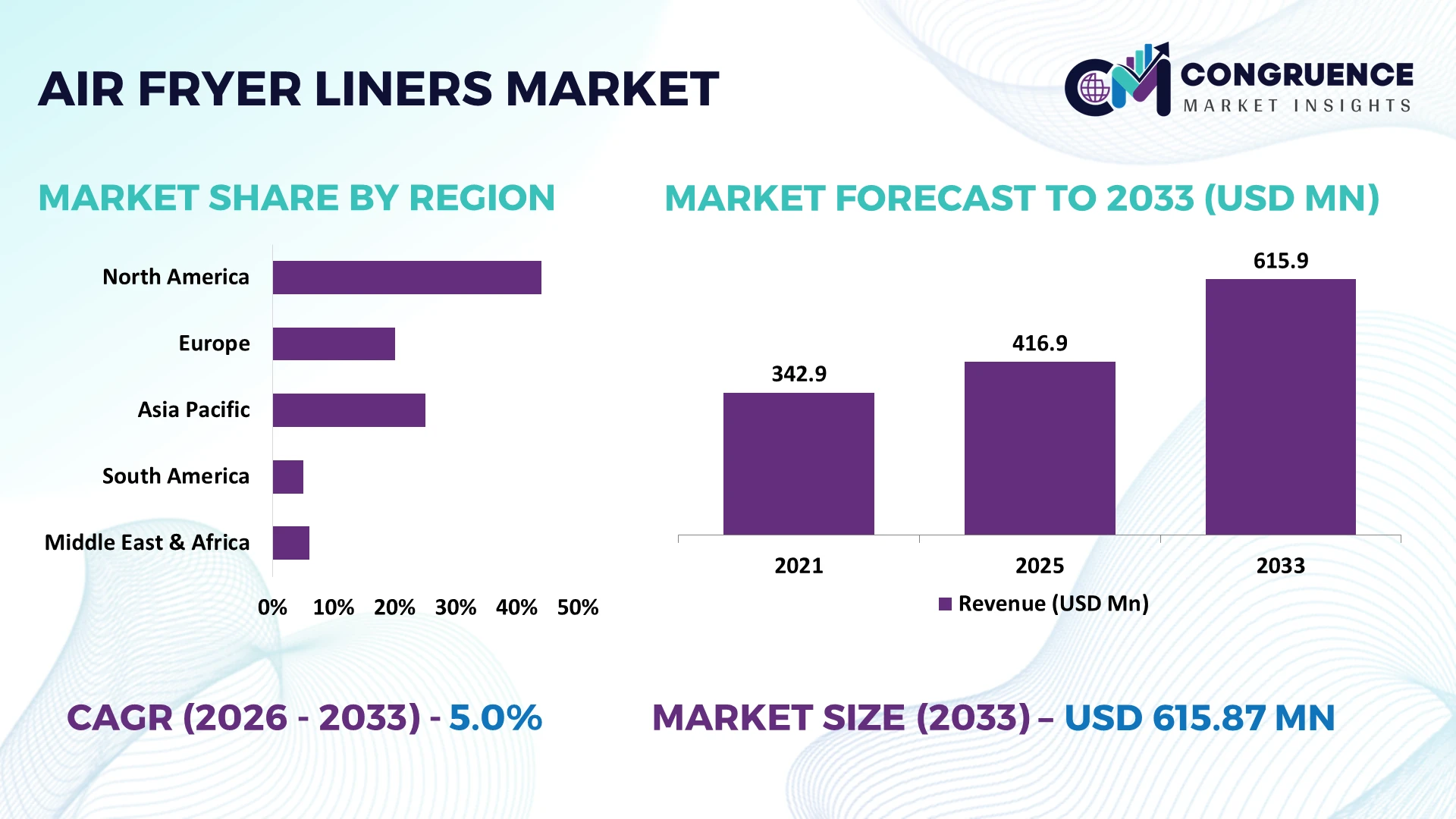
The Global Air Fryer Liners Market was valued at USD 416.85 Million in 2025 and is anticipated to reach a value of USD 615.87 Million by 2033 expanding at a CAGR of 5% between 2026 and 2033. Growth is driven by rising air fryer ownership, recurring disposable liner purchases, demand for precision cut parchment formats, and the transition toward reusable, food contact compliant silicone alternatives.
China dominates the manufacturing landscape, supported by concentrated paper converting, silicone processing, die cutting, and export packaging capabilities across Guangdong and Zhejiang. Its estimated 65% to 75% share of Asia Pacific air fryer accessory production provides a substantial supply advantage. Manufacturing investment increasingly targets automated cutting, molded liner production, and customized basket compatibility. By comparison, the United States represents a significant consumption market, where demand for safer grease resistant materials is reinforced by food contact requirements. China's production scale contrasts with America's stronger emphasis on product compliance and branded distribution.
Manufacturers should prioritize China linked sourcing, North American distribution, and compliant material innovation to strengthen margins and capture recurring replacement purchases.
Market Size & Growth: USD 416.85 million in 2025, reaching USD 615.87 million by 2033 at 5% CAGR, supported by recurring parchment liner consumption.
Top Growth Drivers: Convenience led purchasing (35%), online distribution (30%), and reusable material adoption (20%), representing analytical driver estimates.
Short Term Forecast: By 2028, automated die cutting and optimized material utilization target 8% lower conversion costs and 12% higher production efficiency.
Emerging Technologies: AI assisted dimensional customization, automated perforation, and heat resistant silicone formulations are improving product consistency and appliance compatibility.
Regional Leaders: North America USD 234.03 million, Asia Pacific USD 184.76 million, and Europe USD 135.49 million by 2033, using modeled regional allocations; online purchasing and reusable liners strengthen adoption.
Consumer Trends: Disposable parchment remains convenience oriented, while reusable silicone products attract repeat air fryer users seeking reduced replacement frequency.
Pilot and Regulatory Example: In 2025, the US FDA invalidated 35 PFAS related food contact notifications, accelerating material compliance requirements for paper food contact products.
Competitive Landscape: China based private label manufacturers hold an estimated 35% collective competitive position; key brands include Reynolds, Amazon Basics, Katbite, BYKITCHEN, and Baker's Signature.
Regulatory and ESG Impact: PFAS phaseout requirements increase demand for compliant grease resistant materials and fluorine free alternatives across export markets.
Investment and Funding: Automated converting, food grade coating, and silicone molding are attracting manufacturing expansion; a consolidated global investment total is not publicly established.
Innovation and Future Outlook: Biodegradable parchment, reusable silicone, precision molded shapes, and perforated airflow designs are shifting competition toward material performance and appliance specific compatibility.
The Air Fryer Liners Market is expanding across residential kitchens, online retail, and commercial food preparation, with disposable parchment sheets remaining important for everyday cooking and reusable silicone liners gaining traction among environmentally conscious consumers. Pre-cut round and square designs, perforated surfaces, molded paper bowls, and higher temperature resistant materials are strengthening product differentiation. Online channels account for an estimated 49.5% of air fryer paper liner distribution, highlighting the importance of digital merchandising and multipack availability. Meanwhile, US PFAS restrictions are accelerating investment in compliant food contact materials, creating opportunities for differentiated manufacturers.
The Air Fryer Liners Market is becoming strategically important as manufacturers compete on material safety, appliance compatibility, production economics, and retail differentiation rather than disposable paper pricing alone. The shift toward preformed parchment bowls, perforated liners, and reusable silicone products is changing product development and sourcing priorities. US food contact compliance requirements and tightening PFAS restrictions are accelerating the transition toward fluorine free grease resistant coatings, making material qualification a competitive requirement.
Automation is creating measurable manufacturing advantages over conventional converting. Precision die cutting and automated inspection target 10% to 15% lower material waste compared with less optimized manual production, while standardized dimensions improve basket compatibility and reduce product returns. China maintains a scale advantage through established paper converting and silicone molding clusters, whereas US and European suppliers compete through material certification, premium positioning, and specialized product design.
Over the next 2 to 3 years, manufacturers will prioritize automated cutting, recyclable packaging, and multipack customization. A practical deployment involves integrating perforated parchment production with automated basket size specifications to improve airflow compatibility and reduce trimming waste. Companies are strengthening supplier partnerships and investing in food grade material testing. Competitive advantage will increasingly depend on combining manufacturing scale with verified safety, consistent dimensions, and differentiated product performance.
Increasing air fryer utilization is strengthening recurring demand for disposable parchment liners and reusable silicone inserts. In 2024, 57.93% of US households reported using an air fryer at least once weekly, establishing a substantial consumption base for compatible accessories. Frequent cooking encourages purchases of multipacks, replacement liners, and grease resistant preformed designs. The FDA's January 2025 withdrawal of 35 PFAS related food contact notifications further reinforces demand for compliant paper coatings. Manufacturers are responding through fluorine free material development, automated converting, and expanded private label production. The strategic advantage lies in securing repeat purchase volumes while differentiating products through food safety and appliance specific dimensions.
Dependence on specialty parchment paper, silicone compounds, food grade coatings, and imported converting inputs constrains manufacturing margins. For planning purposes, specialty material procurement can account for an estimated 45% to 55% of disposable liner production costs, while packaging and logistics contribute another 10% to 15%. China based exporters also face freight volatility and changing import compliance requirements in North American markets. Smaller manufacturers experience greater exposure because limited purchasing volumes weaken supplier negotiations. Companies are reducing procurement risks through dual sourcing, longer term paper supply agreements, domestic converting partnerships, and standardized material specifications. Controlling input variability is essential to maintaining competitive multipack pricing.
Fluorine free grease resistant coatings, molded parchment bowls, and reusable silicone inserts offer opportunities beyond conventional disposable sheets. An estimated 20% to 25% improvement in material utilization through precision nesting and automated die cutting represents a potential manufacturing efficiency opportunity rather than an established industry average. In India, expanding online appliance retail and increasing availability of compact kitchen appliances create opportunities for localized basket specific designs. Manufacturers can target premium consumers with biodegradable paper formulations and reusable alternatives, while partnerships with appliance brands strengthen compatibility and distribution. Investment in material testing and customized product development will help companies capture higher value accessory segments.
Maintaining consistent liner performance across different air fryer designs remains a significant execution challenge. Differences in basket geometry, airflow circulation, perforation density, and operating temperatures complicate product standardization. Internal manufacturing targets should prioritize dimensional defect rates below 2% and batch rejection rates below 3%, although these are proposed operational benchmarks rather than established industry averages. Improperly positioned liners also create airflow obstruction and overheating concerns, particularly when lightweight parchment is used without food securing it. Manufacturers must strengthen thermal validation, automated dimensional inspection, and appliance compatibility testing. Partnerships with appliance manufacturers and investment in standardized testing protocols will improve product reliability and protect brand credibility.
PFAS Free Material Conversion: Food contact compliance is reshaping parchment manufacturing, particularly after the US FDA confirmed the withdrawal of 35 PFAS related food contact notifications in January 2025. Manufacturers are replacing conventional grease resistant treatments with fluorine free coatings. This transition increases material qualification requirements while creating differentiation through verified food safety and export compliance. Suppliers are prioritizing coating reformulation and testing to protect access to US retail channels.
Precision Cutting Automation: Manufacturers are integrating automated die cutting, nesting optimization, and dimensional inspection to reduce parchment offcuts and improve production consistency. Advanced converting lines target 10% to 15% lower material wastage and faster customized production cycles against less optimized manual processes. Chinese converters are prioritizing high volume production, while smaller suppliers are adopting flexible cutting systems to serve varied basket dimensions and private label orders.
Online Multipack Distribution: Digital retail is changing purchasing patterns through subscription style replenishment, bundled disposable sheets, and appliance specific product listings. Online channels are estimated to represent 45% to 50% of liner distribution, reflecting the convenience of multipack purchasing. Manufacturers are expanding marketplace partnerships, improving product dimension descriptions, and offering larger pack sizes to increase average order value and strengthen repeat purchasing.
Perforated Design Standardization: Airflow compatibility is becoming a stronger product specification as manufacturers introduce precision perforations, raised edges, and basket matched shapes. Perforated formats are estimated to improve usable airflow exposure by 5% to 10% against comparable solid designs under suitable cooking conditions. Suppliers are expanding round and square variants while investing in dimensional testing to reduce fit related complaints and improve product differentiation.
Disposable Paper Liners Lead Through Manufacturing Scale
Disposable Paper Liners represent the leading type, with an estimated 62% market share, supported by low unit costs, convenient disposal, high volume converting, and multipack retail distribution. Their established position benefits manufacturers through standardized parchment sourcing and compatibility with commonly used basket configurations. Reusable Silicone Liners represent the fastest growing category, with estimated annual adoption expansion of 12% to 15% as consumers prioritize repeated use and reduced disposable consumption. Manufacturers are responding through food grade silicone formulations, temperature resistant designs, and appliance specific product dimensions.
Perforated Liners are gaining preference where airflow circulation and moisture management influence cooking performance, while Solid Liners retain relevance for containing grease and food residue. Round Liners serve circular baskets, whereas Square Liners address rectangular cooking chambers. Customized dimensions and perforation patterns are becoming investment priorities, with manufacturers targeting 10% to 12% lower material waste through optimized cutting layouts. These overlapping product classifications require separate material and design strategies rather than a single standardized portfolio.
Frying Leads as Baking Expands
Frying represents the leading application, accounting for an estimated 38% market share, reflecting the close functional relationship between air fryers, crisp food preparation, and grease management. Disposable paper formats remain widely suited to fries, vegetables, and breaded foods because they simplify basket cleaning and residue removal. Baking is the fastest growing application, with estimated adoption expansion of 11% to 14%, supported by increasing use of air fryers for cakes, pastries, muffins, and portion controlled recipes. Manufacturers are developing deeper parchment bowls and heat resistant formats for batter containing foods.
Roasting maintains demand through preparation of vegetables, poultry, and meat, while Grilling benefits from liners designed to contain marinades and cooking residue. Reheating remains a practical application, particularly for preventing food particles from adhering to basket surfaces. Baking focused products require greater attention to liner depth and structural stability, whereas frying formats prioritize grease containment and airflow. Companies are expanding application specific packaging and recipe compatibility guidance to improve product selection and reduce incorrect usage.
Households Dominate Recurring Consumption
Household Consumers represent the leading end user category, accounting for an estimated 76% market share. Demand concentration reflects widespread residential air fryer ownership, frequent meal preparation, and recurring purchases of disposable parchment multipacks. Restaurants represent the fastest growing end user category, with estimated adoption expansion of 12% to 15% as foodservice operators use countertop air fryers for smaller batches, side dishes, and reduced oil preparation. Manufacturers are targeting households through affordable multipacks and reusable silicone options, while developing higher durability and customized dimensions for commercial buyers.
Cafés and Bakeries are expanding their use of specialized liners for portion controlled baking and snack preparation. Hotels and Resorts prioritize standardized kitchen accessories for consistent food preparation, whereas Catering Services require portable, disposable formats that simplify batch handling and cleanup. Commercial buyers place greater emphasis on pack volume, dimensional consistency, and procurement reliability than individual consumers. Suppliers are strengthening foodservice distribution partnerships, introducing bulk packaging, and separating household and institutional product portfolios. This creates opportunities for manufacturers to improve customer retention through differentiated pricing and application specific product development.
North America accounted for the largest market share at 38.1% in 2025; however, Europe is expected to register the fastest growth, expanding at a CAGR of 10.4% between 2026 and 2033.

Established Appliance Ownership and Premium Accessory Demand
North America maintains the largest consumption base for air fryer liners, supported by established household appliance penetration, extensive e commerce distribution, and strong private label retail networks. The region represents an estimated 38.1% of global demand, with the United States accounting for the largest national contribution. Reynolds Consumer Products strengthens branded competition through pre cut, unbleached parchment formats featuring perforations for airflow. Retailers are expanding multipack assortments and compatible round and square designs to increase repeat purchases. Food contact compliance and restrictions on PFAS containing materials are also influencing procurement decisions. Manufacturers are prioritizing fluorine free coatings, product testing, and localized distribution to protect shelf access and reduce import exposure.
United States Market Outlook: The United States leads North American consumption through established kitchen appliance ownership, broad supermarket coverage, and mature online marketplaces. Air fryer liner manufacturers benefit from established parchment converting capabilities and recognizable household brands. The country's food contact regulatory framework also encourages investment in material testing and compliant grease resistant coatings. Suppliers offering certified materials, consistent dimensions, and convenient multipack packaging are positioned to strengthen retail relationships and institutional procurement.
Material Compliance and Sustainable Product Differentiation
Europe represents an estimated 28.5% of global air fryer liner demand, supported by established household appliance ownership, developed retail infrastructure, and growing preference for material transparency. The European Union's Packaging and Packaging Waste Regulation, which entered into force in February 2025 and generally applies from August 2026, is increasing attention to packaging recyclability and waste reduction. Manufacturers are responding through reduced packaging material, recyclable cartons, and improved product labeling. Germany, the United Kingdom, France, and Italy provide important consumption markets, while European retailers increasingly differentiate products through unbleached parchment and reusable silicone formats. An estimated 10% to 15% reduction in packaging material is becoming a relevant supplier optimization target, strengthening the commercial case for packaging redesign and efficient distribution.
Germany Market Outlook: Germany offers a strategically important market through its developed household goods distribution network, established paper processing industry, and strong technical standards for consumer products. Manufacturers supplying German retailers must demonstrate material traceability, reliable thermal performance, and packaging compliance. Investment in certified parchment formulations and recyclable secondary packaging strengthens access to established retail procurement channels. Suppliers with localized distribution partnerships can also reduce replenishment delays and improve product availability.
Manufacturing Scale and Export Supply Chain Advantage
Asia Pacific represents an estimated 25.8% of global air fryer liner demand while maintaining a substantial advantage in manufacturing and export supply. China anchors production through paper converting, silicone molding, packaging, and high volume private label manufacturing. India, Japan, and South Korea contribute through expanding appliance consumption and established consumer goods distribution. Regional manufacturers are investing in automated die cutting, customized basket dimensions, and bulk packaging to serve international retailers. China based converting facilities target 10% to 15% lower material wastage through improved cutting layouts and production automation. However, export competitiveness increasingly depends on food contact documentation, consistent product specifications, and compliance with destination market requirements rather than manufacturing cost alone.
China Market Outlook: China remains the strategically significant production center because of its integrated parchment processing, silicone manufacturing, packaging, and export logistics ecosystem. Guangdong and Zhejiang provide established manufacturing clusters serving international private label buyers. Suppliers benefit from access to industrial converting equipment and diversified packaging vendors. Investment in automated cutting and customized product development supports shorter production cycles, larger export orders, and improved dimensional consistency for international air fryer brands.
Import Distribution and Retail Channel Expansion
South America accounts for an estimated 5.1% of global air fryer liner demand, with Brazil serving as the principal consumption and distribution market. Growing availability of compact kitchen appliances is strengthening demand for disposable parchment sheets and multipack accessories. Importers rely on established consumer goods distributors and online marketplaces to reach households beyond major metropolitan centers. Brazil's import dependence creates exposure to currency fluctuations, international freight costs, and inconsistent replenishment cycles. Retailers are therefore emphasizing standardized pack sizes and competitive pricing, while suppliers explore regional warehousing and distributor partnerships. Improving local inventory coverage and reducing packaging complexity offer practical opportunities to increase product availability without requiring extensive domestic manufacturing investment.
Brazil Market Outlook: Brazil offers the strongest commercial entry point through its large consumer market, established household appliance retail network, and developed e commerce ecosystem. Manufacturers can strengthen distribution through partnerships with kitchenware importers and major online retailers. Localized packaging, Portuguese product instructions, and basket compatible sizing improve consumer confidence. Importers prioritizing consolidated shipments and regional inventory management can reduce stockout exposure and maintain competitive pricing across major urban markets.
Premium Appliance Adoption and Import Network Development
The Middle East and Africa represents an estimated 2.5% of global air fryer liner demand, with the United Arab Emirates, Saudi Arabia, and South Africa providing important commercial markets. Premium kitchen appliance distribution, modern retail development, and online grocery platforms support demand for disposable parchment and reusable silicone accessories. The UAE functions as a regional re export and distribution hub, enabling suppliers to reach neighboring Gulf markets through established logistics infrastructure. Saudi Arabia's Vision 2030 investment program is supporting retail, hospitality, and tourism infrastructure expansion, creating additional institutional distribution opportunities. Import dependence and fragmented retail coverage remain operational constraints. Suppliers are responding through regional distributors, consolidated shipments, and differentiated multipack pricing.
United Arab Emirates Market Outlook: The UAE offers a strategic distribution advantage through Jebel Ali's logistics ecosystem, established re export infrastructure, and access to Gulf consumer markets. Importers can use Dubai based warehousing to consolidate shipments and supply retailers across neighboring countries. Premium kitchenware stores, hospitality procurement networks, and online marketplaces provide multiple sales channels. Companies offering heat resistant, food contact compliant liners in standardized dimensions can strengthen distribution partnerships and improve regional inventory availability.
The Air Fryer Liners Market remains fragmented, with Reynolds Consumer Products competing against Chinese private label suppliers such as Katbite and BYKITCHEN. COSORI leverages appliance ecosystem visibility, while Baker's Signature, Frieling, and Amazon Basics target branded and value conscious buyers. The five largest participants are estimated to hold 18% to 22% collectively, reflecting low entry barriers in basic parchment converting and substantial private label supply. Competition centers on landed price, paper quality, food contact compliance, perforation design, basket fit, and retail replenishment. Cost focused suppliers target 5% to 10% lower unit pricing through bulk converting and direct marketplace sales; differentiated brands invest in unbleached paper, silicone reuse, and precision sizing. Reynolds' perforated formats illustrate product differentiation, while Asian suppliers compete through scale and customization. Retailer contracts, testing capability, and export logistics remain barriers to repeat business. Winning requires low cost scale, verified safety, consistent fit, and fast fulfillment across markets.
Reynolds Consumer Products
Frieling USA
COSORI
Baker's Signature
Katbite
BYKITCHEN
Amazon Basics
AIEVE
Linda's Essentials
Infraovens
Smartake
PaperChef
Perforated parchment is the established technology: pre-cut sheets with airflow holes and non-stick, grease-resistant surfaces reduce residue while preserving circulation. Reynolds' commercial 9-inch format uses quarter-inch perforations and tolerates 400°F. Compared with unperforated sheets, optimized perforation can deliver an estimated 1–2% improvement in airflow consistency. Adoption is established in major retail markets and channels, although category-wide usage is not reliably measured.
Emerging designs combine molded edges, basket-specific dimensions and silicone-coated or unbleached paper. Reusable food-grade silicone trays add raised channels for drainage and repeated washing, while paper formats increasingly target compostability. Better fit could reduce liner movement by an estimated 1–2%. Adoption is evident in round, square and dual basket product ranges, not a verified penetration rate. Brands offering tested materials, clear temperature limits and multiple sizes gain shelf and marketplace advantage.
The disruptive opportunity is material engineering linked to appliance ecosystems: PFAS-conscious coatings, compostable substrates and liners tailored to dual-zone baskets. QR-linked cooking guidance on adjacent air fryer products can connect accessories with recipes. During 2026–2028, suppliers validating food-contact safety, heat stability and airflow across models can differentiate beyond price. Paper converters benefit from scale; silicone specialists gain reusable niches. Investment in testing, tooling and fit libraries can accelerate launches and protect access.
September 2024: Reynolds Consumer Products reported expanded distribution of Reynolds Kitchens Air Fryer Liners in its update. The company said cooking and baking retail volume fell 3%, partly offset by broader liner distribution, supporting wider retail reach and category visibility. Source: Reynolds
June 2025: Reynolds Kitchens launched Air Fryer Cups and Parchment Cooking Bags, adding 2 air fryer specific formats. QR codes on the products link buyers to recipes and usage guidance, extending the brand beyond basket liners into meal preparation and cross category engagement. Source: PR Newswire
June 2025: Uncle Bill's monthly release introduced air fryer parchment in 3 formats: 20 × 13 cm, 21 × 21 cm and 20 cm round, each in 30 count packs. The assortment strengthens size specific retail choice and helps address varied basket dimensions. Source: Uncle Bills
March 2024: What More UK introduced a new air fryer bakeware range with a Skandia non stick coating. The company reported air fryer ownership above 30% of UK households, signalling a sizeable installed base for compatible accessories and broader retailer assortment expansion opportunities. Source: What More UK
The report examines disposable and reusable air fryer liners by material, including parchment paper, silicone and aluminum foil, and by design, including round, square, rectangular, perforated, molded and dual basket formats. Application coverage includes frying, baking, roasting and reheating; end users span household consumers, foodservice operators, commercial kitchens and institutional buyers. Distribution analysis considers online marketplaces, supermarkets, specialty kitchenware retailers and direct sales.
Regional assessment covers North America, Europe, Asia Pacific, Latin America, and the Middle East and Africa, with country level attention to major consumption and manufacturing markets. Technology coverage includes non stick and grease resistant coatings, heat resistant substrates, perforation, reusable silicone, compostable materials and appliance specific sizing. The analysis supports supplier benchmarking, investment planning, market entry, product portfolio expansion and competitive positioning, while identifying emerging niches and strategic priorities shaping decisions from 2026 through 2033.
| Report Attribute/Metric | Report Details |
|---|---|
Market Revenue in 2025 | USD 416.85 Million |
Market Revenue in 2033 | USD 615.87 Million |
CAGR (2026 - 2033) | 5% |
Base Year | 2025 |
Forecast Period | 2026 - 2033 |
Historic Period | 2021 - 2025 |
Segments Covered | By Type
By Application
By End-User
|
Key Report Deliverable | Revenue Forecast, Growth Trends, Market Dynamics, Segmental Overview, Regional and Country-wise Analysis, Competition Landscape |
Region Covered | North America, Europe, Asia-Pacific, South America, Middle East, Africa |
Key Players Analyzed | Reynolds Consumer Products, Frieling USA, COSORI, Baker's Signature, Katbite, BYKITCHEN, Amazon Basics, AIEVE, Linda's Essentials, Infraovens, Smartake, PaperChef |
Customization & Pricing | Available on Request (10% Customization is Free) |




