
Reports
The Global Air Fresheners Market was valued at USD 14,499.3 Million in 2025 and is anticipated to reach a value of USD 23,109.7 Million by 2033 expanding at a CAGR of 6.0% between 2026 and 2033. Growth is being driven by premium fragrance formats, refillable dispensers, odor-neutralizing formulations, and connected air-care devices replacing basic masking products.
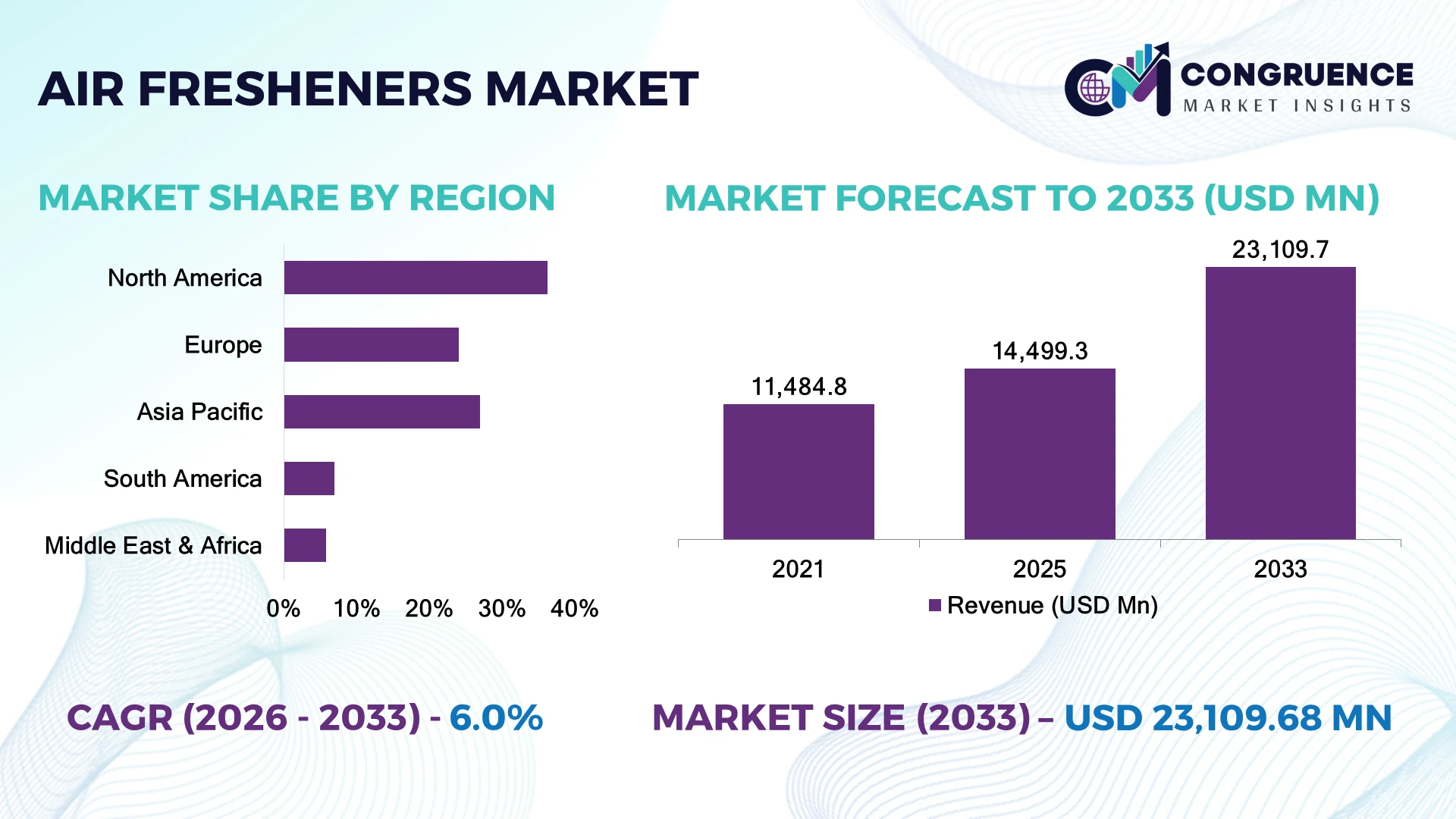
The United States remains the dominant country market, supported by high household penetration, premium home-care spending, and commercial scenting adoption; North America represented about 44% of global air-freshener revenue in 2025. India is smaller but expanding faster, with its domestic market reaching about USD 587 million and sprays holding 39% share. California’s tightening VOC framework is accelerating formulation redesign.
Strategically, suppliers that combine low-VOC chemistry, refill economics, and differentiated fragrance delivery are best positioned to capture premiumization.
Market Size & Growth: USD 14.5 billion in 2025 to USD 23.1 billion by 2033 at 6.0% CAGR, supported by premiumization and connected dispensing.
Top Growth Drivers: Premium formats 35%, refill systems 28%, smart-device adoption 22%.
Short-Term Forecast: By 2028, automated dispensing can reduce servicing frequency by 15% while improving fragrance consistency by 20%.
Emerging Technologies: AI scent personalization, IoT dispensers, and low-VOC formulations are shifting 18% of innovation activity toward connected air care.
Regional Leaders: North America, Europe, and Asia-Pacific lead, with Asia-Pacific showing the fastest premium-format adoption at about 7%.
Consumer/End-User Trends: Residential applications account for approximately 71% share, while wellness-oriented fragrance usage is strengthening among younger consumers.
Pilot/Case Example: 2025 smart-dispenser deployments demonstrated approximately 20% better dosing consistency versus manual dispensing workflows.
Competitive Landscape: Leading brands collectively control a substantial share of premium air care, with Reckitt, SC Johnson, P&G, Henkel, and Godrej competing across formats.
Regulatory & ESG Impact: VOC controls have already reduced regulated consumer-product emissions by about 50% from uncontrolled levels, accelerating low-emission formulation development.
Investment & Funding: More than USD 100 million in category expansion and technology-focused investment is shifting toward refillable, automated, and sustainable delivery systems.
Innovation & Future Outlook: Water-based aerosols, bio-based fragrance ingredients, smart refills, and odor-neutralization technologies will shift competition from fragrance variety toward measurable performance.
Air fresheners are increasingly positioned as multifunctional indoor air-care products spanning residential spaces, automobiles, offices, hospitality venues, and commercial facilities. Demand is strengthening around long-lasting formats, premium fragrances, and automated dispensing, with India’s residential segment alone representing about 51% of its domestic market in 2025. Meanwhile, tighter VOC requirements are forcing manufacturers to reformulate aerosol and fragrance systems, making formulation efficiency and compliance capabilities increasingly important for strategic expansion.
The air fresheners market is becoming strategically important because product differentiation is shifting from scent selection toward delivery precision, odor neutralization, wellness positioning, and recurring refill economics. Manufacturers are therefore reallocating investment from conventional aerosol portfolios toward automated dispensers, concentrated refills, water-based formulations, and digitally enabled consumer experiences.
Technology is creating a measurable operating advantage. Automated dispensing systems can improve dosing consistency by roughly 20% compared with manual application while reducing unnecessary fragrance consumption by around 10–15%. North America remains stronger in premium connected air care, whereas India and other Asian markets are expanding through affordable sprays, gels, automotive formats, and e-commerce-led distribution.
Over the next 2–3 years, connected dispensing, refill subscriptions, and low-VOC formulations will become increasingly important procurement criteria. Commercial operators are integrating timed dispensers across hospitality, retail, and workplace environments to standardize scent delivery while controlling maintenance cycles. Companies are responding through formulation partnerships, localized manufacturing, and expanded refill ecosystems. Competitive advantage will increasingly depend on combining fragrance performance with compliance, device economics, and supply-chain efficiency.
Premium fragrance formats and automated dispensing are reshaping purchasing decisions, particularly in commercial facilities and higher-income households. Connected dispensers can reduce fragrance consumption by 10–15% while improving dosing consistency by approximately 20%, strengthening the economics of recurring refill models. In the United States, hospitality, offices, and retail operators are increasingly standardizing scent delivery through programmable systems rather than manual aerosol placement. At the same time, low-VOC formulation requirements are pushing manufacturers toward water-based and concentrated formulations. Companies are responding by expanding refill portfolios, integrating IoT controls, and forming fragrance-technology partnerships. The non-obvious advantage is recurring consumables revenue: suppliers with compatible dispenser-refill ecosystems capture repeat purchasing while reducing customer switching.
Regulatory pressure on volatile organic compounds and fluctuations in fragrance chemicals, propellants, and packaging inputs are constraining product economics. Reformulation can increase development and qualification costs by 8–12%, while fragrance and packaging inputs can represent more than 30% of finished-product costs in selected formats. California’s tighter consumer-product emissions requirements are accelerating reformulation across aerosol portfolios, creating different compliance specifications between markets. Manufacturers are reducing exposure through regional sourcing, multi-supplier contracts, and greater use of water-based, gel, and concentrated formats. The operational challenge is not simply formulation cost; fragmented compliance requirements increase SKU complexity and inventory buffers. Companies with localized manufacturing and flexible formulations gain a measurable margin advantage over suppliers dependent on standardized global recipes.
Smart dispensing and refillable systems create an opportunity to move air fresheners from disposable products toward managed air-care services. IoT-enabled dispensers can lower servicing requirements by roughly 15% and improve dosing precision by about 20%, making them attractive for hospitality, healthcare, offices, and retail facilities. India and Southeast Asian urban markets provide additional whitespace as organized commercial scenting expands alongside modern retail and hospitality infrastructure. Bio-based fragrance ingredients and concentrated refill cartridges are also gaining strategic relevance as sustainability requirements tighten. Companies are investing in sensor-enabled dispensers, subscription refill models, and formulation partnerships. A distinctive opportunity lies in converting fragrance consumption data into procurement intelligence, enabling suppliers to optimize refill frequency and build higher-retention enterprise contracts.
The transition toward connected air care introduces execution challenges that conventional aerosol portfolios largely avoid. IoT dispensers require reliable connectivity, battery management, firmware maintenance, and interoperability across facility-management systems; deployment complexity can raise installation and servicing requirements by 10–20%. Workforce shortages in technical maintenance further complicate scaling across geographically dispersed commercial sites. In Japan and Germany, where facility operators prioritize automation and documented maintenance, suppliers must integrate dispensing equipment with existing operational workflows rather than deploy standalone devices. Cybersecurity also becomes relevant when connected dispensers transmit usage information across enterprise networks. Companies must therefore invest in standardized device architectures, remote diagnostics, technical training, and cybersecurity controls to maintain consistent performance while scaling connected air-care deployments.
Smart Dispenser Deployment Accelerates Connected fragrance dispensers are moving beyond pilot installations into hospitality, retail, and workplace environments, with automated dosing improving consistency by approximately 20% and reducing fragrance consumption 10–15%. Companies are expanding IoT-enabled portfolios and remote-monitoring capabilities to lower servicing frequency and create recurring refill contracts.
Low-VOC Formulations Gain Priority Regulatory tightening in markets such as California is accelerating reformulation, while water-based and concentrated formats increasingly replace conventional high-propellant products. Manufacturers are directing roughly 10% more formulation-development activity toward lower-emission systems, reducing compliance exposure while preserving fragrance performance and expanding cross-market product compatibility.
Refill Economics Reshape Portfolios Refillable cartridges and concentrated fragrance systems are gaining traction as businesses seek lower packaging intensity and predictable operating costs. Concentrates can reduce packaging material requirements by roughly 20–30% versus comparable ready-to-use formats. Suppliers are redesigning dispenser ecosystems around standardized cartridges, longer service intervals, and contract-based replenishment.
Premium Scenting Becomes Data-Driven Commercial scenting is shifting toward measurable occupancy-based deployment, particularly in offices, hotels, and retail facilities. Sensor-enabled systems can adjust dispensing according to usage patterns, reducing unnecessary output by around 15%. Companies are integrating occupancy sensors, analytics, and remote controls to optimize fragrance intensity while differentiating enterprise service offerings.
Sprays and aerosols remain the leading product type, accounting for approximately 46.7% of the global air fresheners market in 2025, supported by instant fragrance delivery, low upfront cost, portability, and extensive retail availability. Electric air fresheners represent the fastest-growing shift as consumers increasingly favor continuous scent diffusion and programmable intensity. Their refill-based economics also create stronger recurring-revenue potential than one-time spray purchases.
Electric formats are estimated at roughly 27% of demand, positioning them well ahead of more mature gel, candle, and other formats in technology adoption. Gel products retain relevance where passive, maintenance-light fragrance delivery is preferred, while candles occupy a more premium, experiential niche. Companies are consequently investing in water-based aerosols, refillable electric systems, concentrated formulations, and differentiated fragrance portfolios. The strategic shift is toward formats that combine performance with repeat-purchase economics and lower material intensity.
In 2025, India’s sprays/aerosols segment held a 39% share, with industry activity emphasizing water-based, long-lasting, and refillable innovations at the India Aerosols Expo 2025.
Residential applications represent the leading demand center, accounting for approximately 60.6% of the global air fresheners market in 2025. Household usage spans sprays, plug-ins, gels, and candles, giving suppliers broad opportunities to segment consumers by room, fragrance preference, and purchasing frequency. Automotive applications remain strategically important because compact formats and continuous-use products support repeat purchases, while corporate and other commercial environments prioritize consistent odor management and controlled dispensing.
Automotive and commercial applications are becoming more technology-intensive as users shift toward longer-lasting and programmable delivery. Residential demand remains more format-diverse, whereas enterprise buyers increasingly evaluate refill intervals, dosing consistency, and maintenance requirements. Companies are adapting through application-specific fragrances, automated dispensers, concentrated refills, and differentiated packaging. The commercial opportunity is particularly attractive where standardized dispensing can reduce servicing frequency by roughly 15%, creating an operational case beyond fragrance appeal.
A 2025 India market assessment placed residential air fresheners at 51% share, while sprays/aerosols represented 39%, confirming the concentration of demand around household usage and immediately effective formats.
Individual household users form the dominant end-user group, reflecting the broad penetration of sprays, gels, plug-ins, and other consumer air-care formats. Their purchasing behavior is driven by affordability, fragrance variety, convenience, and increasingly by wellness-oriented positioning. Enterprise users represent the faster-evolving segment as hotels, offices, retail locations, healthcare facilities, and other managed environments adopt automated scent delivery. The contrast is significant: households optimize fragrance experience and price, while enterprises prioritize consistency, coverage, refill economics, and maintenance efficiency.
Enterprise adoption is shifting toward programmable and connected dispensers, creating higher-value recurring relationships than conventional consumer transactions. Connected systems can reduce fragrance consumption by about 10–15% through controlled dosing, while remote monitoring improves operational visibility. Companies are responding with customized commercial programs, dispenser-refill bundles, service contracts, and application-specific formulations. The strategic priority is therefore moving from maximizing unit sales toward building integrated air-care ecosystems that increase customer retention and recurring consumables demand.
A 2026 home-care assessment reported that 86% of surveyed consumers used air freshener more than once weekly and 45% used it daily, reinforcing high-frequency household engagement with air-care products.
North America accounted for the largest market share at 36.2% in 2025 however, Asia-Pacific is expected to register the fastest growth, expanding at a CAGR of 7.1% between 2026 and 2033.
Premiumization and automated scent management are reshaping established air-care demand
North America maintains the leading position in the Air Fresheners Market, supported by high household penetration, premium fragrance consumption, automotive air-care adoption, and commercial scenting across hospitality and retail. The United States contributes the majority of regional demand, with residential applications representing more than 60% of consumption and automated dispensing gaining traction in commercial facilities. Premium electric and connected formats are expanding faster than conventional passive products as businesses prioritize controlled dosing and predictable refill cycles. Manufacturers are strengthening regional production and distribution networks while introducing water-based aerosols, concentrated refills, and low-VOC formulations. Approximately 15% lower fragrance consumption from controlled dispensing is improving the operating economics of commercial installations, shifting competition toward refill efficiency and service integration rather than fragrance variety alone.
United States Market Outlook: The United States remains the region’s primary demand and innovation hub, supported by extensive retail distribution, sophisticated consumer-product manufacturing, and strong commercial scenting infrastructure. Premium and electric formats account for an increasingly important share of category innovation, while low-VOC formulation development is accelerating. Major manufacturers are prioritizing refill systems, concentrated fragrances, and automated dispensers to improve recurring-purchase economics. Connected commercial installations can reduce fragrance consumption by approximately 10–15%, strengthening adoption among hotels, offices, and retail operators seeking standardized air-care management.
Regulatory reformulation is accelerating low-emission and refill-oriented air care
Europe is shifting toward low-VOC formulations, concentrated products, refillable systems, and packaging-efficient delivery formats as environmental requirements increasingly influence product development. Germany, France, the United Kingdom, and Italy represent major consumption centers, while established household penetration supports premiumization rather than basic category expansion. Water-based aerosols and electric diffusers are gaining importance as manufacturers redesign portfolios around lower-emission chemistry and longer product life. Refillable formats can reduce packaging material use by approximately 20–30% compared with comparable ready-to-use systems. Companies are responding through localized formulation, recyclable packaging, and fragrance partnerships, while commercial operators increasingly favor automated dispensers that provide consistent dosing and reduce servicing requirements.
Germany Market Outlook: Germany combines strong household purchasing power with advanced retail infrastructure, sustainability-focused product development, and sophisticated commercial facility management. Demand is increasingly concentrated around low-emission formulations, electric diffusers, and refillable fragrance systems rather than conventional disposable formats. German manufacturers and distributors are adapting packaging and formulation specifications to meet tighter environmental expectations across European markets. Commercial scenting systems that lower fragrance consumption by around 10–15% provide a practical efficiency advantage for hotels, offices, and retail facilities, strengthening demand for automated dispensing solutions.
Urbanization and premium format adoption are shifting Asia-Pacific toward higher-value air care
Asia-Pacific is the fastest-changing market for air fresheners, driven by urban household formation, expanding organized retail, automotive ownership, and rising acceptance of premium fragrance products. China, Japan, South Korea, India, and Southeast Asian economies are strengthening their roles as consumption and manufacturing centers. India is particularly important because sprays and aerosols account for roughly 39% of domestic demand, while premium electric formats are gaining visibility through modern retail and e-commerce. Manufacturers are localizing fragrance profiles and packaging while expanding affordable refill systems. Regional production scale also supports shorter supply chains, allowing companies to reduce imported component exposure and respond faster to localized fragrance preferences.
China Market Outlook: China represents the region’s most strategically significant manufacturing and consumer market, combining extensive aerosol production, electronics capabilities, e-commerce penetration, and rapidly expanding premium home-care consumption. Local manufacturers increasingly integrate fragrance products with compact electric diffusers, smart-home ecosystems, and refill cartridges. E-commerce provides a particularly efficient channel for testing new fragrance variants and subscription-style replenishment. Companies are using localized production and digital distribution to shorten product-development cycles and compete more effectively on price, packaging innovation, and fragrance differentiation.
Brazil-led premiumization is expanding beyond conventional household formats
South America is centered on Brazil as the principal consumption, manufacturing, and distribution hub for air-care products. Household sprays remain important because of their affordability and immediate fragrance delivery, but electric diffusers, gels, automotive products, and premium fragrances are expanding the category mix. Brazil’s established consumer-goods manufacturing base supports localized formulation and packaging, reducing exposure to imported finished products. E-commerce and modern retail are increasing access to premium formats, while commercial facilities are adopting controlled dispensing selectively. Automated systems can reduce fragrance usage by approximately 10–15%, creating an operational incentive for hospitality and retail customers. Companies are responding with localized fragrances, multipack formats, refill products, and distributor partnerships to improve market coverage while managing logistics costs.
Brazil Market Outlook: Brazil is the strategic anchor for South American air-care demand because of its large consumer base, developed household-product manufacturing ecosystem, and extensive modern-retail network. Localized production enables manufacturers to adapt fragrance profiles and packaging to domestic purchasing patterns while controlling transportation exposure. Automotive air fresheners and premium household formats are expanding product breadth, while commercial scenting remains concentrated in hospitality, retail, and corporate facilities. Companies with domestic manufacturing and broad distributor coverage hold an advantage in managing price-sensitive demand and maintaining consistent product availability.
Hospitality investment and premium scenting are elevating commercial air-care demand
Middle East & Africa is developing as a premium-oriented air-care market, particularly across the Gulf states where hospitality, luxury retail, commercial real estate, and tourism infrastructure support sophisticated scenting applications. The United Arab Emirates and Saudi Arabia are leading deployment activity, with hotels, malls, airports, and premium residences increasingly using automated fragrance systems. Commercial scenting solutions can reduce manual servicing requirements by approximately 15%, supporting adoption in large facilities. Manufacturers are expanding through regional distributors, fragrance partnerships, and localized product portfolios. High temperatures and extensive air-conditioning usage also reinforce the importance of long-lasting formulations and controlled diffusion, creating demand for concentrated systems rather than frequent manual aerosol application.
United Arab Emirates Market Outlook: The United Arab Emirates is the region’s strongest premium air-care market because of its concentration of luxury hotels, shopping centers, airports, commercial towers, and high-end residential developments. Professional scenting is increasingly integrated into customer-experience strategies, particularly in hospitality and retail environments. Automated dispensers allow operators to standardize fragrance intensity across large properties while reducing servicing requirements by approximately 15%. Suppliers are therefore prioritizing high-performance fragrances, programmable systems, and long-duration refills, positioning the UAE as an important testing ground for premium commercial air-care concepts.
Procter & Gamble, Reckitt, SC Johnson, Church & Dwight, and Newell Brands compete as global brand leaders, while regional FMCG manufacturers challenge them through value pricing and localized fragrances. The top five players collectively command approximately 60% share, leaving meaningful room for regional challengers. Competition centers on formulation performance, scent personalization, packaging, and distribution: premium innovations command roughly 10–15% price advantages, while localized products can reduce costs 5–10%. P&G and Reckitt emphasize technology-led differentiation; SC Johnson competes through fragrance breadth and sustainability, while regional players prioritize affordability and rapid format adaptation. Companies are expanding refill systems, launching smart dispensers, strengthening e-commerce partnerships, and integrating fragrance development with packaging capabilities. The competitive shift is moving from simple odor masking toward wellness, antimicrobial functionality, personalization, and lower-material packaging. Entry barriers remain high because established brands control retail visibility, formulation expertise, and supply networks. Winning requires superior scent technology, disciplined cost architecture, localized distribution, and faster product innovation.
Procter & Gamble Co.
Reckitt Benckiser Group plc
S.C. Johnson & Son, Inc.
Church & Dwight Co., Inc.
Newell Brands Inc.
Henkel AG & Co. KGaA
Godrej Consumer Products Ltd.
Dabur India Ltd.
Kobayashi Pharmaceutical Co., Ltd.
Bath & Body Works, Inc.
Farcent Enterprise Co., Ltd.
N. Ranga Rao & Sons Pvt. Ltd.
Jyothy Labs Ltd.
ITC Limited
Connected dispensers, programmable aerosol systems, membrane gels, and controlled-release fragrance technologies are reshaping air freshener deployment in offices, hospitality, retail, and premium households. Smart dispensers can reduce fragrance consumption by approximately 10–15% through timed release and occupancy-based control, while membrane and gel formats extend fragrance duration by 20–30% versus conventional open systems. Adoption is strongest in commercial environments where centralized maintenance and predictable replenishment create measurable operating advantages.
AI-enabled scent personalization and sensor-integrated dispensers represent the next disruptive layer. Systems combining occupancy detection, room-size sensing, and programmable intensity can improve dispensing efficiency by roughly 15–20% versus fixed-interval devices. P&G’s adjustable-intensity plug format illustrates the shift toward user-controlled fragrance output, benefiting premium brands with stronger refill ecosystems and differentiated consumer experiences. Natural fragrance encapsulation, biodegradable carriers, and lower-VOC formulations are also gaining importance as manufacturers redesign product chemistry and packaging.
Between 2026 and 2028, the strongest competitive impact will come from integrating smart controls with refill optimization, digital inventory monitoring, and sustainable materials. Companies deploying connected dispensing can target 10–15% lower servicing frequency, while advanced controlled-release systems support longer replacement cycles. The strategic advantage will favor manufacturers combining formulation science, hardware, data capabilities, and scalable refill supply chains.
February 2025 Procter & Gamble introduced the Febreze PLUG Scent Booster with adjustable intensity control, shifting air care toward personalization. Users fine-tune fragrance levels, strengthening premium differentiation and repeat-refill economics while broadening demand for controlled scent experiences channels. Source: P&G
September 2025 Godrej Consumer Products launched aer Plug at INR 149, cutting usage cost nearly 70% to INR 2.5 daily while delivering fragrance for 60 days. The move lowered entry barriers and accelerated penetration in India. Source: Godrej Consumer Products
September 2024 Reckitt’s Lysol Air Sanitizer won an R&D100 Award in Process/Prototyping, validating its air-sanitization platform. The recognition strengthened technology positioning around products killing 99.9% of airborne viruses and bacteria, supporting premium commercial and household applications sales. Source: Reckitt
August 2026 Wipro Consumer Care’s Yardley London launched Floralis in India with sprays and air pockets for homes and cars. Priced from INR 70, the range expands premium fragrance competition beyond personal care and establishes an air-care channel. Source: Indian Retailer (Indian Retailer)
The Air Fresheners Market Report evaluates the industry across product types including sprays, aerosols, gels, electric and plug-in systems, liquid refills, solid formats, and emerging controlled-release solutions. Application coverage spans residential spaces, commercial facilities, automobiles, hospitality, healthcare, retail, and institutional environments, with analysis of premium, mass-market, wellness-oriented, and sustainable fragrance niches. The study assesses formulation technologies, dispensing mechanisms, refill architectures, smart sensors, natural ingredients, and low-VOC product development.
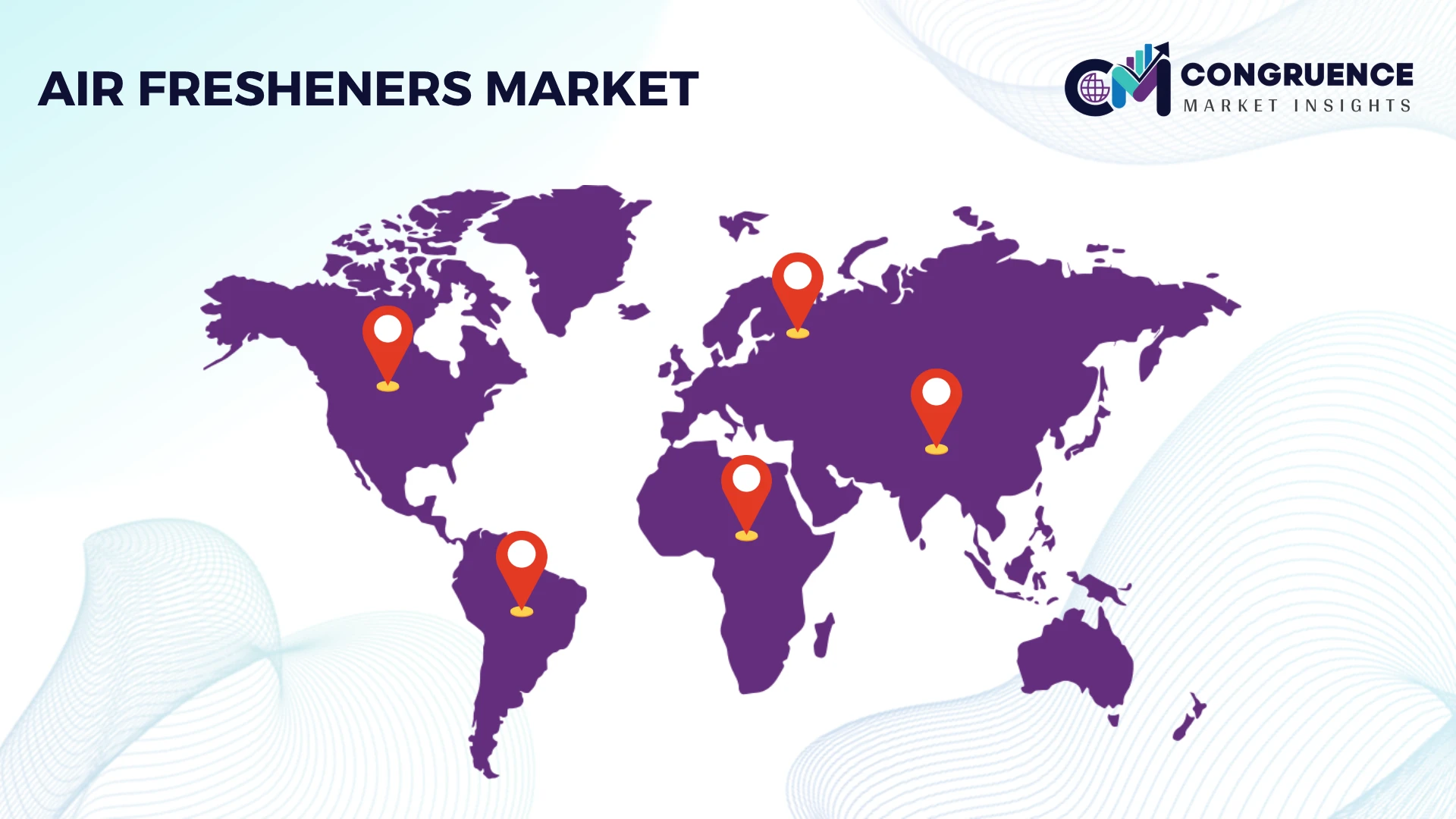
Regional analysis covers North America, Europe, Asia-Pacific, South America, and Middle East & Africa, with country-level assessment of adoption, distribution intensity, manufacturing positioning, and regulatory influence. Competitive evaluation covers leading multinational and regional manufacturers, with strategic insights supporting portfolio planning, market entry, localization, channel expansion, partnership decisions, and technology investment. The report provides a forward-looking framework for competitive positioning and market direction from 2026 to 2033.
| Report Attribute/Metric | Report Details |
|---|---|
|
Market Revenue in 2025 |
USD 14,499.3 Million |
|
Market Revenue in 2033 |
USD 23,109.7 Million |
|
CAGR (2026 - 2033) |
6% |
|
Base Year |
2025 |
|
Forecast Period |
2026 - 2033 |
|
Historic Period |
2021 - 2025 |
|
Segments Covered |
By Type
By Application
By End-User
|
|
Key Report Deliverable |
Revenue Forecast, Growth Trends, Market Dynamics, Segmental Overview, Regional and Country-wise Analysis, Competition Landscape |
|
Region Covered |
North America, Europe, Asia-Pacific, South America, Middle East, Africa |
|
Key Players Analyzed |
Procter & Gamble Co., Reckitt Benckiser Group plc, S.C. Johnson & Son, Inc., Church & Dwight Co., Inc., Newell Brands Inc., Henkel AG & Co. KGaA, Godrej Consumer Products Ltd., Dabur India Ltd., Kobayashi Pharmaceutical Co., Ltd., Bath & Body Works, Inc., Farcent Enterprise Co., Ltd., N. Ranga Rao & Sons Pvt. Ltd., Jyothy Labs Ltd., ITC Limited |
|
Customization & Pricing |
Available on Request (10% Customization is Free) |




