
Reports
The Global Air Filters Market was valued at USD 17,498.1 Million in 2025 and is anticipated to reach a value of USD 27,889.3 Million by 2033 expanding at a CAGR of 6.0% between 2026 and 2033. Growth is driven by stricter indoor-air-quality requirements, semiconductor and pharmaceutical cleanroom expansion, higher-efficiency HVAC upgrades, and increasing replacement demand for HEPA, activated-carbon, and low-pressure-drop filtration systems.
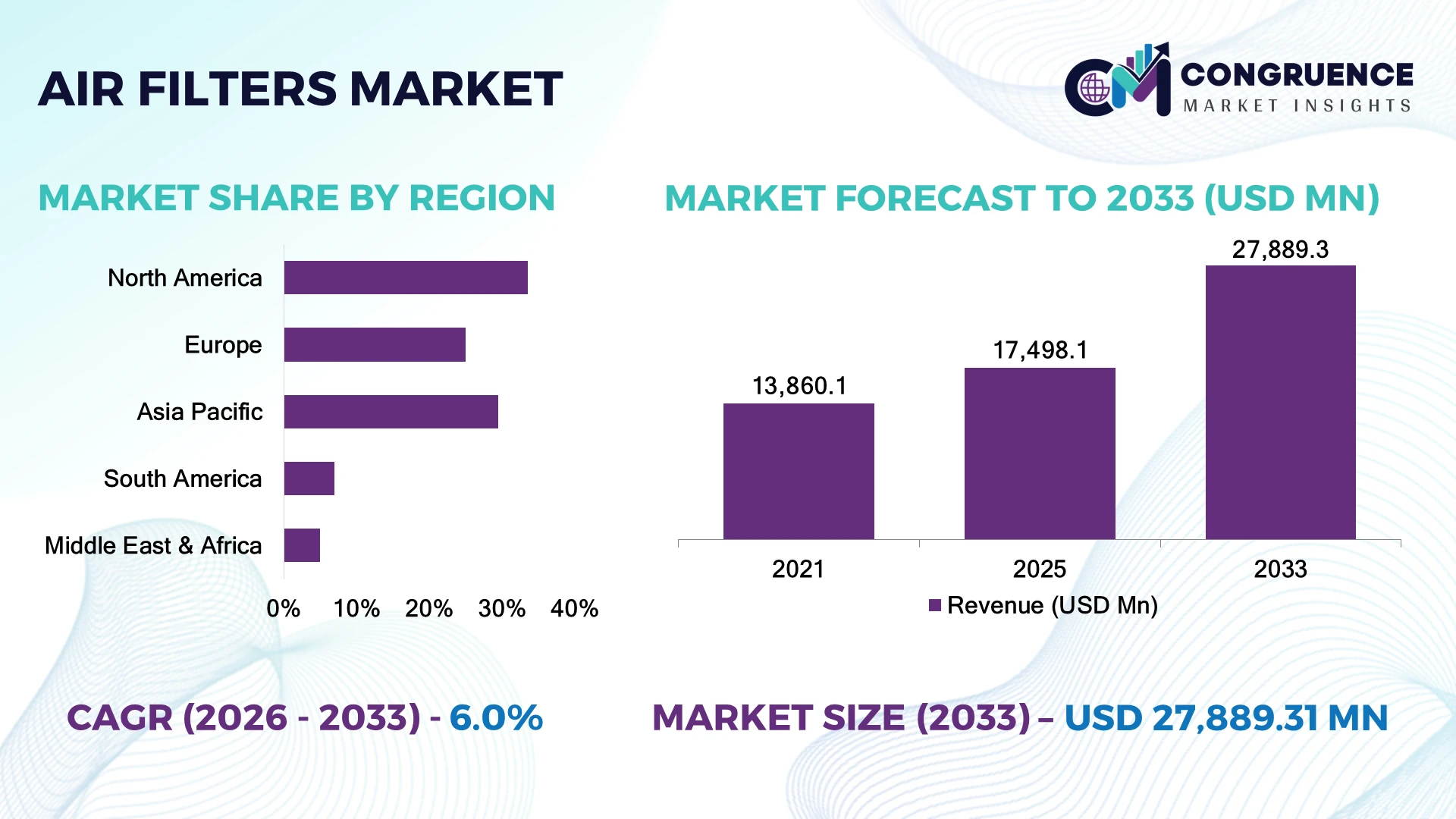
The United States remains the dominant country market at approximately 26% of global value, supported by healthcare, commercial buildings, semiconductor fabs, pharmaceuticals, and industrial ventilation. China contributes about 11%, while India represents nearly 7% and is expanding cleanroom and HVAC capacity. HEPA adoption is accelerating, with the segment representing roughly 31% of air-filter demand. U.S. investment remains concentrated in advanced filtration infrastructure, while Asia's manufacturing expansion is narrowing the technology gap.
Strategically, suppliers that combine high-efficiency media, low pressure drop, localized manufacturing, and recurring replacement programs will capture the strongest value pools.
Market Size & Growth: USD 17.5 Billion in 2025 to USD 27.9 Billion by 2033 at a 6.0% CAGR, driven by HEPA adoption, cleanroom expansion, and energy-efficient HVAC upgrades.
Top Growth Drivers: Healthcare 24%, commercial HVAC 22%, pharmaceuticals and semiconductors 18%.
Short-Term Forecast: By 2028, smart filtration controls will improve filter-life utilization by 10–15% and reduce avoidable replacement costs by 8–12%.
Emerging Technologies: AI-enabled monitoring, nanofiber media, electrostatic filtration, low-pressure-drop HEPA designs, and sensor-connected filter systems.
Regional Leaders: North America approaches USD 7.0 Billion with advanced HVAC adoption; Asia-Pacific approaches USD 6.5 Billion with semiconductor and pharmaceutical expansion; Europe approaches USD 4.8 Billion with energy-efficiency upgrades.
Consumer/End-User Trends: More than 50% of commercial and residential HVAC users increasingly prioritize higher-efficiency filtration where indoor-air-quality requirements are tightening.
Pilot/Case Example: 2025 smart-filter deployments demonstrated approximately 10–15% longer replacement intervals through differential-pressure monitoring and condition-based maintenance.
Competitive Landscape: The United States leads with about 26% country share; major players include 3M, Camfil, Donaldson, Parker Hannifin, Honeywell, and MANN+HUMMEL.
Regulatory & ESG Impact: Higher-efficiency HVAC filtration can support 5–10% reductions in selected energy penalties when low-pressure-drop media replace poorly optimized high-resistance filters.
Investment & Funding: More than USD 2.0 Billion in announced filtration, cleanroom, HVAC, and advanced-material investment is reinforcing localized manufacturing and technology partnerships.
Innovation & Future Outlook: 2026–2028 priorities center on AI filter monitoring, recyclable media, nanofiber structures, ultra-low-pressure-drop HEPA, and service models based on predictive replacement.
Air Filters demand is concentrated across HVAC systems, healthcare, pharmaceuticals, semiconductor cleanrooms, automotive manufacturing, food processing, and residential air purification. HEPA filters account for roughly 31% of market demand, while smart monitoring and low-pressure-drop media are becoming more important as energy costs rise. In 2026, manufacturers are also regionalizing filter-media sourcing and production as logistics volatility encourages shorter supply chains, creating a transition toward higher-performance, locally supported filtration systems.
Air filters are becoming strategically important because filtration performance now affects occupant health, manufacturing yield, equipment uptime, and building energy consumption simultaneously. Semiconductor fabs, pharmaceutical plants, hospitals, and high-density commercial buildings increasingly treat filtration as a controlled operating asset rather than a consumable maintenance item. This shift is strengthening demand for HEPA, ULPA, activated-carbon, and sensor-enabled systems.
Technology differentiation is increasingly centered on pressure drop and usable filter life. Advanced low-resistance media can reduce selected fan-energy penalties by approximately 5–10% compared with poorly optimized legacy configurations, while differential-pressure monitoring can extend replacement intervals by 10–15%. The United States leads in sophisticated commercial and healthcare deployment, whereas China and India are expanding faster through cleanroom, manufacturing, and urban HVAC investment.
Over the next 2–3 years, predictive maintenance and connected filtration will move deeper into facility-management workflows. A practical deployment combines pressure sensors, airflow monitoring, filter-life algorithms, and automated maintenance alerts. Companies are therefore investing in nanofiber media, localized production, digital service platforms, and partnerships with HVAC integrators. Competitive advantage will increasingly belong to suppliers that sell measurable air-quality and energy outcomes rather than filters alone.
Semiconductor, pharmaceutical, and healthcare expansion is increasing demand for high-efficiency air filtration, particularly HEPA and ULPA systems. HEPA filters represent approximately 31% of market demand, while cleanroom applications account for nearly 28% of industrial filtration consumption. U.S. semiconductor-fab investment and India's pharmaceutical manufacturing expansion are increasing requirements for controlled particulate environments. Manufacturers are responding with low-pressure-drop media, modular filtration units, and localized production. Advanced nanofiber media can improve particle-capture efficiency by 5–10% while maintaining lower airflow resistance. The strategic shift is toward filtration engineered around process yield and contamination control, making filter performance a production-quality variable rather than a routine facility-maintenance specification.
Higher filtration efficiency can increase system pressure drop and operating expenditure when HVAC equipment is not designed for advanced media. Poorly optimized high-efficiency filters can raise fan energy consumption by 10–20%, while replacement and disposal costs can represent 15–25% of annual filtration expenditure in large facilities. European manufacturers face additional pressure from elevated electricity costs, while Asian factories often operate mixed-generation HVAC infrastructure. Companies are addressing the constraint through low-pressure-drop media, variable-speed fans, filter-life monitoring, and localized media sourcing. The operational insight is that a higher-rated filter is not automatically the lowest-cost solution; lifecycle economics increasingly depend on balancing particle capture, airflow resistance, replacement frequency, and fan efficiency.
Connected filtration systems are creating new opportunities through differential-pressure sensors, airflow analytics, and predictive replacement algorithms. Condition-based monitoring can extend usable filter life by approximately 10–15% and reduce unnecessary replacement activity by 8–12%. Adoption is strongest in data centers, hospitals, semiconductor fabs, and large commercial buildings where continuous ventilation is operationally critical. U.S. facility operators are increasingly integrating filtration data into building-management platforms, while Indian data-center development is creating new demand for automated HVAC monitoring. Manufacturers are investing in sensor-enabled filters, cloud analytics, and facility-management partnerships. The non-obvious opportunity is shifting from filter-unit sales toward recurring performance services, where suppliers monetize energy optimization, predictive maintenance, and documented indoor-air-quality outcomes.
Integration across legacy HVAC systems, building-management platforms, and new sensor-enabled filtration equipment remains a major execution challenge. Approximately 20–30% of installed commercial HVAC systems operate with limited digital monitoring capability, restricting automated filter-life optimization. In older U.S. and European buildings, incompatible controls and constrained equipment rooms can increase retrofit labor requirements by 10–15%. Manufacturers are developing retrofit-ready sensors, standardized communication interfaces, modular housings, and technician training programs to reduce integration friction. The long-term pressure is not filtration technology itself but interoperability across heterogeneous building infrastructure. Suppliers that simplify installation, commissioning, cybersecurity, and data integration will achieve stronger deployment consistency and avoid turning advanced filtration into a high-maintenance technology upgrade.
Low-Pressure Media Gain Traction: Commercial facilities are increasingly replacing conventional high-resistance media with low-pressure-drop synthetic and nanofiber constructions. Optimized designs can reduce airflow resistance by 10–20% while maintaining required particle capture. U.S. hospitals and data centers are prioritizing these configurations to control HVAC energy consumption, while manufacturers are expanding pleated-media and nanofiber portfolios.
Filter Monitoring Becomes Standardized: Differential-pressure sensors and automated maintenance alerts are moving into larger commercial HVAC installations. Connected monitoring can extend replacement intervals by 10–15% and reduce avoidable filter changes by 8–12%. Facility operators are integrating sensor outputs with building-management systems, shifting maintenance from calendar-based replacement toward condition-based workflows.
Regional Media Supply Expands: Supply-chain disruptions are encouraging manufacturers to localize synthetic fiber, meltblown media, activated-carbon, and HEPA-component sourcing. Localized procurement can shorten selected replenishment cycles by 20–30% and reduce exposure to imported-material delays. Producers in India, China, and the United States are expanding supplier qualification and regional inventory to protect production continuity.
Compliance Drives Better Documentation: Indoor-air-quality and energy-performance requirements are increasing documentation around filtration efficiency, pressure drop, and replacement practices. Large facilities are targeting 5–10% reductions in avoidable HVAC energy penalties through optimized filter selection. Manufacturers are responding with digitally traceable product specifications, performance testing, and lifecycle documentation to strengthen enterprise procurement decisions.
HEPA filters represent the leading type at approximately 31% market share, supported by 99.97% rated capture efficiency for 0.3-micron particles and extensive deployment in hospitals, pharmaceutical plants, semiconductor fabs, and cleanrooms. MERV-rated filters account for roughly 36%, benefiting from broader HVAC compatibility and lower lifecycle cost, while activated-carbon and other specialized filters serve odor, VOC, and gas-phase control requirements. MERV systems remain more scalable across commercial buildings because they require less demanding HVAC configurations, whereas HEPA dominates contamination-sensitive environments.
The fastest-growing shift is toward low-pressure-drop synthetic and nanofiber filters, where improved media structures can deliver approximately 5–10% lower airflow resistance than older high-density constructions. Companies are investing in advanced media, modular housings, and sensor-enabled replacement programs. The business implication is a shift from maximum capture efficiency alone toward optimized filtration performance per unit of fan energy, favoring suppliers that combine high efficiency with lower pressure drop and longer service intervals.
ASHRAE's 2025 residential ventilation standard increased the minimum filtration requirement from MERV 6 to MERV 11, strengthening the specification environment for higher-efficiency residential air filters.
HVAC systems represent the leading application at approximately 46% market share because commercial buildings, healthcare facilities, manufacturing plants, and residential systems require continuous particulate control. Industrial and process filtration follows at roughly 29%, supported by automotive, food processing, chemical, and manufacturing environments. Cleanroom filtration is smaller but faster-growing, with demand rising approximately 9–11% as semiconductor and pharmaceutical capacity expands. Residential air purification remains strategically relevant, particularly in high-pollution urban markets.
The fastest-growing application is cleanroom and controlled-environment filtration, where HEPA and ULPA systems are integrated with pressure-control and contamination-monitoring infrastructure. Companies are expanding modular filtration units, validated cleanroom systems, and service contracts rather than selling standalone filters. The operational shift increases the value of airflow management and filter integrity testing, while mature HVAC applications increasingly prioritize low-pressure-drop media. Suppliers are therefore directing investment toward integrated filtration packages and application engineering rather than competing solely on replacement-filter pricing.
ASHRAE's 2025 Standard 62.1 introduced updated filter-efficiency calculation methods alongside new ventilation and control requirements, reinforcing tighter filtration integration within commercial building design and operation.
Commercial buildings represent the leading end-user group at approximately 32% market share because offices, retail facilities, hotels, airports, and institutional buildings operate large HVAC networks requiring recurring filter replacement. Healthcare facilities account for roughly 21%, while industrial and manufacturing users contribute about 19%. Commercial buyers prioritize lifecycle cost, energy performance, and standardized replacement programs, whereas healthcare and cleanroom users accept higher filtration costs to protect occupants, equipment, and sensitive processes.
The fastest-growing end-user group is semiconductor and pharmaceutical manufacturing, expanding at approximately 10–12% as new fabs, laboratories, and controlled production areas require validated HEPA and ULPA filtration. Companies are responding with application-specific media, factory-integrated filter modules, predictive maintenance, and long-term supply agreements. Industrial users increasingly seek filters engineered around pressure drop and particulate loading rather than nominal efficiency alone. This creates a strategic advantage for suppliers capable of combining filtration hardware, monitoring, technical qualification, and recurring service into one procurement relationship.
ASHRAE identifies MERV 13 or higher as desirable for improved particulate filtration and notes that newer MERV 13 filters can achieve pressure drops comparable to older MERV 8 technologies, supporting higher-efficiency upgrades without equivalent airflow penalties.
North America accounted for the largest market share at 33.5% in 2025 however, Asia-Pacific is expected to register the fastest growth, expanding at a CAGR of 10.9% between 2026 and 2033.

Replacement-driven HVAC demand shifts toward high-efficiency filtration
North America represents approximately 33.5% of the global Air Filters Market, supported by mature HVAC infrastructure, healthcare modernization, data-center construction, industrial emission controls, and recurring replacement demand. The United States accounts for the majority of regional consumption, with commercial buildings and healthcare facilities representing major deployment centers. North American demand is increasingly shifting toward HEPA, synthetic-media, activated-carbon, and low-pressure-drop filters as facility operators balance indoor-air-quality requirements with energy performance. Tariff-related pressure on imported filtration media during 2025 also encouraged manufacturers to diversify sourcing and increase regional inventory. The market's structural advantage lies in established distribution and replacement networks, which allow suppliers to monetize recurring service relationships alongside new equipment installations.
United States Market Outlook: The United States is the region's primary market because of its extensive commercial HVAC installed base, healthcare infrastructure, pharmaceutical manufacturing, semiconductor investment, and data-center expansion. Approximately one-third of global air-filter demand is concentrated in North America, while U.S. buyers increasingly favor higher-efficiency media that maintain manageable pressure drop. Federal and state indoor-air-quality requirements further strengthen replacement and retrofit activity.
Energy efficiency reshapes filtration specifications
Europe contributes approximately 25% of global Air Filters demand, with Germany, France, Italy, the United Kingdom, and Benelux forming the principal industrial and commercial markets. Energy-efficiency requirements are pushing buyers toward synthetic and nanofiber media that maintain particulate capture while limiting fan-energy penalties. Pharmaceutical production, healthcare, food processing, automotive manufacturing, and commercial-building retrofits remain important demand centers. European procurement increasingly evaluates total operating cost rather than nominal filter efficiency, strengthening suppliers offering lower pressure drop and longer service intervals. Germany's industrial base also supports specialized process-air filtration, while tightening sustainability requirements encourage recyclable media and lower-material designs.
Germany Market Outlook: Germany remains Europe's most strategically significant market because of its concentration of automotive, pharmaceutical, chemical, semiconductor, and advanced manufacturing facilities. Industrial buyers increasingly require validated filtration performance and predictable replacement cycles. The country's mature engineering ecosystem supports deployment of high-efficiency filtration alongside automated HVAC controls, creating opportunities for suppliers that combine advanced media with energy-optimization services.
Manufacturing scale accelerates advanced filtration deployment
Asia-Pacific accounts for approximately 29.5% of global Air Filters demand and represents the fastest-expanding major market, supported by electronics, semiconductor, pharmaceutical, automotive, and urban construction activity. China, Japan, South Korea, and India are driving investment in cleanrooms and industrial HVAC systems, while local filter-media manufacturing improves supply responsiveness. Asia-Pacific already represents about 39% of global air-filter-media demand, demonstrating its importance within the filtration value chain. Companies are expanding synthetic-media production, HEPA manufacturing, modular cleanroom systems, and regional distribution networks to capture industrial demand. The strategic shift is toward localized production combined with higher-performance filtration, reducing dependence on imported media while supporting shorter qualification and replenishment cycles.
China Market Outlook: China is the region's largest manufacturing hub for air filtration, supported by semiconductor fabs, electronics plants, pharmaceutical facilities, automotive production, and extensive HVAC deployment. Dense domestic supply chains enable rapid sourcing of filter media and components, while industrial buyers increasingly adopt high-efficiency systems for controlled environments. China's scale also provides manufacturers with an important base for exporting filtration products into other Asian markets.
Industrial modernization strengthens Brazil-centered demand
South America represents approximately 7% of global Air Filters demand, with Brazil and Mexico serving as the principal markets. Demand is concentrated in commercial HVAC, food processing, automotive manufacturing, pharmaceuticals, mining, and industrial facilities, where particulate and process-air control increasingly influence equipment reliability. Brazil's large installed base creates recurring replacement demand, while industrial modernization is encouraging adoption of higher-efficiency synthetic and cartridge filtration. Import dependence for specialized media remains a constraint, making regional inventory and distributor partnerships commercially important. Manufacturers are therefore strengthening local channel coverage, qualifying alternative media suppliers, and expanding application-specific filtration portfolios. The opportunity is strongest in industrial and commercial retrofits where replacing legacy filters can improve particulate control without requiring complete HVAC-system replacement.
Brazil Market Outlook: Brazil is the region's strongest market because of its diversified industrial base, large commercial-building stock, food-processing activity, mining operations, and expanding healthcare infrastructure. Industrial customers increasingly require dependable replacement availability and filtration suited to high-dust environments. Local distributors and service providers remain important because they shorten replenishment cycles and provide installation support, giving suppliers with established technical networks an advantage in recurring procurement.
Infrastructure investment drives premium filtration adoption
Middle East & Africa accounts for approximately 5% of global Air Filters demand, with Saudi Arabia and the UAE leading commercial activity. Data centers, airports, hospitals, hospitality developments, petrochemical facilities, and large-scale mixed-use projects are increasing demand for HEPA, activated-carbon, and particulate filtration. Harsh dust conditions increase filter loading and replacement frequency, making filtration efficiency and service intervals commercially important. Gulf construction programs are also shifting procurement toward integrated HVAC packages rather than standalone filter purchases. Manufacturers are responding through regional distribution hubs, local technical partnerships, and application-specific media designed for high-dust environments. The strategic opportunity is recurring replacement and service revenue from large facilities rather than one-time equipment sales.
Saudi Arabia Market Outlook: Saudi Arabia is the region's leading strategic market because of its large-scale urban, hospitality, healthcare, transport, industrial, and data-center investments. High ambient dust loads increase filtration requirements across HVAC and industrial systems, while major developments increasingly specify controlled indoor environments. Suppliers with local inventory, rapid replacement capability, and high-dust filter designs are positioned to secure longer-term facility-management contracts and recurring aftermarket demand.
Daikin, Camfil, MANN+HUMMEL, Honeywell, and 3M compete globally, while Parker Hannifin, Donaldson, and regional specialists challenge them across industrial and replacement filtration. The top five players are estimated to hold about 55% combined share in the broader air-filter market. Competition centers on media efficiency, pressure drop, lifecycle cost, and supply responsiveness; advanced designs can reduce airflow resistance 10–20%, while nanofiber media improve filtration efficiency 5–10%. Daikin benefits from integrated HVAC and filtration capabilities, Camfil emphasizes high-efficiency systems, and MANN+HUMMEL is strengthening proprietary media and digitalization. Regional manufacturers counter through localized production and faster customization. The competitive shift is moving toward integrated filtration-plus-monitoring solutions and localized supply chains. Entry barriers include validated performance, cleanroom qualification, OEM relationships, and manufacturing scale. Winners will combine efficient media, digital monitoring, application engineering, reliable regional supply, and recurring aftermarket services to outperform established specifications.
Daikin Industries, Ltd.
Camfil AB
MANN+HUMMEL GmbH
Honeywell International Inc.
3M Company
Donaldson Company, Inc.
Parker Hannifin Corporation
Filtration Group Corporation
Freudenberg Filtration Technologies SE & Co. KG
AAF International
Cummins Inc.
MAHLE GmbH
Lennox International Inc.
Koch Filter Corporation
Low-pressure-drop synthetic media, HEPA/ULPA filtration, electrostatic separation, and nanofiber structures define current technology deployment. Advanced media can reduce airflow resistance by 10–20% versus conventional high-density designs while maintaining targeted particle capture. Sensor-enabled differential-pressure monitoring is moving beyond premium facilities, with adoption strongest in data centers, hospitals, semiconductor fabs, and pharmaceutical cleanrooms. The operational benefit is longer usable filter life and lower fan-energy exposure.
Emerging systems integrate pressure sensors, airflow analytics, building-management platforms, and predictive replacement algorithms. Condition-based monitoring can extend replacement intervals by 10–15% and reduce unnecessary changes by 8–12%. Daikin benefits from HVAC-filter integration, while Camfil and MANN+HUMMEL gain from specialized media, cleanroom systems, and digital filtration capabilities. Proprietary filtration materials are also reducing external supply dependency and accelerating product development.
During 2026–2028, AI-assisted filter optimization, recyclable media, molecular filtration, and automated integrity testing will gain commercial importance. Compared with calendar-based replacement, predictive systems can improve filter utilization by approximately 10–15%. Advanced V-bank designs can also provide up to 20% lower initial resistance than conventional configurations. Suppliers combining media science, sensors, software, and localized manufacturing will secure stronger lifecycle relationships as filtration becomes an energy, quality, and uptime management tool.
November 2024 Camfil opened its expanded Manesar facility, adding AHU and minipleated HEPA production aligned with IS 17570:2021. The expansion strengthens local sourcing, shortens supply routes, and supports pharmaceutical, healthcare, and microelectronics customers across India reliably at scale. Source: camfil.com
June 2025 AAF launched BioCel VXL RC and VariCel VXL RC V-Bank filters with up to 50% more media and 20% lower initial resistance. The redesign improves airflow capacity, extends filter life, and reduces operating costs for facilities. Source: aafintl.com
September 2025 Camfil added a HEPA and ULPA production line at Manesar, with 100% individual scan testing for every filter. The expansion strengthens certified supply for ISO 5–8 hospitals, pharmaceutical facilities, biotechnology laboratories, and semiconductor cleanrooms in India. Source: camfil.com
February 2026 Donaldson launched ArmorSeal air-cleaner technology for heavy-duty equipment, validated through modeling and OEM durability testing. The platform targets higher vibration, dust loads, and service cycles, improving seal integrity, manufacturing repeatability, and filtration reliability across equipment applications. Source: donaldson.com
The Air Filters Market Report covers HEPA, ULPA, MERV-rated, activated-carbon, electrostatic, nanofiber, and other specialized filtration technologies across HVAC, industrial/process filtration, cleanrooms, automotive, residential, healthcare, pharmaceutical, semiconductor, and commercial applications. End-user coverage includes commercial buildings, industrial manufacturers, healthcare facilities, pharmaceutical companies, semiconductor fabs, automotive producers, and residential users. Regional analysis spans North America, Europe, Asia-Pacific, South America, and Middle East & Africa.
The report evaluates advanced filter media, low-pressure-drop architectures, smart monitoring, predictive maintenance, molecular filtration, automated integrity testing, and localized manufacturing. Segment analysis identifies HEPA at approximately 31% of demand, while connected monitoring is gaining adoption in critical facilities. Competitive assessment covers leading global suppliers and regional manufacturers, supporting investment planning, capacity expansion, technology selection, supplier qualification, partnership strategy, and competitive positioning through 2026–2033.
| Report Attribute/Metric | Report Details |
|---|---|
|
Market Revenue in 2025 |
USD 17,498.1 Million |
|
Market Revenue in 2033 |
USD 27,889.3 Million |
|
CAGR (2026 - 2033) |
6% |
|
Base Year |
2025 |
|
Forecast Period |
2026 - 2033 |
|
Historic Period |
2021 - 2025 |
|
Segments Covered |
By Type
By Application
By End-User
|
|
Key Report Deliverable |
Revenue Forecast, Growth Trends, Market Dynamics, Segmental Overview, Regional and Country-wise Analysis, Competition Landscape |
|
Region Covered |
North America, Europe, Asia-Pacific, South America, Middle East, Africa |
|
Key Players Analyzed |
Daikin Industries, Ltd., Camfil AB, MANN+HUMMEL GmbH, Honeywell International Inc., 3M Company, Donaldson Company, Inc., Parker Hannifin Corporation, Filtration Group Corporation, Freudenberg Filtration Technologies SE & Co. KG, AAF International, Cummins Inc., MAHLE GmbH, Lennox International Inc., Koch Filter Corporation |
|
Customization & Pricing |
Available on Request (10% Customization is Free) |




