
Reports
The Global Air Cushion Packaging Market was valued at USD 4,120.0 Million in 2025 and is anticipated to reach a value of USD 7,078.9 Million by 2033 expanding at a CAGR of 7.0% between 2026 and 2033. Growth is anchored in the shift toward on-demand inflation systems that cut warehouse film inventory by up to 90% compared with pre-inflated stock, alongside tightening void-fill restrictions in major fulfilment markets.
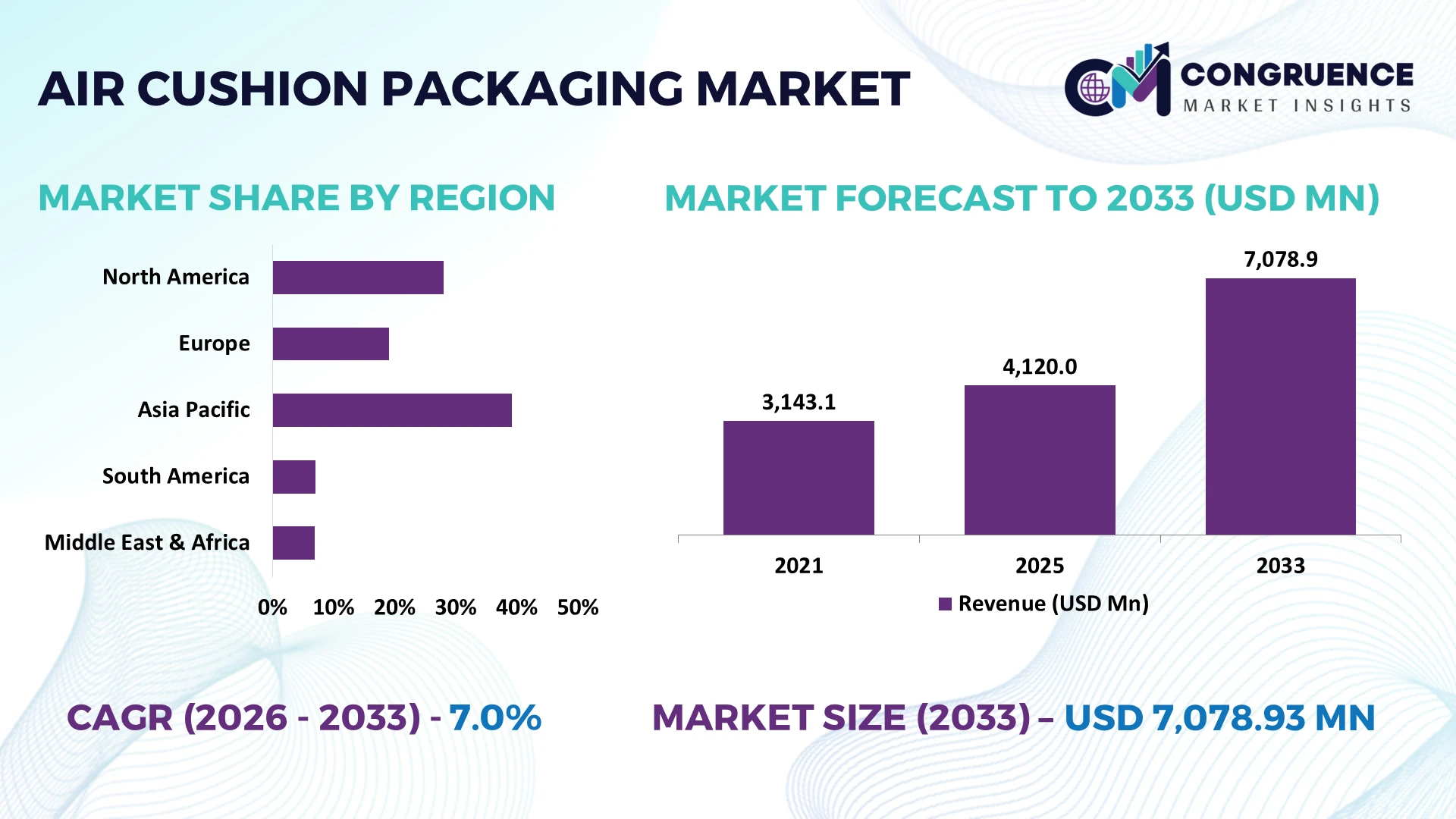
Asia-Pacific commands 39.14% of global revenue, led by China’s export-fulfilment corridors and Japan’s high-automation packing lines, while the United States generated USD 1.14 billion in 2025 with mature installed equipment bases across third-party logistics hubs. Germany’s enforcement of the EU Packaging and Packaging Waste Regulation from August 2026 imposes a 50% empty-space ceiling on e-commerce parcels by 2030, directly pressuring conventional over-boxing practices.
Suppliers integrating machine-agnostic film formulations with local converting partnerships will defensibly capture replacement demand as compliance scrutiny intensifies.
Market Size & Growth: The market stands at USD 4.12 billion in 2025, advancing to USD 7.08 billion by 2033 at 7.0% CAGR, driven by automated fulfilment centres replacing pre-inflated stock with on-demand inflation systems.
Top Growth Drivers: E-commerce parcel volume growth of 4.4% globally, material substitution pressure from Amazon’s plastic air-pillow phase-out, and EU empty-space compliance obligations collectively steer procurement toward recyclable and precisely dimensioned cushioning.
Short-Term Forecast: By 2028, integrated inflation-and-wrapping stations are expected to reduce per-parcel film waste by 15–18% as warehouse management software automatically calibrates cushion dimensions to carton geometry.
Emerging Technologies: AI-driven packaging controllers that read item barcodes and auto-adjust inflation parameters, compostable Airpad BIO cushions disintegrating in under six months, and cloud-connected film-consumption monitoring represent the leading technology vectors.
Regional Leaders: Asia-Pacific holds 39.14% revenue share on manufacturing and export density; North America’s USD 1.14 billion US base prioritises automation retrofits; Europe’s compliance-driven market favours fibre-plastic hybrid formats.
Consumer/End-User Trends: 55.34% of revenue derives from inflatable air pillows, with personal care and cosmetics direct-to-consumer shipments demanding precision cushioning at 7.82% growth, reflecting premiumisation of unboxing experiences.
Pilot/Case Example: Papair’s 2026 Rethem facility expansion doubled production width to 800mm for paper-based air cushions, targeting industrial accounts seeking plastic-free alternatives at comparable throughput.
Competitive Landscape: Sealed Air leads with installed equipment relationships across major 3PLs, followed by Pregis, Storopack, Smurfit Westrock, and FROMM, with the top tier controlling an estimated 40–45% of professional fulfilment accounts.
Regulatory & ESG Impact: EU PPWR Article 24 caps parcel empty space at 50% by 2030; Germany’s VerpackDG transposition explicitly restricts oversized packaging and unnecessary air cushions, forcing format redesign across cross-border sellers.
Investment & Funding: CD&R’s USD 10.3 billion take-private of Sealed Air signals private-equity conviction in protective packaging consolidation, while Pregis expanded renewable electricity to 22 US plants covering 20% of Scope 2 emissions.
Innovation & Future Outlook: Next-generation systems will compete on software compatibility and film recyclability rather than cushion geometry alone, with machine-agnostic consumables and certified home-compostable formats positioning suppliers for procurement shortlists.
Air cushion packaging demand concentrates in electronics fulfilment, personal care direct-to-consumer, and pharmaceutical cold-chain adjacencies, where damage costs dwarf material spend. Recent innovation centres on home-compostable Airpad BIO cushions achieving 85% carbon-footprint reduction versus paper alternatives, and AI-enabled inflation controllers auto-adjusting to item profiles. A measurable signal: 43% less water and 38% fewer resources consumed in next-generation honeycomb-paper hybrids compared with conventional panels. Operationally, Germany’s August 2026 packaging rules now treat air pillows as void rather than protection, forcing sellers to shrink cartons first. These pressures reframe air cushioning from a commodity input into a compliance and efficiency lever—setting the stage for strategic differentiation.
Air cushion packaging has shifted from a low-cost void-fill commodity to a strategic control point in fulfilment economics. EU packaging rules now count air pillows as empty space rather than protection, forcing sellers to redesign carton dimensions and material choices simultaneously. In the United States, Amazon’s plastic air-pillow phaseout has redirected procurement toward paper-based alternatives and machine-compatible recyclable films, with suppliers who demonstrate measurable material reduction gaining preferred access to sustainability-linked contracts.
Technology comparison illustrates the gap: AI-enabled inflation controllers reading item barcodes reduce film consumption by 15–18% per parcel versus fixed-setting legacy machines, while cutting packing-station changeover time. Regionally, Asia-Pacific scales on manufacturing volume and export fulfilment density, whereas Europe leads on compliance-driven format innovation and certification depth. Germany’s VerpackDG implementation, effective August 2026, restricts oversized packaging and unnecessary air cushions outright, creating a template other member states will follow.
Operationally, Papair’s 2026 doubling of paper-based air-cushion production capacity at Rethem signals that fibre alternatives are moving from pilot to industrial scale, with a €19 million BIOWRAP consortium targeting fully paper-based replacements through 2031. Over the next 24–36 months, procurement teams will prioritise suppliers offering machine-agnostic films with certified recyclability and software integration, not lowest unit price. Competitive advantage accrues to converters that co-locate film production with fulfilment clusters and embed compliance documentation into order-management workflows—turning regulatory pressure into account-level differentiation rather than margin erosion.
Global parcel volumes rose 4.4% in 2024, with cross-border e-commerce intensifying demand for on-demand cushioning at fulfilment stations. Air pillows alone command 55.34% of revenue because they integrate with automated inflation systems and occupy minimal pre-inflation storage. In Germany, the VerpackDG transposition of EU rules now restricts unnecessary air cushions and oversized packaging, compelling sellers to recalibrate carton dimensions and cushioning volumes simultaneously. Companies are responding by co-specifying inflation equipment with film formulations that meet recyclability criteria, and by shifting procurement toward suppliers offering cloud-connected machines that auto-adjust cushion output to order profiles. The operational insight: film cost is no longer the primary selection criterion—machine-software compatibility and certified recyclability determine supplier shortlists.
LLDPE generated USD 1.62 billion in 2025, but polymer input costs move faster than customer contracts allow pass-through, creating timing mismatches that constrain equipment upgrades and recycled-content development. Multilayer film designs face qualification cycles of six to twelve months as EU recyclability criteria tighten, delaying format changes for suppliers without in-house formulation capability. The direct business impact: converters operating on thin margins defer capex for automated inflation lines, constraining throughput scalability precisely when fulfilment centres demand faster packing cycles. Companies are mitigating exposure through index-linked film contracts, localised resin sourcing, and partnerships with certification bodies to pre-qualify recyclable structures before regulatory deadlines. The strategic insight: formulation capability is becoming a barrier to entry, not a cost centre.
Home-compostable air cushions now achieve complete disintegration in under six months and deliver 85% carbon-footprint reduction versus protective paper, opening procurement pathways where recycling infrastructure is absent. Polylactic acid and starch-blend formulations are the fastest-growing material segment at 7.13% CAGR, supported by sustainability procurement mandates. India and Southeast Asian fulfilment networks are specifying automated inflation systems for the first time, creating greenfield opportunities for suppliers offering compact equipment with localised film supply. Companies positioning through R&D consortia—such as the €19 million BIOWRAP project targeting industrial-scale paper-based cushions—secure first-mover advantage in certified compostable formats. The non-obvious opportunity: machine-agnostic compostable films that run on existing inflation equipment eliminate switching friction and accelerate adoption in price-sensitive markets.
Cloud-connected inflation controllers promise material savings of 15–18%, but deployment across multi-site 3PL networks requires warehouse-management-system integration that many operators underestimate. Cybersecurity exposure increases as packaging machines connect to order-management platforms, with film-consumption data and machine settings representing new attack surfaces. Workforce gaps compound the problem: packing-station operators require retraining to interpret auto-adjusted cushion profiles and troubleshoot connectivity faults, with turnover in fulfilment roles exceeding 40% annually in some US markets. Companies must solve these through standardised API protocols, vendor-managed integration support, and embedded training modules—not by treating equipment installation as a standalone transaction. The long-term risk: fragmented data architectures across sites undermine the very efficiency gains that justify automation investment, eroding competitive positioning as compliance reporting requirements expand.
AI Vision Redefines Void-Fill Precision Storopack’s September 2025 module expansion introduced AI-powered vision scanning that calculates carton void volumes before dispensing air or paper padding, cutting material waste at pack stations and reducing rework from under-filled parcels. The shift moves inflation equipment from fixed-setting dispensers to sensor-driven systems that adapt to item geometry in real time. Operators deploying these retrofits report tighter film consumption per parcel and faster station throughput, prompting suppliers to bundle vision hardware with consumable contracts rather than sell machines as standalone assets.
Amazon’s Paper Pivot Resets North American Demand Amazon completed elimination of 95% of plastic air pillows across North American fulfilment by mid-2024, removing an estimated 15 billion pillows annually from roughly 2 billion shipments. The move forced third-party sellers and logistics partners inside Amazon’s ecosystem to re-specify void-fill formats toward paper-based alternatives, compressing conventional PE pillow volume in US fulfilment clusters. Suppliers are responding by accelerating paper-hybrid and recyclable film launches, with Storopack’s February 2025 AIRfiber launch illustrating the convergence between inflatable protection and fibre recyclability.
Bubble Cushioning Gains Dual-Use Traction Bubble cushioning is projected to expand at 6.75% through 2031, outpacing air pillows as operators seek formats that serve both void fill and surface wrap without switching consumables mid-pack. The format’s scratch-protection performance matters in consumer electronics and home goods shipments where cosmetic damage triggers returns even when the product functions. Fulfilment centres in Japan and South Korea are adopting dual-purpose bubble rolls at pack stations handling mixed SKU profiles, reducing changeover time and simplifying film inventory across shifts.
Compostable Film Moves from Pilot to Procurement Polylactic acid and starch-blend formulations are advancing at 7.13% as compliance pressure and sustainability procurement goals push brand owners beyond recyclable PE toward certified compostable alternatives. Home-compostable air cushions now disintegrate in under six months, creating viable pathways in markets where industrial composting infrastructure is absent. European converters are partnering with certification bodies to pre-qualify starch-blend films against DIN EN 13430 separability criteria, positioning certified compostable formats for procurement shortlists ahead of Germany’s August 2026 VerpackDG enforcement.
Air pillows commanded 55.34% of revenue in 2025, sustained by flat-pack storage efficiency, compatibility with inline inflation systems, and low cost-per-cubic-foot protection in high-throughput fulfilment. Deflated film rolls occupy a fraction of the floor space required by pre-inflated stock, simplifying pack-station replenishment across multi-site operations. The format’s installed base advantage is reinforced by proprietary machine ecosystems that bundle hardware, film, and service contracts, raising switching costs once systems are commissioned.
Bubble cushioning represents the fastest-growing product category at 6.75% through 2031, driven by dual-use performance as both void fill and surface wrap for scratch-sensitive shipments. Air tubes and inflatable bags remain smaller in absolute terms but gain ground in industrial equipment and pharmaceutical device transport where axial load distribution outweighs simple gap filling. Suppliers are prioritising film formulations that run across existing inflation platforms, reducing adoption friction for operators testing bubble and hybrid formats alongside conventional pillows.
Void filling held approximately 49.53% of functional demand in 2026, reflecting its role as the default protective strategy for parcel fulfilment across e-commerce, consumer electronics, and general retail shipments. The segment’s scale is anchored in high-volume, relatively undifferentiated carton configurations where air pillows displace empty space at minimal material cost. Operators favour void-fill formats for their compatibility with automated inflation lines and the ease of training pack-station staff on standard pillow dispensing.
Wrapping functionality is gaining traction at 6.0% as cosmetics, home goods, and consumer electronics shippers prioritise surface protection alongside gap displacement. The shift reflects growing recognition that abrasion and cosmetic damage trigger returns even when products remain functionally intact, particularly in premium direct-to-consumer channels. Blocking and bracing retain relevance for industrial components and multi-item shipments where preventing in-carton movement matters as much as external impact absorption. Suppliers are responding by developing film structures that transition between void-fill and wrap configurations without equipment changes, reducing SKU complexity for fulfilment centres.
Consumer electronics represented the largest end-user segment in 2024 and is projected to account for 36.18% of demand in 2026, driven by the need for reliable protection of smartphones, laptops, and accessories through increasingly complex last-mile networks. The segment’s scale reflects both shipment volume and the high replacement cost of damaged goods, which justifies investment in cushioning formats that outperform basic void fill. Electronics manufacturers and distributors in China, Japan, and South Korea specify air cushion systems for precision protection in semiconductor-adjacent shipments, anchoring demand in higher-value industrial applications alongside volume fulfilment.
Personal care and cosmetics represent the fastest-expanding end-user group at 7.82%, propelled by premium direct-to-consumer shipments where breakage costs and unboxing presentation both matter. The shift toward subscription models and gift-ready packaging increases per-parcel cushioning intensity, creating demand for formats that protect glass and fragile containers without excessive material bulk. E-commerce and food and beverage segments maintain steady demand, though growth is more closely tied to parcel volume fluctuations than to format innovation. Suppliers are targeting personal care brands with customised film widths and low-profile pillow designs that fit smaller carton footprints typical of cosmetic shipments.
Asia-Pacific accounted for the largest market share at 39.1% in 2025 however, North America is expected to register the fastest growth, expanding at a CAGR of 7.66% between 2026 and 2033.
North America represented 28.0% of global air cushion packaging revenue in 2025, anchored by a deep installed base of on-demand inflation systems across US third-party logistics networks and a mature fulfilment infrastructure that favours machine-compatible film formats. The United States alone generated USD 1.14 billion in 2025, reflecting sustained capex in automated packing stations and growing procurement preference for certified recycled-content films. Regional demand concentrates in consumer electronics fulfilment and general e-commerce, where damage costs justify equipment-integrated cushioning over manual alternatives. Suppliers with multinational service capabilities and film portfolios qualified for PCR blends hold placement advantages as retail procurement teams embed sustainability criteria into supplier scorecards.
United States Market Outlook: The United States operates the region's most concentrated deployment base, with Amazon's North American fulfilment network having eliminated 95% of plastic air pillows by mid-2024, redirecting third-party seller procurement toward paper and recyclable film formats. US parcel carriers processed record volumes in 2024, sustaining replacement demand for inflation equipment and consumable contracts across UPS, FedEx, and Amazon Logistics fulfilment clusters.
Europe accounted for 19.0% of global air cushion packaging revenue in 2025, with regulatory timing rather than volume expansion defining the regional trajectory. Germany's VerpackDG transposition of EU packaging rules imposes empty-space limits that directly constrain conventional air pillow usage in parcel shipments, while the UK represented 20.0% of European revenue in 2025, reflecting its mature e-commerce fulfilment base and concentration of third-party logistics operators specifying machine-compatible cushioning. Suppliers capable of navigating material certification pathways and aligning film formulations with recyclability criteria convert compliance pressure into account-level differentiation. Southern European markets lag in automated inflation adoption but compensate through higher consumption of pre-inflated formats in retail distribution.
Germany Market Outlook: Germany anchors European regulatory enforcement, with VerpackDG rules effective August 2026 restricting oversized packaging and unnecessary air cushions in e-commerce parcels. The country's dense fulfilment network and concentration of packaging machinery manufacturers create a testbed for machine-agnostic film formulations that satisfy DIN-certified recyclability criteria while maintaining throughput on existing inflation platforms.
Asia-Pacific held 39.1% of global air cushion packaging revenue in 2025, underpinned by China's 174.5 billion parcel deliveries in 2024 and the region's concentration of electronics and consumer goods manufacturing. The region functions as both the largest consumption base and a critical production hub, with local converters supplying film stock to fulfilment networks across China, Japan, and Southeast Asia. India's tier-2 and tier-3 e-commerce expansion is driving greenfield warehouse investment, though price sensitivity keeps lightweight LDPE formats dominant. Regional suppliers benefit from proximity to extrusion capacity but face mounting domestic recycling policy scrutiny targeting single-use plastic formats in parcel delivery.
China Market Outlook: China's parcel volume of 174.5 billion units establishes the world's largest single-country demand base for protective cushioning, with platforms and third-party logistics standardising machine-compatible roll stock across automated fulfilment lines. The country's manufacturing density in consumer electronics sustains specification of air cushion systems for precision protection, while domestic recycling directives create format pressure without yet displacing polyethylene volume at scale.
South America represented 7.0% of global air cushion packaging revenue in 2025, concentrated in Brazil and Argentina where e-commerce growth is outpacing warehouse automation investment. The region operates a bifurcated market: large fulfilment centres in São Paulo and Buenos Aires adopt on-demand inflation systems, while smaller operators rely on pre-inflated formats and manual void fill. Infrastructure limitations—uneven parcel network coverage and limited film converting capacity—constrain adoption of machine-dependent formats. Brazil's larger fulfilment operators are investing in automated packing stations to reduce labour dependency and material waste, but currency volatility and import duties on equipment raise deployment costs. Suppliers with local film converting partnerships and flexible contract terms gain traction over global players requiring capital equipment commitments.
Brazil Market Outlook: Brazil concentrates South America's fulfilment investment, with São Paulo's e-commerce corridor driving adoption of automated inflation systems among large retailers and third-party logistics providers. The country's domestic film converting capacity supports localised supply, though equipment import costs and currency fluctuations favour suppliers offering leasing structures or consumable-inclusive pricing models.
The Middle East and Africa region represented 6.9% of global air cushion packaging revenue in 2025, the smallest regional base, but Gulf Cooperation Council markets are investing in fulfilment infrastructure that creates greenfield demand for on-demand inflation systems. Saudi Arabia's e-commerce expansion under Vision 2030 logistics initiatives and the UAE's position as a regional distribution hub are driving warehouse automation projects that specify machine-compatible cushioning. South Africa's more mature retail sector sustains steady demand for protective formats, though load-shedding and port congestion constrain supply chain reliability. Regional adoption favours suppliers offering compact, low-maintenance inflation equipment suited to smaller fulfilment footprints and distributors capable of servicing equipment across multiple countries without dense local presence.
Saudi Arabia Market Outlook: Saudi Arabia's fulfilment investment under Vision 2030 logistics corridors is creating first-time demand for automated inflation systems, with e-commerce and electronics distribution driving specification of on-demand cushioning over imported pre-inflated formats. Warehouse development in Riyadh and Jeddah is attracting equipment suppliers and local distributors capable of servicing multi-site deployments across the Kingdom.
The competitive field splits into three camps: equipment-integrated global leaders (Sealed Air, Pregis, Storopack) defending installed-base economics; fibre-transition specialists (Smurfit Westrock, Papair) attacking plastic pillow share with paper-based formats; and cost-driven Asian film converters (Anzhi Packing, Guozhi Gongjiang) competing on rollstock price and local supply speed. The top five players hold an estimated 42–46% combined share, concentrated in North American and European fulfilment accounts where machine-service contracts lock in consumable loyalty. Competition pivots on film qualification speed and compliance documentation rather than unit price alone—suppliers with DIN-certified recyclable structures command placement on EU procurement shortlists, while Asian converters win on 15–20% rollstock cost advantages in price-sensitive India and Southeast Asia. Sealed Air’s 95% recycled-content pillow, certified in China for global distribution, illustrates the shift from volume pricing to certified circularity as the primary differentiator. The decisive barrier is co-located film certification paired with machine integration—converters without in-house formulation and compliance capability cannot qualify for EU fulfilment accounts before 2027 deadlines. Winning requires owning the consumable specification, not the equipment sale.
Sealed Air Corporation
Pregis LLC
Storopack Hans Reichenecker GmbH
Smurfit Westrock
FROMM Packaging Systems
Papair Holding GmbH
Anzhi Packing (Zhejiang Anzhi New Material Co., Ltd.)
Guozhi Gongjiang
Ranpak Holdings Corp.
Intertape Polymer Group
Pregis Ariston
Airpack (Air Protection Systems)
Cortec Corporation
Elipack
AI-coupled inflation controllers now read item barcodes and auto-adjust cushion profiles, cutting film waste 15–18% per parcel versus fixed-setting legacy dispensers. Adoption remains concentrated in US and German fulfilment hubs where labour costs justify capital outlay, with roughly 12–15% of high-throughput pack stations running sensor-driven systems.
Water-soluble paper coatings represent the disruptive format shift: Storopack’s AIRfiber delivers conventional pillow volume while qualifying for paper recycling streams, removing the plastic-separation bottleneck that disqualifies 60–70% of mixed-material cushions from circular procurement. Fibre-hybrid formats undercut PE pillows on disposal cost while matching protection performance.
Between 2026 and 2028, machine-agnostic compostable films (CARBIOS-FROMM Airpad BIO) and cloud-connected consumption analytics will determine supplier shortlists. Converters embedding compliance documentation into order-management APIs secure multi-site accounts; equipment-only vendors lose consumable pull. The competitive gain accrues to formulation owners, not machine builders.
February 2025 — Storopack launched AIRfiber, paper-based air pillows with water-soluble inner coating certified recyclable under DIN EN 13430, using existing inflation machines to deliver conventional pillow volume with paper-stream compatibility. Source: storopack.uk
January 2025 — Sealed Air’s BubbleWrap 95% recycled-content air pillows received China’s Materials Award for sustainable innovation, achieving 95% recycled HDPE content (55% PCR, 40% PIR) and reducing carbon footprint nearly 15% versus virgin resin. Source: sealedairchina.com.cn
July 2025 — CARBIOS and FROMM commercialized Airpad BIO Home Compost air cushions, certified to disintegrate in under six months at room temperature and reducing carbon footprint 85% compared to paper protective packaging. Source: carbios-active.com
April 2026 — Anzhi Packing unveiled biodegradable PLA and mono-material air cushion films at KOREA PACK, leveraging in-house multi-layer co-extrusion from raw material formulation through finished film to target global e-commerce logistics markets. Source: kidd.co.kr
This report delivers a complete operational and strategic assessment of the global air cushion packaging market across type, application, end-user, and regional dimensions. Coverage spans air pillows, bubble cushioning, air tubes, and inflatable bags, with demand mapping across void filling (49.53% of functional demand), wrapping, and blocking applications. End-user analysis prioritizes consumer electronics (36.18% of demand) and personal care (7.82% expansion), while regional insights cover Asia-Pacific’s 39.14% dominance, North America’s mature equipment base, and Europe’s compliance-driven format shift.
The report integrates technology adoption curves—AI inflation controllers, compostable films, paper-hybrid formats—with competitive positioning across equipment-integrated leaders, fibre-transition specialists, and Asian cost competitors. Companies gain deployment benchmarks, regulatory timelines (EU PPWR, German VerpackDG), and supplier qualification criteria to support investment planning, facility expansion, and consumable contract negotiations through 2033.
| Report Attribute / Metric | Details |
|---|---|
| Market Revenue (2025) | USD 4,120.0 Million |
| Market Revenue (2033) | USD 7,078.9 Million |
| CAGR (2026–2033) | 7.0% |
| Base Year | 2025 |
| Forecast Period | 2026–2033 |
| Historic Period | 2021–2025 |
| Segments Covered |
By Type
By Application
By End-User
|
| Key Deliverables | Revenue Forecast; Market Trends; Growth Drivers & Restraints; Technology Insights; Segmentation Analysis; Regional Insights; Competitive Landscape; Regulatory & ESG Overview; Recent Developments |
| Regions Covered | North America; Europe; Asia-Pacific; South America; Middle East & Africa |
| Companies Profiled | Sealed Air Corporation; Pregis LLC; Storopack Hans Reichenecker GmbH; Smurfit Westrock; FROMM Packaging Systems; Papair Holding GmbH; Anzhi Packing (Zhejiang Anzhi New Material Co., Ltd.); Guozhi Gongjiang; Ranpak Holdings Corp.; Intertape Polymer Group; Pregis Ariston; Airpack (Air Protection Systems); Cortec Corporation; Elipack |
| Customization & Pricing | Available on Request (10% Customization Free) |




