
Reports
The Global Air-Cooled Condensers Market was valued at USD 13154.4 Million in 2025 and is anticipated to reach a value of USD 18564.14 Million by 2033 expanding at a CAGR of 4.4% between 2026 and 2033. Growth is being driven by water-constrained thermal power expansion, stricter industrial water-use controls, and deployment of dry-cooling systems that reduce cooling-water requirements by up to 95%.
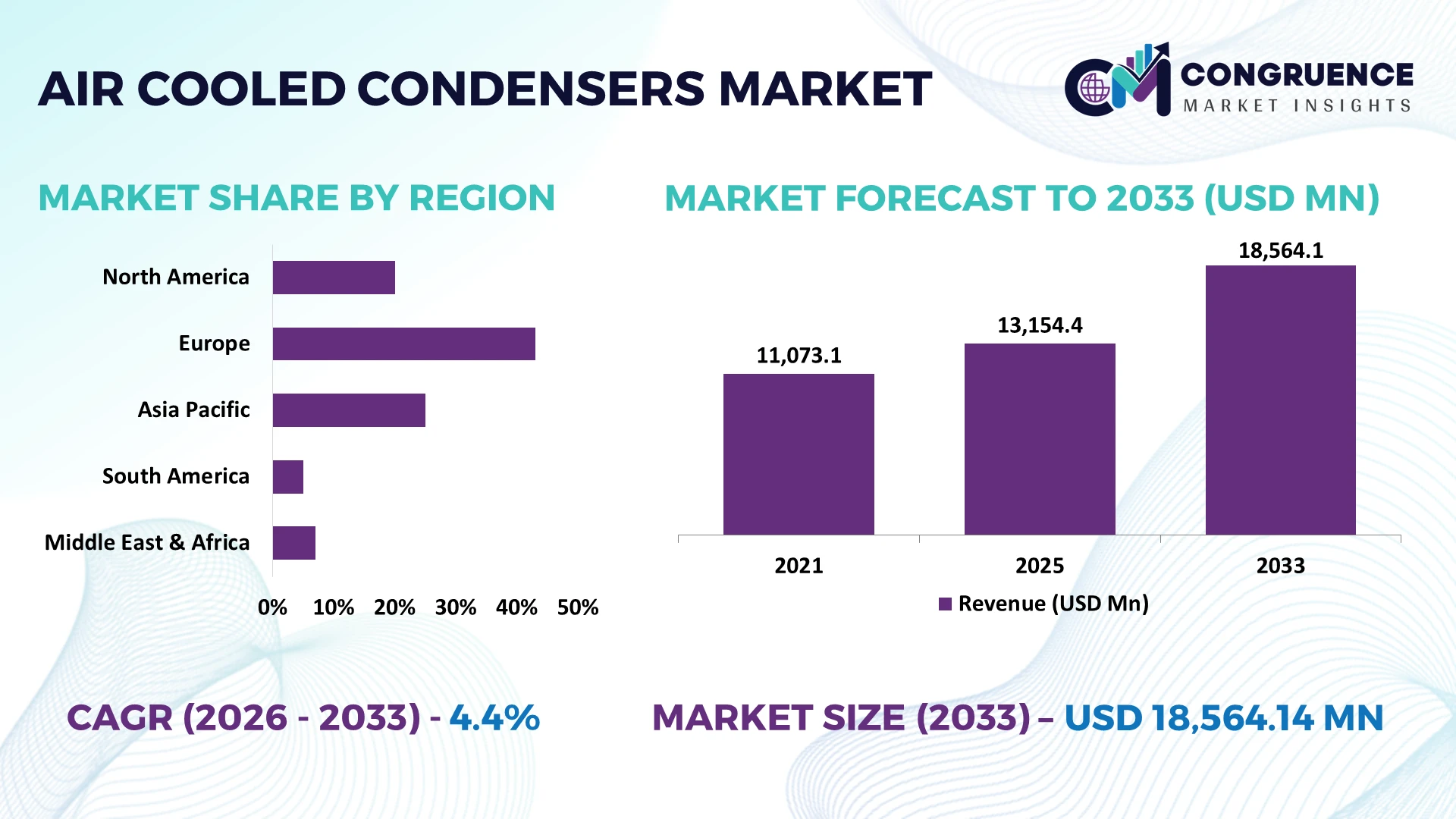
China anchors the dominant Asia-Pacific air-cooled condensers market, where regional demand represents approximately 38.2% of global activity, supported by large coal, gas, chemicals, metallurgy, and industrial-processing fleets. India provides the strongest comparison: thermal capacity reached 242.04 GW in June 2025, while 2026 BHEL procurement covers ACC packages for another 3.2 GW of thermal projects. China’s larger installed thermal base sustains materially higher equipment deployment.
Water-security pressures across northern China and drought-exposed Indian industrial states make advanced air-cooled condenser technology a strategic procurement priority for utilities and EPC contractors seeking lower water dependence and stronger operating resilience.
Market Size & Growth: USD 13.15 billion in 2025 advances toward USD 18.56 billion by 2033 at 4.4%, supported by water-efficient thermal power cooling.
Top Growth Drivers: Water conservation delivers up to 95% lower cooling-water use; power applications represent about 35% of demand; Asia-Pacific holds approximately 38% share.
Short-Term Forecast: By 2028, advanced VFD fan controls and digital optimization are positioned to reduce condenser auxiliary energy requirements by approximately 5–10%.
Emerging Technologies: AI-based fan control, digital twins, CFD-optimized airflow, microchannel surfaces, and hybrid adiabatic precooling are reshaping high-efficiency ACC configurations.
Regional Leaders: 2033 modeled values reach approximately USD 7.09 billion in Asia-Pacific, USD 5.20 billion in North America, and USD 4.46 billion in Europe, with smart-control adoption expanding.
End-User Trends: Power generation remains the principal deployment area, while more than 60% of new plants in water-stressed Asian locations increasingly specify dry-cooling configurations.
Pilot/Case Example: A 2024 Chennai experimental deployment combining evaporative pads and mist precooling achieved approximately 39.2% energy savings and lifted COP from 2.8 to 5.0.
Competitive Landscape: ENEXIO and SPX Dry Cooling remain leading global suppliers; market estimates place their combined share near 34%, alongside EVAPCO, Kelvion, Thermax, and regional Chinese manufacturers.
Regulatory & ESG Impact: Dry cooling cuts water requirements by as much as 95%, strengthening compliance where utilities face tighter withdrawal limits and recurring drought exposure.
Investment & Funding: A documented industrial ACC installation requiring roughly USD 1.8 million equivalent investment achieved annual water savings approaching 2 million cubic meters, reinforcing lifecycle economics.
Innovation & Future Outlook: Hybrid precooling, automated cleaning, low-noise fans, corrosion-resistant finned tubes, and predictive maintenance will shift global competition toward digitally optimized, climate-resilient condenser platforms.
Air-cooled condensers are becoming critical across thermal power, combined-cycle generation, petrochemicals, metallurgy, process industries, and water-stressed industrial sites. Advanced VFD fans, CFD-designed airflow systems, digital monitoring, and hybrid precooling are improving performance, with dry cooling reducing water requirements by up to 95%. India’s continuing multi-gigawatt thermal projects reinforce the shift toward water-efficient infrastructure, setting the foundation for deeper strategic market analysis.
Air-cooled condensers are becoming strategically important as utilities and industrial operators prioritize water security, plant availability, and lower dependence on cooling-water infrastructure. Dry cooling can reduce cooling-water consumption by approximately 90–95% versus conventional wet systems, strengthening its relevance in water-stressed power-generation corridors. Infrastructure modernization is also shifting procurement toward digitally controlled fan systems, condition monitoring, and modular condenser configurations that reduce operating variability and simplify maintenance.
Technology economics increasingly influence competitive positioning. Variable-frequency-drive fan systems can lower auxiliary electricity consumption by roughly 5–10% compared with fixed-speed legacy configurations, while optimized fin geometry improves heat-transfer performance without proportional footprint expansion. China benefits from its enormous thermal-generation fleet and domestic equipment manufacturing base, whereas India is accelerating deployment alongside new coal-fired capacity; India’s installed thermal capacity exceeded 240 GW in 2025. This creates distinct opportunities for localized manufacturing, EPC integration, and aftermarket services.
Over the next 2–3 years, hybrid precooling, automated tube cleaning, predictive maintenance, and AI-supported airflow optimization will move from premium specifications toward mainstream large-project requirements. In Indian thermal projects, ACC packages are already being specified for multi-gigawatt developments to reduce freshwater dependence. Suppliers are expanding engineering capabilities, local sourcing, and EPC partnerships accordingly. Competitive advantage will increasingly belong to manufacturers delivering water savings, lower parasitic loads, reliable high-temperature performance, and lifecycle service support together.
Water scarcity is accelerating dry-cooling adoption across thermal power and industrial facilities because air-cooled condensers can reduce cooling-water requirements by approximately 90–95% compared with wet cooling towers. India’s thermal generation capacity exceeded 240 GW in 2025, while electricity-demand growth continues to trigger new coal and combined-cycle infrastructure. China also operates more than 1,400 GW of thermal generating capacity, creating a substantial replacement and modernization base. Stricter industrial water-management policies in water-stressed provinces strengthen the economics of closed-loop and dry-cooling configurations. The non-obvious advantage is site flexibility: plants can be developed where reliable cooling-water infrastructure is unavailable. ACC manufacturers are responding through localized fabrication, larger modular bundles, low-noise fans, EPC partnerships, and optimized finned-tube systems designed for high-ambient-temperature operation.
Air-cooled condensers eliminate substantial water infrastructure but carry higher equipment footprints and thermal-performance penalties during extreme heat. Compared with wet cooling, dry-cooled power plants can experience approximately 1–3% lower generating efficiency under demanding ambient conditions, while peak summer temperatures above 45°C in parts of India and the Middle East reduce condenser vacuum performance. Fan systems can also represent approximately 1–2% of plant auxiliary electricity consumption depending on configuration and operating load. These limitations directly affect project economics where land, electricity, or summer capacity is constrained. The strategic issue is therefore not simply equipment price but the value of lost peak-period output. Suppliers are reducing exposure through VFD-controlled fans, optimized tube geometry, hybrid dry-wet configurations, long-term component contracts, and localized steel-structure and finned-tube sourcing.
Digital controls and hybrid thermal-management systems create an opportunity to improve ACC economics without sacrificing water-saving advantages. Variable-speed fan control can reduce auxiliary energy consumption by approximately 5–10%, while evaporative or mist precooling can improve heat rejection by more than 20% during high-temperature operating periods under suitable conditions. India offers a particularly attractive deployment environment because new thermal projects increasingly combine water-efficiency requirements with digitally monitored balance-of-plant equipment. Predictive analytics can additionally identify fan, gearbox, vibration, and tube-fouling anomalies before forced outages occur. The non-obvious opportunity lies in software-enabled aftermarket services rather than equipment sales alone. Manufacturers are therefore investing in sensor integration, automated cleaning, digital twins, advanced fin coatings, hybrid precooling, and partnerships with EPC and automation providers to build recurring lifecycle-service capabilities.
Long-term competitiveness depends on solving performance degradation across increasingly demanding climates. Ambient temperatures exceeding 40–45°C can weaken condenser vacuum, increase fan loading, and reduce turbine output precisely when electricity systems experience peak cooling demand. Fouling, wind recirculation, fin damage, and uneven airflow can collectively reduce heat-transfer effectiveness by more than 10% when maintenance and site design are inadequate. Large ACC installations also contain hundreds of fan motors and extensive finned-tube surfaces, increasing inspection and reliability complexity. India’s dust-intensive industrial corridors and China’s northern coal-power provinces demonstrate why standardized designs cannot guarantee consistent lifecycle performance. Manufacturers must strengthen CFD-based layout engineering, automated cleaning, corrosion-resistant materials, vibration monitoring, predictive diagnostics, and technician training. The decisive competitive metric will be sustained condenser performance across actual site conditions, not nameplate heat-rejection capacity alone.
Flexible Thermal Operation Gains Priority: Coal’s share of China’s electricity generation declined to 55% in 2025, while wind and solar capacity surpassed thermal capacity. ACC suppliers are therefore optimizing variable-speed fans, sectional control, and low-load condenser operation as thermal plants increasingly cycle around renewable generation, shifting equipment value from maximum heat rejection toward operating flexibility.
Combined-Cycle Specifications Move Upmarket: U.S. developers have 18.7 GW of combined-cycle capacity planned through 2028, including 4.3 GW already under construction. New installations increasingly integrate automated fan sequencing, vibration monitoring, and condenser-performance analytics. Suppliers are strengthening turbine-EPC partnerships because flexible gas generation demands faster response, tighter back-pressure management, and lower auxiliary consumption during variable-load operation.
Localization Reshapes Equipment Procurement: China commissioned almost 80 GW of coal capacity during 2025, while India added roughly 14 GW of new coal-fired units. Large project pipelines are encouraging localized finned-tube fabrication, structural-steel sourcing, and modular assembly. Manufacturers are expanding domestic vendor networks to shorten delivery schedules and reduce exposure to freight, metals, and cross-border procurement disruptions.
Maintenance Becomes Data-Led: Large ACC installations contain hundreds of rotating components, making manual inspection increasingly inefficient. Operators are integrating vibration sensing, thermal monitoring, automated cleaning, and predictive diagnostics, targeting maintenance-cost reductions of approximately 10–15% and availability improvements of 2–4%. Vendors are responding with remote-monitoring platforms and service agreements, turning lifecycle performance into a stronger competitive differentiator than equipment supply alone.
Mechanical Draft air-cooled condensers lead the type segmentation with an estimated 42% share, supported by controllable airflow, scalable fan-cell architecture, and compatibility with large thermal and industrial installations. Forced Draft systems account for approximately 23% and remain relevant where accessible fan maintenance and compact equipment arrangements are priorities. Induced Draft configurations strengthen performance where uniform airflow and reduced hot-air recirculation justify higher structural complexity. Natural Draft remains concentrated in specialized installations where operators prioritize minimal fan-energy consumption over compactness and precise operating control.
Hybrid Draft is the fastest-expanding type as operators combine mechanical airflow with supplemental evaporative or natural-draft mechanisms to improve hot-weather performance. Properly engineered hybrid configurations can reduce water consumption by 30–85% compared with conventional wet cooling while limiting the summer efficiency penalty associated with fully dry systems. Manufacturers are consequently prioritizing modular hybrid packages, VFD-controlled fans, optimized fin geometry, and retrofit-compatible designs. Investment is shifting toward configurations that balance auxiliary electricity, water availability, ambient-temperature resilience, and lifecycle maintenance rather than maximizing cooling capacity alone.
Power Generation represents the leading application, accounting for approximately 46% of air-cooled condenser demand because utility-scale steam cycles require substantial heat rejection and increasingly face restrictions on freshwater withdrawal. Large coal-fired installations in China and India sustain this mature demand base. Industrial Cooling represents approximately 19%, supported by metals, manufacturing, and continuous-process facilities where closed-loop cooling improves site flexibility. Process Cooling remains important across temperature-sensitive manufacturing, while Waste Heat Recovery installations increasingly use compact dry-cooling systems where conventional cooling-water infrastructure would weaken project economics.
Combined-Cycle Plants are the fastest-growing application within the specified categories. Flexible CCGT assets increasingly complement variable renewable generation, requiring condenser systems capable of rapid load changes and efficient part-load operation. U.S. developers plan 18.7 GW of combined-cycle additions through 2028, with 4.3 GW already under construction in 2025. ACC suppliers are responding with VFD fan arrays, automated back-pressure control, modular bundles, and integrated monitoring. The strategic shift favors suppliers capable of supporting both baseload thermal applications and increasingly dynamic operating profiles without excessive auxiliary-power consumption.
Power Utilities dominate the end-user segmentation with approximately 52% share because individual thermal projects require large condenser footprints, extensive fan-cell arrays, and long-duration balance-of-plant support. Industrial Plants represent roughly 20%, with adoption concentrated where water availability restricts conventional cooling. Petrochemical Facilities and Refineries maintain established demand for process-steam condensation and closed-loop heat rejection, particularly across India, China, the Middle East, and the U.S. Gulf Coast. Chemical Plants represent a smaller but increasingly technically demanding buyer group because continuous production requires stable cooling across fluctuating process loads.
Chemical Plants are emerging as the fastest-growing end-user category as capacity additions and process electrification increase cooling intensity while environmental controls tighten water management. China’s chemical sector remained resilient during 2025 even as steel output declined 4% and cement production fell 7%, demonstrating a notable divergence in heavy-industry investment. Suppliers are targeting chemical and petrochemical buyers with corrosion-resistant metallurgy, customized fin spacing, redundant fan architecture, and predictive monitoring. Competitive positioning is therefore expanding from utility-scale equipment engineering toward application-specific lifecycle solutions and localized service capabilities.
Asia-Pacific accounted for the largest market share at 38.2% in 2025 however, Asia-Pacific is expected to register the fastest growth, expanding at a CAGR of 6.1% between 2026 and 2033.
Gas-Fired Capacity Revives Dry-Cooling Demand
North America accounts for approximately 26% of global air-cooled condenser demand, anchored by the United States power-generation, petrochemical, refining, and industrial-processing base. Deployment is shifting toward combined-cycle gas plants, plant retrofits, modular heat rejection, and digitally controlled fan systems. U.S. developers plan 18.7 GW of combined-cycle capacity additions through 2028, with 4.3 GW already under construction, creating a measurable equipment pipeline for condenser and balance-of-plant suppliers. Water constraints across Texas and western states reinforce dry-cooling economics, while Gulf Coast industrial projects support corrosion-resistant and high-capacity configurations. Operators increasingly prioritize variable-speed fans, vibration monitoring, modular bundles, and predictive maintenance. Suppliers are consequently competing through retrofit engineering, domestic service capabilities, automation integration, and closer partnerships with turbine OEMs and EPC contractors.
United States Market Outlook: The United States leads regional demand through its large gas-fired generation fleet, extensive refining and petrochemical infrastructure, and expanding combined-cycle pipeline. Planned 18.7 GW of CCGT capacity through 2028 strengthens requirements for flexible heat rejection. Texas is particularly important because power expansion, data-center electricity demand, industrial investment, and water constraints increasingly intersect, favoring high-efficiency dry-cooling packages.
Flexible Generation Reshapes Cooling Specifications
Europe represents approximately 22% of global air-cooled condenser activity, supported by gas-fired generation, waste-to-energy facilities, chemical processing, industrial CHP, and modernization of existing thermal assets. Procurement is increasingly influenced by flexible operation rather than continuous baseload performance as renewable penetration changes dispatch patterns. Germany’s 2026 power-plant strategy provides a particularly important demand signal: approximately 10 GW of new long-duration dispatchable capacity is scheduled for initial auctions, with another 2 GW following in 2027. New facilities must align with hydrogen-ready generation requirements, raising specifications for adaptable balance-of-plant equipment. European ACC suppliers are responding with induced-draft architectures, low-noise fans, optimized steel structures, automated controls, and lifecycle services. Modern designs can reduce structural steel requirements by up to 60%, making compact configurations increasingly attractive where permitting, footprint, and material intensity influence investment decisions.
Germany Market Outlook: Germany provides the strongest strategic opportunity as coal retirement creates requirements for new dispatchable generation. The country’s framework targets substantial new controllable capacity while requiring future hydrogen compatibility. ACC vendors positioned around flexible gas plants, industrial CHP, and efficiency-focused retrofits gain an advantage as utilities demand cooling equipment capable of frequent cycling and variable-load operation.
Thermal Scale Accelerates Localized Manufacturing
Asia-Pacific holds approximately 38.2% of the global market, making it the largest air-cooled condenser deployment and manufacturing center. China and India dominate through coal-fired generation, industrial steam systems, chemicals, metallurgy, and increasingly water-conscious power-project design. China commissioned almost 80 GW of coal-fired capacity during 2025, while India continues developing a substantial pipeline of thermal generating projects. These projects favor large modular ACC structures, domestically fabricated finned-tube bundles, VFD fan arrays, and automated cleaning systems. Localization has become commercially important because steel structures, motors, gearboxes, tubes, and fan assemblies materially influence project schedules. Chinese manufacturers compete aggressively on integrated fabrication and cost, while Indian suppliers are strengthening engineering and manufacturing capabilities. The resulting competitive structure increasingly rewards vendors combining localized sourcing, high-ambient-temperature engineering, and rapid EPC execution.
China Market Outlook: China remains the region’s principal ACC market because its thermal fleet exceeds 1,400 GW and supports an unmatched installed base for new equipment, replacement components, and performance upgrades. Domestic suppliers benefit from vertically integrated fabrication and proximity to power projects. Northern provinces additionally strengthen dry-cooling adoption because coal-generation concentration coincides with structurally constrained freshwater availability.
Flexible Gas Infrastructure Broadens Demand
South America represents approximately 6% of global air-cooled condenser demand, with Brazil providing the principal deployment base through gas-fired power, refining, petrochemicals, biomass generation, and industrial processing. The July 2025 commissioning of Brazil’s 1.7 GW GNA II natural-gas plant at Porto do Açu demonstrates the growing scale of flexible thermal infrastructure supporting grid reliability. Argentina and Chile provide additional opportunities where gas resources, mining, and water constraints favor dry heat rejection. ACC procurement remains project-driven, however, with imported components, currency exposure, and uneven domestic manufacturing depth limiting deployment speed. Suppliers are therefore pursuing local EPC relationships, modular systems, standardized fan-cell configurations, and regional aftermarket support. The non-obvious opportunity lies in industrial cogeneration and waste-heat applications, which reduce dependence on utility-scale thermal construction cycles.
Brazil Market Outlook: Brazil leads regional demand through its diversified electricity system, large refining sector, industrial complexes, and expanding gas infrastructure. The 1.7 GW GNA II project can supply electricity equivalent to around 8 million homes, illustrating the scale of new dispatchable assets. Porto do Açu’s integrated LNG, industrial, and power infrastructure creates an especially concentrated addressable market for engineered cooling systems.
Water Scarcity Directs Cooling Investment
Middle East & Africa accounts for approximately 8% of global ACC demand, but water scarcity gives dry cooling unusually high strategic relevance. Saudi Arabia, the UAE, Egypt, and South Africa concentrate deployment across combined-cycle generation, petrochemicals, refining, chemicals, and utility infrastructure. Saudi Arabia’s Rumah 2 and Nairyah 2 projects alone will add 3.6 GW of gas-fired capacity, while equipment localization is expanding through domestic manufacturing initiatives. High ambient temperatures create tougher condenser-pressure and auxiliary-power requirements, pushing suppliers toward optimized fin geometry, larger heat-transfer surfaces, VFD fan control, and hybrid enhancement. Manufacturers are also developing long-term maintenance arrangements because dust accumulation and extreme heat increase lifecycle-performance requirements. Competition increasingly favors suppliers that combine desert-climate engineering with localized fabrication, field service, and reliable cleaning strategies.
Saudi Arabia Market Outlook: Saudi Arabia is the region’s strongest strategic market as power-system modernization converges with industrial localization and replacement of oil-fired generation. Rumah 2 and Nairyah 2 will provide 3.6 GW of combined-cycle capacity and are supported by 25-year maintenance arrangements. Domestic equipment manufacturing around Dammam further strengthens opportunities for localized condenser components, engineering services, and lifecycle support.
ENEXIO, SPX Dry Cooling, EVAPCO, Holtec, and Thermax compete globally against cost-focused Chinese suppliers including Shouhang and Shuangliang across utility, industrial, and process-cooling projects. The top five suppliers collectively control approximately 55% of market activity, creating a moderately concentrated engineering landscape. ENEXIO holds roughly 18%, while SPX represents about 16%, supported by installed-base experience and aftermarket capabilities. Competition increasingly centers on thermal efficiency, localized fabrication, project execution, and customization; advanced induced-draft designs can reduce structural steel quantities by up to 60% and weight by 50%. ENEXIO emphasizes proprietary tube bundles and Indian manufacturing, while Chinese suppliers leverage vertical integration and domestic power-project scale. EVAPCO and Holtec differentiate through modular architectures and engineered thermal performance. The competitive shift is moving from equipment supply toward integrated digital monitoring, retrofits, and lifecycle services. Qualification requirements, engineering references, large-project execution capability, and finned-tube manufacturing remain substantial entry barriers. Winning requires localized execution, proven thermal performance, and bankable lifecycle reliability.
ENEXIO
SPX Dry Cooling
EVAPCO
Holtec International
Kelvion
Thermax Limited
Shouhang High-Tech
Shuangliang Eco-Energy
Tianrui Group
Modine Manufacturing Company
HAC
BGR Energy Systems
Current ACC technology centers on single-row finned tubes, variable-frequency-drive fans, automated cleaning, and CFD-optimized airflow. VFD control can reduce fan electricity consumption by 5–10%, while modern induced-draft configurations cut structural-steel quantities by up to 60% and weight by 50% versus conventional arrangements. Deployment is strongest in utility-scale thermal plants, where dry cooling can reduce cooling-water consumption by roughly 60–90%, improving permitting flexibility and operating resilience.
Emerging systems combine predictive condition monitoring, digital twins, vibration sensing, and hybrid deluge precooling. Sensor-led maintenance can target 10–15% lower maintenance expenditure, while supplemental wet operation during extreme heat protects turbine backpressure and generator output. Compared with legacy fixed-speed forced-draft systems, intelligent induced-draft ACCs can deliver approximately 5–10% lower auxiliary consumption. Utilities, EPC contractors, and operators in water-stressed markets gain the strongest lifecycle advantage.
Disruptive development is shifting toward AI-controlled fan sequencing, self-cleaning heat exchangers, advanced corrosion-resistant coatings, and integrated plant optimization. Adoption will accelerate through 2026–2028 as new 660–800 MW thermal projects specify water-efficient cooling and digital diagnostics. Suppliers combining localized bundle manufacturing, software-enabled monitoring, and hybrid thermal management will secure stronger project positions. Acting now matters because future competition will center on verified heat-rate performance, water resilience, and lifecycle availability under variable loads.
March 2024 NTPC commissioned North Karanpura’s ACC-equipped supercritical project, with three 660 MW units designed to consume about one-third the water of conventional water-cooled systems. The deployment established India’s large-scale dry-cooling benchmark and strengthened water-efficient thermal power infrastructure. Source: ntpc.co.in
January 2025 R.P.P. Infra Projects secured the Patratu Unit 2 ACC erection, testing, and commissioning contract for the 3×800 MW station, valued at INR 287.7 million. The award expanded specialized dry-cooling execution capacity within India’s thermal construction pipeline. Source: powerline.net.in
August 2026 BHEL launched a global tender for ACC packages covering one 800 MW Darlipali unit and three 800 MW Telangana units, totaling 3.2 GW. The procurement expands dry-cooling deployment and opens major opportunity for qualified international suppliers. Source: bhel.com
August 2026 ENEXIO expanded its ALEX tube-bundle production facility, adding an advanced furnace and increasing overall manufacturing capability to four times its previous level. The expansion strengthens delivery speed, project scale, and supply reliability for global dry-cooling requirements. Source: linkedin.com
The Air-Cooled Condensers Market Report evaluates Natural Draft, Forced Draft, Induced Draft, Mechanical Draft, and Hybrid Draft systems across Power Generation, Industrial Cooling, Combined-Cycle Plants, Waste Heat Recovery, and Process Cooling. Mechanical Draft systems represent approximately 42% of deployment, while Power Generation contributes about 46%, reflecting concentration in utility-scale steam-cycle heat rejection and water-efficient thermal infrastructure.
Coverage extends across North America, Europe, Asia-Pacific, South America, and Middle East & Africa, with Asia-Pacific representing approximately 38% of market activity. End-user analysis examines Power Utilities, Industrial Plants, Petrochemical Facilities, Refineries, and Chemical Plants alongside emerging hybrid cooling, VFD fan control, predictive monitoring, automated cleaning, and advanced finned-tube technologies. The 2026–2033 assessment supports investment planning, manufacturing localization, geographic expansion, competitive benchmarking, technology selection, partnership strategy, and identification of high-value retrofit and aftermarket opportunities.
| Report Attribute/Metric | Report Details |
|---|---|
Market Revenue in 2025 | USD 13154.4 Million |
Market Revenue in 2033 | USD 18564.14 Million |
CAGR (2026 - 2033) | 4.4% |
Base Year | 2025 |
Forecast Period | 2026 - 2033 |
Historic Period | 2021 - 2025 |
Segments Covered | By Type
By Application
By End-User
|
Key Report Deliverable | Revenue Forecast, Growth Trends, Market Dynamics, Segmental Overview, Regional and Country-wise Analysis, Competition Landscape |
Region Covered | North America, Europe, Asia-Pacific, South America, Middle East, Africa |
Key Players Analyzed | ENEXIO, SPX Dry Cooling, EVAPCO, Holtec International, Kelvion, Thermax Limited, Shouhang High-Tech, Shuangliang Eco-Energy, Tianrui Group, Modine Manufacturing Company, HAC, BGR Energy Systems |
Customization & Pricing | Available on Request (10% Customization is Free) |




