
Reports
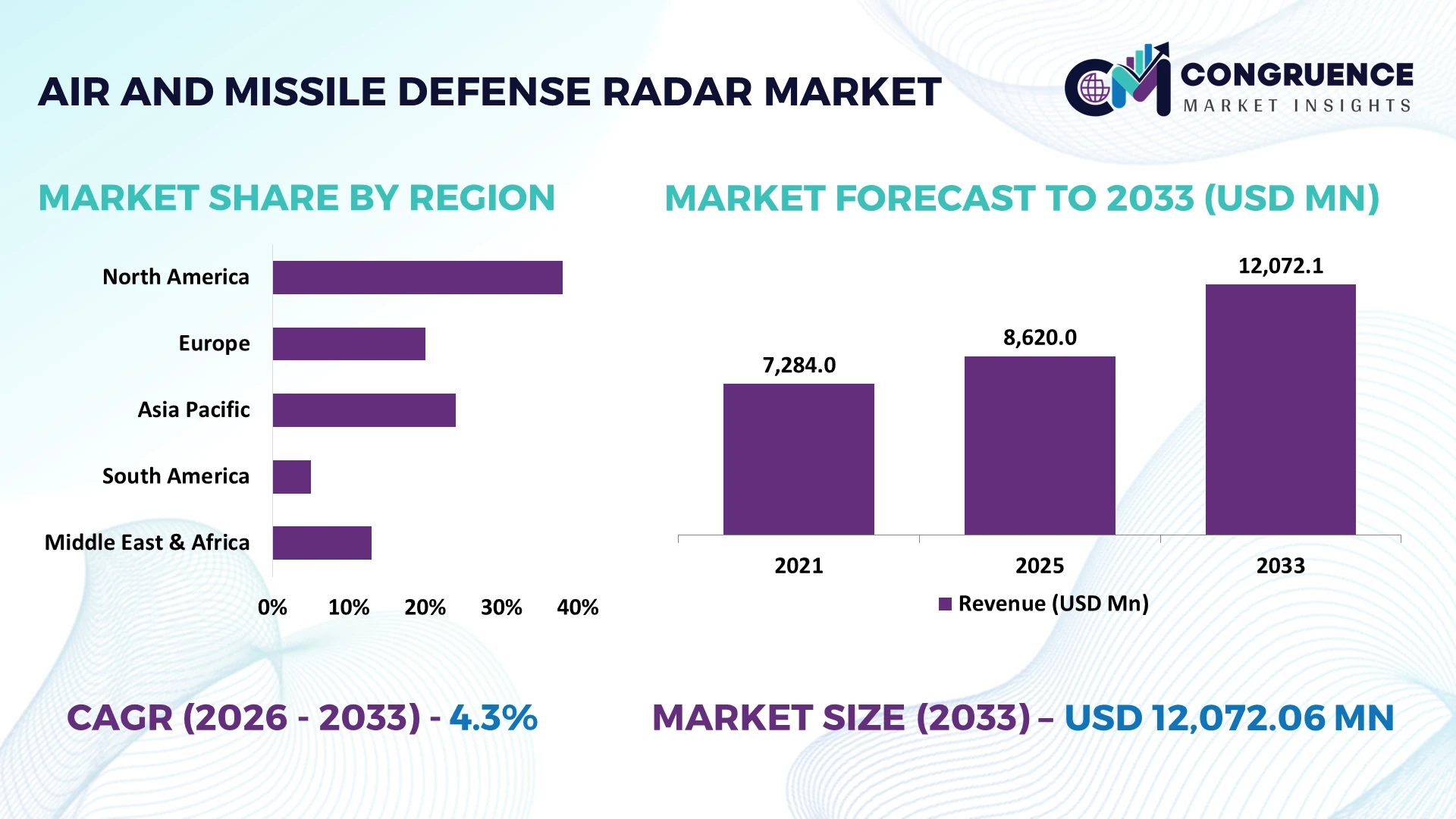
The Global Air and Missile Defense Radar Market was valued at USD 8620 Million in 2025 and is anticipated to reach a value of USD 12072.06 Million by 2033 expanding at a CAGR of 4.3% between 2026 and 2033. Growth is driven by 360° AESA radar replacement, hypersonic and cruise-missile detection requirements, counter-UAS coverage, and accelerated NATO and Indo-Pacific integrated air-defense modernization.
The United States dominates deployment with 15 operational Patriot battalions and next-generation LTAMDS adoption, delivering 360° coverage versus 270° from legacy configurations. Poland is scaling toward 12 LTAMDS radars under WISŁA, while Germany is strengthening ground-based air defense through Patriot and IRIS-T expansion. Japan operates 28 Patriot fire units and is reinforcing sensor coverage against regional ballistic and cruise-missile threats. South Korea operates 8 Patriot batteries alongside indigenous M-SAM/L-SAM architectures, while Israel’s layered Iron Dome, David’s Sling, and Arrow network demonstrates intensive multi-radar integration. Compared with Europe’s fragmented modernization cycle, U.S., Israeli, Japanese, and South Korean deployments show faster movement toward interconnected multi-layer sensing, reinforced by operational lessons from Russia’s war in Ukraine and persistent Indo-Pacific missile threats.
Networked AESA architectures, interoperability, and multi-threat tracking capability will increasingly determine procurement wins as countries transition from isolated radar platforms toward integrated air and missile defense networks.
Market Size & Growth: USD 8.62 billion in 2025 is projected to reach USD 12.07 billion by 2033 at 4.3% CAGR, supported by AESA replacement, counter-hypersonic sensing, and integrated missile-defense networks.
Top Growth Drivers: 360° surveillance provides 33% greater angular coverage than 270° legacy radar architectures; GaN adoption improves transmitter performance, while networked sensor fusion expands multi-threat tracking capability.
Short-Term Forecast: By 2027, expanding LTAMDS and integrated battle-management deployments will push advanced radar coverage toward 100% azimuth surveillance, strengthening simultaneous ballistic-missile, cruise-missile, and drone detection.
Emerging Technologies: GaN AESA arrays, AI-assisted target classification, and distributed sensor fusion lead innovation, while 3-array LTAMDS architecture enables continuous 360° surveillance against increasingly complex multi-vector attacks.
Regional Leaders: North America is positioned near USD 4.8 billion by 2033, Europe around USD 3.0 billion, and Asia-Pacific approximately USD 2.7 billion, supported by LTAMDS, NATO modernization, and Indo-Pacific defense expansion.
Consumer/End-User Trends: Military operators increasingly prioritize interoperable radar networks, with more than 12 countries showing interest in LTAMDS as governments shift procurement toward integrated, multi-domain air-defense architectures.
Pilot/Case Example: In 2025, LTAMDS completed a 360° engagement test integrated with IBCS and PAC-3 MSE, demonstrating full-sector detection, tracking, and fire-control-quality targeting against representative airborne threats.
Competitive Landscape: RTX remains a leading advanced radar supplier alongside Lockheed Martin, Northrop Grumman, HENSOLDT, and Saab; LTAMDS had completed 9 progressively complex flight tests by August 2025.
Regulatory & ESG Impact: U.S. FY2025 defense authorization supported approximately USD 6.9 billion across selected missile-defense programs, strengthening procurement visibility as NATO members increase readiness and layered-defense requirements.
Investment & Funding: Approximately USD 1.98 billion was designated for improved U.S. ground-based missile-defense radars, alongside USD 200 million for accelerated Guam defense capabilities and associated sensor infrastructure.
Innovation & Future Outlook: Advanced systems are shifting from sector-focused radar toward 360° GaN AESA sensing and distributed tracking, while Poland’s planned 12 LTAMDS radars demonstrate international scaling of next-generation architectures.
Air and missile defense radar demand is concentrating around 360° AESA surveillance, GaN transmitters, counter-UAS detection, and networked fire-control architectures. LTAMDS increases angular coverage by 33% versus legacy 270° Patriot radar configurations, while international interest spans more than 12 countries. Ukraine combat lessons and Indo-Pacific missile threats are accelerating distributed multi-threat sensing, creating a clear transition into strategic procurement and competitive positioning.
Air and missile defense radar is becoming strategically critical as ballistic missiles, low-altitude cruise missiles, hypersonic weapons, and unmanned systems compress military reaction times. Procurement is shifting from standalone sensors toward integrated air and missile defense networks linking radars, command systems, and interceptors. Russia’s war in Ukraine has reinforced this transition, while Poland, Germany, Japan, Israel, and South Korea are restructuring inventories around layered sensing and distributed engagement.
Technology competition increasingly centers on GaN-based AESA architectures. RTX’s LTAMDS provides 360° coverage versus the legacy Patriot radar’s 270°, representing a 33% increase in angular surveillance while supporting simultaneous threat tracking. The United States operates 15 Patriot battalions, whereas Poland plans 12 LTAMDS radars; Japan’s 28 Patriot fire units illustrate the larger installed base supporting Indo-Pacific modernization. Over 2026–2028, deployment emphasis will move toward sensor fusion, counter-UAS discrimination, and resilient networking.
Operationally, LTAMDS integration with IBCS and PAC-3 MSE has demonstrated full-sector detection-to-engagement connectivity. Suppliers are consequently increasing GaN electronics investment, localized production, software integration, and international partnerships. Competitive advantage will increasingly belong to vendors capable of delivering interoperable radar ecosystems rather than isolated high-performance sensors.
The principal driver is the transition from sector-based surveillance toward persistent, multi-directional air defense. Modern AESA systems provide 360° coverage, 33% greater angular surveillance than legacy 270° Patriot configurations, while GaN technology supports higher-power sensing against smaller and faster targets. Poland’s planned 12 LTAMDS radars and Japan’s 28 Patriot fire units demonstrate the scale of country-level modernization. Combat experience from Ukraine has also exposed the operational requirement to detect drones, cruise missiles, and ballistic threats within the same defensive architecture. This changes procurement from radar replacement to network modernization. RTX, Lockheed Martin, Northrop Grumman, Saab, and HENSOLDT are responding through digital sensor integration, GaN investment, partnerships, and interoperable command-and-control development, strengthening recurring upgrade opportunities beyond initial hardware deployment.
Advanced radar economics remain constrained by expensive GaN components, specialized semiconductors, long qualification cycles, and dependence on defense-grade electronics. A 360° LTAMDS architecture requires 3 antenna arrays compared with the directional configuration of legacy Patriot radar, increasing hardware, cooling, processing, and integration requirements. Defense electronics can require qualification periods exceeding 24 months, while semiconductor lead times for specialized military components remain substantially longer than commercial equivalents. Poland’s procurement illustrates another constraint: advanced radar acquisition must synchronize launchers, interceptors, IBCS nodes, communications, and training rather than replacing one sensor independently. Export controls further narrow sourcing options for sensitive RF components. Suppliers are responding by localizing production, establishing second-source component arrangements, signing multiyear procurement agreements, and transferring selected manufacturing capabilities to customer countries to reduce schedule exposure.
The strongest opportunity extends beyond traditional ballistic-missile defense into distributed counter-UAS, cruise-missile, and hypersonic surveillance. Small drones increasingly require radars to discriminate low-RCS targets amid ground clutter, creating demand for AI-assisted classification and software-defined processing. LTAMDS delivers 360° surveillance through 3 arrays, while international interest has extended to more than 12 countries, indicating a widening addressable deployment base. Poland’s planned 12-radar program provides a template for other NATO countries transitioning toward networked architectures. Between 2026 and 2028, passive sensors, multifunction AESA platforms, edge processing, and integrated battle-management software will increasingly complement dedicated missile-defense radars. Suppliers are positioning through GaN R&D, counter-UAS partnerships, open-architecture software, and localized integration. The non-obvious opportunity is software-led capability upgrading, enabling installed radars to address new threat classes without complete hardware replacement.
The central long-term challenge is converting increasingly heterogeneous sensors into reliable, combat-speed engagement networks. A modern architecture can connect dozens of radar, interceptor, identification, and command nodes, while 360° systems process substantially more simultaneous surveillance data than 270° sector radars. Poland’s planned 12 LTAMDS units must operate alongside Patriot launchers and IBCS, illustrating the integration burden created when hardware generations and suppliers overlap. Cybersecurity compounds this complexity because distributed radar networks expand the number of software interfaces and communications links requiring protection. Electronic warfare also forces systems to sustain tracking under jamming, deception, and contested connectivity rather than laboratory conditions. Vendors must therefore invest in open interfaces, secure software updates, electronic protection, digital twins, and multinational interoperability testing. Long-term leadership will depend on maintaining engagement-quality data across the entire defense network, not simply maximizing radar detection range.
Production Shifts From Prototype to Scale: Advanced radar programs are moving into serial manufacturing as qualification barriers fall. LTAMDS reached Milestone C after 8 successful flight tests, followed by a ninth 360° test, while 9 additional radars were contracted for U.S. and Polish requirements. Manufacturers are expanding automated testing and production capacity to shorten qualification-to-delivery cycles and support multi-country configurations.
Passive Sensing Enters Defense Networks: Active radar is increasingly complemented by passive acoustic, electromagnetic, and networked sensing. In 2025, 16 NATO countries joined a passive-surveillance initiative, while 15 Allies separately targeted threats operating below 150 meters. Suppliers are integrating passive detection with AESA radar feeds, improving low-signature UAS coverage without continuously increasing transmitter power or spectrum exposure.
Radar Testing Becomes More Distributed: Development workflows are shifting from sequential qualification toward parallel hardware, software, and interceptor testing. Six LTAMDS units previously rotated across simultaneous U.S. test locations, while the system progressed through 9 increasingly complex flight events. Digital engineering, multiple test assets, and software-centric validation are helping manufacturers reduce certification bottlenecks and accelerate configuration upgrades.
Manufacturing Moves Closer to Demand: Defense suppliers are adding dedicated radar infrastructure rather than depending entirely on established electronics plants. RTX announced a USD 100 million Portsmouth expansion in 2026 following a separate USD 53 million Andover radar-facility expansion. The underlying shift is production resilience, with testing, integration, and manufacturing increasingly colocated to reduce handoffs and accelerate domestic and international deliveries.
3D AESA Radar accounts for approximately 38% of the market, supported by simultaneous range, elevation, and azimuth tracking required for ballistic missiles, aircraft, cruise missiles, and increasingly complex drone formations. Its electronically steered architecture eliminates much of the mechanical repositioning associated with older radar designs while enabling rapid beam scheduling and multi-target tracking. 2D AESA Radar represents an estimated 23% share and remains relevant for lower-cost surveillance and gap-filler applications where elevation accuracy is less critical.
Passive Radar is the fastest-expanding type as militaries seek emission-controlled detection against low-observable aircraft and unmanned systems. PESA Radar retains approximately 18% of deployments because substantial installed fleets remain operational, although modernization budgets are shifting toward AESA. Doppler Radar continues supporting velocity discrimination and tactical detection. RTX, Saab, HENSOLDT, and Lockheed Martin are prioritizing GaN arrays, software-defined processing, and modular architectures, redirecting investment toward upgradeable 3D sensing rather than fixed-function platforms.
Air Surveillance leads application demand with an estimated 34% share because continuous battlespace awareness remains the first layer of integrated air and missile defense. Persistent surveillance networks must identify aircraft, missiles, and unmanned systems across multiple altitudes before downstream tracking or engagement begins. Missile Tracking represents approximately 25% and is the fastest-growing application as ballistic, maneuvering cruise, and hypersonic threats require higher update rates, precision trajectory prediction, and sensor-to-interceptor connectivity.
Target Detection retains broad usage across fixed and mobile defense architectures, while Fire Control is increasingly integrated directly with AESA surveillance sensors rather than operating independently. Weapon Guidance remains specialized because engagement-quality information requires tighter latency, accuracy, and interoperability. This transition toward integrated battle-management networks is collapsing traditional boundaries between surveillance, tracking, and fire-control functions. RTX, Northrop Grumman, Saab, and other suppliers are integrating automated track correlation, software-defined signal processing, and open command interfaces, making multifunction capability an increasingly important procurement differentiator.
Defense Forces represent approximately 44% of market demand because army-led integrated air-defense formations operate the largest concentration of ground-based surveillance, fire-control, and missile-tracking infrastructure. Air Forces account for approximately 27%, emphasizing long-range airspace surveillance and national air-defense integration, while Naval Forces deploy multifunction radars for fleet protection, ballistic-missile warning, and cooperative engagement. Government Defense Agencies coordinate strategic acquisition, testing, and national sensor-network modernization.
Border Security Agencies are the fastest-expanding end-user group as low-cost drones and low-altitude incursions blur the boundary between conventional air defense and persistent border surveillance. Their requirements increasingly emphasize compact AESA systems, low-RCS detection, automated classification, and smaller operational footprints rather than traditional long-range missile defense alone. Suppliers are developing scalable radar families, configurable software, and counter-UAS integration packages. Defense Forces remain the principal volume buyers, but competitive differentiation increasingly depends on adapting military-grade sensing for distributed infrastructure and border-protection missions.
North America accounted for the largest market share at approximately 39% in 2025 however, Asia-Pacific is expected to register the fastest growth, expanding at a CAGR of approximately 5.8% between 2026 and 2033.
Networked Missile Defense Drives Deployment Leadership
North America accounts for approximately 39% of global demand, led by extensive U.S. investment in integrated air and missile defense, ballistic-missile warning, counter-UAS surveillance, and homeland protection. Deployment is shifting from sector-based Patriot sensors toward 360° GaN AESA architectures connected through IBCS. LTAMDS has progressed through 9 increasingly complex flight tests, demonstrating the transition from development toward operational fielding. Canada adds demand through NORAD modernization and Arctic surveillance, where long-range detection against cruise missiles and emerging hypersonic threats is becoming operationally important. U.S. suppliers also hold an industrial advantage in GaN semiconductors, interceptor integration, command-and-control software, and defense-qualified electronics. Manufacturing investment increasingly targets colocated radar assembly, integration, and testing, reducing production handoffs while supporting export programs and accelerated configuration upgrades.
United States Market Outlook: The United States remains the region’s strategic center through Patriot modernization, LTAMDS production, homeland missile warning, and counter-UAS deployment. The Army operates 15 Patriot battalions, while LTAMDS delivers 360° surveillance compared with 270° legacy configurations. Domestic suppliers benefit from established interceptor ecosystems, government testing infrastructure, and vertically integrated radar-electronics manufacturing.
Layered Air Defense Replaces Fragmented Procurement
Europe represents approximately 25% of global demand, with Russia’s war in Ukraine fundamentally changing radar procurement priorities. Countries are moving from isolated national platforms toward NATO-interoperable surveillance, fire-control, passive sensing, and missile-defense networks. Germany, Poland, Finland, Sweden, and the Baltic states are strengthening detection against drones, cruise missiles, ballistic missiles, and low-altitude threats. In 2025, 16 NATO Allies participated in a multinational passive-air-surveillance initiative, demonstrating growing emphasis on emission-independent sensing. Poland’s planned acquisition of 12 LTAMDS radars establishes one of Europe’s largest next-generation Patriot sensor deployments. Germany is simultaneously expanding IRIS-T-based air-defense infrastructure and TRML-4D radar deployment. This modernization favors HENSOLDT, Saab, Thales, Leonardo, and transatlantic suppliers capable of delivering interoperable sensors, localized manufacturing, and software upgrades rather than standalone radar hardware.
Germany Market Outlook: Germany combines substantial procurement momentum with an established radar manufacturing base led by domestic sensor expertise. TRML-4D deployments supporting IRIS-T SLM strengthen Germany’s position in multifunction AESA technology, while European Sky Shield requirements create additional integration opportunities. Domestic production capabilities also provide Germany with strategic leverage as European governments prioritize shorter supply chains and sovereign defense-electronics capacity.
Missile Threats Accelerate Sensor Modernization
Asia-Pacific holds approximately 22% of global demand and shows the strongest deployment momentum as China’s military expansion, North Korean missile launches, and contested Indo-Pacific airspace reshape surveillance requirements. Japan operates a layered architecture combining 8 Aegis-equipped destroyers, PAC-3 units, fixed warning radars, and the JADGE command network. Its modernization now includes FPS-series radar upgrades, next-generation JADGE, and preparations for LTAMDS integration. South Korea is strengthening indigenous layered defense through M-SAM and L-SAM architectures, while Australia is investing in long-range surveillance and integrated missile defense. The operational shift favors multifunction AESA sensors capable of ballistic, cruise-missile, aircraft, and UAS tracking from shared hardware. Local electronics production in Japan and South Korea also creates opportunities for technology transfer, component localization, and partnerships between domestic defense groups and international radar OEMs.
Japan Market Outlook: Japan represents a strategically advanced market because its island geography demands persistent, interconnected detection across maritime and airborne approaches. Its FY2026 planning allocated approximately ¥517.4 billion to integrated air and missile defense capabilities, including radar upgrades and next-generation JADGE development. AI-assisted decision-making and cloud-enabled battle management are increasingly linking sensors with distributed interceptor assets.
Sovereign Radar Development Gains Strategic Weight
South America accounts for approximately 5% of global demand, with procurement centered on airspace sovereignty, border monitoring, critical-infrastructure protection, and selective military air-defense modernization. Brazil dominates industrial capability through locally developed SABER radar families and its broader defense-electronics ecosystem. The Brazilian Army contracted a series-configuration SABER M200 Vigilante for low- and medium-altitude surveillance, while development continues on the M200 Multimission AESA platform. The M200 Vigilante provides approximately 108 nautical miles of surveillance reach, strengthening mobile coverage across geographically dispersed operational areas. Argentina, Colombia, and Chile maintain requirements for airspace surveillance but face smaller procurement volumes and longer replacement cycles. Limited defense budgets constrain rapid layered-defense deployment, making modularity, lifecycle cost, local support, and dual-purpose surveillance capability decisive purchasing factors across the region.
Brazil Market Outlook: Brazil has the strongest regional industrial position through Embraer’s radar engineering and Brazilian Army partnerships. In 2026, upgrades covered an 8-unit SABER M60 program; the radar provides up to 60-kilometer range and simultaneously tracks 60 targets. Indigenous signal processing and AESA development reduce dependence on imported defense electronics while creating future export opportunities.
Layered Defense Investment Reshapes Procurement
Middle East & Africa represents approximately 9% of global demand, with deployment heavily concentrated in Saudi Arabia, Israel, the UAE, Qatar, and selected North African states. Missile and drone attacks against energy facilities, military bases, shipping infrastructure, and population centers have accelerated investment in persistent surveillance and multi-layer interception. Israel operates one of the world’s most integrated sensor environments, linking radar assets with Iron Dome, David’s Sling, Arrow-2, and Arrow-3. Saudi Arabia combines Patriot and THAAD architectures as protection requirements extend from ballistic missiles toward cruise missiles and unmanned aircraft. Gulf procurement is increasingly emphasizing 360° AESA coverage, counter-UAS discrimination, command-network interoperability, and domestic sustainment. African adoption remains more selective, constrained by infrastructure and procurement capacity, creating stronger demand for mobile multifunction radars than capital-intensive national missile-defense networks.
Saudi Arabia Market Outlook: Saudi Arabia is a major radar procurement center because strategic oil infrastructure, cities, military installations, and critical logistics corridors require layered protection. Patriot and THAAD deployment creates demand for high-performance tracking and fire-control sensors, while Vision 2030 localization policies encourage international suppliers to expand domestic maintenance, integration, training, and defense-manufacturing partnerships.
RTX, Lockheed Martin, Northrop Grumman, Thales, and Saab compete at the high-performance end against HENSOLDT, Leonardo, Israel Aerospace Industries, and emerging sovereign radar suppliers. The top five hold an estimated 55% combined share, reflecting defense certification barriers and installed-system advantages. Competition centers on detection range, 360° coverage, GaN AESA performance, interoperability, and delivery speed. New AESA architectures provide roughly 33% wider angular coverage than 270° legacy Patriot configurations, while software-defined processing can reduce hardware-dependent upgrade requirements by approximately 20%. Suppliers are competing through localized manufacturing, multinational partnerships, vertical integration of transmit/receive modules, and open-architecture command interfaces. The competitive shift favors multifunction sensors capable of surveillance, tracking, fire control, and counter-UAS missions from common hardware. Export controls, classified signal-processing expertise, qualification cycles exceeding 24 months, and defense-grade semiconductor access remain powerful entry barriers. Winning requires sovereign supply resilience, rapid software modernization, proven interceptor integration, and scalable international production capacity across allied defense networks.
RTX
Lockheed Martin
Northrop Grumman
Thales
Saab
HENSOLDT
Leonardo
Israel Aerospace Industries
Elbit Systems
BAE Systems
L3Harris Technologies
Bharat Electronics Limited
Mitsubishi Electric
Indra Sistemas
Current technology leadership centers on gallium-nitride AESA radars, digital beamforming, software-defined processing, and integrated battle management. LTAMDS provides 360° coverage versus 270° for legacy Patriot radar, a 33% angular-surveillance improvement, while three-array architectures increase awareness. AESA fleets are expanding across U.S., Polish, Swedish, and allied networks, improving reaction speed by roughly 15% through beam steering and automated tracking. Suppliers with GaN production gain advantage.
Emerging systems combine AI-assisted classification, passive sensing, counter-UAS algorithms, and open-architecture command interfaces. Machine-assisted track correlation can reduce operator workload by approximately 20%, while software-defined upgrades can cut hardware-dependent modernization requirements by about 15%. Passive surveillance adoption is widening, with 16 NATO countries participating in a multinational initiative, creating complementary detection against low-signature threats without constant active transmission. Integration of radar, interceptor, electronic-warfare, and command data determines value.
Disruptive development is shifting toward distributed, multi-static, over-the-horizon, and networked sensor constellations tracking hypersonic, ballistic, cruise-missile, and drone threats. By 2026–2028, 360° multifunction AESA radars, edge analytics, and automated sensor fusion will move toward procurement baselines, potentially improving track availability by 10–15%. Vendors connecting sensors with existing interceptors and command networks will capture programs. Acting now matters because qualification cycles, semiconductor supply, and integration testing exceed 24 months.
December 2024 Saab secured a Giraffe 4A order supporting U.S. Air Forces in Europe, valued at approximately USD 48 million, with deliveries starting in 2027. The deployment strengthens mobile long-range surveillance and expeditionary air-base defense across allied operations. Source: saab.com
February 2025 RTX’s LTAMDS successfully detected, tracked, and classified a cruise-missile surrogate in 360° mode while integrated with IBCS, enabling a PAC-2 GEM-T intercept. The test validated full-sector engagement capability for next-generation Patriot modernization under operationally representative conditions. Source: army.mil
September 2025 RTX received a U.S. Army LTAMDS contract covering 9 radars for the United States and Poland after Milestone C. The award moved the program into production and deployment, strengthening international 360° air-defense adoption and supplier scaling. Source: rtx.com
June 2026 BAE Systems Australia supported Australia’s landmark agreement to supply Canada with JORN-derived over-the-horizon radar technology in a USD 1.75 billion arrangement. The deal expands long-range continental surveillance and establishes Australia’s largest-ever defense export to date globally. Source: breakingdefense.com
The report covers Air and Missile Defense Radar Market structure across 2D AESA Radar, 3D AESA Radar, PESA Radar, Doppler Radar, and Passive Radar, alongside Air Surveillance, Missile Tracking, Target Detection, Fire Control, and Weapon Guidance applications. End-user analysis spans Defense Forces, Air Forces, Naval Forces, Border Security Agencies, and Government Defense Agencies, with 3D AESA systems representing an estimated 38% segment share.
Regional coverage evaluates North America, Europe, Asia-Pacific, South America, and Middle East & Africa, tracking deployment intensity, procurement localization, supply-chain resilience, and radar-network interoperability. Technology assessment includes GaN AESA, AI-assisted classification, passive sensing, counter-UAS processing, distributed architectures, and over-the-horizon surveillance. With more than 12 countries showing LTAMDS interest, the report supports 2026–2033 investment planning, partnership selection, expansion strategy, competitive benchmarking, and identification of emerging software-defined and multi-sensor defense opportunities.
| Report Attribute/Metric | Report Details |
|---|---|
Market Revenue in 2025 | USD 8620 Million |
Market Revenue in 2033 | USD 12072.06 Million |
CAGR (2026 - 2033) | 4.3% |
Base Year | 2025 |
Forecast Period | 2026 - 2033 |
Historic Period | 2021 - 2025 |
Segments Covered | By Type
By Application
By End-User
|
Key Report Deliverable | Revenue Forecast, Growth Trends, Market Dynamics, Segmental Overview, Regional and Country-wise Analysis, Competition Landscape |
Region Covered | North America, Europe, Asia-Pacific, South America, Middle East, Africa |
Key Players Analyzed | RTX, Lockheed Martin, Northrop Grumman, Thales, Saab, HENSOLDT, Leonardo, Israel Aerospace Industries, Elbit Systems, BAE Systems, L3Harris Technologies, Bharat Electronics Limited, Mitsubishi Electric, Indra Sistemas |
Customization & Pricing | Available on Request (10% Customization is Free) |




