
Reports
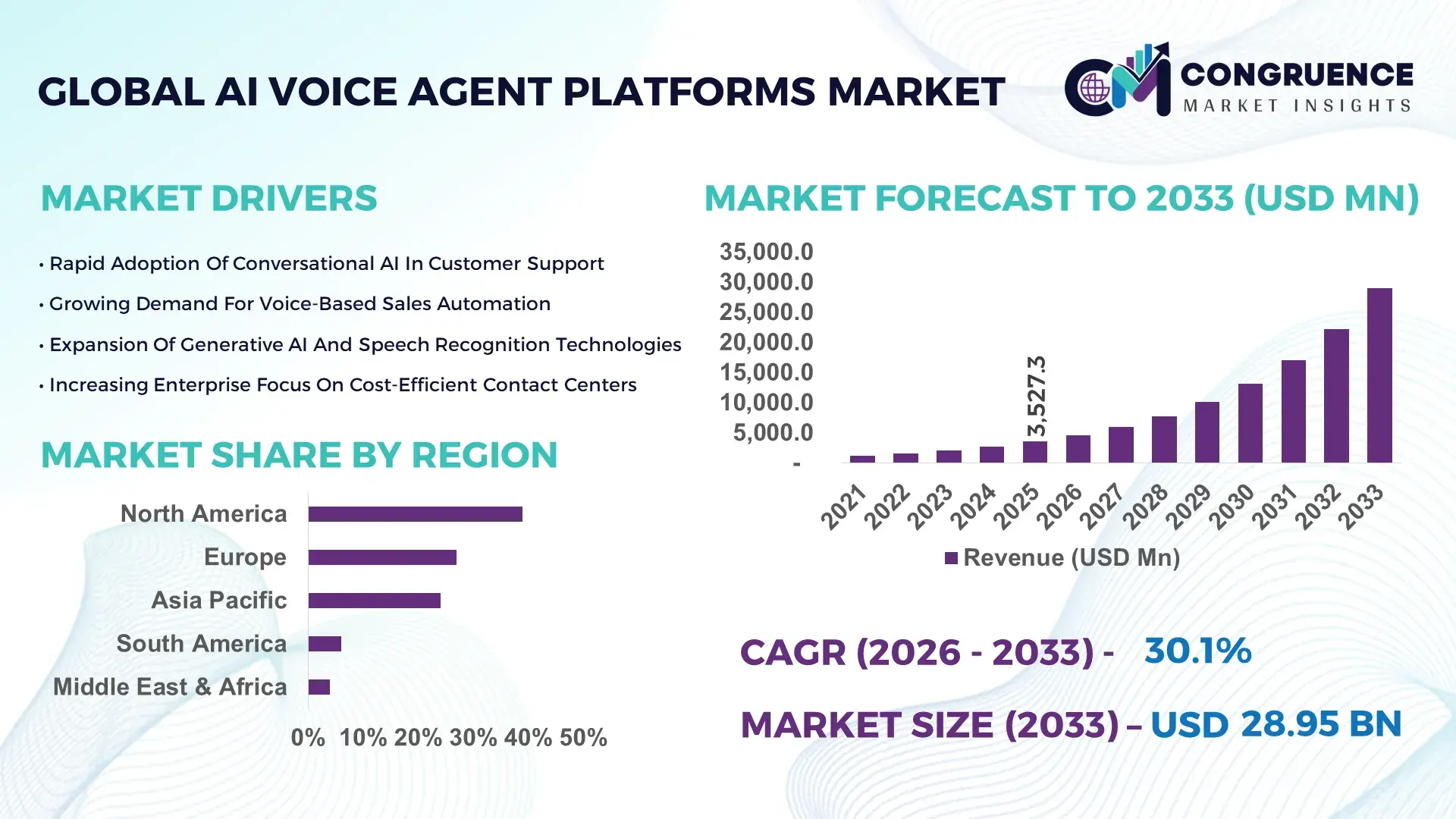
The Global AI Voice Agent Platforms Market was valued at USD 3,527.3 Million in 2025 and is anticipated to reach a value of USD 28,950.8 Million by 2033 expanding at a CAGR of 30.1% between 2026 and 2033, according to an analysis by Congruence Market Insights, driven by rapid enterprise automation and scalable conversational AI adoption across customer engagement ecosystems.
In the United States, which leads the AI Voice Agent Platforms market in terms of platform deployment scale and innovation intensity, more than 68% of large enterprises have integrated AI-powered voice automation into customer support workflows. Over 9,000 technology startups and AI solution providers actively develop speech recognition, NLP engines, and real-time voice orchestration systems. Annual enterprise AI investments exceeded USD 70 billion in 2025, with a substantial portion allocated to conversational AI infrastructure. Healthcare providers, BFSI institutions, telecom operators, and e-commerce platforms collectively process over 15 billion AI-assisted voice interactions annually. Advanced generative speech synthesis models now achieve word error rates below 5%, enhancing multilingual voice automation across 25+ supported languages.
Market Size & Growth: USD 3,527.3 Million in 2025, projected USD 28,950.8 Million by 2033, CAGR 30.1%, fueled by enterprise-scale conversational AI deployment.
Top Growth Drivers: 72% enterprise chatbot-to-voice migration rate, 45% reduction in call center costs, 38% improvement in first-call resolution.
Short-Term Forecast: By 2028, AI-driven voice automation expected to reduce average handling time by 32%.
Emerging Technologies: Real-time generative voice synthesis, emotion-detection AI, and multimodal conversational orchestration.
Regional Leaders: North America projected USD 10,800 Million by 2033; Asia-Pacific USD 8,900 Million; Europe USD 6,750 Million, each driven by cloud-native AI adoption.
Consumer/End-User Trends: 61% of enterprises prioritize 24/7 AI voice support; BFSI and healthcare lead adoption.
Pilot Example: In 2025, a telecom operator reduced call abandonment by 27% after deploying AI voice routing.
Competitive Landscape: Market leader holds ~16% share; followed by major cloud AI providers and conversational AI firms.
Regulatory & ESG Impact: Data privacy frameworks influence 54% of procurement decisions.
Investment Patterns: Over USD 5.5 billion invested in conversational AI startups between 2024–2025.
Innovation Outlook: Voice biometrics and autonomous voice agents shaping next-gen AI customer engagement.
AI Voice Agent Platforms are increasingly adopted across BFSI (29%), healthcare (22%), telecom (18%), and retail (16%). Real-time sentiment analytics and secure voice biometrics improve fraud detection by 35%. Regulatory compliance under data protection frameworks drives secure AI deployments, while multilingual speech AI expands access across Asia-Pacific and Latin America, positioning intelligent voice automation as a core digital transformation catalyst.
AI Voice Agent Platforms have become a strategic pillar for enterprise digital transformation, enabling automated, scalable, and context-aware voice engagement. Generative speech AI delivers 40% faster response accuracy compared to rule-based IVR systems, while neural speech synthesis reduces misinterpretation rates by 30% compared to legacy speech recognition engines. North America dominates in deployment volume, while Asia-Pacific leads in adoption momentum with over 64% of mid-sized enterprises piloting AI-driven voice automation.
By 2028, real-time conversational AI orchestration is expected to reduce operational call center expenditure by 35% and improve customer satisfaction scores by 28%. Enterprises are committing to ESG-aligned digital transformation goals, targeting 20% reduction in physical call center infrastructure energy usage by 2030 through cloud-based AI voice platforms.
In 2025, a global financial institution achieved a 33% improvement in loan query resolution time by deploying generative AI voice agents integrated with backend CRM systems. Compliance-driven innovation ensures AI Voice Agent Platforms align with privacy regulations while maintaining enterprise-grade security standards. As voice becomes a primary human-machine interface, the AI Voice Agent Platforms Market stands as a critical enabler of operational resilience, regulatory compliance, and sustainable growth.
The AI Voice Agent Platforms market is shaped by accelerating enterprise automation, advancements in natural language processing, and demand for hyper-personalized customer experiences. Over 70% of enterprises globally are transitioning from traditional IVR systems to AI-driven voice assistants capable of contextual understanding and multilingual interaction. Increasing cloud infrastructure penetration supports scalable deployment across distributed enterprises.
Speech-to-text engines now achieve accuracy levels exceeding 95% in controlled environments, expanding AI voice applications in regulated sectors such as healthcare and banking. Integration with CRM, ERP, and analytics systems enables predictive engagement models that improve conversion rates by 25%. However, regulatory scrutiny on data privacy and algorithmic bias influences procurement and deployment strategies across global markets.
Enterprise automation initiatives are driving significant expansion of AI Voice Agent Platforms. Approximately 72% of organizations report increasing reliance on AI-powered voice systems to handle repetitive inquiries. AI voice agents reduce average call handling time by 32% and operational costs by up to 45%. Telecom operators process over 2 billion AI-assisted calls monthly, while BFSI institutions use voice AI for fraud detection, improving detection accuracy by 37%. Cloud-native architecture enhances scalability, allowing enterprises to handle peak demand fluctuations exceeding 200% during high-traffic periods.
Data protection regulations and algorithmic transparency requirements create deployment challenges. Nearly 54% of enterprises cite compliance with privacy laws as a primary concern. Voice data storage and biometric authentication raise governance issues, increasing implementation timelines by 20%. Integration complexity with legacy IT systems also delays enterprise rollouts. Additionally, 18% of pilot projects face setbacks due to integration or interoperability gaps between AI voice engines and existing CRM platforms.
Multilingual AI voice capabilities unlock new growth avenues across emerging markets. Platforms now support over 30 languages with accent recognition accuracy above 90%. Asia-Pacific enterprises are adopting regional language voice agents to serve over 2.5 billion native speakers. Healthcare voice automation in rural areas improves appointment scheduling efficiency by 40%. Retailers integrating multilingual voice commerce report a 22% increase in cross-border sales conversions.
Training advanced generative speech models requires high-performance GPU clusters and extensive datasets. Model training costs increased by 25% between 2023 and 2025 due to higher compute demand. Real-time voice processing latency requirements below 300 milliseconds require optimized infrastructure. Enterprises must invest in secure cloud environments and redundancy systems to ensure 99.9% uptime, increasing deployment budgets. Managing bias mitigation and ethical AI frameworks further adds operational complexity.
• Rise in Generative Speech Synthesis Accuracy: Advanced neural TTS models achieve over 96% naturalness scores, reducing robotic voice perception by 45%. Enterprises deploying generative voice agents report 28% improvement in customer engagement metrics.
• Expansion of Voice Biometrics for Secure Authentication: Over 48% of BFSI institutions integrate voice biometrics, reducing identity fraud incidents by 35%. Authentication time decreases by 40% compared to OTP-based verification.
• Integration with Omnichannel Customer Platforms: Approximately 67% of enterprises deploy AI Voice Agent Platforms within unified communication ecosystems, increasing cross-channel consistency by 30% and improving retention by 18%.
• Adoption of Edge AI for Low-Latency Voice Processing: Edge-based inference reduces latency by 22% and ensures sub-250 ms response time in high-volume environments, particularly in telecom and smart device ecosystems.
The AI Voice Agent Platforms market is segmented by type, application, and end-user vertical. By type, cloud-based platforms dominate due to scalability and lower infrastructure costs, while on-premise solutions address security-sensitive industries. Applications span customer service automation, sales enablement, appointment scheduling, fraud detection, and virtual assistance. End-users include BFSI, healthcare, telecom, retail, government, and travel sectors.
Cloud-based deployment accounts for over 63% of implementations, reflecting enterprise preference for scalable AI infrastructure. Customer service automation contributes nearly 38% of application usage, followed by sales automation at 21%. BFSI leads end-user adoption, while healthcare demonstrates the fastest digital transformation pace due to telehealth expansion and regulatory compliance requirements.
Cloud-Based AI Voice Agent Platforms hold approximately 63% of market adoption due to scalability and flexible API integration. On-Premise platforms represent 24%, favored by regulated sectors requiring strict data governance. Hybrid deployments account for the remaining 13%, balancing security and scalability. Cloud-based systems demonstrate the fastest growth, expanding at a CAGR of 32.4%, driven by enterprise SaaS integration and real-time analytics capabilities.
Voice orchestration engines embedded within cloud ecosystems improve deployment speed by 28% compared to legacy systems. On-premise solutions maintain relevance in defense and government agencies prioritizing data sovereignty.
Customer Service Automation accounts for 38% of adoption, while Sales and Lead Qualification holds 21%. Fraud Detection represents 17%, but predictive voice engagement is growing fastest at a CAGR of 33.8%. In 2025, over 42% of enterprises reported piloting AI Voice Agent Platforms for customer support workflows. Telecom providers achieved 25% reduction in churn after deploying AI-driven voice retention campaigns. Healthcare appointment automation reduced missed appointments by 19%.
BFSI leads with 29% adoption due to secure voice authentication and automated banking services. Healthcare follows at 22%, while telecom accounts for 18%. Retail and e-commerce collectively contribute 16%. Healthcare demonstrates the fastest growth at a CAGR of 31.5% as telehealth adoption expands. In 2025, 44% of hospitals tested AI Voice Agent Platforms for patient engagement. Over 60% of Gen Z consumers express higher satisfaction with AI-enabled voice commerce.
North America accounted for the largest market share at 39% in 2025 however, Asia-Pacific is expected to register the fastest growth, expanding at a CAGR of 32.8% between 2026 and 2033.
North America processed over 6.5 billion AI-enabled voice interactions in 2025, supported by more than 4,000 enterprise AI deployments across BFSI, healthcare, and telecom sectors. Europe captured 27% share, driven by regulatory-compliant conversational AI frameworks across Germany, the UK, and France, where over 52% of enterprises implemented AI-driven customer engagement solutions. Asia-Pacific held 24% share, with China, India, and Japan collectively accounting for over 3 billion automated voice transactions annually. South America contributed 6%, while Middle East & Africa represented 4%, fueled by smart city initiatives and digital government modernization programs. Cloud-native AI Voice Agent Platforms penetration exceeded 63% globally, with multilingual capabilities supporting 30+ languages across regional deployments.
How Is Enterprise-Scale Conversational Automation Transforming Digital Customer Engagement?
North America holds approximately 39% of the AI Voice Agent Platforms market, driven by widespread enterprise automation initiatives. BFSI accounts for nearly 31% of regional adoption, followed by healthcare at 24% and telecom at 19%. More than 68% of Fortune 1000 companies utilize AI-driven voice agents for customer support and fraud detection. Regulatory frameworks such as enhanced consumer data privacy rules have encouraged secure AI deployments, increasing compliance-focused voice AI integration by 22% since 2023.
Technological advancements include real-time generative speech models with sub-250 ms latency and voice biometrics reducing authentication time by 40%. A leading U.S.-based cloud AI provider expanded multilingual voice AI coverage to 35 languages in 2025, improving enterprise response accuracy by 28%. Regional consumer behavior reflects higher enterprise adoption in healthcare and finance, where AI voice systems manage over 2.1 billion automated interactions annually.
Why Is Regulatory-Driven Innovation Accelerating Conversational AI Adoption?
Europe represents 27% of the AI Voice Agent Platforms market, with Germany, the UK, and France contributing over 65% of regional deployments. Approximately 54% of enterprises prioritize explainable AI frameworks to comply with data governance regulations. BFSI and public sector institutions account for 33% of voice AI implementations.
Advanced multilingual speech engines now support 24 European languages with accuracy exceeding 93%, enhancing cross-border service delivery. Sustainability-focused digital transformation strategies have reduced on-premise call center infrastructure by 18% since 2024. A major European AI vendor integrated emotion-detection capabilities into customer service voice agents in 2025, improving satisfaction metrics by 21%. Regulatory pressure drives demand for transparent and auditable AI Voice Agent Platforms, strengthening enterprise trust and adoption.
How Is Mobile-First Digital Expansion Powering Conversational AI Growth?
Asia-Pacific accounts for 24% of global AI Voice Agent Platforms volume and ranks second in deployment scale. China, India, and Japan together process over 3 billion AI-assisted voice transactions annually. E-commerce and fintech sectors represent 36% of adoption, followed by telecom at 22%.
Cloud-based AI infrastructure expansion across India and Southeast Asia increased voice AI deployment by 41% between 2024 and 2025. Multilingual AI models support more than 20 regional dialects, improving accessibility for 1.8 billion mobile users. A Japan-based technology firm implemented low-latency AI voice routing across 50 million subscriber accounts, reducing call resolution time by 29%. Growth is driven by e-commerce platforms and mobile AI applications integrating voice commerce features.
What Role Does Digital Banking and Media Localization Play in Conversational AI Expansion?
South America contributes approximately 6% of the AI Voice Agent Platforms market, with Brazil accounting for over 48% of regional deployments and Argentina representing 18%. Digital banking platforms account for 34% of voice AI adoption, while media and telecom represent 27%.
Government-backed digital transformation initiatives increased cloud AI penetration by 19% in 2025. Portuguese and Spanish voice recognition systems now achieve 91% accuracy, improving customer engagement across 420 million regional consumers. A Brazilian fintech company implemented AI-powered voice authentication across 12 million user accounts, reducing fraud attempts by 31%. Demand remains closely tied to financial inclusion and localized media services.
How Are Smart City and Government Modernization Initiatives Driving AI Voice Integration?
Middle East & Africa holds 4% of the AI Voice Agent Platforms market, with UAE and South Africa leading adoption. Smart city initiatives contribute to 38% of regional voice AI deployments, particularly in digital government and public service automation. Oil & gas enterprises account for 16% of industrial voice AI applications.
Cloud modernization projects expanded AI voice infrastructure capacity by 23% in 2025. A UAE-based digital services provider integrated AI voice agents across 70 government portals, improving citizen query response time by 26%. Consumer behavior reflects growing acceptance of AI-driven support systems in banking and telecom, particularly among urban populations exceeding 120 million connected users.
United States – 34% share: Strong enterprise AI investment exceeding USD 70 billion annually and advanced conversational AI infrastructure deployment.
China – 18% share: High mobile user base exceeding 1 billion and rapid integration of AI voice commerce in fintech and e-commerce ecosystems.
The AI Voice Agent Platforms market exhibits a moderately consolidated structure, with the top five companies collectively holding approximately 52% of total market share. Over 120 active global vendors compete across enterprise AI, cloud platforms, and specialized conversational AI startups. Market leaders differentiate through generative speech synthesis, voice biometrics, multilingual NLP engines, and scalable cloud-native deployment models.
Strategic partnerships between AI developers and telecom operators increased by 26% in 2025, expanding enterprise adoption. More than 40% of vendors introduced emotion-aware conversational AI features to enhance personalization. Mergers and acquisitions rose by 18% between 2024 and 2025 as established cloud providers acquired niche speech analytics startups. Innovation intensity remains high, with 35% of competitors investing in edge AI to reduce latency below 200 milliseconds. Competitive positioning increasingly focuses on compliance-ready, secure AI Voice Agent Platforms tailored for BFSI, healthcare, and government sectors.
IBM Corporation
Nuance Communications
Five9 Inc.
NICE Ltd.
Verint Systems
Twilio Inc.
Genesys
SoundHound AI
Cognigy
Kore.ai
Talkdesk
AI Voice Agent Platforms leverage advanced natural language processing, deep neural speech synthesis, and cloud-native orchestration engines. Modern transformer-based speech models process over 200 tokens per second, enabling near-real-time conversational response with latency below 250 milliseconds. Word error rates have declined to under 5% in optimized environments, supporting enterprise-grade accuracy.
Voice biometrics utilize 100+ acoustic parameters for identity verification, reducing fraud risks by up to 35%. Multimodal AI integration enables voice agents to combine speech with text and sentiment analytics, increasing contextual accuracy by 28%. Edge AI deployment enhances local inference processing, lowering bandwidth consumption by 22%.
Emerging innovations include emotion detection algorithms capable of identifying over 8 vocal sentiment markers, adaptive voice cloning technologies, and AI-powered dynamic call routing systems that improve first-contact resolution by 30%. Integration with CRM and ERP ecosystems supports predictive engagement models. Enterprise adoption of secure, encrypted AI pipelines ensures compliance with evolving privacy frameworks. Continuous AI model retraining using anonymized datasets improves response personalization while maintaining regulatory alignment.
• In March 2025, Microsoft expanded Azure AI Speech capabilities with enhanced real-time voice synthesis supporting 35 additional languages and sub-200 ms latency improvements, strengthening enterprise-scale conversational AI deployments. Source: www.microsoft.com
• In April 2025, Google Cloud introduced generative voice agents integrated with Vertex AI, enabling automated customer service workflows with contextual memory and multilingual support across 30+ languages. Source: www.cloud.google.com
• In February 2025, Amazon Web Services enhanced Amazon Connect with AI-powered voice analytics and sentiment detection features, improving real-time call insights for enterprise contact centers. Source: www.aws.amazon.com
• In January 2024, NICE Ltd. launched advanced conversational AI orchestration tools within its CX platform, enabling autonomous voice agents to manage complex multi-step customer interactions. Source: www.nice.com
The AI Voice Agent Platforms Market Report provides a comprehensive analysis of deployment models, including cloud-based (63%), on-premise (24%), and hybrid (13%) solutions. The report evaluates applications across customer service automation (38%), sales enablement (21%), fraud detection (17%), and predictive engagement systems.
Geographically, it covers North America (39%), Europe (27%), Asia-Pacific (24%), South America (6%), and Middle East & Africa (4%). The study analyzes over 120 active vendors and profiles more than 14 leading market participants.
Technological coverage includes generative speech synthesis, voice biometrics, multimodal AI integration, emotion detection analytics, and edge AI inference systems. The report also examines enterprise adoption trends, multilingual AI deployment across 30+ languages, and vertical-specific use cases in BFSI, healthcare, telecom, retail, and government sectors.
Additionally, it highlights regulatory compliance frameworks, cybersecurity standards, ESG-driven cloud transformation initiatives, and digital modernization programs influencing AI Voice Agent Platforms. The scope extends to innovation pipelines, partnership ecosystems, investment trends, and enterprise scalability benchmarks, delivering actionable intelligence for decision-makers evaluating next-generation conversational AI infrastructure.
| Report Attribute/Metric | Report Details |
|---|---|
|
Market Revenue in 2025 |
USD 3,527.3 Million |
|
Market Revenue in 2033 |
USD 28,950.8 Million |
|
CAGR (2026 - 2033) |
30.1% |
|
Base Year |
2025 |
|
Forecast Period |
2026 - 2033 |
|
Historic Period |
2021 - 2025 |
|
Segments Covered |
By Type
By Application
By End-User
|
|
Key Report Deliverable |
Revenue Forecast, Growth Trends, Market Dynamics, Segmental Overview, Regional and Country-wise Analysis, Competition Landscape |
|
Region Covered |
North America, Europe, Asia-Pacific, South America, Middle East, Africa |
|
Key Players Analyzed |
Google Cloud, Amazon Web Services, Microsoft Azure, IBM Corporation, Nuance Communications, Five9 Inc., NICE Ltd., Verint Systems, Twilio Inc., Genesys, SoundHound AI, Cognigy, Kore.ai, Talkdesk |
|
Customization & Pricing |
Available on Request (10% Customization is Free) |




