
Reports
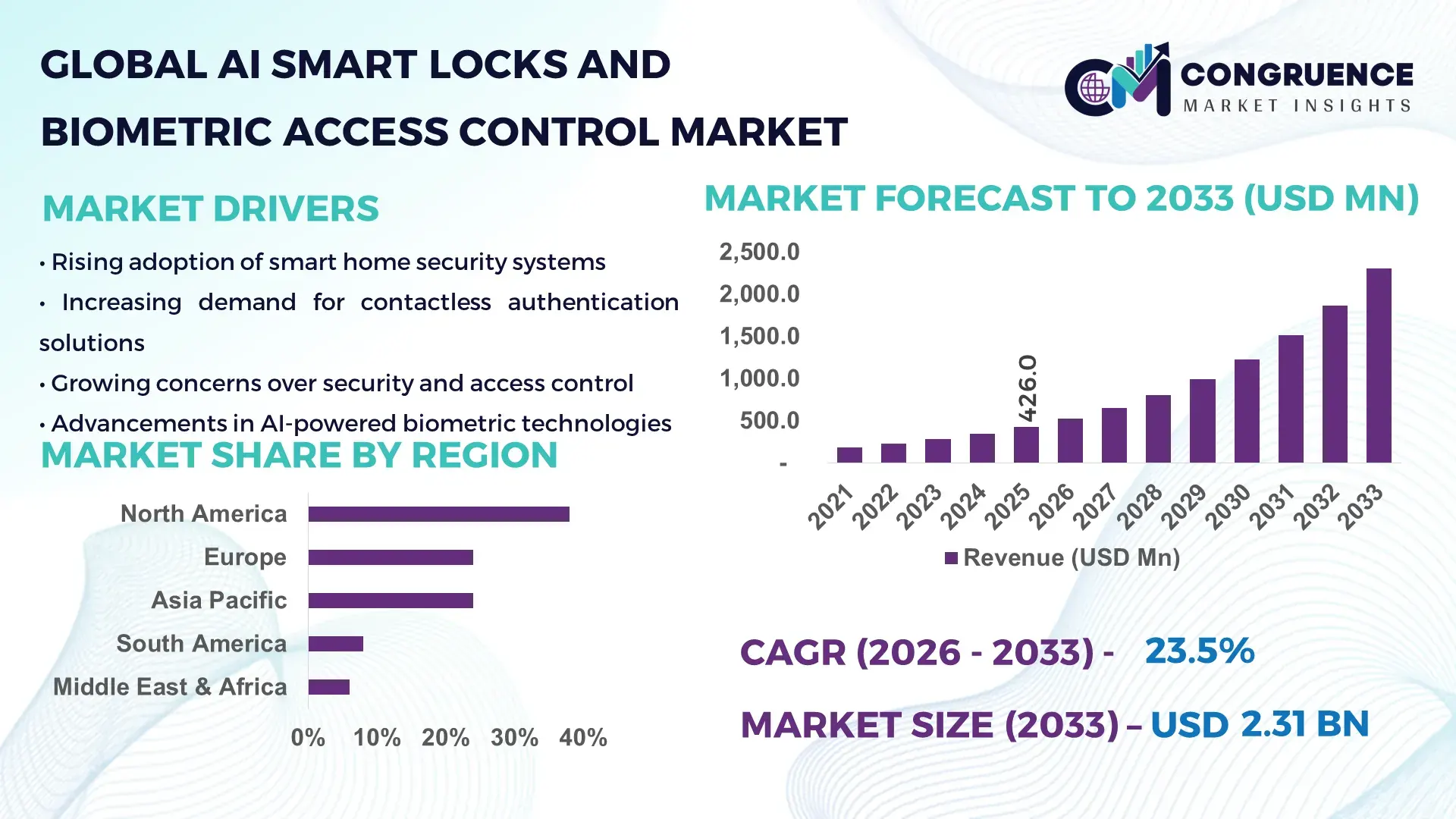
The Global AI Smart Locks and Biometric Access Control Market was valued at USD 426.0 Million in 2025 and is anticipated to reach a value of USD 2,305.4 Million by 2033 expanding at a CAGR of 23.5% between 2026 and 2033, according to an analysis by Congruence Market Insights. This growth is primarily driven by increasing demand for advanced security solutions integrated with AI-based authentication and real-time monitoring capabilities across residential and commercial infrastructures.
The United States leads the AI Smart Locks and Biometric Access Control Market with strong production capacity and large-scale adoption across commercial and institutional sectors. Over 68% of commercial buildings in urban regionshave deployed some form of biometric access control, while smart lock penetration in residential housing exceeds 35%. Investments exceeding USD 1.2 billion annuallyare directed toward smart security technologies, with AI-enabled surveillance and access systems widely used in banking, healthcare, and government facilities. The country also accounts for over 40% of global patents in biometric authentication technologies, reflecting strong innovation and deployment capabilities.
Market Size & Growth: USD 426.0 Million in 2025, projected to reach USD 2,305.4 Million by 2033, growing at 23.5% CAGR, driven by rising demand for AI-enabled security automation.
Top Growth Drivers: Biometric adoption +62%, smart home integration +55%, enterprise security upgrades +48%.
Short-Term Forecast: By 2028, AI-based access systems are expected to reduce unauthorized access incidents by 37%.
Emerging Technologies: Facial recognition AI, cloud-based access management, edge AI-enabled security devices.
Regional Leaders: North America (USD 820M by 2033, enterprise adoption focus), Asia-Pacific (USD 690M, rapid urbanization), Europe (USD 510M, regulatory-driven deployment).
Consumer/End-User Trends: Over 58% of smart home users prefer biometric locks, while enterprises increasingly deploy multi-factor authentication systems.
Pilot or Case Example: In 2025, a smart city project reduced access breach incidents by 42% using AI-enabled biometric locks.
Competitive Landscape: Market leader holds ~18% share, followed by 4–5 major global competitors with diversified product portfolios.
Regulatory & ESG Impact: Data privacy regulations have driven 45% increase in secure biometric deployments with encryption compliance.
Investment & Funding Patterns: Over USD 2.5 billion invested globally in AI-driven security startups and infrastructure upgrades.
Innovation & Future Outlook: Integration with IoT ecosystems and predictive AI analytics is expected to enhance system efficiency by over 40%.
AI Smart Locks and Biometric Access Control Market is increasingly influenced by residential (38%), commercial (34%), and industrial (28%) sectors. Innovations such as contactless facial recognition and AI-based anomaly detection are reshaping deployment strategies. Regulatory frameworks on biometric data security are strengthening compliance requirements, while Asia-Pacific drives consumption growth. Future demand is expected to rise with smart city projects and enterprise digital transformation initiatives.
The AI Smart Locks and Biometric Access Control Market holds strong strategic relevance as organizations transition toward intelligent, automated, and secure infrastructure ecosystems. The integration of AI-driven authentication systems enables enhanced threat detection, reduced manual intervention, and improved operational efficiency across industries such as banking, healthcare, government, and real estate. Facial recognition and behavioral biometrics are becoming key enablers of secure access systems, with measurable improvements in identification accuracy and response times.
For instance, AI-based facial recognition delivers nearly 35% faster authentication compared to traditional PIN-based systems, significantly reducing access time while improving security reliability. In terms of regional performance, Asia-Pacific dominates in volume deployment due to rapid urban infrastructure expansion, while North America leads in adoption, with over 60% of enterprises integrating biometric access control systems into their operations.
In the short term, by 2028, AI-enabled predictive security systems are expected to reduce unauthorized access incidents and operational downtime by approximately 30–40%, driven by real-time analytics and anomaly detection capabilities. From a compliance perspective, organizations are aligning with ESG and data privacy frameworks, committing to 50% improvement in data protection and encryption standards by 2030to safeguard biometric data.
A notable micro-scenario includes a 2025 smart infrastructure deployment in Singapore, where AI-based biometric access systems improved facility security efficiency by 38%, while reducing manual monitoring requirements significantly.
Looking ahead, the AI Smart Locks and Biometric Access Control Market is positioned as a foundational pillar for digital transformation, ensuring resilience, regulatory compliance, and sustainable growth through advanced security automation and intelligent access ecosystems.
The AI Smart Locks and Biometric Access Control Market is evolving rapidly due to the convergence of artificial intelligence, IoT connectivity, and advanced authentication technologies. Increasing concerns over unauthorized access, identity fraud, and infrastructure security have accelerated the adoption of biometric-based access systems globally. Organizations are prioritizing real-time monitoring, predictive analytics, and automated response mechanisms to enhance operational efficiency and mitigate risks.
The market is also influenced by the proliferation of smart homes, where AI-enabled locks are becoming standard features, particularly in urban residential developments. Additionally, enterprise sectors such as healthcare, BFSI, and government institutions are deploying multi-layered biometric systems to comply with strict security regulations. Technological advancements in facial recognition, fingerprint sensors, and cloud-based access management platforms are further driving innovation. However, data privacy concerns and high implementation costs continue to influence adoption dynamics across developing regions.
The increasing need for intelligent and automated security systems is a primary driver of the AI Smart Locks and Biometric Access Control Market. With rising incidents of unauthorized access and cyber-physical security breaches, organizations are adopting AI-based biometric systems to strengthen access control mechanisms. Over 65% of enterprises globally have upgraded to smart access systems, integrating AI-powered authentication methods such as facial recognition and fingerprint scanning. Smart city initiatives are also contributing significantly, with more than 120 global cities implementing AI-based surveillance and access control systems. In residential sectors, approximately 55% of newly constructed smart homesare equipped with AI-enabled locks, highlighting strong consumer adoption. Furthermore, AI-driven systems can improve authentication accuracy by over 30% compared to traditional systems, making them more reliable and efficient. These advancements are accelerating deployment across high-security environments such as airports, hospitals, and government facilities.
High initial investment and maintenance costs remain a key restraint for the AI Smart Locks and Biometric Access Control Market, particularly in price-sensitive regions. Advanced biometric systems require specialized hardware, AI software integration, and secure data storage infrastructure, increasing overall deployment costs. On average, enterprise-grade biometric access systems can cost 40–60% more than traditional locking mechanisms, limiting adoption among small and medium-sized enterprises. Additionally, maintenance costs related to system upgrades, software updates, and cybersecurity measures add to the financial burden. Around 30% of organizations report challenges in maintaining system efficiency due to ongoing technical upgrades. The need for skilled professionals to manage AI-driven systems further increases operational costs. These factors collectively hinder widespread adoption, especially in developing markets with limited budgets for advanced security infrastructure.
The rapid expansion of smart city projects presents significant opportunities for the AI Smart Locks and Biometric Access Control Market. Governments worldwide are investing heavily in digital infrastructure, with over USD 1 trillion allocated globally toward smart city development initiatives. These projects require advanced security systems to manage access across transportation hubs, public buildings, and residential complexes. Biometric access control systems are being integrated into urban infrastructure, with over 70% of smart city projects incorporating AI-based security solutions. The rise of contactless authentication technologies, such as facial and iris recognition, is also creating new growth avenues. Additionally, the increasing adoption of cloud-based access management platforms enables centralized control and scalability, making it easier for cities to manage large populations securely. These developments position the market for sustained growth and innovation.
Data privacy and cybersecurity concerns are significant challenges impacting the AI Smart Locks and Biometric Access Control Market. Biometric systems collect sensitive personal data, including fingerprints and facial recognition patterns, raising concerns about data misuse and breaches. Approximately 45% of consumers express concerns about biometric data security, which affects adoption rates. Cyberattacks targeting access control systems have also increased, with security breaches rising by over 25% in connected devices. Compliance with strict data protection regulations, such as GDPR and other global frameworks, requires companies to invest heavily in encryption and secure data storage solutions. Additionally, ensuring interoperability across different systems while maintaining data integrity remains a complex challenge. These factors create barriers to adoption and require continuous innovation to address security vulnerabilities.
Rapid adoption of facial recognition authentication systems: Over 62% of new installations in 2025 utilize facial recognition technology, driven by demand for contactless security solutions. Enterprises report a 35% improvement in access speedand reduced dependency on physical credentials, especially in high-traffic environments such as airports and corporate offices.
Integration with IoT-enabled smart home ecosystems: Approximately 58% of smart homes globally now integrate AI smart locks with IoT platforms, enabling centralized control via mobile applications. This integration has improved user convenience by 40%while enhancing remote monitoring capabilities across residential and commercial properties.
Expansion of cloud-based access management platforms: Nearly 47% of enterprises have adopted cloud-based access systems, enabling real-time monitoring and remote access control. These platforms reduce operational inefficiencies by 30%, allowing organizations to manage multiple facilities through a unified interface.
Rising demand for multi-factor biometric authentication: Multi-factor authentication systems combining fingerprint, facial recognition, and mobile credentials account for over 52% of enterprise deployments. These systems enhance security reliability by 45%, particularly in sectors such as banking and healthcare where data protection is critical.
The AI Smart Locks and Biometric Access Control Market is segmented based on type, application, and end-user, each playing a crucial role in shaping overall market dynamics. The increasing adoption of AI-powered security systems across residential, commercial, and industrial sectors has led to diversified product offerings and use-case scenarios. Biometric authentication technologies, including fingerprint, facial recognition, and iris scanning, dominate product segmentation due to their reliability and accuracy.
Application-wise, the market spans residential security, commercial infrastructure, industrial facilities, and government institutions, with each segment requiring tailored solutions based on security intensity and operational scale. End-user insights reveal strong demand from real estate developers, enterprises, and public sector organizations. The growing need for smart infrastructure and digital transformation is driving segmentation expansion, with significant emphasis on integrated and scalable security solutions.
The AI Smart Locks and Biometric Access Control Market by type includes fingerprint recognition systems, facial recognition systems, iris recognition systems, and hybrid multi-biometric systems. Fingerprint recognition systems lead the market with approximately 42% share, owing to their affordability, ease of use, and widespread adoption in residential and commercial settings. In comparison, facial recognition systems account for around 28%, while iris recognition systems hold approximately 12% of adoption. However, multi-biometric systems are the fastest-growing segment, expanding at an estimated CAGR of 26%, driven by the need for higher security and reduced false acceptance rates. These systems combine multiple authentication methods, enhancing reliability and security across high-risk environments. The remaining segments collectively contribute around 18%, serving niche applications such as high-security government facilities.
• In 2025, a major airport deployed multi-biometric authentication systems, improving passenger processing efficiency by 33% while reducing identity fraud incidents significantly.
The application segment includes residential, commercial, industrial, and government sectors. Commercial applications dominate with a 38% share, driven by demand from offices, retail spaces, and hospitality sectors requiring advanced access control systems. Residential applications account for approximately 32%, while government and industrial sectors collectively hold around 30%. The residential segment is the fastest-growing, expanding at an estimated CAGR of 25%, supported by increasing smart home adoption and consumer demand for convenience and security. In 2025, over 58% of homeowners globally preferred biometric smart locks, highlighting strong consumer inclination toward advanced security solutions. Additionally, 42% of enterprises reported deploying AI-based access systems to enhance operational security and efficiency.
• In 2025, a large hospital network implemented AI-driven biometric access systems across 120 facilities, improving staff access efficiency by 28% and reducing unauthorized entry incidents significantly.
End-users of the AI Smart Locks and Biometric Access Control Market include residential users, enterprises, government agencies, and industrial operators. Enterprises lead with a 40% share, driven by high demand for secure access control in corporate offices, financial institutions, and healthcare facilities. Residential users account for approximately 35%, while government and industrial users collectively contribute around 25%. The residential segment is the fastest-growing, expanding at an estimated CAGR of 27%, fueled by increasing adoption of smart home technologies and IoT-enabled devices. Around 60% of urban householdsshow interest in upgrading to AI-based smart locks for enhanced security and convenience. Additionally, over 50% of government facilities globally have implemented biometric access systems to improve security protocols.
• In 2025, a government infrastructure project deployed biometric access control across 200 public buildings, enhancing security compliance by 40% and reducing unauthorized access incidents.
North America accounted for the largest market share at 38% in 2025 however, Asia-Pacific is expected to register the fastest growth, expanding at a CAGR of25.8% between 2026 and 2033.
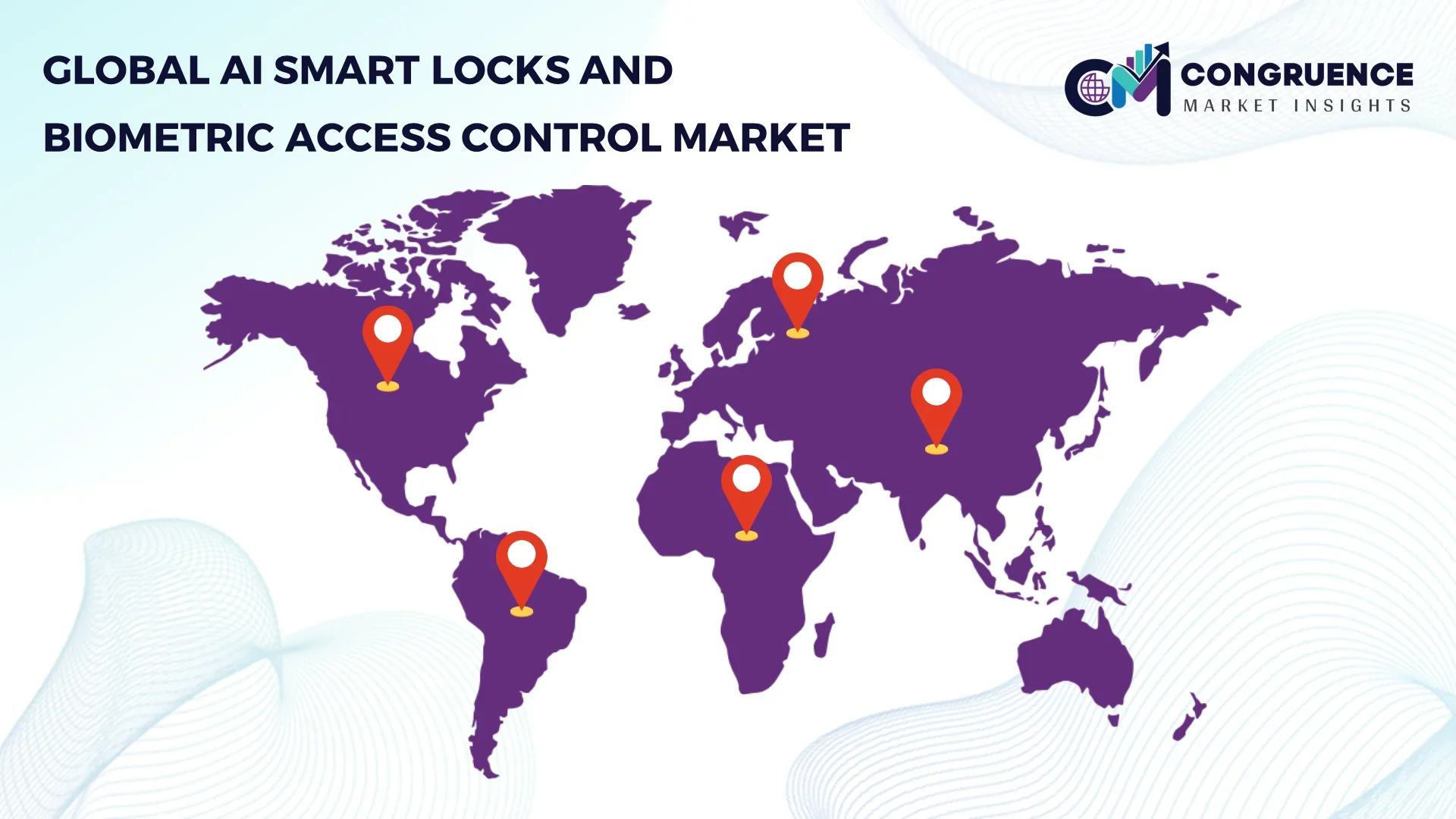
North America leads due to strong enterprise adoption, while Asia-Pacific benefits from rapid urbanization and smart infrastructure investments. Europe holds approximately 24% share, supported by regulatory frameworks and advanced technological adoption. South America and Middle East & Africa collectively account for around 14%, driven by infrastructure development and increasing awareness of smart security solutions.
North America holds approximately 38% market share, driven by high adoption across sectors such as healthcare, BFSI, and government. The region benefits from strong regulatory frameworks and technological advancements, including AI-based surveillance and biometric authentication systems. Over 65% of enterpriseshave deployed smart access systems, reflecting significant digital transformation. Government regulations promoting data security and infrastructure modernization further support market expansion. A notable example includes a leading technology provider deploying AI-based access control systems across corporate campuses, improving operational efficiency by 35%. Consumer behavior shows a preference for integrated smart home solutions, with over 55% of households adopting connected security devices.
Europe accounts for around 24% market share, with key markets including Germany, the UK, and France. Regulatory bodies enforce strict data privacy laws, driving demand for secure and compliant biometric systems. Over 50% of enterprises prioritize GDPR-compliant access solutions, influencing purchasing decisions. The region is witnessing increased adoption of contactless authentication technologies, particularly in public infrastructure and transportation systems. Local players are focusing on energy-efficient and sustainable security solutions, aligning with ESG goals. Consumer behavior reflects a strong preference for privacy-focused technologies, with demand for encrypted biometric systems increasing significantly.
Asia-Pacific is the fastest-growing region, driven by countries such as China, India, and Japan. The region ranks second in market volume, with increasing investments in smart cities and infrastructure projects. Over 70% of urban development projectsincorporate AI-based security systems. Technological innovation hubs in China and Japan are leading advancements in biometric authentication technologies. A regional player recently deployed AI-enabled smart locks across residential complexes, improving security efficiency by 30%. Consumer behavior indicates strong demand for mobile-integrated solutions, with over 60% of users preferring app-based access control systems.
South America accounts for approximately 8% of the market, with Brazil and Argentina as key contributors. Infrastructure modernization and urban development projects are driving demand for advanced security systems. Governments are introducing incentives to promote smart technology adoption. Local players are focusing on cost-effective solutions tailored to regional needs. Consumer behavior shows increasing awareness of smart security technologies, particularly in urban residential areas. Adoption is also supported by growth in commercial infrastructure projects requiring enhanced access control systems.
The Middle East & Africa region holds around 6% market share, driven by demand from construction, oil & gas, and commercial sectors. Countries such as the UAE and South Africa are investing heavily in smart infrastructure projects. Technological modernization initiatives and trade partnerships are accelerating adoption of AI-based security systems. A regional project deployed biometric access systems across commercial buildings, improving operational efficiency by 28%. Consumer behavior reflects growing demand for secure and automated access solutions in urban areas.
United States – 34% Market share: strong enterprise demand and high investment in AI-driven security infrastructure
China – 22%Market share: large-scale production capacity and rapid smart city deployment
The AI Smart Locks and Biometric Access Control Market is characterized by a moderately fragmented competitive landscape with over 50 active global and regional players. The top five companies collectively hold approximately 45% of the market share, indicating a balanced mix of dominant players and emerging innovators.
Key players are focusing on product innovation, strategic partnerships, and mergers to strengthen their market position. Around 60% of companies have introduced AI-enabled biometric solutionsin the past two years, highlighting the rapid pace of technological advancement. Additionally, collaborations between technology providers and real estate developers are increasing, with over 30% of new projects integrating smart security solutions.
The competitive environment is further shaped by investments in R&D, with companies allocating up to 15% of their annual budgets toward developing advanced authentication technologies. The market is expected to witness increased consolidation as companies aim to expand their global footprint and enhance product portfolios.
Allegion plc
Dormakaba Group
Samsung SDS
Honeywell International Inc.
Bosch Security Systems
HID Global
Identiv Inc.
ZKTeco
NEC Corporation
Panasonic Corporation
Siemens AG
Schlage
Yale Locks
Technological advancements are at the core of the AI Smart Locks and Biometric Access Control Market, with innovations focused on improving security, efficiency, and user experience. AI-powered facial recognition systems have achieved accuracy rates exceeding 98%, significantly enhancing authentication reliability. Fingerprint sensors are also evolving, with response times reduced to less than 0.5 seconds, improving user convenience.
Cloud-based access management platforms are gaining traction, with over 45% of enterprises adopting centralized control systems. These platforms enable real-time monitoring, remote access management, and seamless integration with IoT devices. Edge computing is another emerging technology, allowing data processing at the device level, reducing latency by up to 30%and enhancing system performance.
Blockchain technology is being explored to enhance data security, ensuring tamper-proof storage of biometric data. Multi-factor authentication systems combining biometrics, mobile credentials, and PINs are becoming standard, improving security by over 40%. Additionally, AI-driven predictive analytics enable proactive threat detection, reducing security breaches significantly.
Integration with smart home ecosystems and enterprise systems is further driving innovation, enabling seamless interoperability across devices. These technological advancements are expected to shape the future of the market, making AI-based access control systems more secure, efficient, and scalable.
• In November 2025, ASSA ABLOYshowcased advanced biometric-enabled smart lock solutions including facial recognition-based digital locks such as Yale Cornelius, enabling keyless entry with real-time authentication for residential and commercial applications. Source: www.assaabloy.com
• In July 2025, HID Globalannounced that its biometric eGate solution developed with ASSA ABLOY received the Red Dot Award for design innovation, enhancing automated identity verification and passenger processing efficiency in high-security environments such as airports.
• In January 2026, ZKTecolaunched OSDP Verified access control products, strengthening secure communication protocols and improving biometric authentication reliability across enterprise-grade access control systems.
• In March 2025, ASSA ABLOYemphasized strategic expansion of biometric access control through its subsidiary HID Global, prioritizing AI-driven identity and authentication technologies as part of its long-term innovation roadmap.
The AI Smart Locks and Biometric Access Control Market Report provides a comprehensive analysis of key segments, technologies, and regional dynamics shaping the industry. The scope includes detailed evaluation of product types such as fingerprint recognition, facial recognition, iris recognition, and multi-biometric systems, with insights into their adoption across residential, commercial, industrial, and government applications.
Geographically, the report covers North America, Europe, Asia-Pacific, South America, and Middle East & Africa, analyzing regional demand patterns, infrastructure development, and technological adoption trends. The report highlights that over 60% of deployments are concentrated in urban regions, driven by smart city initiatives and digital transformation strategies.
The study also explores key technologies including AI-driven authentication, cloud-based access management, IoT integration, and edge computing. These technologies collectively improve system efficiency, reduce response times, and enhance security reliability. Additionally, the report examines regulatory frameworks related to biometric data security and privacy compliance, which influence market adoption.
Industry focus areas include smart homes, enterprise security, public infrastructure, and industrial facilities, each contributing significantly to market expansion. Emerging segments such as contactless authentication and mobile-based access control are also analyzed, reflecting evolving consumer preferences and technological advancements.
Overall, the report offers actionable insights for decision-makers, enabling strategic planning, investment evaluation, and competitive benchmarking in the rapidly evolving AI Smart Locks and Biometric Access Control Market.
| Report Attribute / Metric | Details |
|---|---|
| Market Revenue (2025) | USD 426.0 Million |
| Market Revenue (2033) | USD 2,305.4 Million |
| CAGR (2026–2033) | 23.5% |
| Base Year | 2025 |
| Forecast Period | 2026–2033 |
| Historic Period | 2021–2025 |
| Segments Covered |
By Type
By Application
By End-User Insights
|
| Key Report Deliverables | Revenue Forecast; Market Trends; Growth Drivers & Restraints; Technology Insights; Segmentation Analysis; Regional Insights; Competitive Landscape; Regulatory & ESG Overview; Recent Developments |
| Regions Covered | North America; Europe; Asia-Pacific; South America; Middle East & Africa |
| Key Players Analyzed | ASSA ABLOY; Allegion plc; Dormakaba Group; Samsung SDS; Honeywell International Inc.; Bosch Security Systems; HID Global; Identiv Inc.; ZKTeco; NEC Corporation; Panasonic Corporation; Siemens AG; Schlage; Yale Locks |
| Customization & Pricing | Available on Request (10% Customization Free) |




