
Reports
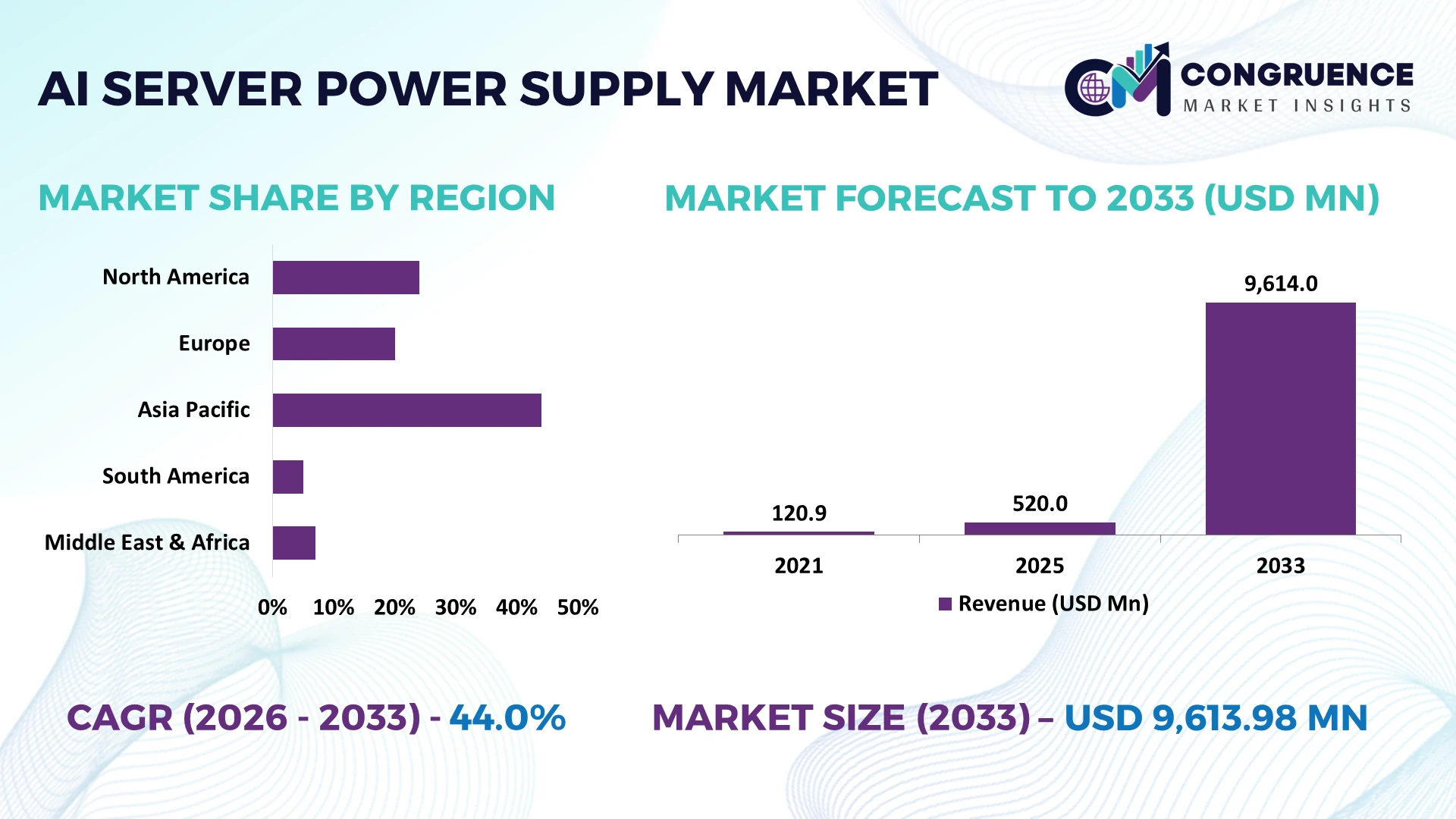
The Global AI Server Power Supply Market was valued at USD 520 Million in 2025 and is anticipated to reach a value of USD 9613.98 Million by 2033 expanding at a CAGR of 44% between 2026 and 2033. Growth is driven by hyperscale AI infrastructure expansion, high-density GPU deployments, adoption of 80 PLUS Titanium power supplies, and increasing rack-level power requirements exceeding 20–30 kW across enterprise and cloud data centers.
The United States leads the global AI Server Power Supply Market with approximately 39% of installed AI computing capacity, supported by multi-billion-dollar hyperscale investments, semiconductor manufacturing, and cloud infrastructure expansion. China follows with nearly 28% capacity, backed by national AI initiatives and domestic server production, while the U.S. maintains stronger adoption of high-efficiency power architectures exceeding 96% conversion efficiency. Ongoing technology competition and supply-chain diversification following advanced semiconductor export controls continue to reshape regional investment priorities.
Businesses should prioritize high-efficiency, scalable power architectures and geographically diversified supply chains to strengthen long-term competitiveness.
Market Size & Growth: USD 520 Million in 2025, projected to reach USD 9613.98 Million by 2033 at a CAGR of 44%, supported by accelerating AI server deployments and advanced GPU infrastructure.
Top Growth Drivers: AI data center expansion (+36%), high-density computing adoption (+31%), and power-efficiency upgrades (+24%) are strengthening global demand.
Short-Term Forecast: By 2028, power conversion efficiency improves by nearly 5% while energy losses decline by approximately 8% through advanced digital power management.
Emerging Technologies: Digital power control, GaN and SiC semiconductors, and AI-based power optimization improve system efficiency above 96%.
Regional Leaders: North America exceeds USD 3600 Million, Asia-Pacific approaches USD 3200 Million, and Europe surpasses USD 1500 Million, driven by hyperscale expansion and enterprise AI adoption.
Consumer/End-User Trends: Over 62% of hyperscale AI server deployments specify redundant high-efficiency power supplies for uninterrupted computing.
Pilot/Case Example: A 2026 AI data center modernization project reduced power losses by 12% through intelligent power distribution and advanced server power modules.
Competitive Landscape: Leading manufacturers collectively account for roughly 48% market share, with Delta Electronics, Lite-On Technology, Murata Manufacturing, AcBel Polytech, and Flex Power Modules maintaining strong positions.
Regulatory & ESG Impact: High-efficiency standards reduce facility electricity consumption by nearly 10%, supporting corporate carbon reduction initiatives amid evolving energy regulations.
Investment & Funding: More than USD 18 Billion in global infrastructure investments is accelerating AI data center expansion and resilient power supply ecosystems amid supply-chain diversification.
Innovation & Future Outlook: Rack-scale power architectures, liquid-cooled server integration, and intelligent monitoring platforms are defining the next phase of high-growth AI infrastructure.
The AI Server Power Supply Market is advancing through demand from hyperscale cloud providers, enterprise AI clusters, and edge computing facilities requiring higher power density and intelligent energy management. New digital power modules and wide-bandgap semiconductor technologies improve operational efficiency by approximately 15%, while regional manufacturing expansion and resilient component sourcing strategies strengthen supply continuity. These developments establish the foundation for the following strategic market assessment.
The AI Server Power Supply Market has become strategically important as AI infrastructure shifts from experimental deployments to mission-critical computing environments requiring reliable, high-density power delivery. Infrastructure modernization and supply-chain restructuring are redefining procurement priorities, with hyperscale operators increasingly sourcing power components from diversified manufacturing networks outside single-country dependencies. This transition is accelerating investment in digital power management, redundant architectures, and higher-efficiency conversion systems that reduce operating costs while supporting continuous AI workloads.
Modern digital power supplies achieve conversion efficiencies above 96%, compared with approximately 91% for legacy enterprise server platforms, lowering energy losses by nearly 5% and reducing cooling requirements. The United States remains the largest deployment hub for advanced AI clusters, while Taiwan strengthens its position through power electronics manufacturing and server ecosystem integration. Over the next two to three years, more than 65% of newly commissioned AI racks are expected to incorporate intelligent monitoring and predictive power management for improved operational resilience and utilization.
A practical example is the deployment of liquid-cooled AI racks requiring redundant high-capacity power modules with real-time telemetry to maintain uninterrupted GPU performance. Manufacturers are responding through strategic partnerships with semiconductor suppliers, localized production expansion, and modular product development to shorten lead times. Companies securing scalable power architectures, resilient supply ecosystems, and advanced energy optimization capabilities will strengthen competitive positioning as AI infrastructure becomes a core enterprise asset.
The rapid deployment of GPU-intensive AI data centers is fundamentally increasing demand for high-capacity, high-efficiency server power supplies. More than 70% of newly designed hyperscale AI racks now exceed 20 kW power density, while digital power management improves energy utilization by approximately 12%. The United States continues expanding AI infrastructure, supported by advanced semiconductor investments and large-scale cloud computing projects. This structural shift is pushing manufacturers toward higher-output redundant power systems, gallium nitride technologies, and intelligent monitoring platforms. Companies are expanding manufacturing capacity, forming technology partnerships, and investing in modular power architectures that accelerate deployment while improving operational reliability. Businesses capable of delivering scalable, energy-efficient platforms gain stronger positions in enterprise AI infrastructure procurement.
The market continues to face structural pressure from dependence on advanced semiconductors, magnetic components, and high-performance capacitors sourced through concentrated supplier networks. Power electronics material costs have experienced fluctuations exceeding 15% in certain procurement cycles, while qualification timelines for enterprise-grade server power systems frequently extend beyond 20 weeks. Export restrictions affecting advanced computing technologies have also complicated sourcing strategies for several manufacturers. These conditions reduce production flexibility, delay infrastructure deployment, and compress operating margins. Companies are mitigating risk through supplier diversification, localized assembly operations, long-term procurement agreements, and standardized component platforms that improve inventory resilience while reducing exposure to external supply disruptions.
The transition toward gallium nitride and silicon carbide power devices creates substantial opportunities for higher-density AI server infrastructure. Wide-bandgap technologies improve power conversion efficiency by approximately 4% while reducing thermal losses by nearly 18% compared with conventional silicon-based designs. Japan and South Korea continue expanding advanced power electronics manufacturing, supporting broader commercialization of next-generation server platforms. Companies are increasing R&D investments in digitally controlled power modules, predictive maintenance software, and rack-level energy optimization systems integrated with AI operations. An emerging opportunity lies in standardized modular power architectures that simplify upgrades, reduce maintenance complexity, and accelerate deployment across rapidly expanding enterprise AI environments.
Supporting increasingly complex AI workloads requires synchronized development of electrical infrastructure, thermal management, and intelligent monitoring systems. AI server deployments can increase rack-level electrical demand by more than 40%, while unplanned power interruptions remain among the highest operational risks for hyperscale facilities. Workforce shortages in advanced power engineering and integration expertise further complicate deployment consistency. Taiwan's manufacturing ecosystem supports component availability, yet end-user implementation still requires specialized engineering capabilities. Companies must strengthen digital monitoring, predictive diagnostics, engineering partnerships, and infrastructure modernization programs to maintain operational continuity. Organizations that successfully integrate resilient power management with scalable AI infrastructure will establish stronger long-term competitiveness and deployment efficiency.
High-Density Rack Power Scaling AI server racks exceeding 30 kW now represent over 42% of new hyperscale deployments, while demand for power supplies above 3,000 W has increased by nearly 35% during recent procurement cycles. This transition is reshaping equipment specifications as enterprises prepare for larger GPU clusters. Manufacturers are expanding high-capacity product portfolios and redesigning power architectures to support higher thermal loads, improving deployment efficiency and reducing infrastructure redesign requirements.
Digital Power Intelligence Expansion More than 60% of enterprise AI server installations now integrate digital monitoring, predictive diagnostics, and remote power management, reducing unplanned maintenance by approximately 18%. Increasing operational complexity and rising electricity costs are accelerating intelligent energy optimization. Companies are embedding telemetry, firmware analytics, and automated fault detection into power platforms while strengthening software partnerships that improve uptime and lifecycle management across distributed AI environments.
Supply Chain Localization Strategies Following continuing geopolitical trade adjustments, over 40% of global manufacturers have expanded localized production or secondary sourcing programs outside highly concentrated component ecosystems. Taiwan remains a critical manufacturing hub, while India and Vietnam continue attracting electronics assembly investments. Companies are restructuring supplier networks, increasing regional inventories, and standardizing component platforms to shorten lead times by nearly 20% while improving procurement resilience.
Liquid Cooling Power Integration Adoption of liquid-cooled AI infrastructure has exceeded 28% in newly commissioned high-performance computing facilities, requiring redundant power modules with higher current stability and advanced monitoring capabilities. This transition reduces cooling energy consumption by approximately 15% while supporting continuous AI workloads. Equipment suppliers are collaborating with cooling system providers and server manufacturers to deliver integrated rack-level power solutions that simplify deployment and improve long-term operational efficiency.
Redundant Power Supply remains the dominant segment with an estimated 39% market share, reflecting its essential role in maintaining uninterrupted AI computing operations across hyperscale and enterprise environments. Dual-power architectures minimize downtime, improve fault tolerance, and support mission-critical GPU clusters where continuous availability is mandatory. Modular Power Supply is the fastest-growing segment as organizations increasingly prioritize flexible upgrades, simplified maintenance, and scalable infrastructure expansion. Modular platforms can reduce deployment complexity by nearly 20%, while configurable designs improve infrastructure utilization by approximately 15%.
AC-DC Power Supply continues to provide the primary power conversion stage across most AI server platforms, sustaining broad deployment through proven reliability and compatibility. DC-DC Power Supply is expanding steadily alongside higher-density processor architectures requiring precise voltage regulation and improved conversion efficiency exceeding 96%. Manufacturers are investing in digitally managed power modules, strategic component partnerships, and standardized modular platforms that accelerate deployment while supporting evolving AI infrastructure requirements. Investment priorities increasingly favor scalable architectures capable of supporting next-generation computing densities without extensive hardware redesign.
Hyperscale Data Centers account for approximately 44% of AI Server Power Supply demand due to continuous deployment of GPU-intensive infrastructure supporting cloud AI services and foundation model training. High-capacity power redundancy, advanced monitoring, and energy optimization remain central procurement priorities. Edge AI Servers represent the fastest-growing application as real-time analytics, industrial automation, and autonomous systems increase demand for distributed computing. Edge deployments have expanded by roughly 27% across manufacturing and smart infrastructure environments requiring compact, high-efficiency power systems.
AI Training Servers continue driving demand for high-output redundant power supplies capable of supporting multi-GPU clusters operating continuously under heavy computational loads. AI Inference Servers are expanding across enterprise environments where lower-latency processing and energy-efficient deployments are becoming operational priorities. Equipment suppliers are responding through customized power solutions, intelligent monitoring integration, and platform-specific optimization while expanding collaborations with server manufacturers. Demand is steadily shifting toward application-specific power architectures that balance reliability, efficiency, and deployment flexibility.
Cloud Service Providers remain the largest end-user segment with approximately 48% market share, supported by continuous expansion of hyperscale AI infrastructure and high-density computing environments. Their purchasing decisions emphasize redundant architectures, digital monitoring, and operational efficiency across geographically distributed data centers. Telecommunications represents the fastest-growing end-user category as AI-enabled network optimization, edge computing, and 5G infrastructure increase demand for compact, resilient power platforms. AI-focused network deployments have expanded by nearly 24% within major telecom operators.
Enterprises continue increasing investments in private AI infrastructure to support analytics, automation, and secure workload processing, driving demand for scalable modular power systems. Research Institutes maintain strategic importance through high-performance computing projects requiring precision power delivery for scientific simulations and AI model development. Manufacturers are strengthening customer-specific product customization, ecosystem partnerships, and lifecycle support services while refining pricing strategies for large infrastructure deployments. Competitive positioning increasingly depends on application-specific engineering capabilities rather than standardized hardware offerings.
North America accounted for the largest market share at 38% in 2025 however, Asia-Pacific is expected to register the fastest growth, expanding at a CAGR of 47% between 2026 and 2033.
High-Density AI Infrastructure Drives Procurement Leadership
North America remains the primary deployment hub for AI server power supplies, supported by hyperscale cloud expansion, advanced semiconductor ecosystems, and enterprise AI adoption. The region contributes approximately 38% of global demand, with the United States accounting for the majority of high-density AI server installations. Growing deployment of liquid-cooled AI clusters and racks exceeding 30 kW is accelerating demand for redundant, digitally managed power platforms. Cloud operators continue upgrading facilities with higher-efficiency power architectures, while equipment manufacturers expand localized production and engineering support. Strategic collaborations between server OEMs and power electronics suppliers are shortening qualification cycles and improving deployment readiness for next-generation AI infrastructure. Operational priorities increasingly focus on energy optimization, predictive monitoring, and resilient power delivery supporting continuous GPU-intensive computing.
United States Market Outlook: The United States leads regional deployment through hyperscale cloud operators, AI semiconductor development, and large-scale enterprise infrastructure investments. More than 65% of newly commissioned AI data center capacity incorporates high-efficiency redundant power systems with digital monitoring capabilities. Domestic manufacturing expansion, advanced research programs, and strategic technology partnerships continue strengthening supply resilience while supporting faster deployment of AI server infrastructure across commercial and government sectors.
Energy Efficiency and Sustainable Infrastructure Modernization
Europe continues strengthening its AI server power supply ecosystem through energy-efficient infrastructure upgrades, digital transformation initiatives, and advanced industrial automation. The region represents nearly 24% of global deployment activity, with increasing adoption of high-efficiency power architectures across enterprise and research computing facilities. Modernization programs prioritize intelligent power management, modular infrastructure, and lower operating energy consumption. Equipment suppliers are introducing digitally controlled power platforms aligned with evolving sustainability requirements while expanding partnerships with regional system integrators. AI infrastructure investments across industrial manufacturing, financial services, and scientific computing continue driving demand for resilient power solutions that balance operational performance with long-term energy optimization.
Germany Market Outlook: Germany serves as Europe's strongest industrial market through advanced manufacturing, engineering expertise, and enterprise AI implementation. Approximately 32% of regional industrial AI deployments are concentrated within German manufacturing and engineering sectors. Continued investment in data center modernization, industrial automation, and power electronics innovation supports growing adoption of intelligent server power systems optimized for high-performance enterprise computing.
Manufacturing Scale Accelerates Global Deployment
Asia-Pacific is emerging as the fastest-expanding market through large-scale electronics manufacturing, hyperscale infrastructure investment, and AI hardware production. The region contributes roughly 34% of global demand while maintaining leadership in server manufacturing, power electronics, and component exports. Taiwan, China, South Korea, and Japan collectively support extensive production capacity for AI server ecosystems. Ongoing investments in semiconductor fabrication and advanced power devices continue improving supply availability and manufacturing flexibility. Companies are expanding regional production facilities, increasing automation, and strengthening component localization to support growing enterprise and hyperscale deployment requirements with shorter delivery timelines.
China Market Outlook: China remains the region's largest deployment market through domestic AI infrastructure expansion, cloud computing investment, and integrated electronics manufacturing. More than 55% of locally deployed AI servers utilize domestically assembled power systems supported by national manufacturing capabilities. Continuous investment in advanced computing infrastructure and localized supply chains strengthens production resilience while accelerating enterprise AI adoption across multiple industries.
Enterprise Digitalization Expands Infrastructure Demand
South America is experiencing steady market expansion as enterprises modernize digital infrastructure and increase investment in cloud-enabled AI workloads. The region accounts for approximately 5% of global deployment, supported by financial services, telecommunications, and industrial automation projects. Demand increasingly centers on reliable, energy-efficient server power solutions suitable for expanding regional data center capacity. Infrastructure limitations remain in selected markets, yet international cloud providers continue investing in localized facilities and network expansion. Equipment suppliers are strengthening distributor partnerships, technical support capabilities, and localized inventory strategies to improve deployment speed and operational continuity.
Brazil Market Outlook: Brazil leads regional adoption through expanding cloud infrastructure, enterprise digital transformation, and telecommunications investment. Nearly 45% of South America's commercial data center capacity is concentrated in Brazil, creating sustained demand for high-efficiency AI server power platforms. Continued investment in digital infrastructure and regional connectivity strengthens long-term deployment opportunities for advanced power system manufacturers.
Digital Infrastructure Investment Reshapes Enterprise Computing
The Middle East & Africa market is advancing through government-backed digital transformation, smart city initiatives, and expanding hyperscale data center investments. The region contributes approximately 4% of global demand while strengthening enterprise AI infrastructure across finance, energy, and public services. Modern facilities increasingly specify redundant, high-efficiency server power architectures supporting continuous AI operations. International technology partnerships, new colocation projects, and infrastructure modernization programs continue improving regional deployment capacity. Suppliers are expanding technical service networks and localized support operations to meet increasing enterprise requirements for resilient AI computing infrastructure.
United Arab Emirates Market Outlook: The United Arab Emirates remains the region's most strategically significant market due to advanced digital infrastructure, AI investment strategies, and hyperscale data center expansion. More than 40% of Gulf AI infrastructure projects are concentrated within the country, supported by enterprise modernization and smart government initiatives. Strong public-private collaboration continues accelerating deployment of advanced AI server ecosystems requiring intelligent, high-efficiency power technologies.
The competitive landscape is led by Delta Electronics, Lite-On Technology, Murata Manufacturing, AcBel Polytech, Advanced Energy Industries, and Flex Power Modules, with global technology leaders competing against regional power electronics manufacturers and OEM-focused suppliers. The top five players collectively control approximately 57% of market activity through advanced engineering, manufacturing scale, and long-term enterprise partnerships. Competition centers on conversion efficiency exceeding 96%, power density improvements of 15%, faster product qualification, and customized redundant power architectures for hyperscale AI servers. Leading companies are expanding production capacity, forming semiconductor partnerships, integrating digital power management, and strengthening vertical supply chains to secure critical components. Regional manufacturers compete through localized production, lower logistics costs, and rapid customization capabilities. Increasing demand for high-density AI infrastructure is accelerating technology differentiation while raising certification and engineering barriers for new entrants. Sustainable competitive advantage depends on scalable manufacturing, advanced power electronics expertise, resilient supply networks, and rapid product innovation.
Delta Electronics
Lite-On Technology
Murata Manufacturing
Advanced Energy Industries
AcBel Polytech
Flex Power Modules
Bel Fuse
Artesyn Embedded Power
MEAN WELL Enterprises
FSP Group
TDK-Lambda
Vicor Corporation
Zippy Technology
Compuware Technology Inc.
AI server power supply technology is rapidly shifting toward digitally controlled redundant architectures, wide-bandgap semiconductors, and high-density power shelves designed for GPU-intensive computing. Digital power management improves conversion efficiency by approximately 3–5% while reducing fault detection time by nearly 20%. More than 60% of newly deployed hyperscale AI servers now integrate intelligent telemetry and predictive diagnostics, enabling higher uptime and lower maintenance effort. These technologies provide operators with stronger workload stability while improving rack-level energy optimization.
Emerging technologies include gallium nitride (GaN) and silicon carbide (SiC) power devices, Open Compute Project-compatible power shelves, and AI-assisted power optimization software. Compared with conventional silicon-based power supplies, GaN-enabled platforms deliver roughly 15% higher power density while reducing thermal losses by approximately 10%. Adoption has exceeded 35% across advanced hyperscale deployments where liquid-cooled AI infrastructure requires compact, high-efficiency redundant power modules. Companies investing in these technologies gain deployment flexibility, improved thermal performance, and faster qualification for next-generation AI platforms.
Between 2026 and 2028, intelligent rack-level power orchestration, 800V DC architectures, and software-defined energy management will become key competitive differentiators. Manufacturers integrating hardware, firmware, and predictive analytics will outperform suppliers focused solely on hardware efficiency. Organizations acting now can reduce operational energy consumption, accelerate AI infrastructure deployment, and strengthen long-term competitiveness as power delivery becomes a strategic component of AI computing ecosystems.
March 2025 Murata Power Solutions announced adoption of ROHM EcoGaN™ 650V GaN HEMTs for its 5.5 kW AI server power supply, improving efficiency and supporting product miniaturization before mass production. The development strengthens next-generation AI power platform competitiveness. Source: Rohm
May 2025 Delta Electronics introduced the world's first 5,500 W AI server redundant power supply achieving 80 PLUS Ruby certification with peak efficiency of 97.5% and 59% higher power density than its previous generation. This strengthens leadership in hyperscale AI infrastructure.
May 2025 Delta Electronics showcased 33 kW ORv3 AI server power shelves at the OCP EMEA Summit, featuring 5+1 redundancy and up to 97.5% efficiency. The launch reinforces standardized hyperscale deployments and closer collaboration with global AI infrastructure partners.
April 2026 Delta Electronics stated that accelerating AI data center demand continued driving orders despite rising material costs, highlighting ongoing investment in AI power and cooling solutions. The announcement reflects sustained infrastructure expansion across hyperscale deployments.
The report provides comprehensive analysis of the AI Server Power Supply Market across AC-DC Power Supply, DC-DC Power Supply, Redundant Power Supply, and Modular Power Supply, together with application coverage spanning AI Training Servers, AI Inference Servers, Hyperscale Data Centers, and Edge AI Servers. It evaluates demand across Cloud Service Providers, Enterprises, Telecommunications, and Research Institutes while examining market dynamics throughout North America, Europe, Asia-Pacific, South America, and the Middle East & Africa. More than 60% of the assessment emphasizes deployment patterns, technology adoption, and infrastructure evolution influencing competitive positioning.
The study examines digital power management, GaN and SiC semiconductor technologies, redundant architectures, liquid-cooling compatibility, and intelligent monitoring platforms shaping AI infrastructure between 2026 and 2033. It assesses competitive strategies, product innovation, manufacturing expansion, supply-chain resilience, and deployment priorities across leading industry participants. The report supports investment evaluation, capacity planning, market entry, partnership development, and long-term competitive strategy through detailed segmentation, regional benchmarking, operational trends, and technology-focused business intelligence.
| Report Attribute/Metric | Report Details |
|---|---|
Market Revenue in 2025 | USD 520 Million |
Market Revenue in 2033 | USD 9613.98 Million |
CAGR (2026 - 2033) | 44% |
Base Year | 2025 |
Forecast Period | 2026 - 2033 |
Historic Period | 2021 - 2025 |
Segments Covered | By Type
By Application
By End-User
|
Key Report Deliverable | Revenue Forecast, Growth Trends, Market Dynamics, Segmental Overview, Regional and Country-wise Analysis, Competition Landscape |
Region Covered | North America, Europe, Asia-Pacific, South America, Middle East, Africa |
Key Players Analyzed | Delta Electronics, Lite-On Technology, Murata Manufacturing, Advanced Energy Industries, AcBel Polytech, Flex Power Modules, Bel Fuse, Artesyn Embedded Power, MEAN WELL Enterprises, FSP Group, TDK-Lambda, Vicor Corporation, Zippy Technology, Compuware Technology Inc. |
Customization & Pricing | Available on Request (10% Customization is Free) |




