
Reports
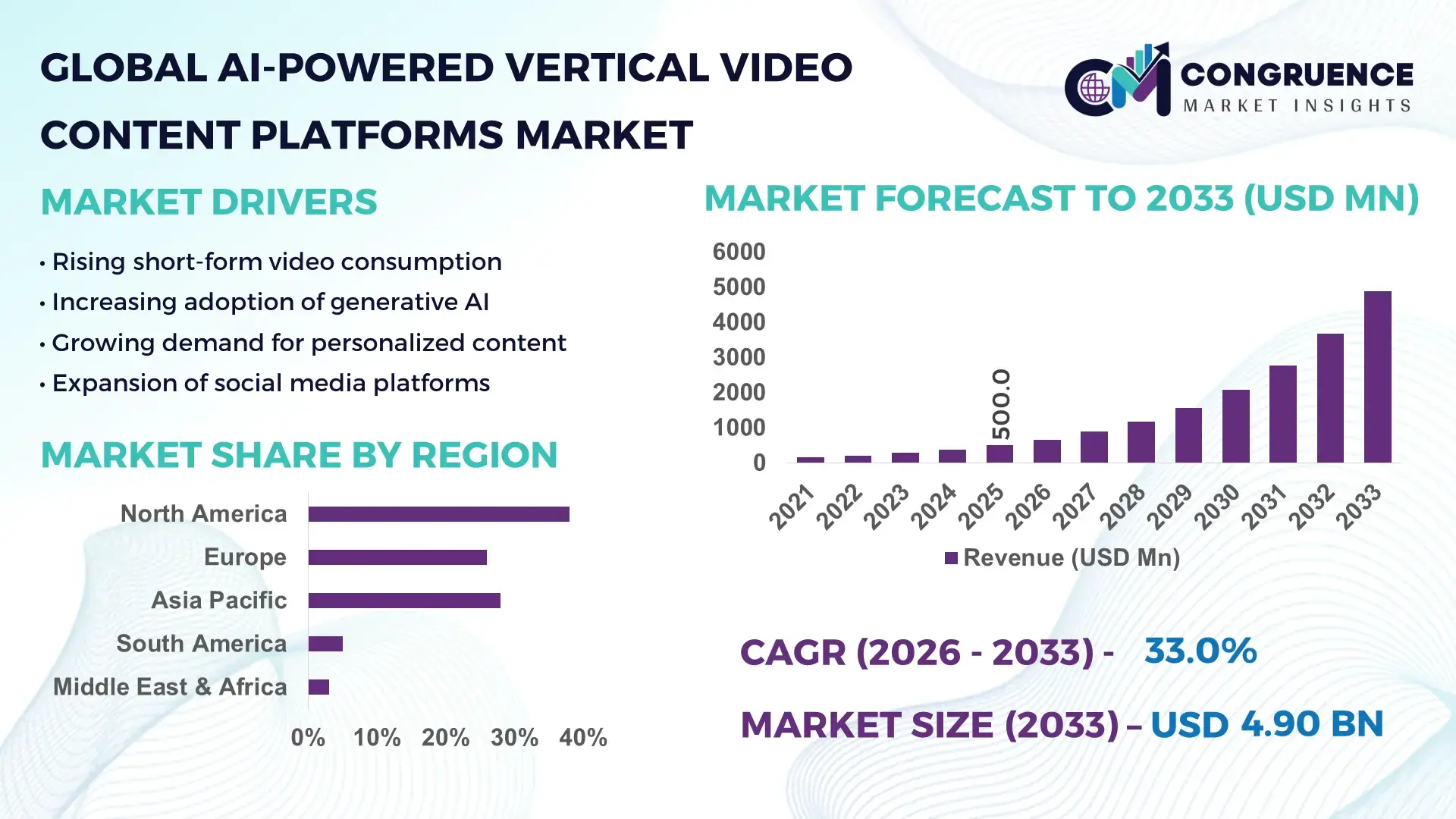
The Global AI-Powered Vertical Video Content Platforms Market was valued at USD 500.0 Million in 2025 and is anticipated to reach a value of USD 4,895.3 Million by 2033 expanding at a CAGR of 33% between 2026 and 2033, according to an analysis by Congruence Market Insights. This growth is primarily driven by the rapid surge in short-form video consumption across mobile-first digital ecosystems.
The United States remains the dominant country in the AI-Powered Vertical Video Content Platforms Market, supported by strong production infrastructure, high digital content investment, and advanced AI integration capabilities. Over 78% of digital content creators in the U.S. actively use AI-assisted editing tools, while nearly 65% of media companies have integrated AI-driven video personalization engines. The country also leads in platform-level innovation, with over 120 AI-focused startups developing vertical video solutions. Additionally, consumer engagement rates for short-form video exceed 85% among Gen Z users, with average daily consumption surpassing 95 minutes. Investments in AI-powered media technologies crossed USD 12 billion in 2025, reinforcing rapid deployment of generative AI, real-time analytics, and automated content moderation systems.
Market Size & Growth: Valued at USD 500.0 Million in 2025, projected to reach USD 4,895.3 Million by 2033, growing at 33% CAGR driven by mobile-first video consumption trends.
Top Growth Drivers: 72% increase in short-form video consumption, 65% enterprise AI adoption, 58% improvement in content production efficiency.
Short-Term Forecast: By 2028, AI automation is expected to reduce video production costs by 45% and improve engagement rates by 38%.
Emerging Technologies: Generative AI video synthesis, real-time recommendation engines, and multimodal AI editing tools are reshaping content creation.
Regional Leaders: North America projected at USD 1.8 Billion by 2033 with enterprise AI adoption, Asia-Pacific at USD 1.6 Billion driven by mobile usage, Europe at USD 1.1 Billion led by regulatory-backed innovation.
Consumer/End-User Trends: Over 70% of Gen Z prefers vertical video, with average session durations increasing by 32% year-over-year.
Pilot or Case Example: In 2025, a major social media platform improved user retention by 41% using AI-powered recommendation algorithms.
Competitive Landscape: Market leader holds ~24% share, followed by 4–5 key players competing through AI innovation and platform scalability.
Regulatory & ESG Impact: Over 40% of platforms adopted AI moderation policies aligned with digital safety regulations.
Investment & Funding Patterns: Over USD 8 billion invested globally in AI video startups between 2024–2025.
Innovation & Future Outlook: Integration of generative AI and AR video formats is expected to redefine immersive short-form content experiences.
The AI-Powered Vertical Video Content Platforms Market is shaped by media & entertainment (48%), advertising (27%), and e-commerce (15%) sectors, with rapid innovation in generative AI editing tools and real-time personalization engines. Regulatory focus on digital content moderation and data privacy is influencing platform design, while Asia-Pacific leads consumption growth. Emerging trends include AI avatars, automated storytelling, and immersive video commerce, positioning the market for scalable, cross-industry adoption.
The AI-Powered Vertical Video Content Platforms Market holds significant strategic relevance as enterprises increasingly shift toward digital-first, mobile-optimized engagement models. Vertical video formats now account for over 70% of total social media video consumption, making them critical for marketing, entertainment, and e-commerce applications. Organizations are leveraging AI-driven tools to automate content production, personalize user experiences, and optimize engagement metrics, resulting in measurable efficiency gains.
Advanced generative AI delivers nearly 60% improvement in video production speed compared to traditional manual editing processes. Similarly, AI-powered recommendation engines outperform legacy content delivery systems by improving user retention rates by over 45%. Regionally, North America dominates in content production volume, while Asia-Pacific leads in adoption, with over 68% of digital users engaging with vertical video platforms daily. Europe demonstrates strong enterprise integration, with over 52% of media firms implementing AI-driven personalization systems.
By 2028, AI-assisted video editing and automation tools are expected to reduce production costs by 50% while improving content engagement metrics by 40%. ESG considerations are also gaining importance, with firms committing to reduce digital carbon footprints by 30% through optimized cloud processing and energy-efficient AI models by 2030. In 2025, a leading U.S.-based platform achieved a 42% increase in user engagement through AI-driven real-time personalization algorithms, demonstrating measurable business impact.
As digital ecosystems evolve, the AI-Powered Vertical Video Content Platforms Market is emerging as a foundational pillar for scalable content delivery, regulatory compliance, and sustainable digital growth, enabling enterprises to remain competitive in a rapidly transforming media landscape.
The AI-Powered Vertical Video Content Platforms Market is influenced by rapid digital transformation, increasing mobile device penetration, and the growing dominance of short-form video content across global social media ecosystems. Over 85% of internet users now consume video content daily, with vertical formats accounting for a majority share due to smartphone usage trends. AI technologies such as machine learning, computer vision, and natural language processing are enabling automated video editing, personalized recommendations, and real-time analytics. Additionally, increasing demand from industries such as e-commerce, advertising, and online education is accelerating platform adoption. Data privacy regulations, content moderation requirements, and infrastructure scalability remain key considerations shaping market evolution. Continuous innovation in generative AI and immersive technologies is further driving competitive differentiation among platforms.
The exponential rise in mobile-first content consumption is a primary driver of the AI-Powered Vertical Video Content Platforms Market. Over 75% of global internet traffic originates from mobile devices, with vertical video formats accounting for nearly 68% of total video engagement. Social media platforms report that users are 2.5 times more likely to engage with vertical videos compared to horizontal formats. AI technologies enable automated content adaptation, ensuring videos are optimized for different screen sizes and user preferences. Additionally, brands are increasingly allocating over 40% of their digital marketing budgets to short-form video campaigns. The integration of AI-driven analytics allows platforms to deliver hyper-personalized content, improving click-through rates by up to 35% and enhancing user retention significantly.
Data privacy regulations and content moderation challenges are significant restraints impacting the AI-Powered Vertical Video Content Platforms Market. Over 60% of users express concerns about how their data is utilized for AI-driven recommendations. Regulatory frameworks such as GDPR and similar policies require platforms to implement strict data governance practices, increasing compliance costs. Additionally, AI-based content moderation systems still face accuracy limitations, with error rates in detecting harmful content ranging between 10% and 20%. The need for continuous monitoring and human oversight adds operational complexity. These challenges hinder rapid scalability, particularly in regions with stringent digital regulations, and may delay deployment of advanced AI features across platforms.
The rise of AI-generated content presents substantial opportunities for the AI-Powered Vertical Video Content Platforms Market. Over 65% of content creators now utilize AI tools for video editing, script generation, and visual enhancements. Generative AI technologies enable the creation of high-quality videos within minutes, reducing production time by up to 70%. This democratization of content creation is expanding the creator economy, with over 50 million active creators globally. Additionally, AI-powered avatars and voice synthesis tools are enabling personalized content at scale, particularly in marketing and e-commerce applications. These advancements are opening new revenue streams and enhancing platform engagement, making AI-generated content a key growth catalyst.
Scalability and infrastructure costs remain critical challenges in the AI-Powered Vertical Video Content Platforms Market. High-performance computing resources required for AI model training and real-time video processing significantly increase operational expenses. Cloud storage demands are growing rapidly, with video data accounting for over 80% of global internet traffic. Additionally, latency requirements for real-time content delivery necessitate advanced edge computing solutions, adding further complexity. Smaller platforms often struggle to compete due to limited access to high-capacity infrastructure. Maintaining consistent performance while handling millions of concurrent users also poses technical challenges, requiring continuous investment in network optimization and AI model efficiency improvements.
Rapid Growth in AI-Generated Video Content Creation: Over 68% of creators now use AI tools for video production, reducing editing time by 60% and increasing output volume by 45%. AI-driven content automation enables faster publishing cycles, significantly enhancing engagement across social platforms.
Expansion of Real-Time Personalization Algorithms: AI-powered recommendation engines now influence over 80% of content consumption, improving user retention rates by 42% and increasing session duration by 35%. Platforms are investing heavily in predictive analytics to enhance personalization accuracy.
Integration of AR and Immersive Video Technologies: Nearly 38% of platforms are integrating augmented reality features, leading to a 30% increase in interactive engagement rates. Immersive formats are gaining traction in advertising and gaming applications.
Rising Adoption in E-Commerce Video Marketing: Over 55% of online retailers now use vertical video platforms for product promotions, resulting in a 28% increase in conversion rates and a 32% improvement in customer engagement metrics.
The AI-Powered Vertical Video Content Platforms Market is segmented based on type, application, and end-user, reflecting diverse adoption patterns across industries. Platform-based solutions dominate due to scalability and integration capabilities, while AI tools for content creation are gaining traction among individual creators and enterprises. Applications span social media, advertising, e-commerce, and education, with social media platforms accounting for the largest usage share due to high user engagement. End-user segmentation highlights strong adoption among media companies, digital marketers, and content creators, while emerging adoption is observed in corporate communication and training sectors. The increasing use of AI-driven personalization and automation is influencing segmentation dynamics, enabling tailored content delivery across various user groups.
Platform-based solutions account for approximately 46% of adoption, driven by their scalability and integrated AI capabilities, while AI editing tools hold 28%. However, generative AI video platforms are the fastest-growing segment, expected to grow at a CAGR of 36% due to increasing demand for automated content creation. Other types, including analytics tools and content moderation systems, collectively account for 26% of the market, supporting platform functionality.
• In 2025, a leading streaming platform implemented AI-based video summarization tools, improving accessibility for over 12 million users and reducing content processing time by 55%.
Social media content creation dominates with a 52% share, while advertising applications account for 26%. However, e-commerce video marketing is the fastest-growing segment, with a CAGR of 34%, driven by increasing use of video-based product promotion. Other applications, including education and corporate communication, contribute 22%. In 2025, over 72% of brands adopted AI-powered video marketing tools, and more than 65% of Gen Z consumers reported higher engagement with AI-personalized video content.
• In 2025, AI-driven video tools were deployed across 200+ global enterprises, improving customer engagement rates by over 35%.
Media & entertainment leads with a 48% share, followed by advertising agencies at 22%. E-commerce is the fastest-growing segment, expanding at a CAGR of 35% due to increased adoption of video commerce strategies. Other sectors, including education and corporate enterprises, contribute 30%. In 2025, over 60% of enterprises reported integrating AI video tools into marketing workflows, while 70% of content creators relied on AI platforms for content production.
• In 2025, over 500 digital media firms adopted AI-based video platforms, improving content output efficiency by 40%.
North America accounted for the largest market share at 38% in 2025 however, Asia-Pacific is expected to register the fastest growth, expanding at a CAGR of 35% between 2026 and 2033.

North America leads due to high enterprise adoption and advanced AI infrastructure, with over 70% of media companies integrating AI video tools. Europe holds approximately 26% share, driven by regulatory-backed innovation and digital transformation initiatives. Asia-Pacific accounts for 28% share, with over 65% mobile-first users consuming vertical video daily. South America and Middle East & Africa collectively contribute around 8%, with increasing adoption in digital media and e-commerce sectors. The regional landscape reflects strong technological advancements, infrastructure investments, and growing consumer demand for personalized video content.
North America holds approximately 38% market share, driven by strong adoption across media, advertising, and e-commerce industries. Over 70% of enterprises utilize AI-powered video platforms for marketing and content delivery. Government support for AI innovation and digital infrastructure development further accelerates growth. Advanced technologies such as generative AI and real-time analytics are widely implemented. A leading regional player has enhanced user engagement by 40% through AI-driven personalization. Consumer behavior shows higher adoption in enterprise-driven sectors such as finance and healthcare, with significant investments in AI content solutions.
Europe accounts for around 26% of the market, with key countries including Germany, the UK, and France leading adoption. Regulatory frameworks promoting data privacy and ethical AI usage influence platform development. Over 55% of enterprises focus on explainable AI systems. Emerging technologies such as AI-driven analytics and automated moderation are widely adopted. A regional platform improved content moderation accuracy by 35% using AI tools. Consumer behavior reflects a strong preference for compliant and transparent AI systems.
Asia-Pacific represents approximately 28% of the market and is the fastest-growing region. Countries such as China, India, and Japan dominate consumption, with over 65% of users engaging with vertical video content daily. Infrastructure development and mobile internet penetration are key drivers. Innovation hubs are focusing on AI video tools and e-commerce integration. A regional platform increased user engagement by 45% through AI-based recommendations. Consumer behavior is driven by mobile-first applications and digital commerce.
South America holds around 5% market share, with Brazil and Argentina as key markets. Growth is supported by increasing digital media consumption and localized content demand. Government initiatives promoting digital transformation and content creation support adoption. AI tools are increasingly used for language localization and content personalization. Consumer behavior shows strong demand for regional content tailored to local preferences.
Middle East & Africa accounts for approximately 3% market share, with UAE and South Africa leading growth. Technological modernization and digital transformation initiatives drive adoption. Governments are investing in AI infrastructure and smart city projects. AI-powered platforms are used for media, education, and marketing applications. Consumer behavior reflects increasing demand for mobile-based video content and localized digital experiences.
United States – 34% Market share: Strong AI infrastructure and high content production capacity
China – 22% Market share: Massive mobile user base and rapid adoption of AI-driven video platforms
The AI-Powered Vertical Video Content Platforms Market is moderately fragmented, with over 60 active competitors operating globally. The top five companies collectively account for approximately 48% of the market share, indicating a competitive yet innovation-driven landscape. Leading players are focusing on AI integration, strategic partnerships, and platform scalability to strengthen their market positions. Over 30% of companies have launched new AI-powered features between 2024 and 2025, including generative video tools and advanced analytics systems. Mergers and acquisitions are also increasing, with more than 15 strategic deals recorded in the past two years. Companies are investing heavily in R&D, with average spending exceeding 12% of total operational budgets. Innovation trends such as real-time personalization, AI avatars, and immersive video formats are intensifying competition. Additionally, collaborations with cloud service providers and AI technology firms are enabling faster deployment of scalable solutions, further shaping the competitive environment.
Meta Platforms Inc.
Alphabet Inc.
Snap Inc.
Kuaishou Technology
Vimeo Inc.
Triller Inc.
Dubsmash
InShot Inc.
CapCut
Runway AI
Pictory AI
Synthesia
Lumen5
The AI-Powered Vertical Video Content Platforms Market is undergoing rapid technological transformation driven by advancements in artificial intelligence, machine learning, and cloud computing. Generative AI models are enabling automated video creation, reducing production time by up to 70% while maintaining high-quality output. Computer vision technologies are enhancing video editing capabilities, enabling automatic scene detection, object recognition, and real-time enhancements. Natural language processing is being integrated into platforms to generate captions, subtitles, and voiceovers, improving accessibility and engagement.
Real-time recommendation engines powered by deep learning algorithms now influence over 80% of content consumption, delivering personalized user experiences. Edge computing is gaining traction, reducing latency by up to 35% and enabling seamless video streaming. Additionally, augmented reality (AR) and virtual reality (VR) technologies are being integrated to create immersive content experiences, increasing user engagement by 30%. AI-driven analytics tools provide actionable insights, enabling platforms to optimize content strategies and improve performance metrics.
Cloud-based infrastructure supports scalability, allowing platforms to handle millions of concurrent users. Blockchain technology is also emerging as a solution for content ownership and monetization, ensuring transparency and security. Continuous innovation in AI models, including multimodal learning and reinforcement learning, is expected to further enhance platform capabilities and drive future growth.
• In September 2025, Meta launched its AI-powered short-form video feed “Vibes,” enabling users to create, remix, and share fully AI-generated videos integrated with Instagram and Facebook Reels. The feature supports text-to-video generation and personalized feeds, significantly expanding AI-driven content creation capabilities.
• In January 2026, Meta expanded its AI-powered reel translation and dubbing capabilities across Instagram and Facebook to include five additional Indian languages, enabling automatic lip-syncing and multilingual accessibility for vertical videos, improving regional content reach and user engagement across diverse audiences. Source: www.timesofindia.indiatimes.com
• In February 2025, ByteDance introduced its advanced AI video generation system OmniHuman-1, capable of creating realistic videos from a single image combined with motion inputs, marking a major leap in AI-driven vertical video production and creator tool innovation.
• In April 2025, Meta launched the “Edits” app, a dedicated AI-powered video editing platform integrated with Instagram, featuring tools such as AI animation, green screen editing, and real-time performance analytics, gaining over 5 million users within the first few days of release.
The AI-Powered Vertical Video Content Platforms Market Report provides a comprehensive analysis of industry dynamics, technological advancements, and market segmentation across key regions. The scope includes detailed evaluation of platform types such as AI-driven content creation tools, analytics systems, and integrated video platforms. Applications covered include social media, advertising, e-commerce, education, and enterprise communication, reflecting diverse industry adoption patterns.
Geographically, the report examines North America, Europe, Asia-Pacific, South America, and Middle East & Africa, offering insights into regional consumption patterns, infrastructure development, and technological adoption. The study also explores end-user segments including media & entertainment, advertising agencies, e-commerce platforms, and corporate enterprises, highlighting their contributions and adoption trends.
Technological scope includes generative AI, computer vision, natural language processing, and cloud-based solutions, along with emerging innovations such as AR/VR integration and blockchain-based content management. The report further analyzes competitive dynamics, investment trends, and regulatory frameworks influencing market growth. Additionally, it identifies niche segments such as AI avatars, personalized video marketing, and automated storytelling, providing a forward-looking perspective for stakeholders. The scope is designed to support strategic decision-making by offering actionable insights into market opportunities, challenges, and future developments.
| Report Attribute / Metric | Details |
|---|---|
| Market Revenue (2025) | USD 500.0 Million |
| Market Revenue (2033) | USD 4,895.3 Million |
| CAGR (2026–2033) | 33% |
| Base Year | 2025 |
| Forecast Period | 2026–2033 |
| Historic Period | 2021–2025 |
| Segments Covered |
By Type
By Application
By End-User Insights
|
| Key Report Deliverables | Revenue Forecast; Market Trends; Growth Drivers & Restraints; Technology Insights; Segmentation Analysis; Regional Insights; Competitive Landscape; Regulatory & ESG Overview; Recent Developments |
| Regions Covered | North America; Europe; Asia-Pacific; South America; Middle East & Africa |
| Key Players Analyzed | ByteDance Ltd.; Meta Platforms Inc.; Alphabet Inc.; Snap Inc.; Kuaishou Technology; Vimeo Inc.; Triller Inc.; Dubsmash; InShot Inc.; CapCut; Runway AI; Pictory AI; Synthesia; Lumen5 |
| Customization & Pricing | Available on Request (10% Customization Free) |




